What's inside
- Key Takeaways
- Quick Picks
- How Did We Choose These Large Countertop Microwaves?
- What Does Inverter Power Actually Change at Dinner?
- How Do the Six Machines Compare?
- What Does Living With the Biggest Class Teach a Household?
- How Should You Measure Your Space Before Ordering?
- How Do Controls and Displays Differ Across These Six?
- Should a Family Replace a Working Smaller Microwave With This Class?
- What Mistakes Do Buyers Make in This Size Class?
- How Does a Big Microwave Change a Holiday Kitchen?
- What Should You Check in the First Week With a New Machine?
- How Do You Reheat a Full Family Plate Without Ruining It?
- Final Recommendation
- How Do You Defrost Properly in a Machine This Size?
- What Kitchen Jobs Does a 2.2 Machine Do Better Than a Small One?
- How Should You Clean and Care for a Large Microwave?
- Frequently Asked Questions
- Related Guides
As an Amazon Associate I earn from qualifying purchases. This post may contain affiliate links at no extra cost to you.
cottageverdict.com is reader-supported. When you buy through links on our site, we may earn an affiliate commission.
Where to buy: all six microwaves below are available on Amazon, and each name links to its listing so you can confirm the exterior dimensions, turntable size and wattage of the current model before ordering. Measure your counter and your largest casserole dish first; in this size class, an inch is the difference between a workhorse and a return.
Let us begin with the honest fact this whole category hides in plain sight: if you go shopping for the best 2.0 cubic foot countertop microwaves, the shelves answer with 2.2. The large-family countertop class has effectively standardised at 2.2 cubic feet, joined by inverter models that compete on cooking quality rather than raw volume, and this guide treats the class truthfully as 2.0 to 2.2 cubic feet rather than pretending a row of exact 2.0 models exists. Five of the six picks are 2.2 cubic foot machines; the sixth is a 1.6 cubic foot inverter included deliberately for households whose counters cannot take the full class but who still want inverter cooking, and it is labelled as the smaller alternative wherever it appears.
It also buys a different relationship with the appliance. A small microwave is a reheating box that a household tolerates; a machine in this class, chosen well, becomes a genuine second cooking station that earns its counter every day, steaming, defrosting, proofing and reheating at a scale that changes meal planning. That promotion is the real purchase being made here, and it is why the differences among these six, power delivery, sensor judgement, carousel size and control manners, deserve the careful reading the rest of this guide gives them.
What the class buys you is family scale: a turntable in the sixteen-inch neighbourhood that accepts a full casserole or a large dinner plate without the tilt-and-pray manoeuvre, wattage between 1200 and 1250 that reheats family portions in family time, and cavities tall enough for a mixing bowl or a tall mug. The differences that matter among the six are how the power is delivered, transformer-style cycling or inverter steadiness, how the controls behave at midnight, and how honestly each maker describes its own machine.
Key Takeaways
- The shelf reality of this class is 2.2 cubic feet; treat any exact 2.0 claim with suspicion and check the listing.
- Inverter models cook at true reduced power, which transforms defrosting and gentle reheating.
- Turntable diameter decides which of your dishes fit more honestly than the cubic-foot figure does.
- Sensor cooking earns its keep on reheating and popcorn, the two jobs these machines do most.
- Exterior dimensions and door swing, not cavity volume, decide whether the machine fits your counter.
- At 1200 watts and above, check that your kitchen circuit is not already sharing its load with a kettle and a toaster oven.
Quick Picks
| Pick | Badge | Why it earns a place |
|---|---|---|
| FRIGIDAIRE 2.2 Cu Ft Countertop Microwave 1200W | Best Straightforward Family Oven | A programmable 1200W Frigidaire with multi-function cooking and a name your repair shop will recognise. |
| Countertop Microwave Oven 2.2 Cu Ft 1200W Stainless | Best Sensor Feature Set | Smart sensor cooking, multi-stage programming and six presets across ten power levels. |
| Sharp SMC2266KS 2.2 Cu Ft Countertop Microwave | Best Carousel Simplicity | A Sharp with a removable 16.5-inch carousel and the plain competence the brand built its name on. |
| TOSHIBA 2.2 Cu Ft Inverter Countertop Microwave | Best Inverter Value in Class | True inverter power at 1200W with sensor cooking and the class-standard 16.5-inch turntable. |
| Panasonic Inverter Countertop Microwave | Best Inverter Performance | 1250W of Cyclonic Wave inverter power with a Genius Sensor, from the company that pioneered the technology. |
| TOSHIBA 1.6 Cu Ft Inverter Countertop Microwave | Best Smaller Inverter Alternative | A 1.6 cubic foot inverter at 1250W for counters that cannot house the full 2.2 class. |
How Did We Choose These Large Countertop Microwaves?
We set the class boundary honestly first: machines marketed into the two-cubic-foot family segment, which in practice means 2.2 cubic foot models, plus one smaller inverter whose inclusion is argued openly rather than smuggled. Within that boundary we required at least 1200 watts, a turntable large enough for a family casserole, and controls that a household can operate without a manual in hand.
Power delivery divided the field. Conventional microwaves blast at full power and rest, cycling to imitate lower settings; inverters deliver genuinely reduced, continuous power, and the difference is edible in defrosted meat that stays raw at the edges and in reheated pasta that warms instead of toughening. Both architectures earned places here, because households divide honestly between those who defrost daily and those who mostly reheat, but the inverter models carry this guide’s enthusiasm for anyone whose cooking is varied.
Finally we weighed serviceability and sense: brands with parts networks, doors that feel like they will survive a decade of family use, child locks where listings state them, and interior finishes that wipe clean. A microwave is the most-used appliance in many kitchens; the cost of a flimsy door is paid daily, in annoyance, for years.
We also checked each listing’s dimensional honesty, because this class lives or dies by fit. Where a maker published exterior dimensions and turntable size plainly, we trusted the rest of the specification more; where a listing led with the cubic feet and buried the footprint, we noted the omission in that machine’s review. A buyer should perform the same audit in the opposite order, footprint first, turntable second, capacity third, because that is the order in which the machine will succeed or fail in a real kitchen.
What Does Inverter Power Actually Change at Dinner?
A conventional microwave owns only one trick: full power, interrupted. Ask it for half power and it delivers ten seconds of everything followed by ten seconds of nothing, and food experiences that as alternating boiling and resting. Delicate work suffers first. Butter scorches at the edges while its centre stays solid, chocolate seizes, and a chicken breast being defrosted cooks at its thin ends while its middle is still icy, a small crime every home cook has committed and blamed on themselves.
An inverter replaces the interruption with a dimmer. At half power it delivers half power, continuously, so defrosting proceeds evenly, sauces warm without splitting as readily, and reheating a plate of leftovers stops producing the familiar pattern of lava edges around a cold heart. The Panasonic and the two Toshibas in this guide cook this way, and once a household has defrosted mince evenly a dozen times, returning to a cycling machine feels like a downgrade no specification sheet warned them about.
Inverters also tend to be lighter and can hold their power steadier across a long cook, which matters in this class because family portions ask for sustained minutes rather than quick bursts. None of this makes a conventional 1200W machine a bad purchase; the Frigidaire, Sharp and sensor-equipped models here reheat, cook vegetables and handle family basics with complete competence. It means the buyer should choose with their own menu in mind, and this guide’s individual reviews say plainly which menu each machine serves best.

FRIGIDAIRE 2.2 Cu Ft Countertop Microwave 1200W — Best Straightforward Family Oven
Frigidaire’s entry in this class makes no exotic claims: 2.2 cubic feet, 1200 watts, stainless steel, multi-function and programmable cooking. That plainness is its recommendation. This is the microwave for a household that wants the big cavity and the strong wattage without a research project, from a brand whose appliances service technicians across the country already know. The controls follow the conventional grammar of the category, so any family member or guest can reheat a plate without a tutorial, which is a real feature in a real kitchen at a real dinner party.
Programmability is the quiet substance here: the ability to set a sequence, a defrost followed by a cook, and walk away is what separates a family oven from a reheating box. At 1200 watts the machine handles the class’s core work, family casseroles, big bowls of soup, a queue of baked potatoes, at the pace the size promises. Its conventional power delivery means defrosting asks for the usual turning and shielding patience, the honest trade this guide has already described.
Choose the Frigidaire when your priorities are capacity, pace and a familiar name, and when your defrosting is occasional rather than daily. It is the class’s sensible default, and defaults earn that status by disappointing nobody.
- Capacity: 2.2 cu ft
- Power: 1200W
- Finish: stainless steel
- Controls: multi-function, programmable
- Architecture: conventional power delivery
Strengths
- Familiar brand with a real service network
- Programmable sequences suit family routines
- Controls any guest can operate unaided
Trade-offs
- Conventional cycling power for defrosting
- Feature set is plain beside the sensor models
- Full class footprint demands a deep counter
Best for: families wanting big, fast and familiar. Not suited for: daily defrosters who would feel the cycling power.
There is a household rhythm this machine fits precisely: the weekday relay of reheated lunches, vegetables steamed in their bowl, potatoes started while the oven handles the roast, and a late plate warmed for whoever the motorway delayed. None of that asks for sensor genius or inverter subtlety; it asks for a big, willing cavity that starts quickly, stops honestly and wipes clean in seconds. Frigidaire has built family appliances to exactly that brief for generations, and the value of the badge is the confidence that the door will still latch sweetly when the youngest child who now slams it is old enough to cook for themselves.

Countertop Microwave Oven 2.2 Cu Ft 1200W Stainless — Best Sensor Feature Set
This unbranded-feeling listing competes on a specification sheet rather than a name: 2.2 cubic feet, 1200 watts, ten power levels, multi-stage cooking, six preset options, smart sensor cooking, an LED display and a child safety lock. Sensor cooking is the headline that matters. A sensor microwave sniffs the steam rising from the food and judges doneness by humidity rather than by a clock set in ignorance, and on the two jobs these machines perform most, reheating a plate and cooking a bag of popcorn, that judgement removes the commonest disappointments in the category.
Multi-stage cooking extends the same convenience: defrost, rest and cook chained into one programme, so a frozen casserole can be staged toward dinner without the cook returning to press buttons between acts. Ten power levels on a conventional architecture are partly theatre, since the levels are duty cycles rather than true power steps, but for reheating they still give useful control over how violently a delicate plate is treated.
The honest caution is provenance. A feature-rich machine without a famous badge asks its buyer to lean on the listing’s current terms, the reviews of owners and the retailer’s returns umbrella rather than on a brand’s service network. Households comfortable with that trade gain the richest sensor feature set in this guide; households who buy appliances the way they buy roofs, once and for decades, should look at the Sharp or the Frigidaire.
- Capacity: 2.2 cu ft
- Power: 1200W, ten power levels
- Cooking: smart sensor, multi-stage
- Presets: six options
- Safety: child lock, LED display
Strengths
- Sensor cooking judges food rather than time
- Multi-stage programmes chain defrost to cook
- Full preset and power-level range
Trade-offs
- No major brand service network behind it
- Power levels are cycles, not inverter steps
- Long-term parts outlook is a listing question
Best for: feature hunters who reheat and use presets daily. Not suited for: buyers who rank decades-long serviceability first.
Sensor cooking deserves one more piece of respect, because it changes who can cook. A teenager reheating pasta, a grandparent warming soup, a guest making midnight popcorn all face the same problem: they do not know this machine’s timings, and guessing wrong is how food gets ruined and interiors get redecorated. A sensor removes the guesswork by watching the food instead of the clock, and a household where the microwave must serve many hands of varying experience gets that value back weekly. Judge this machine as shared infrastructure rather than a chef’s tool, and its feature list reads less like indulgence and more like peacekeeping.

Sharp SMC2266KS 2.2 Cu Ft Countertop Microwave — Best Carousel Simplicity
Sharp helped invent the countertop microwave’s modern form, and the SMC2266KS carries that heritage in its priorities: 2.2 cubic feet, 1200 watts, stainless steel, and a removable 16.5-inch carousel turntable. The turntable is the specification to linger on. Sixteen and a half inches is the class’s honest measure of usefulness, the diameter that swallows a family casserole dish, a large pizza plate or a pair of mugs without choreography, and its removability matters because a turntable that lifts out gets washed, while one that does not gets wiped at and resented.
There is a philosophy in this machine’s restraint. Rather than competing on sensor theatre, it offers the size, the power and the rotating evenness that made the category indispensable, executed by a maker with generations of microwave production behind it. Controls are correspondingly direct, which suits households where the microwave serves everyone from a teenager reheating pizza to a grandparent warming soup, none of whom should need a tutorial or a submenu.
Its conventional power delivery shares the class’s defrosting caveats, and cooks who melt, proof and defrost daily should read the inverter reviews below with care. For the reheating, cooking and family-volume work that fills most of a microwave’s life, the Sharp’s combination of carousel, capacity and pedigree is the steadiest conventional answer here.
- Capacity: 2.2 cu ft
- Power: 1200W
- Turntable: removable 16.5-inch carousel
- Finish: stainless steel
- Architecture: conventional power delivery
Strengths
- Class-standard carousel fits real family dishes
- Deep microwave heritage behind the design
- Direct controls suit every age of user
Trade-offs
- No inverter gentleness for defrosting
- Sensor features thinner than rivals
- Large footprint, as with the whole class
Best for: families valuing capacity and carousel size over gadgets. Not suited for: cooks whose microwave life centres on delicate work.
The carousel’s size has a second-order benefit nobody lists: it changes what the household cooks. When the big dish fits, the microwave becomes the second oven of a holiday kitchen, holding the casserole, reheating the sides in their serving dishes and freeing the range for the main event. Families discover this by accident the first December the machine is in the house, and afterwards they plan around it. A microwave that enlarges the kitchen’s capacity at its most congested hour has justified its counter space in the only currency that matters, which is dinners that arrive together and hot.

TOSHIBA 2.2 Cu Ft Inverter Countertop Microwave — Best Inverter Value in Class
Toshiba’s 2.2 brings the inverter’s dimmer-switch cooking to the full family size at 1200 watts, with sensor cooking, six auto menus and the same 16.5-inch removable turntable the Sharp offers, plus a child lock. Read that combination slowly, because it is the most complete in the guide: the class’s full volume, the class’s full carousel, true reduced power for defrosting and delicate work, and a sensor to judge reheats. If a household’s microwave life is varied, and most family households’ lives are, this is the specification that covers all of it without a compromise paragraph.
The inverter changes the daily texture of the machine’s work. Defrosting mince for a weeknight sauce stops being a negotiation with cooked edges; reheating a child’s portion at gentle power stops producing a plate that is dangerous at the rim and cold at the centre; melting butter becomes a setting rather than a supervision task. Sensor cooking then handles the routine reheats, reading steam and stopping at done, which is the correct division of labour between a machine’s senses and its power supply.
Toshiba’s microwave lineage is long, and the brand’s inverter models have a following among cooks who defrost seriously. Against the Panasonic below, this machine concedes the last measure of power and the flagship sensor branding, and gains whatever the current listings say it gains in value; that is a trade many households should take with both hands.
- Capacity: 2.2 cu ft
- Power: 1200W inverter
- Turntable: 16.5-inch removable
- Cooking: sensor cook, six auto menus
- Safety: child lock
Strengths
- True inverter power at full class size
- Sensor cooking covers routine reheating intelligently
- Full-size turntable matches the conventional rivals
Trade-offs
- Concedes peak wattage to the Panasonic
- Inverter menus take a week to learn properly
- Still a large machine on the counter
Best for: varied family cooking with daily defrosting. Not suited for: buyers who want the simplest possible control panel.
Watch the Toshiba handle the two ends of a family’s day and the inverter case completes itself. In the morning it defrosts the evening’s mince so gently that the meat goes into the pan as meat rather than as a grey-edged brick; at night it reheats a plated dinner for a latecomer at low, continuous power, and the food tastes cooked rather than punished. Conventional machines can perform both tasks with supervision and turning; the inverter performs them with settings. That difference, repeated twice daily for years, is what its owners are actually buying, and it is why this machine, rather than any conventional rival, carries the guide’s main recommendation.
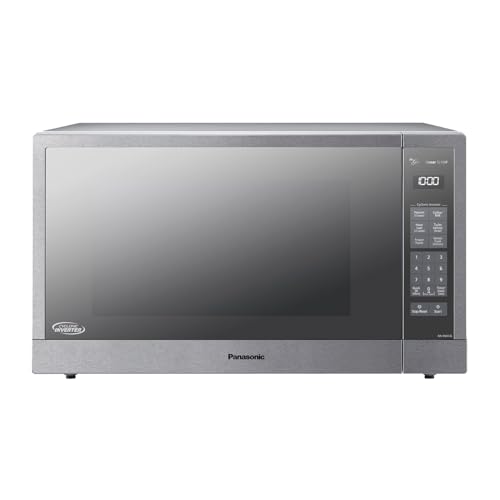
Panasonic Inverter Countertop Microwave — Best Inverter Performance
Panasonic invented the inverter microwave, and the NN-SN97JS is its flagship expression in this class: 2.2 cubic feet, 1250 watts, Cyclonic Wave inverter technology and a Genius Sensor, in a stainless design that can sit on the counter or be built in with a trim kit. The extra fifty watts over the class standard is the least interesting number here. Cyclonic Wave describes the effort to distribute energy in three dimensions rather than in the usual rotating pattern, attacking the cold spots that turntable alone cannot cure, and the Genius Sensor is the mature version of the steam-judging idea, refined across generations of these machines.
In practice this is the microwave for the household that uses a microwave as a cooker rather than an accessory. Defrosting is even enough to plan around, reheating preserves the texture of rice and pasta to a degree that surprises people raised on cycling machines, and the power holds steady through the long cooks that family portions demand. The built-in option adds a second life for the machine in a kitchen remodel, a flexibility none of its rivals here offer.
The costs are the flagship’s usual ones: the highest commitment in the group and a control scheme that rewards a week of learning. Households that mostly reheat coffee should not buy it, and this guide will not pretend otherwise; households that cook with their microwave daily will understand within a fortnight why Panasonic’s name leads this technology’s history.
- Capacity: 2.2 cu ft
- Power: 1250W inverter, Cyclonic Wave
- Sensor: Genius Sensor
- Installation: countertop or built-in with trim kit
- Model: NN-SN97JS, silver
Strengths
- Most refined inverter cooking in this guide
- Highest wattage in the class here
- Built-in option extends the machine’s life
Trade-offs
- Flagship commitment for a countertop appliance
- Controls reward learning rather than guessing
- Overkill for reheat-only households
Best for: households that genuinely cook in their microwave. Not suited for: counters that only ever reheat drinks and leftovers.
One more Panasonic trait deserves naming: consistency across the cavity is where its price hides. Cheaper machines, conventional and inverter alike, leave a geography in the food, a hot ring and a cool centre that the turntable only partly forgives, so cooks learn to stop, stir and rotate by hand. The Cyclonic design’s whole purpose is to erase that geography, and in dishes that cannot be stirred, a whole fish, a custard, a layered bake, the difference is not subtle. A household that cooks such dishes in the microwave has exactly one correct answer in this guide, and it is this one.

TOSHIBA 1.6 Cu Ft Inverter Countertop Microwave — Best Smaller Inverter Alternative
This Toshiba is in the guide under an honest label: it is not a member of the 2.2 class at all, but a 1.6 cubic foot inverter machine included for the households who read this far wanting inverter cooking and family pace, then measured their counter and felt their hearts sink. At 1250 watts it matches the Panasonic’s power, with a smart sensor, auto defrost and a 13.6-inch turntable, in a black stainless finish that suits smaller kitchens visually as well as spatially.
The 13.6-inch turntable defines what fits: a standard dinner plate, a medium casserole, most family side dishes, but not the largest roasting pans and platters the 16.5-inch machines swallow. For a couple, a small family or a household whose big-batch cooking happens in the oven anyway, that boundary rarely bites, and the inverter’s even defrosting and gentle reheating serve daily life exactly as they do in its larger sibling.
Consider it the class’s pressure valve. Rather than forcing a 2.2 machine onto a counter it dominates, blocking sockets and crowding the kettle, the smaller Toshiba keeps the technology this guide most recommends and surrenders only the volume some households never use. If your largest regular dish fits its turntable with room to rotate, it is not a compromise at all; it is the correctly sized machine.
- Capacity: 1.6 cu ft, below this guide’s main class
- Power: 1250W inverter
- Turntable: 13.6-inch
- Cooking: smart sensor, auto defrost
- Finish: black stainless steel
Strengths
- Full inverter cooking in a smaller footprint
- Class-leading wattage despite the size
- Sensor and auto defrost match its big sibling
Trade-offs
- Not a 2.2 machine; largest dishes will not fit
- Turntable limits family casserole sizes
- Black stainless shows a different care routine
Best for: smaller counters that still want inverter quality. Not suited for: families whose largest dishes define the purchase.
The smaller Toshiba also suits a pattern of life the big class ignores: the household of two that cooks properly. Its cavity takes the two-person casserole, the pair of jacket potatoes, the bowl of soup for a working lunch, and its inverter treats those modest loads with the same evenness the flagship gives a feast. Counter space in a small kitchen is a budget like any other, and spending it on volume that hosts a turkey once a year, while the kettle lives on the hob all year, is the kind of trade this machine exists to correct.
How Do the Six Machines Compare?
| Pick | At a glance |
|---|---|
| FRIGIDAIRE 2.2 Family Microwave | Full-size cavity, 1200W output, programmable, conventional power |
| Countertop Microwave Oven 2.2 Cu Ft 1200W Stainless | Full-size cavity, 1200W output, smart sensor, multi-stage, six presets |
| Sharp SMC2266KS 2.2 Microwave | Full-size cavity, 1200W output, removable 16.5-inch carousel |
| TOSHIBA 2.2 Inverter Microwave | Full-size cavity, inverter power at 1200W, sensor cook, big turntable |
| Panasonic Inverter Countertop Microwave | Full-size cavity, 1250W Cyclonic inverter, Genius Sensor |
| TOSHIBA 1.6 Inverter Microwave | Compact 1.6 cavity, 1250W inverter, 13.6-inch turntable, smaller option |
What Does Living With the Biggest Class Teach a Household?
The first lesson is that capacity changes behaviour more than speed does. Cooks begin batch-steaming vegetables for the week, reheating in serving dishes instead of decanting, and treating the microwave as the default first resort for anything that does not need browning, which quietly demotes the oven to specialist work. Energy bills barely notice; the cook’s evening notices a great deal, because meals assemble in parallel instead of in sequence.
The second lesson is respect for the door and the seal, the two components whose condition decides whether the machine feels new in year five. Households that close the door rather than slam it, and wipe the seal as part of the weekly clean, own machines that age gracefully; the rest own machines that rattle, steam at the corners and cook unevenly while their owners blame the wattage. In this class more than any other, longevity is a handling habit disguised as a product feature.
The third lesson is that guests judge a kitchen by its microwave more than its oven, because the microwave is the appliance they are handed. A big, clean, comprehensible machine makes a household look competent at midnight; a small, stained, mysterious one does the opposite. It is a frivolous consideration with a serious core, which is that the most-used appliance in the house should be the one bought with the most care.
How Should You Measure Your Space Before Ordering?
Measure the counter’s depth before its width, because this class is deep, and a machine whose door opens into the room’s traffic will be hated daily. Leave the ventilation clearance the manual specifies on the sides and top; a large microwave suffocating in a tight alcove cooks its own electronics slowly and voids sympathies you may later need. Check the door swing against neighbouring appliances and cupboard handles, and confirm the socket’s position, since a cord stretched across a hob is a hazard wearing an appliance’s clothes.
Then measure your dishes, the step everyone skips. The largest casserole, the dinner plates, the tall travel mug and the mixing bowl you proof dough in should each be checked against the turntable diameter and the cavity height of the model you favour, with the dish’s handles included in the measurement. A machine that fits the counter but not the casserole has failed at its only job, and the return of a forty-pound appliance is a lesson best learned from this paragraph rather than from experience.
Finally, weigh the circuit. A 1200 or 1250 watt microwave shares a kitchen’s wiring with the kettle, the toaster and the coffee machine, and simultaneous use can trip breakers in older homes. Note which sockets share a circuit before the new machine arrives, and give the largest appliance in the room first claim on its own.
How Do Controls and Displays Differ Across These Six?
A microwave’s panel is its daily personality. The conventional machines here speak the category’s traditional language of numbered presets and power levels, learnable in an afternoon and operable by touch in a dark kitchen once the express buttons are memorised. The sensor models add a layer of delegation: press reheat, walk away, and let the machine’s nose decide, a kindness whose value compounds in households where the cook’s attention is the scarcest resource at dinner time.
Inverter panels ask slightly more of their owners, because true power levels and sensor programmes reward being understood rather than merely pressed. The Panasonic’s scheme is the most considered here and the least guessable; the Toshibas split the difference with auto menus that group the common jobs under plain names. None of the six requires an app, an account or a network, and in an era of appliances that demand all three, that independence deserves to be recorded as a virtue in itself.
Displays and lighting matter at the margins that turn out to be daily: a clock that can be dimmed for a kitchen that doubles as a guest room, an interior light bright enough to judge bubbling without opening the door, a mute for the beeps in a house with a sleeping baby. Check those small mercies on the listing of the model you favour, because they are the features you will bless or curse ten thousand times while the headline specifications fade into the background.
Should a Family Replace a Working Smaller Microwave With This Class?
Only if the smaller machine is failing at a job the family actually does. The honest triggers are specific: the casserole that must be decanted into smaller dishes to reheat, the defrosting that ruins edges weekly, the holiday when the microwave queue held dinner hostage. When one of those sentences describes your kitchen monthly, the class change pays for itself in friction removed, and the old machine can retire to a basement, a student flat or a workplace kitchen where its size is a virtue.
When none of those sentences applies, a working microwave is a working microwave, and the counter space, the circuit and the money are all better kept. This guide’s enthusiasm for the class is conditional in exactly that way, and the 1.6 inverter’s presence in the list is the standing reminder: the right size is a household fact, not a marketing direction, and upgrading past your own needs is just clutter with a power cord.
What Mistakes Do Buyers Make in This Size Class?
The first is shopping by the cubic-foot headline, which counts corners no dish can use, instead of by turntable diameter and cavity height, which describe the space food actually occupies. The second is assuming the class is 2.0 because the search said so, and being surprised by a 2.2 machine’s exterior; this guide has tried to retire that surprise, but the listing check remains the buyer’s job. The third is ignoring door swing and depth until the machine is on the counter and the kettle has nowhere to live.
Cooking mistakes follow the purchase home. Defrosting on full power in a conventional machine, reheating everything at maximum regardless of delicacy, and covering nothing, so the cavity redecorates itself weekly, are the habits that make owners blame good machines. A microwave-safe cover, a lower power setting and thirty seconds of patience outperform any feature on any box in this guide.
How Does a Big Microwave Change a Holiday Kitchen?
The first holiday with a 2.2 machine in the house reorganises the cooking plan. The oven keeps the roast and the trays that need browning; the microwave becomes the second front, reheating the sides in their serving dishes, holding the gravy’s components at temperature, softening the butter, warming the plates’ worth of bread and rescuing the one dish that finished twenty minutes early. Work that once queued for a single oven door proceeds in parallel, and the cook’s stress, which is mostly queue management wearing a festive hat, falls by half.
It also changes the leftovers economy in the days after. Family portions reheat in family dishes rather than in relays of small bowls, a plate can be composed and warmed as a plate, and the inverter machines do that work gently enough that the third day of a holiday roast still eats like food rather than evidence. Households that entertain rarely may never feel these benefits; households that host the extended family twice a year will find the class earns its counter in those weeks alone.
Plan the holiday division of labour before the day, assigning the microwave its dishes the way the oven gets its own, and the machine stops being the appliance of last resort and becomes what its size always promised: a second, faster, quieter oven for everything that does not need to brown.
What Should You Check in the First Week With a New Machine?
Run the water test the manuals describe: time how long a measured litre takes to heat, and compare it with the expectation for the stated wattage, because a machine that cannot heat water at its rated pace will not cook food at it either, and the return window is the time to learn that. Cook one familiar dish you know by heart, a bowl of porridge, a plate of leftovers, and judge the evenness against your old machine while the comparison is still honest.
Test the defrost on the food you actually freeze, not on a token ice cube, and test the sensor on the reheat you actually perform, because those two programmes are the ones whose quality you will live with. Check the door’s seal and latch feel, the turntable’s wobble, the noise level against your household’s tolerance, and the panel’s readability in your kitchen’s real light, bright morning and dim evening alike.
Finally, register the purchase, photograph the rating plate, and file the manual where the household can find it, because the day a code appears on the display in year four, that small archive becomes the difference between a five-minute answer and a service call. A week of deliberate testing converts a large purchase into a known tool, which is the state every appliance in a serious kitchen should be in.
How Do You Reheat a Full Family Plate Without Ruining It?
Reheating is this class’s daily exam, and the technique matters as much as the machine. Spread food in an even layer rather than a mound, separate the dense items from the delicate ones by a finger’s width, and add a spoonful of water to rice, pasta and anything else that dries as it warms. Cover the plate, because trapped steam is the difference between food that warms and food that desiccates while warming, and let the plate stand for a minute after the cycle so the temperatures inside it can finish their negotiations.
Power choice is the second half of the craft. On an inverter, a moderate setting run a little longer produces a plate that eats like it was freshly served; on a conventional machine, the same effect is approximated with a mid-level setting and a rest halfway through, during which the food is stirred or the plate turned. The sensor programmes on several of these machines automate exactly that judgement, which is why this guide scored them as highly as it did: they encode the patience most cooks, at the end of a long day, do not reliably supply.
Judge your machine by this test above all others, because it is the task you will set it a thousand times. A microwave that reheats a Sunday plate beautifully on an ordinary Tuesday has earned its counter; the defrosting, the popcorn and the holiday heroics are all, by comparison, occasional guests.
Final Recommendation
For most families in this class, the TOSHIBA 2.2 Inverter Microwave is the balanced buy: full 2.2 size, full carousel, true inverter power and sensor cooking in one machine. Cooks who want the finest version of that idea should step to the Panasonic Inverter Countertop Microwave, while households that reheat more than they cook will be served happily for years by the Sharp SMC2266KS 2.2 Cu Ft Countertop Microwave and its honest carousel. And if the tape measure vetoes the whole class, the smaller Toshiba keeps the inverter faith at a size your counter can forgive.
Buy the turntable your biggest dish needs, the power your cooking style deserves, and no more cabinet-filling ambition than your kitchen can hold.
How Do You Defrost Properly in a Machine This Size?
Defrosting is where the class divides against itself, so learn your own machine’s method rather than the category’s folklore. In an inverter, use the auto defrost honestly: weigh the food, enter the weight truthfully, and let the continuous low power do what cycling cannot, which is thaw the centre before the edges begin to cook. Turn or separate pieces when the machine asks, because even inverter energy enters from outside, and a compacted mass of mince will always thaw unevenly if it is left as a brick.
In a conventional machine, defrosting is a supervised craft. Work at a low power setting in short bursts, resting the food between them so temperatures equalise, and remove thawed portions as they release rather than letting them ride along to be cooked by later bursts. Shield thin edges, wings, tails, the corners of a steak, with small pieces of foil where the manual permits, because those edges are where full-power cycles do their damage. The few minutes of attention this costs are the true price difference between the architectures, paid in time rather than money.
Whichever machine you own, plan the defrost into the day rather than discovering it at six o’clock. A fridge defrost overnight remains the gentlest method of all, and the microwave’s defrost, inverter or not, is best understood as the rescue service for forgotten plans, excellent at its job and happier when it is not the whole strategy.
What Kitchen Jobs Does a 2.2 Machine Do Better Than a Small One?
Batch work is the obvious answer: a queue of baked potatoes for a crowd, a family-size casserole reheated in its own dish, a double batch of rice or a whole winter squash softened for the knife. The large cavity also changes reheating geometry, because a full dinner plate with its components separated rewarms more evenly than food mounded in a small bowl, and two mugs or a jug and a bowl can share a run instead of queueing.
The subtler answer is proofing, melting and holding at scale. A big cavity is a draught-free box where dough can proof beside a mug of warm water, where a large bowl of chocolate or butter can melt without a bain-marie, and where plates can warm while the main course finishes. Small machines perform these tricks for small households; the 2.2 class performs them at the scale of a family’s actual cooking, which is the entire argument for surrendering the counter.
Against that, honesty requires the counter-argument: a small household reheating single portions in a vast cavity wastes a little time and energy on every run, and gains nothing on the days between big cooks. That is precisely why the 1.6 inverter sits in this guide, and why the correct question is never which machine is biggest, but which machine’s ordinary day matches your own.
How Should You Clean and Care for a Large Microwave?
Steam is the cleaner’s friend. A bowl of water with a slice of lemon, run until the cavity steams, loosens the week’s splatters so they wipe away without scouring, and the turntable, removable in the Sharp and Toshiba here, can go to the sink for a proper wash rather than a guilty wipe. Wipe the door seal and its mating surface with the same care, because that seal is both a safety component and the first place odour builds a home.
Habits decide the rest. Cover food as a reflex, with a lid, a plate or a microwave cover, and the cavity’s cleaning interval stretches from weekly to monthly. Never run the machine empty, which stresses components with nowhere for the energy to go, and never use it as a storage cupboard for bread or fruit, a habit that ends, eventually, in someone microwaving the shopping. Treat the door as a door rather than a handle for moving the machine, and the latch, the part that ends most microwaves’ lives, will outlast the household’s patience with the colour.
Odours yield to the same steam treatment with a spoonful of bicarbonate in the water, left to sit in the closed, cooling cavity. Persistent smells after cleaning usually live in the seal or the vents rather than the walls, so give those their own careful wipe before concluding that the machine itself has turned.
Frequently Asked Questions
Should I keep my old microwave as a second unit?
If a basement, workshop or student in the family can use it, yes; a sound older machine has real second-life value. If it would simply occupy the garage shelf, pass it on while it still works, because a microwave’s remaining years are worth more to a household that needs one than to a shelf that does not.
Is 1200 watts too powerful for small portions?
Not with the power levels used honestly: a small portion at a reduced setting, or on an inverter’s true low power, reheats gently and well. The mistake is running everything at maximum because the button is there; a powerful machine driven at full blast for a child’s portion will punish the food exactly as a powerful oven would, and the remedy is the setting, not a smaller appliance.
Why can I not find a microwave that is exactly 2.0 cubic feet?
Because the large countertop class has consolidated around 2.2 cubic feet, and most models advertised into a 2.0 search are those 2.2 machines. A small number of older or regional models sit nearer 2.0, but the practical choice today is between the 2.2 class and smaller 1.6-class inverters like the Toshiba included here, which is why this guide frames the class as 2.0 to 2.2 from the outset.
Is an inverter microwave worth it for reheating leftovers?
For households that reheat full plates often, yes: continuous low power warms food more evenly, soups and rice especially, without the scorched edges and cold centres of cycling power. For a household reheating mostly drinks and the occasional single portion, a conventional machine’s simplicity may serve just as well.
What size dish fits a 16.5-inch turntable?
A dish needs clearance to rotate, so plan on cookware up to roughly fifteen inches across, including handles, which covers family casseroles, large dinner plates and most roasting dishes used at home. Measure your own largest dish, handles included, against the stated turntable before ordering, because that single measurement decides daily satisfaction.
Can a 2.2 cubic foot microwave go under a cabinet?
Only with the ventilation clearances its manual specifies, and never in a sealed alcove. These are countertop machines that breathe through their sides and top; if your kitchen needs a built-in look, the Panasonic here offers a trim-kit path, while the others should be given open counter air.
Does a bigger microwave use much more electricity?
Per minute, somewhat; per meal, barely. A 1250W machine reheats a family portion faster than a small machine reheats it in relays, and the total energy per dinner lands close to even, while the food arrives together. The real energy question in a kitchen is almost never the microwave, which runs for minutes, but the oven, which runs for hours, and shifting reheating work to the microwave is usually the frugal direction.
Can I put metal or foil in these microwaves?
Follow each model’s manual rather than folklore: small amounts of foil for shielding are permitted by some makers under strict conditions, and forbidden by others, and metal racks supplied with a machine are engineered for it while random cutlery is not. When in doubt, leave metal out; the defrosting techniques in this guide work without it.
How long should a microwave in this class last?
A well-kept machine from an established maker should serve a household for many years, with the door latch, the turntable motor and the interior finish deciding the real lifespan. Keeping the cavity clean, never running it empty and treating the door gently are the habits that separate a decade of service from a premature replacement.
Related Guides
Size is a theme across the kitchen; our related guides take it further: Best Portable Microwaves (0.7 Cu Ft Class) for the opposite end of the scale, Best Espresso Capsules for Nespresso Machines for the counter’s other resident, and Best Finish for Kitchen Faucets for the sink beside them.


