What's inside
- Key Takeaways
- Quick Picks
- How We Chose These Picks
- How Do the Six Slow Cookers Compare Side by Side?
- Why Does Searing in the Insert Change the Finished Dish?
- How Do You Sear in an Insert Safely and Well?
- What Should Never Go on the Stovetop in This Category?
- What Mistakes Do Sear-and-Cook Owners Make?
- How Do You Clean and Store a Searing Insert?
- Which Hob Types Do These Inserts Work On?
- What Dishes Gain the Most From a Sear-First Slow Cook?
- How Full Should the Pot Be, and How Much Liquid Is Right?
- How Do You Convert a Favourite Recipe to the Slow Cooker?
- What Food-Safety Habits Matter With Slow Cooking?
- How Does the Locking Lid Change Potluck Cooking?
- How Much Energy Does a Slow Cooker Use Across a Day?
- Which Size Suits Your Household, Honestly?
- How Should a Working Household Run a Slow-Cooker Week?
- What Should You Check in the First Cook?
- How Do the Two Hamilton Beach and Two Magic Mill Listings Differ?
- What Accessories Actually Help a Sear-and-Cook Household?
- Why Did Slow Cooking Survive Every Kitchen Fashion Since?
- How Do You Store and Freeze a Big Batch Properly?
- How Do You Gift a Slow Cooker Without Gifting a Burden?
- What Is the Simplest Sign You Bought the Right Pot?
- Final Recommendation
- Frequently Asked Questions
- Related Guides
As an Amazon Associate I earn from qualifying purchases. This post may contain affiliate links at no extra cost to you.
cottageverdict.com is reader-supported. When you buy through links on our site, we may earn an affiliate commission.
Where to buy: the six slow cookers in this guide are sold through Amazon, and every model name in the Quick Picks table, the reviews and the comparison table links to its listing, where you can check price on Amazon and confirm the insert material, capacity and stovetop guidance for the exact model before it joins your kitchen.
The best slow cookers with stovetop-safe inserts solve the one problem that has always dogged slow cooking: flavour lives in the sear, and a traditional ceramic crock cannot go near a flame. Browning meat in a separate pan works, but it costs a washing-up debt and loses the fond, the caramelised crust stuck to the pan, unless you deglaze carefully and pour everything over. A metal or otherwise stovetop-safe insert removes the compromise: sear in the insert on the hob, carry the whole pot to its base, add the liquid and let the slow cooker take the afternoon shift.
One safety rule governs this entire guide and it is not negotiable: stovetop-safe describes the removable insert only. The slow cooker’s base, the part with the cord, the controls and the heating element, never goes on a burner, ever, under any circumstances, however convenient the shape looks. Every review below repeats the distinction where it matters, and one pick, the GreenLife, carries a manufacturer-stated cooktop-safe claim for its ceramic insert that we report in the maker’s own terms rather than upgrading into a promise of our own.
Key Takeaways
- Stovetop-safe applies to the removable insert alone; the powered base of any slow cooker must never sit on a burner.
- Metal inserts, aluminium and coated steel, dominate this class because they sear evenly and shrug off the hob.
- Two Hamilton Beach siblings differ mainly in a travel lid lock, a detail that decides the pick for potluck households.
- Capacity spans a wide range here, from the GreenLife at 3.5 quarts to the two Magic Mill models at 10 quarts.
- The GreenLife’s ceramic cooktop-safe claim is the manufacturer’s own statement on its listing, reported as such in its review.
Quick Picks
| Pick | Badge | Why it earns its place |
|---|---|---|
| Hamilton Beach 6Qt Sear & Cook | Best All-Round | A programmable 6-quart with a stovetop-safe searing crock and a locking travel lid for meals that go visiting. |
| Hamilton Beach 33662 Sear & Cook | Best No-Frills Searing | The same 6-quart sear-and-cook idea in its plainer form, for households whose slow cooker stays home. |
| Magic Mill 10Qt Searing Pot | Best Extra Large | Ten quarts of non-stick metal searing pot that the listing says can go on the flame, built for crowds and batch cooking. |
| Magic Mill 10Qt Metal Searing Pot alt | Best Big-Batch Alternative | The other 10-quart Magic Mill route to a metal searing pot and tempered glass lid, in the brand’s earlier, simpler form. |
| ICOOK 6.5Qt Stovetop Safe | Best Mid-Size With Warming | A 6.5-quart aluminium sear and stew pot with adjustable temperature and a food warmer role, in a cheerful blue. |
| GreenLife 3.5QT Cooktop Safe | Best Small Ceramic | A compact 3.5-quart ceramic nonstick insert the maker states is cooktop and oven safe, with three simple heat settings. |
How We Chose These Picks
The entry requirement was the title’s promise, verified against each listing: an insert the maker explicitly describes as stovetop-safe or searing-capable. Plenty of handsome slow cookers failed that test, because a standard stoneware crock on a burner risks cracking from thermal shock, and this guide does not ask readers to gamble a dinner and a pot on a forum’s reassurance. Where a claim is the manufacturer’s own, as with GreenLife’s ceramic, the review says so in those terms.
Beyond the gate, we weighed the working variables. Insert material decides searing quality and care: aluminium conducts heat evenly and stays light, coated metal releases food kindly, ceramic nonstick asks for gentler tools. Capacity was mapped honestly from the 3.5-quart GreenLife, a two-person machine, to the 10-quart Magic Mills, which are event equipment. Programmability, lids that lock for travel, and dishwasher-safe parts finished the picture, because a slow cooker is bought for the days it makes easier.
We also kept the two Hamilton Beach and two Magic Mill siblings side by side deliberately. Their listings are close enough to confuse a midnight shopper, and the differences, a lid lock here, a feature emphasis there, are exactly the kind a guide should untangle rather than duplicate silently.
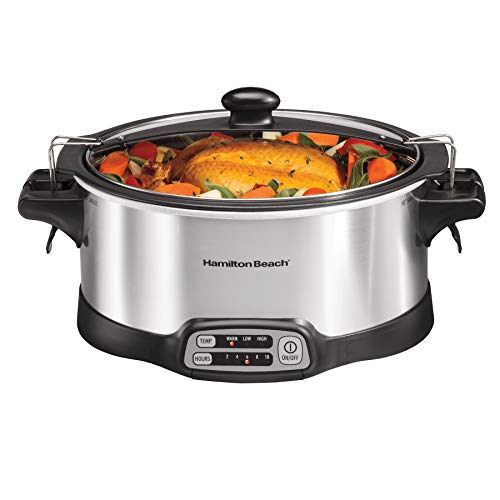
Hamilton Beach 6Qt Sear & Cook — Best All-Round
The 33663 is the complete expression of the sear-and-cook idea from the brand that popularised it. Its 6-quart crock is the stovetop-safe component: lift it out, set it on a burner, brown the beef properly in the very vessel the stew will braise in, then settle it back into the base and let the programmable timer run the afternoon. The fond stays in the pot where it belongs, the hob does the work it is good at, and the washing up is one insert rather than a pan plus a crock plus a deglazing argument.
The detail that separates this model from its sibling below is the travel lid lock, and it is not a garnish. A locking lid turns a slow cooker into a portable meal: the chilli that travels to a potluck, a relative’s kitchen or a tailgate without redecorating the car boot on the first corner. Programmable timing with an automatic shift to warm suits the working household that loads the pot at breakfast, and the silver finish keeps the whole arrangement looking like kitchen equipment rather than camping gear. For most buyers, this is the pick where the questions stop.
- Capacity: 6 quarts
- Insert: stovetop-safe Sear and Cook crock
- Lid: travel lid lock for transport
- Controls: programmable with warm shift
- Model: 33663 per listing
- Finish: silver
Strengths
- Searing in the cooking vessel keeps every browned bit in the meal.
- Locking lid makes the cooker genuinely portable.
- Programmable timing fits the load-it-and-leave household.
Trade-offs
- The insert is lighter than cast iron, so searing heat must be managed steadily.
- Six quarts is generous for two and modest for a crowd.
- The base stays home by the socket; only the crock travels to the hob.
Best for: working families who want one-pot browning and a cooker that can travel to gatherings.
Not suited for: cooks feeding a dozen, who should look at the 10-quart picks.
Check the crock details on the Hamilton Beach 6Qt Sear & Cook listing and check price on Amazon.
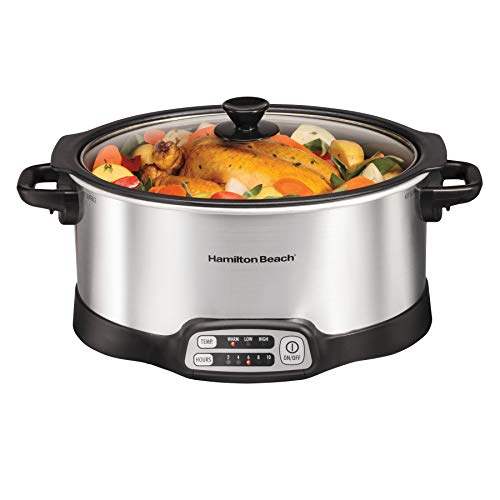
Hamilton Beach 33662 Sear & Cook — Best No-Frills Searing
The 33662 is the same idea with the travel equipment left off, and for a large class of households that is the smarter purchase. The 6-quart stovetop-safe crock sears on the burner and slow-cooks in the base exactly as its sibling’s does, the controls are programmable in the same spirit, and the silver presentation is identical on the counter. What you forgo is the locking travel lid arrangement that headlines the 33663’s listing.
Decide by itinerary. A slow cooker that lives on your counter, feeds your household and never rides in a car gains nothing from a travel lock except a feature to clean around, and the plainer model directs the budget at the cooking itself. A slow cooker that visits, potlucks, church halls, a parent’s Sunday table, should be the sibling above, because spilled stew in a footwell is a story told for years. Neither answer is a compromise; they are two honest configurations of one good design, and this guide separates them so the choice is yours rather than the listing page’s.
- Capacity: 6 quarts
- Insert: stovetop-safe Sear and Cook crock
- Controls: programmable
- Model: 33662 per listing
- Lid: standard lid, no travel lock headline
- Finish: silver
Strengths
- The full sear-in-the-pot experience without travel extras.
- Programmable convenience for weekday cooking.
- Simple specification that is easy to buy correctly.
Trade-offs
- No locking lid for transporting full, hot meals.
- Same capacity ceiling as its sibling for large gatherings.
- Insert care follows the same steady-heat discipline.
Best for: home-based cooks who want browning built in and never move the cooker.
Not suited for: potluck regulars, who need the locking lid of the 33663.
Confirm the configuration of the Hamilton Beach 33662 Sear & Cook on its listing and check price on Amazon.

Magic Mill 10Qt Searing Pot — Best Extra Large
Ten quarts changes the conversation from dinner to logistics. The Magic Mill’s non-stick metal searing pot is the stovetop component, described on its listing as safe to put on the flame, and at this size that matters doubly: browning the meat for a crowd’s worth of stew in batches in a separate pan is an hour of anyone’s life, while the big pot takes the sear in stride before settling onto its base for the long cook. A transparent tempered glass lid keeps the contents visible without lifting away the heat.
Scale brings its own honest arithmetic. A full 10-quart pot is heavy, and it should be moved with two hands and a plan, seared on a burner that suits its wide base, and stored where its footprint has been measured rather than hoped for. The lightweight metal construction helps, keeping the empty pot manageable in a way a ceramic vessel of this volume could never be, and dishwasher-safe parts soften the cleanup after event-scale cooking. For batch cooking, big families, freezer-filling weekends and community meals, this is the capacity pick of the guide.
- Capacity: 10 quarts, extra large
- Insert: non-stick metal searing pot
- Stovetop claim: pot safe on the flame per listing
- Lid: transparent tempered glass
- Care: dishwasher-safe parts per listing
- Role: crowds, batches and big families
Strengths
- Sears and braises event quantities in one vessel.
- Lightweight metal keeps the big pot liftable.
- Glass lid allows monitoring without heat loss.
Trade-offs
- Storage footprint is a genuine commitment.
- A full pot demands two-handed, planned carrying.
- Small households will rarely fill it properly.
Best for: batch cooks, large families and anyone feeding a gathering from one pot.
Not suited for: couples, small kitchens, or shelves already at capacity.
Measure your shelf against the Magic Mill 10Qt Searing Pot listing and check price on Amazon.

Magic Mill 10Qt Metal Searing Pot alt — Best Big-Batch Alternative
Magic Mill sells more than one route to a 10-quart searing pot, and this listing is the plainer of the two in this guide: an extra large slow cooker with a metal searing pot and a transparent tempered glass lid, stated without the newer listing’s extra emphasis. The working proposition is the same and equally valid, a lightweight metal vessel that browns on the hob and then slow-cooks in the base, at a size that treats a whole crowd as a single batch.
Why keep both in the guide? Because listings, availability and feature emphasis shift, and a shopper comparing the two Magic Mill pages deserves a map. Read the newer listing for its explicit flame-safe and non-stick wording; read this one for the straightforward version of the same idea, and let the current listing details, included parts and your own priorities arbitrate. In either case the ownership experience converges: a big, light pot that sears, a base that braises, and a freezer that fills up on batch day.
- Capacity: 10 quarts, extra large
- Insert: metal searing pot
- Lid: transparent tempered glass
- Positioning: the brand’s simpler big listing
- Best context: batch and event cooking
- Note: compare included parts with the sibling listing
Strengths
- Full 10-quart sear-and-cook capacity.
- Metal pot keeps handling light for its size.
- Straightforward specification, easy to verify.
Trade-offs
- Listing states fewer extras than the newer sibling.
- Same storage and lifting considerations at this scale.
- Shoppers must compare the two listings carefully.
Best for: big-batch cooks happy with the plainer configuration of a proven idea.
Not suited for: buyers who want every stated extra of the newer listing.
Compare both routes via the Magic Mill 10Qt Metal Searing Pot alt listing and check price on Amazon.

ICOOK 6.5Qt Stovetop Safe — Best Mid-Size With Warming
The ICOOK takes the aluminium route: a 6.5-quart sear and sauté stew pot, stovetop safe per its listing, in a blue finish that refuses to pretend slow cookers must be silver. Aluminium is the thoughtful metal for this job, conducting heat evenly across the base so the sear browns in a sheet rather than in hotspots, while staying light enough that a full pot is a comfortable carry from hob to base.
Its controls lean flexible, with adjustable temperature and a food warmer role that suits the household whose dinner hour stretches: the stew finishes, the cooker holds it kindly, and late arrivals eat the same meal as the punctual. The glass lid keeps watch over the braise, and dishwasher-safe construction covers the cleanup. At 6.5 quarts it sits in the useful middle, a family pot with headroom for a chicken or a double batch of soup, without the storage demands of the 10-quart machines.
- Capacity: 6.5 quarts
- Insert: aluminium sear and sauté stew pot, stovetop safe
- Controls: adjustable temperature
- Extra role: food warmer function
- Lid: glass, dishwasher-safe build
- Finish: blue
Strengths
- Aluminium sears evenly and carries lightly.
- Adjustable temperature widens the recipe range.
- Warming role suits staggered family dinners.
Trade-offs
- A newer brand name with a thinner track record.
- Aluminium wants prompt washing to stay bright.
- No travel-lock headline for transporting meals.
Best for: families wanting a mid-size searing pot with flexible temperature control.
Not suited for: traditionalists who prefer the established Hamilton Beach route.
Look over the ICOOK 6.5Qt Stovetop Safe listing details and check price on Amazon.

GreenLife 3.5QT Cooktop Safe — Best Small Ceramic
The GreenLife is the small, ceramic exception in a metal class, and its claim needs the precise wording this guide promised: the manufacturer states on the listing that its ceramic nonstick inner pot is cooktop and oven safe, and we report that as a manufacturer-stated claim for this specific pot, not as a general truth about ceramic inserts, most of which must never meet a burner. The pot is also described as PFAS-free nonstick, removable and dishwasher safe, with a glass lid and three heat settings, low, high and warm.
At 3.5 quarts this is the two-person or small-kitchen pick: a pot of soup for two with leftovers, a small braise, a side dish that minds itself while the main event happens elsewhere. The lightweight, compact build stores where the 10-quart machines cannot dream of fitting, and the ceramic surface releases food kindly and asks for gentle utensils in return. Treat the cooktop claim with the respect due to any manufacturer’s instruction: follow the listing’s guidance on heat levels and handling, warm the pot gradually rather than shocking it, and the smallest member of this guide will earn its counter space.
- Capacity: 3.5 quarts, compact
- Insert: ceramic nonstick, removable
- Claim: cooktop and oven safe, manufacturer-stated
- Coating: PFAS-free nonstick per listing
- Settings: low, high and warm
- Care: dishwasher safe, glass lid
Strengths
- The only ceramic route here, with an explicit maker claim.
- Compact and light for small kitchens and couples.
- Simple three-setting operation suits set-and-forget cooking.
Trade-offs
- Ceramic demands gentler handling than the metal inserts.
- Capacity will not stretch to family-plus cooking.
- No programmable timer; the settings are deliberately basic.
Best for: couples and small households wanting a sear-capable pot at modest scale.
Not suited for: crowds, batch cooking, or anyone rough with coatings.
Read the maker’s guidance on the GreenLife 3.5QT Cooktop Safe listing carefully and check price on Amazon.
How Do the Six Slow Cookers Compare Side by Side?
| Model | Capacity | Insert | Signature trait |
|---|---|---|---|
| Hamilton Beach 6Qt Sear & Cook | 6 qt | Stovetop-safe crock | Locking travel lid |
| Hamilton Beach 33662 Sear & Cook | 6 qt | Stovetop-safe crock | Plainer home-based version |
| Magic Mill 10Qt Searing Pot | 10 qt | Non-stick metal | Flame-safe claim, crowd size |
| Magic Mill 10Qt Metal Searing Pot alt | 10 qt | Metal searing pot | Simpler big-batch listing |
| ICOOK 6.5Qt Stovetop Safe | 6.5 qt | Aluminium | Adjustable temp, warmer role |
| GreenLife 3.5QT Cooktop Safe | 3.5 qt | Ceramic nonstick | Manufacturer-stated cooktop claim |
Capacity sorts this table before material does: 3.5 quarts for two, 6 to 6.5 for families, 10 for events. Within a size, choose by life: the Hamilton Beach pair split on travel, the Magic Mill pair on listing emphasis, and the GreenLife stands alone as the ceramic, maker-claimed route for small kitchens.
Why Does Searing in the Insert Change the Finished Dish?
Browning is chemistry with good public relations. The Maillard reactions that colour meat create the deep, savoury compounds a pale braise cannot imitate, and they happen on the pot’s floor, in the fond that sticks there as the meat sears. Deglazing that same vessel with wine, stock or even water lifts the fond into the sauce, which is why a stew seared in its cooking pot tastes assembled rather than merely combined.
The insert method protects that chain of custody. A separate frying pan can be deglazed too, honestly and well, but every transfer loses a spoonful of the good stuff and adds a pan to the sink. Searing in the insert also means the meat’s rendering fat becomes the braise’s cooking medium from the first minute, seasoning the vegetables that join it later. The difference is not subtle in a beef stew, and it is the entire reason this category exists.
How Do You Sear in an Insert Safely and Well?
Start with the rule that outranks all technique: only the insert goes on the burner, never the base, and the insert returns to the base before any liquid-based slow cooking begins. Dry the meat thoroughly, because surface moisture steams where it should sear, heat the insert steadily rather than blasting it, and give the pieces room; a crowded pot steams its contents grey no matter how noble the intentions. Work in batches for a big braise and let each batch colour properly.
Mind the materials. Metal inserts take metal utensils within reason, while the GreenLife’s ceramic nonstick asks for wood or silicone and a gentler heat ramp, per its maker’s guidance. Handles on inserts are rarely designed as oven mitts are, so treat every handle as hot, keep a towel stationed by the hob, and plan the carry from burner to base before the pot is full and heavy rather than improvising it at the steaming moment.
What Should Never Go on the Stovetop in This Category?
The base unit, first and always: it contains the heating element, the controls and the cord, and placing it on a burner would damage the appliance and create a genuine hazard, not a shortcut. Standard stoneware crocks from ordinary slow cookers belong on the never list as well, however sturdy they feel, because ceramic that is not made and rated for direct heat can crack from thermal shock, sometimes mid-braise, which is a mess with a safety briefing attached.
Glass lids deserve their own sentence: a lid that is happy in the slow cooker is not thereby rated for a burner or a broiler, and it should rest on the counter, not the hob, during searing. When in doubt about any component, the listing and the manual are the authority, and this guide’s picks were chosen because their makers state the insert’s stovetop role explicitly rather than leaving it to folklore.
What Mistakes Do Sear-and-Cook Owners Make?
The dangerous mistake is the base-on-burner error covered above, and it is prevented by a habit: the base lives by its socket, the insert commutes alone. The culinary mistakes are gentler. Skipping the drying of meat, overcrowding the sear, and lifting pieces too early, before the crust releases, account for most pale stews. The third error is thermal impatience, ramping a cold insert over maximum flame, which even metal prefers to avoid and ceramic actively dislikes.
Fourth is forgetting that a slow cooker rewards a full-ish pot and a measured amount of liquid: slow braises evaporate little, so the sauce you start with is close to the sauce you finish with, and an insert sear that reduced everything beautifully can be undone by a flood of stock added from habit. Trust the method; it has been refining itself since long before it had a programmable timer.
How Do You Clean and Store a Searing Insert?
Most inserts here are described as dishwasher safe, and the dishwasher will indeed clean them; the fond’s revenge is that a good soak in warm water loosens a sear’s residue more kindly than any cycle, preserving nonstick surfaces for the years when you will want them. Avoid abrasive scouring on coated and ceramic surfaces, dry metal inserts promptly to keep them bright, and never put a hot insert under cold water, a thermal shock that warps metal and threatens ceramic alike.
Storage is where inserts earn scars, so nest them with a cloth between surfaces if they share a cupboard with other pans, and keep the base and its insert together rather than divorcing them across the kitchen. A slow cooker stored complete, cord tidy and lid seated, is a slow cooker that gets used on the grey Tuesday when it was bought to redeem.
Which Hob Types Do These Inserts Work On?
An insert that is stovetop-safe still has to suit your particular stove. Gas and radiant electric hobs heat any flat-based metal insert happily, which is why the sear-and-cook category grew up around them. Induction hobs add their familiar condition: the insert’s base must be magnetic to couple with the field, and aluminium, the ICOOK’s virtue, is not magnetic unless the specific pot carries an induction-ready base layer. Check the listing for your chosen model’s hob guidance before assuming, because an insert that will not register on your induction top has lost the very trick it was bought for.
Glass-ceramic radiant tops ask for flat bases and a lifting habit, since a dragged metal pot can mark the surface, while a heavy, fully loaded 10-quart insert deserves a grate or a ring that supports its span on gas. None of this is exotic; it is the ordinary marriage of pot and burner, applied to a pot that happens to have a second job waiting beside the socket.
When the listing is silent on a hob type, ask the seller rather than experimenting with a full stew. The makers in this guide state their inserts’ stovetop role clearly, and the follow-up question about your specific hob deserves the same clarity in reply.
What Dishes Gain the Most From a Sear-First Slow Cook?
Beef is the headline beneficiary: shin, chuck and short rib all carry the connective tissue that slow heat melts into richness, and all of them arrive at that richness wearing a better flavour when they were browned first. A goulash, a bourguignon-style braise or a simple pot roast cooked this way tastes like a single decision rather than an assembly of parts. Lamb shanks and pork shoulder follow the same logic, and sausages, browned in the insert before braising in beer or cider, become a dish rather than an ingredient.
The method also rescues dishes that never needed meat’s sear but love a head start: onions softened and coloured in the insert before lentils join them, spices bloomed in the rendering fat for thirty honest seconds, a tomato paste cooked dark at the bottom of the pot before the stock goes in. Vegetarian slow cooking gains as much from these foundations as any stew, which is why the sear-capable insert is a cook’s tool rather than a carnivore’s gadget.
What gains least is what slow cookers were never for: delicate fish, quick greens and anything whose virtue is freshness. Let the insert sear the aromatics for those meals and add the principals late, or cook them elsewhere entirely and let the slow cooker handle the rice pudding.
How Full Should the Pot Be, and How Much Liquid Is Right?
Slow cookers cook best in their middle register, roughly half to two-thirds full, where the heat surrounds the food evenly and the lid’s condensation rains back as designed. A nearly empty big pot can overcook a small stew’s edges over a long day, which is the practical reason the 10-quart models are event equipment rather than everyday ones, and a pot filled to the brim risks bubbling at the lid and cooking unevenly at the centre.
Liquid is the second discipline. A slow cooker is a nearly sealed system; the braise loses very little to evaporation, so most recipes need markedly less stock than their stovetop versions, often just enough to come partway up the ingredients. The sear-first method helps here too, because the vegetables and meat bring their own juices, released slowly into a sauce that concentrates by richness rather than reduction. You can always tighten a finished sauce by simmering the insert briefly on the hob at serving time, one more dividend of a stovetop-safe pot, whereas an over-diluted braise has no road home.
How Do You Convert a Favourite Recipe to the Slow Cooker?
Keep the sear, cut the liquid, and rethink the order. Brown the meat and aromatics in the insert exactly as the original recipe directs, then reduce added liquid by roughly a third to a half, since the slow cooker will not evaporate what a casserole loses in the oven. Dairy, fresh herbs and quick vegetables move to the end of the cook, where their character survives; dried beans want their own safety-aware preparation, and pasta is usually better cooked separately and married at serving.
Time converts by temperament more than by table: a dish that braises for two hours in a low oven will take a long afternoon on low in the slow cooker, and low is nearly always the better setting for anything with connective tissue to melt. High suits soups, pulses and the household that started late. Keep notes on the first conversion of any beloved recipe, because the second attempt, adjusted by those notes, is where a slow cooker stops being an appliance and becomes a repertoire.
What Food-Safety Habits Matter With Slow Cooking?
Start cold ingredients cold and meat thawed, because a slow cooker’s gentle climb should not be asked to drag a frozen joint through the temperature zone where bacteria thrive; thaw in the fridge overnight and let the sear, which this category makes so easy, be the meat’s first heat. Fill the pot within its happy register so the contents heat through evenly, and resist lifting the lid to admire progress, since each peek costs the pot a meaningful slice of its accumulated warmth.
At the other end of the cook, serve or refrigerate promptly, cooling leftovers in shallow containers rather than in the deep insert, however tempting its fridge-shaped convenience looks. Reheat leftovers until they are properly hot throughout, ideally back in the insert on the hob where you can see the simmer with your own eyes, which is yet another quiet advantage of a pot that works in both worlds.
The warm setting is a holding pattern for a couple of hours, not a storage strategy, and the household that treats it as such will never have the argument this paragraph exists to prevent.
How Does the Locking Lid Change Potluck Cooking?
It changes the vehicle from a hazard into a boot. A standard slow cooker lid rides loose, and a full pot of chilli in a car is a wager against the first roundabout; the Hamilton Beach 33663’s travel lock converts that wager into a plan. Transport the cooker in its base for stability, set it in a lined box or a footwell where it cannot slide, and carry it by its handles with the respect a full, hot vessel deserves.
At the destination the arrangement completes itself: the base plugs in, the warm setting holds the dish at serving temperature through an afternoon, and the insert that seared at home serves at the hall without a transfer dish in between. Hosts who cook for gatherings learn to value that continuity out of all proportion to its simplicity, which is why a single lid detail earned a badge in this guide.
If your cooker lacks the lock, the honest workarounds are cling film under the lid, a towel over the top and a driver who brakes like a chauffeur, or choosing the dish that travels as ingredients and assembles on arrival. All three have fed many parties; the lock simply retires the anxiety.
How Much Energy Does a Slow Cooker Use Across a Day?
Very little, and it is part of the method’s original appeal: a slow cooker sips power at a rate comparable to a bright bulb or two, holding its temperature for hours, where an oven cycles a large element to keep a mostly empty cavity hot for the same braise. The sear at the start costs a few minutes of hob time, which the method repays by making the hours that follow taste better, not by any arithmetic of watts.
The comparison that matters to most households is summer comfort. A slow cooker on the counter leaves the kitchen cool while dinner cooks itself, where an oven would have the extractor and the cook both working against its heat. In winter the equation flatters the oven slightly, since its warmth is welcome, but the slow cooker’s case was never only about energy; it is about a meal that is ready when the household is, cooked in one pot that browned its own beginnings.
Which Size Suits Your Household, Honestly?
Count the mouths and the leftovers philosophy together. A couple that loves a second-day stew is well served by the GreenLife’s 3.5 quarts or a 6-quart run at half capacity, while a family of five with teenage appetites should start at the Hamilton Beach size and treat 6 quarts as the floor rather than the ceiling. Batch cooks think in freezer containers: a 10-quart session fills a shelf of future dinners, and the household that eats that way plans its month around two such sessions rather than nightly cooking.
Storage votes in the same election. Measure the cupboard or the counter corner with the same honesty you would give a stand mixer, because a slow cooker exiled to a garage shelf is a slow cooker used twice a year, while one that lives within reach becomes the Tuesday default. The compact GreenLife and the mid-size ICOOK win kitchens where the big Magic Mills would become monuments.
When torn between two sizes, choose by the dish you cook most, not the feast you cook once. Christmas has caterers and relatives with ovens; Tuesday has only you and the pot that fits it.
There is a rental-household footnote to the same question: a cooker that must move house every year or two should be light, simple and replaceable without grief, which argues for the mid-size metal inserts over both the giant batch pots and the ceramic piece, however charming, that would need packing like a heirloom at every move.
Students and first-flat cooks belong in this footnote too: a compact searing cooker replaces a frying pan, a saucepan and an oven dish in one stroke, teaches the two foundational skills of browning and patience simultaneously, and produces the kind of food that makes a small kitchen feel like a deliberate choice rather than a compromise.
How Should a Working Household Run a Slow-Cooker Week?
Load in the morning what the evening needs, and let the machine’s patience cover the unpredictable hour of return. Monday is a seared beef stew, assembled in fifteen minutes because the insert browns the meat while the coffee brews. Wednesday is a lentil and vegetable braise built on onions coloured in the same insert, proof that the sear-first habit serves the meatless table as faithfully. Friday is a pork shoulder that asks for nothing but its morning seasoning and returns pulled, sauced and ready for bread rolls.
The weekend belongs to the big pots if you own one: a 10-quart batch of chilli or soup, half for the table and half for the freezer, cooked once and eaten across the month. That rhythm, two weeknight loads and one weekend batch, is the pattern these appliances were designed by decades of households to serve, and the stovetop-safe insert simply removes the extra pan that used to stand between the cook and the habit.
What Should You Check in the First Cook?
Run a forgiving recipe first, a soup or a simple braise, and use it to learn your machine’s temperament: how hot its low truly is, how its lid fits, how the insert behaves on your particular hob during the sear. Check the insert’s base against your burner before the stew depends on it, confirm which utensils its surface prefers, and note where the full pot will live while it cooks, on a counter with the cord comfortably reaching and the steam’s path clear of cupboard undersides.
Photograph the model plate and file the manual’s stovetop guidance where the household can find it, because the insert-versus-base rule will eventually need explaining to a helpful relative who offers to warm the stew by putting the whole cooker on the stove. That sentence, delivered kindly in advance, is the cheapest safety device in this entire guide.
Also note, during that first cook, how the finished dish’s sauce behaves: slow cookers vary in how much they reduce and how hot their low setting truly runs, and one observation written down now will calibrate every recipe conversion you attempt for the life of the machine.
How Do the Two Hamilton Beach and Two Magic Mill Listings Differ?
Sibling listings confuse more buyers than rival brands do, so here is the untangling in one place. The Hamilton Beach pair share the 6-quart sear-and-cook concept; the 33663 adds the travel lid lock that suits meals on the move, while the 33662 is the same cooking in a plainer, stay-at-home configuration. Choose by itinerary and the decision takes ten seconds.
The Magic Mill pair share the 10-quart metal searing pot concept; the newer listing states its non-stick surface and flame-safe claim in the fullest terms, while the earlier listing presents the same working idea more simply. Stock, included parts and current listing details should arbitrate between them at the moment of purchase, and either delivers the essential experience: a big, light pot that browns on the hob and braises in the base.
The general lesson travels beyond these four: when two listings look alike, compare the stated extras line by line rather than assuming the cheaper page is the same product wearing a plainer photograph.
What Accessories Actually Help a Sear-and-Cook Household?
Very few, which is the category’s charm. A long-handled wooden spoon that can work both the sear and the serving, tongs that grip a slippery piece of beef without tearing its crust, and a splatter screen for the hob stage will cover nearly every session. A trivet for the counter protects surfaces when the hot insert lands between stove and base, and a shallow ladle serves the braise without dismantling it.
Liner products divide opinion and this guide stays neutral except on one point: a liner in the insert defeats the sear, which is the entire reason these models exist, so households that value the browning should skip liners on sear days whatever they do on others. Beyond that, spend on ingredients; the pot has already spent its ingenuity on the only trick that matters.
A final accessory earns its mention for the big-pot owners: a sturdy, low crate that the 10-quart cooker can live and travel in, because an appliance that size survives its decades in proportion to how thoughtfully it is stored between its starring weekends, and a crate turns a cupboard negotiation into a simple lift.
Why Did Slow Cooking Survive Every Kitchen Fashion Since?
Because it respects the two scarcest resources in a household: money and attention. The cuts it glorifies are the economical ones, transformed by time rather than by expense, and the hours it demands are the machine’s rather than the cook’s. Every generation rediscovers it under a new name, one-pot cooking, set-and-forget, batch Sunday, and each rediscovery adds a refinement; the stovetop-safe insert is simply the current generation’s contribution, fixing the one compromise, the separate searing pan, that purists had grumbled about for fifty years.
That is why this guide treats a humble feature, a pot that can meet a flame, as worth six reviews and several thousand words. It completes the method. The braise that begins with a proper sear and ends eight unattended hours later, in the same vessel, washed in the same sink, is the slow cooker’s idea finally expressed without an asterisk.
How Do You Store and Freeze a Big Batch Properly?
Cool the batch with intent: divide the big pot’s work into shallow containers so the cold reaches the centre quickly, refrigerate what the next two days will eat, and freeze the rest in portions sized to real meals rather than heroic ones. Label with the dish and the date in the handwriting of someone who has opened a freezer to three identical mysteries and sworn an oath.
Thaw in the fridge overnight and reheat in the insert on the hob, where the stew can come back to a visible, honest simmer and where a splash of stock or a knob of butter can restore the sauce’s intentions. A frozen braise reheated gently this way is frequently better than it was on its first night, the flavours having married in the cold, which is the batch cook’s whole philosophy vindicated in a single bowl.
How Do You Gift a Slow Cooker Without Gifting a Burden?
Give the size the recipient’s household will fill, not the size that impressed you in the listing, and give it with the first meal attached: the ingredients for one forgiving stew, your own recipe written out, and the insert rule, the base never meets the burner, delivered as a friendly note rather than a warning label. A slow cooker given that way debuts within the week; one given as a bare box joins the archaeology of a cupboard.
For a wedding or a first home, the Hamilton Beach pair are the natural gifts, sized for the family the couple may become and forgiving of beginners. For the established cook who has everything, the ICOOK’s cheerful difference or the GreenLife’s compact ceramic charm make the present feel chosen rather than defaulted, which is the entire art of the appliance gift.
What Is the Simplest Sign You Bought the Right Pot?
It disappears into the week’s rhythm. By the second month the right slow cooker is no longer an appliance being used but a habit being kept: the stew that assembles itself on a work morning, the batch that fills the freezer without a production meeting, the insert whose sear has quietly raised the standard of every braise the household makes. Nobody photographs it any more, and everybody plans around it.
The wrong pot announces itself oppositely, in the sear skipped because the extra pan felt like too much, in the size that never fills, in the lid that made one journey too many. This guide’s six were chosen so that each household size and style meets the first fate rather than the second, and the only remaining step is the honest matching of pot to life that the comparison table exists to make easy.
There is one more small test worth running before the first month is out: cook the dish your household requests most, the one with a reputation to defend, and let the family deliver the verdict without knowing a new method was involved. When the table asks what changed and the answer is simply that dinner browned its own beginnings in its own pot, the purchase has justified itself in the only court whose ruling matters.
Final Recommendation
Most households should take the Hamilton Beach 6Qt Sear & Cook, whose locking lid, programmable timing and proper searing crock make it the complete one-pot answer, with its sibling as the equally sensible stay-at-home alternative. Crowds and batch cooks should step up to the Magic Mill 10Qt Searing Pot, while couples in small kitchens will be happiest with the GreenLife 3.5QT Cooktop Safe and its maker-stated ceramic claim. Whichever pot comes home, tape the rule inside a cupboard door until it is reflex: the insert sears on the stove, the base never does, and dinner improves accordingly.
Frequently Asked Questions
Can I put the whole slow cooker on the stove to sear?
No. Only the removable insert is stovetop-safe, and only where the maker says so. The base contains the heating element and electronics and must never sit on a burner; sear in the insert, then return the insert to the base for slow cooking.
Can any ceramic crock go on a burner?
Standard stoneware crocks should not; direct heat can crack them. The GreenLife in this guide is the exception because its manufacturer explicitly states its ceramic pot is cooktop safe, and even then its listing’s guidance on heat and handling should be followed.
What is the difference between the two Hamilton Beach models?
Both offer a 6-quart stovetop-safe searing crock and programmable cooking. The 33663 headlines a locking travel lid for transporting meals, while the 33662 is the plainer configuration for households whose cooker stays home.
Is a 10-quart slow cooker too big for a family?
For a family of four’s ordinary dinners, usually yes; slow cookers work best reasonably full. The 10-quart Magic Mill models shine for gatherings, batch cooking and freezer-filling sessions rather than Tuesday’s stew for four.
Do metal inserts sear as well as a cast iron pan?
They sear well, with a small technique adjustment: metal inserts are lighter, so they hold less residual heat and prefer a steady burner and uncrowded batches. The reward is that the fond stays in the cooking pot instead of a separate pan.
Can the insert go in the oven as well?
It depends on the model and material, and the listing is the authority. The GreenLife’s maker states oven safety for its pot; for the metal inserts, check the specific listing’s temperature guidance before using any insert as ovenware.
Related Guides
The natural companions start with Best Tiger Rice Cookers for the other great set-and-forget pot in the kitchen. Bedding for the food-coma afterwards is compared in Best Organic King Size Flannel Sheet Sets, and the from-scratch household continues in Best Manual Meat Grinders.


