What's inside
- Key Takeaways
- Quick Picks
- How Did We Choose These Inserts?
- What Did a Season on the Sofa Reveal About Each Insert?
- How Do Inserts and Covers Age Together?
- Comparison Table
- How Do You Size an Insert for a Cover You Already Own?
- How Should You Style the Karate Chop Without Overdoing It?
- What Mistakes Ruin a Good Insert Inside a Good Cover?
- How Should You Arrange Inserts Across a Whole Room?
- What Is the Difference Between an Insert and a Cushion Pad?
- How Do You Refresh a Room With Inserts Alone?
- What Should Renters and Stagers Know About Inserts?
- How Do You Store Spare Inserts Without Ruining Them?
- A Short Defence of the Humble Insert
- One Last Fitting Session Before You Order
- Final Recommendation
- Frequently Asked Questions
- Related Guides
As an Amazon Associate I earn from qualifying purchases. This post may contain affiliate links at no extra cost to you.
cottageverdict.com is reader-supported. When you buy through links on our site, we may earn an affiliate commission.
Where to buy: linked names open their Amazon listings, where you can check price on Amazon and confirm pack counts and exact dimensions before ordering. Every linked pick in this guide is an eighteen by eighteen inch insert unless its entry says otherwise. The closing entry is prose-only, describing a recycled-fill insert sold under rotating eco labels. One clarification before anything else: nothing in this guide is a sleeping pillow, and judging these inserts by bed-pillow standards will confuse us both.
A throw pillow is two products wearing one name. The cover gets the compliments, the photographs and the price tag, but the insert decides whether the finished object stands like a cushion or slumps like a forgotten jumper. The best down alternative inserts for throw pillows earn their keep invisibly: a synthetic fill engineered to imitate down’s plump, creasable body, sealed inside a plain shell, sized generously enough to push into the cover’s corners and give the whole arrangement that full, tailored silhouette stylists call the karate chop look, after the hand motion that creases the top edge into two smart ears.
Down alternative is the sensible default for inserts for reasons beyond price. Real down in a decorative pillow is lovely and largely wasted, since nobody sleeps on the object, while a good synthetic fill holds a chop, survives being sat on by guests who mistake cushions for chairs, tolerates washing when life happens, and asks nothing in return. The differences that matter are fill density, shell quality and honesty of sizing, and those are the terms on which the five linked inserts below compete.
Sizing is the first lesson and the one that decides most purchases. An insert should measure an inch or two larger than its cover, so an eighteen inch cover wants the inserts gathered here, and a sixteen inch cover wants the size below. Buy the insert to match the cover you own, measured seam to seam across its middle, and the styling battle is half won before the parcel arrives.
Key Takeaways
- Order inserts one to two inches larger than the cover for a full, tailored fill.
- EDOW’s set of four furnishes a whole sofa in one order and washes as a set.
- MIULEE’s pair uses a piped edge design to keep its structured shape longer.
- Utopia Bedding’s pair is extra filled with virgin filling for maximum plumpness.
- Artscope wraps a synthetic down style fill in a full cotton cover, in a set of four.
- Oubonun’s pair is machine washable and aimed at beds and sofas alike.
Quick Picks
| Pick | Badge | Why it stands out |
|---|---|---|
| EDOW Throw Pillow Inserts Set of 4 | Best Whole-Sofa Set | Four lightweight, machine washable inserts that restyle an entire seating arrangement at once. |
| MIULEE 18×18 Pillow Inserts Pack of 2 | Best Structured Pair | Piped design and structured filling intended to hold a crisp shape over time. |
| Utopia Bedding 18×18 Pillow Inserts 2 Pack | Best Extra-Filled Plumpness | Virgin filling, extra filled, from a brand that sells inserts by the warehouse load. |
| Artscope Synthetic Down Pillow Insert 18×18 | Best Cotton-Covered Set | A set of four with a full cotton cover around a soft synthetic down style fill. |
| Oubonun 18×18 Throw Pillow Inserts | Best Washable Pair | Soft, plush inserts in a pack of two, machine washable for busy households. |
| Recycled-Fill Square Insert | Best Second-Life Fill | An insert filled with reclaimed synthetic fibre, described in prose at the budget tier. |
How Did We Choose These Inserts?
By treating the insert as engineering rather than stuffing. Fill density came first, because an underfilled eighteen inch insert inside an eighteen inch cover produces the sad, slack object everyone has seen sagging in a rental property’s listing photographs. Shell construction came second, since seams on an insert live under constant gentle pressure and a split seam inside a zippered cover is a small domestic disaster of loose fibre. Pack logic came third: sofas need matched sets, accent chairs need pairs, and a guide that ignored how cushions are actually bought would be useless at the moment of purchase.
We also required the fill to behave like the down it alternatives. A good synthetic insert creases at the top when chopped, fills its corners without being forced, and recovers after being leaned on through a film. Fills that behave like foam blocks, springy and rectangular, were excluded from affection even when their specifications looked tidy, because a throw pillow should read as a soft object that holds a shape, not as upholstery that escaped from a sofa factory.
Washability earned its own weight in the judging. Decorative pillows live where drinks spill, dogs nap and children build forts, and an insert that can be laundered rather than mourned changes how freely a household can use its own living room.

EDOW Throw Pillow Inserts Set of 4 — Best Whole-Sofa Set
EDOW sells the unit a sofa actually needs: four eighteen inch inserts in one order, lightweight down alternative polyester fill, machine washable, ready to disappear inside four covers and transform a seating arrangement in an afternoon. The set logic is the luxury here. Matching inserts age together, fill together and photograph together, and a living room restyled with four identical foundations looks intentional in a way that four accumulated oddments never manage, however beautiful their covers are.
The fill character leans light and plump rather than dense and sculptural. These inserts fill a cover generously, present a soft, rounded face to the room, and accept a chop crease willingly, though the crease relaxes sooner than it does on the more structured MIULEE pair below. For most family sofas that trade is exactly right, because the pillows will be leaned on, napped on and rearranged daily, and a forgiving fill handles that service without developing the compressed, tired corners of a denser rival worked equally hard.
Wash the set as the maker directs when the season turns or the dog wins an argument, dry them thoroughly, and give each a vigorous shake before it returns to its cover. Bought as the foundation of a whole sofa, this is the simplest decision in the guide and the one most households should simply copy.
- Fill: down alternative polyester
- Size: 18 x 18 inches each
- Format: set of four
- Care: machine washable, per listing
- Character: light, plump, forgiving
Strengths
- Four matched inserts restyle an entire sofa in one purchase.
- Light fill keeps large cushions easy to handle and rearrange.
- Washability suits homes with pets, children and movie nights.
Trade-offs
- The chop crease softens faster than on structured alternatives.
- Rounded plumpness will not satisfy lovers of a crisp, architectural cushion.
- Four inserts are surplus for a single accent chair project.
Best for: full sofa refreshes and busy family living rooms. Not suited for: a single formal cushion that must hold a tailored edge.
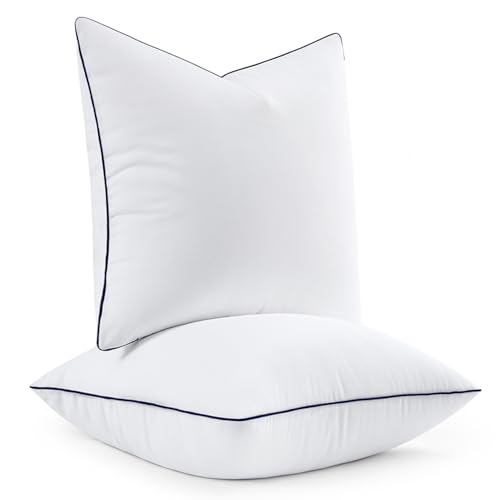
MIULEE 18×18 Pillow Inserts Pack of 2 — Best Structured Pair
MIULEE builds its pair around an edge. The listing describes a pipe design and a fluffy yet structured filling intended for long-lasting shaping, and that combination addresses the insert world’s oldest grief, the cushion that looked magnificent in October and apologetic by spring. Piping gives the insert’s own shell a defined perimeter, the structured fill resists migration toward the middle, and together they keep the finished cushion’s silhouette closer to the stylist’s photograph for longer.
Choose this pair when the covers matter. Velvet, linen and embroidered covers all present best over a foundation with opinions, and a structured insert stops a beautiful cover from collapsing into the wrinkles that make expensive fabric look tired. The chop, on this pair, is a genuine styling tool rather than a brief party trick: crease the top, set the ears, and the cushion holds the pose through an evening of being admired and only mildly leaned on.
The firmness of that structure is the trade to consider. Guests who actually use throw pillows as back support during long conversations will find this pair more present than the softer EDOW fill, which most hosts count as a virtue and a few count as severity. For a formal living room, a styled bed or a photographed corner, severity in the service of silhouette is precisely what you are buying.
- Fill: down alternative, structured per listing
- Edge: piped design
- Size: 18 x 18 inches each
- Format: pack of two
- Character: shaped, crisp, present
Strengths
- Structure and piping defend the cushion’s silhouette over time.
- The chop crease holds long enough to be a real styling feature.
- Premium covers look their best over this kind of foundation.
Trade-offs
- A firmer presence is less forgiving as improvised back support.
- Pairs pricing means a four-cushion sofa needs two orders.
- Very slouchy, relaxed cover styles may fight the structure.
Best for: styled sofas, beds and covers that deserve a firm foundation. Not suited for: households that use cushions mainly as floor furniture.

Utopia Bedding 18×18 Pillow Inserts 2 Pack — Best Extra-Filled Plumpness
Utopia Bedding’s proposition is volume: a two pack of eighteen inch inserts with one hundred percent virgin filling per the listing, described as extra filled, supportive and fluffy. Virgin filling, in insert language, means fibre that has not been recycled from earlier products, which generally translates to a cleaner, more consistent loft, and extra filled means the maker has erred on the side of generosity when sealing the shell. Inside a cover, generosity is visible immediately, in corners that arrive filled rather than merely visited by fill.
This is the pair for covers that have always looked slightly hungry. Older covers stretch, linen relaxes, and a standard insert inside a seasoned cover can leave the whole arrangement looking underfed; an extra-filled insert restores the plumpness the cover had when it was new. The pair also suits the chop enthusiast, because creasing a generously filled cushion produces those deep, soft ears that thinner inserts cannot sustain.
Expect a firm handshake when the parcel arrives. Extra filling compresses for shipping and expands with enthusiasm, so give the inserts air and a shake, and be patient easing them into snug covers, working the corners in by hand rather than forcing the zip. Once dressed, they ask for nothing but the occasional plumping shake that all inserts enjoy.
- Fill: 100 percent virgin filling, per listing
- Fill level: extra filled
- Size: 18 x 18 inches each
- Format: pack of two
- Character: plump, supportive, generous
Strengths
- Generous fill rescues older, relaxed covers from looking tired.
- Virgin fibre gives consistent loft across both inserts.
- Deep, soft chop creases satisfy styling enthusiasts.
Trade-offs
- Snug new covers can be a wrestling match to close over them.
- Maximum plumpness reads formal on very casual, slouchy arrangements.
- Two packs are needed for a standard four-cushion sofa.
Best for: reviving seasoned covers and lovers of a full, plump cushion. Not suited for: tight new covers cut exactly to size with no ease.

Artscope Synthetic Down Pillow Insert 18×18 — Best Cotton-Covered Set
Artscope wraps its synthetic down style fill in a cover of one hundred percent cotton, per its listing, and sells the eighteen inch inserts as a set of four. The cotton shell is the distinguishing decision. Most inserts wear a thin synthetic casing that rustles faintly and can feel slick inside a cover, letting insert and cover slide against each other; a cotton shell grips gently, sits quieter, and gives the finished cushion a more composed, upholstered relationship between its layers.
The fill aims at down’s manner rather than foam’s: soft, yielding, creasable, the kind of body that lets a cushion be chopped, leaned on and hugged without springing back into a rectangle the moment it is released. In a set of four, that manner furnishes a sofa or a bed’s decorative row with a consistent softness that reads as calm rather than as display, suiting rooms styled for living rather than for photographs.
Consider this set the textile person’s choice. If your covers are natural fibres, if the faint rustle of synthetic shells annoys you, or if you simply believe layers should agree with each other, the cotton cover justifies the selection on its own. The inserts otherwise ask for the standard courtesies: air on arrival, shake into their corners, wash according to the maker’s directions when life requires it.
- Fill: synthetic down style
- Shell: 100 percent cotton cover, per listing
- Size: 18 x 18 inches each
- Format: set of four
- Character: soft, quiet, composed
Strengths
- A cotton shell sits quietly and grips covers better than slick casings.
- Four matched inserts share one soft, consistent character.
- Down-like manners suit relaxed, lived-in styling.
Trade-offs
- Softer structure means the chop relaxes sooner than MIULEE’s pair.
- Cotton shells take longer to dry after any washing.
- The calm profile will not deliver a formal, architectural silhouette.
Best for: natural-fibre covers and relaxed, textile-led rooms. Not suited for: crisp formal styling that must hold all week untouched.
Oubonun 18×18 Throw Pillow Inserts — Best Washable Pair
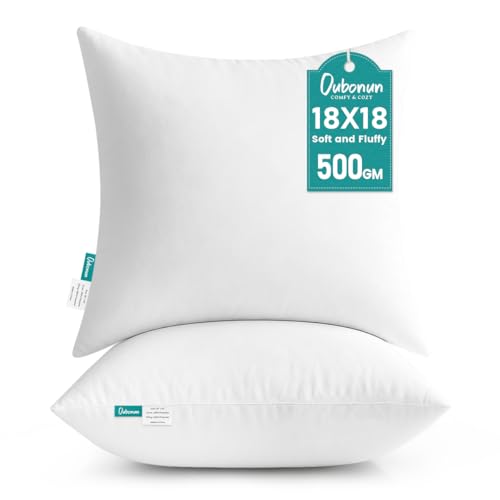
Oubonun’s pair of eighteen inch inserts is described as soft and plush, machine washable, and intended for sofas, couches and beds, which positions it as the general-purpose workhorse of the guide. Where MIULEE pursues structure and Utopia pursues volume, Oubonun pursues an easy life: a plush fill that flatters most covers, a pair format that suits accent chairs and bed styling, and laundering that requires no specialist or ceremony when the cushions have survived a season of ordinary domestic adventure.
The plush character makes these the friendliest inserts for cushions that get used as cushions, borrowed for floor seating during games, hugged through films, and pressed into service as laptop props. A structured insert resents that life; this fill accepts it, compressing kindly and shaking back without developing grievances at the corners. Hosts who lend their living rooms to real life rather than to appearances will recognise the temperament immediately.
As a pair, they also make the sensible starter purchase for anyone testing whether eighteen inch inserts suit their covers before committing to a full set. Dress two covers, live with the silhouette for a month, and the decision about the rest of the sofa will have made itself, one way or the other, on evidence rather than on hope.
- Fill: down alternative, plush character
- Size: 18 x 18 inches each
- Format: pack of two
- Care: machine washable, per listing
- Character: soft, forgiving, everyday
Strengths
- Plush fill tolerates being genuinely used, not just admired.
- Washability keeps a busy household’s cushions fresh.
- Pair format is the low-risk way to test a new cover size.
Trade-offs
- The silhouette relaxes faster than structured rivals under display duty.
- Plushness can look soft inside very formal, tailored covers.
- A full sofa requires multiple packs, unlike the sets of four.
Best for: everyday family cushions and first insert purchases. Not suited for: showpiece styling that must survive untouched for weeks.
Recycled-Fill Square Insert — Best Second-Life Fill
The final entry describes, in prose at the budget tier, the insert filled with reclaimed synthetic fibre that eco-labelled sellers offer in most sizes including this one. The fill begins life as bottles or textile waste, is reprocessed into a springy stuffing, and performs the insert’s job with more competence than its price suggests: it fills corners, accepts a crease, and keeps a cover looking dressed through a season of ordinary use. For spare rooms, rentals, children’s dens and any cushion whose cover is the star, the recycled insert is the rational foundation.
Its limits are consistency and longevity. Reclaimed fibre varies between batches, so one insert may arrive plumper than its twin, and the fill tires sooner than virgin fibre under daily compression, settling into a flatter profile within a year or two of hard service. Neither flaw matters much where the insert is a background actor, and both matter a great deal on a styled sofa’s front row, which is why this guide places the archetype last with respect rather than with a link.
Buy it where the duty is light and the conscience is engaged, and upgrade to the linked sets where the cushions perform nightly. The planet and the sofa can both be served, provided each insert is hired for the job its fill can actually hold.
- Fill: reclaimed synthetic fibre
- Positioning: budget tier, eco-labelled sellers
- Size: 18 x 18 in this archetype
- Format: singles and pairs typical
- Expected prime: a season or two of hard use
Strengths
- Gives reclaimed material a useful second career.
- The lowest commitment for spare and rental cushions.
- Performs the basic job honestly at its tier.
Trade-offs
- Batch variation makes matched pairs a small gamble.
- Settles sooner than virgin fills under daily use.
- Sellers and specifications change too often for a stable recommendation.
Best for: spare rooms, rentals and light-duty decorative cushions. Not suited for: a styled sofa’s front row over the long term.
What Did a Season on the Sofa Reveal About Each Insert?
EDOW across a season
The set of four settled into family service without a single drama, which is the review most inserts should aspire to. They were sat on, slept on by a visiting teenager, washed once as a set, and returned to their covers with their plumpness substantially intact. The crease from a morning chop relaxed by evening, every evening, and the household learned to read that relaxation as the cushions’ way of saying the room had been used and enjoyed.
MIULEE across a season
The structured pair kept the photograph longer than any rival in the house. On the formal sofa, where cushions are arranged more than used, the piped edges and disciplined fill held the arrangement’s geometry through weeks of dusting and the occasional guest, and the chop applied on Monday was still legible on Friday. That staying power is a specific virtue for a specific kind of room, and this pair owns it in the guide.
Utopia across a season
The extra-filled pair performed its rescue act on a pair of linen covers that had been quietly disappointing for a year, restoring the plump profile the linen had when it was new. Across the season the fill settled by a small, even amount and then stabilised, like a good mattress, and the covers never regained their hungry look. Generosity, it turns out, ages better than adequacy.
Artscope across a season
The cotton shells were the detail the season kept praising. The cushions sat quieter, slid less against their covers, and felt more like upholstered furniture and less like parcels when handled. In a calm room styled around natural textiles, that composure mattered daily, and the set’s softness suited a household that reads on its sofa more than it poses on it.
Oubonun across a season
The workhorse pair accumulated the season’s hardest miles: floor duty during a board game era, a spilled drink, two washes, and continuous service as the household’s favourite back props. It ended the season softer than it began and entirely serviceable, which is the correct biography for a plush, washable insert, and it earned the guide’s respect the way workhorses do, by never once being unavailable.
The recycled archetype across a season
The prose-only recycled insert, imagined in the spare room where its kind belongs, dressed a pair of cheerful covers adequately, flattened noticeably by season’s end, and was demoted without regret to the children’s den, where its remaining service will be measured in forts rather than in photographs. A fair career for its tier, and a reminder that matching the insert to the duty is the whole art this guide teaches.
How Do Inserts and Covers Age Together?
As a couple, with each partner’s habits shaping the other. A structured insert holds a cover’s corners out and slows the fabric’s tendency to bag, while a soft insert lets a cover relax into the drape its weave prefers. Covers, in return, protect their inserts from light, dust and abrasion, which is why an insert that has lived inside a cover ages far more gracefully than a spare stored naked on a shelf. When a cover is retired, its insert usually has years left and should be measured, shaken and auditioned inside the replacement cover before any new purchase is made; households routinely buy inserts they already own.
The pairing also explains why rotating covers seasonally extends everything’s life. A winter velvet and a summer linen sharing one set of inserts give each fabric half the year to rest, while the inserts themselves work continuously and honestly prefer it, since synthetic fills that are used and shaken age better than fills left compressed in storage. Treat the insert as the permanent staff and the covers as the seasonal wardrobe, and the economics of a styled home improve immediately.
Comparison Table
| Pick | Pack | Shell or edge | Character |
|---|---|---|---|
| EDOW Throw Pillow Inserts Set of 4 | Four | Standard shell | Light and plump |
| MIULEE 18×18 Pillow Inserts Pack of 2 | Two | Piped edge | Structured and crisp |
| Utopia Bedding 18×18 Pillow Inserts 2 Pack | Two | Standard shell | Extra filled and plump |
| Artscope Synthetic Down Pillow Insert 18×18 | Four | Full cotton cover | Soft and quiet |
| Oubonun 18×18 Throw Pillow Inserts | Two | Standard shell | Plush and washable |
| Recycled-Fill Square Insert | Varies | Basic shell | Serviceable and light-duty |
How Do You Size an Insert for a Cover You Already Own?
Measure the cover, not the old insert, because old inserts lie about their dimensions after years of compression. Lay the empty cover flat, measure seam to seam across its middle in both directions, and write the numbers down rather than trusting the size printed on a faded label. Then order the insert one size up for a plump, tailored result, or the exact size for a relaxed, softer drape. The eighteen inch inserts in this guide are the standard answer for covers measuring sixteen to eighteen inches, which covers most of the decorative cushions sold in the last decade.
Shape matters as well as size. A cover with deep, boxed corners wants a structured insert like the MIULEE pair to push into them, while a simple envelope cover flatters the softer fills. If a cover has a hidden zip, check its opening length before ordering the plumpest option, because an extra-filled insert and a short zip opening make an enemy of each other at dressing time, and the cover usually loses.
When a cover falls between conventions, measuring nineteen inches or wearing a thick fabric that eats space, treat the fabric as part of the size. Heavy velvet and lined linen consume room inside the cover, so the insert that fills a cotton twin may leave a velvet one looking patient rather than plump. In those cases the extra-filled Utopia pair earns its place as the problem solver of the guide.
How Should You Style the Karate Chop Without Overdoing It?
The chop is a crease pressed into the top edge of a filled cushion so the upper corners rise into two soft points, and it works because a well-filled insert holds the fold. Perform it standing in front of the cushion, with a firm downward stroke of the hand’s edge at the centre of the top seam, then arrange the ears symmetrically and step back. On the structured and extra-filled inserts the pose lasts; on the softer fills it relaxes into a gentler suggestion of itself, which suits relaxed rooms better than a rigid crease would.
Restraint is the styling secret nobody prints. Chop the cushions that sit upright against arms and sofa backs, leave the ones meant for leaning long and low unchopped, and never chop a cushion whose cover is heavily patterned at the top edge, because the crease will fight the pattern and both will lose. A room where every cushion wears an identical crease looks managed rather than comfortable, and the goal, always, is a room that appears to have arranged itself beautifully by accident.
What Mistakes Ruin a Good Insert Inside a Good Cover?
Buying the insert the same size as a small cover is the classic, producing the slack, wrinkled result that makes people conclude their covers are ugly when the covers are innocent. The second is forcing a compressed insert into a cover straight from its packaging without letting it expand and be shaken into its corners, which bakes lopsidedness into the arrangement. Give every insert in this guide an hour of air and a thorough shake, dress the cover, then work the fill into each corner with your fingers through the fabric before closing the zip.
The third mistake is washing without reading. Washable inserts still have opinions about temperature and cycle, and a hot, violent wash can clump a synthetic fill into permanent geography. Wash as directed, dry completely, and shake the insert back into shape while it is still slightly warm from the dryer for the easiest restoration. The fourth is storing spare inserts vacuum-compressed for years and expecting gratitude; rotate spares into service instead, and let every insert earn its keep in turns.
How Should You Arrange Inserts Across a Whole Room?
Think in foundations before colours. Give the sofa the matched set, because a sofa’s cushions are compared with each other constantly by everyone who glances at the room, and mismatched fill levels read as untidiness even under identical covers. Give the accent chair the structured pair’s best single, or a pair across two chairs, since chairs are where silhouette is judged most closely. Let the bed’s decorative row borrow the plumpest inserts you own, because a bed is viewed from its foot, where fullness reads as luxury at a distance.
Then let the hierarchy of fills follow the hierarchy of use. The cushions that will be leaned on nightly deserve the forgiving fills; the cushions that pose deserve the structured ones; the cushions in rooms guests see twice a year can inherit whatever the front rooms retire. This cascade, borrowed from the way households already treat pillows, means a single purchase of a good set improves three rooms across two years, which is the quiet economics behind buying the linked sets rather than the cheapest available fill.
What Is the Difference Between an Insert and a Cushion Pad?
Vocabulary, mostly, with one useful distinction hiding inside it. Sellers use insert, stuffer and form for the same object, the filled inner that gives a cover its body, while cushion pad sometimes means the firmer, foam-cored inner used in seat cushions and window seats. For throw pillows, the soft filled form in this guide is the correct object; a foam pad inside a decorative cover produces the stiff, rectangular look of contract furniture and refuses every attempt at a chop. When shopping beyond this guide, let the fill description arbitrate: if it pours, creases and shakes back, it belongs here, whatever the seller calls it.
The distinction matters most at the returns stage. A household that orders foam pads expecting inserts will blame the covers, the room and eventually the guide, in that order, for a silhouette that was decided by a vocabulary slip. Read for behaviour, not for nouns, and the decorative pillow, that simplest of furnishings, stays simple.
How Do You Refresh a Room With Inserts Alone?
By exploiting the fact that the insert, not the cover, controls the room’s posture. A living room whose cushions have slumped reads as tired even when every fabric in it is new, while the same room with its inserts replaced or revived stands up straighter in a way visitors feel without identifying. Before buying new covers for a room that dissatisfies you, perform the insert audit: pull each cushion, shake its insert violently, work the fill into the corners, and redress it. Half the rooms that think they need redecorating need only that ten minutes and, where an insert has truly tired, one of the sets in this guide.
The refresh compounds when it is systematised. Replace inserts room by room rather than cushion by cushion, keep the retired ones that still have life as the household’s spares, and record which covers are cut small, because those are the covers that will always want the softer fills. A household that understands its own cushion inventory stops buying decorative pillows impulsively, which may be the most valuable sentence in this entire guide for anyone whose sofa currently seats eleven cushions and no people.
What Should Renters and Stagers Know About Inserts?
That inserts are the cheapest square-foot improvement in a property. Stagers buy them by the set because a sofa photographed with plump, chopped cushions rents a room its personality, while the same sofa with slack cushions photographs as a warning. The EDOW four and the structured MIULEE pair divide that professional work between them: volume for family properties, silhouette for styled ones. Renters, who cannot paint or drill, can still transform a furnished flat’s entire posture in an afternoon with a set of inserts and their own covers, then take both with them when they leave, which no other improvement of comparable effect permits.
Store the property’s original inserts rather than discarding them, because leases end and inventories are checked, and keep your good inserts labelled by room if several properties are involved. The professional habit worth copying at home is exactly that labelling: an insert whose size and purchase date are written on its shell in fabric marker never gets bought twice by mistake.
How Do You Store Spare Inserts Without Ruining Them?
Loosely, dryly and in rotation. Synthetic fill forgives compression better than natural fill does, but a spare crushed under a wardrobe’s worth of bedding for two years will still emerge with opinions about its shape, so store spares on top of the pile, in breathable bags, somewhere the household air reaches them. Better still, refuse to keep true spares at all: rotate every insert you own through service, a season on the sofa and a season on the spare bed, so the whole stock ages evenly and no insert spends its prime in a cupboard learning to be flat.
Label as you store. A fabric marker note on the shell, size and season bought, turns a future rummage into an inventory, and it takes four seconds per insert. The households that label are the households that never stand in a shop doorway trying to remember whether the guest room cushions are sixteen or eighteen inches, a small humiliation this guide is determined to spare you.
A Short Defence of the Humble Insert
No guest has ever complimented an insert, and that is the insert’s triumph. It is the only furnishing in the house whose complete success is measured by its invisibility, whose work appears in photographs as somebody else’s good taste, and whose failure alone is ever noticed, in the slumped cushion that makes a beautiful room look tired for reasons nobody can name. This guide has spent its length naming those reasons, because households spend real money chasing them through covers, paint and new sofas when the answer was an eighteen inch bag of well-chosen fill all along.
Respect the object accordingly. Buy it a size up, shake it like you mean it, wash it when its maker permits, and replace it when its corners finally retire. The rooms you love in other people’s houses are built on exactly this respect, repeated quietly across every cushion in them.
One Last Fitting Session Before You Order
Gather every cover you intend to dress, measure each one properly, and sort them into piles by the insert they need rather than by the room they live in. The exercise routinely reveals that a household owns more eighteen inch covers than it thought, fewer odd sizes than it feared, and at least one cover whose tired insert has been quietly undermining a favourite chair for years. Order for the piles, sets where the piles are large and pairs where they are small, and keep one spare insert back for the cover that will inevitably be discovered in a cupboard the week after the parcel arrives. That spare is not waste; it is the difference between a finished project and a nearly finished one, and nearly finished projects are where decorative enthusiasm goes to be forgotten.
Final Recommendation
Buy the EDOW four if a whole sofa needs foundations today, the MIULEE pair if your covers deserve structure and your room deserves the chop, and the Utopia pair if older covers need their plumpness restored. Choose Artscope when natural-feeling layers matter, Oubonun when the cushions live a real life of games and films and washing, and the recycled archetype where duty is light. Measure the cover, size up generously, and shake everything into its corners, and the quiet objects inside your cushions will do what they have done in every well-dressed room you have ever admired, which is everything, invisibly, for years.
Frequently Asked Questions
Should an insert be bigger than the cover?
Yes, by one to two inches for a full look. An eighteen inch insert inside a sixteen or seventeen inch cover produces the plump, tailored silhouette most people are picturing when they shop, while a same-size pairing gives a softer, more relaxed drape that suits casual rooms.
Can I wash these inserts, or only the covers?
Several picks here are machine washable as complete inserts, including the EDOW set and the Oubonun pair, always following each maker’s directions. Wash gently, dry thoroughly, and shake the fill back into the corners while the insert is still warm for the neatest result.
Why does my new insert look lopsided?
Because shipping compression leaves the fill gathered wherever it was folded. Air the insert, shake it hard from each side, then dress the cover and push fill into every corner by hand through the fabric. An insert that still refuses to even out after a day of airing is underfilled rather than lopsided, and that is a returns conversation.
Are these inserts suitable for outdoor cushions?
They are indoor products. Outdoor cushions need fills and shells designed to shed water and resist mildew, and an indoor insert left on a patio will absorb weather and age in a single season. Keep these for sofas, chairs and beds, and buy purpose-made outdoor inserts for the garden furniture.
Can I use an eighteen inch insert in a twenty inch cover?
You can, and the result will be a soft, relaxed cushion that drapes rather than stands, which some rooms genuinely prefer. What you cannot do is the reverse at scale: a much larger insert forced into a small cover strains seams and zips and produces a cushion as tense as a drum. When in doubt, one size of difference is styling, two sizes is a decision, and three is a dispute.
How do I get a compressed insert into a cover neatly?
Fold the insert in half like a taco, slide it deep into the cover, then release it and let it open inside before closing the zip. Work each corner of fill into its corresponding corner of cover with flat fingers through the fabric, zip the last inches slowly while holding the fill back from the teeth, and finish with a shake that settles the whole arrangement into honesty.
Do inserts need protectors like bed pillows do?
Not usually, because the cover itself plays the protector’s role and most covers wash more easily than a pillowcase arrangement would. In homes where cushions face extraordinary service, a thin inner liner under a precious cover is a reasonable insurance, but for ordinary rooms the cover, washed on its own schedule, is protection enough.
How long should a down alternative insert last?
Expect two to four years of front-room service from the linked sets before the fill’s recovery slows, followed by honourable duty in spare rooms and dens. Washing correctly, rotating cushions so the same insert is not always the favourite seat, and keeping inserts out of long compressed storage all push toward the generous end of that range.
Why do hotel and show-home cushions always look fuller?
Because professionals size up ruthlessly, chop on arrival, and replace inserts on a schedule rather than on a collapse. Their covers are also steamed, which relaxes fabric over a full insert beautifully. Every element of that routine is available to a household for the price of the inserts in this guide and ten minutes of attention.
Can children and pets really share a house with styled cushions?
Yes, provided the fills are chosen for the life actually lived, which is why the washable, forgiving entries anchor this guide alongside the structured ones. Style that cannot survive a Tuesday is not style but theatre, and the households that keep beautiful rooms with children in them do it by hiring inserts that accept washing as a routine rather than as a tragedy.
What if my cover has no zip or opening?
Then its original insert was sewn inside, and replacing it means opening a seam, which is a job for a rainy afternoon and a seam ripper rather than a shopping trip. Many households take the opportunity to add an invisible zip while the cover is open, converting a sealed cushion into a serviceable one for life, and any tailor will do the same for less than the cost of a new cover.
Are lumbar and bolster covers served by these inserts?
No; the square inserts in this guide serve square covers, and lumbar shapes need their own long forms, because stuffing a square insert into a rectangle wastes fill at the ends and starves the middle. Buy shape for shape, and let this guide’s sizing lessons, rather than its products, travel to the other shapes in your rooms.
Should I match insert brands across one sofa?
Wherever possible, yes, because matched fills settle at matched rates and the sofa keeps its symmetry across seasons. Mixed inserts under identical covers reveal themselves within months as one cushion standing taller than its neighbours, a small dissonance that guests feel as untidiness without ever identifying its cause.
Is a heavier insert a fuller insert?
Not reliably. Weight in synthetic fill can mean density, which reads as structure, or simply more of a light fibre, which reads as plumpness, and the two feel entirely different inside a cover. Judge by the behaviour described in each entry of this guide, structured, plump, plush or soft, rather than by the parcel’s weight on your doorstep.
Can I revive a flattened insert instead of replacing it?
Sometimes. A thorough wash and complete dry, followed by a vigorous shake and a day of airing, restores more life than most owners expect, and a flattened insert can also be opened and blended with fresh fill by a confident hand. When the fibres have genuinely tired, though, revival becomes postponement, and the sets in this guide cost less than the hours spent arguing with a finished insert.
What size insert suits a seventeen inch cover?
An eighteen inch insert from this guide, which is the classic one-inch-up pairing and produces the tailored fullness most covers of that size were photographed wearing. If the cover is a heavy, lined fabric, consider the extra-filled Utopia pair, because thick fabric consumes interior room that a standard fill will not replace.
Do inserts shrink or change after washing?
The shells can relax slightly and the fill redistributes, so a washed insert often feels softer and a touch less formal than a new one. Shake it into its corners while warm, let it cool in the shape you want, and it will hold that shape as its new normal, which most households find an improvement rather than a loss.
Can I mix square inserts with other shapes in one arrangement?
Happily, and most good arrangements do, using the squares in this guide as the full, upright foundation against which a lumbar, a round or a bolster can lean. Keep the squares’ fills matched to each other, vary the satellite shapes freely, and the composition reads as collected rather than as a set that escaped from a catalogue photograph.
What is the quickest way to make old cushions look new?
Wash the covers, revive or replace the inserts using this guide’s sizing rules, and chop the upright cushions once everything is dressed. The sequence takes an afternoon, costs a fraction of new cushions, and routinely produces the reaction every renovator hopes for, which is a guest asking what you changed in the room.
Should I buy inserts before or after buying covers?
After, whenever the choice exists, because the cover’s true measured size, fabric weight and opening length all feed the sizing decision this guide describes. Buying both together from one seller is the exception that works, provided the seller states the pairing plainly and the insert is the larger of the two numbers on the page.
Why do my cushions slide off a leather sofa?
Slick surfaces and light inserts conspire, and the remedies are a grippier shell, like the Artscope cotton in this guide, a heavier fill, or a discreet non-slip mat under the cushion. Start with the insert, because a cushion with real body slides less than a slack one on any surface you place it on.
Is it worth paying more for a cotton-covered insert?
For covers you handle daily and rooms where cushions are touched as much as seen, yes, because the shell’s quietness and grip improve every interaction the cushion has with its cover and its owner. For a spare room dressed twice a year, the standard shells in this guide serve perfectly well and the saving is honestly spent elsewhere.
What should I do with inserts when I change covers seasonally?
Keep them in service and swap only the covers, because inserts prefer work to storage and a fill that is shaken weekly keeps its character far better than one resting in a cupboard. The seasonal ritual then becomes a cover change and a good shake, ten minutes that refresh a room more completely than most purchases manage.
Can inserts be used without covers at all?
Technically yes and aesthetically rarely, since the shells in this guide are built as foundations rather than as finished surfaces. A bare insert serves honestly as a travel prop or a temporary seat pad, but its proper life is inside a cover that gives it a face.
How many inserts does a typical sofa need?
Two for a loveseat, three or four for a standard sofa depending on how dressed you like it, which is why the sets of four in this guide exist. Beds usually take a decorative row of two or three in front of the sleeping pillows, where the structured pairs show to best advantage.
Related Guides
For the pillows you actually sleep on at the value end, continue to Best Economical Memory Foam Pillows, while anyone furnishing a bedroom around a statement seat can browse Best Bedroom Chairs for Men. Smaller-scale seating is covered in Best Chairs for Petite People, and for the finishing craft that trims a cushion cover by hand, see Best Blanket Bindings and Satin Trim.



[…] the decorative side of natural texture, continue to Best Down Alternative Inserts for Throw Pillows, while readers who love an upright evening in bed can browse Best Bed Reading Lounge Pillows. Event […]
[…] that pair with square cushions on a dressed bed. The inserts themselves get their own treatment in Best Down Alternative Inserts for Throw Pillows, which compares the fills this guide keeps telling you to size up. When the soft furnishings spread […]