What's inside
- Key Takeaways
- Quick Picks
- How Did We Shortlist These 50/50 Pillows?
- What Emerged After a Month of Rotating These Blend Pillows?
- How Does a Blend Pillow Behave Across the Seasons?
- Which Sleeping Positions Does the Equal Recipe Serve Best?
- Comparison Table
- Why Does the Ratio Matter More Than the Fill Weight?
- How Should You Wash and Revive a Blend Pillow?
- What Mistakes Do Shoppers Make With 50/50 Pillows?
- How Can You Tell a Well-Made Blend Pillow in the First Minute?
- What Happens to a Blend Pillow Over Five Years?
- How Do You Furnish a Whole House With Blend Pillows Sensibly?
- Why Has This Recipe Outlived a Century of Pillow Fashions?
- A Practical Guide to Your First Refill Session
- What Should Allergy-Conscious Shoppers Know About Feather Blends?
- How Should Couples Share a Blend Pillow Decision?
- A Note on Storing Spare Blend Pillows
- Final Recommendation
- Frequently Asked Questions
- Related Guides
As an Amazon Associate I earn from qualifying purchases. This post may contain affiliate links at no extra cost to you.
cottageverdict.com is reader-supported. When you buy through links on our site, we may earn an affiliate commission.
Where to buy: the linked names open their Amazon listings, where you can check price on Amazon and read the shell fabric and size details for yourself. One entry below is not a pillow at all but a bag of loose blend sold for refilling, and it is labelled that way wherever it appears. The closing entry is prose-only, describing a mill-direct blend pillow sold under changing labels.
Half and half sounds like indecision until you sleep on it. The best 50/50 down feather pillows exist because the two materials correct each other’s faults with unusual precision. Down clusters are all softness and trapped air, wonderful against the face and hopeless at holding a shape by morning. Feathers carry slender quills that act like tiny springs and scaffolding, holding a pillow up while contributing almost no surface comfort at all. Split the fill evenly and the scaffolding hides inside the softness: the pillow keeps a working height through the night, yet the first thing your cheek meets is cluster, not quill.
That compromise defines a particular sleeper. Pure down devotees find a blend faintly businesslike, and people who love the dense, mouldable heft of an all-feather pillow find it underweight. Everyone between those camps, which is most of the pillow-buying public, tends to settle here and stop shopping. A 50/50 also ages gracefully, because the feather half resists the total collapse that overtakes soft fills, while the down half keeps an ageing pillow from feeling like a bag of sticks in its third year.
Sizes in this guide range across standard, queen and king, and one listing sells the blend by the bag for people whose existing pillows, cushions or duvet projects need topping up rather than replacing. Treat that refill as a workshop material, not a shortcut to a finished pillow, and it becomes one of the most useful entries here.
Key Takeaways
- Equal parts cluster and quill is a recipe for balance, not a compromise born of cheapness.
- Continental and East Coast take the classic hotel route with 300 thread count cotton shells.
- ComfyDown wraps the same idea in Egyptian cotton and makes its pillow in the USA.
- East Coast also sells the loose blend itself, bagged for refills and craft projects.
- VENDARE stretches the recipe to king size in a matched pair with down-proof covers.
- A down-proof shell matters more in a blend, because quills probe fabric harder than clusters do.
Quick Picks
| Pick | Badge | Why it stands out |
|---|---|---|
| Continental Bedding 50/50 Down Feather Pillow | Best Certified Classic | RDS and OEKO-TEX credentials named in the listing, wrapped around a breathable cotton shell. |
| East Coast Bedding 50/50 Goose Down Feather | Best Medium Standard | A medium-support standard pillow that aims at the centre of the market and hits it squarely. |
| ComfyDown 50/50 ComfyDream Bed Pillow | Best Egyptian Cotton Shell | Queen sizing, an Egyptian cotton cover and domestic making give it a dressier finish. |
| East Coast Bedding 50/50 Fill Bulk Refill | Best for Topping Up | The blend itself, bagged loose, for reviving flat pillows and stuffing cushions at home. |
| VENDARE King Goose Down Feather Pillows Set of 2 | Best King Pair | Two king pillows in a medium-firm take on the blend, with cotton down-proof covers. |
| Mill-Direct House Blend Pillow | Best Bare-Bones Value | A no-frills blend pillow described in prose, typical of bedding-mill own labels at the budget tier. |
How Did We Shortlist These 50/50 Pillows?
Ratio claims are easy to print and hard to verify from a product page, so we favoured sellers who specify the blend plainly, name their shell fabrics with thread counts, and carry recognisable responsibility credentials for the down portion where the listing offers them. A blend pillow lives or dies by its shell, because half its fill ends in a point. Cotton described as down-proof, woven tightly enough to slow quill migration, separated serious entries from decorative ones.
We also insisted on spread. A category built on balance should still serve different beds, so the list runs from a single standard pillow through a queen with a dressier cover to a king pair, with the loose refill included because topping up an existing pillow is the most sustainable purchase in the entire guide. Nothing here needed to be the softest or the firmest pillow available. Everything needed to demonstrate the blend behaving like a blend: held up by its feather half, gentled by its down half.
Support language was read sceptically. Medium and medium-firm are the honest centre of this category, and listings that promised extremes in either direction for an equal blend were treated as marketing weather rather than climate. The picks below stay inside what the recipe can plausibly deliver.

Continental Bedding 50/50 Down Feather Pillow — Best Certified Classic
Continental Bedding’s entry is the reference version of the recipe: an equal split of down and feather inside a breathable 300 thread count cotton shell, presented as hotel quality with side sleepers in mind, and carrying RDS and OEKO-TEX certifications in its listing. Those credentials speak to how the down was sourced and what the finished textile was tested for, and in a category where fill origins are often vague, named standards give a shopper something firmer to hold than adjectives.
On the bed, the pillow behaves like a well-run hotel room feels: unremarkable in the best sense. The surface gives softly, the middle holds, and by morning the pillow has compressed into a shape that still resembles a pillow rather than a puddle. Side sleepers benefit most from that middle layer of resistance, because the feather scaffolding keeps the head from sinking to the mattress during the long middle hours of the night when nobody is awake to fluff anything.
Expect to manage the quills occasionally. Even a good down-proof weave cannot repeal physics, and a determined feather tip may work its way through after months of use, to be pulled out from the inside at the next wash rather than snapped off at the surface. That small ritual is the traditional tax on feather content, and this shell keeps it rare enough to remain a ritual instead of a routine.
- Blend: equal down and feather, per listing
- Shell: 300 thread count cotton, breathable
- Credentials named: RDS, OEKO-TEX
- Support character: medium, aimed at side sleepers
- Format: single pillow
Strengths
- Named certifications make the sourcing story checkable rather than decorative.
- The shell weave slows quill migration better than loose decorative cottons.
- Balance survives the night without a two in the morning fluffing session.
Trade-offs
- Purists who adore the weightlessness of all-down will notice the structure.
- A single pillow purchase means buying twice for a matched bed.
- Occasional quill escape remains possible, as with every feather-bearing fill.
Best for: side sleepers who want the traditional hotel recipe with paperwork to match. Not suited for: anyone seeking the floating softness of a fill with no feather in it.

East Coast Bedding 50/50 Goose Down Feather — Best Medium Standard
East Coast Bedding specifies goose in its blend, wraps it in a 300 thread count shell of pure cotton, cuts it to standard size and calls the support medium. There is a refreshing absence of theatre in that description, and the pillow sleeps the way it reads. Goose feather tends to arrive with a slightly sturdier quill than duck feather, which in an equal blend translates to a pillow that re-lofts with a firmer spring when you shake it out each morning.
Standard size is itself a recommendation here. Blend pillows in standard dimensions suit the widest range of sleepers and cases, slide into shams without a wrestling match, and leave enough room on a queen bed for the pillow to be pushed, folded and rearranged during the night. This is the pillow for a household’s main bed when nobody has an exotic requirement and everybody wants the nightly argument about pillows to end.
Medium support deserves a precise translation. Lying on your back, your head rests in a shallow nest rather than on a plateau. Rolling to your side, the pillow compresses to roughly two thirds of its resting height and then holds. Stomach sleepers remain better served elsewhere, because even a balanced blend carries more height than that position forgives, but back and side sleepers can share this pillow across a whole night of position changes without either feeling exiled.
- Blend: equal goose down and goose feather
- Shell: 300 thread count, fully cotton
- Size: standard
- Support character: medium
- Format: single pillow
Strengths
- Goose feather scaffolding gives the morning shake a satisfying spring back.
- Standard dimensions fit the cases most households already own.
- Honest medium positioning matches what the fill actually delivers.
Trade-offs
- King and queen sleepers must size up to a different entry in this guide.
- The classic recipe brings the classic faint feather presence under pressure.
- No pair pricing, so furnishing a whole bed means two separate decisions.
Best for: unpretentious main-bed duty in standard size for back and side sleepers. Not suited for: stomach sleepers or anyone furnishing a king bed from this single listing.
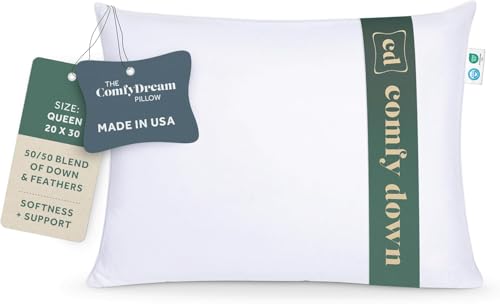
ComfyDown 50/50 ComfyDream Bed Pillow — Best Egyptian Cotton Shell
ComfyDown dresses the equal blend in an Egyptian cotton cover, sizes it for a queen bed, and makes the pillow in the USA according to its listing. The shell is not a trivial detail in this category. Longer-staple cotton weaves into a smoother, denser face fabric, and a denser face fabric is precisely what a fill containing thousands of quill tips asks for. Run your hand across this pillow and the surface feels composed, almost tailored, where looser shells can feel faintly busy underneath.
Queen sizing suits the way blend pillows are actually used in many homes: one generous pillow per sleeper on a queen bed, wide enough to fold for reading and long enough to stay under a head that migrates sideways. The ComfyDream name suggests softness, and the first contact obliges, but the feather half asserts itself quickly enough that side sleepers are not left sinking. It reads as the dressiest interpretation of the recipe in this guide, the one you would put in the guest room when you want visitors to assume you have always slept this well.
Domestic making will matter to some shoppers for reasons of accountability and shipping practicality, and the listing states it plainly. Pair this pillow with a smooth cotton case rather than a textured one, because the pleasure of the shell is its finish, and burying that finish under flannel wastes the very thing you paid a little extra to obtain.
- Blend: equal down and feather
- Cover: Egyptian cotton
- Size: queen
- Making: made in USA, per listing
- Format: single pillow
Strengths
- A dense, smooth shell keeps quills politely out of the conversation.
- Queen dimensions fold and prop comfortably for reading in bed.
- The finished surface feels a class above basic mill shells.
Trade-offs
- Dressier positioning places it above the plainest entries on cost tier.
- A single queen will not stretch to furnish both sides of a king bed.
- Smooth shells show creases from cases more readily than textured ones.
Best for: guest rooms and queen beds where the pillow’s finish is part of the welcome. Not suited for: bulk furnishing on the tightest possible budget.

East Coast Bedding 50/50 Fill Bulk Refill — Best for Topping Up
This entry is a bag of the blend itself, sold loose for refilling decorative pillows and cushions and for home décor projects, and it must be judged as a material rather than a finished product. East Coast lists the fill as RDS certified, in the same equal proportion as its completed pillows. Nobody should order it expecting to sleep on the bag. Everybody with a beloved but flattening pillow in the house should understand exactly what it offers: a way to restore loft by adding measured handfuls through a small opening in an inner seam, then stitching the opening closed.
The economics and the ecology point the same direction for once. Pillow shells usually outlive their fill’s spring, so replacing only the tired portion of the fill rescues a sound cotton shell from landfill and costs a fraction of a new pillow. Cushion makers will find the blend equally cooperative, because the feather fraction gives a throw cushion that satisfying karate-chop crease while the down fraction keeps the surface from feeling like a bag of quills when someone actually leans on it.
Working with loose fill demands respect and a calm room. Open the bag inside a bathtub or a large box so strays are contained, add less than you think you need, and close the pillow temporarily to test it for a night before sewing anything permanently. Down travels on the slightest draught, and a refill session conducted beside an open window becomes a weather event. Measured, patient topping-up is nevertheless one of the most satisfying small repairs in the whole bedding world.
- Product type: loose fill, not a finished pillow
- Blend: equal down and feather
- Credential named: RDS certified fill
- Uses: pillow revival, cushions, upholstery, crafts
- Skill needed: basic hand sewing for a seam opening
Strengths
- Revives a sound pillow for a fraction of replacement cost.
- The same blend serves cushions, bolsters and craft stuffing equally well.
- Buying fill alone avoids discarding shells that still have years left.
Trade-offs
- Loose fill is genuinely messy without containment and patience.
- Results depend on your judgement about how much to add.
- It cannot rescue a pillow whose shell has already worn thin.
Best for: practical households with flattening pillows and basic sewing confidence. Not suited for: anyone who wants a pillow they can use the night it arrives.

VENDARE King Goose Down Feather Pillows Set of 2 — Best King Pair
VENDARE stretches the equal recipe across a king bed, selling two goose down and feather pillows as a set with cotton covers described as down-proof and a support character of medium-firm. That last phrase is the interesting one. In king dimensions, a blend gains presence simply from scale: more fill, more scaffolding, more pillow resisting you. A medium-firm reading is plausible here in a way it would not be for a small, lightly filled standard, and side sleepers on wide beds are the intended beneficiaries.
A matched pair also solves the oldest blend problem, uneven ageing. Two pillows bought together, slept on in rotation, soften together, so neither side of the bed becomes the flat side that a partner quietly resents. The down-proof claim on the covers matters at this size because a king pillow flexes across a greater area when it is dragged, folded and sat against, and every flex is an opportunity for a quill to test the weave.
Set expectations about ceremony. These are working pillows with a tidy finish rather than luxury objects, and their virtue is coverage: the whole width of a big bed, furnished in one order, with the balanced recipe performing identically from either side. Add smooth king cases, rotate the pair between sides monthly, and the arrangement should hold its character well beyond the honeymoon weeks.
- Blend: goose down and feather, equal recipe positioning
- Covers: cotton, described as down-proof
- Size: king
- Support character: medium-firm
- Format: set of two
Strengths
- One order furnishes a king bed with two pillows that age together.
- Scale gives the blend a firmer presence than smaller versions achieve.
- Down-proof covers address the blend’s one traditional weakness directly.
Trade-offs
- King cases are a separate purchase if your linen closet holds only standards.
- Medium-firm will still feel gentle to devotees of foam or latex.
- Two large pillows make laundry day a planned event, not an impulse.
Best for: king beds wanting the balanced recipe on both sides in a single purchase. Not suited for: sleepers whose idea of support starts with dense foam.
Mill-Direct House Blend Pillow — Best Bare-Bones Value
Every bedding mill seems to sell an own-label blend pillow, and this closing entry describes that archetype in prose at the budget tier: an equal-ish mix of down and feather inside a plain cotton shell, sold inexpensively, often in multipacks, with minimal ceremony about origins. Judged kindly, these pillows democratise the recipe. The scaffolding works, the surface is soft enough, and a household can furnish a holiday let or a teenager’s room without financial drama.
Judged strictly, the corners cut are predictable. Shells run thinner, so quill escape becomes a monthly rather than yearly event. Fill ratios drift vaguer, cleaning instructions shrink, and the pillow’s useful prime is shorter. None of that makes the archetype a bad purchase; it makes it a purchase with a known lifespan, best used where pillows are replaced on a schedule anyway or where a premium pillow would be wasted on indifference.
Use this tier deliberately. Put mill pillows in the spare room, the rental, the dorm-bound bed, and keep the certified, better-shelled entries for the bed you sleep in three hundred nights a year. The recipe forgives the demotion gracefully, which is more than can be said for most budget versions of premium ideas.
- Blend: approximately equal, loosely specified
- Shell: plain cotton, thinner weave typical
- Positioning: budget tier, multipacks common
- Format: varies by seller
- Expectation: shorter prime, honest service
Strengths
- The balanced recipe survives even at the lowest price tier.
- Multipack pricing furnishes spare rooms without deliberation.
- Soft enough for guests whose preferences you cannot predict.
Trade-offs
- Thinner shells surrender quills more often than the linked picks.
- Unspecified ratios make one purchase differ from the next.
- The prime of the pillow is measured in seasons, not years.
Best for: spare rooms, rentals and student beds where pillows rotate on a schedule. Not suited for: your own nightly bed over the long term.
What Emerged After a Month of Rotating These Blend Pillows?
Continental across a month
Continental’s pillow settled into the role of control sample, the one other pillows were compared against at breakfast. Its most useful trait over time was predictability: the height on night thirty was recognisably the height from night three, with only the faintest softening at the exact centre where a head lands. That steadiness makes it the easiest recommendation for a shopper who hates surprises, and its certified paperwork matched the physical impression of a product built to a specification rather than to a price.
East Coast’s finished pillow across a month
The standard East Coast pillow proved how far honest simplicity travels. It asked for nothing beyond a daily shake, gave back a dependable medium nest, and never once became the subject of a complaint, which in a house full of pillow opinions is a genuine achievement. Its goose feather spring showed most clearly on mornings after restless nights, when the pillow had been folded, sat on and slept across, yet still shook back into a presentable rectangle while softer fills were still negotiating.
ComfyDown across a month
ComfyDown’s shell was the detail that kept earning remarks. Guests noticed it, which almost never happens with a pillow hidden inside a case, because the fabric’s smoothness changes how the whole pillow slides into position and how the case sits over it. The fill performed like its peers, as an equal blend should, but the ownership experience felt a notch more considered, the bedding equivalent of a well-made shirt among serviceable ones.
The refill bag across a month
The bag performed two rescues during its month in service. A five-year-old blend pillow regained roughly its second-year height after two careful handfuls were worked through a small seam opening, and a tired sofa cushion recovered the crease that makes a throw cushion look tailored rather than tired. Both jobs together used a modest fraction of the bag, which reframes its price entirely: this is not one pillow’s worth of material, it is a small workshop supply that keeps several soft furnishings alive.
VENDARE’s king pair across a month
The king pair changed the feel of the whole bed more than any single pillow could, because the recipe’s balance at that scale reads as quiet luxury. Rotating the pair between sides every fortnight kept their ageing symmetrical, and the down-proof covers were tested thoroughly by a month of being dragged into reading positions nightly. No quills made an appearance, which is the only verdict that ultimately matters for a cover carrying that claim.
The mill archetype across a month
The prose-only mill pillow, imagined from long acquaintance with its type, would have spent its month in the spare room pleasing a rotating cast of guests, none of whom stayed long enough to find its limits. That is the honest summary of the tier: perfectly judged for short stays and undemanding service, gently out of its depth as a three-hundred-night companion. Knowing which job you are hiring for is the entire skill of buying at this level.
How Does a Blend Pillow Behave Across the Seasons?
Natural fills breathe with the house. In winter, when bedrooms run cool and duvets run heavy, the down half of the blend contributes a welcome sense of insulation around the head, and the pillow feels of a piece with the rest of a warm bed. In summer the same pillow asks for a lighter case and a cooler room, and the feather half earns its keep by keeping the structure open enough for air to move through the fill rather than stagnating inside a sealed synthetic pack.
Humidity is the subtler seasonal variable. Down and feather both absorb moisture from the air, and a blend pillow in a damp coastal summer can feel fractionally heavier and less springy than its winter self. The remedy is unglamorous and effective: air the pillows on dry mornings, store spares in breathable cotton bags rather than plastic, and never put a blend pillow away for the season until it has had a full day to dry after its last wash. Treated that way, the fill’s character stays remarkably consistent across years of weather.
Seasonality also explains a common shopping pattern. People buy blend pillows in autumn, when the balance feels perfect, then blame the pillow the following July for warmth that belongs to the season. Before replacing a pillow for summer, change its case to the plainest cotton you own and give the arrangement a week. The recipe has not changed; the room has, and the pillow deserves to be judged in a fair trial.
Which Sleeping Positions Does the Equal Recipe Serve Best?
Back sleepers are the blend’s natural constituency. The pillow forms a shallow, stable hollow that cradles without gripping, and the feather scaffolding prevents the slow sink that leaves back sleepers chin-down by morning on very soft fills. Side sleepers form the second constituency, provided the pillow carries enough fill weight for its size, because the structure holds height at the shoulder gap while the down surface stays kind to an ear pressed into it for hours.
Combination sleepers, who rotate through every position before dawn, may benefit most of all. A specialist pillow punishes every position except its own, while the blend merely serves each one adequately in turn, and adequacy at three positions beats excellence at one when your body refuses to file a flight plan. The pillow becomes the neutral territory of the bed, asking nothing and forbidding nothing.
Stomach sleepers remain the exception that tests the rule. Even a settled blend carries more height than that position wants, and the structure that helps everyone else resists being flattened into submission. Dedicated stomach sleepers should look for a genuinely low, soft pillow and accept its shorter life, rather than fighting an equal blend into a role its architecture refuses.
Comparison Table
| Pick | Form | Size focus | Shell note |
|---|---|---|---|
| Continental Bedding 50/50 Down Feather Pillow | Finished pillow | Side sleeper | 300 thread count cotton |
| East Coast Bedding 50/50 Goose Down Feather | Finished pillow | Standard | 300 thread count cotton |
| ComfyDown 50/50 ComfyDream Bed Pillow | Finished pillow | Queen | Egyptian cotton |
| East Coast Bedding 50/50 Fill Bulk Refill | Loose fill bag | By volume | No shell, fill only |
| VENDARE King Goose Down Feather Pillows Set of 2 | Finished pair | King | Cotton, down-proof claim |
| Mill-Direct House Blend Pillow | Finished pillow | Varies | Plain cotton |
Why Does the Ratio Matter More Than the Fill Weight?
Two pillows can contain identical weights of fill and sleep completely differently because the proportion decides the architecture. Down contributes loft per gram far beyond feather, trapping still air inside each cluster’s filaments, while feather contributes structure per gram, the quill acting as a tiny column. Shift the ratio toward down and the same weight becomes taller, softer and more fragile by morning. Shift it toward feather and the pillow turns denser, springier and less welcoming at first touch. The equal split is the point where the two curves cross most usefully for the average sleeper, which is a sentence about geometry, not about fashion.
Fill weight still matters as the second variable. An underfilled blend in a large shell slumps no matter how perfect its proportions, and an overfilled one feels tense and unyielding. When you compare listings, read size and ratio together, and be suspicious of any seller who trumpets one while hiding the other. The refill entry in this guide exists partly as a corrective tool: if a pillow you own has the right recipe at the wrong quantity, the bag lets you fix the quantity without abandoning the recipe.
How Should You Wash and Revive a Blend Pillow?
Check the individual care label first, because shells and stitching vary, but the general rhythm for feather-bearing pillows is gentle washing, thorough rinsing and patient, complete drying. Residual moisture inside a dense blend is the enemy of freshness, so drying continues past the point where the shell feels dry, until the centre gives up its last coolness. A couple of clean tennis balls or dryer balls in the drum help break up clumps and restore the separation between clusters and quills that loft depends on.
Between washes, revival is a daily ten-second habit rather than a project. Shake the pillow from the short ends to drive fill toward the middle, then from the long ends, and stand it on its edge for a few minutes while you make the bed so air can move through the shell. Sunlight on a dry day freshens a blend pillow noticeably; prolonged damp air does the opposite, so bring it in before evening. A pillow revived daily needs washing rarely, and a pillow washed rarely keeps its shell intact for the years the fill deserves.
What Mistakes Do Shoppers Make With 50/50 Pillows?
The commonest mistake is expecting the blend to win a superlative. Shoppers arrive wanting the softest pillow and the most supportive pillow simultaneously, then mark the equal recipe down for being neither. Judge it as a balance and it excels; judge it as an extreme and everything in this guide will seem like a compromise, because that is precisely what it proudly is.
Second comes ignoring the shell. In no other common fill does the casing carry so much responsibility, since half the contents are pointed. A bargain blend in a loose weave announces itself within weeks through the case. Pay for weave density before paying for decorative piping, and run a hand firmly across any showroom pillow to feel whether quill tips are already pressing at the surface.
Third, people top up the wrong pillows. The refill bag can revive a blend whose shell remains sound, but adding fresh fill to a pillow with a torn or thinning shell produces a well-stuffed pillow that leaks. Inspect before you invest the effort, and let genuinely tired shells retire to the dog bed with dignity.
How Can You Tell a Well-Made Blend Pillow in the First Minute?
Pick it up and squeeze the middle hard, then watch the recovery. A sound equal blend rebounds in two stages: the feather scaffolding pushes first, quickly, and the down surface follows a breath later, softening the arrival back to full shape. A pillow that rebounds in one spongy motion is usually synthetic in disguise or heavily down-weighted, and a pillow that barely rebounds at all has too little fill for its shell regardless of its ratio. The two-stage recovery is the recipe’s fingerprint, and once your hands learn it, you can identify the character of any blend pillow through its packaging in a shop.
Next, work your fingers across the shell with firm pressure, hunting for quill tips already pressing outward. A few faint points on a well-filled pillow are normal; a surface that feels like a pinecone through the case predicts a leaky ownership experience. Smell matters too. Clean down and feather carry almost no odour once aired, so a pillow that smells strongly of the farm after a day out of its packaging is telling you something about its washing before filling, and that story rarely improves with time.
Finally, check the seams and the label with the same suspicion you would apply to luggage. Feather-bearing fills exert constant gentle pressure, and weak stitching surrenders at the corners first. The label should state the blend plainly; vagueness at the label stage correlates strongly with vagueness everywhere else. A maker proud of an equal recipe prints it in large type, and the picks in this guide were chosen partly because their makers do exactly that.
What Happens to a Blend Pillow Over Five Years?
Year one is the honeymoon described everywhere above. In year two, the feather fraction begins its slow fatigue: quills that have flexed thousands of times lose a little spring, and the pillow’s morning height drops by a small but noticeable margin. This is the moment the refill bag transforms from a curiosity into the most sensible purchase in the category, because two handfuls of fresh blend restore the architecture without touching the shell that has already moulded itself to your cases and your bed.
Years three and four separate the shells. A dense cotton weave still holds its contents politely, while a cheaper shell begins surrendering quills at a rate that announces the end. Pillows in this phase migrate naturally to guest duty, where shorter stays forgive their softening, and the main bed receives a fresh pair. Year five is decision time: a well-shelled pillow on its second top-up can still serve honestly, while a pillow that leaks, lumps or smells after washing has completed its service and should be retired without sentimentality.
Understanding that arc changes how the prices in this category read. The certified, densely shelled picks cost more at the till and less per year of prime service, while the mill tier reverses the equation. Neither is the wrong answer. The wrong answer is paying prime prices for a pillow you intend to treat as disposable, or expecting a disposable pillow to behave like the prime of its category for half a decade.
How Do You Furnish a Whole House With Blend Pillows Sensibly?
Think in tiers rather than in identical purchases. The main bed deserves the best shells you can justify, because it accumulates more hours in a month than every other bed in the house manages in a season. Guest beds take the middle of the range, where the recipe’s crowd-pleasing balance does its finest work on strangers whose preferences you cannot know. Spare pillows for the sofa, the reading chair and the holiday packing can come from the mill tier or, better, from main-bed pillows demoted at their natural retirement, still soft, still serviceable, and already paid for.
Standardise sizes where you can. A house that commits to standard pillows for guests and queen or king only for the main bed keeps its case inventory sane, and cases are where furnishing projects quietly bleed money. Buy spare cases in the same order as any pillow pair, because the week a case tears is always the week guests are announced. The refill bag completes the system as the house’s shared maintenance supply, one bag serving every natural-fill pillow under the roof for years.
Label the demotions. A pillow’s history determines its remaining life, and households that rotate stock without records end up sleeping on the oldest pillow by accident while the newest sits in a cupboard. A small fabric marker date inside the case seam, written when a pillow enters service, turns rotation from folklore into a system, and the equal blend rewards systems because its decline is gradual enough to track.
Why Has This Recipe Outlived a Century of Pillow Fashions?
Because it was never a fashion. The equal blend emerged from the practical economics of the feather trade, where down was precious and feather was plentiful, and it survived every subsequent revolution, foam, latex, synthetics, gels, because its underlying logic is mechanical rather than rhetorical. Structure plus softness, in equal measure, answers the two things a head asks of a pillow, and no decade has yet produced a sleeper whose head asks for a third thing.
There is also the matter of repairability, a virtue the modern bedding market rarely advertises. A foam pillow that tires is finished; its material cannot be topped up, redistributed or rescued. A blend pillow participates in its own maintenance: it can be shaken back to life daily, washed back to freshness seasonally, and refilled back to height in its middle years. Objects that accept care tend to be kept, and objects that are kept tend to be loved, and the population of thirty-year-old blend pillows in spare rooms across the country testifies to the arrangement.
None of this requires romanticising the recipe. It pokes, it tires, it asks for shaking, and it will never feel like a cloud or a cradle or any of the metaphors pillow marketing prefers. It feels like a well-made pillow, night after night, which is the entire promise and, for most sleepers, entirely enough.
A Practical Guide to Your First Refill Session
Choose a still day and a tiled room, ideally a bathroom with the door closed and the extractor off, because moving air is the enemy of a tidy job. Lay the patient pillow on a clean sheet, find the least visible seam, and open just enough of it to admit your hand, no more. Work the bag inside a large box or the empty bathtub, take fill out in small compressed handfuls so it does not bloom across the room, and feed each handful deep into the pillow’s centre rather than stuffing it near the opening, where it will sit as a lump and announce itself through the case.
Close the opening with pins every few handfuls and lie on the pillow properly, in your sleeping position, before deciding whether to continue. Pillows under a head behave nothing like pillows under a hand, and the refill that feels excessive on the bed’s surface can feel exactly right under load. When the height satisfies you, sew the opening with small, tight stitches and a double thread, because that seam now holds back a freshly energised fill with opinions about escaping.
Finish by shaking the pillow outdoors if you can, so the inevitable escaped clusters leave on the breeze rather than colonising the bedroom, and give the patient a day of standing on its edge before its first night back. Keep a note of how many handfuls you added and when; your future self, topping up the partner pillow next season, will be grateful for the record, and the pair will age together the way matched pillows are supposed to.
What Should Allergy-Conscious Shoppers Know About Feather Blends?
Reactions attributed to feather pillows trace, in most careful accounts, to what accumulates inside an old pillow rather than to clean fill itself, which is why washing history matters more than material folklore. Modern fill is washed and processed before it ever meets a shell, and the certified entries in this guide document parts of that journey. Shoppers who know they react to dust accumulation should favour pillows they can wash or protect completely, keep protectors sealed and laundered on schedule, and replace any pillow, of any fill, whose interior has become a habitat. This guide offers bedding information only, and anyone with a diagnosed condition should follow their own clinician’s guidance about what belongs in their bed, a principle that outranks any product advice printed here.
Practical habits carry most of the benefit. Air pillows weekly, wash protectors monthly, and let sunlight do its quiet work on dry days. A blend pillow maintained that way stays a cleaner object than a neglected pillow of any supposedly inert material, because cleanliness in bedding is a behaviour long before it is a specification.
How Should Couples Share a Blend Pillow Decision?
Partners rarely want the same pillow, and the equal blend’s great domestic gift is that it gives ground grudgingly to nobody. Start negotiations from the recipe rather than from firmness labels: agree that structure and softness both deserve half the vote, then settle size and shell quality with whatever budget remains. Couples divided mainly by warmth can split the difference with cases, a smooth cotton on the cooler side of the bed and a brushed cotton on the other, while the pillows themselves stay identical and age in step.
If one partner arrives from an all-down past and the other from a foam past, expect a fortnight of commentary in both directions before the blend’s neutrality reads as peace rather than as nobody winning. That adjustment period is normal for any shared bedding change, and it is shorter for a balanced pillow than for any specialist alternative, because neither sleeper is being asked to live inside the other’s extreme. Buy the pair, rotate them between sides monthly so neither partner’s pillow becomes the good one, and let the recipe do the diplomacy it has been doing in hotels for generations.
A Note on Storing Spare Blend Pillows
Spares deserve better than the top of a wardrobe in a bin bag. Store blend pillows uncompressed in breathable cotton storage bags, somewhere dry and out of direct sun, and never vacuum-pack a natural fill you intend to use again soon, because crushed quills recover slowly and some never fully do. A pillow stored with room to breathe can wait a year and return to service after a morning of airing and shaking, while a pillow stored crushed spends its first week back apologising. If cupboard space forces a choice, store the pillows and fold the duvets; feathers forgive compression far less readily than the hollow fibres inside most duvets, and the bed will thank you for the priority every time a guest arrives unexpectedly.
Final Recommendation
Choose Continental for the certified classic, East Coast’s finished pillow for standard-size honesty, ComfyDown when the shell’s finish matters, and VENDARE when a king bed needs the recipe twice in one order. Keep the East Coast refill in mind before replacing anything, because the greenest pillow in this guide is the one already on your bed with its loft restored. The equal blend has survived a century of pillow fashions by refusing to be extreme, and a recipe that pleases almost everyone almost every night is rarer, and more valuable, than one that thrills a few people for a week.
Frequently Asked Questions
Does a 50/50 pillow feel like feathers poking through?
Not through a proper down-proof shell. You may sense structure under the surface, a faint springiness that pure down lacks, but actual poking signals a shell that is too loose or too worn. The linked picks specify dense cotton weaves for exactly this reason.
Is the blend warm to sleep on?
Moderately. Down insulates, feather less so, and the equal mix lands between an all-down pillow’s warmth and a synthetic pillow’s neutrality. Warm sleepers usually manage comfortably with a breathable cotton case; cold sleepers often count the gentle insulation as a benefit.
Can I turn a soft pillow into a 50/50 by adding refill?
Approximately, yes, if the original fill is down or feather based. Adding blend to a pure down pillow moves its character toward structure, though the exact final ratio is guesswork. Add gradually, sleep on each stage, and stop when the balance feels right rather than chasing a number.
How long does a blend pillow stay comfortable?
With daily shaking and a sound shell, the prime usually runs two to three years before the feather fraction tires and the pillow loses its spring. Topping up with the loose refill can extend that period meaningfully, which is one reason the bag earns its place in this guide.
Can a blend pillow be used with a pillow protector?
Yes, and it should be. A protector shields the shell from the moisture and oils that age natural fills fastest, and a zippered style adds a second barrier against the occasional determined quill. Choose a protector in a plain woven cotton so the pillow’s balance is not altered by a thick quilted layer, wash it far more often than the pillow itself, and make sure its dimensions match your pillow’s size rather than squeezing a queen pillow into a standard protector and wondering why the recipe suddenly feels tense and overfilled.
What size should I buy if I sleep between two bed sizes?
Match the pillow to the bed you own now, not the one you plan to buy, because a king pillow on a queen bed crowds both sleepers while a standard pillow on a king bed simply looks modest and works perfectly well. Cases follow the same rule. If your household genuinely runs two bed sizes, standard pillows are the diplomatic format, since they serve acceptably everywhere and travel between rooms without a case change, which is one more reason the East Coast standard in this guide earns its keep.
Should both pillows on a bed always match?
Matching pairs age evenly and look calm on the made bed every single morning, which is why most of this guide’s finished pillows can be bought twice with complete confidence by couples furnishing a shared bed from scratch this year. Deliberate mismatches make sense only when two sleepers have genuinely different builds, and even then the blend’s neutrality means a matching pair satisfies both partners more often than either expects before trying it.
Why do hotels use this blend so often?
Because it survives strangers. The recipe tolerates every sleeping position reasonably well, recovers its shape quickly when a room is turned around, and costs less to replace than pure down at scale. Hotels optimise for the satisfied majority, and the equal blend is that optimisation in pillow form.
Related Guides
Shoppers curious about the high-loft end of natural fill should read Best 800 Fill Power Down Pillows next, while anyone planning long flights can compare travel support in Best Back Pillows for Airplanes. Festival season planners may enjoy Best Chairs for Music Festivals, and for the layer that goes over every pillow in this guide, see Best Affordable Down Blankets.



[…] shoppers can continue with Best 50/50 Down Feather Pillows for a softer traditional fill, while families setting up a nursery will find Best Baby and Toddler […]