What's inside
- Key Takeaways
- Quick Picks
- How Did We Choose These Airplane Back Pillows?
- Why Does Cabin Pressure Change How You Should Inflate?
- The Six Pillows, One Flight at a Time
- How Do the Six Compare in the Cabin?
- Where Exactly Should the Pillow Sit Behind Your Back?
- What Mistakes Do Travellers Make With Inflatable Back Pillows?
- How Does a Back Pillow Fit the Rest of a Long-Haul Kit?
- Pad, Roll or Panel: How Do You Know Your Shape?
- How Should You Store a Self-Inflating Pillow Between Trips?
- What About Trains, Buses and Stadium Seats?
- How Do You Buy One for a Partner Who Did Not Ask?
- What Should Your First Flight With One Look Like?
- How Long Should a Travel Lumbar Pillow Last?
- Which Seats Benefit Most — and Which Barely Need One?
- How Do You Keep a Shared Travel Pillow Hygienic?
- What Should You Look for in the Valve, of All Things?
- How Does a Back Pillow Change the Way You Pack?
- Final Recommendation
- Frequently Asked Questions
- Related Guides
As an Amazon Associate I earn from qualifying purchases. This post may contain affiliate links at no extra cost to you.
cottageverdict.com is reader-supported. When you buy through links on our site, we may earn an affiliate commission.
Where to buy: linked names open each pillow’s Amazon page, where you can check price on Amazon alongside the inflated dimensions and valve details that decide whether a design suits your carry-on. One pick is described in prose because it represents a whole shelf of similar foam cushions rather than a single model worth singling out.
An airline seat is engineered for density, not for spines, and anyone who has spent six hours in one knows the exact geography of the gap: the seat back curves away precisely where your lower back wants contact, leaving a hollow that your posture spends the whole flight negotiating with. The best back pillows for airplanes exist to fill that hollow with something you control. The five linked designs here all inflate, which is the category’s defining trick — a pillow that boards the plane as a flat envelope in your bag and becomes a shaped support once you are seated, then deflates at the gate and disappears again.
Inflation splits into two philosophies worth understanding before money moves. Self-inflating pillows hide a foam core inside an air chamber; open the valve and the foam expands, drawing air in and giving you a hybrid of foam feel and air adjustability. Blow-up designs are pure air: lighter, smaller when packed, and tuned by breath — a few puffs for a soft pad, more for a firm wedge. Each philosophy has devoted travellers, and the honest difference is less about comfort than about temperament. Foam-core people like support that stays put; air people like a pillow that vanishes into a jacket pocket.
A word about promises, because this category attracts them. A lumbar pillow is a comfort device for a long sit, nothing grander. This guide will describe support, pressure and posture in plain terms, and it will not claim that any inflatable rectangle treats, prevents or cures anything. What these pillows genuinely do — fill a gap, soften a hard seat back, let you shift the support up or down as the hours pass — is valuable enough on a long-haul night without borrowing medical language to sell it.
Key Takeaways
- Every linked pick inflates, so each one boards flat and becomes support only after you sit down.
- SMART TRAVEL and Therm-a-Rest use self-inflating foam cores for travellers who distrust pure air.
- The McKenzie AirBack carries the longest pedigree in travel lumbar rolls and folds smallest of the foam-core three.
- Luxtude is the pure blow-up option, tuned by breath and light enough to forget in a tote.
- The Adjustable Inflatable Back Pillow is the biggest design here, strapping to the seat for full-back coverage.
- A fixed foam cushion still wins at a desk; it simply cannot come on the plane with you.
Quick Picks
| Pick | Badge | Why it earns its place |
|---|---|---|
| SMART TRAVEL Inflatable Lumbar Pillow | Best Overall | Self-inflating foam core with adjustable firmness that behaves in car and office seats too. |
| Therm-a-Rest Lumbar Travel Pillow | Best Outdoor-Bred Design | A camp-gear maker’s take on the lumbar pillow, built around a dependable self-inflating core. |
| OPTP McKenzie AirBack Lumbar Support | Best Compact Classic | The self-inflating roll from the McKenzie line, folding small enough for a handbag. |
| Luxtude Inflatable Lumbar Pillow Travel | Best Pure Blow-Up | Mouth-inflated and featherweight, doubling as an office or car cushion between trips. |
| Adjustable Inflatable Back Lumbar Pillow | Best Full-Back Coverage | A larger eighteen-by-fourteen panel with straps, usable vertically or horizontally. |
| Generic Moulded Foam Lumbar Cushion | Desk-Bound Alternative | The familiar fixed foam cushion sold everywhere, covered in prose as a mid-tier type that stays home. |
How Did We Choose These Airplane Back Pillows?
Packed size ruled the first cut. A back pillow for flying competes for the same litres as your headphones, book and emergency sandwich, so any design that could not collapse to something genuinely flat was excused early. That single rule is why the fixed foam cushion appears here as a prose-only contrast rather than a linked pick: it is a fine object that fails the aeroplane part of the assignment completely.
Valve quality came second, because the valve is the whole machine. A good travel valve opens with cold fingers, seals without a wrestling match, and — crucially at altitude — lets you bleed a little air when cabin pressure makes an over-inflated pillow drum-tight. Self-inflating models were checked for foam cores thick enough to matter; a core that contributes nothing turns the design into a blow-up pillow wearing a heavier costume.
Shape came third. The useful travel lumbar is a modest, wide pad that spreads support across the lower back rather than a narrow roll that concentrates it, though preferences divide honestly there and the McKenzie’s roll heritage earns its place for travellers who know they like a roll. Straps, finally, separated the seat-specific designs from the merely portable: a pillow that clips to the seat back stays where you put it through meal service, turbulence and the neighbour’s recline.
Throughout, listing language was read sceptically. Where a brand’s page reaches for clinical promises, this guide translates back into comfort terms — support you can feel, pressure spread wider, a gap filled. Travellers deserve to know what an inflatable pad can actually do for a long sit, which is plenty, rather than what its marketing wishes it could certify.
Why Does Cabin Pressure Change How You Should Inflate?
Air expands as the aircraft climbs, and a pillow inflated firmly at the gate will feel noticeably harder at cruising altitude. Experienced travellers inflate to about two-thirds at sea level and let the cabin finish the job, then bleed the valve briefly if the pillow still feels like a football an hour in. The reverse happens on descent, when a pillow tuned at altitude softens as the air outside it thickens — a small top-up by breath, on the mouth-inflated designs, restores the shape for the final hour.
Self-inflating foam-core pillows forgive this physics more gracefully. The foam holds a baseline of support even as the air component fluctuates, so the pillow’s character stays recognisable from gate to gate. Pure-air designs swing further in both directions, which their owners treat as a feature: the same pillow can be a soft pad on the outbound leg and a firm wedge on the red-eye home, with nothing changed but breath and patience.
Temperature plays a smaller part in the same story. Cabin air cools at altitude, and cool air contracts slightly, softening an air pillow a touch during the night hours. None of this requires engineering on your part — just the habit of touching the valve once after the seatbelt sign goes off, the way you adjust a mirror after settling into a hire car. Thirty seconds of attention at the right altitude is the difference between a pillow that works all flight and one that peaked before takeoff.
The Six Pillows, One Flight at a Time
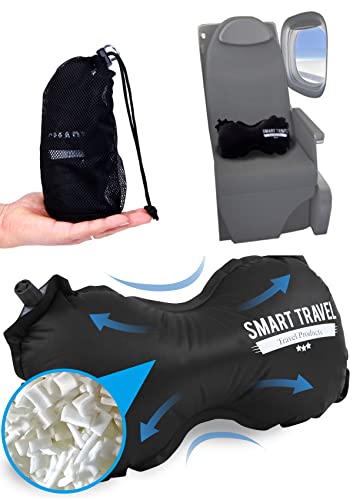
SMART TRAVEL Inflatable Lumbar Pillow — Best Overall
SMART TRAVEL builds its pillow around the hybrid idea executed properly: a memory foam core inside an inflatable chamber, so the valve adjusts firmness around a foundation that never collapses to nothing. Open the valve on the taxiway and the foam draws air in by itself; close it early for a softer pad, or let it fill fully and then press air out in small sighs until the support matches your back. That press-to-tune ritual is the design’s pleasure — firmness becomes a dial rather than a purchase decision made weeks earlier.
The shape is a broad lumbar pad rather than a roll, spreading contact across the curve of the lower back, and the listing points it at office chairs and car seats as naturally as at aircraft. That versatility matters for value: a pillow used weekly at a desk and monthly in the air justifies its drawer space in a way a flight-only gadget cannot. Deflated, it rolls down to a modest cylinder that tolerates being sat on in an overstuffed carry-on without complaint.
- Build: self-inflating chamber around a memory foam core
- Firmness: adjustable at the valve, from soft pad to firm support
- Shape: broad lumbar pad for the lower back
- Other seats listed: office chair and car
- Packed form: deflates and rolls for carry-on storage
Strengths
- Foam core keeps a baseline of support even under-inflated.
- Firmness adjusts in seconds without removing the pillow.
- Desk and car duty make it a weekly tool, not a holiday ornament.
Trade-offs
- Packs larger than the pure blow-up designs in this guide.
- Self-inflation takes a minute of patience rather than two breaths.
- The broad pad suits lumbar use only; it will not double as a head pillow.
Best for: frequent flyers who want one support for plane, car and desk. Not suited for: ultralight packers counting every cubic inch of a personal item.

Therm-a-Rest Lumbar Travel Pillow — Best Outdoor-Bred Design
Therm-a-Rest comes to the aeroplane from the campsite, and the accent shows in the best way: the valve is the kind outdoor people trust at altitude in a tent, the materials assume rough handling, and the self-inflating core borrows directly from the brand’s sleeping-pad lineage. Travellers who already own camp gear will find the ritual familiar — unroll, open valve, wait, close — and the pillow’s support has that distinctive foam-and-air resilience that pure inflatables never quite imitate.
On the seat it behaves with unusual manners. The shape is compact enough to sit behind the lower back without pushing the sitter forward off the cushion, a balance some larger pads get wrong in economy seats where every inch of depth is contested. It also earns a second career on the trips where the flight is only the beginning: trains, hire cars, and the wooden chairs of rented cottages all accept it gratefully, and it packs back into luggage that was always going to hold outdoor kit anyway.
- Build: self-inflating foam core, outdoor-grade valve
- Shape: compact lumbar pad sized for tight economy seats
- Heritage: sleeping-pad technology adapted to a seat cushion
- Other uses: car, train, office and camp chairs
- Packed form: rolls down beside other travel gear
Strengths
- Valve and materials carry genuine outdoor durability.
- Compact profile preserves precious seat depth in economy.
- Foam-core feel stays consistent as cabin pressure shifts.
Trade-offs
- No straps, so it can migrate during a long, restless flight.
- Outdoor styling looks utilitarian beside sleeker travel brands.
- Core needs a first full inflation at home to reach its stride.
Best for: travellers whose trips mix flights with road and trail. Not suited for: anyone wanting a pillow that clips in place and stays there.

OPTP McKenzie AirBack Lumbar Support — Best Compact Classic
The AirBack comes from the McKenzie line of lumbar rolls, a name with decades of history in the world of back-care seating, and its travel version keeps the family’s defining shape: a roll rather than a pad. Self-inflating foam inside lets the roll firm or soften at the valve, and the whole thing folds down, in the listing’s own framing, small enough for a bag or purse — the most aggressive packed size among the foam-core picks here, and a genuine argument for travellers who fly with only a personal item.
A roll concentrates support into a narrower band than a pad does, and travellers divide honestly over which they prefer. Roll loyalists like the defined contact low on the back and the way a roll can be nudged up or down a vertebra at a time as the flight wears on. Pad people find rolls fiddly. The AirBack is the pick to buy when you already know which person you are; it also moonlights happily on bleachers, car seats and dining chairs pressed into desk service, which broadens its value beyond the airport.
- Build: self-inflating roll with foam core
- Shape: narrow lumbar roll, position adjustable by hand
- Packed form: folds small enough for a handbag, per the listing
- Lineage: travel version of the McKenzie lumbar roll family
- Other seats listed: car, bleachers and chairs generally
Strengths
- Smallest packed size of the self-inflating trio in this guide.
- Roll shape allows precise, inch-by-inch placement.
- Long product lineage suggests a design that has been debugged for years.
Trade-offs
- Narrow contact band will not suit travellers who prefer a broad pad.
- Rolls wander more than strapped panels on reclined seats.
- Foam core makes it heavier than a pure blow-up pillow.
Best for: committed roll users and personal-item-only flyers. Not suited for: first-time buyers unsure whether a roll suits their back at all.

Luxtude Inflatable Lumbar Pillow Travel — Best Pure Blow-Up
Luxtude strips the concept to air and fabric: no foam, no core, just a chamber you inflate by mouth to whatever the hour demands. The virtues are immediate. It weighs almost nothing, packs to the size of a folded handkerchief, and tunes across the widest range in this guide — barely-there padding for a short hop, a firm wedge for the long night sector. Travellers who prize a personal item that closes without a fight will understand the appeal instantly.
The brand’s listing wanders into campsites and neck-pillow territory, and positions the cushion for office chairs and cars as readily as for aircraft. Read that breadth as versatility rather than confusion: a pure-air pad is genuinely a shape-shifter, propping a lower back at cruising altitude and a book at a campsite with equal indifference. The discipline it asks in return is valve attention — pure air swings most with cabin pressure, so expect one small adjustment after climb and another before descent, a ten-second habit that becomes automatic by the second trip.
- Build: pure inflatable chamber, mouth-inflated
- Weight: the lightest approach in this line-up
- Firmness: widest tuning range, set entirely by breath
- Other uses listed: office chair, car and camping
- Packed form: folds nearly flat, pocket-scale
Strengths
- Packs smaller than anything else recommended here.
- Firmness range runs from whisper-soft to properly firm.
- Price of admission is low for the utility on offer.
Trade-offs
- Pure air feels less planted than a foam core under a shifting sleeper.
- Needs valve attention as cabin pressure changes through the flight.
- A puncture ends its career; carry the repair mindset of a camper.
Best for: minimalists and occasional flyers who pack light above all. Not suited for: travellers who want set-and-forget support across a whole long-haul.

Adjustable Inflatable Back Lumbar Pillow — Best Full-Back Coverage
This is the maximalist of the group: an inflatable panel measuring eighteen by fourteen inches, designed to be used vertically for full-back coverage or horizontally as a deep lumbar pad, with straps to hold it against the seat and a carry bag in the box. Where the other picks fill the lumbar hollow, this one reupholsters the seat back. Travellers who find that their discomfort spreads — shoulders against a hard seat shell, a whole back negotiating with thin padding — are its natural constituency.
The listing notes a physical-therapist-designed origin, which this guide reports as provenance rather than as a promise; what you can verify yourself is the geometry. Straps change the travel experience materially, because the panel is where you left it after the meal tray, the lavatory queue and the neighbour’s third recline adjustment. Inflation is by breath and valve, and the panel’s size means a few more breaths than the Luxtude asks. In a car it becomes a genuinely useful seat upgrade; in an office chair it is arguably more at home than in the air.
- Size: 18 x 14 inches, the largest panel here
- Orientation: vertical for full back, horizontal for lumbar
- Attachment: straps plus a carry bag included
- Build: inflatable, adjustable firmness at the valve
- Other seats listed: airplane, car and office
Strengths
- Full-back coverage answers discomfort that a lumbar pad cannot reach.
- Straps keep the panel positioned through a whole flight’s fidgeting.
- Two orientations make one purchase serve several seats and postures.
Trade-offs
- Largest packed size of the inflatable picks, though still flat.
- Can push a sitter forward in the shallowest economy seats.
- More breaths to inflate than the compact designs require.
Best for: travellers who want the whole seat back softened and strapped in place. Not suited for: anyone whose airline seats already feel short on depth.
Generic Moulded Foam Lumbar Cushion — Desk-Bound Alternative
Every office-supply catalogue sells this cushion: a shaped block of foam, often with a strap, contoured to sit behind the lower back of a desk chair. At a desk it is honestly excellent — always ready, impossible to puncture, supportive in the same way every morning. Its presence in an aeroplane guide is as the control group, the thing the inflatables are measured against, because the moment a trip begins the foam block’s virtues invert: it cannot shrink, it eats half a carry-on, and it arrives at security as the most embarrassing object in your bag.
Buy it in the mid tier wherever office goods are sold if your problem lives at your desk, and let the inflatables handle the sky. Described in prose because a hundred near-identical versions compete on the same shelf, it completes this guide’s honest map of the territory: fixed foam for fixed chairs, air for everywhere the chair is not yours.
- Build: one-piece moulded foam, sometimes with a strap
- Packed size: full size, always — the disqualifying fact for flying
- Support: constant, unadjustable, dependable at a desk
- Care: cover usually removable; foam itself spot-clean only
- Availability: office and home stores everywhere, prose-only
Strengths
- Zero setup; it works the second it touches a chair.
- Cannot leak, puncture or deflate at an awkward altitude.
- Consistent support that never needs valve attention.
Trade-offs
- Cannot travel by air in any sane packing arrangement.
- Firmness is fixed at whatever the factory decided.
- Foam ages and compresses permanently over heavy years.
Best for: a permanent desk chair that hosts you forty hours a week, in the mid tier. Not suited for: any journey involving a cabin bag and a departure board.
How Do the Six Compare in the Cabin?
| Pick | Inflation style | Shape | Straps | Packed size |
|---|---|---|---|---|
| SMART TRAVEL Inflatable Lumbar Pillow | Self-inflating, foam core | Broad pad | No | Modest roll |
| Therm-a-Rest Lumbar Travel Pillow | Self-inflating, foam core | Compact pad | No | Small roll |
| OPTP McKenzie AirBack Lumbar Support | Self-inflating, foam core | Narrow roll | No | Handbag-small |
| Luxtude Inflatable Lumbar Pillow Travel | Mouth-inflated | Pad | No | Nearly flat |
| Adjustable Inflatable Back Lumbar Pillow | Mouth-inflated | Full panel | Yes | Flat but broad |
| Generic Moulded Foam Lumbar Cushion | None — solid foam | Contoured block | Sometimes | Full size |
The table resolves into a single question: how much of your bag will you trade for how much support? The Luxtude asks almost nothing and gives a tunable pad. The strapped panel asks the most and reupholsters the seat. The three self-inflating designs sit between, charging a small roll of space for the calm, planted feel of foam. Frequent flyers tend to settle at one point on that line and stay there for years; occasional flyers should start cheap and small, then upgrade only if the first trip teaches them a specific complaint.
Where Exactly Should the Pillow Sit Behind Your Back?
Placement beats product. The support belongs in the hollow above your hips, roughly where a belt sits and slightly above, filling the curve rather than propping the shoulder blades. Slide it into place after you sit, not before — a pillow positioned on an empty seat shifts the moment your weight arrives. Then sit back fully and let the seat’s own cushion take your hips; the pillow’s job is contact, not leverage, and if it pushes you toward the edge of the seat it is either too high, too full, or too big for that particular chair.
Revisit placement twice during a long flight. After the meal, when you have been sitting upright and forward, the pillow may have ridden up; after a doze, it may have slipped toward a hip. A ten-second reset at each visit keeps the support honest. Window-seat sleepers who lean sideways should move the pillow toward the lean, accepting an asymmetric arrangement that matches the posture actually being slept in rather than the posture in the brochure.
On arrival, deflate fully and roll from the end opposite the valve, squeezing air ahead of the roll like toothpaste toward its cap. That single habit keeps packed size honest trip after trip, and it prevents the slow ballooning that makes a travel pillow seem to grow inside a luggage drawer over the years.
What Mistakes Do Travellers Make With Inflatable Back Pillows?
Over-inflating at the gate leads the list, for the pressure reasons already covered: the pillow that felt perfect beside the departure board becomes a drum at altitude and gets abandoned under the seat by hour three. Second comes buying size without respect for seat depth — a full panel in a shallow economy seat steals the inches your knees were already negotiating for. Third is forgetting the pillow entirely in the seat pocket at arrival, a loss so common that airlines could furnish a lost-property museum with lumbar supports alone.
Fourth, travellers judge the pillow on a forty-minute hop and discard conclusions that only a long sector can teach; support is an hours-long argument, and short flights acquit almost anything. Fifth, some owners inflate a self-inflating pillow by blowing into it habitually, adding moisture to a foam core that would rather stay dry — open the valve, let the foam breathe in, and keep your breath for the designs that actually ask for it.
How Does a Back Pillow Fit the Rest of a Long-Haul Kit?
Think of the seat as a system with three contact problems: the back’s hollow, the head’s lean, and the feet’s dangle. A lumbar pillow solves the first and, by steadying the torso, quietly improves the second, because a supported back holds the head nearer the headrest. It does nothing for the third, which is why experienced travellers pair it with a footrest or a bag under the seat ahead. Judged as one component among three, the lumbar pillow usually delivers the largest comfort per cubic inch in the whole kit, which is why it survives packing purges that claim the neck pillow and the blanket.
It also travels home better than most flight purchases. The souvenir cushion and the novelty blanket retire to a cupboard; the lumbar pillow goes to the desk, the car, the kitchen chair where laptop work happens. When you assess cost, count those second careers. A pillow used on two hundred desk days and six flights is not a travel accessory at all — it is furniture that occasionally flies.
Pad, Roll or Panel: How Do You Know Your Shape?
Travellers usually discover their shape by accident — a borrowed pillow on one flight feels miraculous, another feels like a rumour — but the preference can be reasoned out in advance. If your discomfort spreads across the lower back as a general ache of contact, a pad’s wide, even pressure will likely suit you; pads are the diplomats of the category, rarely loved passionately and rarely regretted. If your complaint localises to one precise hollow that you can point to with a thumb, a roll’s concentrated band can be parked exactly there and adjusted by the inch, which pad people find fussy and roll people find like a key in a lock.
Panels answer a different complaint altogether: the seat itself. Thin shells, worn padding, a back that flexes under your weight — when the whole chair feels like the problem, covering more of it is the honest fix, provided the seat’s depth can spare the thickness. Travellers in premium cabins with deep, well-padded seats rarely need panels; travellers enduring the hardest economy shells benefit most. Read your usual airline and route the way you read a menu: the seat you actually fly in should choose the pillow, not the seat in the advertisement.
Uncertainty has a cheap resolution. The mouth-inflated Luxtude costs the least commitment and can be shaped, within limits, toward pad or wedge behaviour by how fully you blow it up. One trip with it teaches you more about your own back’s preferences than a month of reading — including this guide — and the pillow remains useful forever as the spare, the car pillow, or the one lent to a travelling companion who packed optimism instead of support.
How Should You Store a Self-Inflating Pillow Between Trips?
Foam cores have a memory for how they are kept. A self-inflating pillow stored rolled tight in a hot car boot for a summer will eventually expand reluctantly, the foam having learned compression the way it once learned loft. The kinder routine is the one outdoor shops teach for sleeping pads: store the pillow unrolled, valve open, somewhere cool and dry — the top of a wardrobe is ideal — so the foam rests at full thickness and wakes up ready to draw air. Travel compression is for journeys, not for the months between them.
Pure-air pillows ask almost nothing: dry, folded, anywhere. Their storage enemy is sharp company — keys, zips, the metal corners of other gear — so give the folded pillow a small pouch or a dedicated pocket in the travel drawer. Valves on all designs appreciate a cap check before each trip; grit in a valve seat is the most preventable cause of the slow leak that ruins a night sector.
Once a year, give the foam-core pillows a full home inflation and leave them open overnight. It exercises the foam, reveals slow leaks while they are still a home problem rather than a cruising-altitude discovery, and reminds you the pillow exists before the morning of a flight. Gear that is inspected in calm gets trusted in transit, and trust, at thirty-five thousand feet, is most of what you packed.
What About Trains, Buses and Stadium Seats?
The same gap haunts every moulded seat ever bolted to a vehicle or a venue, and a travel lumbar earns its keep far beyond the airport once you notice. Intercity trains offer generous seats with the same lumbar hollow; long bus journeys offer worse seats with the same anatomy; stadium and bleacher seating offers a bench and a prayer. A pillow that boards flat can attend all of them, and the McKenzie’s listing nods to bleachers explicitly because its makers know where rolls spend their weekends.
Venue rules deserve one check. Some stadiums restrict bag sizes or cushion types at the gate, and an inflatable pillow deflated in a clear bag passes scrutiny that a solid foam cushion sometimes fails. In cinemas and theatres the pillow works invisibly, which is its own pleasure — two hours of film with a supported back, and nobody around you aware that your seat was upgraded for the price of a coffee.
Commuters may find the pillow’s highest calling is the daily train rather than the annual flight. A support that lives in a work bag and deploys in eleven seconds turns the worst seat on the 7:40 into a tolerable office annex, and the cost-per-use arithmetic becomes almost absurd within a single season. Judge travel gear by the journeys you actually take most, and the humble lumbar pillow climbs the rankings quickly.
How Do You Buy One for a Partner Who Did Not Ask?
Gifting a back pillow is an act of observation disguised as shopping. You have watched someone shift, sigh and wedge a jumper behind their back across three journeys; the gift simply industrialises the jumper. Choose adjustability above all, because you are guessing at another person’s firmness, and a valve forgives guesses that fixed foam cannot. The SMART TRAVEL’s foam-core hybrid is the safest gift in this line-up precisely because its middle setting suits most backs and its dial lets the recipient finish the fitting themselves.
Present it before a trip, not during one, so the first inflation happens at a kitchen table rather than in a departure lounge performance. Include the smallest of orientations: valve here, bleed a little at altitude, roll from the far end. A gifted tool that arrives with thirty seconds of teaching gets used; one that arrives as a mystery gets left in the bag it came in, however good its foam.
And buy the second one for yourself without embarrassment. Shared travel with mismatched comfort breeds a quiet negotiation over the single pillow that nobody wins gracefully at hour nine. Two pillows, each tuned to its owner, is not extravagance — it is the same logic as two pairs of headphones, applied to the part of the journey your spine remembers longest.
What Should Your First Flight With One Look Like?
Rehearse at home once. Inflate the pillow at the kitchen table, sit against it in a dining chair, and learn its valve with your eyes open and your patience unhurried — which way it twists, how a bleed sounds, how the foam-core models sigh as they fill. Five calm minutes at home buy you competence in a dark cabin at midnight, when the person beside you is asleep and your own fingers must work by touch. Pack the pillow last, on top of the bag’s contents, so it can be retrieved without an excavation in the aisle.
During the flight, set the pillow before the meal service rather than after it, because trays and seatbelts conspire to make later adjustments awkward. Inflate modestly, sit back, and give the arrangement ten honest minutes before touching the valve again; first impressions of support are unreliable while your body is still arranging itself around a new seat. Make the altitude adjustment when the cabin settles — you will feel the pillow firm up as the aircraft climbs, and a short bleed restores the truce.
On descent, notice whether the pillow has softened and decide whether the final hour deserves a top-up; on a short taxi to the gate it does not, and on a long descent into a delayed arrival it might. Deflate during the taxi rather than at the gate, roll it tight, and put it somewhere in your bag you will find at home — the traveller who unpacks the pillow that evening, valve open on the wardrobe, is the traveller whose pillow is ready for the next decade of departures.
How Long Should a Travel Lumbar Pillow Last?
The shell fabric usually outlives everything else; valves and foam cores decide the real lifespan. A foam-core pillow used monthly and stored unrolled can serve five years and beyond, its support softening so gradually that owners notice only when they sit against a new one. Pure-air pillows live faster lives — seams and valves under repeated pressure cycles — but their low cost and tiny footprint reframe the arithmetic: two seasons of flawless service from something that folds into a pocket is a fair trade by any traveller’s ledger.
Extend any pillow’s life with three habits. Keep valves clean and capped, since grit is the silent assassin of seals. Dry a pillow fully before storing it after a trip, because a foam core rolled away damp will remember the smell longer than the journey. And resist lending the pillow as a seat cushion for sitting on the floor, a kneeling pad, or a child’s booster — loads it was never shaped to carry will compress a foam core unevenly and teach an air chamber’s seams bad habits.
Retire a pillow when it can no longer hold its tune across a single flight: a valve that will not seal, a core that stays flat after a night open at home, a leak that returns after patching. At that point the object has given honest service, and its replacement — by then, you will know your shape, your firmness and your valve preference — becomes the easiest purchase in travel gear, because the first pillow already taught the whole lesson.
Which Seats Benefit Most — and Which Barely Need One?
Economy seats on older aircraft are the pillow’s home ground: thin padding, a pronounced lumbar hollow, and hours long enough for both to matter. Newer slimline seats vary — some are sculpted surprisingly kindly, others feel like upholstered plywood — and the honest test is your own last flight rather than any fleet review. Premium economy’s wider, deeper seats accept pads and panels gracefully, though their own padding sometimes makes a compact roll the wiser choice, adding contact without crowding.
Exit rows and bulkheads present a small paradox: more legroom, often harder and narrower seat shells, and armrests that fix the geometry. A pillow earns its place there precisely because everything else about the seat refuses to adapt. In business class, lie-flat seats redesign the problem entirely; a lumbar pillow’s role shrinks to the upright hours of taxi, meal and work, where it still fills the same old hollow before the bed comes out to play.
Short-haul flying barely argues for any of this, and this guide will not pretend a ninety-minute hop needs equipment. The pillow’s case builds with sector length: past three hours the gap starts charging rent, past six it owns the flight, and past ten a well-tuned support becomes the difference between arriving as a person and arriving as a cautionary tale told by your own posture at the baggage belt.
How Do You Keep a Shared Travel Pillow Hygienic?
Households share travel pillows the way they share umbrellas, and a little protocol keeps the arrangement pleasant. Wipe the shell down after every trip before the pillow returns to the drawer — cabin air, tray tables and seat pockets leave their biography on anything soft. If the pillow has a removable cover, wash it on the same cycle as the travel laundry; if it does not, a thorough wipe and a full airing stand in honourably. Foam-core models should dry with the valve open so the interior breathes rather than seals in the journey.
Assign the pillow a home pocket in one specific bag, and let it always return there. Shared gear dies by diffusion — borrowed into a car, left in a study, absorbed by a child’s den — and the next departure becomes a search through rooms that did not need searching. One bag, one pocket, one pillow: the dullest sentence in travel organisation, and the one that saves the most mornings.
When a pillow has served through an illness-shadowed trip, give it the full treatment without debate: cover washed, shell wiped twice, a day of open air. These objects press against travellers for hours at their most tired and least defended, and treating their hygiene as part of the trip — like unpacking itself — is the small discipline that separates gear you trust from gear you merely own.
What Should You Look for in the Valve, of All Things?
Spend your scrutiny where failure actually lives. A travel pillow’s valve should open with one hand, turn or press with a positive feel you can find by touch, and seal with an audible or tactile certainty rather than a hopeful guess. Flat valves sit comfortably against a back; proud, knobbly ones announce themselves through the fabric by hour four, which is why the better designs bury the valve at an edge or under a flap. At the shop or on the doorstep, inflate the pillow fully, sit on it against a chair for ten minutes, and listen — the valve that whispers on day one will be shouting its leak by the third trip.
Double-seal designs deserve their small premium. A primary seal that slows air plus a cap that finishes the job gives you redundancy exactly where a single grain of grit otherwise ruins a flight. On self-inflating models, check that the valve’s open diameter lets the foam breathe in at a reasonable pace; a core that takes twenty minutes to wake will be half-inflated by travellers in a hurry and judged unfairly for their haste.
Finally, consider the valve as the pillow’s only moving part and therefore its biography. Everything else — fabric, foam, straps — ages in years. The valve ages in cycles, and every flight spends several. Choosing the pillow whose valve inspires confidence is not pedantry; it is simply buying the product at the point where the product actually is.
How Does a Back Pillow Change the Way You Pack?
Adopting one rearranges a corner of your packing philosophy. The pillow claims the top of the bag, the pocket of the daypack, or the strap under a jacket, and in return it retires a family of improvisations — the rolled jumper, the folded blanket, the spare hoodie — that used to travel as unofficial lumbar support. Those garments return to being clothes, the bag closes more honestly, and the seat receives a tool shaped for its one job rather than a compromise borrowed from the wardrobe.
It also changes what you check before leaving. Pillow, valve closed, in its pocket — three seconds in the doorway liturgy — replaces the older hope that the airline seat might be kind this time. Travellers who fly monthly describe the pillow the way they describe a passport: not exciting, never debated, simply part of the kit that makes the system work. For an object that costs less than the airport taxi, that is a remarkable promotion, and it is earned entirely at altitude, one filled hollow at a time.
Final Recommendation
Choose the SMART TRAVEL if you want the most complete traveller: foam-cored, tunable, and useful every working day between flights. Take the Therm-a-Rest if your journeys continue past the airport into cars and campsites, the McKenzie AirBack if a roll is your known preference and your bag is small, and the Luxtude if you pack like a rumour and want support that folds to nothing. Book the strapped panel when the whole seat back is the problem and depth allows it. Whichever you board with, inflate it kindly, place it low, adjust it once at altitude — and let the seat’s worst gap become the part of the flight you simply stop noticing.
Frequently Asked Questions
Can I take an inflatable back pillow through security?
Yes, without exception in ordinary travel. Inflatable pillows travel deflated in cabin bags without any special handling, and valves contain no restricted parts, no batteries and nothing else that security regimes concern themselves with anywhere in the world. Pack it deflated and rolled; inflating before boarding only invites the pressure problem described above, every single time, without any exception whatsoever. If a screener asks, it is a cushion, and the conversation ends there. The same applies to trains and coaches, where nobody inspects anything and the pillow simply goes about its work. Keep it inside your bag rather than clipped outside like a trophy, both for cleanliness and because dangling gear sheds itself in overhead racks with a reliability that suggests intent.
Will a self-inflating pillow inflate on its own in my bag?
Only if the valve is left open, and even then the foam expands against the bag rather than bursting anything. Close the valve after rolling the air out and the pillow stays flat indefinitely. Storing it at home with the valve open, unrolled, actually keeps the foam livelier between trips. Travellers who fly weekly sometimes keep a second pillow permanently in the work bag rather than transferring one between bags, because the transfer is where forgetting happens — usually discovered at the departure gate, at the precise moment the shops have closed. Duplication feels extravagant until the first forgotten-pillow flight prices the lesson, after which a pillow per bag reads as simple insurance, and the older of the two can retire to the car, where its support continues earning long after its flying career has been honourably succeeded.
How firm should the pillow feel during the flight?
Firm enough that your lower back feels continuous contact when you sit back, soft enough that you can press a thumb into it with modest effort. If you are aware of the pillow as an object, it is probably too full; the best-tuned support disappears from attention within minutes, which is the entire point of carrying it. Expect the right firmness to differ between the outbound morning flight, when you sit upright and work, and the overnight return, when you recline and doze against it. Working posture wants the pillow fuller and lower; sleeping posture wants it softer and a fraction higher, cushioning the curve as your body relaxes into the seat. Travellers who learn to make that one adjustment per direction stop thinking of the pillow as a fixed object and start treating it as what it really is — a small piece of the seat that finally answers to them.
Does a lumbar pillow work in a car or office chair too?
Every linked pick here lists car or office use, and the foam-core designs are arguably better there than in the air, since pressure stays constant and the pillow can live on the chair permanently. The strapped panel is the most natural desk resident of the group.
How do I clean an inflatable travel pillow?
Wipe the shell with a damp cloth and mild soap, valve closed, and dry it fully before rolling it away. Keep water out of the valve on foam-core models, since a damp core dries slowly and smells of its ordeal. Pure-air designs tolerate a more thorough rinse and dry fastest of all.
What if my pillow develops a slow leak mid-trip?
Re-inflate more often and finish the journey; a slow leak is an inconvenience, not an emergency. At home, inflate the pillow, listen and feel along the seams and valve for escaping air, and patch with the repair kit most outdoor shops stock. Valves are the usual culprit and often reseat with a firm twist. A pillow that has leaked once deserves a probationary flight in the bag as a spare before it is trusted again as your only support; pack the Luxtude-style backup on that trip if you own one, since its folded size makes carrying a understudy painless. Gear that has failed once and been forgiven without testing has a way of choosing the longest available night to fail again, and the middle of the Pacific is a poor place to renegotiate trust in a valve.
Related Guides
A supported back pairs naturally with the rest of a considered travel and home kit. Best Backpacking Sleeping Pillows takes the same inflatable logic onto the trail, where packed size matters even more. For the hours spent seated at home between journeys, Best Designer Chairs for New Mothers explores chairs built around one person’s posture, while Best Box Springs and Mattresses covers the foundation waiting at the journey’s end. And for the flight itself, Best Airplane Blankets and Pillow Sets handles the warmth and head support that complete the seat this guide has been furnishing.



[…] and the house around them keeps changing too. When the toddler bed gives way to longer journeys, Best Back Pillows for Airplanes covers the grown-up version of sleeping away from home. For the child who now treats every outing […]