What's inside
- Quick Picks
- How We Chose These Picks
- Key Takeaways
- Detailed Reviews
- Comparison Table
- How to Choose the Right Indoor Outdoor Rug for Your Floor
- Where Should an Indoor Outdoor Rug Actually Live?
- Common Mistakes When Buying Indoor Outdoor Rugs
- How Do You Clean and Store One Across the Seasons?
- How Does Each Weave Behave in a Real Week of Weather?
- What About Allergies, Pets and the Mudroom Problem?
- Can These Rugs Layer, and What Goes Underneath Them?
- How Should You Judge Quality When the Rug Arrives?
- Which Rooms Benefit Least, and What Should You Buy Instead?
- A Short Note on Colour, Light and Honest Expectations
- What Does a Season of Ownership Actually Cost in Effort?
- One Last Check Before You Order
- Final Recommendation
- Frequently Asked Questions
- Related Guides
As an Amazon Associate I earn from qualifying purchases. This post may contain affiliate links at no extra cost to you.
As an Amazon Associate, cottageverdict.com earns from qualifying purchases made through links in this guide — at no extra cost to you.
Where to buy: all six rugs below are sold on Amazon, and every pick’s name links straight to its listing in the Quick Picks table, again in its review heading, and once more in the comparison table near the end. Please check price on Amazon before ordering and double-check the exact size, colourway and pile description on the listing page, because indoor outdoor area rugs are sold in many sizes under one product page and the photograph rarely matches the variant you actually need.
A rug that can live on a patio in July and under a dining table in November solves a very specific household problem. Most floor coverings force a choice: either a handsome indoor rug that mildew, sun and tracked-in rain will ruin outdoors, or a stiff outdoor mat that looks like it belongs under a barbecue and nowhere else. The modern indoor-outdoor category exists in the gap between those two failures. These rugs are woven flat or very low, usually on power looms, from yarns chosen to shrug off moisture and fading, and they are styled closely enough to ordinary living-room rugs that guests seldom notice the difference until you tell them the same rug spent last summer on the deck.
What varies between models is more than pattern. Construction decides how the rug feels under bare feet and how it behaves under furniture: a flatweave lies thin and crisp, slides easily under a door swing, and lets dining chairs glide, while a slightly textured weave adds grip and visual depth at the cost of trapping a little more grit. Size decides the room’s whole geometry, because an 8×10 anchors a seating group while a 5×8 suits a porch conversation corner or a small dining set. Colour does quieter work — natural and beige grounds hide outdoor dust between cleanings, dark borders frame a space, and a vintage medallion can disguise the everyday marks of a busy hallway better than a plain field ever will.
The six picks in this guide divide along those honest lines. Two are 8×10 flatweaves from established rug houses, one Moroccan geometric and one bordered classic, aimed at buyers who want a proper room-size anchor. One is a natural-toned courtyard weave sized for either a living room or a deck. One is a washable 5×8 with a vintage medallion and a quick-dry non-slip backing, the only backed rug here. One is a reversible plastic outdoor rug, the hardiest and least carpet-like of the group. And one is a bordered 8×10 sold explicitly for patios, kitchens and hallways as well as living spaces. Read the reviews with your own floor in mind: the right answer for a screened porch is seldom the right answer for a front hall.
Quick Picks
| Pick | Badge | Why it earns its place |
|---|---|---|
| JONATHAN Y Ourika Rug | Best Pattern | A Moroccan geometric 8×10 flatweave in natural and black that reads as a designed living-room rug yet is built for patio and porch duty. |
| Nourison Courtyard Rug | Best Neutral Anchor | A natural 8×10 flatweave from a long-running rug house, non-shedding and fade resistant, that calms busy rooms indoors or out. |
| GENIMO Indoor Outdoor Rug | Best Washable Pick | A 5×8 vintage medallion in light blue with quick-dry non-slip backing, made for sunrooms and porches where washing matters most. |
| SAND MINE Outdoor Rug | Best for RV and Camping | A reversible waterproof plastic 5×8 that folds into camp life, picnic duty and muddy backyard service without complaint. |
| CAMILSON Indoor Outdoor Rug | Best Bordered Classic | An 8×10 bordered design in dark grey and black, washable, and sized to frame a full seating group or a large patio set. |
| JONATHAN Y Dover Rug | Best Quiet Classic | A three-stripe border 8×10 in beige and cream, two-tone and low-pile, for rooms that need definition without visual noise. |
How We Chose These Picks
We began with the listing language itself, because a rug earns a place in an indoor-outdoor guide only when its own title claims both settings or names the outdoor stations — patio, porch, deck — alongside indoor rooms. Rugs that were outdoor mats wearing a decorative photograph, with no indoor claim at all, were set aside unless they filled the camping and RV role honestly. Within the field we weighed weave: flatweave and low-pile constructions dominate here because they dry quickly, sit safely under doors, and do not hold water the way a plush pile would after rain. We then checked the traffic claims, since a rug described for high-traffic use is making a promise about density and durability that a delicate decorative weave is not. Size coverage mattered too; a guide with only small mats would fail the many buyers furnishing a full deck, so the 8×10 room-size options anchor the list while two 5×8 picks serve smaller footprints. Finally we read each title for care signals — washable, easy-cleaning, waterproof, reversible — because outdoor rugs live or die by how they handle the hose, the broom and the occasional muddy paw, and a rug that cannot be cleaned easily will be replaced rather than maintained.
Key Takeaways
- Flatweave and low-pile constructions are the indoor-outdoor sweet spot: they dry fast, clear door swings, and let chairs move without fighting a deep pile.
- An 8×10 is the workhorse size for seating groups and dining sets; a 5×8 suits porches, RV awnings and smaller conversation corners.
- Only one pick here, the GENIMO, states a non-slip backing; the flatweaves rely on furniture weight or a separate pad for grip.
- Reversible plastic, represented by the SAND MINE, trades carpet softness for total weather indifference and fold-away storage.
- Natural and beige grounds forgive outdoor dust between cleanings far better than pale solid colours do.
- Confirm the exact size variant on the listing before ordering, since one product page often carries many dimensions.
Detailed Reviews

JONATHAN Y Ourika Rug
The Ourika is the pick for anyone who has looked at outdoor rugs and sighed at how many of them resemble doormats scaled up. Its Moroccan geometric pattern, laid in natural and black, belongs to the same visual family as the vintage tribal rugs that anchor so many living rooms, and at 8×10 it has the scale to do that anchoring properly: front legs of a sofa and chairs on the rug, coffee table centred, and the pattern’s geometry giving the whole arrangement a deliberate, finished look. The listing describes a textured weave in a flatweave, low-pile construction, power loomed, and that combination explains its manners. The texture keeps the surface from looking flat or printed, the low profile lets a vacuum glide and a door swing clear, and the power-loomed build keeps the price of a room-size rug within ordinary reach.
JONATHAN Y lists this rug for high traffic and calls it easy-cleaning and water-resistant, a trio of claims that fits the households most likely to buy it: families whose living room opens onto a garden, dog owners whose back door sees muddy traffic, hosts whose patio furniture needs softening underfoot. Water resistance here should be understood plainly — the rug tolerates splashes, dew and a hosedown rather than drinking water into a backing — and the flat weave means a spill sits on the surface long enough to be blotted instead of vanishing into pile. Underfoot it feels like a woven textile rather than a cushion, so if your household pads around barefoot expecting plushness, pair it with a pad indoors or accept the crisp, cool hand of a flatweave as part of its character.
- Size: 8×10, as titled
- Pattern and colour: Moroccan geometric, natural and black
- Construction: flatweave, low-pile, power loomed, textured weave
- Listing claims: easy-cleaning, high-traffic, water-resistant
- Named settings: indoor/outdoor, patio and porch
- Backing material: not stated in the listing
Strengths
- Pattern with genuine living-room credibility, not outdoor-mat styling
- Full 8×10 scale anchors a seating group without looking skimpy
- Flat profile suits door swings, dining chairs and robot vacuums
Trade-offs
- No stated backing, so a pad helps on slick indoor floors
- Bold geometry can fight with heavily patterned upholstery
- Flatweave feel is crisp rather than cushioned under bare feet
Best for: design-led living rooms and covered patios that open directly off them. Not suited for: buyers wanting a soft, padded surface for children to sprawl on.

Nourison Courtyard Rug
Nourison has made rugs for decades, and the Courtyard shows the restraint of a house that trusts a neutral ground more than a loud motif. The colour here is simply natural, the size a full 8 by 10 feet, and the construction a flatweave with a low pile that the listing describes as non-shedding and easy to clean. A natural-toned flatweave is the diplomat of floor coverings: it lightens a dark room without demanding attention, it gives wooden furniture a calm field to sit on, and outdoors it sits comfortably with teak, wicker, aluminium or stone because it imitates none of them. The listing names an unusually complete set of rooms — living room, dining room, bedroom and family room indoors, patio and deck outside — which tells you the maker intends this as a true crossover rug rather than a patio rug on holiday indoors.
Two practical virtues follow from the flat, non-shedding build. First, dining chairs slide instead of catching, and crumbs shake or vacuum out of a low weave far more easily than out of pile, which matters in the dining room this rug explicitly claims. Second, a non-shedding rug in a bedroom means no fibre tumbleweed gathering under the bed frame. Fade resistance, also claimed in the title, is the outdoor half of the bargain: a natural ground shows sun-fading less dramatically than saturated colour would, but the claim still matters for a south-facing deck where an unprotected rug can bleach unevenly across a single summer. If you want one rug to try the indoor-outdoor idea with the least styling risk, this is the safest pair of hands in the guide.
- Size: 8 x 10 feet, as titled
- Colour: natural
- Construction: flatweave, low pile
- Listing claims: non-shedding, easy clean, fade resistant
- Named rooms: living, dining, bedroom, family room, patio, deck
- Pattern name beyond Courtyard: not given
Strengths
- Neutral ground pairs with almost any furniture finish or style
- Non-shedding flatweave keeps dining and bedroom use tidy
- Established rug-house name behind the construction claims
Trade-offs
- Plain field shows dark spills more than a patterned rug would
- No border, so it defines a zone more softly than framed designs
- Natural tone varies in feel between warm and cool room light
Best for: open-plan rooms and decks needing one calm, full-size foundation. Not suited for: shoppers who want the rug itself to be the room’s statement piece.

GENIMO Indoor Outdoor Rug
The GENIMO plays a different game from the two big flatweaves above. It is a 5×8, sized for a porch seating corner, a sunroom reading chair, or the patch of deck under a bistro set, and its vintage boho medallion design in light blue brings a softness of pattern that the geometric and plain picks deliberately avoid. The listing calls the material a fade resistant chenille and pairs it with a quick-dry non-slip backing — two details that set it apart in this group. Chenille gives a slightly softer hand than a plain flatweave, and a stated non-slip backing means this is the one rug here designed to grip a smooth floor on its own, which matters in a sunroom with tile or sealed concrete where an unbacked flatweave can skate under a chair leg.
Washable is the other headline word, and for the rooms this rug targets it may be the decisive one. Sunrooms collect pollen, porches collect whatever the wind delivers, and a rug that can be washed rather than merely hosed returns to service looking genuinely clean instead of rinsed. The medallion pattern earns its keep in those settings too, because an all-over vintage motif is famously forgiving of the small marks that accumulate between washes. The honest limits are size and setting: at 5×8 it will look lost under a full dining table, and a backed rug should be dried thoroughly after washing, since the backing that gives it grip also slows the last of the moisture leaving. For a smaller, lived-in nook rather than a grand floor, though, the GENIMO is the most feature-complete pick in this guide.
- Size: 5×8, as titled
- Design: vintage boho medallion, light blue
- Material named in title: fade resistant chenille
- Backing: quick-dry non-slip backing, as titled
- Care claim: washable
- Named settings: patio, deck, porch, indoor sunroom
Strengths
- Stated non-slip backing grips smooth sunroom and porch floors
- Washable build suits pollen-heavy and pet-friendly spaces
- Medallion pattern disguises everyday marks between cleanings
Trade-offs
- 5×8 footprint is too small for full seating groups
- Backed rugs dry more slowly after a full wash
- Light blue palette narrows the rooms it can move into later
Best for: sunrooms, covered porches and small deck corners that need grip and washing. Not suited for: anchoring a large living room or an eight-seat dining set.
SAND MINE Outdoor Rug
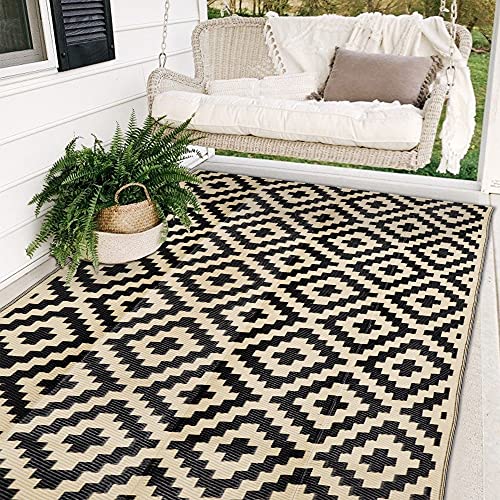
Every guide needs one pick that tells the truth about a different material, and here it is the SAND MINE: a waterproof outdoor rug woven from plastic, reversible between its black and beige faces, measuring 5×8 feet. Plastic weave is the construction behind the classic RV awning mat, and its virtues are absolute rather than relative. Rain passes through or sheets off instead of soaking in. Mud hoses away completely. The rug folds or rolls into a vehicle without adding meaningful weight or any mildew risk, and when one face tires or stains, the other face presents a fresh pattern for the next trip. The listing’s own roll of settings — RV, patio, backyard, deck, picnic, beach, camping — is a fair portrait of where this rug actually lives.
What you surrender is any pretence of carpet. Under bare feet a plastic weave feels like what it is, a woven synthetic mat, and indoors it reads as outdoor equipment even in its calmer beige face, which is why we place it fourth despite its toughness. Its natural home is the threshold zone: under the awning, beneath the picnic table, on the deck boards where planters drip, or as the sacrificial layer under a toddler’s paddling pool. Modern area rug it is not trying to be — the title itself calls it a large floor mat as readily as a rug. Buy it for the places where the woven textile picks would suffer, and it will outlast everything else in this guide while asking almost nothing in care.
- Size: 5×8 ft, as titled
- Material: plastic, reversible weave
- Colour faces: black and beige
- Listing claim: waterproof
- Named settings: RV, patio, backyard, deck, picnic, beach, camping
- Indoor rooms named in title: none stated in the listing
Strengths
- Total weather indifference; hoses clean and dries quickly
- Reversible faces double its service life and styling options
- Folds into RV and car storage without mildew worries
Trade-offs
- Plastic hand-feel is a mat, not a carpet, underfoot
- Looks like outdoor gear in a formal indoor room
- Light weight means wind can lift corners on open decks
Best for: RV travellers, campers and mud-season backyards. Not suited for: a living room where the rug must pass as a woven textile.

CAMILSON Indoor Outdoor Rug
A border is the oldest trick in rug design: it draws a frame on the floor, tells furniture where its territory ends, and makes a plain centre field look intentional rather than empty. The CAMILSON builds its whole identity on that trick, offering an 8×10 bordered design in dark grey and black — this listing’s variant is named Bordered Black — in a modern register that suits contemporary furniture, industrial lofts and the grey-toned patios that dominate new-build gardens. The title spreads its claimed territory widely: indoor and outdoor patios, kitchen and hallway mats, porch and deck, outside carpet. That breadth signals a rug woven to be moved around a household’s problem spots rather than married to one room.
Washable is the second pillar of its pitch, and at 8×10 that claim carries a practical footnote every buyer should consider: a rug this size needs a large machine, a laundromat trip, or a driveway-and-hose interpretation of washing, so read the listing’s care detail before assuming it will fit your home washer. Where the CAMILSON shines is high-visibility, high-traffic placement. The dark bordered field hides the grey dust of a hallway and the leaf-litter shadows of a deck better than pale rugs, while the frame keeps a big floor from looking bare. In a kitchen, an 8×10 is a runner’s big sibling — it covers the whole work triangle’s standing zone — and the flat outdoor-style weave tolerates the spills that would end a woollen runner’s career. Choose it when the floor plan is large, the traffic is relentless and the palette runs dark.
- Size: 8 x 10, as titled
- Design: bordered, dark grey and black; variant named Bordered Black
- Care claim: washable
- Named settings: patios, kitchen, hallway, porch, deck
- Pile height: not given
- Backing type: not given
Strengths
- Bordered frame gives large, plain floors a finished structure
- Dark palette forgives hallway dust and patio debris
- Room-size 8×10 suits kitchens and halls as well as patios
Trade-offs
- Washing an 8×10 at home may exceed a standard machine
- Dark ground shows pale lint and pet hair readily
- Strong border can clash with ornate traditional furniture
Best for: big high-traffic floors, modern schemes and kitchen work zones. Not suited for: small rooms where a bold border would crowd the walls inward.

JONATHAN Y Dover Rug
If the Ourika is the patterned extrovert of the JONATHAN Y pair, the Dover is its composed sibling. The design is a classic three-stripe border in beige and cream, two-tone and deliberately quiet, on an 8×10 power loomed body with a low pile. The listing describes it as high-traffic, easy-cleaning and durable, and names the porch and living room among its settings. A striped border does the same framing work as the CAMILSON’s band but in a lighter, more traditional key: it suits rooms with patterned curtains or a busy sofa, where a geometric field would start an argument, and it flatters pale woods, linen upholstery and the coastal palettes that beige and cream were invented for.
Consider the Dover the choice for a room that changes jobs across the year. On a porch it defines the seating area without darkening a bright space; moved indoors for winter, it slips under a living-room group and asks nothing of the décor around it. The low pile keeps it practical in both lives, sliding under doors and releasing crumbs and grit to an ordinary vacuum. Its trade-offs mirror its virtues. A pale field in an outdoor setting shows muddy paw prints that a mid-tone would forgive, so households with enthusiastic dogs may be shaking and hosing it more often; and buyers who want the rug to carry a room’s personality will find the Dover content to be background. Background, reliably and durably delivered at full 8×10 scale, is exactly what many floors need.
- Size: 8×10, as titled
- Design: classic 3-stripe border, beige and cream, two-tone
- Construction: power loomed, low-pile
- Listing claims: high-traffic, easy-cleaning, durable
- Named settings: indoor/outdoor, porch and living room
- Exact fibre blend: not stated in the listing
Strengths
- Quiet border frames a room without competing with furnishings
- Light palette brightens porches and north-facing living rooms
- Low pile keeps doors, chairs and vacuums moving freely
Trade-offs
- Pale field shows mud and paw marks quickly outdoors
- Understated design will not rescue a bland room on its own
- Shares the flat, unpadded feel of its sibling flatweaves
Best for: calm, light interiors and covered porches that swap roles seasonally. Not suited for: mud-heavy households wanting a hide-everything floor.
Comparison Table
| Pick | Size | Construction | Standout trait |
|---|---|---|---|
| JONATHAN Y Ourika Rug | 8×10 | Flatweave, low-pile, power loomed | Moroccan geometric pattern, water-resistant claim |
| Nourison Courtyard Rug | 8 x 10 ft | Flatweave, low pile | Non-shedding, fade resistant, natural tone |
| GENIMO Indoor Outdoor Rug | 5×8 | Chenille with non-slip backing | Washable vintage medallion for sunrooms |
| SAND MINE Outdoor Rug | 5×8 ft | Plastic reversible weave | Waterproof mat for RV, beach and camping |
| CAMILSON Indoor Outdoor Rug | 8 x 10 | Bordered modern weave | Washable dark border for halls and kitchens |
| JONATHAN Y Dover Rug | 8×10 | Power loomed, low-pile | Three-stripe beige border, high-traffic claim |
How to Choose the Right Indoor Outdoor Rug for Your Floor
Start with the surface the rug must survive, because that decision outranks pattern every time. A covered porch with a roof and screens asks only for moisture tolerance and easy cleaning, which every woven pick here offers. An open deck in full sun adds ultraviolet exposure to the brief, pushing fade resistance — claimed outright by the Nourison and the GENIMO — up the priority list. A truly exposed spot, or one that doubles as a mudroom in wet months, is where the SAND MINE’s plastic weave stops looking basic and starts looking wise. Indoors, the questions invert: the enemy is not weather but friction, so think about door clearance, chair movement and vacuum habits. A low pile or flatweave clears a standard door gap and lets a robot vacuum climb aboard without drama, while anything plusher would need measuring against the swing of every door it sits beneath.
Size is the second decision, and the commonest error is buying one size too small. For a seating group, an 8×10 lets at least the front legs of every seat rest on the rug, knitting the group into one island; a 5×8 under the same furniture leaves chairs half on and half off, which looks accidental and feels worse when a chair leg catches the rug’s edge. Under a dining table, allow enough rug beyond the tabletop that pulled-out chairs stay on the weave — that arithmetic usually lands on 8×10 for a six-seat table. Reserve 5×8 for genuinely smaller stages: a porch loveseat and two chairs, a bistro set, the footprint of an RV awning, a reading corner. Measure with painter’s tape on the floor before ordering; ten minutes with tape has saved more returns than any review ever written.
Then weigh grip honestly. Only the GENIMO among these six states a non-slip backing. Flatweaves on hardwood, tile or decking will creep underfoot and bunch at the corners unless furniture anchors them or a separate rug pad goes beneath, and outdoors a pad is usually impractical, so plan on weight — a table, planter or seating — doing the holding. On stairs-adjacent landings and in homes with toddlers or older relatives, that grip question deserves to be settled before the pattern question is even opened. Finally, match the palette to your dirt. Every floor has a characteristic grime: pale dust, dark soil, red clay, leaf tannin, pet hair in a known shade. Choose the rug whose ground colour sits closest to your grime’s tone and the rug will look clean for twice as long between actual cleanings, which is the closest thing decorating has to a free lunch.
Where Should an Indoor Outdoor Rug Actually Live?
The most successful placements share one trait: the rug is solving a floor problem, not decorating a photograph. Under a dining set on a deck, it silences chair scrape, catches the crumbs of outdoor meals where they can be shaken out, and keeps bare feet off splintery or heat-soaked boards. In a sunroom it draws a boundary between the garden-facing glass and the house proper, absorbing the grit that shoes carry in from the path. In an entry hall it becomes the sacrificial surface for the wettest, dirtiest thirty seconds of every homecoming, and because it can be hosed or washed, it can be restored in a way a wool runner never could. In a kitchen, a flat indoor-outdoor weave under the work zone cushions standing slightly, tolerates splashes at the sink, and releases flour and crumbs to the vacuum instead of harbouring them in pile.
Placements that disappoint are usually about water with nowhere to go. A woven rug laid on a solid, poorly drained slab will hold a damp underside after heavy rain, so lift it to dry over a railing after storms and let the floor beneath breathe. Direct, all-day summer sun will test any dye eventually, whatever the fade claims, so rotating the rug a half-turn each month evens the exposure. And a rug asked to be the sole softness in a playroom will always feel thin; layer it over a pad indoors when small knees are the main traffic, and let the weave do the durable, washable top-layer work it is good at.
Common Mistakes When Buying Indoor Outdoor Rugs
The first mistake is shopping by the room photograph and skipping the construction line. A rug photographed in a living room may still be a plastic mat, and a rug photographed on a yacht deck may be a perfectly house-trained flatweave; the title’s weave and material words are the truth, the staging is theatre. Second comes underestimating size, covered above, which remains the leading cause of returns in this category. Third, buyers forget the door swing: a rug delivered with relief at its beauty gets folded back at one corner forever because a door catches it, a fate a low-pile choice avoids. Fourth, people place a pale rug where dark dirt lives, or a dark rug under a pale-haired dog, and then blame the rug for a scheduling problem that colour choice created. Fifth, outdoor rugs get rolled up wet in autumn and unrolled in spring to a season’s worth of mildew smell; dry before storage is the whole rule. Last, shoppers assume washable means their home machine can handle an 8×10 — check the care line and your drum size first, and treat the hose-and-driveway method as the realistic default for the largest sizes.
How Do You Clean and Store One Across the Seasons?
Routine care is broom-and-vacuum work: a low weave releases dry grit readily, and a weekly shake outdoors does more for these rugs than any product. Spills should be blotted promptly, not rubbed, because rubbing drives pigment into any weave; plain water handles most outdoor marks, and a mild soap solution the rest, rinsed rather than left to dry soapy. The washable picks can go further, following their listing’s care instructions, while the plastic SAND MINE simply wants a hose and a sunny railing. Whatever the construction, drying fully before the rug returns to a floor — especially a wooden one — protects both the rug and the boards beneath it, since trapped moisture is the one enemy even outdoor materials respect.
Storage follows the same dryness rule. Roll rather than fold to avoid crease lines in woven picks, store in a breathable space rather than a sealed damp bag, and let the reversible plastic mat be the exception that tolerates folding for the RV locker. When spring comes, unroll, inspect the edges for winter visitors if the rug lived in a shed, and give it a sun-and-air afternoon before furniture goes back on top. Treated this way, an indoor-outdoor rug’s whole appeal compounds: one purchase quietly serving two territories of the house, season after season, without the ceremony that finer indoor rugs demand.
How Does Each Weave Behave in a Real Week of Weather?
Imagine the same rug living through a ordinary unsettled week, because that is the test this category is really taking. Monday brings a fine morning and a rug that simply sits there doing its decorative work, which is easy duty for any construction. Tuesday’s shower is the first sorting: the plastic SAND MINE sheds the water outright and can be walked on minutes later, the flatweaves get dark and damp across their surface but hold no standing water in pile, and by the time the sun returns they are drying from the top down because there is so little depth for moisture to hide in. A conventional indoor rug caught in that same shower would still be cool and heavy at bedtime, its backing holding the day’s rain like a sponge.
Wednesday’s wind delivers the porch’s weekly ration of dust, seed fluff and leaf fragments. Here the low profiles earn their keep again: debris sits on the surface where a broom or a shake removes it, rather than working down between fibres where only a deep vacuum pass retrieves it. Thursday is a barbecue, with the predictable drip of sauce near the grill and a tipped drink by the lounger. On a flat weave both accidents remain surface events — blot, rinse, blot again — while the same spill in a pile rug becomes a subsurface project. Friday’s heat tests the dyes and the underfoot comfort together: pale grounds like the Dover’s beige and cream stay cooler to stand on than the CAMILSON’s dark field, which absorbs sunshine and can feel genuinely warm at midday, a real consideration for barefoot households in hot climates.
The weekend brings the crowd, and crowds are a traffic test rather than a weather test. Chairs scrape, coolers get dragged, children orbit the table with wet feet from a paddling pool. High-traffic claims, made by both JONATHAN Y listings here, speak to exactly this abuse: a dense, low construction presents no pile to crush into traffic lanes and no loops for chair feet or toy wheels to snag. By Sunday night the honest summary writes itself. Nothing in this guide emerges from the week looking showroom-new, but every pick remains presentable after a shake and a hose, and that recoverability — not any single day’s perfection — is the trait that separates this category from ordinary rugs.
What About Allergies, Pets and the Mudroom Problem?
Households with shedding dogs and cats tend to discover indoor-outdoor rugs through desperation, and the logic holds up. Hair rests on a low weave instead of embedding in pile, so a vacuum pass actually collects it rather than redistributing it, and the rug tolerates the frequent washing that pet ownership schedules. Muddy paws print on the surface where a rinse reaches them. None of that makes any rug here a pet product — none of the six listings claims pet-specific design — but the construction traits that serve a patio serve a hallway full of spaniels for identical reasons. For allergy-conscious households the same shallowness helps in a modest, factual way: a rug that can be taken outside, shaken hard and washed holds less accumulated household dust than a rug that can only be vacuumed in place, simply because the cleaning can be more thorough more often.
The mudroom deserves its own paragraph because it is where this category quietly outperforms everything else in the house. A mudroom floor meets wet boots, dripping umbrellas, sports bags and the occasional leaking plant pot, often within the same hour. A woven indoor-outdoor rug in that space can be lifted, hosed on the drive and returned the same afternoon, while a traditional runner would spend the season slowly darkening. Size the mudroom rug to the door swing and the boot tray rather than the whole room, leave a margin of hard floor at the threshold for the worst of the weather to land on, and rotate two smaller rugs if the traffic is severe, so one is always dry underfoot while the other dries from its wash.
Can These Rugs Layer, and What Goes Underneath Them?
Layering a smaller patterned rug over a large neutral one is a decorator’s habit that this category supports unusually well, because the flat profiles stack without creating a trip ridge. A natural Nourison as the base with a GENIMO medallion centred under a coffee table gives a sunroom a composed, intentional look while keeping every layer washable. Outdoors, layering makes less sense — two rugs trap moisture between them — so keep the single-rug rule on decks and patios. Underneath, the pad question returns: indoors on hard floors a thin non-slip pad preserves both the rug’s position and the floor’s finish, and it adds the whisper of cushion that flatweaves lack. Under a dining set, choose the pad a fraction smaller than the rug so its edge never peeks out. On carpet, paradoxically, a flatweave can ripple and crawl as its backing interacts with the pile beneath; a rug-on-carpet gripper or heavier furniture anchoring settles it, and some households simply accept the indoor-outdoor rug as a hard-floor tool and keep carpeted rooms for carpeted-room rugs.
How Should You Judge Quality When the Rug Arrives?
Unroll the rug and let it relax for a day before judging anything, because woven textiles carry the memory of their shipping roll and corners that curl at hour one often lie flat by hour twenty-four, especially with furniture weight or a warm room helping. Then walk the perimeter. Edges and binding are where power-loomed rugs confess their quality: look for even stitching, a border pattern that runs true rather than drifting, and corners that sit square. Sight down the pattern from standing height — a Moroccan geometric like the Ourika’s should read as a coherent grid, and a bordered design like the Dover’s should frame evenly on all four sides, with no side’s stripe visibly wider than its opposite.
Next, test the surface with your hands and a cup of water. A flatweave should feel uniform, without slubs or thin patches that catch a fingernail. The water test teaches you your own rug’s behaviour better than any description: pour a little on an inconspicuous corner, watch whether it beads briefly or soaks straight in, blot it, and note how the spot dries over the afternoon. That small experiment calibrates your expectations for real spills and tells you how urgently future accidents need attention. Check the reverse side too. On reversible picks, both faces are finished faces; on backed rugs like the GENIMO, the backing should be evenly applied without bare patches or lumps that would print through underfoot. Finally, vacuum once and shake the rug outdoors: a modest release of loose surface fibre is normal in a first week, while continuing heavy shedding beyond that suggests a construction that will thin early, and it is better discovered inside a return window than outside one.
Which Rooms Benefit Least, and What Should You Buy Instead?
Honesty about this category includes naming the rooms where it is the wrong tool. A formal sitting room built around antiques and a deep-pile carpet’s hush will find even the handsomest flatweave here visually thin and acoustically bright; these rugs do soften footfall, but they do not absorb sound the way a thick indoor rug over a pad does, and in a large echoing room that difference is audible. A nursery floor meant for tummy time wants cushioning that no pick in this guide provides on its own. And a bathroom — the one room buyers most often misassign — is generally better served by the small cotton mats covered in the companion bathroom guide, because an 8×10 area rug’s scale and drying pattern suit open floors, not the fitted spaces around a tub and vanity.
Where the category shines instead is precisely the set of in-between territories modern houses keep adding: the garden room, the covered loggia, the kitchen-diner with doors flung open all summer, the rental property that must survive tenants, the holiday home that sits closed for weeks and cannot coddle delicate textiles. In those spaces the choice is rarely between this rug and a finer rug; it is between this rug and bare boards, or between this rug and a finer one being ruined. Framed that way, the six picks above sort themselves quickly, and the remaining decision is the pleasant one of pattern and palette.
A Short Note on Colour, Light and Honest Expectations
Every colour in this guide behaves differently across the indoor-outdoor divide, and planning for that saves disappointment. Natural and beige grounds, like the Nourison’s and the Dover’s, glow warmly under indoor lamps and look almost white in hard noon sun, where they will also show every leaf shadow and soil speck until the next shake. The CAMILSON’s dark grey and black field inverts the bargain: forgiving outdoors at dusk and under trees, it can feel heavy in a small north-facing room and will display pale lint the moment it moves indoors. The GENIMO’s light blue medallion sits between the poles, its pattern breaking up marks while its palette commits you to cooler schemes. None of these is a defect; each is a personality. The practical move is to order with the rug’s primary home in mind and treat its second territory as a bonus, because a rug chosen for the deck that also works in the hall is a triumph, while a rug chosen for the hall that merely survives the deck will spend its life being apologised for. Set the expectation at the door the rug will use most, and both rooms end up pleased.
What Does a Season of Ownership Actually Cost in Effort?
Very little, and that is the category’s quiet promise, but the little it asks is specific. Budget a weekly shake or vacuum, a monthly move-the-furniture pass so traffic lanes do not polish unevenly, and a seasonal deep clean — a wash for the washable picks, a hose and sun-dry for the rest. Add five minutes after any storm to lift a corner and confirm the underside is drying, and a half-turn rotation each month in strong sun. In return you avoid the indoor rug’s calendar of professional cleanings, moth vigilance and spill anxiety. Households that keep those small appointments find these rugs looking respectable for years; households that skip them discover that low maintenance is not the same as no maintenance, usually at the moment a damp underside announces itself. The effort ledger, honestly kept, still favours this category by a wide margin for any floor that opens to the outdoors.
There is also a replacement rhythm worth knowing. A hard-used outdoor position — full sun, daily traffic, winter exposure — will age any of these rugs faster than a protected indoor berth, and planning to rotate a tired patio rug into a utility space like a garage entry or basement work zone extends its useful story instead of ending it. The reversible SAND MINE builds that second life into its design, and the bordered picks retire gracefully into halls and kitchens where their frames still look deliberate. Buy once, demote gradually, and a single purchase can serve three territories across its years.
One Last Check Before You Order
Run through the short ritual that experienced buyers in this category swear by. Tape the footprint on the actual floor and live with the outline for a day, watching how doors, chairs and walking routes cross it. Photograph the space in morning and evening light, because the rug’s ground colour will live in both. Confirm the listing’s size variant, colour name and care line one final time on the product page, since a single page may hold a dozen configurations and the cart remembers whichever one was selected last. Decide where the rug will dry after its first wash before it arrives, not after. Do those four things and the delivery becomes a formality rather than a gamble, which is exactly how a hardworking floor covering should enter a house. Keep the listing’s size and colour details in your order confirmation as well, so any later question about a variant can be answered from your own records instead of guesswork.
One related habit separates satisfied owners from frustrated ones: they photograph the rug in place during its first week. That picture becomes the household reference for how the pattern should sit after every wash and rotation, settles arguments about whether a corner has crept, and documents the original colour against future fading far better than memory can. It takes thirty seconds and pays for itself the first time the rug comes back from a deep clean and nobody can agree which way round it used to lie beneath the table.
Final Recommendation
Most households should start with the JONATHAN Y Ourika Rug, whose pattern, scale and water-resistant flatweave cover the widest range of living rooms and covered patios convincingly. If your scheme runs calm and neutral, the Nourison Courtyard Rug is the quieter full-size answer, while anyone furnishing an RV, a campsite or a truly weather-beaten deck should go straight to the SAND MINE Outdoor Rug and enjoy never worrying about it again. Pick the weave that matches the weather your floor actually gets, and the rug will earn its place in both halves of its name — indoors and out, in every month your house asks it to work.
Frequently Asked Questions
Can an indoor outdoor rug stay outside through winter?
The woven picks tolerate cold and wet far better than indoor-only rugs, but the kindest winter is a dry, rolled storage after a thorough drying. Left out, expect to lift and air the rug after storms so moisture does not sit beneath it against decking or stone.
Do flatweave rugs need a pad indoors?
On smooth floors, usually yes, unless heavy furniture anchors them. A pad adds grip, a little cushion and protection for the floor finish. Only the GENIMO in this guide states its own non-slip backing, so plan a pad for the others on hardwood or tile.
Will these rugs fade in direct sun?
Any dyed textile fades eventually under strong ultraviolet light. Two picks here, the Nourison and the GENIMO, state fade resistance in their listings, and rotating a rug periodically evens whatever lightening occurs across its whole surface.
How do I stop corners curling?
Curl usually follows rolling in storage or a light rug on a breezy deck. Reverse-roll the corner for a day, weight it under furniture, or use outdoor rug tape on a patio. Heavier furniture placement solves most cases permanently.
Are plastic outdoor rugs slippery when wet?
A woven plastic mat sheds water rather than soaking, so its surface can feel slick in standing water; place it where drainage is decent and treat it as a mat for shod feet in downpours. For barefoot pool decks, a textile weave generally feels surer.
What size rug fits under a six-seat patio table?
An 8×10 is the reliable answer, giving pulled-out chairs room to stay on the rug. Both JONATHAN Y picks and the Nourison and CAMILSON in this guide come in that size as titled, while the two 5×8 picks suit bistro sets and smaller groupings.
Related Guides
Three neighbouring guides round out the floors and soft furnishings covered alongside this one.
Best Bathroom Rugs Without Rubber Backing
Best King Pillows for Back Sleepers
Best Extra Large Beach Blankets



[…] Best Indoor Outdoor Area Rugs […]
[…] Best Indoor Outdoor Area Rugs […]