What's inside
- Key Takeaways
- Quick Picks
- How Did We Choose These Wool Rugs?
- The Six Wool Rugs, One by One
- How Do the Six Wool Area Rugs Compare?
- Tufted or Woven: Which Wool Construction Fits Your Room?
- Why Does New Wool Shed, and When Does It Stop?
- How Should You Clean a Wool Rug Week to Week?
- What Mistakes Shorten a Wool Rug’s Life?
- What Does Wool Do to a Room Beyond Looking Good?
- How Do You Place an 8×10 Wool Rug So the Room Works?
- Wool Grades and Blends: What Do the Labels Mean for Your Feet?
- How Long Should a Wool Rug Last, and What Decides It?
- What Does the First Month with a Wool Rug Actually Look Like?
- How Do You Pair Wool with the Furniture You Already Own?
- Wool Through the Seasons: Heating, Storage, and Moths
- What Should You Verify Before Ordering a Wool Rug Online?
- How Does Wool Handle Children and Everyday Family Traffic?
- Final Recommendation
- Frequently Asked Questions
- Related Guides
As an Amazon Associate I earn from qualifying purchases. This post may contain affiliate links at no extra cost to you.
cottageverdict.com is reader-supported. When you buy through links on our site, we may earn an affiliate commission.
Where to buy: each rug below links to its Amazon listing, where you can check price on Amazon and confirm the current colourway and any size options before you commit. Wool is a long-haul purchase, so measure your room twice and order once.
Wool area rugs occupy a strange position in modern homes: they are the oldest floor covering technology in the room and still, fibre for fibre, the hardest to beat. A good wool rug is warm in January without feeling stuffy in July, because the fibre breathes and buffers humidity as it does so. It resists the daily crush of chair legs and foot traffic by springing back rather than flattening into felt. It even shrugs off ordinary dirt more gracefully than most synthetics, because soil sits near the surface of a wool fibre instead of bonding with it, which is why a wool rug often looks cleaner than it has any right to after a month of family life.
This guide gathers six wool rugs, all in the generous 8×10 size that anchors a real living room, and all genuinely wool rather than wool-look. Three are hand-tufted in India by SAFAVIEH in three distinct moods — a green ikat swirl, a washed dip-dye gradient, and a quiet ivory-and-brown abstract. One is a merino-rich tufted rug from ANSSO with a cotton non-slip backing already built in. One is a handwoven merino blend from LIANLAM that behaves almost like a flatweave. And one is a hand-tufted Oushak-style piece from RUGWYN for households whose taste runs traditional. Same fibre family, six very different rooms.
Two honest warnings belong at the front of any wool guide. First, new wool rugs shed. Loose fibres worked free during tufting and weaving rise to the surface over the first weeks, and you will vacuum up soft clouds of them; this is the rug settling, not the rug failing, and it slows steadily. Second, wool asks for a different cleaning temperament than synthetics: spot-clean promptly, vacuum without violence, and treat a full immersion wash as the exception rather than the routine — one pick below is listed as washable, and we flag exactly where that matters. Buyers who accept those two terms get a rug that can serve a room for a decade. Buyers who cannot should choose a different fibre with our blessing.
Key Takeaways
- All six picks are real wool in an 8×10 anchor size — three hand-tufted SAFAVIEH designs, two merino blends, and one Oushak-style tufted rug.
- Hand-tufted wool gives the plushest feel; handwoven wool sits flatter, runs cooler, and suits dining rooms and doorways better.
- Early shedding is normal and temporary in wool — judge a new rug at week six, not on day two.
- Wool’s natural resilience suits high-traffic rooms, but its care routine is spot-cleaning and gentle vacuuming, not frequent machine washing.
- A rug pad matters more under wool than under synthetics, protecting both the floor and the rug’s own backing.
- Colour choice is a maintenance choice: mid-tone patterns like the ikat and the abstract hide everyday soil between cleans.
Quick Picks
| Pick | Badge | Why it earns its place |
|---|---|---|
| SAFAVIEH Ikat Wool Rug 8×10 Green | Boldest pattern | A hand-tufted green swirl that gives a plain room a point of view and hides a busy household’s footprints inside its movement. |
| SAFAVIEH Dip Dye Wool Rug 8×10 | Softest colour story | Light blue melting into ivory, tufted at a comfortable half inch, for rooms that want calm with a horizon line through it. |
| SAFAVIEH Abstract Wool Rug 8×10 Ivory Brown | Easiest to live with | A lower 3/8-inch pile in ivory and brown abstraction that slips under doors, takes chairs well, and argues with nothing. |
| ANSSO Wool Rug 8×10 Merino Tufted | Best with built-in grip | Merino-rich tufting over a cotton non-slip backing, so the rug stays planted without a separate pad purchase on day one. |
| LIANLAM Handwoven Wool Rug 8×10 Beige | Best flatweave feel | Handwoven merino and cotton in a quiet beige, listed as washable and stain resistant — the wool rug for people who fear wool care. |
| RUGWYN Hand Tufted Oushak Wool Rug 8×10 | Most traditional character | A light beige Oushak floral with the soft geometry of an antique, tufted thick enough to feel like an heirloom from the first step. |
How Did We Choose These Wool Rugs?
We required the wool to be the point of the rug, not a garnish in a blend dominated by synthetics. Every pick is either full wool in the pile or a merino-and-cotton construction where wool does the wearing and cotton plays a supporting role in the structure. We checked each listing for construction honesty — tufted or woven, pile height stated, origin stated — because wool rugs reward buyers who know exactly which of the fibre’s personalities they are bringing home. A hand-tufted half-inch rug and a handwoven flat rug are both legitimately wool, but they live different lives in a house.
We also fixed the size at 8×10 across the guide on purpose. Wool shows its value at anchor scale, where its warmth, sound-softening, and traffic resilience cover the whole seating arrangement rather than a decorative island in the middle of it. Within that frame we spread the picks across the decisions buyers actually face: pattern boldness, pile height, whether a backing grips on its own, whether the rug tolerates a wash, and whether the room’s style runs modern or traditional. What we did not do is rank wool against synthetic rugs on price or convenience, because that comparison belongs to a different guide; this one assumes you have already decided the fibre is worth it and helps you choose which wool. We also read the care language of every listing twice, because wool is where marketing adjectives go to stretch themselves, and we have described each rug’s care in the plainest terms the listing supports — spot-cleaning where that is the truth, washing only where the maker genuinely invites it.
The Six Wool Rugs, One by One

SAFAVIEH Ikat Wool Rug 8×10 Green — Boldest pattern
Some rugs furnish a room and some rugs direct it, and the Ikat is firmly a director. Its hand-tufted wool surface carries a modern swirl in greens that reads like ikat dyeing loosened into weather — bands and eddies of colour moving across the full 8×10 field. In a room of plain sofas and pale walls, which describes a large share of real living rooms, that movement is the decoration; you can keep everything else quiet and the room still looks decided. The half-inch pile gives the pattern a slight depth as light crosses it, so the swirl seems to shift between morning and lamplight.
Underfoot it is the full wool experience: dense, springy, warm. Hand-tufting packs the fibres through a backing one tuft at a time, and at this pile height the result suits a seating zone where people actually put their feet down and stay. Green is also a shrewd maintenance colour. Mid-tone greens sit in the forgiving middle of the soil spectrum, neither showing every crumb like ivory nor every pale hair like charcoal, and the swirling pattern breaks up whatever does land. Expect the early shedding weeks to be visible against dark floors, then to fade into the normal rhythm of a weekly vacuum.
- Size: 8 x 10 ft
- Construction: hand-tufted wool, made in India
- Pile: about 1/2 in, medium
- Pattern: modern ikat swirl in green
- Care: vacuum gently, spot-clean spills promptly
Strengths
- Pattern carries a plain room without help from other decor
- Dense half-inch pile delivers wool’s warmth and spring
- Mid-tone green hides everyday soil between vacuums
Trade-offs
- The swirl will dominate rooms that already have strong patterns
- Half-inch pile needs a pad and patience at door swings
- Early shedding shows clearly on dark flooring
Best for: living rooms that need one confident gesture and owners who vacuum weekly without resentment. Not suited for: pattern-layered bohemian rooms where one more motif starts an argument.

SAFAVIEH Dip Dye Wool Rug 8×10 — Softest colour story
The Dip Dye takes the same hand-tufted wool construction and spends it on atmosphere instead of pattern. Light blue deepens and dissolves into ivory across the surface the way dye takes unevenly in a vat — which is the effect the name promises — so the rug reads less like a print and more like a piece of weather laid on the floor. In a bedroom or a north-facing living room, that gradient does quiet psychological work: the pale end lifts the room’s light, the blue end grounds the furniture, and the transition between them keeps either from feeling stark.
At a half inch of tufted wool, the feel matches the look — soft landing for bare feet beside a bed, enough body to make a reading chair corner feel finished. The pale palette asks for honesty about lifestyle: ivory fields show soil more readily than the ikat’s green, and a house with muddy dogs will spend more time spot-cleaning this rug’s light end. Wool’s saving grace is that soil releases from it well when treated promptly, and the gradient conveniently places its darkest tones where you can choose to put the traffic end, near the door, if you orient it with intent.
- Size: 8 x 10 ft
- Construction: hand-tufted wool, made in India
- Pile: about 1/2 in, medium
- Pattern: dip-dye gradient, light blue to ivory
- Care: spot-clean the pale areas promptly; vacuum on a gentle setting
Strengths
- Gradient brightens a room while still anchoring furniture
- Plush tufted feel suits bedrooms and quiet seating areas
- Orientation lets you place the darker end toward traffic
Trade-offs
- Ivory sections record muddy seasons more honestly than darker picks
- Gradient direction constrains how the rug can be rotated
- Same early shedding period as any new tufted wool
Best for: calm bedrooms and light-starved living rooms in households without heavy mud traffic. Not suited for: entryway-adjacent spaces or homes where dogs come in wet daily.

SAFAVIEH Abstract Wool Rug 8×10 Ivory Brown — Easiest to live with
If the Ikat directs and the Dip Dye daydreams, the Abstract simply gets along with everyone. Its hand-tufted surface sits lower than its siblings at three-eighths of an inch, and its ivory-and-brown abstraction is the kind of pattern that survives furniture changes: wood tones find their echo in the browns, pale upholstery finds its match in the ivory, and nothing in the design dates itself to a particular year’s taste. This is the wool rug for the household that rearranges, inherits furniture, and buys sofas one decade at a time.
The lower pile is a practical upgrade in disguise. Doors clear it more easily, dining chairs roll on and off it without climbing, and vacuuming takes less out of both the machine and the operator. It still feels unmistakably like wool underfoot — resilient, warm, substantial — just with less loft between your foot and the floor. For a combined living-dining space, where one 8×10 has to serve a sofa at one end and a table at the other, that compromise is often the smartest specification in this entire guide.
- Size: 8 x 10 ft
- Construction: hand-tufted wool, made in India
- Pile: about 3/8 in, low
- Pattern: abstract in ivory and brown
- Care: vacuum regularly, spot-clean, pad recommended
Strengths
- Lower pile welcomes chairs, doors, and easy vacuuming
- Neutral abstraction survives redecorating around it
- Still delivers wool’s warmth and resilience at full size
Trade-offs
- Less plush than the half-inch picks for floor-sitters
- Ivory areas need the same prompt spot care as the Dip Dye
- Quiet design may underwhelm rooms wanting a centrepiece
Best for: open-plan living-dining rooms and households that redecorate in stages. Not suited for: anyone whose priority is maximum cushion for children playing on the floor.

ANSSO Wool Rug 8×10 Merino Tufted — Best with built-in grip
The ANSSO approaches wool from the fibre grade outward. Its tufted surface blends a high share of merino — the finer, softer class of wool — with cotton, and the result is a beige-cream rug that feels gentler against bare skin than the hardier SAFAVIEH trio while keeping wool’s body and warmth. Where the ANSSO really separates itself is underneath: a cotton non-slip backing is built into the rug, so it arrives ready to stay where you put it on hard floors without a same-day pad purchase.
That backing changes the ownership experience in small, compounding ways. The rug does not creep toward the sofa over a week of foot traffic, its corners stay in their assigned places, and vacuuming does not drag it around the room. The plain beige-cream field is the calmest surface in this guide, which makes it the natural candidate for bedrooms and for dining rooms where the table and chairs are the visual event. Plainness has its price in upkeep honesty — a solid pale field shows what a patterned one forgives — but wool’s cleanability and the rug’s generous size, which keeps most life happening away from its edges, keep that price reasonable.
- Size: 8 x 10 ft
- Construction: tufted, merino wool blended with cotton
- Colour: beige cream, solid field
- Backing: cotton non-slip, built in
- Care: vacuum gently, spot-clean, keep backing dry
Strengths
- Merino-rich surface feels noticeably soft for a wool rug
- Built-in grip backing removes the separate pad errand
- Solid neutral field pairs with any furniture palette
Trade-offs
- Solid beige shows spills and soil sooner than patterned picks
- Blend construction differs from the pure-wool trio for purists
- Built-in backing still benefits from a pad on very smooth floors
Best for: bedrooms and dining rooms wanting soft, quiet wool that stays put from day one. Not suited for: households that need pattern camouflage for heavy daily traffic.
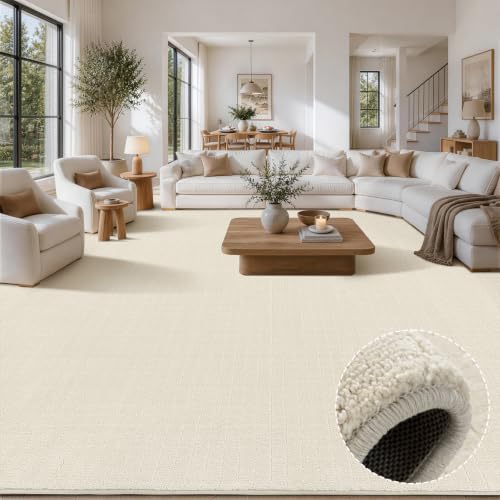
LIANLAM Handwoven Wool Rug 8×10 Beige — Best flatweave feel
The LIANLAM is woven rather than tufted, and your feet will know the difference within one step. Instead of fibres standing upright from a backing, its merino-and-cotton yarns interlace in a handwoven structure that sits low and firm, closer in spirit to a dhurrie than to a plush carpet. The beige tone is even and unpatterned, the surface has the slight irregularity that handwork leaves behind, and the whole rug feels tailored rather than upholstered — the wool choice for people who like their rooms calm, architectural, and easy to rearrange.
Its listing makes two claims that matter enormously to wool-anxious buyers: washable and stain resistant, alongside a non-slip character. A woven structure explains the confidence — there is no tufted backing to protect from water, and the flat surface releases soil the way flat surfaces do. We still counsel treating a full wash of an 8×10 wool rug as a considered event rather than a weekly habit, both for the machine’s sake and the fibre’s, but for dining rooms where spills are routine and for households that chose wool while fearing wool care, this is the most forgiving specification in the guide. Chairs glide on it, doors clear it, and its low profile lets it slip under furniture arrangements that would defeat a half-inch tufted rug.
- Size: 8 x 10 ft
- Construction: handwoven, merino wool blended with cotton
- Colour: beige, even solid tone
- Surface: listed as stain resistant and washable
- Profile: low and firm, flatweave character
Strengths
- Woven structure tolerates washing better than tufted wool
- Flat profile suits dining chairs and door clearance
- Handwoven texture gives a plain beige real character up close
Trade-offs
- Firm underfoot — no plush landing for floor play
- Solid beige still asks for prompt attention to spills
- Cooler feel than tufted wool in winter rooms
Best for: dining rooms and wool newcomers who want the fibre without the folklore. Not suited for: anyone buying wool specifically for deep, warm pile.

RUGWYN Hand Tufted Oushak Wool Rug 8×10 — Most traditional character
The RUGWYN speaks a different design language from the rest of this guide. Oushak rugs come from a Turkish tradition of softened geometry — large-scale floral motifs, generous borders, colours washed toward pastel by design — and this hand-tufted wool version renders that tradition in light beige at full living-room scale. Where the modern picks in this guide use abstraction, the RUGWYN uses memory: it looks like the rug a well-kept older house would already own, which is precisely its appeal in rooms with antiques, inherited wood furniture, or a deliberate vintage scheme.
The listing describes the rug as soft, thick, and durable, and hand-tufting supports that reading — this is a rug with presence underfoot, meant to be the warm centre of a formal-ish living room or a large bedroom. Its traditional pattern is also a quiet maintenance ally, since the floral field breaks up the surface into forgiving compartments the way all good patterns do. The trade is versatility in the other direction: an Oushak commits a room to its mood, and ultra-minimal interiors will find its ornament one voice too many. For the right room, though, nothing else in this guide comes close to its sense of occasion.
- Size: 8 x 10 ft
- Construction: hand-tufted wool
- Pattern: traditional Oushak floral, light beige
- Feel: soft and thick per listing
- Care: gentle vacuuming, spot-clean, pad recommended
Strengths
- Authentic traditional character that modern prints cannot imitate
- Thick tufted body suits formal living rooms and large bedrooms
- Floral field camouflages everyday soil gracefully
Trade-offs
- Ornamental style commits the room’s whole direction
- Thick pile shares the door-clearance and shedding considerations of tufted wool
- Light beige ground needs prompt spot care at its palest areas
Best for: traditional and vintage-leaning rooms that want a rug with ancestry. Not suited for: stark minimalist spaces where ornament reads as noise.
How Do the Six Wool Area Rugs Compare?
| Pick | Construction | Pile character | Pattern | Standout strength |
|---|---|---|---|---|
| SAFAVIEH Ikat Wool Rug 8×10 Green | Hand-tufted wool | Medium, about 1/2 in | Green ikat swirl | Decorative confidence |
| SAFAVIEH Dip Dye Wool Rug 8×10 | Hand-tufted wool | Medium, about 1/2 in | Blue-to-ivory gradient | Lightening atmosphere |
| SAFAVIEH Abstract Wool Rug 8×10 Ivory Brown | Hand-tufted wool | Low, about 3/8 in | Ivory-brown abstract | Versatility and clearance |
| ANSSO Wool Rug 8×10 Merino Tufted | Tufted merino blend | Soft tufted | Solid beige cream | Built-in non-slip backing |
| LIANLAM Handwoven Wool Rug 8×10 Beige | Handwoven merino blend | Flat and firm | Solid beige | Washable woven structure |
| RUGWYN Hand Tufted Oushak Wool Rug 8×10 | Hand-tufted wool | Thick and soft | Traditional floral | Heirloom character |
Tufted or Woven: Which Wool Construction Fits Your Room?
Tufting and weaving produce the two personalities of wool, and the choice between them shapes daily life more than any colour decision. A tufted rug stands its fibres upright, which traps air, feels plush, insulates a cold floor, and softens a room’s acoustics — the SAFAVIEH trio, the ANSSO, and the RUGWYN all live here. The costs are door clearance, a slower response to spills, and a backing you should keep away from soaking. A woven rug like the LIANLAM interlaces its fibres flat, which gives up the plush landing in exchange for chair glide, easy door swings, faster cleaning, and a structure with no delicate backing to protect.
Rooms usually announce which personality they need. Bedrooms and living rooms where people sit on the floor reward tufting. Dining rooms, home offices with rolling chairs, and spaces under doors with tight clearances reward weaving. Mixed-use rooms — the open-plan space that is both — are where the Abstract’s lower tufted pile earns its keep as the diplomatic middle. Whichever you choose, a felt pad underneath is wool’s best friend: it cushions the tufted rugs, keeps woven ones from any hint of travel, and shields both the floor’s finish and the rug’s underside from abrasion.
Why Does New Wool Shed, and When Does It Stop?
Shedding frightens new wool owners out of proportion to its meaning. During tufting and weaving, fibres are cut, handled, and packed, and a population of short or loosely held fibres is left distributed through the pile. Foot traffic and vacuuming work those fibres free over the first weeks, which is why a new wool rug seems to manufacture fluff. The fibres coming out are surplus from manufacture, not the rug unmaking itself; the pile underneath remains as dense as it was designed to be. Gentle, regular vacuuming — suction without an aggressive beater bar — clears the surplus fastest, and the rate falls steadily until shedding becomes a non-event.
What should actually concern a wool owner is not shedding but the slow enemies: grit and moisture. Grit that reaches the base of the pile acts like sandpaper underfoot, cutting fibres at their roots over months, which is why vacuuming a wool rug on schedule matters more than vacuuming it hard. Moisture left sitting in the pile — a spill blotted at the surface but wet at the base, a rug replaced on a damp floor — invites mustiness and weakens the backing of tufted pieces. Blot deep, dry fully, and keep the grit vacuumed out, and a wool rug’s famous longevity stops being a legend and becomes your floor’s ordinary behaviour.
How Should You Clean a Wool Rug Week to Week?
The weekly routine is short. Vacuum with suction, ideally with the beater bar raised or switched off on tufted pieces, moving slowly enough for the airflow to lift grit from the pile base. Rotate the rug a half-turn every few months if the room’s traffic and sunlight allow it, evening out both wear and fading. Shake smaller wool pieces outside when you can; an 8×10 mostly stays in place and relies on the vacuum, which is another argument for doing that job properly rather than often.
Spills follow a calm protocol. Lift solids with a spoon, blot liquids with a clean cloth pressed straight down, and resist the household instinct to scrub in circles, which felts the surface fibres and spreads the mark. Cool water handles most fresh incidents; a small amount of mild detergent solution handles the rest, rinsed by blotting with a damp cloth so no residue stays behind to attract new soil. Then dry the spot fully — a fan pointed at it is not overkill — because wool returned to service while damp at the base will remind you of the omission by smell. Save deep cleaning for rare occasions, and treat the LIANLAM’s washable listing as permission for careful, occasional washing rather than a weekly invitation.
What Mistakes Shorten a Wool Rug’s Life?
- Attacking a new rug with a stiff beater bar and interpreting the resulting fluff harvest as a defect rather than a settling process.
- Soaking a hand-tufted rug through its backing during enthusiastic cleaning, then wondering why the underside weakens.
- Leaving a spill blotted on top but wet at the pile base, where it quietly turns musty over the following week.
- Skipping the pad, so the rug grinds against the floor finish and its own backing abrades with every step.
- Parking one heavy furniture leg in the same fibres for years without rotation, crushing a permanent dent into the pile.
- Judging wool by synthetic rules and machine-washing a tufted rug that was only ever meant to be spot-cleaned.
What Does Wool Do to a Room Beyond Looking Good?
Start with temperature, because it is the benefit owners mention most after the first winter. Wool fibres trap still air inside the pile, and that trapped air insulates the floor, so a room with a large wool rug loses less warmth downward and feels steadier in temperature. Bare feet register the difference instantly on a January morning: wood and tile pull heat from skin, while wool meets the foot at something close to room temperature. In summer the same fibre works in the other direction, absorbing and releasing humidity as the room’s air changes, which takes the clammy edge off humid evenings in a way no synthetic pile quite reproduces.
Then there is sound. A hard-floored room without a rug is an echo chamber at household scale — chair legs, footsteps, dropped cutlery, and the television all arrive sharper than they should. An 8×10 wool rug absorbs a meaningful share of that mid-frequency noise, and the tufted picks absorb more than the woven one. Flat-dwellers notice it first, because the downstairs neighbours notice it too. Finally, wool changes how a room smells and feels at the level of air: the fibre’s structure takes up airborne moisture and odours and releases them when the room is aired, which is part of why a wool-rugged room can feel fresher than its cleaning schedule strictly earns. None of these are reasons to buy a rug you dislike looking at, but they explain why owners who switch to wool rarely switch back.
How Do You Place an 8×10 Wool Rug So the Room Works?
The standard living room arrangement puts the rug under the front legs of every seat in the conversation group, and wool rewards that discipline because its warmth then covers exactly the territory bare feet occupy. Leave a border of visible floor around the rug — a hand’s breadth at minimum, more in a large room — so the rug reads as a placed object rather than a failed wall-to-wall carpet. In a bedroom, run the rug under the bed with its long side across, extending on both sides and at the foot, so the first steps of the morning land on wool; the Dip Dye and the ANSSO were practically designed for that landing.
Dining placement has its own arithmetic: the rug must extend beyond the table far enough that chairs stay on it when pulled out for sitting, which usually means the rug’s edge sits well past the chair’s rear legs at rest. The LIANLAM and the Abstract, with their lower profiles, forgive small miscalculations here because a chair leg crossing their edge does not climb a cliff. Under a desk, centre the rug on the chair’s rolling range rather than the desk itself. And in every room, check door swing before the rug settles in: a door that grazes a half-inch tufted pile will announce the mistake daily, while the same door passes silently over the woven pick.
Wool Grades and Blends: What Do the Labels Mean for Your Feet?
Not all wool arrives equal, and this guide’s six picks quietly demonstrate the range. The SAFAVIEH trio and the RUGWYN use sturdy rug wool — fibre chosen for resilience and dye-holding, the workhorse grade that has floored homes for generations. It feels substantial rather than silky, and it wears like a material that expects decades. The ANSSO and LIANLAM blends specify merino, the finer grade associated with next-to-skin softness, mixed with cotton. Merino’s finer fibres bend more easily, which is why those two rugs feel gentler, and the cotton share adds structural stability and keeps the woven LIANLAM crisp.
Buyers sometimes worry that a blend is a compromise smuggled past them, and the honest answer is that it is a trade with terms worth reading. A merino-cotton rug gives up a measure of pure wool’s legendary abrasion resistance and gains softness, a steadier structure, and in the LIANLAM’s case a washable build that pure tufted wool cannot offer. A full-wool tufted rug gives up washability and gains the deepest pile resilience. Neither trade is a trick; they are different tools. What deserves suspicion is any listing that hides its composition entirely — every pick in this guide states what it is made of, which is exactly why they are in this guide.
How Long Should a Wool Rug Last, and What Decides It?
A well-kept wool rug is measured in decades, and the archaeological evidence is on your side: antique Oushaks like the RUGWYN’s ancestors are still traded and used after a century of feet. The fibre itself is rarely the limiting factor. Wool bends tens of thousands of times before breaking, where many synthetics fatigue far earlier, and its natural oils and scale structure keep soil from bonding permanently. What actually ends wool rugs’ lives is almost always circumstantial — a backing dried and cracked by years of heat from underfloor systems run hot, a spill left to sit at the pile base, moth damage in a rug stored rolled and forgotten, or grit allowed to saw away at the fibre roots in a hallway nobody vacuumed.
That list is good news, because every item on it is within the owner’s control. Vacuum the traffic lanes, blot with intent, store any rug clean and rolled with the pile outward, and keep a pad between rug and floor so neither abrades the other. Do those four things and the question stops being how long the rug lasts and becomes whose room it furnishes next. It is the deepest reason wool commands its price: you are not buying a floor covering for a season, you are buying the last rug that room may need for a very long time, and choosing its pattern deserves the seriousness that timescale implies.
What Does the First Month with a Wool Rug Actually Look Like?
Week one is dominated by fluff and by the pleasure of the thing itself. The rug arrives rolled, unrolls with a memory of its journey, and wants a day of books on its corners and ordinary walking to persuade it flat. Shedding begins immediately and peaks early; the vacuum canister fills with soft fibre that looks alarming until you remember it is surplus, not structure. The room, meanwhile, sounds different by the first evening — quieter, with the television turned down a notch without anyone deciding to turn it down — and the floor feels warmer at the exact hours it used to feel coldest.
Weeks two and three are when households either settle into the wool rhythm or start fighting it. The households that settle vacuum twice a week without drama, blot the first coffee incident calmly, and watch the shedding curve bend downward. The ones that fight it are usually fighting a placement mistake instead: a door grazing the pile, a rug edge landing exactly where a chair leg climbs it fifty times a day, a pale field positioned under the muddiest traffic line in the house. Nearly every early wool regret we hear about is a geometry problem wearing a fibre costume, and nearly all of them are fixable by rotating the rug, shifting it a foot, or swapping which pick serves which room.
By week four the rug has become furniture in the household’s mind — the place the dog chooses, the place children migrate to with books, the warm island everyone crosses the room to stand on while talking. Shedding has faded into the background of ordinary housekeeping. This is also the right moment for the first honest assessment: traffic lanes vacuumed clean should look as full as the sheltered areas, colours should read even, and the surface should spring back when you press and release it with a palm. A wool rug that passes that week-four check, with its shedding behind it and its care rhythm established, has effectively introduced itself as a decade-long resident.
How Do You Pair Wool with the Furniture You Already Own?
Wooden furniture and wool are old allies, and the pairing rules are mostly about temperature. Warm mid-tone woods — oak, walnut, cherry — sit happily on the Abstract’s browns, the RUGWYN’s beige floral, and the ANSSO’s cream, because the rug’s palette shares their warmth without competing for the title of darkest object in the room. Pale Scandinavian wood wants either the Dip Dye’s cool gradient or the LIANLAM’s even beige, both of which keep the room’s light, airy contract intact. Dark-stained or black furniture creates the contrast that makes the Ikat’s green swirl look deliberate and expensive.
Upholstery asks a different question: which surface is allowed to have the pattern? If the sofa is plain, the rug can sing — Ikat or RUGWYN. If the sofa carries a print, a stripe, or a strong colour of its own, the rug should step back into the ANSSO’s solid field, the LIANLAM’s quiet weave, or the Abstract’s low-contrast movement. Leather sofas, being visually heavy and smooth, pair beautifully with tufted wool’s texture because the rug supplies the softness the leather withholds; the half-inch SAFAVIEH picks earn their keep in exactly those rooms. Metal-and-glass modern furniture, finally, needs wool’s warmth more than any other style does, and a room of hard edges softened by one deep wool field is often the difference between a showroom and a home.
Rugs also mediate between furniture generations, which matters in real houses where the armchair is inherited, the sofa is new, and the sideboard came from a marketplace listing. A well-chosen wool rug gives those pieces a shared ground — literally — and its pattern or palette can borrow one colour from each piece so the collection reads as curated rather than accumulated. The Abstract performs this diplomacy best in this guide, precisely because its ivory and brown abstraction contains something for almost every wood and fabric to relate to. When in doubt, choose the rug that makes your existing furniture look intentional; that is a higher and more useful standard than choosing the rug that photographs best alone.
Wool Through the Seasons: Heating, Storage, and Moths
Underfloor heating deserves a direct answer because so many wool buyers have it. Wool itself tolerates gentle, even warmth well — it is an animal fibre evolved for temperature swings — but the systems beneath it matter. Tufted rugs rely on their backing, and years of high heat can dry some backings out, so keep floor temperatures moderate and use a pad as a thermal buffer as well as a cushion. The woven LIANLAM, having no tufted backing to protect, is the most relaxed pick over heated floors. If your heating runs hot enough to be uncomfortable in socks, it is too hot for any rug’s long-term health, wool or otherwise.
Storage is the other seasonal test, and it is where moths enter the story. Moths are not interested in a clean, aired, in-use rug nearly as much as folklore suggests; their target is wool put away dirty in the dark. If a rug must be stored — between tenancies, during a renovation — clean it first, dry it completely, roll it with the pile facing outward so the backing is not stretched, and store it somewhere dry with air movement. Check it once mid-storage. Households that follow that unglamorous protocol hand rugs down; households that roll a dirty rug into a loft in May meet the consequences in October.
What Should You Verify Before Ordering a Wool Rug Online?
Measure the room with the furniture in its final arrangement, then check the rug’s stated dimensions against the space between the furniture’s outer edges, not the room’s walls. An 8×10 sounds standard until it meets a hearth, a radiator pipe, or a door that swings inward across its corner. Check pile height against your lowest door clearance with the door actually closed over a sample thickness — a folded towel of similar depth is a fair stand-in. Confirm the composition on the listing matches what you intend to buy, because this category is full of wool-look synthetics photographed beautifully; every pick in this guide states its fibre plainly, and any listing that will not say what it is made of is answering your question by omission.
Finally, plan the pad and the first month before the rug arrives. Order the pad to land the same week, since a tufted wool rug’s first days should not be spent grinding directly on a hard floor. Clear the calendar expectation that the first fortnight involves extra vacuuming, and warn the household that fluff is coming so nobody files a complaint with the rug. Wool bought with those expectations set is wool that gets judged at week six, in its settled state — which is the only judgement of a wool rug that has ever been fair.
How Does Wool Handle Children and Everyday Family Traffic?
Family life tests a rug in ways no showroom simulates: a fort built from sofa cushions and body weight, a board game played entirely at floor level, a juice cup set down with a toddler’s confidence, and the daily migration of toys that seem to travel by grit. Wool’s resilience is its family credential. The pile that springs back from a chair leg springs back from a fort, and the fibre’s reluctance to bond with soil means the juice cup, blotted promptly, leaves far less evidence than it would on a synthetic of similar colour. The tufted picks add a genuine play surface to the bargain — warm, cushioned, and quiet enough that floor play does not soundtrack the whole house.
The honest cautions are about process rather than fragility. Children spill at floor level and forget to mention it, so a wool rug in a family room wants a household rule that spills get announced, plus a parent willing to blot first and ask questions later. Craft materials deserve respect: glue and poster paint are enemies of every fibre ever made, and a washable mat under the art station protects the wool without rationing creativity. Felt-tip colour that lands on wool should be blotted with cool water immediately and never scrubbed, since scrubbing works pigment into the pile and frays the surface in one motion.
What families consistently report, once the rhythm is set, is that wool changes where children choose to be. A warm, soft 8×10 becomes the default territory for reading, homework sprawled at full length, and the long negotiations of sibling life, in a way that a thin washable rug or bare floor never quite achieves. That gravitational pull is a benefit with a cost — the rug becomes the most-used surface in the house and must be vacuumed like it — but most households decide the trade is the entire point of buying wool in the first place.
Final Recommendation
Choose by room before you choose by photograph. A living room that wants a voice should take the Ikat; a bedroom that wants light should take the Dip Dye; an open-plan space that must do everything should take the Abstract and its diplomatic lower pile. The ANSSO suits anyone who values a soft merino feel and a rug that grips without extra hardware, the LIANLAM is the thinking person’s wool for dining rooms and cautious first-time wool owners, and the RUGWYN belongs wherever a room has been waiting for a rug with a past life.
Whichever of the six lands in your home, give it the unglamorous gifts wool actually wants — a pad beneath, a gentle vacuum on schedule, and patience through its shedding spring — and it will repay you in the only currency that matters here: a floor that stays warm, quiet, and handsome long after trendier rugs have been rolled up and forgotten by everyone except the person who paid for them.
Frequently Asked Questions
How long does the shedding phase of a wool rug last?
Expect noticeable shedding for the first several weeks of regular use, easing steadily as the loose manufacturing fibres clear. Vacuuming gently on a normal schedule speeds the process along. If shedding is still heavy after a couple of months of ordinary traffic, that is worth raising with the seller, because settled wool should calm down. Short fibres in the vacuum are normal throughout; long strands pulling free in handfuls are not, and that distinction is the one to watch.
Can a wool rug handle a high-traffic hallway?
Wool fibre itself handles traffic beautifully — it is resilient and hides soil well — but construction decides the rest. A low or woven wool like the Abstract or the LIANLAM suits a hallway’s doors and grit better than a half-inch tufted pile, and any hallway wool wants frequent vacuuming because tracked grit is pile’s worst enemy. Hallways also concentrate wet-weather traffic, so a hallway wool rug earns a strict blot-and-dry routine in winter and rewards it by outlasting the synthetic runner it replaced.
Is a rug pad really necessary under wool?
For tufted wool, yes in practice: a pad protects the floor finish, cushions the backing against abrasion, and stops creep. The ANSSO’s built-in grip backing reduces the urgency on hard floors, and the LIANLAM sits flatter than most, but even those two feel and wear better with a thin felt pad beneath them in permanent placements.
Why do all six picks come in 8×10?
Because wool earns its premium at anchor scale, covering the full seating group so its warmth, resilience, and sound-softening apply to the whole arrangement. Smaller wool rugs exist across these same lines, but the 8×10 is the size where the fibre’s advantages stop being samples and become the room’s actual climate.
Does wool suit a home with pets?
Wool and pets coexist in millions of homes, with two caveats. Hair shows and sheds from the animal blend with the rug’s own early shedding, so vacuuming becomes a real commitment; and accidents need prompt, thorough blotting because wool absorbs liquid willingly. Households wanting a fully machine-washable routine for frequent accidents may prefer synthetic washable rugs in the pet’s main rooms and keep wool for calmer territory.
How do I keep the colours from fading unevenly?
Sunlight fades one side of any rug faster than the other, so rotate the rug a half-turn every few months where furniture allows, and use curtains or film on glass that pours direct sun onto the same patch all afternoon. Wool takes dye beautifully and holds it well; uneven exposure, not the fibre, is what creates a two-tone rug.
Is wool a sensible choice for allergy-conscious households?
That is a comfort question rather than a medical one, and households answer it differently. Wool’s defenders point out that its fibres trap dust within the pile until vacuuming removes it, instead of letting it puff into the air at every footstep the way a hard floor does. Its sceptics note that a rug of any fibre collects what a bare floor would show plainly. What can be said without overclaiming is that the care rhythm matters more than the fibre label: a wool rug vacuumed gently and often, in a room aired regularly, behaves very differently from the same rug neglected. Anyone managing a diagnosed condition should take advice from their own clinician rather than from a rug guide, and choose the floor covering that fits the routine they will actually keep.
Related Guides
Wool is one chapter of a larger natural-fibre story, and the neighbouring guides pick it up from different directions: Best Animal Rugs for Baby and Kids Rooms covers the playful end of the rug shelf, Best Basement Workout Rugs handles floors that work for a living, Best Bath Rugs That Resist Mold and Mildew deals with the wettest room in the house, and Best 9×12 Natural Fiber Rugs widens the natural-fibre comparison to the next size up.



[…] bigger rug plan, these guides continue the thinking in neighbouring rooms and materials: start with Best Wool Area Rugs for the natural-fibre alternative, compare traffic-proof options in Best Bamboo and Seagrass Rugs, […]