What's inside
- Key Takeaways
- Quick Picks
- How Did We Choose These Six Sinks?
- How Do the Six Sinks Compare Side by Side?
- Should You Choose Stainless Steel or Granite Composite?
- How Deep Should a Kitchen Sink Bowl Be?
- What Does Steel Gauge Mean in Practice?
- How Do You Measure a Cabinet for an Undermount Sink?
- What Is a Workstation Sink Actually Good For?
- How Should You Care for Steel and Composite Differently?
- Where Should the Drain Sit, and Does It Matter?
- How Loud Should a Kitchen Sink Be?
- How Do You Keep an Undermount Rim Clean?
- What Accessories Are Worth Buying With a Sink?
- How Does a Sink Choice Affect the Faucet You Can Use?
- When Is a Double Bowl Genuinely the Right Answer?
- How Much Does Installation of an Undermount Cost in Effort?
- What Should You Know About Sink Sound at the Showroom?
- How Do Sinks Handle Garbage Disposals and Hot Water?
- What Is the Best Sink Shape for a Corner or Island?
- How Long Should a Good Kitchen Sink Last?
- Do Coloured and Dark Sinks Show Wear Differently?
- How Do You Stop a New Sink Smelling in Its First Month?
- What Should Renters Ask Before Replacing a Sink?
- How Should You Plan Sink Lighting and Task Visibility?
- What Does a Sink Warranty Usually Cover?
- What Mistakes Do Sink Buyers Make Most Often?
- Final Recommendation
- Frequently Asked Questions
- Related Guides
As an Amazon Associate I earn from qualifying purchases. This post may contain affiliate links at no extra cost to you.
cottageverdict.com is reader-supported. When you buy through links on our site, we may earn an affiliate commission.
Where to buy: Every sink below is sold on Amazon, where you can check price on Amazon and verify the bowl dimensions, gauge and included accessories against your cabinet measurements before ordering, because a sink is the least returnable object in any kitchen renovation.
Choosing among the best kitchen sinks looks like a style decision until the first week of cooking reveals it as a workflow decision. Bowl depth decides whether sheet pans soak flat or perch at an angle, steel gauge decides whether the basin drums under the faucet or answers with a dull thud, and the choice between stainless and granite composite decides how the sink sounds, stains and ages for the next twenty years. This guide’s six picks cover that real decision space rather than six shades of the same basin.
Four of the six are stainless, in thirty and thirty-two and thirty-three inch widths, including a workstation model with a ledge for boards and racks. Two are granite composite, one a single-bowl workstation and one a double-bowl that mounts two ways, because the composite question deserves a fair hearing inside a general sink guide rather than exile to a specialist corner. Every pick is an undermount or flexible-mount design intended for a serious kitchen rather than a bar corner.
Measure your cabinet before falling for any of them. A thirty-three inch sink typically demands a thirty-six inch cabinet, exterior dimensions are not bowl dimensions, and the faucet holes live in the countertop, not the sink, on undermount installations. The reviews below keep returning to those unglamorous facts, because the best kitchen sink is the one that fits, drains, quiets and cleans in your kitchen, not the one with the longest feature list.
Key Takeaways
- Sixteen gauge steel is the thickness to insist on; thinner basins drum, flex and dent more readily.
- Bowl depth between nine and ten inches swallows stockpots while sparing most backs at the rim.
- Granite composite trades steel’s brightness for quiet, heat tolerance and a matte, stone-like calm.
- A workstation ledge converts the sink into counter space during prep and drying alike.
- Double bowls suit households that soak and rinse simultaneously; single bowls suit pan people.
- Undermount rims disappear under stone, making counter sweeping a one-motion job.
Quick Picks
| Pick | Badge | Why it earns a place |
|---|---|---|
| KRAUS KHU100-32 Stainless Undermount Sink 32 Inch | The Benchmark Single Bowl | Sixteen gauge TRU16 steel, rounded corners, drainage grooves and NoiseDefend padding: the specification other undermounts get measured against. |
| KRAUS 32 Inch Undermount Granite Composite Sink KGUW2-33MBL | Composite Workstation in Metallic Black | Quartz composite with an integrated ledge, a cutting board and roll-up rack in the box, and a surface rated heat-safe to 500 degrees. |
| Sarlai 33 Inch Stainless Workstation Undermount Sink | Deepest Steel Workstation | Thirty-three by nineteen inches, ten inches deep, sixteen gauge steel with rounded corners: the biggest washing-up bowl in this line-up. |
| KRAUS 33 Inch Double Bowl Granite Sink KGD-52 | Double Bowl, Two Mounting Ways | A fifty-fifty double bowl in black quartz composite that installs as drop-in or undermount, with a thick deck and heat-safe surface. |
| VEVOR Stainless Undermount Kitchen Sink | Accessory-Rich Steel Workstation | A thirty-two inch 304 stainless workstation with ledge and accessories, pitched at kitchens, prep rooms, RVs and bars alike. |
| KRAUS KHU100-30 Stainless Undermount Sink 30 Inch | Benchmark Build, Smaller Footprint | The KHU100 formula at thirty inches: same sixteen gauge TRU16 steel, rounded corners, drainage grooves and NoiseDefend hush. |
How Did We Choose These Six Sinks?
Gauge came first among the stainless candidates, and sixteen gauge was treated as the serious threshold. Gauge runs backwards, so sixteen is thicker than eighteen, and that thickness buys dent resistance, a quieter basin and a rim that holds its line under a heavy faucet decade. Any stainless sink unwilling to state its gauge was set aside, because silence about the single most important steel number is a confession in this category.
Geometry came second. The six span thirty to thirty-three inches externally, single and double bowls, depths around nine to ten inches, because those are the sizes that serve real family cooking inside standard cabinet runs. Corners mattered too: rounded interiors rinse clean in seconds, while near-zero radius corners look architectural and demand a brush, so the picks favour radii a household can actually maintain.
For the composite entries, the judging shifted to quartz content character, heat tolerance and mounting flexibility. A composite sink that tolerates a hot pan’s brief landing and resists the staining habits of coffee, wine and turmeric earns its premium over steel, while one that merely colours plastic does not. The Kraus composite models here publish heat tolerance and include useful accessories, which is why they represent the material in this guide.
Sound behaviour closed the selection. Pads and coatings that deaden the clatter of cutlery and the drumming of running water separate a sink you enjoy from a sink you endure, and every pick below addresses noise in its construction, whether through steel padding or composite’s inherent density.

KRAUS KHU100-32 Stainless Undermount Sink 32 Inch — The Benchmark Single Bowl
Some products become the reference because they got the fundamentals right early and never needed rescuing. The KHU100-32 is that sink: thirty-two inches of sixteen gauge steel, a single deep bowl, corners rounded generously enough to wipe in one pass, and channel grooves pressed into the floor so water herds toward the drain instead of pooling around yesterday’s pasta pot. Nothing on that list is glamorous, and together it describes the sink most households actually want.
NoiseDefend padding earns its mention because sink noise is a quality-of-life figure disguised as a detail. A thin basin turns every dropped spoon into a cymbal and every running faucet into weather; the padded sixteen gauge bowl answers with a thud and a hush. In open-plan homes where the kitchen sink performs in front of the living room sofa, that hush is worth as much as any dimension on the sheet.
The undermount rim vanishes beneath the counter, so crumbs sweep straight in and the counter’s edge line stays clean. Pair it with a bottom grid if you drop cast iron carelessly, choose a drain position your disposal and dishwasher lines can reach gracefully, and this remains the safest single recommendation in the guide for a standard thirty-six inch cabinet run.
As the reference pick, its real virtue is the absence of surprises across a decade: no drumming, no corner archaeology, no rim drama. Reference products earn their status by being boring in exactly the ways a sink should be boring.
- Steel: 16 gauge TRU16 stainless construction
- Exterior: 32 inch undermount single bowl
- Corners: rounded for fast, brush-free wiping
- Floor: channel grooves guide water to drain
- Sound: NoiseDefend pads deaden basin noise
Strengths
- Thick steel resists dents from heavy cookware
- Rounded corners clean faster than square designs
- Padded basin stays civilised in open-plan rooms
Trade-offs
- Single bowl means soaking and rinsing share space
- Undermount demands a solid, well-supported counter
- Grid and drain assembly are separate considerations
Best for: most family kitchens wanting one deep, quiet, do-everything bowl in a standard cabinet.
Not suited for: households that habitually soak in one bowl while rinsing in another.

KRAUS 32 Inch Undermount Granite Composite Sink KGUW2-33MBL — Composite Workstation in Metallic Black
This is the sink for cooks who prep at the basin. The integrated ledge runs along the bowl’s upper edge and carries the included cutting board and roll-up dish rack, so vegetables chop directly over the sink, scraps sweep straight down, and washed glasses dry above the bowl instead of colonising the counter. In a small kitchen that ledge is not a luxury; it is the missing square foot of workspace that appears exactly where the work happens.
The material changes the sink’s whole temperament. Quartz composite in metallic black feels like stone, sounds like almost nothing when a pan lands, and shrugs off the brief contact of hot cookware that would panic a lesser surface, with heat tolerance stated to five hundred degrees. The matte darkness also hides the water spotting that keeps stainless owners wiping, trading that chore for an occasional oiling-style refresh where the maker recommends it.
Composite asks for respect in two places: heavy point impacts from a falling cast-iron skillet edge, and pale scratching habits from abrasive powders. Cook households that can grant those courtesies gain the quietest, calmest basin in this guide, and a black focal point that lets pale counters and steel faucets look deliberate rather than default.
Treat the included board and rack as the start of a prep system rather than free gifts, and position knives, boards and produce around the ledge from the first week so the habit forms while the kitchen still feels new.
- Material: quartz composite granite, metallic black
- Rating: heat-safe surface to 500 degrees
- Ledge: integrated rail for boards and racks
- Included: cutting board and roll-up rack
- Mount: undermount single bowl, 32 inch class
Strengths
- Workstation ledge adds prep space over the bowl
- Composite runs far quieter than any steel basin
- Included accessories arrive matched to the ledge
Trade-offs
- Dark surface shows pale dust and flour plainly
- Abrasive powders can mark the matte finish
- Costs more than the benchmark steel equivalent
Best for: compact kitchens and prep-heavy cooks who will use the ledge every single day.
Not suited for: households that scrub everything with scouring powder by reflex.

Sarlai 33 Inch Stainless Workstation Undermount Sink — Deepest Steel Workstation
Dimensions are this Sarlai’s argument, stated plainly: thirty-three inches long, nineteen wide and ten deep, in sixteen gauge steel. That depth swallows a roasting pan and its rack together, lets a stockpot fill without the faucet gymnastics shallower bowls demand, and keeps splash inside the basin when the sprayer works hard on a sheet pan. Households that cook in batches will feel the extra inch of depth every weekend.
The workstation ledge extends the usefulness upward, carrying boards and drying racks across the bowl so the sink participates in prep rather than merely receiving its aftermath. Rounded corners keep the big interior honest to clean, since a thirty-three inch bowl with brush-demanding corners would be a part-time job disguised as a sink. Sarlai’s specification names the round corner design explicitly, which is the detail experienced buyers look for first.
Check the cabinet maths with care, because a thirty-three inch undermount generally wants a thirty-six inch cabinet and a counter run that can spare the width. Where it fits, this is the capacity pick of the guide, the sink chosen by people whose previous basin lost arguments with lasagne dishes and turkey roasters every holiday season.
Capacity sinks change behaviour subtly: pans stop queuing on the hob, soaking stops being negotiated, and the whole washing-up conversation shortens. That behavioural dividend is the real return on the extra inches.
- Steel: premium 16 gauge stainless construction
- Footprint: 33 by 19 inches undermount
- Depth: 10 inch single bowl for roasting pans
- Corners: rounded design for easier cleaning
- Format: workstation ledge across the bowl
Strengths
- Largest, deepest washing volume in this guide
- Ledge turns prep and drying into sink work
- Rounded corners keep the big bowl maintainable
Trade-offs
- Needs a genuinely wide cabinet to fit properly
- Deep bowl raises the reach for shorter users
- Steel shows water spots without a wipe habit
Best for: batch cooks and big-pan households with the cabinet width to house it.
Not suited for: compact kitchens or anyone whose current sink already feels too deep.

KRAUS 33 Inch Double Bowl Granite Sink KGD-52 — Double Bowl, Two Mounting Ways
The KGD-52 exists for households divided against themselves: one cook soaking, another rinsing, neither willing to surrender the bowl. Its fifty-fifty split gives each task a full home, and the quartz composite construction keeps the divided basin quiet and calm in black, with metallic particles giving the surface a subtle depth that flat black plastics never achieve. Crystal and china, incidentally, survive composite’s softer landing better than steel’s ring.
Mounting flexibility is its second argument. The same sink drops into a counter cutout with its thick deck on display or undermounts for the seamless look, which makes it the one pick here that can serve a laminate counter today and survive a stone upgrade later. Renovators working in phases, and landlords standardising across varied units, should read that flexibility as money saved twice.
Heat tolerance and a non-porous character complete the composite case: hot pans can land briefly without drama, and the surface resists absorbing the stains that coffee grounds and berry juices offer daily. The trade is bowl width, since each half of a thirty-three inch double is narrower than a single bowl, so the largest roasting pans will still soak diagonally and grumble about it.
Renovators should photograph this sink’s mounting flexibility into their plans, because the same unit surviving a counter upgrade is a rare chance to buy once during a two-phase project.
- Material: quartz composite with metallic particles
- Layout: 50/50 double bowl, 33 inch span
- Mounting: drop-in or undermount, thick deck
- Surface: heat-safe, stain-resistant character
- Colour: black with subtle metallic depth
Strengths
- Two true bowls for parallel soak and rinse work
- Mounts either way across renovation phases
- Composite quiet suits glassware and open plans
Trade-offs
- Each bowl is narrower than a single-bowl rival
- Black shows light-coloured dust between wipes
- Heavier than steel when installers work alone
Best for: two-cook households and phased renovations needing one sink that mounts both ways.
Not suited for: single-pan maximalists whose roasting tins already fight a full-width bowl.
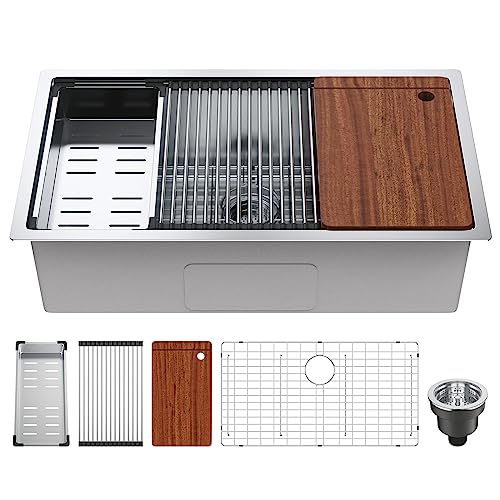
VEVOR Stainless Undermount Kitchen Sink — Accessory-Rich Steel Workstation
VEVOR’s entry competes on completeness. The thirty-two inch basin arrives in 304 stainless with a working ledge and an accessory set, aiming to be a workstation on delivery day rather than after a second order. For prep kitchens, bars and serious RV installations, that out-of-box readiness has genuine value, since accessory ecosystems are where budget sink projects quietly bleed money and weekends.
The ledge format mirrors the working pattern this guide praised in the Sarlai and the composite Kraus: board over bowl, rack over bowl, counter liberated. In a bar or prep setting the pattern is even stronger, because the sink becomes the station, with washing, draining and staging stacked vertically in one footprint while the surrounding surface stays clear for service.
Judge this pick with a value eye rather than a pedigree eye. The 304 grade is the industry-standard food-contact stainless, the format is right, and the bundle is generous, while the brand’s sink-specific literature runs thinner than Kraus’s deep catalogue. Buyers comfortable trading some documentation depth for a complete, ready workstation will find the exchange reasonable and the sink entirely serious.
For bars and prep rooms, judge this bundle by a Friday night test: can one person wash, drain and stage glassware without leaving the station. The ledge and accessories are designed to make that answer yes.
- Steel: 304 stainless, undermount single bowl
- Size: 32 inch basin with working ledge
- Bundle: accessories included for workstation use
- Settings: kitchen, prep, RV and bar service
- Format: ledge supports boards and drying racks
Strengths
- Arrives as a working station, accessories included
- Ledge format suits prep and bar workflows
- Standard 304 steel is proven food-contact material
Trade-offs
- Brand sink literature thinner than Kraus documentation
- Accessory quality varies more than the basin itself
- Steel care routine applies in full, spots included
Best for: prep kitchens, bars and RV fit-outs wanting a complete station in one delivery.
Not suited for: documentation maximalists who want a deep maker catalogue behind a sink.

KRAUS KHU100-30 Stainless Undermount Sink 30 Inch — Benchmark Build, Smaller Footprint
Not every kitchen can host a thirty-two or thirty-three inch sink, and the honest answer for a thirty-three inch cabinet is not a squeezed compromise but a properly engineered thirty inch sink. The KHU100-30 keeps everything that makes its larger sibling the benchmark, the sixteen gauge TRU16 steel, the rounded corners, the grooved floor and the noise padding, and simply scales the footprint to the cabinets that apartments, galleys and older homes actually contain.
That continuity matters because small kitchens cook as ambitiously as large ones. The bowl still takes a Dutch oven and a dinner party’s pans, the steel still answers dropped cutlery with a thud instead of a clang, and the undermount rim still lets a galley counter sweep clean in one motion. What shrinks is only the simultaneous capacity, the second pan waits on the counter rather than in the bowl.
Choose this over the thirty-two when the tape measure says so, and choose it over no-name thirty inch rivals because the gauge is stated and the padding is real. In sink buying, a smaller honest sink beats a larger vague one every time, and this is the most honest small sink in the guide.
Small kitchens deserve the same engineering seriousness as large ones, and this thirty-inch version is the proof inside this guide that a tape-measure constraint need not become a quality compromise.
- Steel: 16 gauge TRU16 stainless construction
- Exterior: 30 inch undermount single bowl
- Corners: rounded, quick to wipe clean
- Floor: channel grooves direct water out
- Sound: NoiseDefend pads fitted as standard
Strengths
- Full benchmark specification in a smaller size
- Suits thirty-three inch cabinets properly
- Quiet, thick steel for apartment living
Trade-offs
- Less simultaneous pan capacity than the 32
- Single bowl juggling returns in busy moments
- Undermount still needs a supportive counter
Best for: apartments and galley kitchens with thirty-three inch cabinets that cook seriously.
Not suited for: large families who regularly soak two big pans at once.
How Do the Six Sinks Compare Side by Side?
| Pick | Material and gauge | Bowl layout | Defining strength |
|---|---|---|---|
| KRAUS KHU100-32 Stainless Undermount Sink 32 Inch | 16 gauge stainless steel | Single bowl, 32 inch | Benchmark undermount, quiet and proven |
| KRAUS 32 Inch Undermount Granite Composite Sink KGUW2-33MBL | Granite composite, metallic black | Single bowl workstation, 32 inch | Ledge accessories, heat-safe surface |
| Sarlai 33 Inch Stainless Workstation Undermount Sink | 16 gauge stainless steel | Single bowl workstation, 33 inch | Deep ten inch bowl, rounded corners |
| KRAUS 33 Inch Double Bowl Granite Sink KGD-52 | Granite composite, black | Double bowl 50/50, 33 inch | Drop-in or undermount flexibility |
| VEVOR Stainless Undermount Kitchen Sink | 304 stainless steel | Single bowl with ledge, 32 inch | Accessory bundle and workstation ledge |
| KRAUS KHU100-30 Stainless Undermount Sink 30 Inch | 16 gauge stainless steel | Single bowl, 30 inch | Same benchmark build for smaller cabinets |
Should You Choose Stainless Steel or Granite Composite?
Steel is the brighter, lighter, more forgiving material to install, and it develops a soft patina of fine scratches that most owners stop seeing within a month. Composite is the quieter, calmer, more stone-like material, heavier to fit and kinder to dropped glassware, with heat tolerance that lets a hot pan land briefly without a trivet hunt. Neither wins in the abstract; each wins in a kitchen whose habits match its character.
Ask how your household treats surfaces. Abrasive scrubbers and dropped cast iron argue for steel’s repairable dullness, while noise sensitivity, dark design schemes and a hatred of water spots argue for composite. The six picks split deliberately across that argument, with the Kraus composite pair representing the material at its most credible and the sixteen gauge steels holding the traditional ground.
How Deep Should a Kitchen Sink Bowl Be?
Nine to ten inches is the modern sweet spot for a main bowl. Shallower than eight, and stockpots ride high with their rims near the faucet, splash escapes during spraying, and sheet pans refuse to sit flat for soaking. Deeper than ten, and shorter users begin reaching down into the bowl in a way that taxes backs during long washing sessions, especially with an undermount adding the counter’s thickness to the journey.
Depth interacts with the faucet’s arc as well. A high-arc faucet over a deep bowl gives genuine working volume for filling and rinsing tall vessels, while the same faucet over a shallow bowl manufactures splash. Judge sink and faucet as one water system, using the dimensions in these listings together rather than shopping for each in separate, innocent tabs.
What Does Steel Gauge Mean in Practice?
Gauge measures thickness on a backwards scale, so the smaller number wins: sixteen gauge steel is noticeably thicker than the eighteen gauge found in bargain basins. In the hand, thickness reads as solidity when a heavy pot lands; in the ear, it reads as quiet; in the long term, it reads as a rim that stays true and a floor that resists the oil-can flexing that makes thin sinks pop and drum under temperature changes.
Because gauge is a single verifiable number, insist on seeing it stated, as every steel pick in this guide states it. A listing that praises ‘premium stainless’ while omitting gauge is asking adjectives to do a number’s job. The same goes for grade: 304 is the food-service standard, and its presence in a specification, as with the VEVOR above, is a quiet mark of seriousness.
How Do You Measure a Cabinet for an Undermount Sink?
Start with the cabinet’s interior width, not its door size, and compare it against the sink’s exterior dimension plus the mounting clips’ appetite for space. A thirty-two inch sink typically lives in a thirty-six inch cabinet; a thirty inch sink in a thirty-three. Then measure front-to-back depth against the counter’s, leaving room for the faucet’s mounting behind the bowl, a detail first-time renovators discover with the counter already cut.
Template discipline saves the day. Most quality sinks ship with or publish a cutout template; use it, and have the counter fabricator confirm drain position against your disposal, dishwasher branch and any water filter already resident under the sink. The under-sink cabinet is a small room with several tenants, and the new sink is merely the largest of them.
What Is a Workstation Sink Actually Good For?
A workstation ledge earns its keep in three daily moments: chopping with the board suspended over the bowl so trimmings fall away, rinsing with a colander parked on the rails instead of in the splash zone, and drying with the roll-up rack holding glasses above the basin while the counter stays in service. Each moment is small; multiplied by years of dinners, the ledge becomes the hardest-working inch in the kitchen.
The format particularly rescues small kitchens, where the sink is often the largest uninterrupted surface available. Turning it into a prep stage effectively adds a cutting station without adding a room. If your cooking is mostly reheating, the ledge will gather dust and a plain bowl serves better; if you cook from raw ingredients most nights, the ledge will feel less like a feature and more like a correction.
How Should You Care for Steel and Composite Differently?
Steel wants frequent light attention: a rinse and wipe after acidic or salty residues, a weekly polish along the grain with a soft cloth, and protection from steel wool and chloride-heavy cleaners that can invite rust freckles even on stainless. Its scratches blend into a general satin over time, which is steel’s way of forgiving a busy household without any intervention at all.
Composite wants gentler chemistry and occasional nourishment. Mild detergents handle daily soil, a mineral-oil style refresh restores depth to dark surfaces where the maker advises it, and abrasive powders are the enemy, capable of dulling the matte face. In exchange, composite ignores water spots that keep steel owners wiping, and it never rusts, drums or dents, which many owners count as the better bargain.
Where Should the Drain Sit, and Does It Matter?
Rear-set drains free the bowl’s floor for flat soaking and let large pans sit level while water escapes beneath them, while centred drains suit symmetrical double bowls and traditional plumbing runs. Offsetting also changes the under-sink map, sometimes freeing the front of the cabinet for a pull-out bin where a centred disposal would have squatted. Small decision, long shadow, worth a tape measure and five quiet minutes before ordering.
Disposal compatibility deserves the same foresight. Most modern sinks accept standard disposal flanges, yet bowl floor thickness and drain diameter should be confirmed against your unit, particularly with composite sinks whose floors are thicker than steel. The listings above publish their formats plainly; a two-minute cross-check there prevents the classic renovation pause where the sink, the disposal and the plumber regard each other in silence.
How Loud Should a Kitchen Sink Be?
Noise is the specification nobody lists in decibels and everybody lives with. Steel without padding broadcasts every rinse; padded sixteen gauge steel, like the Kraus entries here, cuts the drumming to a murmur; composite, dense and stone-like, barely speaks at all. In open-plan homes and flats with thin walls, that acoustic ladder should influence the choice as directly as size does.
Running water noise also scales with bowl geometry, since deep bowls contain sound better than shallow trays. If your household washes up late while others sleep, prioritise the padded and composite picks and consider a bottom grid, which breaks the fall of cutlery. A quiet sink is a courtesy to everyone not standing at it.
How Do You Keep an Undermount Rim Clean?
The undermount joint is a narrow frontier where counter, sealant and steel meet, and it rewards a weekly pass with an old soft toothbrush and mild detergent. That minute of attention prevents the dark line of film that otherwise establishes itself along the seam and convinces guests the whole sink is neglected, even when the bowl itself gleams.
Sealant condition is the deeper issue. If the bead along the rim cracks or lifts, water migrates where it should never go, and resealing promptly is a small job compared with the cabinet damage a patient leak performs. Inspect the joint whenever you deep-clean the sink, and treat the sealant as a consumable with a service life rather than a permanent part of the architecture.
What Accessories Are Worth Buying With a Sink?
Beyond the workstation boards and racks covered above, the worthwhile list is short: a bottom grid matched to the bowl, a drain assembly in a finish that agrees with the faucet, and, for composite sinks, the maker’s recommended care product for restoring depth. Colanders that sit on workstation ledges multiply the format’s value and are worth choosing in the same order so the fit is guaranteed.
Resist the novelty tail of sink accessories, the gadgets that promise to organise sponges in ever more elaborate ways. The sink’s job is water, pans and produce, and money spent on gauge, depth and quiet construction returns itself daily, while money spent on clip-on caddies returns itself mostly to the charity shop within a year.
How Does a Sink Choice Affect the Faucet You Can Use?
Undermount sinks delegate faucet drilling to the countertop, so the faucet’s hole count and the counter’s drilling must be planned together, with enough rear clearance for handles and pull-down hoses. A workstation ledge can also sit high enough to meet a low faucet’s swing, a collision only visible on paper beforehand, which is why this guide keeps returning to drawings and templates.
Tall gooseneck faucets pair naturally with deep bowls, while compact faucets over a ten-inch Sarlai will splash their displeasure. Plan the pair as one water instrument: bowl depth, spout height, reach and spray pressure in a single conversation, ideally before either box is opened on the kitchen floor.
When Is a Double Bowl Genuinely the Right Answer?
Households that hand-wash delicate items while soaking roasting trays, homes without a dishwasher, and keen cooks who keep a vegetable-washing bowl separate from a dish bowl all use both sides daily and honestly. For them the KGD-52’s equal split is not a compromise but a floor plan, and its composite quiet makes the two-bowl routine calmer than steel would.
The test is the last fortnight of your own washing up. Count the times you wished the soaking could move aside for a clear rinsing space; if the answer approaches daily, divide the bowl without guilt. If the honest answer is twice, keep the single bowl’s full width and let the occasional juggling act remain occasional.
How Much Does Installation of an Undermount Cost in Effort?
Undermount fitting is a two-person, patience-first job: the bowl must be supported level while adhesive and clips set, plumbing reconnected in a cabinet that suddenly feels smaller, and the counter’s cut edge sealed against the rim. Professional fabricators absorb that work into a counter installation, while retrofitting an undermount beneath an existing counter is a specialist conversation rather than a Saturday project.
Drop-in mounting, offered by the KGD-52 in this guide, forgives far more, settling into its cutout on a sealant bead with the deck visible. Households replacing a sink without replacing counters should start from that forgiving end of the catalogue, and phase their ambitions: sink now, stone and undermount together later.
What Should You Know About Sink Sound at the Showroom?
Tap the bowl with a knuckle and run a hand across the floor. A quality padded steel sink answers with a low, damped note and a floor that feels immovable; a thin basin rings and flexes, announcing every future spoon drop in advance. Composite gives almost no note at all, a stony silence that some buyers find luxurious and others find oddly lifeless for the first week.
Showroom acoustics flatter everything, so judge relatively between candidates side by side rather than absolutely. The sink that sounds calmest among its neighbours on the same shelf will also be calmest under your faucet, and the difference compounds across thousands of washing-up sessions in an open-plan room.
How Do Sinks Handle Garbage Disposals and Hot Water?
A disposal adds weight, vibration and a second motor’s worth of plumbing beneath the bowl, so the sink’s floor stiffness and the mounting’s security matter more than brochures admit. Thick steel and dense composite both carry a disposal calmly; thin steel can buzz sympathetically at certain speeds, a small annoyance that arrives nightly. Confirm flange compatibility with composite floors, whose thickness can exceed the standard hardware’s reach.
near-boiling water from pasta pots is routine for every material here, though composite owners should still avoid parking a dry, oven-hot pan in the bowl, since the heat ratings in these listings describe brief contact with hot cookware rather than a licence to use the sink as a trivet for cast iron fresh from a fierce oven.
What Is the Best Sink Shape for a Corner or Island?
Island sinks earn a workstation ledge more than any other placement, because island counters host audiences and prep simultaneously, and the ledge keeps the working mess contained over the bowl while guests occupy the far side. Choose a single deep bowl for an island, since island cooking is social cooking, with big pans and shared rinsing rather than divided, solitary washing.
Corner installations punish width and reward depth, making the thirty-inch KHU100-30 the natural candidate where a corner cabinet twists the available run. In both placements, walk the tape measure around the actual cabinet carcass rather than trusting the plan’s nominal sizes, because islands and corners are where nominal and real dimensions most often divorce.
How Long Should a Good Kitchen Sink Last?
A sixteen gauge steel or quality composite sink should outlast the countertop above it and possibly the kitchen’s design life entirely, measured in decades rather than product cycles. That longevity is why the unglamorous criteria in this guide, gauge, corner radius, mounting honesty, dominate the fashionable ones: you are not buying for the reveal photograph but for the ten-thousandth washing-up session.
Plan the purchase accordingly. Spend on the bowl’s construction, keep the receipt and template with the house documents, and let the next owners inherit a sink that still thuds instead of ringing. Few purchases in a renovation offer that ratio of daily contact to total cost, and none forgives being chosen carelessly for quite so long.
Do Coloured and Dark Sinks Show Wear Differently?
Dark composite sinks, including the two black Kraus models above, hide the grey scratch bloom that pale surfaces collect and disguise water spotting inside their matte depth, while announcing pale dust, flour and dried soap at a glance. Pale sinks reverse the ledger exactly. The choice is therefore about which kind of evidence your household produces more of, mineral and flour or scratches and stains.
Metallic particles in the KGD-52’s composite soften the whole question by giving the black a visual texture that breaks up both kinds of marks. Where a flat black surface reports everything, a subtly flecked one negotiates, which is a large part of why that model represents the double-bowl case in this guide.
How Do You Stop a New Sink Smelling in Its First Month?
New-sink odours are usually plumbing odours wearing a disguise: a dry trap, a dishwasher hose without its high loop, or food film establishing itself in a disposal that has not yet settled into service. Run the disposal with cold water and a tray of ice, confirm the dishwasher hose rises before it descends, and keep the trap wet by using the sink daily, which a new kitchen rarely struggles to arrange.
If a smell clings to the bowl itself after cooking, a paste of bicarbonate left for twenty minutes and rinsed handles both steel and composite gently. Persistent odours after those checks belong to the drain line rather than the sink, and a plumber’s hour spent early is cheaper than a season of scented candles burned in denial beside a beautiful new basin.
What Should Renters Ask Before Replacing a Sink?
Renters rarely own the counter their sink sits in, so the first question is permission, and the second is reversibility. A drop-in composite like the KGD-52 can replace an ageing drop-in without touching the counter’s structure, making it the one upgrade in this guide a landlord might plausibly approve and a tenant could even take along at the lease’s end if the original is stored safely.
Document the existing sink’s condition with photographs before any work, keep every removed part, and choose finishes and sizes that match the drilling already present. The goal is a kitchen that works better during the tenancy and returns to its documented state afterwards, a modest ambition that the right sink choice makes entirely achievable.
How Should You Plan Sink Lighting and Task Visibility?
A sink under poor light hides the very evidence cleaning needs to see: the film in a corner, the last of the grease rainbow on the water, the chip in a glass rim. A pendant or under-cabinet strip aimed into the bowl rather than at the faucet transforms washing up from guesswork into inspection, and it makes a dark composite bowl as legible as a steel one during evening sessions.
Glossy steel under a badly placed light returns the favour with glare, bouncing the bulb into the washer’s eyes. Angle task lighting from behind the user’s shoulder where possible, and prefer fittings whose light spreads across the bowl instead of spearing its centre. These are small electrical decisions made during the same renovation week as the sink order, and they belong in the same conversation.
What Does a Sink Warranty Usually Cover?
Sink warranties speak mainly to manufacturing defects: a weld that fails, a composite that cracks under normal thermal life, a finish fault present from the box. They rarely cover the scratches of honest service, the dent from a dropped Dutch oven or the consequences of a leaking third-party drain assembly, which is another reason the construction numbers in this guide matter more than the warranty’s headline length in years.
Keep the template, receipt and a photograph of the installed sink with the house papers. If a defect ever does appear, that folder converts a claim from a debate about dates into a short administrative exchange, and it helps the next owner of the house just as much as it helps you.
What Mistakes Do Sink Buyers Make Most Often?
Ordering by exterior width alone tops the list, because a thirty-three inch sink in a thirty-three inch cabinet is a sculpture, not an installation. Interior cabinet width, clip space and counter depth all take their cut before the bowl does, and the tape measure is cheaper than the return freight on a sixty-pound sink.
Choosing a double bowl for a household of pan soakers is the second classic error, made in showrooms where divided sinks look organised and sensible. At home, the roasting pan that fits neither side delivers the verdict nightly. Match the layout to the largest object you wash weekly, not to the neatest photograph.
Third, buyers chase near-zero radius corners for their architectural crispness and inherit a permanent brushing chore, since food film colonises sharp internal corners that cloths cannot reach. The rounded corners specified on the Kraus and Sarlai picks exist because their makers have read the warranty letters from square-corner owners.
Finally, forgetting the faucet and disposal while sink shopping strands the project at its final step. Hole drilling lives in the counter for undermounts, disposal flanges vary, and a workstation ledge can collide with a tall faucet’s swing in tight runs. Buy the sink as part of a system, with the whole system’s measurements on one page.
Final Recommendation
For the majority of kitchens, the KRAUS KHU100-32 Stainless Undermount Sink 32 Inch remains the recommendation to beat: thick, quiet, easy-cleaning steel in the size that fits the standard run. Smaller cabinets take the same answer at thirty inches, and capacity hunters take the Sarlai’s deeper, wider bowl with the ledge as a bonus.
Composite earns its place where quiet and calm matter most, with the KRAUS 32 Inch Undermount Granite Composite Sink KGUW2-33MBL serving prep-heavy single-bowl cooks and the KRAUS 33 Inch Double Bowl Granite Sink KGD-52 serving divided households. Choose by your largest pan, your cabinet’s true interior and your tolerance for wiping, in that order.
A sink is the one kitchen purchase you will touch at its best and worst moments for decades, so buy the bowl that fits your pans and your patience, and it will quietly repay you at every single meal.
Frequently Asked Questions
Is 16 or 18 gauge better for a kitchen sink?
Sixteen gauge is better in every practical sense: thicker, quieter, more dent resistant and less prone to flexing under a heavy, hot pan. Eighteen gauge sinks cost less and weigh less, which is why they dominate bargain listings, yet the price gap to sixteen is usually the best-value upgrade in a whole renovation. Every steel pick in this guide is sixteen gauge or stated 304 construction.
Can an undermount sink be fitted to a laminate counter?
Traditional undermounts need the water resistance and rigidity of stone, quartz or solid surface, because the cut edge of laminate is vulnerable to the moisture that gathers at the rim. The KGD-52 above offers a drop-in mode precisely for such counters, wearing its thick deck on top. If laminate is staying, choose a sink designed to drop in rather than improvising an undermount.
Do granite composite sinks stain?
Quality quartz composite resists staining strongly because the surface is dense and non-porous, so coffee, wine and turmeric sit on it rather than in it and rinse away with mild detergent. Prolonged contact with aggressive chemicals is the exception, and abrasive scouring can dull the face over time. Dark colours additionally hide the faint marks that pale composites might reveal.
What size sink fits a 36 inch cabinet?
A thirty-two or thirty-three inch sink is the usual match for a thirty-six inch cabinet, leaving room for mounting clips and plumbing. The thirty-three inch Sarlai and KGD-52 in this guide sit at the generous end of that pairing, while the thirty-two inch models fit with a little more breathing space. Always confirm against the maker’s stated minimum cabinet size before the counter is cut.
Are workstation ledges worth it on a sink?
For households that cook from scratch, yes: the ledge converts dead air above the bowl into a chopping, draining and drying station, which in a small kitchen is found space. For households that mostly reheat and rinse, the ledge and its accessories will see little action, and a plain deep bowl like the KHU100 models serves better for less money.
Should a new sink come with a bottom grid?
A grid protects the bowl floor from pan scratches and lifts dishes out of standing water, and heavy cookware users will appreciate it daily. It also adds a cleaning task of its own, since grids collect film underneath. Treat it as a worthwhile accessory for steel sinks in hard-working kitchens, and an optional one for composite, whose surface shrugs off pan contact more calmly.
How do I remove the grey lines pans leave on steel?
Those grey trails are metal transfer and surface burnishing rather than true scratches, and a paste of bicarbonate worked gently along the grain with a soft cloth lifts most of them. Deeper scratches are best left to join the sink’s general satin, since chasing each one with abrasives thins the very surface you are trying to protect and creates bright patches that draw more attention than the original marks ever did.
Is a single bowl or a workstation the better gift for a keen cook?
A workstation, provided the recipient cooks from raw ingredients often enough to live on its ledge. The board-over-bowl arrangement changes daily prep in a way a plain bowl, however excellent, cannot, while a household that cooks simply will get more from the benchmark single bowl’s depth and quiet. Match the gift to the cook’s actual weeknight behaviour rather than their most ambitious Sunday.
Related Guides
A sink choice pulls cleaning and cooking decisions along with it, so these companion guides are worth opening before the cabinet order is finalised. Best Cleaner for Kitchen Counters and Sinks Best Bluetooth Digital Meat Thermometers (Waterproof Class) Best Black Friday Deals on KitchenAid Hand Mixers.



[…] and these guides continue the same evidence-first approach in other corners of the kitchen. Best Kitchen Sinks Best Industrial Electric Meat Grinders Best Alternatives to […]