What's inside
- Key Takeaways
- Quick Picks
- How We Chose These Picks
- The Six Best Electric Indoor Grills, Reviewed in Detail
- How Do the Six Picks Compare Side by Side?
- What Actually Makes an Indoor Grill Sear Instead of Steam?
- How Can You Keep Smoke Down When Grilling Indoors?
- Which Indoor Grill Format Fits the Way You Cook?
- How Do You Get the Best Results From Your First Cook?
- What Should You Know About Cleaning and Looking After Nonstick Plates?
- How Much Counter and Storage Space Do Indoor Grills Really Need?
- How Does Indoor Grilling Honestly Compare With Cooking Outdoors?
- Which Temperatures and Timings Work as a Starting Point?
- What Should You Check Before You Buy Any Indoor Grill?
- How Do You Adapt Outdoor Recipes for an Indoor Grill?
- What About Safety, Ventilation and Everyday Practicalities?
- What Are the Most Common Mistakes With Indoor Grills?
- Final Recommendation
- Frequently Asked Questions
- Related Guides
As an Amazon Associate I earn from qualifying purchases. This post may contain affiliate links at no extra cost to you.
cottageverdict.com is reader-supported. When you buy through links on our site, we may earn an affiliate commission.
Where to buy: all six models below are sold through Amazon, and the names in the Quick Picks table and the detailed reviews link straight to each listing so you can check price on Amazon before ordering. This guide to the best electric indoor grills starts from a familiar frustration: the craving for grilled food does not check the weather, the season, or whether your building even allows a balcony barbecue. Rain in November, a flat with no outdoor space, a smoke alarm with strong opinions — any of these can close the patio door on grilling for months at a time.
An electric indoor grill will not perfectly imitate charcoal, and this guide will not pretend otherwise. What the best electric indoor grills genuinely deliver is browning, speed and weeknight convenience: steaks with a real crust on a Tuesday, burgers that do not require standing outside in the cold, vegetables with charred edges in January. The six picks below were chosen to cover the distinct ways people actually grill indoors — high-heat searing, lid-down cooking, fast contact grilling, big open surfaces, breakfast griddling and tabletop Korean barbecue — because the right choice depends far more on your cooking habits than on any single specification.
Key Takeaways
- Heat ceiling decides searing quality: models reaching 450–500°F brown steaks properly, while gentler units suit sandwiches and vegetables better.
- Format matters more than wattage — contact, lidded, open and griddle designs each cook differently, so match the format to your usual meals.
- Smoke is managed, never eliminated: water trays, lids and leaner cuts keep indoor air clearer than any marketing claim.
- Removable plates are the single biggest quality-of-life feature, turning a greasy scrub into a quick wash.
- Size your grill to your typical batch, not your biggest party, or you will resent its storage footprint every day.
Quick Picks
| Pick | Badge | Why it earns its place |
|---|---|---|
| Ninja Sizzle Indoor Grill and Griddle | Best Overall | Interchangeable grill and griddle plates with edge-to-edge heat up to 5
Living with the Sizzle day to day is mostly about rhythm. The plates preheat while you season the food, the lid contains the messiest part of the cooking, and both plates go into the sink or dishwasher afterwards, so the gap between deciding to grill and sitting down stays short. It also handles vegetables with unusual confidence for an electric unit: asparagus, courgette planks and pepper strips take real char at full heat instead of wilting. Owners of small kitchens should measure the open footprint before ordering, because the lid swings up and back and needs headroom under cabinets. Given that clearance, it becomes the appliance other indoor grills get compared against — the one that asks the fewest compromises of the cook. 00°F |
| Hamilton Beach Electric Indoor Searing Grill | Best With a Lid | Lidded searing grill that cooks with the top down and lets you watch through a wi
The viewing window sounds like a novelty until the first week of use, when it quietly changes how you cook. Lifting a lid to peek costs the trapped heat that makes lidded cooking work, so being able to judge colour through glass keeps the cooking environment stable and the timings predictable. Frozen burgers, a classic weak point for indoor grills, cook through evenly here because the lid surrounds them with heat rather than scorching the underside while the middle thaws. Cleanup is a two-piece job — plate and drip tray — and the stainless exterior wipes down without showing every fingerprint. It is not the fastest preheater in this group, so build a few extra minutes into weeknight plans and let it come fully up to temperature. ndow |
| George Foreman 4-Serving Indoor Grill | Best Compact Classic | Sloped contact grill that drains fat while it cooks and stores upright in a cupb
There is a particular honesty to this grill’s design: it does a short list of jobs quickly and asks very little in return. Breakfast sandwiches, quesadillas, burgers for two, chicken breasts sliced for salads — the weekly staples of small households all pass across its plates with minimal thought. The sloped bed genuinely changes the eating experience too, because food arrives less greasy than from a flat plate where it fries in its own fat. Where it asks for technique is thickness: even, boneless cuts cook predictably, while uneven pieces cook unevenly, since the top plate contacts the high spots first. A few seconds of pounding chicken to an even thickness transforms the results, and that small habit is the difference between adequate and excellent on this machine. oard |
| Chefman Smokeless Indoor Electric Grill XL | Best Large Open Grill | Extra-large open grill surface with adjustable temperature and dishwasher-safe p
The XL earns its keep at gatherings. Set it on a counter or sturdy table, lay out skewers, halloumi, sliced peppers and flatbreads, and guests graze as food comes off the surface in waves — a style of eating that a small contact grill simply cannot host. The adjustable dial matters in that setting, because you can run one end hot for meat and the other gentle for breads. At home on a Tuesday it is admittedly a lot of appliance for two burgers, and households should be honest about how often the big surface will truly be filled. When it is filled, though, nothing else in this guide matches the feeling of abundance it produces, and the dishwasher-safe parts mean the host is not punished afterwards. arts |
| Chefman XL Electric Griddle | Best for Breakfast | A 10 x 20 inch flat griddle built for pancakes, eggs and big weekend breakf
Beyond breakfast, the big flat top has a second life as a batch-cooking station. A kilo of onions caramelises in one layer instead of crowding a frying pan, tortillas warm by the half dozen, and reheated pizza regains a crisp base that a microwave destroys. The immersible design changes maintenance habits: because washing is easy, people actually wash it, so flavours stay clean between meals instead of layering into a seasoned haze. Temperature recovery across the surface is steady rather than spectacular, which suits its foods perfectly — pancakes forgive what a ribeye would not. Store it on its side like a tray if shelf depth is tight, and keep the removable control in the same drawer so the pair never gets separated. asts |
| 1500W 2-in-1 Smokeless Indoor Grill | Best for Korean BBQ | 1500W grill and griddle combo with cheese pans for tabletop Korean barbecue ni
Tabletop cooking changes the social maths of dinner: the cook sits down with everyone else, and the meal becomes an activity instead of a service. This unit supports that style with enough power to recover between additions, which is the technical detail that decides whether group grilling feels abundant or frustrating. The cheese pans, easy to dismiss as a gimmick, turn out to be the feature guests remember, melting dipping cheese and corn-cheese alongside the meat. Solo cooks should know the plates are sized for sharing, so a single portion rattles around; pair it with a smaller everyday grill if most meals are for one. As a second appliance bought for occasions, it has a clear and happy job. ghts |
How We Chose These Picks
We started by dividing indoor grills into their real formats, because comparing a contact press with an open griddle on one scorecard produces nonsense. Within each format we weighed the things that decide daily satisfaction: how hot the surface truly gets, whether heat stays even at the edges, how smoke is handled, how the unit comes apart for washing, and how much counter and cupboard it consumes when dinner is over. Models that demanded a sink full of scrubbing to clean one burger night were marked down hard, however well they cooked.
We also read the specifications skeptically. Wattage figures are easy to print and hard to feel; a well-sealed lidded grill at moderate power can out-cook a leaky open plate with a bigger number on the box. Temperature range, plate removability and lid design told us more than raw watts. Finally, every pick had to justify its storage space with a clear job: if a model did nothing that a cheaper or smaller rival could not, it did not stay on the list. The result is six grills that overlap as little as possible, so your decision becomes a matter of cooking style rather than brand loyalty.
The Six Best Electric Indoor Grills, Reviewed in Detail
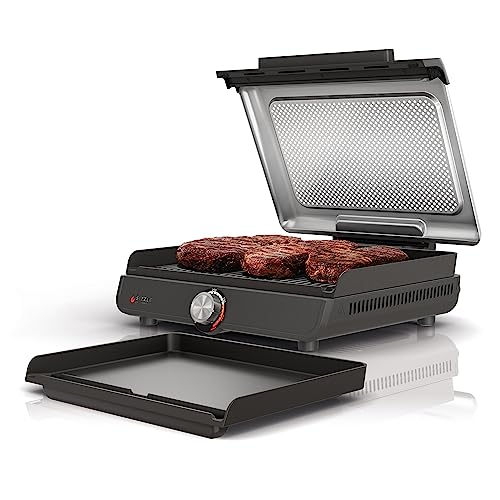
Ninja Sizzle Indoor Grill and Griddle — Best Overall
The Ninja Sizzle earns the top spot because it treats indoor grilling as two jobs rather than one. On weeknights the flat griddle plate handles eggs, pancakes, smash burgers and quesadillas across a wide, evenly heated surface; on weekends the ridged grill plate goes on and produces the dark, defined marks that most electric models only hint at. Edge-to-edge heating matters more than the headline temperature here: corners that run cold are the usual reason indoor grills leave pale edges on steaks, and this design spreads heat across the full plate instead of concentrating it in the middle.
Reaching 500°F also separates it from gentler contact grills. That ceiling lets a thin skirt steak or a pair of chicken thighs develop real browning before the interior overcooks, and the splatter lid keeps much of the resulting spatter inside the unit rather than across the hob. The trade is footprint: with the lid open for loading, it asks for clear counter on three sides, and households that grill twice a day may find swapping and washing two plates a small ritual. For a household that wants one appliance to cover breakfast and barbecue-style dinners, though, the flexibility is genuine rather than decorative.
- Cooking format: countertop grill with swappable grill and griddle plates
- Maximum temperature: 500°F from the verified listing details
- Plate size: 14-inch family-size cooking surface
- Lid: dishwasher-safe splatter lid included in the design
- Cleaning: nonstick plates remove for washing
Strengths
- Genuine 500°F ceiling for hard searing indoors
- Grill and griddle plates swap in seconds
- Even heat reaches the corners of the plate
Trade-offs
- Larger counter footprint than contact grills
- Two plates to wash after mixed meals
- Lid is bulky to store in shallow cabinets
Best for: households that want one countertop unit for breakfast griddling and weeknight searing.
Not suited for: tiny kitchens where a compact folding contact grill is the only thing that fits.

Hamilton Beach Electric Indoor Searing Grill — Best With a Lid
Most indoor grills ask you to choose between an open griddle and a sandwich-press contact grill. The Hamilton Beach takes a third route: a hinged lid that closes over the food like a miniature outdoor barbecue. Cooking with the lid down traps heat around thicker cuts, so pork chops and bone-in chicken pieces cook through more evenly than they do on an open plate, and the viewing window lets you check colour without lifting the lid and dumping the accumulated heat each time.
The 118 square inch plate suits one to three eaters comfortably. Its dedicated sear function pushes the surface hot at the start of cooking, which suits steaks that benefit from an early crust before the temperature settles back for finishing. Because the lid contains spatter, this is also the calmest option for a small kitchen with a smoke alarm nearby. The compromise is batch size: a family of five will cook in rounds, and the lid hinge makes the stored shape taller than flat griddles that slide into a drawer.
- Cooking surface: 118 sq. in. PFAS-free removable nonstick plate
- Temperature control: adjustable dial up to 450°F
- Lid: hinged cover with a viewing window
- Searing function: dedicated high-heat sear setting
- Cleaning: plate and drip tray remove for washing
Strengths
- Lid-down cooking suits thicker cuts
- Viewing window avoids heat loss while checking
- Sear setting builds an early crust
Trade-offs
- 118 sq. in. plate means batches for big families
- Taller profile is awkward in low cabinets
- Dial control is less precise than digital settings
Best for: smaller households cooking chops, chicken and steaks under a lid.
Not suited for: large families who need to feed five or six people in one pass.
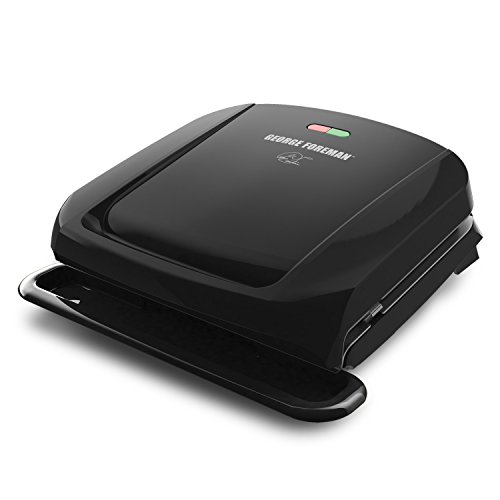
George Foreman 4-Serving Indoor Grill — Best Compact Classic
The George Foreman name is nearly shorthand for indoor grilling, and this four-serving model shows why the format endures. Food cooks between two heated plates at once, so burgers, panini and chicken breasts finish faster than on a single-sided surface, and the sloped bed channels rendered fat away into a drip tray instead of letting food sit in its own grease. For weeknight cooking in a small flat, that combination of speed and tidiness is hard to beat.
Removable plates fix the oldest complaint about this grill family: earlier fixed-plate models were miserable to scrub, while these lift out and wash properly. The limits are equally clear. Contact cooking presses food, so delicate fish fillets and thick bone-in cuts fare poorly, and there is no temperature dial to finesse doneness — timing and thickness do that work instead. Treat it as a fast, honest tool for burgers, sandwiches and boneless cuts rather than a steakhouse substitute and it earns its cupboard space.
- Cooking format: sloped dual-contact grill plates
- Capacity: four servings per batch
- Plates: removable nonstick plates for easier washing
- Fat management: sloped surface channels grease to a drip tray
- Storage: compact body designed for cupboard storage
Strengths
- Dual plates cook both sides at once
- Slope drains fat away from food
- Removable plates wash far more easily
Trade-offs
- No adjustable temperature control
- Pressing action squeezes delicate foods
- Four servings is the hard ceiling per batch
Best for: singles and couples wanting fast burgers, panini and chicken breasts.
Not suited for: cooks who want precise temperature control or thick-cut steaks.

Chefman Smokeless Indoor Electric Grill XL — Best Large Open Grill
Where contact grills press, the Chefman XL spreads out. Its extra-large open surface works like a short-order line: peppers and onions on one side, burgers in the middle, buns warming at the edge. That layout suits households that cook mixed loads and people who enjoy tabletop cooking, where everyone watches dinner happen. Adjustable temperature control lets you hold a gentler zone for vegetables while the centre runs hotter for meat.
The smokeless claim rests on the water tray beneath the element, which cools dripping fat before it can burn and smoke; in practice it reduces smoke noticeably rather than abolishing it, especially with fatty cuts at full heat. Dishwasher-safe parts soften the cleanup that open grills usually demand. The honest cautions are size and speed: an XL surface needs XL storage, and an open grill will never match a lidded or contact model for cooking thick cuts through quickly.
- Cooking format: open flat-top indoor grill, XL surface
- Temperature control: adjustable dial
- Smoke management: water-filled drip tray design
- Cleaning: nonstick surface with dishwasher-safe parts
- Serving style: cook-and-serve at the table
Strengths
- Roomy surface cooks mixed loads at once
- Water tray meaningfully cuts down smoke
- Parts go in the dishwasher after cooking
Trade-offs
- Big footprint demands serious storage space
- Open design cooks thick cuts slowly
- Very fatty food can still produce some smoke
Best for: families who cook mixed grill loads and enjoy tabletop serving.
Not suited for: anyone expecting literally zero smoke with fatty cuts at full heat.

Chefman XL Electric Griddle — Best for Breakfast
Not every indoor grill job involves grill marks. The Chefman XL griddle is the pick for the meals a flat top does best: a dozen pancakes without crowding, eggs that stay put instead of sliding into ridges, bacon lying flat, and grilled sandwiches with an even, all-over crust. The 10 by 20 inch surface is the story here — it converts breakfast for a family from a relay race into a single batch.
The removable temperature control is a quietly excellent detail, because once it is unplugged the whole griddle can go into the sink for a proper wash rather than being wiped around an attached cord. A slide-out drip tray catches bacon fat before it pools. What this unit will not do is sear like a ridged grill or cook with a lid; it is a specialist. Households whose indoor cooking leans toward breakfast, quesadillas and smash burgers will use it weekly, while dedicated steak cooks should look at the lidded or high-heat picks instead.
- Cooking surface: 10 x 20 inch nonstick flat top
- Temperature control: removable probe-style control
- Cleaning: immersible once the control is removed
- Grease handling: slide-out drip tray
- Best tasks: pancakes, eggs, bacon, burgers, quesadillas
Strengths
- Huge flat surface ends breakfast batch cooking
- Fully immersible once the control is removed
- Even heat suits pancakes and eggs perfectly
Trade-offs
- No ridges, so no grill marks at all
- No lid for trapping heat around thick food
- Long shape needs a wide shelf for storage
Best for: breakfast-heavy households and anyone who loves smash burgers and quesadillas.
Not suited for: cooks whose priority is seared steaks with deep grill marks.

1500W 2-in-1 Smokeless Indoor Grill — Best for Korean BBQ
This 2-in-1 unit is built around a social idea: dinner cooked at the table, Korean barbecue style. Thin slices of beef and pork cook in moments on the ridged plate, the flat griddle takes mushrooms, garlic and kimchi, and the three small cheese pans melt dipping cheese at the edge of the heat. At 1500 watts it has enough output to keep up with a table of diners adding food in waves, which is exactly where weaker tabletop grills fall behind and start steaming instead of searing.
As a daily driver it is more mixed. The feature set is broad but the finish and controls are simpler than the big-brand picks above, and replacement parts for unbranded appliances can be harder to source later. Buy it for the experience it is designed around — interactive tabletop meals, hot-pot-adjacent gatherings, melted-cheese everything — and it offers something none of the other five picks replicate. Buy it as a precision steak tool and the dial-only control will frustrate you.
- Power: 1500W electric heating
- Cooking format: removable grill plate and griddle plate
- Extras: three cheese pans for tabletop serving
- Temperature control: adjustable dial
- Cleaning: nonstick plates described as dishwasher safe
Strengths
- Designed for interactive Korean BBQ at the table
- Cheese pans add a genuinely fun serving option
- 1500W output keeps pace with group cooking
Trade-offs
- Simpler controls than the big-brand picks
- Long-term spare parts may be hard to find
- Feature breadth beats depth for solo cooking
Best for: groups who love tabletop Korean barbecue and shared cooking nights.
Not suited for: solo cooks wanting a simple, precise everyday steak grill.
How Do the Six Picks Compare Side by Side?
| Pick | Badge | Format | Key specification |
|---|---|---|---|
| Ninja Sizzle Indoor Grill and Griddle | Best Overall | countertop grill with swappable grill and griddle plates | 500°F from the verified listing details |
| Hamilton Beach Electric Indoor Searing Grill | Best With a Lid | 118 sq. in. PFAS-free removable nonstick plate | adjustable dial up to 450°F |
| George Foreman 4-Serving Indoor Grill | Best Compact Classic | sloped dual-contact grill plates | four servings per batch |
| Chefman Smokeless Indoor Electric Grill XL | Best Large Open Grill | open flat-top indoor grill, XL surface | adjustable dial |
| Chefman XL Electric Griddle | Best for Breakfast | 10 x 20 inch nonstick flat top | removable probe-style control |
| 1500W 2-in-1 Smokeless Indoor Grill | Best for Korean BBQ | 1500W electric heating | removable grill plate and griddle plate |
Read the table as a map of formats rather than a league ladder. The Ninja and Hamilton Beach chase high-heat, lid-assisted cooking; the George Foreman trades finesse for speed; the two Chefman units split the open-surface world between ridged grilling and flat breakfast work; the 1500W combo exists for shared tabletop meals. Once you know which row describes your cooking, the detailed reviews above will confirm whether the details fit your kitchen.
What Actually Makes an Indoor Grill Sear Instead of Steam?
Searing is a race between surface temperature and moisture. When cold, wet meat lands on a plate that is not hot enough, the surface water boils, the temperature collapses, and the food steams in its own juices until the liquid finally evaporates — by which time the interior is grey and overcooked. A grill that preheats fully to 450°F or beyond wins that race: the crust forms in the first minute, before the inside has time to dry out. This is why the picks with genuine high ceilings behave so differently from gentle sandwich presses, and why patting meat dry and preheating with patience matter as much as the appliance itself.
Plate material and heat distribution decide the second half of the equation. Thick plates hold their temperature when food lands; thin ones dip and recover slowly, leaving pale stripes. Even, edge-to-edge heating prevents the familiar pattern of a dark centre and anaemic edges. When you shop beyond this list, press sellers on those two qualities — maximum temperature and recovery — rather than collecting wattage numbers, which describe the plug more than the cooking.
How Can You Keep Smoke Down When Grilling Indoors?
Smoke comes from fat hitting a surface hot enough to burn it, so every control strategy attacks that meeting point. Trimming external fat, choosing leaner cuts for indoor sessions and patting marinades off before cooking all reduce the fuel. Lidded grills contain much of what does form, water-tray designs cool drips before they combust, and a window extractor or a nearby open window handles the remainder. Marinades heavy with sugar smoke earlier and char bitter, so save sweet glazes for the final minute of cooking, brushed on as a finish rather than a bath.
Set expectations honestly: a ribeye at full sear will scent the kitchen whatever you buy. The realistic goal is a kitchen that smells like dinner, not a haze that sets off alarms down the hall. If your household cooks fatty cuts several times a week, prioritise the lidded Hamilton Beach or a water-tray design; if you mostly grill chicken, vegetables and burgers, any pick here will behave well with basic ventilation.
Which Indoor Grill Format Fits the Way You Cook?
Contact grills like the George Foreman are sprinters: both sides cook at once, dinner lands fast, and the method flatters boneless, even-thickness foods. Open grills are hosts — they suit mixed loads, watching food cook and serving at the table. Lidded models are the patient all-rounders, surrounding thicker cuts with heat. Griddles are breakfast specialists that also happen to make superb quesadillas and smash burgers. The most common buying mistake is choosing by maximum capacity or headline temperature while ignoring format, then discovering that a technically excellent grill fights the meals you actually cook.
Think about your last ten grilled meals and let that history vote. Mostly burgers and chicken breasts on busy nights? Contact or lidded. Weekend breakfasts for a crowd? The big griddle. Friends gathered around the table cooking together? The Korean BBQ combo. Steaks are the headline act? Chase the 500°F ceiling. The format question, answered honestly, narrows six good picks to one obvious one.
How Do You Get the Best Results From Your First Cook?
Start with a forgiving food. Boneless chicken thighs, well-seasoned and patted dry, teach you more about a new grill in one session than a expensive steak will, because they brown readily, stay juicy across a range of doneness and reveal the hot and cool zones of the plate without punishing small errors. Preheat the grill empty until it signals ready, then give it two extra minutes; electric plates often report readiness before the whole surface has stabilised, and those two minutes are the cheapest insurance in indoor grilling. Oil the food lightly rather than the plate, lay the pieces down, and then resist touching them. Browning is a contact sport: every lift and shuffle resets the crust clock and tears at the surface you are trying to build.
Work in a deliberate sequence when the meal has several parts. Vegetables that benefit from char — peppers, onions, courgettes — can go on first and rest under foil while the protein cooks, because they hold their quality far better than meat holds its. Cook proteins next, rest them on a warm plate rather than back on the cooling grill, and use the final residual heat for bread, tortillas or halloumi, which need only a minute of contact. Keep a simple log for the first few weeks: food, thickness, setting, minutes per side, result. It feels fussy for about three meals, after which you will have a personal timing chart no manual could give you, because it reflects your grill, your kitchen’s voltage and your taste.
Thickness is the variable beginners most underestimate. Two chicken breasts of uneven thickness will finish at different times on any grill ever made, so either pound them level, butterfly the thick end, or accept staggered removal and use a thermometer rather than the clock to judge each piece. Resting matters indoors exactly as it does outdoors: five quiet minutes under foil lets juices redistribute, and cutting early pours the reward for your patience onto the board. Finally, clean the plates while they are still warm but safe to handle, when residue wipes away in seconds instead of setting into the varnish that makes next week’s dinner taste faintly of this week’s.
What Should You Know About Cleaning and Looking After Nonstick Plates?
Nonstick coatings fail by accumulation rather than catastrophe: a little baked-on oil here, a metal spatula scrape there, a blast of aerosol spray whose propellants bake into a sticky film that no washing fully removes. Brush or pour oil instead of spraying it, use soft tools, and let plates cool before washing so thermal shock does not stress the coating. Dishwasher-safe claims deserve a footnote — most plates survive dishwashing, but hand washing with a soft sponge keeps coatings slick for years longer, and it takes about ninety seconds once the plates are removable.
The drip tray is the forgotten component that decides whether a grill smells fresh or haunted. Empty it after every session, wash it with the plates, and dry everything fully before storage, because a closed grill stored damp grows stale odours that transfer to the next meal. Check the area under removable plates monthly; crumbs and grease migrate there in small amounts and eventually smoke on contact with the element housing. A soft brush and a damp cloth are the whole toolkit. Treat the grill this way and the nonstick surface that made cleanup easy in month one is still making it easy in year three.
How Much Counter and Storage Space Do Indoor Grills Really Need?
Measure three footprints, not one: the closed storage size printed on the box, the open cooking footprint with the lid raised and the cord reaching the socket, and the serving footprint if you plan to cook at the table, where elbows, plates and ingredient bowls join the appliance. Lidded models need vertical clearance under wall cabinets, open XL models need a landing zone beside them for raw and cooked platters, and contact grills need almost nothing, which is precisely their enduring appeal in small flats. If a grill must live on the counter permanently, its looks and closed height start to matter as much as its cooking, because you will see it ten times for every time you use it.
Storage honesty prevents the most common indoor grill regret: the excellent appliance exiled to a high shelf, then quietly never used because fetching it feels like a project. Before buying, nominate the exact cupboard or drawer the grill will live in and measure it. A slightly less capable grill that lives within arm’s reach of the hob will cook a hundred dinners a year; a superior one stored above the fridge will cook six. Every pick in this guide was weighed with that reality in mind, which is why compact competence scores so well here alongside the high-heat flagships.
How Does Indoor Grilling Honestly Compare With Cooking Outdoors?
The honest answer begins with what is missing: smoke. Outdoor grilling over charcoal or wood bathes food in combustion flavours that no electric element can reproduce, and anyone who tells you otherwise is selling something. Wood smoke is an ingredient, and indoor grills do not stock it. What indoor grilling offers instead is control and availability. The temperature of an electric plate is knowable and repeatable in a way a bed of coals never is; the grill is ready in minutes rather than half an hour; and it works in rain, snow, darkness and apartment buildings where outdoor grilling is banned outright. For a Tuesday chicken dinner, availability beats romance almost every time.
Texture is closer than sceptics expect. Browning chemistry does not care whether heat came from charcoal or an element, provided the surface is hot and dry, so crusts, char lines and rendered fat all translate indoors. The gap widens with thick, smoke-loving cuts — brisket, ribs, whole chickens — where hours of smoke are the point of the exercise; those belong outdoors or in a dedicated smoker. It narrows to nothing for the foods most people grill most often: burgers, steaks, chops, sausages, vegetables, fish fillets and sandwiches. Choosing an indoor grill is therefore not a compromise so much as a specialisation, and households that own both tend to use each for what it does best rather than declaring a winner.
Running costs and effort tilt further indoors. There is no charcoal to buy, store and ash out, no propane tank to refill at the worst moment, and no weather check before committing to a menu. Cleanup is a sink job rather than a yard job. The cooks who get the most from an indoor grill are the ones who stop apologising for it and start exploiting its consistency: same setting, same thickness, same minutes, same result, in February as in July.
Which Temperatures and Timings Work as a Starting Point?
Use high heat, 450°F and above, for foods you want to crust quickly: steaks around an inch thick, lamb chops, burgers and firm vegetables. Use the middle range for foods that must cook through without scorching — chicken pieces, thick pork chops, sausages — starting hot for colour and easing down to finish. Use gentle heat for reheating, warming breads, melting cheese over finished burgers and cooking delicate fish that would tear under aggressive handling. These are starting points rather than laws, because thickness, starting temperature and sugar in marinades all move the finish line.
Timing follows thickness more faithfully than weight. A boneless chicken breast pounded even cooks in roughly the time a thick one needs for its centre alone, which is why evening out thickness is the single most useful habit in this entire guide. Judge doneness by thermometer for poultry and pork, by touch and timing for steaks once you have calibrated your own grill with the cooking log described earlier. Rest everything. The cooks who love their indoor grills are not the ones with the most features; they are the ones who learned their machine’s habits in the first month and then stopped thinking about them.
What Should You Check Before You Buy Any Indoor Grill?
Begin with the plug and the counter, not the product page. Indoor grills draw serious current, so they deserve a socket of their own during cooking rather than a shared strip alongside a kettle. Check the cord length against your kitchen layout; a short cord dictates where the grill lives, and a grill that cannot sit under the extractor will smoke up the room it was bought to protect. Then check the ceiling of the temperature range, the removability of every part that touches food or fat, and the availability of replacement plates, because a grill whose plates are discontinued becomes disposable the day the coating wears.
Read the cleaning instructions before the cooking claims. If the manual describes wiping around a fixed element with a damp cloth, understand that you will be doing exactly that, greasy-handed, after every meal, and decide whether the cooking justifies it. Look for drip trays that slide out from the front rather than lifting out through the cooking area, hinges that do not trap food, and control dials you can read at a glance. Small frictions decide whether an appliance becomes a habit or a cupboard resident, and they are all visible before purchase if you know to look.
Finally, match the warranty and the brand’s support footprint to your expectations. Established makers stock plates and trays for years and answer for their products; unbranded bargains can be excellent value for occasion cooking but should be bought with disposable expectations. Neither choice is wrong — the mistake is paying flagship money for disposable support, or expecting a decade of service from a novelty appliance. The six picks above were sorted with exactly that honesty in mind, which is why the specialist bargains sit beside the flagships rather than pretending to replace them.
How Do You Adapt Outdoor Recipes for an Indoor Grill?
Most outdoor recipes translate with three adjustments. First, reduce sugar: marinades and rubs designed for the gentler distance of a grate over coals scorch on a contact plate, so cut sweeteners, move them into a finishing glaze, or shorten the cooking time at full heat. Second, dry everything more thoroughly than you would for outdoor cooking, because an electric plate has less surplus heat to boil off surface moisture before browning must begin. Third, scale thickness down slightly; an inch-and-a-quarter steak is the indoor sweet spot, giving the crust time to form before the centre overshoots.
Smoke flavour, the missing ingredient, can be hinted at honestly: smoked paprika, a pinch of smoked salt, or a brief rest with a lid over a few drops of liquid smoke in the marinade all gesture in the right direction without pretending to be the real thing. Restraint is the key — these are accents, not substitutes, and a heavy hand makes food taste artificial. Adapted this way, most weeknight outdoor recipes lose remarkably little indoors, and the ones that suffer most, the long smoked projects, were never weeknight food anyway.
What About Safety, Ventilation and Everyday Practicalities?
Electric indoor grills remove the two hazards that dominate outdoor grilling — open flame and carbon monoxide — which is why they are permitted in buildings where gas and charcoal are banned. The remaining hazards are ordinary kitchen ones, but they deserve respect because the appliance runs hotter than most. Treat the plates like a hob: assume they are hot whenever the unit is plugged in, keep the cord clear of the cooking surface, and never leave a grill at full sear unattended with fatty food aboard. Let the unit cool on a heatproof surface rather than sliding it into a cupboard warm, and keep aerosol sprays away entirely, since their propellants are flammable as well as bad for coatings.
Ventilation deserves a plan rather than hope. The extractor hood on its higher setting, started a minute before the food lands, captures most of what rises; where no hood exists, a window fan blowing outward near the cooking zone does the same job. Positioning matters more than power: a grill placed directly under the hood produces a fraction of the room haze of the same grill on a side counter. Households with sensitive alarms often find that lidded cooking plus a working extractor ends the problem completely, while open grilling of fatty cuts remains an occasional, windows-open pleasure rather than a nightly routine.
Practicalities decide the rest. A grill that preheats during the time it takes to season food and make a salad fits weeknight life; one that needs fifteen minutes of planning becomes a weekend appliance. Noise is rarely an issue with electric plates, which makes them flat-friendly in a way extractor-heavy cooking is not. And because there is no fuel to run out, the only consumable is the occasional replacement plate — one more reason to check parts availability before you fall for any model, in this guide or beyond it.
What Are the Most Common Mistakes With Indoor Grills?
The first mistake is skipping the preheat. Electric plates need several minutes to stabilise, and food added early steams instead of searing. The second is overcrowding: pieces packed edge to edge trap moisture and drop the surface temperature, so cook in two relaxed batches rather than one soggy one. Third comes marinade mismanagement — sugary or oily baths left dripping on the meat smoke heavily and char before the food cooks. Shake off the excess, and add sweet glazes late.
Fourth, people store the grill before it is fully dry, inviting stale odours into the nonstick surface. Fifth, they judge an indoor grill by charcoal standards on day one and dismiss it, instead of learning its strengths: consistency, speed and weather independence. Finally, many buyers ignore cleaning design at purchase and pay for it nightly; removable plates and a reachable drip tray are worth more than a novelty feature you will use twice.
One more consideration separates satisfied owners from disappointed ones: how the grill behaves in its second year. Nonstick surfaces relax, hinges loosen slightly, and the cook’s novelty fades, so the models that remain loved are the ones whose everyday virtues — fast preheat, honest browning, painless washing — never depended on novelty. Read the detailed reviews above with that horizon in mind. A feature you use twice a year cannot compensate for a drip tray you fight weekly, and a slightly smaller plate that washes in the sink will out-cook a vast one that lives dirty. Longevity in this category is mostly a cleaning story, which is why this guide returns to it so often.
Budget thinking follows the same logic. Money spent on plate quality, temperature ceiling and lid design returns value at every meal, while money spent on novelty attachments returns it rarely. If your budget forces a choice, buy the simpler grill from a maker who stocks spare plates over the feature-laden one from a maker who does not. The second year of ownership will thank you for the decision, and so will every weeknight cook who opens the cupboard and finds the grill clean, complete and ready.
Accessories deserve a brief, sceptical word. Most indoor grills need nothing beyond a good spatula, tongs with silicone tips and a thermometer, yet the accessory market will happily sell you baskets, presses and specialty plates. A flat press helps bacon and sandwiches on open griddles, and a second set of plates can suit households that alternate daily between grilling and griddling. Beyond that, spend on ingredients rather than attachments: better chicken, thicker steaks and fresher vegetables improve indoor grilling more than any add-on, because the appliance’s job is simply to apply even heat while the food does the rest.
Keep the thermometer habit even after the log phase ends. Electric grills hold their settings faithfully, but food varies — a thicker chop, a colder fridge, a fattier batch of burgers — and the thermometer is what turns that everyday variation from an unwelcome surprise at the table into a small, calm, confident adjustment right at the grill itself.
Final Recommendation
For most households, the Ninja Sizzle Indoor Grill and Griddle is the indoor grill to buy: it sears at a genuine 500°F, swaps between grill and griddle duties, and heats evenly enough that the corners of the plate are not a compromise zone. Households cooking for one or two under a lid will be happier with the Hamilton Beach Electric Indoor Searing Grill, while breakfast-led homes should take the Chefman XL Electric Griddle and enjoy single-batch pancakes. When the first cold evening of autumn shuts the patio door, the right indoor grill is the one already washed, stored and waiting — and any of these six will make that evening feel like a plan rather than a compromise.
Frequently Asked Questions
Can an electric indoor grill really sear a steak?
Yes, provided it reaches roughly 450°F or higher and you preheat it fully, dry the meat well and avoid crowding the plate. The crust will differ from charcoal — there is no smoke kiss — but the browning, texture and speed are genuinely steak-worthy on the high-heat picks in this guide.
Are smokeless indoor grills completely smoke-free?
No grill that sears fatty food is literally smoke-free. Water trays, lids and good design reduce smoke substantially, and lean cuts produce very little, but a well-marbled steak at full heat will still scent the room. Plan on a window or extractor as a partner to any smokeless design.
What size indoor grill do I need for a family of four?
Around 118 square inches cooks for four in two quick batches; larger open surfaces handle the whole load at once. If most meals are for two, a compact contact grill stores better and preheats faster, and batch cooking the occasional bigger meal is painless.
Can I use metal utensils on nonstick grill plates?
Use silicone, wood or nylon tools to protect the coating, even on plates described as metal-utensil safe. Protecting the nonstick surface is the cheapest way to extend the grill’s life, because once the coating scars, food sticks and cleaning becomes the chore everyone dreads.
How do I stop vegetables sliding around on a griddle?
Cut vegetables into planks or thick slices rather than rounds, oil the food instead of flooding the plate, and let pieces sit undisturbed until they release naturally. A light press with a spatula after the first side browns helps thinner slices make full contact.
Do indoor grills work in flats with strict smoke alarms?
Generally yes, with sensible habits. Choose lidded or water-tray models, cook leaner cuts indoors, keep the extractor running and avoid sugary marinades at full heat. The combination keeps airborne fat low enough for all but the most sensitive alarms, and cooking with the lid down makes the biggest single difference.
Can I cook frozen burgers on an indoor grill?
Contact and lidded grills handle frozen burgers well because heat surrounds the food; open griddles cook them unevenly unless you thaw first. Add a few minutes, expect more moisture on the plate, and check the centre with a thermometer until you know your grill’s timing for the brand you buy.
Related Guides
Grilling season planning continues in our companion guides: see Best Black Friday Grills for timing a bigger outdoor purchase, Best Food Processors, Judged by Test-Kitchen Standards for prep work that makes grill night faster, and Best Coffee Beans for Automatic Espresso Machines for the after-dinner cup.


