What's inside
- Key Takeaways
- Quick Picks
- How Did We Choose These Patio Grills?
- Best Patio Grills: Which Belong in Your Outdoor Room?
- How Do the Patio Picks Compare?
- How Should You Lay Out a Patio Around a Grill?
- Gas, Charcoal, Pellets or a Griddle: Which Suits a Patio Best?
- How Do You Cook for a Crowd on a Patio Grill?
- How Do You Keep a Patio Grill Looking Good for Years?
- How Do You Handle Wind, Rain and Winter on a Patio?
- What Should You Cook First on a New Patio Grill?
- What Mistakes Do Patio Grill Owners Regret Most?
- Final Recommendation
- Frequently Asked Questions
- Related Guides
As an Amazon Associate I earn from qualifying purchases. This post may contain affiliate links at no extra cost to you.
cottageverdict.com is reader-supported. When you buy through links on our site, we may earn an affiliate commission.
Where to buy: each grill in this guide links to its Amazon listing, where you can check price on Amazon and confirm the assembled footprint, lid height and fuel requirements before ordering. Patio purchases live outdoors in full view, so measure the space, walk the delivery route and check the surface it will stand on with the same care you give the cooking specifications.
The best patio grills understand that a patio is not a small backyard; it is an outdoor room. The grill that lives there has to cook beautifully, certainly, but it also has to look like it belongs beside the furniture, share its square metres politely with chairs and planters, and avoid smoking out the conversation it was bought to feed. This guide picks six machines that meet that fuller brief, spanning gas cabinets, a flat-top griddle, the classic kettle, a folding travel grill doing patio duty, and a pellet smoker for leisurely weekends.
Variety is the point. A patio that hosts Tuesday burgers for two and a Saturday crowd of ten needs a different machine from a balcony-adjacent terrace where the grill shares space with a herb garden, and both differ from the entertainer’s patio where a griddle turns breakfast into an event. The six picks below were chosen to cover those lives honestly, with their space demands, smoke behaviour and storage needs stated as plainly as their cooking talents.
One more promise about method: every pick below was assessed as a piece of patio life, not only as a cooker, so its review covers where it stands, how it stores, what it does to the paving and the neighbours, and how it behaves in February as well as July. Readers who only care about the cooking will find those judgements in the first paragraphs of each review; readers furnishing a whole outdoor room will find the rest of the story waiting in the paragraphs after.
Read for your patio’s reality: its size, its surface, its exposure to wind and neighbours, and whether the grill will live there permanently or roll away between sessions. The right answer is the machine that fits all of that and still makes you want to cook outside on an ordinary evening, because that wanting, repeated across a season, is what a patio grill is actually for.
Key Takeaways
- A patio grill is furniture as well as appliance: footprint, silhouette and storage belong in the decision.
- Gas cabinets suit permanent patios and frequent, fast cooking for family and guests.
- A flat-top griddle opens a whole second menu: breakfasts, smash burgers, stir-fries and teppanyaki nights.
- The kettle remains the best-value patio cooker and stores in the least space when the season ends.
- Portable grills on stands serve small patios brilliantly and disappear into storage between uses.
- Pellet grills turn a patio into a weekend smokehouse, provided an outdoor outlet is within reach.
Quick Picks
| Pick | Badge | Why it earned a place |
|---|---|---|
| Charbroil Performance Series 4-Burner Gas Grill | Best Patio Gas Grill | A black cabinet grill with four burners and a side burner that anchors a permanent patio like outdoor furniture. |
| Monument Grills 4-Burner Propane Gas Grill | Best for Steak Nights | A stainless patio grill with an advanced broil zone, foldable shelves and a five-minute sprint to 500°F. |
| Blackstone 28 Inch Omnivore Griddle | Best Patio Griddle | A 28-inch two-burner flat top with hood and side shelves that turns the patio into a breakfast and smash-burger station. |
| Weber Original Kettle Premium 22 Inch | Best Value Patio Grill | The enamelled kettle with lid thermometer and tidy ash catcher: the most flavour per patio square foot available. |
| Coleman RoadTrip 285 Portable Propane Grill | Best for Small Patios | A three-burner grill on a collapsible stand with 20,000 BTU that cooks like a patio grill and stores like luggage. |
| Traeger Pro 22 Pellet Grill | Best Patio Smoker | A 572-square-inch pellet grill that turns a powered patio corner into a weekend smokehouse with set-and-hold ease. |
How Did We Choose These Patio Grills?
We started with the room, not the fire. Each candidate was assessed for the patio it would actually occupy: assembled footprint, the working space a cook needs around it, lid clearance under pergolas and eaves, and whether its silhouette reads as furniture or as machinery. Grills that cook wonderfully but colonise a modest patio were marked down, however fond of them we were, because a patio grill that crowds out the seating has failed its first job.
Cooking range came second, judged across the patio repertoire rather than a single speciality: weeknight proteins, weekend gatherings, vegetables and sides cooked alongside, and the breakfast and brunch duty that patios increasingly host. The six survivors each own a distinct territory in that repertoire, from the griddle’s flat-top theatre to the pellet grill’s low-and-slow patience, with minimal overlap in what they do best.
Neighbourliness was scored as a real criterion. Smoke output at lighting, grease management, noise from fans and augers, and how quickly a grill shuts down at the end of the evening all matter when other households live a fence away. The picks here behave politely by design: lids that contain splatter, grease systems that keep fat off the fire, and fuel choices that let a cook modulate the drama.
We also listened for the sounds a patio makes. A grill is a neighbour in the room: pellet fans hum, kettle lids clang, cabinet doors shut with varying conviction, and a machine whose noises grate on its owners gets used less in the quiet evenings that patios exist for. Build quality reveals itself to the ear as reliably as to the eye, and the picks here all sound like equipment rather than packaging.
Finally, we considered the patio year, not just the patio summer. Covers that fit, wheels that roll on paving, materials that shrug off the local climate, and storage footprints for the machines that come indoors all counted. A patio grill is bought for years of evenings, and the ones below were chosen to still be pleasant company in year five.
Best Patio Grills: Which Belong in Your Outdoor Room?

Charbroil Performance Series 4-Burner Gas Grill — Best Patio Gas Grill
On a permanent patio, the Charbroil Performance Series earns its place before it ever lights, because its black cabinet silhouette sits among outdoor furniture without shouting appliance. The tank disappears into the cabinet, the lines are clean, and the whole machine reads as a deliberate piece of the room’s design rather than an interloper parked in the corner. Then it lights in seconds and cooks like the family workhorse it is, which is the combination patio owners actually live with.
The four burners map neatly onto patio entertaining. A hot zone for the proteins, a calm zone for vegetables and warming, and the side burner running corn, beans or a sauce within the cook’s reach, so the person grilling stays in the conversation instead of commuting to the kitchen. That social geometry is the real product here: a grill positioned and equipped so hosting does not exile the host.
Patio surfaces will appreciate its manners. The enclosed cabinet keeps the grease system tidy, drippings route to a removable tray rather than the paving, and the lid contains the splatter that freckles lighter grills’ surroundings. Porcelain-coated grates wipe down after the cook, and the whole machine, under a fitted cover between sessions, keeps the tidy appearance that justified its place in the room.
Its scale is the one condition: this is a fixture for patios that can give it a permanent corner with proper clearances, not a machine to squeeze past. Assembly is a two-person session, and the propane routine, a spare tank in the cabinet’s orbit, becomes part of the household’s background habits. For patios with the room, it is the most complete answer in this guide: fast on Tuesdays, capacious on Saturdays, handsome every day.
Owners furnishing a patio in stages often find this grill reorganises the plan around itself, in a good way: seating turns to face it, a prep surface appears beside it, and the outdoor room acquires a kitchen end and a lounging end. Equipment that improves the space it occupies, rather than merely fitting into it, is rarer than specification sheets suggest.
Winter behaviour deserves a line in a patio guide, because this grill will likely winter in place. Under its cover, with the tank valve closed and the grease tray emptied, it asks nothing until spring, when a burner check and a grate scrub return it to service in an hour. Machines that winter gracefully get lit in March; machines that winter badly get replaced in May, and the Charbroil’s simple gas architecture is firmly in the first camp.
- Format: Cabinet-style patio fixture in black
- Burners: 4 main burners plus side burner
- Tank storage: Enclosed cabinet hides the propane tank
- Grates: Porcelain-coated for easy wiping
- Grease route: Removable tray keeps drips off paving
- Placement: Permanent corner with standard clearances
Strengths
- Looks like furniture, cooks like a workhorse
- Side burner keeps the host in the party
- Tidy grease handling protects patio surfaces
Trade-offs
- Needs a permanent, spacious patio corner
- Assembly is a two-person job
- No smoke flavour without an accessory tube
Best for: households with a settled patio who grill and host frequently. Not suited for: small terraces, or renters who move the grill seasonally. Check price on Amazon.

Monument Grills 4-Burner Propane Gas Grill — Best for Steak Nights
The Monument brings a stainless presence to the patio and a broil zone to the cooking, and the pairing defines it. Where standard gas burners brown a steak politely, the dedicated broil zone concentrates heat into the kind of fierce, crust-building blast that steak nights are remembered by, while the four main burners handle the rest of the menu with the zoning flexibility a gathering requires. It reaches 500°F in about five minutes, which changes weeknight behaviour: preheating stops being a plan and becomes a button press.
Patio practicalities were clearly on the designer’s desk. The side shelves fold down, so the grill’s parked footprint shrinks against a wall or fence when the patio needs its space back for a party that is not about grilling. The clear-view lid window lets the cook check progress without venting the heat, a small courtesy that compounds across an evening of batches. Assembly is engineered to be fast and square, and a grill that goes together true tends to stay true.
Stainless on a patio is a commitment as well as a look. It rewards a wipe-down habit and a cover, and it punishes neglect with water spots and fingerprints rather than rust, which most owners count as the better bargain. The Mesa-series styling, clean lines and uncluttered front, suits contemporary patios particularly well, and the cabinet keeps the tank and tools behind closed doors where the room’s tidiness survives a season of use.
Cooking beyond steak night is fully covered: the four burners run a gentle corner for fish and vegetables, the warming arrangements hold finished batches, and the total package feeds a family gathering without the relay cooking that smaller grills impose. Gas manners apply throughout, instant on, instant off, minimal smoke beyond the food’s own, which neighbours across a fence experience as consideration.
Choose it when the patio’s calendar features serious grilling, steaks, chops and burgers done properly, and when a stainless fixture suits the room’s design. It is the enthusiast’s gas pick in this guide, the one whose extra firepower gets used weekly rather than admired annually.
A detail hosts will appreciate: the fast heat-up changes party timing. Instead of lighting the grill half an hour before guests arrive and guarding it, the cook can socialise first and fire the Monument when the first tray of steaks is ready, with the broil zone at temperature before the drinks are refreshed. Convenience features are often trivial; this one restructures the evening, and it is the reason owners mention the five-minute figure unprompted.
- Body: Stainless steel, contemporary Mesa styling
- Burners: 4 main burners plus an advanced broil zone
- Heat-up: About 5 minutes to 500°F
- Shelves: Foldable side shelves for a smaller parked footprint
- Lid: Clear-view window for no-lift checking
- Storage: Cabinet for tank and tools
Strengths
- Broil zone delivers genuine steakhouse crust
- Folding shelves shrink its parked footprint
- Fast heat-up suits spontaneous weeknight cooks
Trade-offs
- Stainless shows fingerprints without a wipe habit
- Premium position among gas patio picks
- Cabinet scale still needs a real patio corner
Best for: steak-night households wanting a stainless patio centrepiece. Not suited for: tiny patios, or buyers indifferent to searing power. Check price on Amazon.

Blackstone 28 Inch Omnivore Griddle — Best Patio Griddle
The Blackstone is the pick that changes the menu rather than the grill. Its 28-inch flat steel top, heated by two burners under a hood, cooks everything a grate cannot: eggs and pancakes at dawn, smash burgers with lacy edges at noon, fried rice, cheesesteaks, fajitas and a whole farmers-market of vegetables at night. On a patio, that range turns the grill corner into an outdoor kitchen in the literal sense, and households that buy one routinely report cooking outside more often, not merely differently.
The Omnivore plate is the engineering headline: a griddle top designed for more even heat and better wind resistance than earlier flat tops, so the corners work like the middle and a breezy patio stops dictating the menu. The hood adds a capability griddles used to lack, trapping heat to melt cheese, steam vegetables and finish thick items, while the counter-height side shelves stage the parade of bowls and trays that flat-top cooking generates.
Technique on a griddle is its own craft, quickly learned and deeply satisfying. The top gets seasoned like cast iron until it darkens and slickens; food cooks in zones, hot for searing, cooler for holding; and the cleanup ritual, scrape, steam with water while hot, wipe, oil lightly, takes three minutes and leaves the surface ready for tomorrow. There are no grates to brush and no flare-ups ever, because fat runs to the grease cup instead of onto a fire.
Its limits are the mirror of its gifts. There is no smoke and no grill-mark theatre, delicate fish needs confidence, and the flat top asks for its seasoning and oiling discipline in all weathers, with the hood and a cover protecting the surface between cooks. It also complements rather than replaces a grate grill for many households, though a surprising number discover the griddle doing eighty percent of the work by the second summer.
For patios that host brunches, big breakfasts and crowd-pleasing burger nights, nothing else in this guide creates the same theatre or feeds people as fluidly. The cook performs in the open, the food arrives in waves, and the patio becomes the house’s favourite room three seasons a year.
Budget honestly for the ecosystem: a pair of wide spatulas, a scraper, squeeze bottles for oil and water, and a stack of small trays are the griddle’s working kit, and they cost less than one dinner cooked on it. None is optional in practice, because flat-top cooking is a two-handed, staged performance, and the households that equip it properly from day one are the ones whose griddles look seasoned and effortless by the second month.
- Surface: 28-inch flat steel griddle top
- Burners: 2 propane burners beneath the plate
- Plate design: Omnivore top for even heat and wind resistance
- Hood: Included, for melting, steaming and finishing
- Shelves: Counter-height side shelves both sides
- Grease handling: Rear grease cup, no flare-ups possible
Strengths
- Unlocks breakfasts, smash burgers and stir-fries
- No flare-ups; fat drains away from the fire
- Feeds crowds in fluid, theatrical batches
Trade-offs
- No smoke flavour or grill marks
- Steel top needs seasoning and oiling care
- Complements rather than replaces a grate for purists
Best for: patio hosts who cook breakfasts and burger nights for a crowd. Not suited for: smoke seekers, or anyone wanting one cooker only. Check price on Amazon.

Weber Original Kettle Premium 22 Inch — Best Value Patio Grill
Every patio guide needs its value conscience, and the kettle wears the badge without embarrassment. For a fraction of the cabinet grills’ commitment, the Premium kettle delivers the deepest charcoal flavour in this list, a built-in lid thermometer for roasting work, and an ash system tidy enough for paved life: the One-Touch sweep drops ash into an enclosed catcher that lifts out for the bin, sparing the patio the grey dust that open ash pans scatter.
Its patio manners are better than its silhouette suggests. The round footprint tucks into corners and beside planters where rectangular cabinets cannot go, the wheels roll it to the evening’s best spot and back to its parking place, and the enamel finish, black and glossy, looks deliberate among garden furniture rather than industrial. When winter comes, it stores in a shed corner that the cabinet grills could never fit, returning the patio to its cold-season arrangement.
Cooking is the kettle canon, refined by the Premium trim. The hinged grate admits extra coals mid-cook without moving the food, the thermometer turns roasting from folklore into a reading, and the damper pair gives the cook a thermostat operated by fingertips and experience. Two-zone fires handle the patio repertoire from burgers to a whole chicken, and the flavour, smoke-kissed and honest, is the reason charcoal survives every convenience revolution the industry launches.
The patio-specific cautions are ember discipline and ash patience. Sparks belong inside the bowl, so windy evenings call for the lid and a sensible position away from furniture; ash leaves only when fully cold, into a metal container, never scattered on planting beds mid-season however often visitors claim it helps the roses. A heatproof mat beneath the kettle protects pale paving from the occasional escaped coal and completes the good-neighbour setup.
As a first patio grill, a second grill beside a gas cabinet, or the only grill on a small patio, the kettle’s case is overwhelming: the least space, the least money, the most flavour, and a working life that the durability coverage elsewhere in this batch measures in decades. Patios have been happily organised around this black bowl for generations, and the reasons have not aged.
Second-hand shoppers should know the kettle is the safest used purchase in this entire guide: the enamel either survived or visibly did not, every part is replaceable, and a neglected example can be restored with a brush, new grates and an afternoon. A patio furnished partly from the used market, anchored by a sound kettle, is not a compromise story; it is how many of the best patios in the country actually began.
- Body: Porcelain-enamelled bowl and lid, black
- Grate: 22-inch, hinged for mid-cook coal access
- Thermometer: Built into the lid for roasting
- Ash system: One-Touch sweep into an enclosed catcher
- Footprint: Round and compact; wheels for repositioning
- Storage: Shed-friendly size for winter parking
Strengths
- Most charcoal flavour per unit of patio
- Enclosed ash catcher keeps paving clean
- Stores in a fraction of a cabinet grill’s space
Trade-offs
- Charcoal routine: lighting, ash, patience
- No side tables; wants a small table beside it
- Wind and embers need sensible management
Best for: flavour-first cooks and small patios alike. Not suited for: anyone wanting push-button weeknight speed. Check price on Amazon.
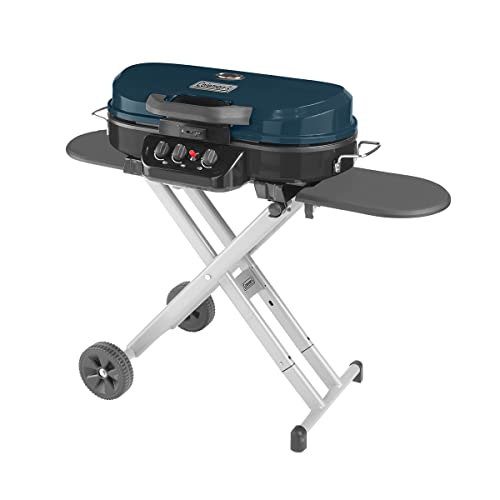
Coleman RoadTrip 285 Portable Propane Grill — Best for Small Patios
The RoadTrip 285 solves the small patio’s central dilemma: how to own a real grill in a space that cannot give one a permanent home. Mounted on its collapsible stand, it is a three-burner propane grill with 20,000 BTU and interchangeable cooktops; folded, it rolls into a garage corner, a storage cupboard or a car boot, and the patio returns to chairs and plants. For renters and small-space households, that disappearing act is not a compromise feature; it is the entire point.
Cooking credentials survive the portability. Three burners give the zoning that one-burner travel grills lack, the Instastart ignition lights without matches, and the grate area handles a family meal in one round rather than the relays small grills usually impose. Swappable cooktops, griddle and stove grates exist in its ecosystem, extend the same machine from burgers to breakfasts to a pot of chilli, which matters when it is the only grill a household owns.
Patio life with it is refreshingly uncommitted. It runs on small canisters for the lightest setup or a full tank with an adapter hose when parked for the season, it wipes down and folds in minutes after the cook, and its absence between sessions means weather, covers and patio tidiness simply stop being grill problems. The trade is stability and presence: a stand grill feels lighter under a full grate than a cabinet does, and nobody mistakes it for furniture.
Its second life is the one in the name. The same machine that grills Tuesday’s chicken on the patio rides to campsites, tailgates and beach-house weekends, which spreads its cost across far more cooking than a fixed patio grill ever sees. Households that split their outdoor life between home and away get two appliances’ work from this one purchase, and small patios get a grill that never overstays its welcome.
Choose it when space is the binding constraint and versatility the ambition. It will not anchor a patio’s design, and it will not try to; it will cook honestly, store invisibly and travel happily, which is a complete answer to a very common brief.
Students in house shares and young households in first homes form an unglamorous but perfect audience here: one purchase covers the patio, the park and the festival field, stores in the space a suitcase would take, and asks for no permanent claim on a landlord’s garden. Equipment that fits the mobile years of life, without cooking like a toy, is a genuinely scarce product, and the RoadTrip has quietly owned that niche for a long time.
- Burners: 3 burners, 20,000 BTU total
- Stand: Collapsible with wheels, folds for storage
- Ignition: Instastart push-button, matchless
- Cooktops: Interchangeable grate options in its ecosystem
- Fuel: Propane canisters or tank with adapter hose
- Best load: A family meal in a single round
Strengths
- Real three-burner cooking that folds away
- Doubles as the household’s travel grill
- Flexible fuel: canisters or a full tank
Trade-offs
- Stand feels lighter than a cabinet grill
- No furniture presence when set up
- Smaller grate than the fixed patio picks
Best for: small patios, renters and households that grill at home and away. Not suited for: design-led patios wanting a permanent fixture. Check price on Amazon.

Traeger Pro 22 Pellet Grill — Best Patio Smoker
A patio with an outdoor outlet and a household that loves smoked food has a standing invitation for this machine. The Pro 22’s barrel body, 572 square inches and pellet-fired convection turn the patio’s corner into a part-time smokehouse: briskets and shoulders at the weekend, roasted chickens and baked sides through the week, all at temperatures the controller holds while the cook is elsewhere being a host, a parent or a person reading a book.
Its patio behaviour is civilised in the ways that matter to neighbours. Pellet smoke at cooking temperatures is a steady, pleasant wisp rather than a bonfire’s announcement, the fan’s hum is modest, and the enclosed fire means no embers, no flare-ups and no ash cloud when the lid opens. The drip bucket and grease path keep the paving clean when maintained, and the all-terrain wheels let the grill roll to the patio’s lee side when wind picks a fight with the smoke direction.
The cooking repertoire flatters patio entertaining specifically. Start a pork shoulder in the morning, spend the day with your guests instead of your fire, and pull the meat when the probe gives the word; bake the cornbread and cobbler in the same chamber while the meat rests, because a pellet grill is a wood-fired oven that happens to live outside. That oven identity, more than any single barbecue triumph, is what patio owners end up using weekly.
Commitments come with the smoke. Pellets need dry storage within carrying distance, ideally a sealed bin on the patio itself; the firepot wants its regular vacuum; and the grill’s appetite for electricity, though small, ties it to the outlet’s neighbourhood when siting the patio layout. None of these survive contact with a household that actually wants smoked food; they are simply the terms, stated plainly as this guide promises.
As the patio’s second grill beside a fast gas machine, or as the only grill in a smoke-loving household, the Pro 22 earns its corner completely. It is the pick for cooks whose patio dream is measured in hours of gentle smoke and tables of people who cannot believe the brisket was the easy part.
One siting tip specific to pellet patios: give the grill a small, dedicated zone with the pellet bin, a weatherproof box for tools and the cover’s parking spot all within arm’s reach, and the machine’s whole routine, load, cook, clean, cover, happens inside that square metre. Pellet grilling rewards an organised station more than any other fuel here, because its chores are small but numerous, and a station that absorbs them makes the routine feel like nothing at all.
- Cooking space: 572 sq in in a barrel body
- Hopper: 18 lb for long patio sessions
- Temperature ceiling: 450°F, with a meat probe included
- Smoke character: Steady, neighbour-friendly wisp at smoking heat
- Mobility: All-terrain wheels for repositioning
- Power: Standard outlet within cord reach of its corner
Strengths
- Set-and-hold smoking frees the host completely
- Doubles as a wood-fired patio oven
- Contained fire suits paved, furnished spaces
Trade-offs
- Needs power and dry pellet storage nearby
- Fan and auger add a cleaning rhythm
- Grilling sear is gentle without a pan assist
Best for: smoke-loving households with a powered patio corner. Not suited for: patios without an outdoor outlet, or sear-first cooks. Check price on Amazon.
How Do the Patio Picks Compare?
The table’s honest message is that patio grills are chosen by lifestyle first and specification second. The two gas cabinets anchor permanent patios, the griddle rewrites the menu, the kettle minimises cost and footprint while maximising flavour, the RoadTrip disappears on demand, and the pellet grill converts a corner into a smokehouse. No row of this table is the wrong answer; each is the right answer to a different patio.
Footprint deserves the final word in the comparison, because it is the specification owners feel daily. Measure yours with the lid open and the cook standing in position, shelves out where they fold, and the true size of each candidate will sort this list faster than any cooking figure can.
| Pick | Fuel and heat source | Cooking space | Standout trait |
|---|---|---|---|
| Charbroil Performance Series 4-Burner Gas Grill | Propane cabinet | Family-size grate | The patio anchor grill |
| Monument Grills 4-Burner Propane Gas Grill | Propane, broil zone | Full-size grate | Searing power, folding shelves |
| Blackstone 28 Inch Omnivore Griddle | Propane flat top | 28-inch griddle | The menu-changing pick |
| Weber Original Kettle Premium 22 Inch | Charcoal kettle | 22-inch grate | Flavour per square foot |
| Coleman RoadTrip 285 Portable Propane Grill | Propane, folding stand | 3-burner portable grate | Cooks big, stores small |
| Traeger Pro 22 Pellet Grill | Wood pellets | 572 sq in | The weekend smokehouse |
How Should You Lay Out a Patio Around a Grill?
Give the grill a working triangle of its own: the machine, a landing surface for raw and cooked trays, and a path to the kitchen door that does not cross the seating. Even a small folding table transforms grilling from juggling into cooking, and positioning the grill so the cook faces the guests, rather than the fence, turns the evening’s work into part of its entertainment. Manufacturers’ clearances from walls, rails and overhangs are minimums; comfort usually asks for a little more.
Think about smoke and sightlines together. A grill placed where its smoke crosses the seating, or where the prevailing breeze delivers it to a neighbour’s windows, will generate friction no recipe can fix, while the same machine two metres away, in the lee of the house, behaves like a different product. Pellet and gas picks forgive poor placement more readily; charcoal asks for the thoughtful corner and rewards it.
Surfaces and storage complete the layout. A level, non-combustible standing area, a mat under charcoal and portable models, a covered spot or a storage route for the machines that come indoors, and a home for fuel that keeps it dry and out of sight: these unglamorous decisions are the difference between a patio that hosts grilling and a patio that merely contains a grill.
Gas, Charcoal, Pellets or a Griddle: Which Suits a Patio Best?
Gas suits the patio that cooks often and cleans rarely: instant heat, tidy manners, a furniture-like presence and food that tastes cleanly of itself. It is the default for permanent patios and busy households, and the two cabinets here show the sensible and the enthusiastic versions of the idea. Its flavour ceiling is its only real concession, and a smoker tube buys back part of the difference for the cuts that miss it most.
Charcoal suits the patio that treats cooking as the evening’s event. It asks for time, a little technique and ember discipline, and it returns flavour and ritual that no valve can imitate, in the kettle’s case at the smallest cost and footprint in this guide. Pellets suit the patio that wants smoke without attendance, trading electricity and cleaning for weekends of freedom, while the griddle suits the patio that hosts: breakfasts, burgers and stir-fries in theatrical, crowd-feeding waves.
Many mature patios end with two machines, most often a gas cabinet for the week and a kettle or pellet grill for the weekend, because the pairing covers every mood a household has. If your budget or space allows only one, choose by your most frequent evening, not your most ambitious one; the grill that serves Tuesdays faithfully will be loved longer than the one bought for a single legendary Saturday.
How Do You Cook for a Crowd on a Patio Grill?
Crowd cooking is a scheduling art disguised as a grilling skill. Start with foods that hold well, smoked shoulders, sausages and chicken thighs, and let them rest warm while the fast items, burgers, steaks and vegetables, cook in waves at serving time. Warming racks, low zones and the pellet grill’s oven character all become holding infrastructure, and a cooler lined with towels is the veteran’s secret chamber for resting meat at safe warmth through a long party.
Set the patio up like a small kitchen before the first guest arrives: raw and cooked trays separated, tongs for each, sauces and seasoning within the cook’s reach, and a drinks station far enough from the grill that guests do not queue across the cooking zone. On a griddle, the crowd cooks in the open and the theatre feeds the party; on a cabinet grill, batch discipline and the side burner keep the line moving.
Finally, plan the menu’s last item to be the easiest. Desserts on the grill, peaches, pineapple, or a cobbler in the pellet oven, let the cook finish when the guests do, rather than performing an encore over a dying fire while the party moves indoors without them.
How Do You Keep a Patio Grill Looking Good for Years?
Patio equipment lives in public, so its care has an aesthetic clause: wipe exteriors while they are warm, keep stainless moving in the direction of its grain, and touch up enamel and paint chips before they freckle. Covers should fit the machine’s actual shape, go on dry, and come off regularly in damp climates so the grill airs rather than marinates. A handsome grill in year four is simply a grill whose owner spent two minutes after each cook.
The cooking surfaces want their own rituals, each described in the picks above: seasoned steel on the griddle, oiled grates on the kettle, brushed porcelain on the gas cabinets, a vacuumed firepot on the pellet grill. Wheels, hinges and shelf brackets earn a seasonal check and a drop of oil, because the parts that move are the parts that announce age first, usually during a party.
Storage decides the winters. Machines that can come indoors should, clean and dry; machines that stay out want the best cover the budget allows and a position out of the weather’s main road. Spring then becomes a pleasure, a wipe-down and a first cook, rather than an archaeological excavation of last season’s neglect.
How Do You Handle Wind, Rain and Winter on a Patio?
Wind is the patio cook’s standing opponent: it steals heat from open lids, bends gas flames, pushes charcoal smoke sideways and makes pellet controllers work for their living. Site the grill in the patio’s natural shelter, cook with the lid down more than pride prefers, and keep a windbreak in the plan, a fence panel, a hedge, the house wall itself, rather than in the improvisation. Griddles with wind-resistant plates and enclosed cabinets shrug off weather that has kettles and portables working hard.
Rain asks for honesty about electricity and hot oil. Pellet grills and their outlets need the manufacturer’s clearances and dry connections, griddles and grills should never be wheeled under low combustible covers to escape a shower, and the correct response to a downpour is a lid, a pause and a drink under proper shelter. Most patio cooking survives weather by waiting twenty minutes; most patio accidents begin by refusing to.
Winter separates the stored from the stationed. Machines with indoor homes should go there clean; machines that stay out want emptied grease systems, closed valves, dry interiors and their best covers, plus a mid-winter check after storms. Spring openings then take an hour rather than a weekend, and the patio’s season starts with a cook instead of a restoration project.
What Should You Cook First on a New Patio Grill?
Cook the meal your patio was designed around, but rehearse it once on a weeknight. A first run of burgers, corn and a vegetable tray teaches any of these machines’ hot spots, preheat times and lid behaviour at forgiving stakes, and it seasons grates and griddle tops in the process. Take the small embarrassments early, the underdone centre, the over-charred edge, when the audience is family and the pizza place is a phone call away.
Second cooks should stretch one new muscle per machine: a two-zone roast chicken on the kettle, a broil-zone steak on the Monument, a full breakfast service on the Blackstone, an overnight shoulder on the Traeger, a mixed grill for six on the Charbroil, a stand-to-storage drill against the clock on the RoadTrip. By the third week the machine’s character is known, and the patio’s repertoire can grow on evidence rather than hope.
Keep a tiny patio notebook if you are inclined: fuel used, timings that worked, the wind direction that smoked the chairs. It sounds earnest because it is, and three entries in it will teach you more about your own patio’s microclimate than any guide, including this one, can know from the outside.
What Mistakes Do Patio Grill Owners Regret Most?
Buying the grill before measuring the patio is the founding error. A cabinet grill that blocks the door swing, a kettle parked where its embers drift onto the outdoor rug, a pellet grill exiled beyond its cord’s reach: each is a good machine in a bad marriage. Measure with the lid up and the cook in place, mark the footprint in tape, and live with the tape for a day before money moves.
Ignoring the neighbours’ geometry runs second. Smoke, sizzling noise at midnight and a fan’s hum are all neighbour experiences as well as cooking by-products, and the patio that plans for them, sensible hours, thoughtful placement, a word before the first long smoke, keeps its social licence indefinitely. The grill itself is rarely the problem; the surprise is.
Letting the patio grill become patio clutter is the slow mistake. A machine left dirty, uncovered and surrounded by its own accessories stops inviting use, and an unused grill deteriorates faster than a working one in every way that matters. The two-minute tidy, the cover, the tools hung in their place: that small order is what keeps the outdoor kitchen a room the household loves.
Over-accessorising the first season is the cheerful mistake. Side tables, tool sets, lighting rigs, pizza stones and rotisseries all arrive before the household knows which evenings the patio actually produces, and half of them retire unused by autumn. Live with the grill for a season, let the real menu nominate its accessories, and the patio stays a room rather than becoming a warehouse with a grill in it.
Finally, owners forget the surface beneath. Grease spots on pale paving, heat shadows on decking and ember freckles on composite boards are permanent souvenirs of careless early cooks. A mat sized to the machine, a drip tray emptied on schedule, and ember patience with charcoal cost almost nothing in the first month and save a patio’s looks for its whole life.
Final Recommendation
For the majority of patios, the Charbroil Performance Series 4-Burner Gas Grill is the recommendation to beat: handsome, fast, capacious and tidy, it anchors an outdoor room the way a good range anchors a kitchen. The Monument Grills 4-Burner Propane Gas Grill takes the same brief and adds steak-night firepower for households that will use it weekly.
The specialists complete the patio map: the Blackstone 28 Inch Omnivore Griddle for hosts whose parties start at breakfast, the Weber Original Kettle Premium 22 Inch for flavour and value in the least space, the Coleman RoadTrip 285 Portable Propane Grill where the patio is small or the household travels, and the Traeger Pro 22 Pellet Grill for smoke-filled weekends on a powered corner.
Measure your patio, picture your ordinary evening on it, and choose the machine that serves that picture best, because a patio grill succeeds one ordinary evening at a time, and the right one will still be earning its place when the furniture around it has been replaced twice over and the patio itself feels less like an addition to the house than like the room the whole household quietly prefers.
Frequently Asked Questions
What size grill is right for a patio?
Match the machine to the patio’s spare square metres first and the guest list second. A kettle or the folding RoadTrip serves patios under about ten square metres gracefully; family patios step up to the four-burner cabinets or the 28-inch griddle; and large entertaining patios can host the pellet grill or a cabinet with room to spare. In every case, measure with the lid open, shelves out and the cook standing in position, because that is the grill’s true size.
Can I use a charcoal grill on a patio safely?
Yes, with the standard disciplines: a level non-combustible surface, clearance from furniture, walls and overhangs, a mat to catch the occasional ember, and ash that leaves only when fully cold, into a metal container. Keep children and pets out of the cooking zone while the bowl is hot, and site the kettle where its smoke does not cross the seating. Apartment balconies are a different and stricter question, covered by the balcony-specific guide in this batch.
Is a griddle better than a grill for a patio?
Better for some menus, not for the idea of barbecue itself. A griddle owns breakfasts, smash burgers, stir-fries and delicate vegetables, cooks for crowds in waves and never flares up, which patios love. It cannot smoke, char over open fire or give a steak its grill-marked crust. Households that entertain at brunch choose the griddle happily; households whose dream is ribs should start with a grate and add the griddle later if the patio allows.
How do I stop my patio grill smoking out the seating?
Placement first: put the grill where the prevailing breeze carries smoke away from chairs and windows, ideally with the cook, not the guests, on the smoky side. Fuel second: gas, pellets and a clean griddle produce modest smoke, while charcoal smokes most at lighting, so light it before guests settle. Technique third: keep fat out of the fire with trimmed cuts, drip management and lids down, since most mid-cook smoke is burning fat rather than fuel.
Does a patio grill need a cover?
If it lives outdoors, yes, a fitted breathable cover is the cheapest protection for finishes, burners and electronics alike. Put it on a clean, dry, cool grill, and lift it periodically in wet seasons to let the machine air. Grills that store indoors, the kettle in a shed or the RoadTrip in a cupboard, can skip the cover entirely, which is part of their small-space charm.
Can I leave a propane tank connected on the patio?
Follow the grill and tank manufacturers’ guidance: tanks live outdoors, upright, with the valve closed when the grill is idle, and the hose and regulator inspected each season for cracks and leaks, with a soapy-water check if you ever smell gas. Never store a spare tank indoors or in a sealed box in the sun. Treated with that ordinary respect, propane is the most convenient fuel a patio can host.
How far should a patio grill be from the house?
Follow the manufacturer’s stated clearances first, since they are written for your exact machine, and treat them as minimums rather than targets. As a working rule, keep any grill well away from siding, eaves, railings and outdoor curtains, never use one in a garage or enclosed porch, and remember that heat rises to whatever hangs above, including the balcony or awning over a terrace. If a spot feels close enough to make you ask the question, it is close enough to move.
What is the best patio grill for a beginner?
A beginner with a permanent patio should start on gas, where the first successful meal is twenty minutes away and the habits formed are about cooking rather than fire management. A beginner drawn to flavour and ritual should start with the kettle and accept its short apprenticeship gladly. A beginner who hosts should look hard at the griddle, whose learning curve is measured in one breakfast. All three starting points are respectable; the mistake is choosing by somebody else’s hobby.
Related Guides
Whichever machine you choose, give it one full season of real evenings, rainy Tuesdays and crowded Saturdays included, before judging the patio around it, because outdoor rooms settle the way gardens do, slowly and then all at once. Finish the patio picture with Best Electric Indoor Grills for the rainy-day backup plan, take the portable option travelling with Best Camping Grills, and start the mornings right with Best Pod Coffee and Espresso Machines.


