What's inside
- Key Takeaways
- Quick Picks
- How Did We Choose Kettles That Truly Suit Induction Hobs?
- How Do the Six Kettles Compare Side by Side?
- Why Does Base Diameter Matter More Than Kettle Brand on Induction?
- How Do You Brew Better Tea From a Kettle With No Temperature Dial?
- What Mistakes Do Induction Kettle Buyers Make Most Often?
- How Often Should You Descale, and What Is the Gentle Method?
- Is Enamel, Brushed or Polished Steel the Wisest Finish?
- How Loud Should a Whistle Be, and Can You Live With It?
- What Size Kettle Does Your Household Honestly Need?
- Can One Kettle Serve Both Induction and Gas Duties?
- How Should a New Induction Kettle Be Broken In During Its First Week?
- How Does Hard Water Change Kettle Ownership, Day to Day?
- What Is the Boost Setting Doing to Your Kettle?
- How Should You Pour for a Teapot, a Cafetière and a Mug Differently?
- What Role Does the Kettle Play Beyond Tea?
- How Long Should a Good Stovetop Kettle Last, and What Ends Its Life?
- What Does the Kettle Teach You About Your New Induction Hob?
- How Should Guests, Children and Older Hands Share Kettle Duty?
- Final Recommendation
- Frequently Asked Questions
- Related Guides
As an Amazon Associate I earn from qualifying purchases. This post may contain affiliate links at no extra cost to you.
cottageverdict.com is reader-supported. When you buy through links on our site, we may earn an affiliate commission.
Where to buy: the six kettles below are sold through Amazon, and the names in the Quick Picks table, the review headings and the comparison table link to their own listings, so you can check price on Amazon and confirm the capacity, base construction and finish before ordering. Anyone hunting the best tea kettles for induction cooktops has usually already learned the category first lesson the hard way: a beloved kettle, silent on the new hob, because its base is not magnetic.
Induction cooking heats the pan, not the hob, by inducing a current in magnetic metal. A kettle for this duty needs a flat, ferromagnetic base that sits flush on the glass, sized sensibly to the ring beneath it. Every pick in this guide declares induction compatibility in its listing, and they divide by the routes they take to it: enamel over steel, brushed or polished stainless steel, and composite bases built to spread heat across the floor of the pot.
Capacity is the second divide, and it is a household question disguised as a number. The six range from a 1.6 quart yellow charmer that serves a desk-side tea ritual to a 3.17 quart black SUSTEAS that can fill a family teapot and a round of hot water bottles. Boiling only what you need is faster, quieter on the energy bill and kinder to the water, which tastes stale when reboiled all day.
The whistle deserves its paragraph, because on an induction hob the water can go from still to boiling with a speed that surprises cooks raised on gas. A clear whistle is not nostalgia; it is the alarm that saves a kettle from boiling dry while you answer the door. Flip-up spout caps, stay-cool handles and marked fill lines all appear across these listings, and each one is a small mercy at seven in the morning.
Tea itself is the final judge. Black tea forgives fully boiling water; green and white teas scald at a rolling boil and reward water taken off the heat a moment earlier. A stovetop kettle has no temperature dial, so the craft lies in listening, watching the spout steam and knowing your hob boost setting habits. The sections after the reviews teach that craft, along with the descaling routine that keeps an induction kettle fast in hard-water postcodes.
A word about why this guide exists separately from its gas-range companion: the flame and the field reward different virtues. Gas forgives a rounded base and punishes a wide one with wasted heat up the sides; induction ignores a non-magnetic base entirely and rewards flat contact above all. Several kettles appear in both guides because good steel is good steel, but the buying questions differ, and a household choosing for induction should ask the induction questions first, which is what every section below is arranged to do.
Key Takeaways
- Every pick declares induction compatibility, via enamel on steel, stainless steel or a composite base.
- Capacities run from 1.6 to 3.17 quarts, so match the kettle to your real daily pour, not your largest party.
- The Circulon enamel finish and the ROCKURWOK yellow bring colour; the All-Clad and WALDWERK bring polished steel restraint.
- A clear whistle matters more on induction, where water reaches the boil faster than gas-trained instincts expect.
- Flat bases sized near the hob ring heat fastest and waste the least energy.
- Regular descaling keeps boil times short and whistles honest in hard-water areas.
Quick Picks
| Pick | Badge | Why it earns its place |
|---|---|---|
| Circulon Induction Teakettle | Best Enamel Finish | Enamel on steel in grey, a whistling 2-quart body and a flip-up spout made for stovetop tea duty. |
| BAERFO Whistling Tea Kettle | Best Brushed Steel All-Rounder | A 2.64 quart body in brushed 304 stainless steel, compatible with induction, electric and gas hobs. |
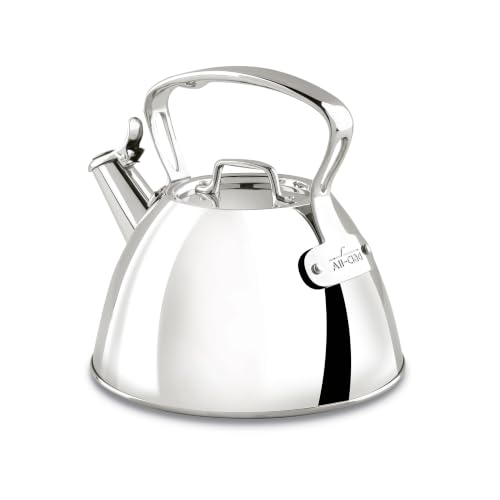
| All-Clad Tea Kettle | Best Polished Steel Classic | A polished stainless 2-quart kettle from All-Clad, induction compatible and dishwasher safe per its listing. |
| WALDWERK Tea Kettle | Best Compact Stainless Pick | A 2.4 quart stainless whistling kettle whose listing covers induction alongside other stovetops. |
| SUSTEAS Tea Kettle | Best Large Family Kettle | The biggest body here at 3.17 quarts, in black, with an ergonomic handle and a composite base for all stovetops. |
| ROCKURWOK Tea Kettle | Best Small Colourful Kettle | A 1.6 quart yellow whistling kettle with a cool ergonomic handle, safe across stovetop types including induction. |
How Did We Choose Kettles That Truly Suit Induction Hobs?
Induction compatibility had to be stated, not assumed. Each pick names induction in its listing, because a kettle that merely contains some steel may still fail to register on a fussy hob. Base construction was read closely: enamel on steel, solid stainless bodies and composite bases each interact with the induction field differently, and the reviews describe the route each maker takes.
Everyday ergonomics carried the second vote. A kettle is lifted one-handed, full of near-boiling water, several times a day, often by someone still half asleep. Handle comfort, spout control, lid behaviour and the whistle cap mechanism were weighed as heavily as capacity, because the best kettle is the one nobody dreads using at dawn.
Size spread was deliberate. A guide that only listed family kettles would fail the single tea drinker, and one that only listed small kettles would fail the household boiling for a pot, a cafetière and a hot water bottle in one round. The six span 1.6 to 3.17 quarts so the reader can buy their actual habit.
Care requirements closed the selection. Enamel chips if abused, polished steel shows every fingerprint, black finishes forgive hard-water bloom, and dishwasher promises vary. Those truths are printed in the reviews rather than discovered at the sink, because a kettle is a decade purchase and its care routine is part of its price.

Circulon Induction Teakettle — Best Enamel Finish
Circulon takes the enamel route to induction: a steel core the hob can grip, wrapped in a grey enamel coat that brings colour and a wipe-clean surface to the job. Two quarts is the classic household size, enough for a four-cup teapot with a margin for the rinse-and-warm ritual, and the whistling spout announces the boil in the clear tone this category lives or dies by.
The flip-up spout is the detail regular tea makers will appreciate most. The whistle cap lifts for pouring and settles back for boiling without being removed and lost to the back of a drawer, which is where loose whistle caps go to die. Enamel also insulates the hand-feel of the exercise slightly and resists the rainbow heat tints that bare steel collects around its base.
Enamel asks for respect in return. A hard knock on a granite worktop can chip it, and thermal shock, cold water into a dry-boiled pot, is its enemy. Treat it like the enamelled cast iron it resembles and it will serve for years; treat it like a camping kettle and the grey coat will record every insult. For cooks who want induction efficiency without the laboratory look of bare steel, this is the warmest answer in the guide.
- Construction: enamel on steel
- Capacity: 2 quarts
- Spout: flip-up whistling spout
- Finish: grey
- Compatibility: induction teakettle per the listing
Strengths
- Enamel coat adds colour and wipes clean
- Flip-up spout cap cannot be lost in a drawer
- Two quarts suits the classic family teapot
Trade-offs
- Enamel can chip under hard knocks
- Grey only, for those wanting a brighter hob
- Enamel dislikes thermal shock after a dry boil
Best for: households wanting induction performance with a softer, coloured finish. Not suited for: cooks who drop, bang and dry-boil their kettles cheerfully.

BAERFO Whistling Tea Kettle — Best Brushed Steel All-Rounder
BAERFO builds its kettle from 304 stainless steel, the food-grade alloy kitchens trust, and gives it a brushed finish that hides the fingerprints and faint water marks polished steel advertises. At 2.64 quarts it sits in the generous middle of this guide: a family teapot, a cafetière for guests and a mug for the cook, all from one boil, without the heft of the largest bodies here.
The listing is unusually practical in its details. It names induction, electric and gas compatibility, which suits households mid-renovation or with a mixed hob history, and it draws attention to the marked fill line and the included hot pad. Those read like small print until the first morning you overfill a kettle and it spits from the spout across the glass, or reach for a handle that has crept hotter than expected.
Brushed steel is also the honest middle path on care. It will not chip like enamel, it shrugs off the descaling routine, and its whistle performs the daily alarm without ceremony. What it will not do is bring colour to the hob or the laboratory polish of the All-Clad. For most induction households wanting one kettle that simply excels at the brief, this is the centre of the shortlist.
- Construction: 304 stainless steel, brushed
- Capacity: 2.64 quarts
- Compatibility: induction, electric and gas per the listing
- Details: marked fill line, included hot pad
- Spout: whistling stovetop design
Strengths
- Food-grade 304 steel with a forgiving brushed finish
- Capacity covers family pot plus extras
- Works across hob types during kitchen changes
Trade-offs
- Brushed finish is handsome, not decorative
- No colour options for a styled hob
- Mid-size body still heavy when filled to the line
Best for: most induction households wanting one versatile steel kettle. Not suited for: shoppers furnishing a colour-led kitchen scheme.
All-Clad Tea Kettle — Best Polished Steel Classic
All-Clad brings its cookware pedigree to the kettle shelf, and the proposition is restraint: a polished stainless steel body of 2 quarts, induction compatible, dishwasher safe, and shaped in the classic stovetop silhouette. There is no colour story and no gadgetry, just a well-made vessel from a maker whose pans anchor serious kitchens, for buyers who find that lineage reassuring.
Polished steel is the extrovert finish. It mirrors the kitchen, shows every fingerprint and water spot, and rewards the cook who buffs it with a shine that enamel and brushed finishes cannot match. On an induction hob it also shows its working honestly: the base meets the glass flat, the body heats evenly, and the whistle reports the boil without theatrics.
Dishwasher safety, stated in the listing, is rarer in this category than it should be and genuinely useful in hard-water homes, where a monthly machine wash with the descaling routine keeps the interior bright. Two quarts will not serve a crowd of tea drinkers in one boil, and the polished surface asks for a soft cloth rather than a scourer. Within those terms, this is the connoisseur plain kettle of the six.
- Construction: polished stainless steel
- Capacity: 2 quarts
- Compatibility: induction compatible per the listing
- Care: dishwasher safe per the listing
- Style: classic stovetop silhouette
Strengths
- Polished finish shines on a styled hob
- Dishwasher-safe care suits hard-water homes
- Trusted cookware maker behind the design
Trade-offs
- Polish shows fingerprints and water spots
- Two quarts means a second boil for crowds
- Shine needs a soft cloth, not a scourer
Best for: cooks who value classic polished steel and easy care. Not suited for: large households boiling for many cups at once.

WALDWERK Tea Kettle — Best Compact Stainless Pick
WALDWERK offers the induction buyer a study in balance: 2.4 quarts of stainless steel, a whistling spout, and a listing that presents the kettle as a teapot for the stovetop across hob types, induction included. The capacity threads the needle between the 2-quart classics and the family giants, suiting a household that boils for a pot and a mug, twice a day, without ceremony.
The stainless body keeps the care contract simple. It tolerates the descaling routine, resists the knocks that threaten enamel, and its weight when full remains manageable for a one-handed pour at the sink-side teapot. In a rental kitchen or a first home, where the kettle must survive house moves and housemates, that unglamorous durability is the feature that matters in year three.
Because this same kettle appears in the gas-range guide as well, a household changing hobs mid-ownership loses nothing; the WALDWERK simply follows the kitchen it lives in. What it does not bring is a colour finish or a dishwasher promise in its title, so its case rests on the fundamentals: sound steel, sensible size, honest whistle. Many tea drinkers will find the fundamentals are the whole argument.
- Construction: stainless steel body
- Capacity: 2.4 quarts
- Compatibility: induction and other stovetops per the listing
- Spout: whistling stovetop spout
- Role: mid-size everyday kettle
Strengths
- Balanced capacity for pot-plus-mug households
- Steel body tolerates knocks and descaling
- Follows a household across hob changes
Trade-offs
- No colour finish in the listing
- No dishwasher claim in the title
- Fundamentals-first design lacks novelty features
Best for: everyday tea households wanting mid-size steel durability. Not suited for: buyers seeking a statement colour or finish.

SUSTEAS Tea Kettle — Best Large Family Kettle
SUSTEAS builds the family tanker of this guide: 3.17 quarts in a black stainless whistling body, sized for the household where one boil must fill a big teapot, top up a stock pot, charge two hot water bottles and still leave a mug for the person pouring. On an induction hob that volume is where the technology flatters the kettle, because the hob delivers its power into the base without the flame spill that wastes a gas ring on a wide pot.
The composite base named in the listing is the engineering to note. A layered base spreads the induction energy across the floor of the kettle, evening out hot spots and helping a large volume climb to the boil as one body of water rather than in rolling patches. The ergonomic handle matters more at this size than any other: a full SUSTEAS is a serious one-handed lift, and handle geometry is the difference between a pour and a negotiation.
Black is the forgiving finish for hard water and busy hobs, hiding the pale bloom that polished steel displays. The cautions are arithmetic: a big kettle tempts its owners to boil big, and reboiled water makes dull tea, so fill to the occasion rather than to the brim. Households that genuinely pour at this scale will find no wasted space in it; households of two will find it mostly air.
- Construction: stainless steel with composite base
- Capacity: 3.17 quarts
- Finish: black
- Handle: ergonomic design per the listing
- Compatibility: works for all stovetops per the listing
Strengths
- Largest capacity for family-scale boiling
- Composite base spreads induction heat evenly
- Black finish hides hard-water bloom
Trade-offs
- Heavy when filled to capacity
- Big boils tempt wasteful reboiling habits
- Oversized for one or two tea drinkers
Best for: large families boiling for pots, bottles and mugs at once. Not suited for: solo drinkers who boil a single mug at a time.

ROCKURWOK Tea Kettle — Best Small Colourful Kettle
ROCKURWOK makes the case for small and cheerful: 1.6 quarts of yellow whistling kettle, sized for the one-or-two-cup ritual and finished in a colour that turns the hob into the brightest corner of the kitchen. Small is a genuine efficiency on induction, because a compact base matched to a small ring boils its modest volume quickly and wastes nothing heating water nobody will pour.
The cool ergonomic handle is the working detail, shaped for the short journeys this kettle makes: hob to teapot, hob to desk mug, hob to the single cup of green tea that punctuates a working afternoon. The listing describes the kettle as non-toxic and safe across stovetop types, induction, gas and electric among them, which suits the small kettle that travels between a home kitchen and a holiday let.
Limits are the price of charm. A 1.6 quart boil will not fill a family teapot, and guests mean a second round on the hob. Yellow also commits the kitchen to its cheerfulness, which most owners count as the point. For the solo tea drinker, the couple with a two-cup ritual or the caravan of one, this is the kettle that right-sizes the whole exercise.
- Construction: stovetop kettle, yellow finish
- Capacity: 1.6 quarts
- Handle: cool ergonomic handle per the listing
- Compatibility: induction, gas and electric per the listing
- Spout: fast-boil whistling design
Strengths
- Right-sized for one or two cup rituals
- Yellow finish brightens the hob
- Light to lift, quick to boil
Trade-offs
- Too small for a family teapot in one boil
- Guests mean a second round on the hob
- Bold colour will not suit every kitchen
Best for: solo drinkers and couples with a small daily tea ritual. Not suited for: households boiling for a table of tea drinkers.
How Do the Six Kettles Compare Side by Side?
| Pick | Capacity | Construction | Standout trait |
|---|---|---|---|
| Circulon Induction Teakettle | 2 quarts | Enamel on steel | Flip-up whistling spout |
| BAERFO Whistling Tea Kettle | 2.64 quarts | 304 stainless, brushed | Fill line and hot pad included |
| All-Clad Tea Kettle | 2 quarts | Polished stainless | Dishwasher safe, classic shape |
| WALDWERK Tea Kettle | 2.4 quarts | Stainless steel | Balanced mid-size body |
| SUSTEAS Tea Kettle | 3.17 quarts | Stainless, composite base | Largest family capacity |
| ROCKURWOK Tea Kettle | 1.6 quarts | Stovetop kettle | Yellow finish, cool handle |
The construction column explains most of the ownership differences. Enamel brings colour and a care caveat, brushed steel brings forgiveness, polished steel brings shine and fingerprints, and the composite base on the largest kettle brings even heating at family volume. Capacity then sorts the households: under two quarts for rituals, two to two and a half for the classic pot, over three for the full family round.
Notice what the table does not contain: a single claim about boiling speed. On the same induction hob, at the same power, physics equalises most kettles of similar base size, and the honest differences are base diameter, volume and how much water you chose to heat. Buy the size and finish your kitchen will love, and the boil will take care of itself.
Why Does Base Diameter Matter More Than Kettle Brand on Induction?
An induction hob heats only where the pan touches its field, and the field lives inside the printed ring on the glass. A kettle base much smaller than the ring under-uses the hob power; a base much larger gains nothing beyond the ring edge and can confuse the hob pan detection. The fastest boil in your kitchen comes from the kettle whose base diameter sits close to the ring you actually use, filled with only the water you need.
Flatness is the silent partner of diameter. A warped or domed base rocks on the glass, breaks contact in patches and heats unevenly, which is why kettles that have been dry-boiled or dropped deserve suspicion even if they still whistle. Run a fingertip around the base rim of an old kettle and the story is written there; the six picks here start life flat, and the care sections below keep them that way.
This is also why the composite base on the SUSTEAS matters at its size. Spreading heat across a wide floor prevents the ring-shaped hot patch that a plain base can develop at family volumes, so the whole 3.17 quarts climbs together. At 1.6 quarts, the ROCKURWOK needs no such help; physics is kind to small volumes.
How Do You Brew Better Tea From a Kettle With No Temperature Dial?
A stovetop kettle offers two instruments: the whistle and your ears. Black tea and herbal infusions take water at a full, rolling boil, straight off the whistle. Green, white and delicate oolong teas scald at that temperature and turn bitter; for them, take the kettle off the heat at the first steady spout steam and rising murmur, before the whistle, or boil fully and let the kettle stand for a minute or two while the water settles to a kinder heat.
Fresh water is the other half of the craft. Water boiled repeatedly through a day loses its dissolved oxygen and concentrates its minerals, and tea made from it tastes flat no matter how fine the leaf. Empty the kettle each morning, fill for the round in hand, and your smallest kettle will outperform a large one reboiled out of habit.
Warm the pot, too. A swirl of the first hot water through the teapot before the leaves go in keeps the brew at temperature through the steep, and it costs nothing but ten seconds. These are nineteenth-century techniques, and they survive because the kettle, the leaf and the water have not changed their natures since.
Altitude quietly rewrites the numbers for mountain households. Water boils cooler as the air thins, so a high-altitude kitchen cannot scald green tea with its boiling water even if it tries, while black tea may need a longer steep to reach the strength a sea-level pot achieves by default. If your kettle lives above a thousand metres, trust the leaf and the clock rather than the whistle alone, and let your palate calibrate what the physics has shifted.
What Mistakes Do Induction Kettle Buyers Make Most Often?
The first mistake is assuming any steel kettle works. Austenitic stainless grades can be barely magnetic, aluminium and copper are invisible to the hob, and a glass kettle is a sculpture. Buyers upgrading to induction should test old kettles with a fridge magnet on the base: if the magnet shrugs, so will the hob. Every pick in this guide declares induction compatibility in its listing, which is the claim to shop for.
The second mistake is buying the largest kettle for the largest imagined occasion. A 3.17 quart body bought for Christmas serves two mugs badly for the other fifty-one weeks, slowly and wastefully. Size for the daily round and borrow a saucepan for the party; the SUSTEAS earns its place only in homes whose daily round genuinely resembles a party.
The third mistake is ignoring the whistle until it fails. Scale builds inside the spout and the whistle cap, muting the alarm that protects the kettle, and a boiled-dry kettle on induction can warp its base in a single distracted morning. Descale on the rhythm the next section describes, and test the whistle with every boil by simply listening for it.
How Often Should You Descale, and What Is the Gentle Method?
In hard-water districts, a kettle can fur visibly within a fortnight, and scale is not merely cosmetic. It insulates the base from the water, lengthening boil times, and it flakes into cups as a gritty snow. A monthly descale is the working rhythm for hard water, quarterly for soft, and the method matters more than the product: fill with equal parts water and white vinegar, or a citric acid solution, bring just to the boil, and leave to stand until the fizzing stops.
Rinse twice and boil a full kettle of plain water to discard before tea duty resumes, because vinegar tea is a punishment nobody deserves. Enamel and polished finishes prefer this gentle chemistry to any abrasive pad, and the whistle cap deserves its own soak in the same solution so its narrow passages clear.
Prevention stretches the intervals. A filter jug for the kettle water, or simply emptying the kettle after the last round instead of letting water stand in it overnight, slows the bloom considerably. Kettles that live empty and dry between uses fur at half the rate of kettles that live full, which is one more reason to boil only what the round requires.
Is Enamel, Brushed or Polished Steel the Wisest Finish?
Enamel, as the Circulon wears it, is a glass coat over steel: beautiful, colour-fast, easy to wipe, and vulnerable to chips from hard knocks and to cracking under thermal shock. It suits careful households and styled kitchens, and it hides the heat discolouration that bare steel collects. Its failures are cosmetic first and structural only if a chip is left to rust at the waterline.
Brushed stainless, the BAERFO choice, is the diplomat. The fine grain of the brushing scatters light so fingerprints and water spots fade into the texture, and small scratches join the pattern instead of announcing themselves. It is the finish for households that want the kettle to look good by being left alone, which is most households, most of the time.
Polished stainless, the All-Clad mirror, is the peacock: glorious when buffed, honest about every mark when not. Black, on the SUSTEAS, plays a fourth strategy, absorbing hard-water bloom and hob scuffs into its darkness. None of these changes the water by one degree; choose the finish whose care routine matches your temperament, because you will perform that routine for a decade.
How Loud Should a Whistle Be, and Can You Live With It?
A kettle whistle is a safety device wearing a musical costume. It must be loud enough to reach the next room over a radio, because its job is to prevent the dry boil, and it should start promptly at the boil rather than after a minute of silent steaming. The classic two-tone whistle on steel kettles like the BAERFO and WALDWERK carries well; softer, breathier whistles suit flats where a baby naps in the next room.
Households that hate the sound have honest options. Watch the spout steam and lift the kettle before the whistle peaks, which green-tea drinkers do anyway, or choose the flip-up spout designs that let you leave the cap open during a supervised boil. What nobody should do is remove a whistle cap permanently and rely on memory, because memory is exactly what fails on the morning the kettle boils dry.
Scale is the whistle silent enemy. A furred whistle passage hoarsens and then mutes the note over months, which is why descaling the cap separately appears in the care section above. If your kettle whistle has grown shy, it is not ageing gracefully; it is asking for vinegar.
What Size Kettle Does Your Household Honestly Need?
Count cups at your busiest regular round, then add the teapot itself. A four-cup pot with a warming rinse wants roughly two quarts, which is why the classic size in this guide is two quarts and why so many kitchens live happily there. A household of mug drinkers who boil individually should count differently: the kettle serves one mug at a time, and a 1.6 quart body like the ROCKURWOK is not a compromise but a precision fit.
Add the secondary duties honestly. Hot water bottles in winter, a cafetière at weekends, the occasional stock or pasta assist: if those are weekly events, the 2.64 quart BAERFO or the 3.17 quart SUSTEAS stops being extravagance and becomes the working size. If they are annual events, they are a saucepan job, and the kettle should stay sized for tea.
Remember that water is heavy and kettles are lifted one-handed. A full large kettle tests wrists, especially for older tea drinkers, and a kettle that is dreaded will be under-filled and then resented for needing two boils. The ergonomic handles on the SUSTEAS and ROCKURWOK exist because makers know the lift is part of the product; test your own grip honestly against the capacity column.
Can One Kettle Serve Both Induction and Gas Duties?
Yes, and several of these listings say so outright. The BAERFO names induction, electric and gas; the ROCKURWOK lists the same spread; the SUSTEAS claims all stovetops; the WALDWERK presents itself for induction and gas alike. A steel or enamelled steel base is at home over a flame as well as in a magnetic field, which makes these kettles safe purchases for households mid-renovation, renters facing an unknown next kitchen, and holiday-home kits.
The flame asks two small courtesies. Keep the handle out of the direct heat path where a wide ring can scorch it, and expect the base to gather the soot and rainbow tints that gas leaves behind; a periodic polish or an acceptance of the working patina settles that account. The whistle, the spout and the lid behave identically over either heat source.
Households that split their cooking between a main induction hob and a secondary gas burner, a common arrangement in older homes, can therefore buy one good kettle rather than two adequate ones. The dedicated gas-range companion guide takes the flame side of the story further, but the overlap between the two lists is real and deliberate.
How Should a New Induction Kettle Be Broken In During Its First Week?
Boil it twice and pour the water away before the first tea, washing away the dust of manufacture and storage. Then time a standard fill on your usual ring, not to race the kettle but to learn its rhythm: how long to the first steam, how long to the whistle, how the boost setting changes both. A kettle whose habits you know is a kettle that never surprises you at seven in the morning.
Pour slowly over the sink and study the spout. A good spout delivers a controlled stream that can fill a narrow teapot neck without splashing, and it stops cleanly when you right the kettle, without a dribble down the body. Check the lid fit while the kettle is hot, with a cloth between hand and metal, and confirm the whistle cap seats firmly in its working position.
Finally, lift it full, once, deliberately, with your pouring hand. That single rehearsal tells you whether the capacity you chose matches the wrist that must serve it, while an exchange is still easy. Kettles are returned for weight more often than for any defect, and a week-one rehearsal is the honest way to learn the truth.
How Does Hard Water Change Kettle Ownership, Day to Day?
Hard water is a slow tax on every kettle in this guide. Calcium carbonate rides in with every fill, deposits on the hottest surfaces first, and builds the familiar pale crust on the base and waterline. On induction the tax arrives as longer boils, because the crust insulates, and as a whistle that gradually loses its voice. Households in limestone country should treat descaling as part of the kettle price, not as an optional spa treatment.
Daily habits decide how heavy the tax falls. A kettle emptied after the last round and left with its lid open to dry furs far more slowly than one left standing full overnight. A filter jug halves the mineral load again. None of this requires buying anything exotic; it requires only that the kettle be treated as a vessel that prefers to rest empty, which most owners discover by accident in year two.
Finish interacts with hard water cosmetically. The black SUSTEAS and the brushed BAERFO wear the pale bloom discreetly, while polished steel displays every tide mark and enamel shows the waterline ring against its colour. None of that affects the water in the cup, but it affects whether the kettle looks cared for on an open hob, which is half the pleasure of owning a handsome one.
What Is the Boost Setting Doing to Your Kettle?
Most induction hobs offer a boost or power mode that pours maximum energy into one ring for a short period, and the kettle is its natural customer. Boost will take a litre to the boil with startling speed, and for the morning round that speed is a genuine quality-of-life feature. The trade is attention: a boosted kettle gives you a shorter window between steam and whistle, and a distracted cook meets the boil as an event rather than a process.
Bases feel the difference too. Repeated maximum-power heating is the hardest service a kettle base performs, and thin bases can develop a slight dome over years of boost abuse, which then rocks on the glass and heats unevenly. The composite and heavier bases in this guide tolerate the regime better, and a sensible household pattern is boost for the first fill of the day, ordinary power thereafter.
There is also a noise footnote. Some hobs hum or click under boost as their electronics work, and a light kettle can vibrate faintly against the glass. Neither sound indicates a fault, but both vanish at normal power, which is worth knowing before concluding that a new kettle rattles. The kettle is innocent; the hob is simply working at its ceiling.
How Should You Pour for a Teapot, a Cafetière and a Mug Differently?
The teapot wants a confident, continuous stream that fills without splashing the leaves into a froth, poured from just above the pot mouth. The cafetière wants a slower, circling pour that wets the grounds evenly, with the kettle spout describing a small spiral rather than a plunge. The mug wants the least ceremony and the most care, because it is usually poured one-handed, at arm length, by someone reading the news.
Spout design serves these differences quietly. A long, tapered spout gives the control the cafetière circle needs; a shorter, wider spout empties a family kettle into a big pot without fuss. The flip-up whistle caps on kettles like the Circulon must be fully open before any of this begins, a two-second habit that prevents the sputtering start that scalds wrists and worktops.
Rest the kettle between pours rather than holding it aloft through a conversation. A full kettle is a weight, wrists tire invisibly, and tired wrists pour badly. Set it back on the glass, where an induction hob, unlike a gas ring, is cool enough within moments to be a safe resting place for the base, though never for a hand checking the surface.
What Role Does the Kettle Play Beyond Tea?
In many homes the kettle is the hot-water utility for the whole kitchen, and its sizing should confess it. It jump-starts pasta water, loosens the lids of stubborn jars under a poured stream, fills the hot water bottle that ends the day, warms the mixing bowl before bread dough and provides the sterile rinse for a baby bottle station. A kettle chosen only for tea may be found too small by its second job.
Induction strengthens that utility role, because the hob delivers kettle-speed heating without a flame to mind, and a wide-based kettle can stand in for a small saucepan of boiling water at short notice. Households that cook dried pulses, blanch vegetables or make packet soups several times a week should read the capacity column of the comparison table with those jobs in mind.
There is a limit, and it is the spout. A kettle is a pouring vessel, not a cooking pot; it cannot be stirred, tasted from or drained of pasta. Let it be the best hot-water tap in the house, and let the saucepans keep their own kingdom, and both will serve longer and better.
How Long Should a Good Stovetop Kettle Last, and What Ends Its Life?
A sound steel or enamelled kettle has no motor, no electronics and no seals under pressure, so its lifespan is measured in decades rather than product cycles. The parts that age are humble: the whistle cap spring, the handle insulation, the lid knob and the base flatness. Several of those are replaceable or ignorable, which is why kettles so often outlive the hobs they were bought for, as the dual-duty WALDWERK in this guide expects to do.
The usual executioner is the dry boil. One unattended boil-dry can warp a base, crack enamel from its steel and bake scale into a permanent crust, ending in an afternoon what years of service built. The second executioner is the drop: a full kettle falling to a tiled floor can dent a base out of true, and on induction a dented base is a death sentence, because the hob demands the flat contact the dent destroyed.
Buy with those endings in mind and the choice clarifies. A whistle you can hear from the garden, a handle that keeps its cool, a base with some substance to it: those are the longevity features, and they are all over the six listings here. Treat the winner gently at the two dangerous moments, the unattended boil and the careless knock, and it will probably whistle for the next kitchen as faithfully as for this one.
What Does the Kettle Teach You About Your New Induction Hob?
For many households the kettle is the first vessel an induction hob ever heats, and it becomes the instrument that teaches the hob habits. You learn which ring matches your daily fill, how the power levels translate into time, whether the boost is a blessing or a drama, and how the pan detection behaves when you lift the kettle mid-boil to check the steam. Those lessons transfer to every pan that follows.
Pay attention to the hob behaviour at the whistle. A good pairing settles into a steady simmer note as you cut the power; a mismatched pairing, base too small for the ring or too large for the sensor, may cycle, click or refuse to hold a gentle heat. None of the six kettles here should provoke that, provided the ring is chosen to match the base rather than by habit.
Keep a note, literally, of your standard boil: ring, level, fill and time. It sounds like pedantry until the morning the boil takes twice as long, when that note tells you instantly whether the kettle has furred, the base has warped or the hob itself needs attention. Appliances that keep diaries are appliances whose problems get caught while they are still small.
How Should Guests, Children and Older Hands Share Kettle Duty?
A kettle is one of the first kitchen tools a young person is trusted with, and one of the last an older person wants to surrender, so its ergonomics are a family matter. The cool-touch handles on the ROCKURWOK and the ergonomic grip on the SUSTEAS exist for hands that are small, arthritic or simply distracted, and a whistle that can be heard through a closed door protects the forgetful of every age.
Weight is the shared constraint. Fill lines are not decoration; a kettle filled to its line is the heaviest object most kitchens ask anyone to lift one-handed, and households with older tea makers often keep a smaller kettle, or fill a larger one halfway by agreement, rather than retiring the ritual along with the strength it needs. The 1.6 quart end of this guide exists for exactly that negotiation.
Teach the two house rules early and repeat them kindly: never leave a boiling kettle unwatched by the whole house, and never reach across a steaming spout to the cupboard beyond. Every kettle in this guide will behave beautifully inside those rules, and most kettle accidents in most kitchens are rule accidents, not equipment failures.
Final Recommendation
For most induction households the centre of this guide is the BAERFO Whistling Tea Kettle: food-grade brushed steel, a 2.64 quart capacity that covers the family pot, and compatibility that survives a kitchen renovation. The Circulon Induction Teakettle is the choice when colour and enamel warmth matter, and the All-Clad Tea Kettle when polished classic steel is the look.
Scale the ends honestly: the SUSTEAS serves genuine family volume, the ROCKURWOK serves the one-cup ritual with charm, and the WALDWERK holds the durable middle. Match the base to your ring, the capacity to your round, and the finish to your temperament, and descale before the whistle grows shy.
Do that, and the kettle becomes what it should be: invisible infrastructure for the best ten minutes of the day, whistling on cue, pouring clean, and asking nothing of you but fresh water and the occasional vinegar bath.
Frequently Asked Questions
How can I tell if my old kettle works on induction?
Hold a fridge magnet to the base. A firm grip means the base is ferromagnetic and the hob should recognise it; a weak or absent grip means the kettle will sit silent. Listings that state induction compatibility, as all six picks here do, remove the guesswork for a new purchase. Test the magnet at the centre of the base rather than the rim, because a decorative steel band can fool the test while the working floor of the kettle stays non-magnetic.
Why does my induction kettle boil so much faster than on gas?
Induction delivers its energy directly into the base of the kettle rather than heating the surrounding air and hob first, so less of the power escapes around the pot. The gain is largest with a flat base matched to the ring size and only the water you need in the kettle. A lid kept on makes the same difference it always has, trapping the heat that an open kettle donates to the kitchen air.
Is a whistling kettle better than a silent one?
For most households, yes: the whistle is a safety alarm against boiling dry, which can warp a base and ruin a kettle in one distracted morning. If the sound troubles the house, lift the kettle at the first strong steam for delicate teas, but keep the whistle working and fitted.
Can I put a stovetop kettle in the dishwasher?
Only where the listing says so, as the All-Clad does here. Enamel and some finishes prefer hand washing, and dishwasher detergents can dull polished steel over time. The interior descaling routine matters more than the exterior wash; a kettle is not a food-contact surface in the way a pan is. Remove the whistle cap before any machine wash, rinse it separately, and refit it only when both parts are dry, so the narrow whistle passage never sits damp between uses.
What capacity is right for a family of four?
If the four drink tea together, a two to two and a half quart kettle fills a family pot in one boil: the Circulon, WALDWERK and BAERFO all live in that band. If the household also charges hot water bottles and a cafetière from the same boil, step up to the 3.17 quart SUSTEAS. Remember to count the cook in the round as well; the person who boils the kettle has earned the fifth cup, and a kettle sized exactly to four will be caught short by hospitality every single time.
Does reboiling water really affect tea?
Yes, in a quiet way. Repeated boiling drives off dissolved oxygen and concentrates minerals, and the tea tastes flatter and can develop a grey film in hard-water areas. Empty the kettle each morning and boil fresh for each round; the leaf you paid for deserves water at its best. Coffee drinkers will taste the same flatness in a cafetière filled from a thrice-boiled kettle, which is why the fresh-fill habit pays across the whole hot-drinks shelf, not only at the teapot.
Related Guides
If your kitchen still runs on flame, or your linens need as much thought as your hob, continue with Best Tea Kettles for Gas Ranges, Best Duvet Covers for Weighted Blankets and Best Griddles for Glass Top Ranges.


