What's inside
- Key Takeaways
- Quick Picks
- How We Chose These Picks
- How Do the Six Cooktops Compare Side by Side?
- How Do You Measure a Cutout for a Built-In Cooktop?
- What Electrical Work Does a Hardwired 240V Cooktop Need?
- How Do Bridge and Flex Zones Change Everyday Cooking?
- What Mistakes Do Cooktop Buyers Make Most Often?
- How Should You Care for a Glass Induction Surface?
- Which Pick Fits an Island, a Wall Run or a Griddle Habit?
- How Quiet Is an Induction Cooktop in a Real Kitchen?
- What Makes Induction Simmering and Melting So Precise?
- How Do the Safety Systems on These Cooktops Behave?
- What Happens Around the Edges: Sealing, Venting and Underneath
- How Should You Cook With Very Large Pans on a Wide Top?
- Slider Controls or Tap Controls: Which Will You Prefer?
- What Should You Ask the Seller Before the Counter Is Cut?
- How Does a 36-Inch Induction Top Compare With Radiant and Gas?
- What Does a Saturday Brunch Service Ask of a Wide Cooktop?
- How Do You Specify a Cooktop for a Rental or a Future Resale?
- When Is the 30-Inch Step-Down Actually the Smarter Buy?
- How Should You Plan the Whole Installation Week?
- What Role Does the Range Hood Play Over an Induction Top?
- How Do You Build a Pan Collection That Suits a Wide Induction Top?
- What Should the First Fortnight of Ownership Teach You?
- Final Recommendation
- Frequently Asked Questions
- Related Guides
As an Amazon Associate I earn from qualifying purchases. This post may contain affiliate links at no extra cost to you.
cottageverdict.com is reader-supported. When you buy through links on our site, we may earn an affiliate commission.
Where to buy: the six cooktops in this guide are sold through Amazon, and each model name in the Quick Picks table, the reviews and the comparison table links to its listing, where you can check price on Amazon and verify the cutout dimensions, wattage and electrical requirements of the exact unit before your cabinet work begins.
Choosing among the best 36 inch induction cooktops is really choosing how your whole kitchen island or range run will behave for the next decade, because a built-in cooktop is cabinetry as much as appliance. At 36 inches, five burners stop being a luxury and become a layout: a stockpot can hold the centre rear while two wide pans work the front without their handles colliding, and bridge or flex zones let a griddle or a roasting pan become a cooking surface in its own right. Under the glass, induction delivers the now-familiar virtues of instant response, fierce boiling and a surface that wipes clean because it never truly baked anything on.
Two ground rules govern everything below. These are hardwired 240V appliances, installed into a cutout in your counter, so the tape measure and an electrician are part of the purchase whether the listing says so or not. And one pick is not 36 inches at all: the Frigidaire Gallery GCCI3047AS is a 30-inch model, included as a clearly labelled step-down for readers whose cutout, on inspection, turns out to be the smaller standard. It is flagged as a step-down in its badge, its review and the comparison table, because a cooktop that does not fit the hole is not a bargain at any specification.
Key Takeaways
- Five picks are true 36-inch five-burner units; the Frigidaire GCCI3047AS is a 30-inch step-down and is labelled as one everywhere it appears.
- Every model here hardwires into a 240V supply and drops into a counter cutout, so measure the existing hole before admiring the glass.
- Bridge and flex zones are the defining 36-inch feature, turning griddles and roasting pans into full cooking surfaces.
- Total wattage ranges from 9600W to 10800W across the true 36-inch picks, which decides how many zones can run hard at once.
- Induction still demands magnetic, flat-based pans; the magnet test applies to cooktops exactly as it does to ranges.
Quick Picks
| Pick | Badge | Why it earns its place |
|---|---|---|
| No-name 36 Induction Cooktop 10800W | Best Raw Power | The highest total output here at 10800W, with dual bridge-sync zones, ETL certification and a pan sensor at 240V. |
| CIARRA 36 Induction Cooktop | Best Flex Zones | Dual flex zones and 9600W under a heavy-duty drop-in build for cooks who live on griddles and big pans. |
| ThermoMate 36 Induction Hob | Best Straightforward Controls | Five boost burners, nine heating levels and sensor touch controls with no menu labyrinth to memorise. |
| Empava 36 Induction Cooktop | Best Pause Feature | Bridge-sync zones plus a Stop and Go function that holds your cooking while the doorbell, child or dog intervenes. |
| Frigidaire Gallery 36 Induction Cooktop | Best Brand Support | The legacy-brand option at full 36 inches, for buyers who value a national service network behind the glass. |
| Frigidaire Gallery 30 Induction Cooktop | Best 30-Inch Step-Down | A 30-inch Gallery model for standard cutouts, included openly as a step-down rather than dressed as a 36. |
How We Chose These Picks
Built-in cooktops punish vague shopping, so our screening started with installation facts: five burners, a published cutout size, 240V hardwired supply and certification marks stated on the listing. Models that hid their dimensions or electrical appetite behind lifestyle photography were set aside, however handsome the glass. A cooktop is the one appliance you literally build a stone counter around; its paperwork matters as much as its wattage.
Cooking flexibility came second. At this width, the interesting question is how zones combine: bridge-sync arrangements that fuse two burners under one long pan, flex zones that adapt to pan shape, and boost functions that lend extra force to a single zone for the pasta pot. We favoured layouts that give a cook options rather than five identical circles, and controls, sliders or touch panels, that can be adjusted precisely with a wet fingertip.
Brand posture formed the final filter. This field mixes young direct-to-consumer names with a legacy manufacturer, and both postures have merit: the newcomers compete ferociously on wattage and zone tricks, while Frigidaire sells the comfort of dealers and service vans. We kept both kinds, labelled the 30-inch step-down honestly, and left the temperament choice to you.
We also excluded portable plug-in hobs and radiant models entirely, however strong their reviews elsewhere, because a guide about built-in 36-inch induction should answer the cabinetmaker’s question, not wander off into countertop appliances.
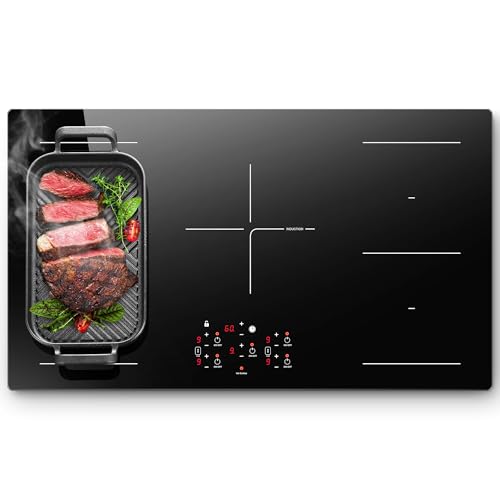
No-name 36 Induction Cooktop 10800W — Best Raw Power
The listing for this unbranded 36-inch unit reads like a specification sheet that wandered into a shop window: 10800W total output, 240V hardwired, ETL certified, dual bridge-sync, nine power levels, booster, timer, child lock and a pan sensor. Taken together that is the fullest feature inventory in this guide, and the headline wattage is real headroom: five zones sharing nearly eleven kilowatts can hold a boil, a sear and two simmers without the apologetic power-sharing that weaker tops impose.
Bridge-sync deserves its sentence. Two zones on a side can be linked so a long griddle or fish kettle heats as one surface, which is precisely the trick that makes a 36-inch top feel like a professional plancha at weekend breakfast. The pan sensor refuses to waste energy on empty glass and prompts when a pan is too small for its zone, and the child lock matters in an island installation where little hands approach from both sides. The counterweight is the badge, or rather its absence: an unbranded unit asks you to lean on the listing’s certification, the seller’s responsiveness and Amazon’s returns framework rather than a dealer network, so buy it as the high-specification value play it is.
- Width: 36 inches, built-in drop-in
- Total power: 10800W, the highest here
- Zones: 5 burners with dual bridge-sync
- Supply: 240V hardwired, ETL certified
- Controls: touch, 9 levels plus booster and timer
- Safety: child lock and pan sensor
Strengths
- Class-leading total wattage keeps busy five-pan cooking honest.
- Dual bridge-sync turns both flanks into griddle territory.
- ETL certification is stated plainly on the listing.
Trade-offs
- No established brand network stands behind service and spares.
- Touch controls at this power level demand dry fingers for fine adjustments.
- Specification-rich listings still require you to verify cutout figures yourself.
Best for: confident buyers who shop by specification and want maximum wattage and bridging at this width.
Not suited for: anyone who needs a local dealer relationship before spending on a built-in appliance.
Verify the cutout chart on the No-name 36 Induction Cooktop 10800W listing and check price on Amazon.
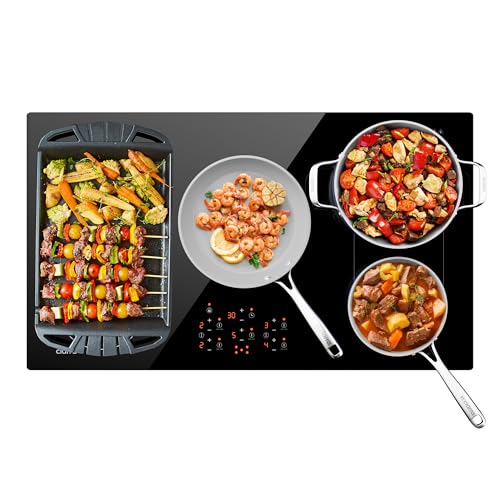
CIARRA 36 Induction Cooktop — Best Flex Zones
CIARRA builds its case around flexibility, literally: dual flex zones let pairs of cooking areas merge or adapt so odd-shaped pans, a long roaster, a rectangular griddle, a pair of small saucepans sharing one flank, all find a heated footprint that matches them. At 9600W the total output sits a step below the leader above, yet the way that power can be arranged is arguably more useful to a cook whose pan collection refuses to be five identical circles.
The listing also stresses a professional heavy-duty drop-in build, which in plain terms means the unit is made to sit in a hard-worked counter and be cooked on daily rather than admired. Booster function covers the water-boiling sprint, and the digital timer and child safety lock complete a specification that reads considered rather than padded. CIARRA, a range-hood name expanding across the kitchen, supports its appliances through direct channels, so expect an online-first service experience and keep the listing’s contact details with your paperwork.
- Width: 36 inches, built-in drop-in
- Total power: 9600W across 5 burners
- Zones: dual flex zones for pan-shape freedom
- Functions: booster, digital timer, child lock
- Build: heavy-duty positioning per listing
- Controls: touch panel
Strengths
- Flex zones genuinely suit griddles, roasters and mixed pan sizes.
- Strong total wattage for simultaneous multi-pan work.
- Timer and lock features suit family kitchens and islands.
Trade-offs
- Flex-zone cooking has a small learning curve in pan placement.
- Service runs through the brand’s channels rather than local dealers.
- 9600W still shares power when every zone demands maximum.
Best for: griddle breakfasts, roasting-pan sauces and cooks whose pans come in every shape except round.
Not suited for: traditionalists who want five fixed burners and a knob to turn.
Check zone diagrams on the CIARRA 36 Induction Cooktop listing and check price on Amazon.
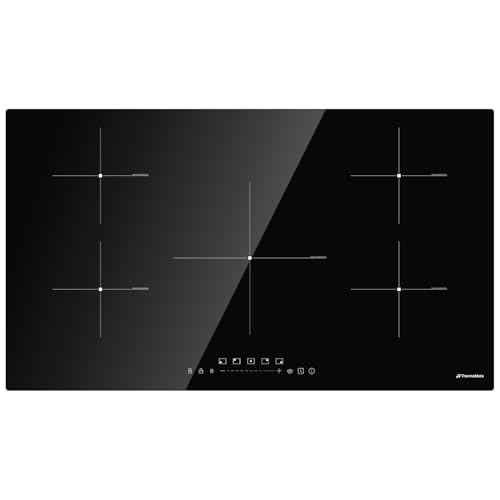
ThermoMate 36 Induction Hob — Best Straightforward Controls
ThermoMate’s 36-inch hob takes the same 9600W, five-burner foundation and presents it without theatre: five boost burners, nine heating levels, a timer, a child safety lock and sensor touch controls, all on a 240V built-in platform. That plainness is a feature. Nine well-spaced levels are easier to cook by than a dozen fiddly increments, and a boost on every burner means the sprint function is never on the wrong side of the cooktop when the big pot lands.
In daily use this is the unit for a cook who wants induction’s speed without a weekend spent learning a control philosophy. Set the level, watch the pan respond immediately, and get on with dinner. ThermoMate sells widely through online channels and its listings tend to publish installation dimensions clearly, which suits the confident self-installer or the contractor who wants numbers, not adjectives. As with the other young brands here, confirm the cutout twice and keep the manual’s wiring diagram for your electrician.
- Width: 36 inches, built-in hob
- Total power: 9600W, 5 boost burners
- Levels: 9 heating levels per zone
- Supply: 240V hardwired
- Safety: timer and child safety lock
- Controls: sensor touch
Strengths
- Boost on all five burners removes zone favouritism.
- Nine clear levels are quick to learn and repeat.
- Specification and dimensions are published plainly.
Trade-offs
- No bridge or flex arrangement for long pans.
- Touch-only controls will not convert knob loyalists.
- Brand support is online-led rather than showroom-based.
Best for: straightforward cooks who want five honest burners and controls that stay out of the way.
Not suited for: griddle devotees who need zones that merge under long pans.
Confirm the wiring notes for the ThermoMate 36 Induction Hob on its listing and check price on Amazon.

Empava 36 Induction Cooktop — Best Pause Feature
Empava’s contribution to the 36-inch conversation is a button that respects real life: Stop and Go. Touch it and the active zones drop to a holding level while you answer the door, rescue a toddler’s tower or find the corkscrew; touch it again and cooking resumes at the previous settings. Anyone who has returned to a boiled-over pan after a ninety-second interruption will understand why this modest feature earns the badge here.
Around that headline, the specification is properly grown-up: dual bridge-sync for long pans, touch slider controls that sweep power up and down in one gesture rather than twenty taps, power boost for the water sprint, a timer and a child lock. Sliders deserve their praise, since a fingertip drag maps intuitively onto heat in a way plus-minus buttons never quite do, especially with a pan already talking back at you. Empava has built a broad North American presence in built-in cooking, so its support channels are a known quantity for many remodelers.
- Width: 36 inches, built-in
- Zones: 5 with dual bridge-sync
- Signature: Stop and Go pause function
- Controls: touch slider for power sweeps
- Functions: power boost, timer, child lock
- Brand: Empava built-in cooking range
Strengths
- Stop and Go is a genuinely humane answer to interrupted cooking.
- Slider controls adjust heat faster than tap-tap buttons.
- Bridge-sync covers the long-pan and griddle repertoire.
Trade-offs
- The listing foregrounds features over a headline total wattage; check the spec table.
- Slider panels need a clean, dry touch to respond precisely.
- Pause functions hold heat low; delicate sauces still want supervision.
Best for: households where cooking is gloriously interrupt-driven and pans must forgive it.
Not suited for: cooks who prefer physical knobs and no electronic intermediaries.
Look at the control layout of the Empava 36 Induction Cooktop on the listing and check price on Amazon.

Frigidaire Gallery 36 Induction Cooktop — Best Brand Support
Sometimes the most important specification is a phone number that gets answered in your own time zone. The Frigidaire Gallery 36-inch induction cooktop is the pick for buyers who feel that way: a full five-burner, 36-inch induction surface from a manufacturer with national distribution, dealer showrooms where you can see the glass before committing, and a service network that can source a control board years from now without a treasure hunt.
The Gallery line sits in Frigidaire’s design-forward tier, so the cooktop presents cleanly, with the smooth black glass and restrained markings that suit a considered kitchen, and the induction performance follows the brand’s established playbook of fast boils and fine low-end control. Its listing is terser than the specification avalanches of the newer brands, which cuts both ways: fewer exotic zone tricks are promised, and the details that matter for installation should be confirmed against the model’s full specification sheet, a habit this guide recommends for every pick regardless of badge.
- Width: 36 inches, built-in Gallery series
- Burners: 5 induction zones
- Brand: Frigidaire, national dealer network
- Design: Gallery tier styling, black glass
- Best context: remodels valuing long-term support
- Note: confirm full spec sheet for wattage details
Strengths
- Dealer and service infrastructure is the deepest in this guide.
- Gallery styling integrates quietly into designed kitchens.
- Brand longevity supports parts availability over a long ownership.
Trade-offs
- Fewer headline zone tricks than the bridge and flex specialists.
- The listing is brief; diligent buyers must chase the full specifications.
- Legacy-brand pricing posture rarely leads the value table.
Best for: remodelers who rank serviceability and brand permanence above spec-sheet fireworks.
Not suited for: bargain hunters or flex-zone enthusiasts who want every zone trick available.
Review the full specifications of the Frigidaire Gallery 36 Induction Cooktop via its listing and check price on Amazon.

Frigidaire Gallery 30 Induction Cooktop — Best 30-Inch Step-Down
Read the badge before the brand: the GCCI3047AS is a 30-inch cooktop, six inches narrower than this guide’s title promises, and it appears here as an openly labelled step-down. Why include it at all? Because a meaningful share of readers hunting for a 36-inch unit discover, tape in hand, that their existing cutout is the 30-inch standard, and at that moment a well-made 30-inch Gallery model from the same brand family is exactly the useful answer.
What you keep is the Frigidaire induction experience and Gallery finish in the smaller footprint: four cooking zones in the usual arrangement, the same fast, precise, wipe-clean cooking, and the same dealer support as its big sibling. What you give up is the fifth burner and the wide bridge territory, which is why this pick should be a deliberate, measured decision and never an accidental one. If your cutout truly is 36 inches, walk back up this page; if it is 30, this is your honest shortlist of one within this guide.
- Width: 30 inches, STEP-DOWN from this guide’s class
- Model: Frigidaire Gallery GCCI3047AS
- Zones: four-zone layout typical of the width
- Brand: Frigidaire Gallery support network
- Best context: existing 30-inch cutouts
- Warning: will not fill a 36-inch opening
Strengths
- Lets a 30-inch kitchen join the induction upgrade without new counters.
- Gallery finish and brand support match the larger pick.
- Four zones still cover most households’ simultaneous cooking.
Trade-offs
- It is not a 36-inch cooktop, and no trim kit changes that honestly.
- No fifth burner or wide bridging for griddle work.
- Buyers must verify their cutout rather than assume the title’s width.
Best for: owners of a genuine 30-inch cutout who want the Gallery induction experience.
Not suited for: any 36-inch opening, remodel plan or five-burner ambition.
Confirm your cutout against the Frigidaire Gallery 30 Induction Cooktop listing and check price on Amazon.
How Do the Six Cooktops Compare Side by Side?
| Model | Width | Total power | Signature trait |
|---|---|---|---|
| No-name 36 Induction Cooktop 10800W | 36 in | 10800W | Dual bridge-sync, ETL listed |
| CIARRA 36 Induction Cooktop | 36 in | 9600W | Dual flex zones |
| ThermoMate 36 Induction Hob | 36 in | 9600W | Boost on all five burners |
| Empava 36 Induction Cooktop | 36 in | See listing | Stop and Go pause, sliders |
| Frigidaire Gallery 36 Induction Cooktop | 36 in | See listing | National brand support |
| Frigidaire Gallery 30 Induction Cooktop | 30 in step-down | See listing | Gallery quality for smaller cutouts |
The table separates into three arguments. Power shoppers start with the 10800W unit and the two 9600W rivals; flexibility shoppers weigh CIARRA’s flex zones against the bridge-sync pair; and risk shoppers land on Frigidaire, in whichever width their counter actually offers. All three arguments are respectable; only the tape measure is non-negotiable.
How Do You Measure a Cutout for a Built-In Cooktop?
Remove the existing cooktop or lift it enough to measure the hole itself, not the glass that covers it: length, width and the depth of counter material the new unit’s flanges must span. Record the counter’s thickness too, and check what lives beneath, drawer boxes, oven cavities, gas lines from an earlier era, because a deeper new unit can collide with all of them. Manufacturers publish a cutout range rather than a single figure, and your hole must fall inside it, not merely near it.
If the hole is slightly small, some counter materials can be trimmed by a professional; if it is slightly large, trim kits and filler rails exist but should be a planned decision, not a delivery-day improvisation. Stone and quartz work belongs to fabricators with the right tools, so fold their visit into the project timeline alongside the electrician.
Photograph everything with the tape visible in frame. Those photographs answer the listing questions, the fabricator’s questions and, if anything is ever disputed, your own questions, all from the same evidence.
What Electrical Work Does a Hardwired 240V Cooktop Need?
Every true 36-inch pick here is a hardwired 240V appliance, meaning it connects directly to a junction box rather than plugging into a socket, and its total wattage dictates the breaker and cable the circuit needs. A kitchen wired for a modest radiant cooktop may already be adequate, or may not; the only honest answer comes from comparing the listing’s electrical specification with your panel, ideally by an electrician who has seen both.
Budget the electrician as part of the appliance, not as an optional extra. The visit also settles placement of the junction box so the cooktop can sit fully flush, and it is the moment to confirm local code requirements for disconnects and cable protection. Gas converts have an extra step: the old line must be capped safely by a qualified person before the glass goes in.
None of this is exotic work, but all of it is consequential. A cooktop installed on an undersized circuit will not merely underperform; it will trip, sulk and age its electronics early.
How Do Bridge and Flex Zones Change Everyday Cooking?
They retire the cold stripe. A long griddle over two ordinary burners cooks pancakes with two brown moons and a pale equator; bridged or flexed zones heat the whole footprint, so the middle cooks like the edges. The same evenness serves a roasting pan gravy built across the top, a fish kettle, or an oval Dutch oven that never sat happily on a round burner of any fuel.
Flex zones add a second trick: they read the pan rather than the diagram, so a small saucepan on a large flexible area heats where it stands instead of demanding the one small burner that is busy with the custard. For households whose cooking wanders between a single egg pan and a brunch griddle, that adaptability is the difference between five fixed stations and a true cooking surface.
The discipline is alignment. Pans must sit within the marked zone boundaries for the coupling to work efficiently, and a griddle overhanging the glass edge wastes heat and invites a hot handle. Place deliberately, and the wide top rewards you every weekend.
What Mistakes Do Cooktop Buyers Make Most Often?
Measuring the glass instead of the cutout leads the list, followed closely by assuming the old circuit will do because the old cooktop did. Third is falling for total wattage alone: a huge figure shared badly across zones, or throttled by power management when two boosters fire together, cooks worse than a slightly smaller total arranged intelligently. Read how the maker describes zone sharing before ranking by the biggest number.
Fourth is ignoring the underside. Cooktop depth, ventilation clearance and the junction box position all live below the counter, in territory occupied by drawers you would rather keep. Fifth, and most avoidable, is ordering before the counter decision is final: a cooktop chosen for a 36-inch run cannot follow you into a redesigned 30-inch kitchen, and the step-down pick in this guide exists precisely because width regrets are so common.
How Should You Care for a Glass Induction Surface?
The daily ritual is a wipe once the surface cools, because spills never carbonised onto it in the first place. A ceramic-glass cleaner lifts the faint metallic sheen that pan bases gradually deposit, and a razor scraper, used flat and gently, removes the one sugary spill that did bond before you noticed. Keep abrasive powders and scouring pads in a different cupboard, ideally in a different house.
Lift heavy pans rather than sliding them, since grit trapped under cast iron engraves arcs that no cleaner can polish out. Check that replacement pans have smooth, flat bases for the same reason; a warped base rocks, buzzes and cooks in stripes. Treat the control panel to the same microfibre courtesy, and the top will look newly installed for years, which matters in an open-plan room where the cooktop is effectively furniture.
Which Pick Fits an Island, a Wall Run or a Griddle Habit?
Islands argue for child locks and pan sensors, since the audience approaches from every side, and for the Empava’s pause button, because island cooking is social cooking and social cooking is interrupted cooking. The unbranded 10800W unit’s lock and sensor make it a credible island candidate too, provided its support model suits you.
Wall runs against a backsplash forgive more and flatter the Frigidaire Gallery’s quiet styling, while serious griddle households should start with CIARRA’s flex zones or either bridge-sync model and a Saturday breakfast will explain why within one round of pancakes. The ThermoMate suits the cook who wants none of these conversations, just five burners that behave, and there is no wrong answer in preferring that.
How Quiet Is an Induction Cooktop in a Real Kitchen?
Two sounds accompany induction cooking, and foreknowledge turns both from worries into background. The first is the pan itself: layered bases can hum or tick at high power as the magnetic field flexes their bonded metals, with thin or slightly warped pans singing loudest and heavy cast iron usually silent. The second is the cooling fan beneath the glass, which runs during demanding cooking and briefly afterwards to protect the electronics, at a level most owners compare to a laptop under load.
Open-plan households notice these sounds for the first week and then file them beside the fridge’s compressor in the mind’s inventory of domestic noises. If your kitchen island doubles as a home office desk, cook a test meal mentally: a simmering sauce is effectively silent, a boosting stockpot is a brief event, and neither resembles the extractor fan that will drown both out the moment anything sears.
A pan that screams at moderate settings is telling you about its base, not the cooktop’s health. Retire it to oven duty and the kitchen quiets down immediately.
What Makes Induction Simmering and Melting So Precise?
Low-end control is where induction quietly embarrasses every rival fuel. The field can be throttled to a whisper and held there without cycling, so chocolate melts in a pan without a bain-marie, butter foams without browning past the point you chose, and a custard thickens under a steady hand rather than a nervous one. There is no flame to blow out at the lowest setting and no element glowing in pulses that overshoot delicate mixtures.
That precision compounds across a meal. A sauce held at the edge of warmth for twenty minutes while guests arrive stays a sauce, not a skin-covered memory of one. Rice rests at a true keep-warm level. Slow braises started on the top before sliding into the oven begin at exactly the simmer you intended, which is half their battle.
Learn your cooktop’s lowest two levels early, because they differ by model and they are where fine cooking lives. The booster gets the photograph; the whisper settings get the compliments.
How Do the Safety Systems on These Cooktops Behave?
Pan detection is the foundation: a zone switched on with nothing magnetic above it simply waits, unheated, until a pan arrives or the control times out. Overheating protection watches for a pan boiling dry and intervenes, and residual-heat indicators warn that the glass above a recently departed pan is still hot from contact, even though the cooktop made no heat of its own there.
Child locks, fitted across these picks, freeze the control panel against exploratory fingers, which matters doubly on islands where the audience is at elbow height on stools. Auto shut-off features add a final layer for the classic forgotten zone, cutting power after a period without adjustment. None of this replaces attention, and a hot pan remains a hot pan on any fuel, yet the layered approach forgives the ordinary distractions of a family kitchen more gracefully than an open flame ever could.
Read your chosen model’s manual section on these systems in the first week. Knowing exactly how your cooktop asks for help, and how it announces a fault, turns a midnight beep from a mystery into a message.
What Happens Around the Edges: Sealing, Venting and Underneath
A built-in cooktop lives in a hole in your counter, and the installation details around that hole decide its long-term happiness. The gasket or sealant line under the glass rim keeps crumbs and spills from migrating into the cabinet below, so it should be continuous and checked whenever the unit is lifted for service. Ventilation slots underneath need the clearances the manual specifies; a drawer crammed to the top with liners can quietly suffocate the electronics’ cooling path.
Heat management surprises some converts from gas: the area below an induction top stays far cooler than below a radiant or gas unit, which is why drawers of utensils directly underneath are practical here. The junction box placement still matters, since the cooktop must sit fully home in its cutout without a cable forcing it proud of the counter.
Ask your installer to leave the installation diagram and the model plate details accessible rather than entombed. Future service visits begin with those numbers, and a photograph taken on installation day is the cheapest insurance in the whole project.
How Should You Cook With Very Large Pans on a Wide Top?
Width tempts excess, and induction rewards a little discipline with big cookware. A pan much wider than its zone heats where the field touches it, so a huge skillet on a medium burner develops a hot heart and lazy edges; match diameters where evenness matters, or use a flex or bridged arrangement sized to the pan. Heavy stockpots belong over the strongest zone, not merely the most convenient one, especially when the goal is a fast boil rather than a patient warm.
Weight is the second discipline. A full canning pot or a loaded Dutch oven concentrates serious mass on glass that is strong but not a workbench. Set pans down rather than dropping them, keep the heaviest vessels off the very front edge where leverage works against the glass, and never use the cooktop as a landing strip for groceries or a step for reaching high shelves, suggestions that sound absurd until the day they are not.
Observed honestly, those two habits, match the pan, mind the weight, unlock everything the 36-inch format promises: multiple large vessels cooking evenly at once, which is the entire reason the width exists.
Slider Controls or Tap Controls: Which Will You Prefer?
The Empava’s slider represents one philosophy: heat as a continuous gesture, swept up or down with a fingertip, mirroring how a knob feels without moving parts. Tap-and-step panels, as on the ThermoMate and the unbranded leader, represent the other: numbered levels, tapped precisely, repeatable by memory, level six is level six on every occasion and in every recipe note you write.
Wet hands arbitrate the debate in working kitchens. Sliders can jump under a dripping fingertip, while step controls can ignore a damp tap entirely, so most cooks develop the same compromise: a tea towel over the shoulder, one dry finger reserved for the panel. Neither system is objectively superior; they suit different temperaments, and a household that cooks by written recipes often loves numbered levels while an improviser loves the sweep.
If the decision stalls, consider who else cooks. Guests and teenagers read a slider instantly and a nine-level scale after one explanation, while a control lock protects everyone’s settings from the cat. Choose for the household’s least technical cook and nobody will dread using the new top.
What Should You Ask the Seller Before the Counter Is Cut?
Ask for the cutout range in writing, the unit’s depth below the counter, and the required clearances on every side, then make the seller confirm the listing’s figures match the manual for the exact model code you are ordering. Ask what the warranty covers on the glass itself, how service is dispatched in your region, and whether a control board is stocked domestically or shipped from overseas, because those answers predict your worst week with the appliance, not your best.
Ask, too, about the return window for a built-in appliance and what condition it must be in; a cooktop that has been wired and installed is a different return proposition from one still in its foam. Photograph the unit from every angle on delivery, before the protective film comes off, and test every zone with a pan of water the day it is installed.
Sellers who answer these questions crisply are telling you something about the next ten years. Sellers who cannot answer them are telling you something as well, and the Frigidaire picks exist in this guide partly for buyers who prefer the conversation to happen in a showroom.
How Does a 36-Inch Induction Top Compare With Radiant and Gas?
Against radiant electric, induction wins nearly every working category: faster boils, finer low control, a cooler room, a surface that wipes clean, and no glowing element cycling under your sauce. Radiant’s remaining argument is price and pan indifference, since it heats anything flat, including the aluminium pan induction refuses. Households with a beloved non-magnetic collection should price its replacement honestly before declaring induction the cheaper long-term path.
Against gas, the contest is cultural as much as technical. Gas offers flame theatre, wok hei with round-bottomed pans and cooking through power cuts. Induction offers precision at both extremes, easier cleaning, no indoor combustion and a top that doubles as extra counter when cold. Many serious cooks who switch report that the wok is the only genuine mourning, and a flat-bottomed carbon steel version recovers most of the technique.
At 36 inches specifically, induction’s advantage compounds, because five gas burners pour serious heat into the room while five induction zones pour it into the food. In a summer kitchen, that difference is not a footnote; it is the review.
What Does a Saturday Brunch Service Ask of a Wide Cooktop?
Brunch is the 36-inch format’s home fixture. A bridged griddle takes the pancakes in a single even field while bacon crisps on a flex zone beside it, eggs wait at a whisper on the smallest burner, and the kettle, or a pan of water for poaching, holds the fifth station. On a 30-inch top that menu becomes a relay race; on this width it becomes a layout, which is the entire argument for the extra six inches in one meal.
The choreography teaches the controls faster than any manual. You learn which zones share power by watching the pancake batter while the kettle boosts, learn the slider’s sweep or the tap scale’s rhythm by seasoning eggs at level two, and learn where your favourite pans truly belong by the second weekend. Hosts also discover the social geometry: an island cooktop with this capacity turns the cook from a servant in another room into the centre of the gathering, which is either the point or a warning, depending on the cook.
Plan the first brunch modestly, one griddle load and one pan, and let the width reveal itself gradually. The cooktop will still be there for the ambitious mornings, and confidence compounds faster than technique.
How Do You Specify a Cooktop for a Rental or a Future Resale?
Landlords and future sellers should think in terms of the next household’s expectations. A recognised brand with a service network, the Frigidaire route, photographs well in a listing and reassures buyers who fear orphan appliances. A high-specification unbranded unit may cook identically yet raise questions at resale that have nothing to do with its pancakes, a quirk of human nature worth pricing into the decision.
Keep every document: the manual, the cutout diagram, the electrician’s invoice and the warranty registration. A future owner handed that folder inherits confidence along with the glass, and a tenant handed clear instructions about magnetic pans and glass care returns a cooktop in far better condition than one left to folklore. Include a cheap magnetic pan set with the property if you want the surest protection of all: tenants cook happily with what is provided instead of experimenting with what is not.
Durability choices matter here too. The heavy-duty positioning of the CIARRA and the plain robustness of the ThermoMate suit high-turnover kitchens, while slider panels and exotic modes earn their keep best in owner-occupied homes where one household learns them deeply.
When Is the 30-Inch Step-Down Actually the Smarter Buy?
When the kitchen is genuinely small, the household cooks two pans at once at most, and the money saved by not rebuilding cabinetry buys the range hood, the pans or the electrician instead. A 30-inch induction top in a compact galley is not a compromise at all; it is the correct tool at the correct scale, and the Frigidaire Gallery step-down delivers it with better support than most full-size rivals in this guide can offer.
The step-down is also the honest answer for a phased renovation. Counters planned for replacement in three years should not dictate a decade of cooking; fit the width you have, cook brilliantly on four zones, and let the future kitchen make its own argument. What the step-down should never be is an accident, a box opened on installation day to reveal six missing inches, which is why this guide labels it at every appearance rather than letting the brand name carry a sleepy reader past the number.
How Should You Plan the Whole Installation Week?
Sequence the trades like a small building project, because that is what this is. The electrician confirms or upgrades the circuit first, while the old cooktop still works and dinners continue. The counter fabricator, if the cutout needs adjustment, works second, with the new unit on site to measure against rather than a printout. Installation day comes last, with the junction box positioned, the gasket ready and a magnetic pan waiting to test every zone before the installer leaves.
Build slack into that week. A cooktop discovered to be damaged in its box is replaceable on a calm schedule and miserable on a tight one, and the household that keeps the old unit until the new one has boiled its first pan of water never faces a week of takeaway by force. Photograph the wiring before the unit drops in; the next person to lift that glass, possibly you in nine years, will be quietly grateful.
Finally, cook something forgiving first: a pot of soup, a pan of eggs. The ambitious five-burner debut can wait until the controls are familiar and the pan map is drawn, because confidence, like a good simmer, should be built at low heat first.
What Role Does the Range Hood Play Over an Induction Top?
Induction removes combustion gases from the kitchen, but it does not remove steam, grease vapour or the smoke of a properly seared steak, all of which still rise exactly where they always did. A competent hood remains part of the installation, sized to the cooktop’s width and cooking style rather than to its fuel. Heavy fryers and griddle households should spec extraction as seriously as wattage.
The pleasant difference is heat: with no burners pouring warmth upward, the hood and the cook both work in a cooler room, and makeup air demands are gentler than over a big gas array. If a remodel budget forces a choice, choose the cooktop you love and a hood that is adequate rather than the reverse, because extraction can be upgraded later without cutting the counter twice.
How Do You Build a Pan Collection That Suits a Wide Induction Top?
Start from the zones rather than the cookware catalogue. A wide top wants one genuinely large skillet or sauté pan for the strongest burner, one long griddle if bridge or flex zones are in play, a stockpot whose base matches a big zone’s diameter, and the small saucepan every kitchen reaches for twice a day. Cast iron and enamelled cast iron anchor the set with their magnetic certainty and their silence under power, while a bonded-base stainless pan adds the responsive, lighter option for sauces and eggs.
Test every candidate in the shop with the magnet you now apparently carry, and at home with a palm pressed to the base feeling for warp. Flat is not a detail; a base that rocks by a millimetre couples unevenly, buzzes under boost and cooks in rings. Lids matter more on induction than elsewhere because the cooking is fast and the steam is the cook’s main progress report once the lid is on.
Buy slowly. One perfect pan a season replaces a boxed set of compromises within two years, and each arrival teaches the cooktop’s personality more clearly than any review, including this one, can promise.
What Should the First Fortnight of Ownership Teach You?
Week one is calibration. Boil the same pot of water on two different zones and learn what your boost actually delivers; melt butter at the lowest setting and note the number, because that number becomes your personal simmer reference for every sauce that follows. Cook one meal entirely with the timer running the zones, not as a gimmick but to learn how the auto shut-off thinks, so its behaviour never surprises you mid-recipe.
Week two is choreography. Run a three-pan dinner and map which pans belong where, which zones share power and which control gestures your household keeps fumbling. Write the map down if your kitchen has several cooks; a shared note on the fridge door about the griddle’s zone pairing saves every future brunch from the same ninety seconds of experimentation.
By the end of the fortnight the glass should feel less like an appliance and more like a worktop that happens to cook, which is the quiet destination of every good induction installation.
Keep the manual within reach for one more week beyond that, not because the cooking is difficult but because the fault codes, lock sequences and timer logic of a new panel are easier to absorb in calm moments than during a dinner party with a zone beeping for attention and six guests offering theories.
Final Recommendation
Specification-led buyers should take the No-name 36 Induction Cooktop 10800W for its wattage, bridging and certification, while flexibility-first cooks will be happier with the CIARRA 36 Induction Cooktop and its pan-shaped zones. If a service network is your deciding comfort, the Frigidaire Gallery 36 Induction Cooktop is the grown-up choice at full width. Whichever name you land on, let the last step before ordering be a photograph of your cutout with a tape across it, because the finest cooktop in this guide is simply an expensive ornament if the hole disagrees.
Frequently Asked Questions
Do all of these cooktops need to be hardwired?
The 36-inch models here are hardwired 240V appliances connected at a junction box, not plug-in devices. Have an electrician confirm your circuit’s breaker and cabling against the listing’s specification before installation day.
Why is a 30-inch model in a 36-inch guide?
Because many shoppers discover their cutout is the 30-inch standard only when they measure. The Frigidaire GCCI3047AS is included as a clearly labelled step-down for exactly that situation, never as a substitute for a true 36-inch opening.
What pans work on these cooktops?
Magnetic, flat-based pans: cast iron and induction-ready stainless steel are the staples. A fridge magnet that sticks firmly to the base predicts success; pure aluminium, copper or glass without a magnetic layer will not heat.
Is more total wattage always better?
It helps when several zones run hard together, but arrangement matters too. Bridge and flex layouts, and how the maker shares power between paired zones, can make a 9600W top cook better than a stronger but simpler rival.
Can a cooktop be installed over drawers?
Often yes, if the unit’s depth and ventilation clearances clear the drawer boxes, which is why underside measurements belong in your planning. Confirm against the listing’s installation diagram rather than assuming.
Why does a zone refuse full power beside a boosting neighbour?
Paired zones commonly share a power budget, so a boosting zone borrows from its partner. It is normal power management, and sequencing your boils and sears around it quickly becomes second nature.
Can the glass double as extra counter space?
When cold and switched off, yes, within reason: it is a smooth, strong surface that hosts a chopping board or a resting tray happily. Never cut on it directly, never set hot pans from the oven onto it, and remember that a zone used minutes ago may still be warm from its pan.
Related Guides
The natural next read for ice-cream households is Best Rock and Salt Ice Cream Makers, since a wide induction top and a churned dessert finish a dinner party between them. Countertop companions for smaller jobs appear in Best Small Countertop Microwave Ovens, and the sleep end of the remodel is covered by Best Mattresses for Back and Side Sleepers.


