What's inside
- Key Takeaways
- Quick Picks
- How Did We Choose These Mattresses for Back and Side Sleepers?
- How Do the Six Mattresses Compare?
- What Do Back Sleepers Actually Need From a Surface?
- What Do Side Sleepers Need That Back Sleepers Do Not?
- Why Does Medium Firm Keep Winning for Combination Sleepers?
- How Do Pocket Springs Differ From Old Connected Springs?
- What Does the Foam Above the Springs Contribute?
- Why Do Buyers Ask About Fiberglass, and Which Listings Answer?
- King or Queen: How Should a Couple Actually Decide?
- Does Mattress Height Matter Beyond Appearances?
- How Does Motion Isolation Change a Shared Night?
- Why Do Edges Decide Whether a Queen Feels Wide?
- What Base Should a Boxed Hybrid Sit On?
- How Long Does a Boxed Mattress Take to Become Itself?
- How Do You Rotate and Care for a Hybrid?
- What Should Heavier and Lighter Sleepers Read Differently?
- How Does a Mattress Feel Different in Winter and Summer?
- What Should Guest-Room Buyers Prioritise?
- How Do You Read a Mattress Listing Like a Skeptic?
- Why Do Couples Disagree About the Same Mattress?
- What Is the Real Cost of a Mattress Over Its Life?
- How Should You Handle Delivery Day for a King Box?
- What Does a Mattress Protector Change About Feel?
- How Do You Know When the Old Mattress Is Truly Done?
- What Part Does the Pillow Play in Back and Side Sleeping?
- How Do Adjustable Bases Change the Hybrid Question?
- Why Is Trial Sleep Worth More Than Showroom Sleep?
- How Should Smaller Bedrooms Handle a King Ambition?
- What Do the Words Hybrid and Pocket Spring Not Tell You?
- How Does Sharing With a Dog or Cat Change the Choice?
- How Do You Keep a Straight Answer About Firmness in the Family?
- What Should You Do in the First Week If the Feel Surprises You?
- A Final Note on Sleeping Positions and Honest Language
- What Mistakes Do Mattress Shoppers Keep Making?
- Final Recommendation
- Frequently Asked Questions
- Related Guides
As an Amazon Associate I earn from qualifying purchases. This post may contain affiliate links at no extra cost to you.
cottageverdict.com is reader-supported. When you buy through links on our site, we may earn an affiliate commission.
Where to buy: the best mattresses for back and side sleepers in this guide are sold on Amazon, and each pick below links to its listing in the Quick Picks table, the detailed reviews and the comparison table, where you can check price on Amazon and confirm the size, height and construction before ordering. Read the sizes carefully as you go: this shortlist deliberately mixes king and queen listings, because real bedrooms do.
Every pick here is a hybrid — pocket springs below, foam comfort layers above — and every maker describes its feel as medium firm. That convergence is not a coincidence. Back sleepers generally want a surface that stays level and supportive under the hips, side sleepers want enough give at the shoulder and hip to sleep in a natural line, and a medium firm hybrid is the industry’s most reliable compromise between those two briefs. This guide judges the six on comfort, support feel, construction honesty and the practicalities of size, height and delivery.
It judges them on nothing else. A mattress is furniture for sleeping, assessed here the way you would assess it across a month of nights: how it feels, how it holds two people, how its edges behave, and how truthfully its listing describes it. Firmness words, remember, belong to each maker — medium firm is a description offered by the brand, not a measurement shared across brands.
Key Takeaways
- All six picks are pocket-spring hybrids with foam comfort layers, and all six are described by their makers as medium firm.
- Sizes are mixed on purpose: two kings and four queens, at 12 or 14 inches tall — check each listing’s size before comparing.
- Back sleepers should prize a level, unsagging feel; side sleepers should prize give at the shoulder — medium firm hybrids serve both.
- CertiPUR-US foam and fiberglass-free construction are stated on several listings and are worth preferring where they appear.
- Motion isolation and edge support decide how a shared bed actually feels, and both are claimed most strongly by the taller and edge-focused picks.
Quick Picks
| Pick | Badge | Why it earns its place |
|---|---|---|
| BedStory Medium Firm King 14in | Best Tall King Hybrid | The group’s only 14-inch king: a medium firm hybrid with more than 960 pocket springs by the listing’s count, CertiPUR-US foam and no fiberglass. |
| King 12in Hybrid Mattress in a Box | Best King Value Format | A 12-inch king hybrid in a black and grey cover, pairing pocket springs with memory foam, described by its listing as medium firm and breathable. |
| Queen 12in Hybrid Mattress in a Box | Best Queen All-Rounder | The queen-size twin of the king above: 12 inches, pocket springs with memory foam, black and grey cover, medium firm by its listing’s description. |
| 14in Queen Pocket Spring Mattress | Best Tall Queen | A 14-inch queen hybrid with pocket springs and memory foam, CertiPUR-US foam and a fiberglass-free build, described as medium firm with motion isolation. |
| Novilla 12 Queen Hybrid | Best No Box Spring Needed | A 12-inch queen hybrid with the brand’s smart coils, CertiPUR-US certified foam, fiberglass-free build, and no box spring required underneath. |
| Ailis Queen Hybrid 12in | Best Edge Support Claim | A 12-inch queen hybrid, medium firm, whose listing emphasises upgraded pocket springs, strong edge support and breathable comfort. |
How Did We Choose These Mattresses for Back and Side Sleepers?
The shortlist began with construction. Hybrids earned their sweep of the six places because pocket springs give back sleepers the level, responsive support they tend to prefer, while foam layers give side sleepers the contouring at shoulder and hip that keeps their posture natural through the night. Pure slabs and old-fashioned connected-spring designs were left out deliberately.
Firmness was taken from the makers’ own descriptions, and every pick here is described as medium firm — the overlap zone where most back and side sleepers report comfort. Listings were then read for the specifications that predict lived experience: height, spring counts where stated, foam certification, fiberglass content, edge and motion claims. Sizes were recorded listing by listing, because a king and a queen are different purchases wearing similar photographs, and this guide refuses to blur them.

BedStory Medium Firm King 14in — Best Tall King Hybrid
Height is this mattress’s opening argument. At 14 inches in king size, the BedStory stands taller than everything else here, and tall hybrids suit sleepers who like a bed that meets them halfway — easier to get out of in the morning, grander against a headboard, and deep enough to layer comfort foams over a substantial pocket-spring core. The listing puts that core at more than 960 individually wrapped springs and describes the feel as medium firm, which is the manufacturer’s own rating.
The listing also highlights shaping at the shoulder and mid-section zones, CertiPUR-US certified foam and a fiberglass-free build — the last two being the specifications careful buyers increasingly ask about by name. the BedStory mattress is the couples’ king of this group in spirit: a wide, tall sleeping surface where two people’s movements have the most material to dissipate into. Judge it, as this guide judges every pick, on comfort, support feel and construction — the experience of sleeping on it, described in plain terms.
- Size and height: king, 14 inches
- Build: hybrid — pocket springs with foam comfort layers
- Spring count stated in the listing: 960-plus pocket springs
- Firmness as described by the maker: medium firm
- Certifications and build notes in the listing: CertiPUR-US foam, fiberglass-free
Strengths
- Tallest profile here makes getting in and out easy
- High stated spring count suits couples sharing a king
- CertiPUR-US and fiberglass-free notes answer careful buyers
Trade-offs
- Fourteen inches needs deeper sheets and a strong bed frame
- King size is a two-person delivery and rotation job
- Medium firm is the maker’s description, not a universal standard
Best for: couples in a king who want height, spring count and certified foams in one package.
Not suited for: low platform beds where a 14-inch mattress would tower awkwardly.

King 12in Hybrid Mattress in a Box — Best King Value Format
This is the straightforward king: 12 inches of hybrid construction, pocket springs under memory foam, wrapped in a black and grey fabric cover that looks more like furniture upholstery than traditional white ticking. The listing describes the feel as medium firm and the sleep surface as breathable and cool-feeling, and it addresses back, side and stomach sleepers in one breath — a generalist’s mattress, in other words, rather than a specialist’s.
Generalist is not an insult in a mattress. Most households contain mixed sleeping positions, changing across a single night, and a medium firm hybrid is the industry’s settled answer to that reality. the 12-inch king hybrid arrives in a box, which solves the king-size problem of staircases and cottage doorways that a traditional delivered king turns into theatre. Unbox it in the room, let it expand, and judge the feel across a week of nights rather than the first afternoon’s impression.
- Size and height: king, 12 inches
- Build: hybrid — pocket springs and memory foam
- Cover: black and grey fabric
- Firmness as described by the maker: medium firm
- Delivery format: mattress in a box
Strengths
- King comfort without a king-sized delivery ordeal
- Medium firm generalist feel suits mixed-position couples
- Dark cover forgives the realities of long service
Trade-offs
- Unbranded listing gives less background to research
- Listing is lighter on certification detail than some rivals
- Memory foam feel will not suit foam sceptics
Best for: mixed-position couples wanting a king hybrid that arrives in a box.
Not suited for: buyers who want extensive certification detail before ordering.
Queen 12in Hybrid Mattress in a Box — Best Queen All-Rounder
Read this listing as the same mattress idea in the size most bedrooms actually hold. Queen, 12 inches, hybrid build with pocket springs and memory foam, black and grey cover, medium firm feel as the maker describes it, breathable and cool-feeling positioning in the listing’s own words. If the king version is the generalist for wide beds, this is the generalist for ordinary rooms, guest doubles and first flats.
Why list both sizes in one guide? Because shoppers compare across sizes constantly — a couple debating whether the room can take a king deserves to see the queen alternative with identical construction rather than a different mattress entirely. the 12-inch queen hybrid keeps that comparison honest: same recipe, smaller footprint, easier delivery, lower commitment. For a main bedroom that hosts two sleepers and two bedside tables in a cottage footprint, the queen is frequently the grown-up answer.
- Size and height: queen, 12 inches
- Build: hybrid — pocket springs and memory foam
- Cover: black and grey fabric
- Firmness as described by the maker: medium firm
- Delivery format: mattress in a box
Strengths
- Same hybrid recipe as the king in a room-friendlier size
- Medium firm feel suits the widest range of sleepers
- Boxed delivery suits stairs and narrow doors
Trade-offs
- Queen width is a compromise for restless couples
- Listing detail is brief compared with branded rivals
- Dark cover limits the crisp white bedding aesthetic
Best for: queen bedrooms wanting the generalist hybrid recipe without upsizing the bed.
Not suited for: couples who already know they need king width to sleep peacefully.

14in Queen Pocket Spring Mattress — Best Tall Queen
Fourteen inches in a queen is a statement of priorities: maximum mattress, moderate footprint. The extra depth over the 12-inch queens here buys thicker comfort layers above the pocket springs and a bed height that older knees and tall frames appreciate every single morning. The listing describes medium firm feel, motion isolation between partners, CertiPUR-US certified foam and a fiberglass-free construction.
Motion isolation deserves translating out of catalogue language. Pocket springs compress individually, so one sleeper’s turning disturbs a smaller neighbourhood of the bed than a connected spring unit would; foam above them absorbs much of what remains. the 14-inch queen is therefore the light-sleeping couple’s queen — the bed for households where one person rises at five and the other is not supposed to know. Pair its height with a frame that can carry it and sheets deep enough to respect it.
- Size and height: queen, 14 inches
- Build: hybrid — pocket spring and memory foam
- Firmness as described by the maker: medium firm
- Listing highlights: motion isolation, fiberglass free
- Foam certification in the listing: CertiPUR-US
Strengths
- Extra depth suits sleepers who like a high bed
- Motion isolation positioning suits light-sleeping couples
- CertiPUR-US and fiberglass-free details are stated plainly
Trade-offs
- Height can overwhelm low-profile frames
- Heavier to rotate than the 12-inch queens
- Deep sheets are a necessity, not an option
Best for: couples in a queen who want tall-bed comfort and calmer nights beside a restless partner.
Not suited for: minimalist platform frames designed around slim mattresses.
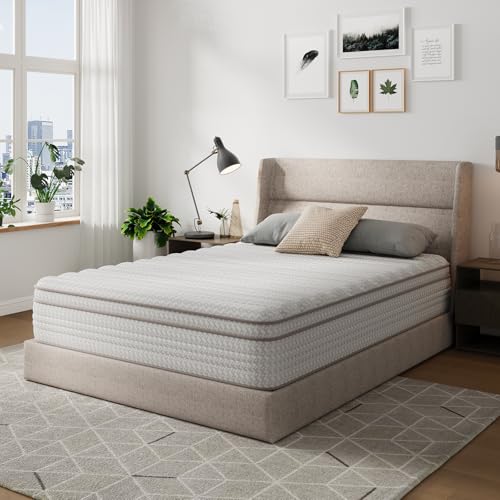
Novilla 12 Queen Hybrid — Best No Box Spring Needed
Novilla is the established boxed-bed brand in this group, and its listing leads with practicalities: 12 inches in queen, hybrid construction around what the brand calls its smart coils, CertiPUR-US certified foam, a fiberglass-free build, a hypoallergenic positioning, and the quietly valuable statement that no box spring is needed. That last line saves real money and real height in rooms where a platform or slatted base already exists.
A named brand buys accountability. There is a maker’s reputation behind the description, a support channel, and a listing written with more care than the anonymous entries in any category. the Novilla mattress suits the buyer who wants the boxed-hybrid idea with the least research burden: the specifications a careful shopper asks about are answered in the title itself. As everywhere in this guide, its feel is discussed as comfort and support for sleeping positions — the terms a mattress can honestly be judged in.
- Size and height: queen, 12 inches
- Build: hybrid with the brand’s smart coils
- Foam certification in the listing: CertiPUR-US certified
- Build note: fiberglass free
- Base requirement per the listing: no box spring needed
Strengths
- Recognised brand with a detailed, accountable listing
- No box spring requirement simplifies the setup
- Certification and fiberglass-free notes stated up front
Trade-offs
- Queen only in this guide’s shortlist — no king sibling here
- Brand polish does not change the medium-firm guessing game
- Smart coil naming is the brand’s own terminology
Best for: platform-bed owners wanting a branded queen hybrid with setup kept simple.
Not suited for: shoppers who need a king from the same product line.

Ailis Queen Hybrid 12in — Best Edge Support Claim
Edges are where cheap hybrids confess. Sit on the side of a weak mattress to tie your shoes and it folds like a sandwich; sleep near its border and you feel the roll-off warning all night. The Ailis listing puts strong edge support in its headline claims, alongside upgraded pocket springs, motion isolation and breathable comfort, in a 12-inch queen described as medium firm.
That emphasis maps to real households. Couples in a queen use every inch of width, and usable width is decided at the edges; a mattress that stays honest out to its border effectively sleeps wider than a softer-edged rival of identical dimensions. the Ailis mattress also suits people who sit on the bed to dress, read to children at the edge, or share the surface with a dog who has claimed the middle. Judge its claims across your first week of mornings — edges, like firmness, reveal themselves in use rather than in photographs.
- Size and height: queen, 12 inches
- Build: hybrid with upgraded pocket springs
- Firmness as described by the maker: medium firm
- Listing highlights: strong edge support, motion isolation
- Comfort positioning in the listing: breathable comfort
Strengths
- Edge support emphasis suits couples using full queen width
- Motion isolation positioning helps shared beds
- Twelve-inch profile fits standard deep sheets
Trade-offs
- Edge claims need a week of mornings to verify
- Listing is lighter on foam certification detail
- Medium firm remains the maker’s own description
Best for: queen couples who sleep near the edges and sit on the bed daily.
Not suited for: buyers who rank foam certifications above all other details.
How Do the Six Mattresses Compare?
| Pick | Standout trait | Watch out for |
|---|---|---|
| BedStory Medium Firm King 14in | Only 14-inch king in the group | Demands deep-pocket bedding |
| King 12in Hybrid Mattress in a Box | King size with the simplest proposition | Thinnest listing detail of the kings |
| Queen 12in Hybrid Mattress in a Box | Queen twin of the king pick above | Brief listing, few extras stated |
| 14in Queen Pocket Spring Mattress | Tallest queen in the group | Needs deep bedding and a sturdy base |
| Novilla 12 Queen Hybrid | Most established brand name here | No king option in this shortlist |
| Ailis Queen Hybrid 12in | Strongest edge support claim here | Certification detail is thinner than rivals |
What Do Back Sleepers Actually Need From a Surface?
A back sleeper’s body asks for levelness. Lying face up, the weight concentrates at the hips and shoulders, and a surface that lets the hips sink dramatically turns the night into a hammock imitation. What back sleepers describe as good support is usually a mattress that keeps the body in one long, relaxed line, with the lower back neither arched by a board nor dropped by a swamp.
Medium firm hybrids answer that brief well because pocket springs push back proportionally — deeper compression meets firmer response — while a modest foam layer smooths the contact points. Back sleepers who wake feeling that the bed argued with them overnight are often sleeping on a surface that has softened unevenly with age, which no pillow arrangement can fully compensate for.
What Do Side Sleepers Need That Back Sleepers Do Not?
The side sleeper balances the body’s weight on a narrow strip: one shoulder, one hip, one knee. Those points need the surface to yield locally, letting the shoulder sink enough that the neck and spine can stay in a natural line with the pillow’s help. A surface with no give turns the shoulder into a load-bearing wall and the night into a series of rotations.
This is where hybrid layering earns its complexity. Foam at the top provides the local yield; springs below prevent that yield becoming a crater. Side sleepers evaluating these six should weight the comfort layers and their own body weight honestly — lighter sleepers feel a medium firm mattress as firmer than heavier sleepers do, because they compress it less.
Why Does Medium Firm Keep Winning for Combination Sleepers?
Most people are combination sleepers, whatever they call themselves: back for the first hour, side by dawn, stomach in the Sunday lie-in. A mattress tuned heroically for one position punishes the others, while the medium firm middle serves all three adequately and two of them well. Adequacy across a whole night beats brilliance across a third of it.
Makers know this, which is why medium firm dominates listings aimed at mixed sleepers, as all six here demonstrate. Treat the phrase as a starting coordinate rather than a guarantee — brands calibrate it differently — and use your first week of nights, plus the seller’s stated trial and return terms on the listing page, as the real measurement.
How Do Pocket Springs Differ From Old Connected Springs?
A traditional spring unit wires its coils together, so pressing one corner tugs the whole neighbourhood. Pocket springs sew each coil into its own fabric sleeve, letting coils compress independently. The sleeper feels the difference as localised support: the mattress responds where the body is, instead of arguing as a single trampoline.
For couples the independence matters even more, because movement stays closer to its source. The BedStory listing’s count of more than 960 springs in a king gives a sense of the granularity involved — hundreds of small decisions under the foam, each night, rather than one big springy opinion. More springs is not automatically better, but the architecture itself is the modern default for good reason.
What Does the Foam Above the Springs Contribute?
Comfort foam is the mattress’s handshake: the first thing the body meets, responsible for pressure distribution at shoulder and hip, for the difference between lying on a bed and lying on a mechanism. Memory foam contours slowly and holds a shape; livelier foams respond instantly and feel bouncier. Hybrids blend these behaviours in layers, and the listings here pair memory foam with springs in most cases.
Certification is the foam detail worth insisting on. CertiPUR-US, named by the BedStory, the 14-inch queen and the Novilla listings, indicates the foam has been checked against a published standard for its content and emissions. It is not a comfort promise, but it is a manufacturing promise, and in a product you breathe beside for a decade, manufacturing promises deserve weight.
Why Do Buyers Ask About Fiberglass, and Which Listings Answer?
Some mattresses historically used fiberglass as an internal fire barrier, and owners discovered it the hard way when removing covers released fibres through the room. The episode made fiberglass-free a specification shoppers now request by name. Three listings in this guide — the BedStory, the 14-inch queen and the Novilla — state fiberglass-free construction outright in their titles.
The lesson generalises: never unzip a mattress cover unless the maker invites it, whatever the mattress contains, and prefer listings that answer the question before you ask it. Where a listing is silent, the product page’s full specification is the place to check before the mattress enters a home with children, pets and curious zips.
King or Queen: How Should a Couple Actually Decide?
Measure the room, then the relationship. A king gives two adults the width of two single beds side by side; a queen asks them to share a width closer to one and a half. In a generous bedroom the king’s case is overwhelming. In a cottage bedroom where a king would leave a shuffle-gap around the bed and crowd out the wardrobe, the queen preserves the room the couple lives in while awake.
This guide’s mixed sizes let you compare honestly: the BedStory and the 12-inch king offer the wide format, while four queens compete on height, edges and brand. Remember that everything scales with size — bedding, frame cost, the effort of rotation day, and the sheer comedy of getting a king up a narrow staircase, which the boxed format of these picks mercifully reduces.
Does Mattress Height Matter Beyond Appearances?
Height is ergonomics disguised as styling. A taller bed — the 14-inch picks here on a standard frame — brings the surface closer to sitting height, which knees and hips appreciate at both ends of the night. A lower total profile suits platform frames, children, and anyone who prefers climbing down to climbing up being the morning’s first decision.
Height also buys layering room. Deeper mattresses can carry thicker comfort foam above their springs, which side sleepers in particular may feel as a plusher welcome. The costs are mundane but real: deeper fitted sheets, a heavier rotation, and a headboard that suddenly looks shorter than it did in the shop. Total sleep height — frame plus mattress — is the number to plan around.
How Does Motion Isolation Change a Shared Night?
Every sleeper knows the two kinds of night: the one where a partner’s turning is weather in another county, and the one where it is an earthquake in the bed. Pocket springs and foam layers are the engineering answer, localising movement instead of broadcasting it, and listings here — the 14-inch queen and the Ailis most explicitly — make motion isolation a headline claim.
Judge the claim across real nights rather than the famous wine-glass test. What matters is whether a partner’s 5 a.m. exit registers as information or as an alarm. Light sleepers in queen beds, where distance cannot help, benefit most from taking these claims seriously and from choosing the pick that emphasises them.
Why Do Edges Decide Whether a Queen Feels Wide?
A queen is 60 inches wide on paper and as narrow as its edges in practice. If the border compresses dramatically, sleepers retreat toward the centre and the bed sleeps like a double. Strong edge support — the Ailis listing’s headline — keeps the full width honest, and it also serves the daytime bed: sitting to dress, perching to read a story, standing a suitcase on the corner while packing.
Edges age first, because they are sat on most. A mattress whose listing discusses edge construction is at least thinking about the problem, which correlates with effort elsewhere. When you trial any of these six, spend one deliberate minute sitting on the side each morning of the first week; the edge’s report is part of the mattress’s character.
What Base Should a Boxed Hybrid Sit On?
Pocket springs want even support: a firm platform, a slatted base with narrow gaps, or a suitable foundation. The Novilla listing’s statement that no box spring is needed reflects the modern arrangement — these mattresses were designed for platforms and slats, and an old, sagging box spring underneath will sabotage a new mattress’s feel completely.
Check the maker’s stated requirements on the listing page before ordering, because warranty terms often specify the base. Floors are a legitimate temporary home during the expansion days, but long-term floor sleeping traps moisture beneath the mattress in humid homes. A modest slatted frame is the cheapest insurance a boxed hybrid can be given.
How Long Does a Boxed Mattress Take to Become Itself?
Unboxed foam needs time. Most hybrids reach near-full expansion within a day, but the feel can keep settling for several nights as foams fully recover and your body recalibrates from the old mattress’s habits. Judging any of these six on night one is like judging a shoe on the walk to the till.
Give the trial a fair fortnight of ordinary nights before forming the verdict, rotating sleep positions as you naturally do. Keep the packaging question practical, too: a king box is heavy, and unboxing in the bedroom rather than downstairs is the decision your back will thank you for, whatever position it sleeps in.
How Do You Rotate and Care for a Hybrid?
Most modern hybrids are one-sided — comfort layers up, always — so care means rotating head-to-foot rather than flipping, typically every few months, to even out the body’s favourite territories. Two people make rotation of a king a scheduled event rather than a whim; queens are a manageable solo job for many owners.
A protector is the other half of care, guarding the foam from the spills and humidity of real life, and it should be breathable so it does not change the surface feel you chose. Vacuum the surface occasionally, air the bed unmade for an hour on wash days, and the mattress will repay the routine with years of consistent feel.
What Should Heavier and Lighter Sleepers Read Differently?
Firmness is a relationship, not a property. A heavier body compresses foam and springs further, experiencing a given mattress as softer and more contouring; a lighter body rides higher on the same surface and experiences it as firmer. Two reviewers can describe the identical mattress oppositely and both be reporting honestly.
Use that lens on every claim in this guide. Heavier side sleepers may prefer the deeper 14-inch builds, whose extra layers keep them from reaching the springs’ firm core; lighter back sleepers often find 12-inch medium firm models perfectly level without extra depth. Your own weight, stated privately to yourself, is the most useful specification in the entire purchase.
How Does a Mattress Feel Different in Winter and Summer?
Foam has seasons. Memory foam firms up in a cold bedroom and softens in a warm one, so the same mattress can greet you differently in January and July, especially in cottages where night temperatures genuinely swing. Springs are indifferent to weather, which is one quiet argument for the hybrid architecture shared by all six picks here: part of the bed’s feel is guaranteed by steel, whatever the room is doing.
Bedding mediates the rest. A mattress protector, flannel sheets and the weight of a winter duvet all change the surface you actually meet. Judge a new mattress across at least a few weeks before concluding anything, and be suspicious of any verdict formed during a heatwave or a cold snap, when the room — not the mattress — was the variable.
What Should Guest-Room Buyers Prioritise?
Guests are diplomats: they sleep two nights, praise everything and report nothing. Furnish the guest bed for the average stranger rather than for yourself — a medium firm hybrid in a queen, like several picks here, suits the widest range of bodies and positions, and its familiarity is a kindness to someone sleeping in a strange room.
Height deserves thought for older visitors, for whom a low platform bed can turn the morning into mountaineering; the taller builds here, on a sensible frame, are the hospitable choice. Add a protector from day one, because guest rooms host the spills of people too polite to mention them, and rotate the mattress on the same schedule as the main bed’s.
How Do You Read a Mattress Listing Like a Skeptic?
Separate the listing into facts, descriptions and hopes. Facts are dimensions, size, construction layers, certifications and stated spring counts — verifiable, comparable, and the basis of any honest shortlist. Descriptions are the maker’s own characterisations, like medium firm: useful, but calibrated privately. Hopes are the adjectives that promise transformation; a good listing needs few of them, and this guide has deliberately repeated none.
Then notice the absences, as with the fiberglass question. A maker who answers certification, materials and base requirements in the title is competing on specification; a maker who answers none is competing on photography. Skepticism is not cynicism — it is simply reading a mattress listing the way you would read a contract you intend to sleep on for a decade.
Why Do Couples Disagree About the Same Mattress?
Because they are sleeping on two different mattresses that happen to share a cover. Body weight, preferred position, sensitivity to movement and personal temperature all differ across a couple, sometimes dramatically. One partner’s level support is the other’s unyielding board, and both reviews are accurate field reports from different bodies.
The hybrid medium firm consensus exists precisely to minimise that disagreement, and features like motion isolation and honest edges reduce the ways one sleeper’s night can tax the other’s. Couples at the extremes — very different weights, opposite firmness loyalties — sometimes solve it with two singles pushed together under one king cover, a continental trick worth knowing before declaring any mattress a failure.
What Is the Real Cost of a Mattress Over Its Life?
Divide honestly. A mattress slept on for eight years hosts nearly three thousand nights, so even a substantial price becomes a modest nightly figure, while a cheap mattress replaced twice in the same span often costs more in money and far more in disrupted sleep. The arithmetic argues for buying the best-constructed mattress the budget allows, once, rather than the cheapest twice.
Remember the entourage in the budget: a frame or base that supports it properly, a protector, and sheets deep enough for its height — the 14-inch picks here will not wear standard pockets gracefully. Costing the whole sleep system at purchase time prevents the common farce of a fine mattress undermined by a dying base and bedding that pops off at the corners.
How Should You Handle Delivery Day for a King Box?
A king mattress in a box is compact by king standards and heavy by any standard. Plan the route from door to bedroom, clear the corners, and recruit the second person before the courier arrives rather than after. Unbox in the room where the mattress will live; dragging an expanding king through a hallway is a slapstick you can simply decline to perform.
Cut the wrapping carefully, keep blades away from the fabric, and let the mattress unroll on its base rather than on a cluttered floor. Then leave it alone for the hours the maker suggests. The temptation to lie on it immediately is universal and harmless, but the verdict-forming should wait until the foam has finished its first full expansion.
What Does a Mattress Protector Change About Feel?
A protector is a compromise worn on purpose. Thick, padded or waterproof models add their own layer of behaviour — a little warmth, a little rustle, a slight blurring of the foam’s contouring — while thin, breathable ones approach invisibility. The protection is worth it: foam cannot be washed, and the protector is the only part of the sleep surface that can.
Choose the protector with the mattress, not after it. Side sleepers who bought a hybrid for its yielding top should avoid a drum-tight protector that bridges across the surface and cancels the give. Fit it smoothly, wash it on the sheet schedule, and it will guard the mattress for years without ever being noticed — the definition of a successful accessory.
How Do You Know When the Old Mattress Is Truly Done?
Beds rarely fail dramatically; they fade. The honest signals are a visible valley where a body sleeps, springs that have begun to announce themselves, edges that have surrendered, and mornings that feel like a report on the bed rather than on the night. When a mattress’s geography has memorised you, its support has stopped being a decision and become a habit.
Test your suspicion fairly before spending: sleep a few nights in the guest room or on a good hotel bed, and compare mornings. If the contrast is embarrassing, the old mattress has delivered its verdict. Every pick in this guide exists for that moment — the upgrade is not indulgence but maintenance of the room where a third of life happens.
What Part Does the Pillow Play in Back and Side Sleeping?
No mattress is judged fairly with the wrong pillow. Back sleepers generally suit a lower, firmer pillow that keeps the head level with the surface the mattress provides; side sleepers need a taller, fuller pillow to fill the shoulder’s width so the neck stays in line with the spine the mattress is supporting. Changing the mattress without reconsidering the pillow is renovating half a system.
Give a new mattress and an existing pillow a week together before shopping further — bodies adapt, and the first nights’ strangeness is often the old pillow’s accent rather than the new bed’s fault. If you do change pillows, change one variable at a time, or you will never know which purchase deserved the credit for the better mornings.
How Do Adjustable Bases Change the Hybrid Question?
An adjustable base bends the bed, and pocket-spring hybrids generally bend with it gracefully, because their coils act independently and their foam layers flex. Very thick mattresses bend less willingly — the 14-inch builds here will sit higher and curve more reluctantly than the 12-inch models — so base owners should check the listing’s stated compatibility before choosing height.
For readers-in-bed and television watchers, an adjustable base plus a medium firm hybrid is a genuinely luxurious combination, and it reframes the mattress decision around evenings as much as nights. It also raises the stakes on edge support and on a base-and-mattress pairing the maker approves, since warranties tend to have opinions about what their mattresses bend on.
Why Is Trial Sleep Worth More Than Showroom Sleep?
Five minutes on a showroom bed, fully clothed, under sales lighting, with your shoes off and your dignity negotiated, tells you almost nothing about a mattress. Real judgement needs your pillow, your bedding, your partner, your room temperature and several unremarkable nights — which is why the boxed model’s home trial, whatever its exact terms on the listing page, changed mattress buying for the better.
Use the trial like a scientist with a diary. Note the first week’s strangeness without verdict, then the second week’s ordinary nights, because ordinary nights are the product. A mattress that disappears from your attention by day ten has passed the only examination that matters, and no showroom in the world can administer it.
How Should Smaller Bedrooms Handle a King Ambition?
Desire for a king in a small room is understandable and sometimes correct — sleep quality outranks walking space in many households’ honest accounting. The boxed format removes the delivery objection, but the room must still hold the bed, the bedding change must still be physically possible, and someone must still vacuum under it occasionally.
If the king truly swallows the room, the queens here are not a consolation prize: a well-chosen queen hybrid with honest edges sleeps wider than its dimensions, as the Ailis listing argues, and leaves a room that functions in daylight. Choose the largest bed the room can serve rather than the largest bed the catalogue can ship, and both your nights and your mornings will notice the difference.
What Do the Words Hybrid and Pocket Spring Not Tell You?
They describe architecture, not quality. Two hybrids can share every headline word — pocket springs, memory foam, medium firm — and differ in foam density, coil gauge, layer order and edge construction, all of which decide feel and lifespan. That is why this guide leans on the stated particulars of each listing: spring counts where given, certifications where claimed, heights and sizes everywhere.
It is also why brand and listing detail carry weight in the recommendations. The Novilla’s accountable specification list and the BedStory’s stated spring count are information; a bare architecture label is a category. Buy the particulars you can verify, and treat every unverifiable adjective as decoration the maker added for the photograph.
How Does Sharing With a Dog or Cat Change the Choice?
A pet on the bed is a third sleeper with no respect for territory. Animals claim the middle, radiate heat and add their own motion events at 3 a.m., which argues for width where the room allows it, motion isolation where it does not, and a protector without negotiation. Edge support matters too, because the human couple gets pushed to the borders the animal has vacated.
Foam feel is wasted on the animal, who would sleep happily on any of the six; choose for the humans and let the pet adapt, as pets triumphantly do. Wash bedding more often than the childless schedule suggests, keep nails trimmed to protect covers, and accept that in a pet household the mattress’s true size is its size minus one warm, immovable resident.
How Do You Keep a Straight Answer About Firmness in the Family?
Households shopping together often talk past each other, because firmness words carry private meanings. One partner’s firm is a plank; the other’s is a marshmallow with ambition. Translate before you shop: describe surfaces you have both slept on — the hotel bed in March, the old mattress in its first year — and agree which direction from those landmarks you are travelling.
That shared map makes the makers’ descriptions usable. Medium firm stops being an argument and becomes a neighbourhood you are both aiming at, within which the six picks here differ by height, size and construction detail rather than by philosophy. Couples who skip the translation often buy a compromise neither recognises, then blame the mattress for a conversation that never happened.
What Should You Do in the First Week If the Feel Surprises You?
First, check the base. A surprising number of too-soft and too-firm verdicts are actually old slats, a tired foundation or a protector fitted like a drum skin. Second, check the calendar: bodies carry the old mattress’s habits for several nights, and foam itself is still settling into its working shape during the first week.
Third, adjust the cheap variables before judging the expensive one — pillow height, bedding weight, room temperature. If, after a fair fortnight of ordinary nights on a sound base, the feel still argues with you every morning, use the return route the listing offered and choose again with better information. A trial honoured calmly is the system working, not a purchase failing.
A Final Note on Sleeping Positions and Honest Language
Positions are tendencies, not diagnoses. Most sleepers migrate through several in a night, wake in a different arrangement from the one they chose, and describe themselves by the position they fall asleep in rather than the one they occupy at dawn. A mattress chosen for a whole night’s migration will always outserve one chosen for a single photographed posture.
That is the spirit in which this guide has discussed back and side sleeping: as comfort preferences that good construction can serve, described in the plain language of feel, height, edges and springs. Keep that language when you shop anywhere. A listing that talks about its mattress the way this guide has tried to — in verifiable particulars — is a listing that expects to be slept on, not just clicked.
What Mistakes Do Mattress Shoppers Keep Making?
The most expensive mistake is comparing photographs instead of sizes — ordering a queen’s price and a king’s picture, or the reverse. This guide labels every pick’s size in its name and specifications; honour that discipline on the listing page too. Second comes firmness faith: medium firm is each maker’s own description, not a shared standard, so plan to judge the feel across your first fortnight at home.
Third, shoppers put a new mattress on a dying base and blame the newcomer for the old sag. Fourth, they ignore the unglamorous specifications — foam certification, fiberglass content, edge construction — that predict how a mattress behaves in year three. Finally, they expect furniture to be medicine. Choose a mattress for comfort, support feel and honest construction, sleep on it for a month of ordinary nights, and let that experience, not a headline, deliver the verdict.
Final Recommendation
For a king, choose between the BedStory’s tall, high-spring-count build with its certifications stated plainly, and the 12-inch king’s simpler generalist recipe in its dark cover. For a queen, the 14-inch pick serves couples who prize a high bed and calmer shared nights, the Novilla serves platform owners who want a named brand and no box spring, the Ailis serves edge-sitters and full-width sleepers, and the 12-inch queen keeps the generalist recipe in the size most rooms want.
Whichever box arrives at your door, may its first month of nights leave you thinking about the mattress less and less — because a bed doing its job properly disappears beneath the life lived on either side of sleep.
Frequently Asked Questions
Are these mattresses really medium firm?
Each maker describes its own mattress as medium firm, and this guide reports those descriptions as the brands’ own. There is no shared industry scale behind the phrase, so two of these can feel noticeably different. Judge the feel across your first fortnight of nights at home, and check the listing page for the seller’s current trial and return terms before ordering.
Which size should I choose, king or queen?
This shortlist contains two kings — the BedStory 14-inch and the 12-inch hybrid — and four queens. Choose by room size and how much personal width you need: kings give each sleeper the width of a single bed, while queens fit smaller rooms and cost less to dress. Every pick’s size is stated in its name and specifications above.
Do these mattresses need a box spring?
The Novilla listing states explicitly that no box spring is needed, and boxed hybrids generally suit firm platforms or closely slatted bases. Check the individual listing’s stated requirements before ordering, because warranty terms can depend on the base, and never put a new mattress on a sagging old foundation.
What does CertiPUR-US mean on a listing?
It indicates the foam has been certified against a published standard covering its content and emissions. The BedStory, the 14-inch queen and the Novilla listings name it. It speaks to how the foam is made rather than how the mattress feels, and it is one of the more useful details a listing can state.
Which picks state that they are fiberglass-free?
The BedStory king, the 14-inch queen and the Novilla queen all state fiberglass-free construction in their listings. Where a listing does not say, check the full specification on the product page, and as a general rule do not remove a mattress cover unless the maker instructs it.
How long should I trial a boxed mattress before deciding?
Longer than a night. Expansion takes a day or so, and both the foam and your own habits need a couple of weeks to settle from the old mattress. Most sleepers form a fair verdict across a fortnight of ordinary nights, rotating through their natural positions.
Related Guides
A good mattress deserves good company in the bedroom and beyond, so continue with our guides to Best Bedroom Runner Rugs Best Nonstick Cookware Sets for Flat Cooktops Best Quiet Dishwashers.



[…] Best Small Countertop Microwave Ovens for the cooking side of a compact home, rest properly with Best Mattresses for Back and Side Sleepers, and add a tiny luxury with Best Handheld Milk Frothers for the morning coffee […]