What's inside
- Key Takeaways
- Quick Picks
- How Did We Choose These Travel Pillows?
- How Do the Six Travel Pillows Compare?
- Why Is Upright Sleep So Difficult, and What Can a Pillow Actually Do?
- How Do You Pack a Foam Pillow Without Losing Half a Bag?
- Window, Middle or Aisle: Does Your Seat Change Your Pillow?
- What Do the Eye Mask and Ear Plugs Really Contribute?
- How Should You Clean a Pillow That Lives in Airports?
- When Does a Pillow Earn a Place on a Road Trip Instead?
- How Firm Should Travel Foam Feel?
- What About Children and Smaller Travellers?
- How Long Does a Travel Pillow Last?
- What Is the Case for Owning Two Different Pillows?
- How Do You Sleep on a Red-Eye and Function the Next Day?
- What Should You Check at the Gate Before Boarding?
- Why Do Some Travellers Prefer a Plain U Shape for Life?
- How Does Cabin Air Change What Comfort Means?
- How Do Train Journeys Treat a Pillow Differently?
- What Is the Office Nap, and Which Pillow Serves It?
- How Do You Choose a Pillow as a Gift?
- What Happens to Foam in a Hot Car or a Cold Hold?
- How Do Window Shades, Hoods and Scarves Join the System?
- What Should a First-Time Buyer Expect on the First Flight?
- How Do Couples and Families Share Travel Pillows?
- Why Does the Headrest Wing Matter as Much as the Pillow?
- How Should You Sit to Give the Pillow a Chance?
- What Is the Environmental Footprint of a Foam Pillow?
- How Do Business Travellers Keep a Pillow Presentable?
- What Role Does Expectation Play in Pillow Satisfaction?
- How Do You Handle a Pillow on Multi-Leg Journeys?
- When Is No Pillow the Right Answer?
- How Has the Travel Pillow Changed in a Decade?
- What Do Flight Crew and Weekly Commuters Know That Tourists Do Not?
- How Should You Test a Pillow During a Film at Home?
- A Word on Sharing Air With a Hundred Strangers
- How Do You Decide Between the Sibling Listings and the Specialists?
- What Mistakes Do Travel Pillow Buyers Keep Making?
- Final Recommendation
- Frequently Asked Questions
- Related Guides
As an Amazon Associate I earn from qualifying purchases. This post may contain affiliate links at no extra cost to you.
cottageverdict.com is reader-supported. When you buy through links on our site, we may earn an affiliate commission.
Where to buy: the best travel pillows in this guide are sold on Amazon, and each pick below links to its listing in the Quick Picks table, the detailed reviews and the comparison table, where you can check price on Amazon and confirm colours, covers and included extras before ordering. Few purchases are tested as honestly as a travel pillow: somewhere over an ocean at 3 a.m., it either works or it becomes luggage.
All six picks here share a common material story — memory foam collars that wrap the neck and give an upright head somewhere to rest — but they diverge in the details that decide real journeys. One adds seat straps. One bundles a mask and ear plugs. One comes in a pink you could spot from the far end of the terminal. Two are siblings from the same brand in different colours, and this guide will say so plainly rather than pretend otherwise.
Judge everything that follows by one standard: comfort while resting upright. These pillows are travel accessories for naps in seats, assessed on fit, portability, cleanliness and how well they stay where you put them. That is the whole job, and it is a job worth doing well, because the first day of a trip is too precious to spend recovering from the journey.
Key Takeaways
- Every pick here is a memory foam collar; the differences are shape, straps, extras and colour, not miracles.
- The Cabeau Evolution S3 is the only pick with seat straps, and its several colours are one model, not several.
- The two napfun picks are close siblings — light grey versus full black — so choose on colour and listing details.
- The Purroch bundles an eye mask and ear plugs, the cheapest objects that most improve sleep in a cabin.
- A washable cover, like the SAIREIDER’s, matters more across a travel year than any single flight’s comfort.
Quick Picks
| Pick | Badge | Why it earns its place |
|---|---|---|
| SAIREIDER Memory Foam Travel Pillow | Best Straightforward Foam Collar | A black U-shaped collar in 100% pure memory foam, per its listing, with a washable cover for planes, cars, home and office naps. |
| napfun Upgraded Travel Pillow | Best Light Grey Classic | napfun’s upgraded light grey collar in 100% pure memory foam, shaped as a flight headrest for sleeping upright in a plane seat. |
| napfun Travel Pillow Black | Best Full Black All-Rounder | The same napfun family in full black, with memory foam described as wrapping a full circle, listed for planes, cars, trains, buses and office naps. |
| Purroch G-Shape Travel Pillow | Best With Sleep Kit Included | A G-shaped memory foam pillow in medium gray that bundles an eye mask and ear plugs, for flights, car trips and office naps. |
| Gosider U-Shaped Travel Pillow | Best Cheerful Colour Pick | A pink U-shaped memory foam pillow, portable and uncomplicated, listed for planes, trains and self-driving car journeys. |
| Cabeau Evolution S3 | Best With Seat Straps | A memory foam positioner in Jet Black with straps that secure it to the seat, built specifically for sleeping through long flights. |
How Did We Choose These Travel Pillows?
The shortlist favoured pillows a traveller can actually live with: foam that holds a head upright without feeling like a brace, covers that survive washing, and shapes that pack into real luggage. Each listing was read for what it states — fill, colour, included extras, intended settings — and this guide reports only that, in the listing’s own terms.
Variety was deliberate across the six. Long-haul specialists, mixed-transport commuters, road-trippers and first-time kit builders all travel differently, so the picks span plain U collars, a wraparound design, an asymmetric G shape and one strapped positioner. Colour was treated as a functional trait, because visibility and visible cleanliness are genuine travel concerns, not decoration. Nothing here is credited with powers beyond helping you rest comfortably in a seat.

SAIREIDER Memory Foam Travel Pillow — Best Straightforward Foam Collar
The SAIREIDER makes one promise and keeps it plainly: a collar of 100% pure memory foam, in black, with a cover you can wash. There are no straps, masks or gadgetry to learn at the gate. You take it out of the bag, it expands into its U shape, and it does the single job of giving your head something shaped to lean against while you doze upright.
That simplicity suits travellers who nap in short bursts across many settings — the listing itself names the plane, the car, home and the office. the SAIREIDER pillow in black hides the evidence of travel well, and a washable cover matters disproportionately on a product that spends its life against skin, hair and airport seating. Judge it as a comfort aid for resting upright, nothing grander: it will not transform a middle seat, but it makes the middle seat’s naps considerably more civilised.
- Form: U-shaped neck pillow
- Fill stated in the listing: 100% pure memory foam
- Colour: black
- Cover: washable, per the listing
- Stated settings: airplane, car, home and office
Strengths
- No accessories or adjustments to learn
- Washable cover suits heavy travel schedules
- Black finish forgives the grime of transit
Trade-offs
- Plain U shape offers no extra securing system
- Memory foam compresses into a bag but still takes space
- One firmness must suit every traveller
Best for: frequent flyers who want a washable, no-fuss foam collar for upright naps.
Not suited for: travellers who need straps or structure to keep a pillow positioned.
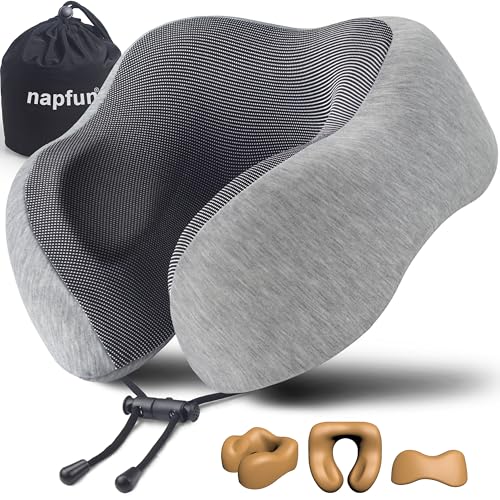
napfun Upgraded Travel Pillow — Best Light Grey Classic
napfun is one of the names travellers encounter constantly in this category, and this Upgraded listing in light grey is the brand’s classic proposition: 100% pure memory foam shaped to wrap the neck and give the head a resting place against the seat. The shaping aims at the familiar failure of upright sleep, where the head tips forward or sideways and wakes you with a start.
Light grey is the friendliest colour here for showing you honestly when the pillow needs a wash — a feature, if you are disciplined, and a burden if you are not. the napfun Upgraded pillow suits the long-haul leisure traveller who sleeps in real stretches on flights and wants a proven, uncomplicated collar from a brand that sells little else. Note for comparison shoppers: this is one of two napfun listings in this guide, and its sibling below is the same family in black, so choose between them mainly on colour and listing details.
- Form: contoured neck pillow for flights
- Fill stated in the listing: 100% pure memory foam
- Colour: light grey
- Design generation: the brand’s Upgraded line
- Role: headrest support for upright flight sleep
Strengths
- Established specialist brand in this category
- Contour aims to limit the head tipping that ruins naps
- Foam fill gives a soft but held resting feel
Trade-offs
- Light grey shows travel marks quickly
- No seat straps in this listing’s description
- Sibling black listing may confuse comparison shoppers
Best for: long-haul passengers who want the classic specialist-brand collar in a pale finish.
Not suited for: travellers who know they will never wash a light-coloured pillow.

napfun Travel Pillow Black — Best Full Black All-Rounder
If the light grey napfun is the classic, this full black listing is the workhorse edition. The listing describes upgraded memory foam shaped to support around the whole neck, and it widens the stated territory beyond flights to cars, trains, buses and office sleep. In practice the two napfun picks are close cousins — same brand, same foam story, different colour and listing emphasis — and this guide treats them that way rather than inventing a rivalry.
Black earns its keep across a travel year. It rides on the outside of a backpack without advertising every airport floor it has met, and it looks acceptable in a car or a train carriage where a pale pillow starts to resemble bedding. the black napfun pillow is the sensible default for travellers whose journeys mix transport types weekly — commuters, sales reps, students crossing the country by whatever leaves next — and who want one collar that follows them through all of it.
- Form: wraparound neck pillow
- Fill: memory foam, described as upgraded 100% foam
- Colour: full black
- Stated settings: airplane, car, train, bus and office
- Design note: support described around the full neck
Strengths
- Black finish suits multi-transport, high-frequency use
- Wraparound shaping suits varied seat types
- One pillow covers commuting and holiday travel alike
Trade-offs
- Very close in concept to its light grey sibling
- Foam collar still needs bag space when not worn
- No bundled mask or earplugs in this listing
Best for: mixed-transport travellers who want one discreet black collar for everything.
Not suited for: shoppers wanting accessories bundled with their pillow.

Purroch G-Shape Travel Pillow — Best With Sleep Kit Included
The Purroch’s G shape is the design experiment of this group: instead of a symmetrical U, the form wraps with an asymmetric curve intended to cradle the head from one side, which some side-leaning sleepers find more natural against a seat or a window. Its listing states 100% pure foam, in a practical medium gray that splits the difference between the black and pale options here.
The bundle is the other half of its case. An eye mask and ear plugs are included, and anyone who has tried to sleep through a bright cabin and a chatty row knows those two cheap objects do half the work of any travel pillow. the Purroch pillow therefore suits the traveller building a sleep kit from zero: one purchase covers the collar, the darkness and the quiet. Travellers who already own a beloved mask can discount the bundle and judge the G shape on its own merits.
- Form: G-shaped neck pillow
- Fill stated in the listing: 100% pure foam
- Colour: medium gray
- Included: eye mask and ear plugs
- Stated settings: flights, car trips and office naps
Strengths
- Bundled mask and ear plugs complete a sleep kit
- Asymmetric shape may suit side-leaning sleepers
- Medium gray balances discretion and visible cleanliness
Trade-offs
- G shape is a matter of personal geometry — not universal
- Extra pieces are extra things to lose in transit
- Foam collar remains carry-on bulk when packed
Best for: new travel-sleep kit builders and side-leaners curious about an asymmetric wrap.
Not suited for: symmetry devotees who know a plain U already works for them.

Gosider U-Shaped Travel Pillow — Best Cheerful Colour Pick
There is a practical argument for a pink travel pillow that has nothing to do with taste: nobody else in the departure lounge owns it, nobody picks it up by mistake, and it can be spotted across a crowded cabin at a glance. The Gosider is otherwise the honest classic of the group — a U-shaped memory foam collar, portable, described by its listing as comfortable support for the neck and head while travelling.
Its stated settings include self-driving cars, a small listing detail that points at its real audience: road-trippers and passengers on long drives as much as flyers. the Gosider pillow makes a good family purchase, because the colour settles ownership arguments between siblings before they start, and a straightforward U shape is the easiest form for a younger traveller to use without instruction. It asks nothing, matches nothing in your luggage, and will be found every single time.
- Form: U-shaped neck pillow
- Fill: memory foam
- Colour: pink
- Portability: described as portable in the listing
- Stated settings: planes, trains and self-driving cars
Strengths
- Unmistakable colour ends lost-pillow searches
- Simple U shape suits younger and occasional travellers
- Road-trip friendly as well as flight friendly
Trade-offs
- Pink is a commitment not every traveller wants
- No straps, mask or extras in the listing
- Foam still occupies real bag space
Best for: families and road-trippers who value visibility and simplicity over discretion.
Not suited for: business travellers wanting their pillow to disappear into a briefcase aesthetic.

Cabeau Evolution S3 — Best With Seat Straps
The Cabeau Evolution S3 attacks the travel pillow’s oldest enemy: migration. Most collars slowly rotate, slip or end up on the floor of the cabin; the S3 adds seat straps that fasten the pillow to the headrest, holding it where you positioned it while the plane, and you, move through the night. Its listing describes supportive memory foam shaped to support around the full circle of the neck, in Jet Black.
One clarification matters for shoppers comparing listings elsewhere: the Evolution S3 is sold in several colours, and those colours are the same model wearing different covers — Jet Black here is a colour choice, not a different pillow. the Cabeau S3 is the long-haul specialist of this group, the one to pick when your journeys are measured in time zones and you sleep in real, hours-long stretches. Occasional short-hop travellers may find its structure more apparatus than they need; red-eye regulars will understand it immediately.
- Form: structured travel pillow with seat straps
- Fill: memory foam
- Colour of this listing: Jet Black — other colours are the same model
- Support described in the listing: around the full neck
- Design focus: long flights
Strengths
- Seat straps hold position through a whole flight
- Structured shape supports committed upright sleepers
- Jet Black finish travels discreetly
Trade-offs
- Straps need a compatible headrest to anchor to
- More structured and bulky than a plain U collar
- Overkill for short daytime hops
Best for: long-haul and red-eye regulars who sleep for hours upright and hate pillow drift.
Not suited for: short-flight travellers who nap in twenty-minute bursts.
How Do the Six Travel Pillows Compare?
| Pick | Standout trait | Watch out for |
|---|---|---|
| SAIREIDER Memory Foam Travel Pillow | Simplest design of the six | No securing straps or bundled extras |
| napfun Upgraded Travel Pillow | The classic light grey napfun | Colour demands washing discipline |
| napfun Travel Pillow Black | Most transport-versatile listing here | Overlaps heavily with its sibling pick |
| Purroch G-Shape Travel Pillow | Only pick bundling mask and ear plugs | Unusual shape will not suit every sleeper |
| Gosider U-Shaped Travel Pillow | Most visible colour in the group | Fewest extras of any pick |
| Cabeau Evolution S3 | Only pick with seat straps | Bulkiest, most structured design here |
Why Is Upright Sleep So Difficult, and What Can a Pillow Actually Do?
Sleep wants a horizontal body and a supported head; an economy seat offers neither. Upright, the head’s weight has nowhere neutral to rest, so it tips toward whichever side gravity negotiates first, and each tip ends in a small waking jolt. By the third hour, the nap has become a series of interruptions wearing the costume of rest.
A collar pillow intervenes modestly and honestly: it fills the space around the neck so the head can settle a few degrees in any direction and meet soft resistance instead of free fall. That is all. It does not reproduce a bed, and any traveller expecting bed-quality sleep from foam and good intentions will be disappointed — but the difference between broken dozing and one long, settled nap is often exactly those few supported degrees.
How Do You Pack a Foam Pillow Without Losing Half a Bag?
Memory foam compresses, which is its saving grace in luggage. Most collars squeeze into a stuff sack or the gaps around shoes, then re-expand at the gate — give the foam a few minutes and a shake, because a pillow compressed for a week wakes up as reluctantly as its owner. Travellers who fly weekly often clip the pillow outside the bag instead, wearing it through the terminal like a declaration of intent.
Carrying it on your neck through the airport is unfashionable and entirely sensible: zero bag space, instant availability during delays, and no risk of the pillow beginning its journey in the hold. The structured Cabeau compresses least willingly, which is the honest tax on its straps and shape — plan its space rather than discovering it at the zip.
Window, Middle or Aisle: Does Your Seat Change Your Pillow?
Window sleepers own a wall. They can lean, and a softer, simpler collar often suffices because the fuselage shares the work. Aisle sleepers own freedom and interruptions in equal measure; they need a collar that supports without a lean, and one that survives being knocked by every passing trolley — a strapped design earns its keep here.
Middle-seat sleepers own the hardest problem in travel: neighbours on both sides, no wall, no exit. For them the wraparound shapes and the Cabeau’s anchored position matter most, because support must come entirely from the pillow. Choose your pillow for the seat you actually get, not the seat you book optimistically in February.
What Do the Eye Mask and Ear Plugs Really Contribute?
Ask any long-haul regular what actually induces sleep and the answer is embarrassingly cheap: darkness and quiet. Cabins are lit like offices and hum like machinery, because they are both. A mask removes the first problem entirely; ear plugs soften the second into background. Together they routinely outperform a pillow upgrade costing several times more.
That is why the Purroch’s bundle deserves respect despite its simplicity, and why travellers choosing other picks should still pack a mask and plugs of their own. The pillow supports the head; the mask and plugs persuade the brain. A travel sleep kit is a system, and its least glamorous components pull surprising weight.
How Should You Clean a Pillow That Lives in Airports?
A travel pillow touches seat headrests, terminal floors, overhead bins and the occasional dropped passport queue. Its cover should be washed after every significant trip, not every season — which is why the SAIREIDER’s washable cover is a headline feature here rather than a footnote. Foam cores themselves prefer airing to washing; sunlight and fresh air on a balcony restore a pillow better than a machine cycle it was never built for.
Travellers without a washable cover can improvise with a pillowcase slipped over the collar in transit, changed as easily as a shirt. However you manage it, build the habit early: a pillow that smells faintly of the last three airports stops being invited on the fourth trip, and an unused pillow is the worst value in travel.
When Does a Pillow Earn a Place on a Road Trip Instead?
Two of these listings name cars among their settings, and the Gosider even cites self-driving journeys, which reflects a truth flyers forget: passengers in cars nap upright for hours too, against seats never designed for it. A collar that lives in the car serves school runs with sleeping grandparents, long drives to the coast, and the passenger-seat power nap at a service station.
Drivers, obviously, use these pillows only when parked and off duty — a travel pillow is passenger equipment, full stop. Households that road-trip often may find a dedicated car pillow, like the cheerful Gosider, gets more annual use than the flight pillow in the suitcase cupboard, simply because the car leaves every week and the airport does not.
How Firm Should Travel Foam Feel?
Foam firmness is personal in a way listings struggle to convey. Too soft and the head sinks through to the seat’s hard geometry; too firm and the collar feels like wearing a life ring to a meeting. Memory foam complicates the judgement because it softens with warmth: the first ten minutes in a cold cabin feel firmer than the third hour.
The practical approach is to test any new pillow at home, in an armchair, for the length of a film, before trusting it at altitude. You will learn your preference cheaply, and a pillow that fails the armchair test can be exchanged without the assistance of an airline. Travellers between preferences — softer for short naps, firmer for long sleeps — are the natural audience for owning two.
What About Children and Smaller Travellers?
Adult collars on small necks gape, slip and end up worn as hats. Children sleep in cars and planes with a flexibility adults envy, but a pillow sized for them still helps on genuinely long journeys, mainly by giving the head a boundary before it reaches a sibling’s shoulder. The simpler U shapes here are the easiest for a young traveller to manage alone.
Colour helps families more than any specification. The Gosider’s pink is findable in a footwell, ownable in an argument and visible on a departure board’s worth of grey seating. For teenagers, discretion usually outranks visibility, and the black collars here pass the crucial test of not embarrassing anyone at the gate.
How Long Does a Travel Pillow Last?
Foam tires with compression cycles. A pillow flown monthly will soften noticeably within a couple of years, losing the resistance that made it supportive, while a holiday-only pillow can serve half a decade. Covers age faster than cores: zips, seams and fabric meet the washing machine regularly, and a tired cover on a sound core is worth replacing if the maker sells spares.
Judge retirement by the nap test. When you wake from a flight feeling that the pillow was present but unhelpful — head tipped as far as ever, foam offering ceremony rather than support — the core has retired whether or not it looks intact. Replacing a two-year-old pillow before a honeymoon or a once-a-decade long-haul is money spent at exactly the right moment.
What Is the Case for Owning Two Different Pillows?
Frequent travellers often end up with a heavy squad and a light squad. The strapped, structured pillow flies long-haul, where hours justify its bulk; a plain U collar handles trains, cars and short hops, where setup time matters more than engineering. Each is used in the conditions it suits, and both last longer for the rotation.
The two napfun listings make an accidental case study: near-identical pillows differentiated by colour can serve as a his-and-hers or home-and-car pair without any learning curve between them. Duplication is wasteful only when the second pillow answers the same journey in the same way; when it answers a different journey, it is a system.
How Do You Sleep on a Red-Eye and Function the Next Day?
The pillow is one instrument in a larger performance. Eat before the flight or immediately after takeoff, then protect one long block of darkness: mask on, plugs in, collar settled, blanket over shoulders, screen off. Fragmented dozing across the whole flight usually delivers less than one committed sleep in its first half, because the body needs an uninterrupted stretch to descend into anything restorative.
Wake deliberately near landing — light, water, movement, a washed face — rather than surfacing in the descent announcement’s panic. None of this requires talent, only sequencing. The travellers who arrive functional are rarely the ones with the most expensive pillow; they are the ones who treated sleep as the flight’s main event rather than its filler.
What Should You Check at the Gate Before Boarding?
Thirty seconds of preparation saves the first hour of the flight. Inflate nothing — these are foam — but do loosen the pillow from its compressed state so it can expand, check the cover is clean side out, and decide your seat strategy before the row fills: window leaners set the pillow early, aisle sleepers wait until the trolley schedule is known.
Keep the mask and plugs in a pocket, not the bag in the overhead bin, because the moment you want them is precisely when standing up becomes a negotiation. Small logistics like these separate travellers who sleep from travellers who intend to. The pillow does the supporting; you must still do the organising.
Why Do Some Travellers Prefer a Plain U Shape for Life?
Because it has no opinions. A plain U collar works in any seat, any vehicle, either way round, borrowed by anyone, washed without instructions and replaced without research. Against the structured designs it looks naive; across a decade of varied travel it looks wise. The SAIREIDER and Gosider embody that philosophy in black and pink respectively.
There is also a packing honesty to the plain U: what you see at home is what arrives at the destination, with no straps to anchor, no asymmetry to orient and no bundle to reassemble. Travellers whose trips are unpredictable — the standby passengers, the multi-leg improvisers — often value that neutrality above every engineered advantage in this guide.
How Does Cabin Air Change What Comfort Means?
Aircraft air is dry, cool and relentless, and it shapes sleep as surely as the seat does. A collar that feels cosy in the terminal can feel warm around the neck by hour three, which is why breathable covers and the ability to loosen or remove the pillow one-handed matter in practice. A light layer you control — a scarf, a hood — pairs better with a foam collar than a heavy jumper chosen at dawn.
Hydration sounds like a lecture and behaves like a pillow feature: a traveller who drinks water through the flight simply sleeps more comfortably in the same seat with the same equipment. Comfort at altitude is a whole-body negotiation, and the pillow, for all this guide’s attention, is one negotiator among several.
How Do Train Journeys Treat a Pillow Differently?
Trains rock gently, stop often and seat you beside windows that invite leaning. A collar on a train works at lower intensity than on a red-eye — naps are shorter, interruptions friendlier — but the same head-tipping physics applies somewhere between the third station and home. Softer, simpler pillows tend to win on rails because the journey rarely demands engineering.
Trains also forgive bulk. With no cabin-bag tyranny, a pillow can ride in a tote at full size and arrive uncompressed, which suits foam that dislikes being squashed for days. Commuters who nap daily on the same service are among the most loyal pillow owners anywhere, because the ritual is short, regular and entirely theirs.
What Is the Office Nap, and Which Pillow Serves It?
Several listings here name the office among their settings, acknowledging the twenty-minute desk-chair or sofa nap that powers many afternoons. Office napping rewards discretion and speed: a black collar in a desk drawer, deployed without ceremony, beats a structured apparatus that announces a production. The SAIREIDER and black napfun both understand that brief.
Keep office pillows separate from travel pillows if hygiene matters to you, which it should. The airport pillow has seen the world; the office pillow should smell only of the office. A second, inexpensive collar for the drawer is a small price for keeping those two biographies apart.
How Do You Choose a Pillow as a Gift?
Travel pillows make unusually safe gifts for people with a trip booked, because the recipient’s need is dated and obvious. Choose the middle of the road: a classic U shape in a forgiving colour, from a brand the recipient can exchange easily. The napfun light grey and the SAIREIDER both sit in that giftable centre, while the pink Gosider is the confident choice for the traveller whose personality is the specification.
Avoid gifting maximum engineering to a minimal traveller. Straps and structure delight enthusiasts and mildly oppress everyone else. If the recipient is a true long-haul devotee, though, the Cabeau stops being a gadget and becomes the rare gift that gets used monthly for years — the highest achievement available to a present.
What Happens to Foam in a Hot Car or a Cold Hold?
Memory foam is temperature-sensitive by design: it stiffens in the cold and softens in warmth, which is why a pillow left in a winter car feels like a different product for its first ten minutes. None of this harms it. Foam left in a hot car recovers as it cools, and foam chilled in a hold re-expands in the cabin — patience is the only requirement.
Long-term storage is the real enemy. A pillow stored compressed for a year may take days to recover its shape and never quite regain its first resistance. Store travel foam loose, in a breathable bag, somewhere dry; treat it like bedding rather than camping gear and it will greet each trip in working order.
How Do Window Shades, Hoods and Scarves Join the System?
Experienced travellers build soft architecture. A hood pulled up adds darkness and a sense of privacy; a scarf fills the gap between collar and shoulder on a cold flight; the airline blanket, tucked behind the pillow, stops it sliding against a smooth headrest. None of these tricks cost anything, and together they personalise a standard seat surprisingly well.
The pillow remains the load-bearing element, but the accessories decide whether the arrangement feels makeshift or composed. Pack your own light layer rather than relying on the airline’s, and the whole system travels with you between carriers, trains and cars without redesign.
What Should a First-Time Buyer Expect on the First Flight?
Expect the pillow to feel strange for twenty minutes. Your neck is accustomed to freedom, and a collar’s embrace reads as interference before it reads as support. By the first nap the relationship usually reverses: the head settles, the foam warms and shapes itself, and the absence of the usual tipping jolt becomes the loudest feature.
Expect also to adjust. Rotate the collar, try it with the opening at the side if you lean, sit on a folded blanket to change your geometry relative to the headrest. A travel pillow is fitted by experiment at altitude, and the travellers who declare them useless after one unadjusted hour have usually tested a single configuration of a configurable thing.
How Do Couples and Families Share Travel Pillows?
Mostly, they do not — and harmony improves when this is accepted early. A collar moulds to its owner’s habits and, frankly, their skin; a pillow each is the hygienic and diplomatic standard for adults. Children can share with a washable cover between users, though colour-coded ownership, Gosider-style, prevents more arguments than any rota.
Families travelling long-haul sometimes buy in a small fleet: structured for the adult who drives on arrival, simple U shapes for everyone else. That hierarchy is not favouritism; it is triage, putting the best rest where the next day’s safety and patience depend on it.
Why Does the Headrest Wing Matter as Much as the Pillow?
Many modern seats have adjustable headrest wings that fold forward to cradle a head, and a pillow’s performance changes completely depending on whether those wings are used. Wings plus a slim collar can equal a structured pillow’s support; a thick collar plus wings can overfill the space and push the head forward. The combination, not the pillow alone, is the product.
On older seats without wings, the pillow must do everything, which is where wraparound shapes and the Cabeau’s straps justify themselves. Before blaming a pillow for a bad flight, reconstruct the seat it was asked to work with — the same collar can be a hero behind wings and a disappointment behind a flat board.
How Should You Sit to Give the Pillow a Chance?
Recline the seat a notch if etiquette and the passenger behind allow; a slight recline moves your weight into the seat back and lets the collar guide the head rather than hold it entirely. Keep feet supported — a bag under the seat in front raises knees and settles the whole posture — and loosen anything at the neck that competes with the collar’s job.
Then commit. The half-committed nap, one earbud in and a film glowing, gives the pillow nothing to work with. Travellers who decide that the next ninety minutes are for sleep, arrange themselves once and stop auditing the arrangement tend to wake surprised at how well an ordinary collar performed.
What Is the Environmental Footprint of a Foam Pillow?
Memory foam is a plastic product with a long life and an awkward end, which argues for buying once and buying well rather than treating travel pillows as disposable trip souvenirs. A collar used for five years of journeys spreads its footprint across hundreds of hours of rest; a novelty pillow abandoned after one holiday is foam spent on a single nap.
Care extends that life materially. Washing covers instead of cores, storing foam uncompressed and replacing a tired cover rather than the whole pillow all keep a sound product in service. When a pillow finally retires, its second careers — pet bed, kneeling pad, packaging for a house move — are humble but real.
How Do Business Travellers Keep a Pillow Presentable?
The professional traveller’s pillow lives a double life between the cabin and the meeting, and black is its camouflage. The black napfun and the Jet Black Cabeau both pass in a briefcase-adjacent wardrobe, while a stuff sack keeps the pillow’s airport biography off a suit jacket. Appearance is not vanity here; it is the difference between equipment and clutter in a work setting.
Routine helps: cover washed on the same cycle as travel laundry, foam aired on the hotel balcony, pillow inspected before the return leg rather than discovered wanting on it. Business travel rewards systems over gear, and the pillow that survives a hundred sectors is usually the one embedded in the dullest, most reliable routine.
What Role Does Expectation Play in Pillow Satisfaction?
More than foam density, honestly. Travellers who board expecting a bed are disappointed by every product in this guide; travellers who board expecting a better class of doze are pleased by most of them. The category’s marketing invites the first mindset and its products serve the second, which is why this guide keeps its language deliberately modest.
Set the expectation before the trip: the goal is to arrive with one solid nap banked and a body that has rested in stretches, not to sleep eight curated hours. Judged against that goal, a well-chosen collar is a small triumph of travel equipment — and triumphs at 35,000 feet are rare enough to appreciate at their actual size.
How Do You Handle a Pillow on Multi-Leg Journeys?
Connections test logistics. A pillow clipped outside the bag survives three legs without repacking; a pillow buried at the bottom serves only the longest leg and sulks through the others. On itineraries with short hops feeding one long sector, wear or carry the collar from the first departure and it will be present when the real sleep window opens.
Layovers offer a second use: the airport nap on a row of seats, collar deployed, bag as a footrest and valuables looped to an arm. It is not glamorous, but a traveller who can rest anywhere owns their itinerary in a way the lounge-dependent never quite manage. Versatility across the whole journey, not one flight, is the metric.
When Is No Pillow the Right Answer?
On a daytime flight of two hours, for a traveller who reads happily and naps never, a pillow is ballast. On journeys where you lie flat — sleeper trains, overnight ferries with bunks — a collar designed for upright seats is the wrong tool entirely, and a small ordinary cushion serves better. Knowing when the category does not apply is part of choosing well within it.
Some travellers also simply dislike anything around the neck, and no shaping persuades them. For those sleepers, a compressible ordinary pillow wedged between shoulder and window outperforms every collar ever moulded. This guide’s six picks serve the majority who do lean, tip and wake; the minority should trust their own evidence over any review, including this one.
How Has the Travel Pillow Changed in a Decade?
The category began with inflatable U shapes that leaked, squeaked and supported little, and its modern form — moulded foam, contoured shaping, washable covers, seat straps — is a genuine improvement bought with bulk. Today’s argument is no longer whether foam beats air, but how much structure a traveller wants around the basic collar, from the SAIREIDER’s plain wrap to the Cabeau’s anchored positioner.
That spread is healthy. It means the category has matured into matching journeys rather than selling one shape to everyone, and it is why a guide like this one spends its words on differences of degree — colour, straps, bundles, settings — rather than declaring a single winner for every seat in the sky.
What Do Flight Crew and Weekly Commuters Know That Tourists Do Not?
People who sleep in seats for a living treat rest as logistics. Their pillows are boring, black and permanently packed; their masks live in the same pocket as their passport; they sleep on a schedule rather than when exhaustion ambushes them. The lesson for occasional travellers is not to imitate the lifestyle but to borrow the preparation — the pillow decided at home, not purchased in a panic at the gate.
They also replace equipment on evidence, not hope. A collar that has softened gets retired before the important trip, not after it. Tourists tend to nurse tired gear through the one journey that mattered most, then blame the destination for a groggy first day that was actually scheduled at the airport shop.
How Should You Test a Pillow During a Film at Home?
Sit in your least comfortable upright chair, collar on, for the length of a film, with the lights low and no pausing to make tea. This cruel little experiment reproduces the essential conditions — duration, upright posture, mild boredom — better than any squeeze test in a shop. Note where the head wants to tip and whether the foam’s resistance still feels kind at minute ninety.
If the pillow fails at home, it will fail more expensively at altitude, and the exchange can happen while exchanges are easy. If it passes, you board with a fitted, familiar piece of kit rather than a hypothesis. Frequent travellers run this test instinctively with all new gear; the armchair is the cheapest laboratory in travel.
A Word on Sharing Air With a Hundred Strangers
Cabin air circulates through every row, and a pillow lives against your face in the middle of it. This is the unglamorous argument for washable covers and for keeping your pillow in its sack until you are seated, rather than trailing it across terminal floors and security trays. Small hygiene habits compound across a travel year.
None of this requires anxiety — just the same respect you would give bedding anywhere. Wash the cover after the trip, air the foam, and let the pillow begin each journey clean. Equipment that starts fresh tends to be treated well, and equipment treated well tends to last, which closes the loop on every other piece of advice in this guide.
How Do You Decide Between the Sibling Listings and the Specialists?
Stand back and the six picks form three pairs. The napfun siblings offer the classic collar in two colours. The SAIREIDER and Gosider offer the plain philosophy in black or pink, car-friendly and washable-minded. The Purroch and Cabeau add apparatus — a sleep kit in one case, seat straps in the other — for travellers whose problem is darkness, noise or drift rather than basic support.
Choose your pair by naming your actual obstacle on the last journey you took. Head tipping into a neighbour points to wraparound support; a pillow found on the cabin floor points to straps; wide-awake hours in a bright cabin point to the mask and plugs. The right purchase is the one that answers a remembered problem, not an imagined one.
What Mistakes Do Travel Pillow Buyers Keep Making?
The first mistake is buying at the airport, where prices are theatrical and choice is whatever the kiosk survived. The second is expecting any collar to deliver bed-quality sleep, then blaming the foam for physics. Third comes colour blindness in the practical sense: a pale pillow on a heavy travel schedule becomes a grey pillow with a guilty owner, while an identical black one still looks new.
Shoppers also ignore the system. A superb pillow with no mask, no plugs and a phone glowing until descent will lose to a modest pillow inside a disciplined sleep routine every time. Finally, do not buy a strapped, structured design for twenty-minute hops or a minimalist U for a fourteen-hour red-eye habit — match the engineering to the journey length, and the pillow will feel smarter than it is.
Final Recommendation
For long flights, the Cabeau Evolution S3 is the specialist: straps, structure and a shape built to stay put while you sleep for hours. For everyday mixed travel, the black napfun is the adaptable default, and its light grey sibling suits those who prefer the classic finish and will wash it. The Purroch builds a whole sleep kit in one purchase, the SAIREIDER keeps things washable and simple, and the Gosider brings road-trip cheer in a colour that cannot be lost.
Whichever collar earns your carry-on space, may your next journey deliver you rested enough to enjoy the first evening — that is the entire point of the thing.
Frequently Asked Questions
Are the two napfun pillows in this guide different models?
They are close siblings from the same brand. The light grey listing is the Upgraded line; the full black listing describes wraparound support and wider use across cars, trains and buses. The foam story is essentially shared, so most buyers should choose between them on colour and the specific listing details.
Do the Cabeau S3’s colours change the pillow?
No. The Evolution S3 is one model sold in several colours; the Jet Black version listed here differs from other colours in its cover colour only. When comparing prices or availability across listings, treat colour variants as the same pillow.
Will a travel pillow guarantee I sleep on the plane?
No pillow can promise that. A collar improves the odds by supporting your head while you rest upright, and a mask and ear plugs — bundled with the Purroch, or bought separately — help further by cutting light and noise. Think of the pillow as one part of a sleep routine, not a switch.
How do I wash a memory foam travel pillow?
Wash the removable cover where one is provided, following its care label, and air the foam core rather than machine washing it. The SAIREIDER’s listing specifies a washable cover. A pillowcase over the collar in transit is a useful extra barrier on long trips.
Which pick suits train and car travel best?
The black napfun lists cars, trains and buses among its settings, and the Gosider explicitly includes self-driving car journeys, so both are framed for mixed transport. Remember that any travel pillow is passenger equipment — drivers should only use one while parked and off duty.
How much bag space will a foam pillow take?
Memory foam compresses into a stuff sack or the corners of a carry-on, then re-expands for use. Structured designs like the Cabeau compress least and should have their space planned. Many travellers clip the pillow outside the bag or wear it through the terminal to save the room entirely.
Related Guides
Comfortable journeys pair well with comfortable arrivals, so continue with our guides to Best Mattresses for Back and Side Sleepers Best Handheld Milk Frothers Best Rock and Salt Ice Cream Makers.


