What's inside
- Key Takeaways
- Quick Picks
- How Did We Choose These Contour Pillows?
- What Does a Contour Shape Actually Do While You Sleep?
- How Do the Six Contours Compare at a Glance?
- How Do You Know Which Ridge Height Fits Your Neck?
- Why Do Contours Feel Strange for the First Few Nights?
- How Should You Care for a Shaped Foam Pillow?
- What Mistakes Do First-Time Contour Buyers Make?
- How Does Mattress Firmness Interact With a Contour?
- What Should Petite and Broad Sleepers Each Watch For?
- How Do Combination Sleepers Live With a Fixed Shape?
- Can You Travel With a Contour Pillow?
- When Should a Contour Pillow Be Replaced?
- How Do You Read a Contour Listing Like a Measurer?
- What Is the Difference Between a Contour and a Wedge or a Roll?
- How Should a Guest Room Handle Contour Pillows?
- How Do You Keep a Contour Working Through the Seasons?
- How Do You Introduce a Contour to a Sceptical Sleeper?
- Final Recommendation
- Frequently Asked Questions
- Related Guides
As an Amazon Associate I earn from qualifying purchases. This post may contain affiliate links at no extra cost to you.
cottageverdict.com is reader-supported. When you buy through links on our site, we may earn an affiliate commission.
Where to buy: the six pillows below are sold on Amazon, and each name links to its listing so you can confirm dimensions, heights and cover details before ordering. Readers comparing the best memory foam pillows cooling contour designs are usually choosing between shapes, not brands: a carved pillow is a piece of geometry you sleep on, and its curves either match the way your head, neck and shoulders arrange themselves or they politely argue with you all night. This guide judges the six shapes here on comfort, support and fit for different sleeping positions — and it makes no medical promises, because a pillow is bedding, and bedding should be honest about what it is.
There is a discipline point this guide insists on before the reviews begin. Because listings in this corner of the market sometimes borrow the language of clinics, it is worth being plain: the pillows below are compared on shape, fit, materials and comfort for different sleeping positions. Nothing in these pages promises to fix, cure or treat anything, and any reader whose mornings involve persistent symptoms deserves a professional conversation that no pillow — however cleverly carved — should be asked to replace.
A contour pillow differs from a flat one in a single decision: instead of offering the same surface everywhere, it is sculpted with a higher ridge, a lower hollow, sometimes a second ridge of a different height, so that the neck rests on structure while the head settles into the dip. Side sleepers and back sleepers are the natural audience, since both positions have a gap — under the neck, behind the head — that a shaped pillow can fill deliberately. Add cooling covers, gel infusions and adjustable layers, and the modern contour family becomes a set of genuinely different answers rather than one shape repeated six times.
Key Takeaways
- A contour pillow is geometry first: ridge height and hollow depth decide comfort more than brand or foam blend.
- Many designs offer two usable heights — turn the pillow around before deciding it does not fit you.
- Adjustable-layer models let you change the height at home, which suits sleepers between standard sizes.
- Cooling here means cool-touch covers and gel infusions that soften the warmth build-up of dense foam.
- Side and back sleepers are the contour’s natural audience; committed stomach sleepers usually prefer flatter pillows.
- Allow several nights for your sleeping habits to learn a new shape before passing a verdict.
Quick Picks
| Pick | Badge | Why it earns a place |
|---|---|---|
| Cervical Contour Memory Foam Pillow | Best Classic Contour | An ergonomic carved shape with a cooling pillow character, in an all-blue finish. |
| EGOHOME Cooling Gel Contour Pillow | Best Gel Contour | Reversible contour design with gel memory foam and a removable washable cover, medium firm. |
| Ultra Cooling Cervical Pillow Adjustable | Best Adjustable Height | An adjustable ergonomic contour with a strong cooling pitch and an odourless foam claim. |
| Royal Therapy Memory Foam Pillow Queen | Best Queen Contour | A queen-size contour at 24x14x5 inches for sleepers who want shaped support with more surface. |
| UTTU Cervical Memory Foam Pillow | Best Layered Design | An adjustable layered sandwich build in queen size, with two heights in the core. |
| C CUSHION LAB Deep Sleep Pillow Contour | Best Patented Shape | A patented ergonomic contour in calm grey, designed for side and back sleepers. |
How Did We Choose These Contour Pillows?
Shape came before everything. We looked for pillows whose contours are the product — a deliberate ridge-and-hollow architecture — rather than flat pillows with a wavy photograph. Within that family we favoured variety of approach: a classic single contour, a reversible design, two adjustable builds that let the sleeper change height at home, a generously sized queen, and one patented shape that arranges its curves differently from the category’s template. A reader should be able to finish this guide understanding which geometry they are shopping for, not merely which logo.
Cooling was judged as a supporting system. Dense memory foam holds warmth, and the contour’s close contact gives that warmth more surface to gather on, so the covers and infusions matter: gel in the foam, cool-touch fabrics against the face, washable covers that keep the surface fresh. We credited each mechanism for what it plausibly does — soften and slow the build-up — and no more, because a pillow that promises refrigeration is a pillow whose other claims deserve a second look.
One more filter deserves naming: language discipline. We set aside listings whose descriptions leaned on clinic vocabulary to sell comfort, because a maker willing to blur that line in the headline is a maker whose dimensions and firmness claims deserve extra suspicion. The six that remain describe themselves as bedding — shapes, foams, covers and sizes — and a buyer can compare bedding honestly, which is the entire premise of this guide.
Finally, we weighed honesty of specification. Listings that publish dimensions, heights and firmness earned trust, because a contour is bought by measurement: an inch of ridge height is the difference between support and a shelf under the chin. Adjustability scored well for the same reason — it forgives the measurement errors every first-time contour buyer makes. Covers that remove for washing appear across the list, and they matter more on a shaped pillow, since a contour’s valleys collect what flat pillows shed.
What Does a Contour Shape Actually Do While You Sleep?
Picture the gap your body leaves on a flat pillow. On your back, the head rests down while the neck curves forward, and the space beneath the neck goes unsupported; on your side, the shoulder holds the body up while the head needs a platform at exactly the shoulder’s height, with the neck bridging between. A contour pillow is built to occupy those two gaps with intention: the ridge rises where the neck lies, the hollow receives the head, and the whole arrangement keeps the head and spine in a straighter conversation than a collapsing flat pillow usually manages.
Comfort, in this design, is mostly about contact. More of the pillow touches more of you — the curve of the neck, the back of the head, sometimes the top of the shoulders — so weight spreads across a wider area and no single point takes the night alone. Support is the companion idea: the foam beneath the ridge is asked to hold its height for hours, which is why firmness and foam quality decide whether a contour still works in month six or has subsided into a lumpy flat pillow with good memories.
None of this is treatment, and this guide will keep that line bright. A well-fitting contour can feel deeply comfortable and can suit a sleeper’s preferred alignment; a poorly fitting one can feel like sleeping on a speed bump. The difference is fit, and fit is personal, measurable and testable at home — which is why the adjustable and two-height designs below earn such respectful coverage.

Cervical Contour Memory Foam Pillow — Best Classic Contour
This is the category’s reference silhouette: an ergonomic contour carved from memory foam, presented in an all-blue finish, with a cooling character to its cover side. The shape speaks the classic language — a ridge for the neck to rest against, a hollow where the head settles — and it addresses side, back and stomach sleepers in its listing, though this guide’s honest translation is that the contour serves the first two positions by design and the third only for sleepers who like a low edge. As an introduction to shaped sleeping, it is the straightforward choice: one considered geometry, no layers to configure, no decisions after unboxing beyond which ridge height faces you.
The blue is worth a sentence because shaped pillows live visibly on beds, and a calm colour under a case — or bare in a minimalist room — keeps the clinical look some contours carry at bay. Cooling here rides on the pillow’s cover character rather than a gel story, so hot sleepers comparing within this list should weigh the gel-forward EGOHOME and Ultra designs below as the stronger thermal answers. What this pillow offers instead is the pure contour argument, cleanly made, at the head of the list where a category benchmark belongs.
- Shape: classic ergonomic contour
- Foam: memory foam
- Cooling: cooling pillow character
- Positions: side, back and stomach per listing
- Finish: all blue
- Approach: fixed single geometry
Strengths
- Reference contour shape, easy to understand and use
- No configuration needed out of the box
- Calm colour suits visible, caseless styling
Trade-offs
- Fixed height cannot be tuned after purchase
- Cooling is cover-led rather than gel-led
- Stomach sleepers get the least from its ridge
Best for: first-time contour buyers who want the classic shape. Not suited for: sleepers who know they need unusual heights.
Spend your first nights learning the pillow’s two orientations if the ridges differ, sleeping several nights on each before choosing a favourite; most contour regrets are orientation errors discovered too late. Keep the pillow’s hollow centred under your head rather than drifting toward a corner, since a carved design only delivers its geometry to a sleeper who actually lies in it. A week of that discipline and you will know whether the classic shape is your shape.
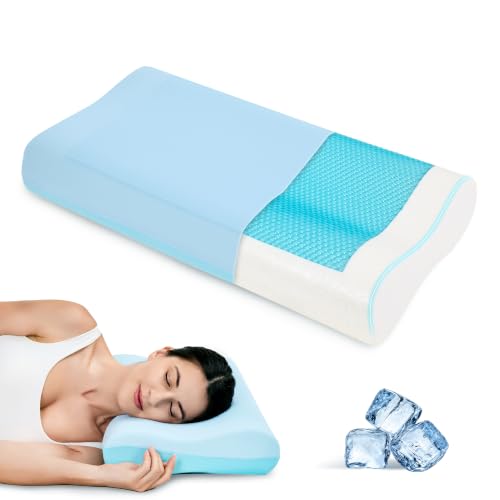
EGOHOME Cooling Gel Contour Pillow — Best Gel Contour
EGOHOME crosses the contour idea with its house talent for reversible design: a gel memory foam core shaped into a contour, reversible in character, medium firm, finished with a removable washable cover. The gel infusion addresses the contour’s known weakness — dense foam in close contact runs warm — by moderating the foam’s temperature behaviour from inside, while reversibility gives the sleeper two relationships with the same pillow across positions and seasons. For side and back sleepers who run hot, this is the most thermally considered contour in the line-up.
Medium firm is the right centre for a shaped pillow, and it matters here in the specific way contours demand: the ridge must be firm enough to keep its height beneath the neck at 4 a.m., while the hollow must give enough that the head feels received rather than parked. Standard size keeps the pillow compatible with ordinary cases and beds, and the washable cover is a practical blessing on a design whose curves would otherwise be hard to keep fresh. If your shortlist question is simply which contour takes heat most seriously, this is the answer the list keeps returning to.
- Shape: contour, reversible design
- Foam: cooling gel memory foam
- Firmness: medium firm
- Cover: removable, washable
- Size: standard
- Finish: blue
Strengths
- Gel infusion tackles foam warmth from inside
- Reversible character spans positions and seasons
- Washable cover suits a high-contact shaped pillow
Trade-offs
- Standard size only for larger beds
- Reversibility means neither face is a specialist
- Gel moderates warmth rather than removing it
Best for: hot side and back sleepers wanting a shaped pillow. Not suited for: king-bed owners wanting a pillow scaled to the bed.
Treat the two faces as a tuning dial during your first fortnight, keeping a simple morning note of which face served which position; combination sleepers often discover a pattern — one face for side-heavy nights, the other when they wake mostly on their back — that no amount of evening testing would have predicted. Wash the cover before first use and on the bedding cycle thereafter, and the gel core will keep its side of the bargain for a long time.

Ultra Cooling Cervical Pillow Adjustable — Best Adjustable Height
Adjustability is this pillow’s headline act, and for contour buyers it is the most valuable word in the category. A carved shape is a bet on dimensions, and an adjustable contour lets you hedge the bet at home — altering the effective height until the ridge meets your neck where your neck actually is. Around that idea the listing wraps an ergonomic memory foam contour, a pronounced cooling pitch and an odourless-foam claim that new-pillow shoppers, sensitive to the first-days scent of foam, will register with relief.
The cooling emphasis suits the design’s close fit. An adjustable contour tends to be worn snugly, with the neck settled into the curve rather than resting loosely on top, and close contact is where warmth gathers; a cooling-led cover and foam character keep that closeness comfortable across a summer night. Judge this pillow by its system rather than any single feature: shape you can tune, foam that holds the tuned shape, and a surface that stays pleasant while it does so. For side, back and stomach sleepers alike, the tuning range is the argument — a household of different frames can each find a setting, which no fixed pillow in this list can promise.
- Shape: ergonomic contour, adjustable
- Foam: memory foam, odourless claim
- Cooling: cooling-led design
- Positions: side, back and stomach
- Approach: height tuned at home
- Character: system of shape plus surface
Strengths
- Adjustable height forgives first-time measuring errors
- Cooling emphasis matches the contour’s close contact
- Odourless claim eases the first nights with new foam
Trade-offs
- Tuning asks for a few nights of patience
- More parts to keep track of than a fixed pillow
- One shape must serve several positions by adjustment
Best for: sleepers between sizes and households sharing a spare pillow. Not suited for: buyers who want zero setup decisions.
Adjust in the smallest steps the design allows and sleep two nights on each setting; the temptation to leap between extremes produces confusion, not data. Photograph your alignment from behind at each setting if a partner can help — the straightest line wins, and it is surprising how often the winning height is one step away from the one that merely felt interesting on the first evening. Keep any removed layers stored with the pillow’s packaging so the full range stays available when seasons, mattresses or sleepers change.

Royal Therapy Memory Foam Pillow Queen — Best Queen Contour
Royal Therapy publishes its dimensions in the listing — queen size, 24 by 14 by 5 inches — and in a category bought by measurement, that plainness is a feature. Five inches at the high side places this contour at the substantial end of the family, suited to side sleepers whose shoulder width asks for real height, while the queen footprint gives the head a wider stage than standard contours offer. The shape is the traditional cervical arrangement, and the white finish keeps the clinical geometry looking like bedding rather than equipment.
Size cuts both ways and this guide will say so. A queen contour on a double bed is a presence; two of them want a king or queen bed’s full width, and the shaped surface asks for a case that respects its curves. In return, sleepers who found standard contours cramped — the head rolling off the designed hollow toward a flat edge — get a shape with room to be itself. Back sleepers of broader build also tend to prefer this scale, since the ridge runs wider and the shoulders meet the pillow’s lower slope more naturally. Measure your bed, measure your current pillow, and let the numbers make this decision.
- Size: queen, 24x14x5 inches
- Shape: contour cervical arrangement
- Foam: memory foam
- Positions: side, back and stomach per listing
- Finish: white
- Character: largest published dimensions here
Strengths
- Published dimensions make fit a calculation, not a guess
- Five-inch height serves broader side sleepers
- Queen width keeps the head inside the design
Trade-offs
- Large footprint crowds smaller beds
- High side may overwhelm petite frames
- Needs cases that follow a big contour
Best for: broad-framed side sleepers on queen or king beds. Not suited for: small frames or narrow single beds.
If you sit between this height and a lower one, remember the pillowcase variable before blaming the foam: a thick, tight case can add effective firmness and a fraction of height, while a soft, roomy case lets the contour present itself as designed. Try the pillow in its intended case for the full first week. Owners who match this pillow’s scale tend to become the category’s quiet loyalists, because a contour that finally fits stops being equipment and becomes simply where sleep happens.

UTTU Cervical Memory Foam Pillow — Best Layered Design
UTTU builds its contour as a sandwich: layered memory foam in a queen format, with the core offering two heights — the listing publishes 5.2 and 4.5 inches across its profile — and adjustability through its layered construction. The sandwich idea is the elegant middle path between a fixed carve and loose shredded fill: the shape stays architectural, the layers stay put, yet the sleeper can still change the pillow’s effective height by reconfiguring what is inside. For households where one pillow must serve a side sleeper most nights and a back sleeper when the guest bed calls, that flexibility is the whole case.
The cooling in its description arrives through the contour’s cover and construction rather than a gel headline, so thermal purists should compare it honestly against the EGOHOME above; what UTTU offers instead is structural intelligence. Two heights in one core also solve the commonest contour disappointment — arriving home to find the single ridge a fraction too tall — without a return label. Queen dimensions, published plainly at 23.6 by 13.8 inches, make the bed-planning arithmetic easy, and the brand’s long presence in this exact niche shows in how completely the listing thinks through its own design.
- Build: layered sandwich memory foam
- Heights: two profiles, 5.2 and 4.5 inches
- Size: queen, 23.6×13.8 inches
- Adjustability: layered core
- Positions: side, back and stomach
- Character: structural flexibility
Strengths
- Two heights in one core double the fit chances
- Layered build adjusts without loose fill
- Published dimensions simplify bed planning
Trade-offs
- Cooling is quieter than the gel-led rivals
- Reconfiguring layers is a small household chore
- Queen size only in this design
Best for: sleepers who want adjustability with a carved shape’s discipline. Not suited for: hot sleepers whose first priority is maximum cooling.
Label your preferred layer arrangement once you find it — a note in the case or a photo on your phone — because a pillow stripped for washing has a way of being rebuilt wrong by a helpful partner. Revisit the arrangement when the seasons change the bed’s other layers; a winter duvet lifts the shoulders’ effective platform less than it lifts morale, but mattress toppers and new mattresses genuinely do change which of the two heights wears the crown.
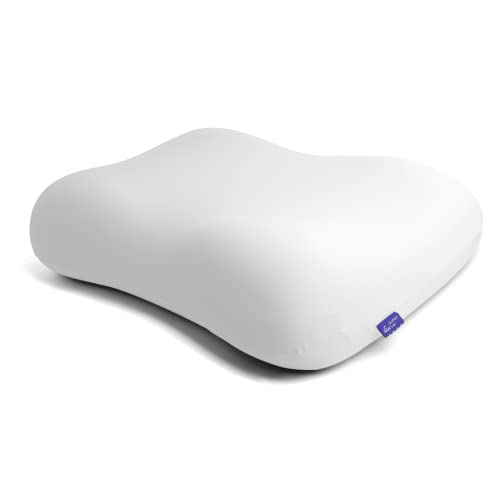
C CUSHION LAB Deep Sleep Pillow Contour — Best Patented Shape
C CUSHION LAB differentiates on design authorship: a patented ergonomic contour, drawn specifically for side and back sleepers, in a calm grey finish. Where the classic contour is a ridge and a hollow, a patented shape implies the curves were arranged with more particular intentions — transitions where the shoulder meets the pillow, a head cradle shaped rather than merely dipped — and sleepers who found the standard silhouette almost-right are this pillow’s natural audience. The grey matters too: shaped pillows can look like medical equipment, and a soft grey reads as bedroom design, which helps a contour earn permanent residence on a made bed.
The Deep Sleep name promises an outcome this guide will translate into its honest components: a shape intended to cradle the head and support the neck’s line for the two positions it was designed around. Nothing here treats anything, and the pillow asks to be judged the way all six should be — by a week of mornings in your own bed. Its specialism is its boundary as well: stomach sleepers are not its audience, and roaming sleepers who use every corner of a pillow may find any carved geography, however patented, more opinionated than they like. For committed side and back sleepers who appreciate design intent, it closes the list with a distinct voice.
- Shape: patented ergonomic contour
- Positions: side and back by design
- Foam: memory foam
- Finish: calm grey
- Approach: cradle-style head support
- Character: design-led specialist
Strengths
- Purpose-drawn curves for side and back sleeping
- Grey finish looks like décor, not equipment
- Clear audience makes fit expectations honest
Trade-offs
- Not designed for stomach sleepers
- Fixed shape offers no height tuning
- Opinionated geometry will not suit pillow roamers
Best for: design-minded side and back sleepers. Not suited for: stomach sleepers or anyone wanting one pillow for every position.
Give a designed shape its fairest trial by keeping everything else constant for the first week — same case, same bed, same side of the pillow facing up — so the mornings you are comparing differ only in your adaptation to the curves. Many sleepers find a patented contour feels strange for two nights and inevitable by the fifth, as their sleeping self learns where the cradle wants the head. If night seven still feels like an argument, believe it and choose a plainer shape; geometry, like advice, only works when it fits the person receiving it.
How Do the Six Contours Compare at a Glance?
| Pick | Shape approach | Adjustable? | Cooling route |
|---|---|---|---|
| Cervical Contour Memory Foam Pillow | Classic contour | No | Cooling cover character |
| EGOHOME Cooling Gel Contour Pillow | Reversible contour | Two faces | Gel-infused foam |
| Ultra Cooling Cervical Pillow Adjustable | Ergonomic contour | Yes | Cooling-led design |
| Royal Therapy Memory Foam Pillow Queen | Queen contour | No | Standard foam character |
| UTTU Cervical Memory Foam Pillow | Layered sandwich contour | Yes, layers | Cover-led |
| C CUSHION LAB Deep Sleep Pillow Contour | Patented contour | No | Standard foam character |
How Do You Know Which Ridge Height Fits Your Neck?
Start with the two orientations most contours offer. The higher ridge generally serves side sleeping, where the platform must match the shoulder’s height; the lower ridge generally serves back sleeping, where the neck wants support without the head being pushed forward. If a pillow arrives and feels wrong, the first experiment is always to turn it around — a remarkable share of contour disappointment is a pillow being slept on backwards, delivering its back-sleeping geometry to a side sleeper and being reviewed accordingly.
Then judge by line, not by luxury. Lying on the pillow in your position, your head should feel centred in the hollow, your neck resting along the ridge rather than perched on its peak or dangling short of it, and your shoulders should meet the pillow’s lower edge without being lifted by it. A partner’s photograph from behind remains the cheapest fitting tool in the category: the spine’s line either flows straight from head to back or it kinks visibly at the neck, and no amount of premium foam talk outranks a visible kink.
Why Do Contours Feel Strange for the First Few Nights?
Because your sleeping self is a creature of long habit, and a shaped pillow changes the geography it navigates blind. On a flat pillow, you arrange yourself; on a contour, the pillow proposes an arrangement, and the negotiation between the two of you takes nights rather than minutes. Mild awareness of the ridge, a tendency to drift back toward a familiar corner, even a night of sleeping half on and half off the design — all of this is the ordinary tuition of a new shape, and it is why verdicts delivered after one night are worth so little in this category.
The adaptation has a direction worth watching. Each night, the shape should feel less present, not more: the ridge retiring from attention, the hollow becoming simply where your head lives. If awareness grows across the week — if you are waking to rearrange the pillow or abandon it for the spare — the geometry is wrong for your frame in a way patience will not fix, and the adjustable designs in this list exist for exactly that discovery. Give a shape five to seven nights of honest trial, then believe the evidence either way.
How Should You Care for a Shaped Foam Pillow?
Shaped foam asks for the same discipline as flat foam, plus respect for its curves. The cover carries the washing load — remove it on the bedding cycle, since the contour’s valleys collect oils and dust more faithfully than a flat surface — while the core is aired, never soaked. Water inside dense foam dries slowly and a damp core inside a clean cover is a mustiness farm. Spot-clean accidents, air the pillow uncovered on the bed through the morning, and let moving air do the rest.
Storage and handling protect the geometry itself. Do not fold a contour in half to cram it into a cupboard, do not store it under heavy boxes, and rotate it end to end only if the design is symmetrical enough to allow it — many are deliberately not. A pillow protector under the case earns its keep doubly on a contour, guarding the valleys you cannot easily clean. Treated this way, good foam holds its carved heights for years; treated as a cushion for sitting on, it will be a flat, tired pillow by spring, and its reviews will blame the foam for the furniture’s misuse.
What Mistakes Do First-Time Contour Buyers Make?
Sleeping on the wrong ridge leads the list, followed closely by judging on night one and by buying a height copied from a differently built friend. Contours are measured garments, not tastes: shoulder width, mattress firmness and preferred position set the correct ridge, and none of those transfer between households. A fourth mistake is the case — a tight, thick pillowcase stretched across a contour bridges its hollow like a drum skin and quietly deletes the design, leaving the buyer sleeping on expensive flat foam and wondering what the fuss was about.
The subtlest mistake is expecting the pillow to fix what the pillow cannot reach. A contour can suit your alignment and comfort preferences beautifully; it cannot compensate for a mattress that has given up, a bedtime that keeps shrinking, or a health question that belongs in a clinic. Buy it as bedding, judge it as bedding, and let it be excellent within its honest remit — the sleepers who love their contours longest are the ones who asked them for comfort and support, not miracles.
How Does Mattress Firmness Interact With a Contour?
A contour’s published height is measured on a table, but it performs on a mattress, and the mattress edits the geometry before your head ever arrives. On a plush mattress the shoulder sinks, the whole sleeper sits lower, and the pillow’s ridge effectively grows taller relative to the neck — a contour that was perfect on a firm guest bed can feel like a wedge at home. On a hard mattress the shoulder rides up, the gap beneath the neck widens, and the same pillow may suddenly feel shy of the support it promised in the shop of your imagination.
This is the practical argument for the adjustable entries in this list. The Ultra design and UTTU’s layered core let you re-tune the pillow when the bed changes, and beds change more often than pillows do: a new mattress, a topper added for a partner, a move from the main bed to a firmer spare. Fixed contours should be bought against the bed they will actually serve, measured with the sleeper lying in position rather than standing in a showroom pressing foam with a thumb — a thumb has no shoulders and lies about everything.
What Should Petite and Broad Sleepers Each Watch For?
Contours are not one-size garments, and the two ends of the frame spectrum fail in opposite directions. A petite sleeper on a tall, firm ridge can find the head pushed forward and the chin nudged down, particularly on their back, because the ridge was drawn for a longer neck and a heavier head. For smaller frames the lower orientation of a two-height design, or the leaner settings of an adjustable model, usually hold the answer, and the Royal Therapy’s five-inch high side should be approached with a tape measure rather than enthusiasm.
Broad shoulders write the opposite review. A low contour under a wide side sleeper collapses the geometry: the head drops past the hollow’s intention, the neck bends toward the mattress, and the pillow gets blamed for being soft when it was merely short. Height and width together are the broad sleeper’s specification — the queen formats in this list exist for them — and a contour that fills the frame’s measurements will feel firmer and more supportive than a nominally firmer pillow that is simply too small to hold the position.
How Do Combination Sleepers Live With a Fixed Shape?
The sleeper who tours all three positions in a night is the contour’s hardest customer, and honesty requires saying that some of them should buy the reversible designs or skip carving altogether. A shape tuned for the back can feel like an obstacle course at the moment its owner rolls onto a stomach, and no ridge height yet designed flatters a face-down sleeper. The reversible EGOHOME and the adjustable Ultra are the list’s peace treaties: geometry present when wanted, moderated when not.
For the side-and-back combination — the commonest tour — a mid-height contour with a gentle transition between ridge and hollow usually works, because the sleeper’s two home positions are the two the shape was drawn for. Watch where you actually wake across a week rather than where you fall asleep; most combination sleepers have a dominant position the pillow should serve first, with the other position tolerated rather than perfected. A pillow that serves the dominant position beautifully and the minor one adequately beats a pillow that serves both at half strength.
Can You Travel With a Contour Pillow?
You can, and devoted contour sleepers do, because hotel pillows are drawn for an average guest who does not exist. Memory foam compresses willingly for a car journey — rolled or bagged, it will expand again at the destination, though it deserves hours rather than minutes to recover its carved heights after a day compressed. Standard sizes travel best; the queen formats in this list are car-boot items rather than cabin companions, and a pillow that arrives still half-compressed will spend its first night auditioning at the wrong height, which is how good pillows collect bad holiday reviews.
At the destination, recreate the home geometry as closely as the strange bed allows. A softer hotel mattress lowers the shoulder and can make your contour feel taller, so the lower ridge or the leaner layer setting earns its keep on the road. Keep the pillow in its own case inside your luggage, wash that case on your return, and a contour can serve a decade of trips — a small, familiar piece of geometry that makes foreign beds behave.
When Should a Contour Pillow Be Replaced?
Foam announces its retirement in the ridge first. Press the highest point of the contour and release: healthy foam returns promptly and completely, while tired foam hesitates and keeps a fingerprint of the press. A ridge that has lost height has quietly rewritten the pillow’s geometry, and no case, protector or hopeful fluffing restores it — the sleeper is then lying on a shape that no longer matches the one they chose, which explains the otherwise mysterious return of morning discomfort with a once-loved pillow.
Other signals corroborate: a permanent valley in the hollow, edges that crumble or crack, a cover whose zip has failed so the foam takes the laundry’s weather directly. Replaced in time, a contour is a renewable system — the new pillow restores the old geometry and the sleeper’s adaptation carries over almost intact, since the shape is familiar even when the unit is new. Replaced late, after months of sleeping on a subsided ridge, the household often misdiagnoses the problem as their own ageing. Check the press test twice a year and let the foam, not the calendar, call the date.
How Do You Read a Contour Listing Like a Measurer?
Three numbers matter and listings do not always volunteer them together: length and width, which decide the bed fit, and the pair of heights — high ridge and low ridge — which decide the body fit. Where a maker publishes all of it, as Royal Therapy and UTTU do here, honour the transparency by actually measuring your current pillow and your shoulder span before ordering. Where a listing is coy about heights, the photographs can be interrogated: a contour photographed beside a hand or a bed gives rough scale, and the questions section of a listing often holds the dimensions the headline hid.
Firmness language needs translating too. Medium firm in a contour means the ridge will hold a neck’s weight without folding; it does not mean the surface feels like a board, because the hollow still receives the head with foam’s usual slow give. Density claims, where they appear, speak to longevity more than to feel — denser foam generally holds its carve longer. And the word cooling should always be chased to its mechanism: a cover fabric, a gel infusion, perforations, or nothing but optimism. This list has tried to name the mechanism wherever a maker provides one.
What Is the Difference Between a Contour and a Wedge or a Roll?
Neighbouring shapes crowd the same shelves and confuse first-time buyers, so the distinctions are worth drawing. A neck roll is a cylinder: it fills the neck’s curve for back sleeping and does almost nothing for the head itself, which is why rolls usually partner a pillow rather than replace one. A wedge is an incline, built to raise the whole upper body — a different tool for different purposes, and far too much architecture for ordinary side or back sleeping. The contour is the only one of the three designed as a complete sleeping surface for the head and neck together.
Hybrids exist at the borders — contours with a roll-like ridge, gently inclined contours — and the six here stay on the classic side of the family because the classic question deserves a classic answer first. A reader who has tried a plain contour and found the ridge right but the head’s hollow wrong may graduate toward the patented and adjustable variations within this list before wandering into wedges and rolls, since the contour family itself contains more variety than its silhouette suggests.
How Should a Guest Room Handle Contour Pillows?
Guests cannot be fitted, so the guest room should stock forgiveness. An adjustable contour set to its middle personality serves the widest range of visiting frames without instruction, and pairing it with an ordinary flat pillow in the same bed lets each guest build the arrangement their body recognises — contour alone, flat alone, or the flat pillow exiled to the knees. What a guest room should not do is impose the household’s most specialised shape on strangers: the patented contour its owner adores is a fitted garment, and lending fitted garments to visitors is hospitality of a doubtful kind.
Hosts can quietly improve the odds with information. A small note — this pillow has a high side and a low side, turn it to taste — converts a strange object into an offered choice, and guests who would never complain about a pillow will happily experiment when invited. Wash covers between guests without exception, since a shaped pillow’s valleys hold a previous sleeper’s evidence more faithfully than flat pillows do, and the guest who finds a fresh-smelling, well-aired contour is receiving a small but real compliment from the house.
How Do You Keep a Contour Working Through the Seasons?
The bed changes with the calendar even when the pillow does not. Summer strips the bed to a sheet, lowering the sleeper’s whole platform by the thickness of the winter duvet that used to lift the shoulders; winter bedding returns that lift and can make a contour feel fractionally lower relative to the neck. Attentive sleepers re-run the orientation test twice a year — a night on each ridge when the heavy bedding arrives and when it leaves — because the winning side in January is not guaranteed the crown in July.
Temperature also edits foam’s behaviour directly: memory foam firms slightly in a cold room and softens in a warm one, which is why a contour can feel stern on a winter’s first night and obliging by morning as it takes the sleeper’s warmth. None of this is failure; it is the material’s nature, and it argues for judging a new contour across several nights in the season you bought it, and for re-judging briefly when the season turns, rather than assuming a pillow that changed its feel has changed its quality.
How Do You Introduce a Contour to a Sceptical Sleeper?
Start with honesty about the first nights. A sleeper told to expect a small apprenticeship — a few evenings of noticing the ridge, a morning or two of reserve — will usually complete it and arrive at the shape’s comfort with their trust intact. A sleeper promised transformation by Friday will return the pillow on Thursday, because the promise was never the pillow’s to keep. Frame the trial as fitting, like shoes: the right pair is not the one that feels like nothing on day one, but the one your feet stop reporting on by the end of the week.
Keep the old pillow in the house during the trial, visibly available and entirely unthreatening. Paradoxically, sleepers adapt faster when retreat is allowed, because the contour stops being an assignment and becomes a choice they renew each night. If the old pillow wins back the bed after a fair week, that is information, not defeat: it tells you the household’s next experiment should be a different height, an adjustable design, or a return to the flat and shredded family with better data about why.
Final Recommendation
Newcomers to shaped sleeping should start with the Cervical Contour Memory Foam Pillow for the classic geometry, or step straight to the UTTU Cervical Memory Foam Pillow if the insurance of two heights appeals. Hot sleepers belong on the EGOHOME Cooling Gel Contour Pillow, where the gel works from inside the foam. Whichever shape you invite home, turn it around before you judge it, give it a week of nights, keep its cover washed and its core dry — and let the line of your spine in a partner’s photograph have the final, friendly say.
Frequently Asked Questions
Which sleeping positions suit a contour pillow best?
Side and back sleeping are the contour’s home ground, because both positions leave a gap beneath the neck that a ridge is built to fill. Stomach sleepers generally prefer low, flat pillows, since a ridge under the neck in that position pushes the head into an angle few people find comfortable.
How do I choose between the two heights on one pillow?
Start with the higher ridge for side sleeping and the lower for back sleeping, then swap for two nights and compare mornings. Combination sleepers often settle on the height that serves their dominant position and accept the compromise in the other.
Do cooling covers on contour pillows really help?
They moderate the first contact and slow the build-up of warmth where the face and neck meet the foam, especially paired with gel infusions. Expect a calmer surface rather than a cold one, and keep the cover washed, since a fresh cover is half the effect.
How long should I trial a contour before deciding?
Five to seven nights is the fair window, changing nothing else about the bed during the trial. Awareness of the shape should fade night by night; if it grows instead, the geometry does not fit your frame and a different height or an adjustable model is the sensible next step.
Can two people share one contour design happily?
Only when their frames and positions genuinely match. Contours are fitted objects; households do best buying per sleeper, or choosing an adjustable design for a shared spare bed where different guests need different heights across the year.
Will a contour pillow work with my existing pillowcases?
Standard contours take standard cases, and the queen formats here want queen or king cases with room for the curves. The fit should be relaxed: a case hauled tight across a contour flattens the hollow and changes the pillow’s behaviour, so if your favourite case fights the shape, size up rather than forcing the marriage.
Is a higher ridge always better for side sleeping?
No — the ridge should match your shoulder span and your mattress, not a league table. Too high cranks the head away from the bed as surely as too low lets it fall toward it. The correct height is the one that leaves your spine running straight, which is why two-height and adjustable designs forgive so many first purchases.
How do I wash a contour pillow?
Wash the removable cover with the bedding, and never soak the foam core. Spot-clean the core if needed, then air it uncovered until fully dry. A protector under the case reduces how often the cover itself needs attention.
Do contour pillows work on adjustable beds?
Yes, with the bed’s incline doing part of the geometry’s work. When the head of the bed is raised, many back sleepers find the lower ridge sufficient, since the incline already supports the upper back’s curve. Side sleepers on a raised bed should re-run the straight-spine check, because the platform beneath them has changed.
Should I keep my old pillow as a backup?
During the trial week, absolutely — an available retreat makes the experiment calmer and the verdict more honest. After the contour has won the bed, the old pillow can serve the guest room or the knees. Keeping it forever as a nightly alternative usually means the contour never quite fitted, which is worth admitting and acting on.
Does a contour need a break-in period for the foam itself?
New foam can feel firmer in its first nights than it will in its third week, as the material settles into working life and takes the room’s temperature habits. Judge the shape across the full trial window rather than the first evening, and let the pillow expand and air for a day after unboxing before its first night of duty.
Related Guides
A bedroom rebuilt around better sleep usually finishes at the floor beneath the bed, and Best Area Rugs 9 x 12 covers the large washable options with a measurer’s eye. For the room beyond, Best Farmhouse and Apron Kitchen Sinks applies the same measurement-first thinking to the kitchen. And the sheets that complete a rebuilt bed are honestly reviewed in Best Jersey Sheet Sets No Pilling, where fibre length matters as much as it does in foam.


