What's inside
- Key Takeaways
- Quick Picks
- How Did We Choose Affordable Portables That Can Honestly Handle 500 Square Feet?
- How Do the Six Compare on the Numbers That Decide a 500-Square-Foot Room?
- What Does 500 Square Feet Actually Demand From a Portable Air Conditioner?
- Why Do Portables Carry Two Different BTU Numbers?
- How Should You Install a Portable So a Big Room Actually Cools Down?
- Which Running Costs Should a Budget Buyer Watch After the Purchase?
- How Does Living With a Portable in a Big Room Feel Day to Day?
- Portable or Window Unit for a Room This Size — Which Saves More Money?
- How Do Climate and Ceiling Height Change the 500-Square-Foot Calculation?
- What Should You Check in the First Evening Before Deciding to Keep It?
- When Is a Second, Smaller Machine Better Than One Large Portable?
- What Mistakes Turn a Good Budget Portable Into a Bad Purchase?
- Final Recommendation
- Frequently Asked Questions
- Related Guides
As an Amazon Associate I earn from qualifying purchases. This post may contain affiliate links at no extra cost to you.
cottageverdict.com is reader-supported. When you buy through links on our site, we may earn an affiliate commission.
Where to buy: all six machines below are sold through Amazon, and every product name in the Quick Picks table, the detailed reviews and the comparison table links directly to its listing so you can check price on Amazon before you commit. This guide exists for one stubbornly common problem — finding the best affordable portable air conditioners for 500 square feet without paying for capacity you will never use or, worse, buying a unit whose real-world output quietly falls short of the room it has to serve.
A 500-square-foot space is an awkward size for portable cooling. It is larger than the bedroom most small portables are honestly built for, yet smaller than the open-plan areas where the biggest dual-hose machines earn their keep. A studio apartment, a finished basement den, a long living room with an adjoining dining corner — all of them sit near this mark, and all of them punish a careless purchase. The machine has to move enough air to change how the far end of the room feels, not merely chill a pool of air around its own grille.
The trap is the number printed largest on the box. Portable air conditioners carry two different cooling figures: an older ASHRAE rating and a lower, more honest SACC figure that accounts for the heat a single-hose machine pulls back into the room. Every pick here is a 12,000 BTU ASHRAE machine, but their SACC numbers and maker-stated room coverage differ, and those differences are exactly what decides whether a budget purchase feels like a bargain or a slow disappointment through August.
Affordable, in this guide, does not mean the cheapest listing on the page. It means the total cost of a comfortable summer stays low: a fair purchase price, modest electricity use, a window kit that seals properly so cooled air is not wasted, and controls simple enough that the machine actually gets used every hot day instead of only during heatwaves. The six reviews below judge each candidate against that fuller definition, room by room and feature by feature.
Our Top Picks
Key Takeaways
- For 500 square feet, shop by the SACC figure and the maker’s stated coverage, not the big ASHRAE number on the carton.
- All six picks here are rated 12,000 BTU ASHRAE, yet their honest cooling reach differs — that gap is the whole story of this category.
- A window kit that seals tightly is worth more than a remote control; leaked air is cooling you paid for and threw away.
- Drainage-free and auto-evaporation designs cut the weekly chore load in humid climates where condensate builds quickly.
- Smart controls only save money when you schedule them; an app you never open is decoration, not efficiency.
- Measure your window type before ordering — sliders and casements need different kits, and the wrong kit delays comfort by days.
Quick Picks
| Pick | Badge | Why it earns its place |
|---|---|---|
| BLACK+DECKER Smart Portable AC 12000 BTU BPACT12WT | Most Trustworthy Budget Pick | Established brand, published 8,000 BTU SACC figure and smart control for rooms the listing sizes up to 550 square feet |
| Global Commander Portable AC 12000 BTU | Leanest Specification Sheet | A plainly stated 8.15K SACC rating and little else — the honest minimalist of this group |
| Humhold 12000 BTU Portable AC | Remote-Control Simplicity | Floor-standing cooling with a remote and no app account standing between you and a cooler room |
| GrowthWing 12000 BTU Smart Portable AC | Smart-Home Value Pick | WiFi, voice control and auto-evaporation sized by its maker for spaces up to 550 square feet |
| Wiytamo 12000 BTU Portable AC with WiFi | Family-Friendly Controls | Sleep mode, child lock and a 24-hour timer wrapped around a straightforward 3-in-1 design |
| DREO Portable Air Conditioner 515S 12000 BTU | Quietest Budget Route | Drainage-free cooling with app, voice and remote control from a maker that publishes both BTU figures |
How Did We Choose Affordable Portables That Can Honestly Handle 500 Square Feet?
We began by fixing the room, not the machine. Five hundred square feet with a standard ceiling, average insulation and one or two occupants is the test case, and any candidate whose maker would not state coverage near that size, or whose SACC figure sagged far below its headline rating, had to justify itself some other way. All six finalists are 12,000 BTU ASHRAE units, because stepping down to smaller portables for this room size is the most common false economy in the category.
Next we weighed the costs that arrive after checkout. A portable that runs an extra two hours daily because its thermostat sits in its own cold exhaust stream wastes real money across a summer. Auto-evaporation and drainage-free designs reduce mid-cycle shutdowns in humidity. Programmable timers and sleep modes trim overnight consumption. We treated each of those as a budget feature, not a luxury, because for this buyer the electricity bill is part of the purchase.
One more filter shaped this list: how forgiving each machine is when a first assumption proves wrong. A slightly loud unit can be repositioned onto a rug, a unit without an app can gain a simple timer plug, and a basic window kit can be sealed better with foam tape on a Saturday morning. The flaws that cannot be managed afterwards are honest output and sizing headroom, which is why those two tests came first in our thinking and why the ordering of the reviews above reflects them.
Finally, we favoured machines a first-time portable owner can install alone in under an hour and live with afterwards: window kits included, hoses that stay seated, filters that wash rather than need replacing, and controls that work from the unit itself when the WiFi drops. A cheap air conditioner that fights its owner gets resold by July; these six were picked to still be in the room, working, in September.

BLACK+DECKER Smart Portable AC 12000 BTU BPACT12WT — Most Trustworthy Budget Pick
The BLACK+DECKER BPACT12WT earns the lead slot because its listing does something budget listings often avoid: it publishes the honest number. Alongside the 12,000 BTU headline sits an 8,000 BTU SACC rating and a stated reach of up to 550 square feet, which brackets our 500-square-foot test room with a small margin instead of a hopeful stretch. For a buyer counting every pound or dollar of value, that transparency matters — you know precisely which room sizes this machine can serve and which it cannot.
As a 3-in-1 design it cools, fans and dehumidifies, and the smart control layer means the unit can be started from the sofa or scheduled before you leave work. In a 500-square-foot studio that flexibility changes how the machine is used: a short pre-cool before you arrive home replaces the expensive habit of leaving it running all day. The Follow Me style of sensing found elsewhere in this brand family is absent here, so place the unit where its onboard thermostat reads the room fairly — away from its own discharge and out of direct sun patches.
Living with it is unremarkable in the good sense. The window kit follows the familiar panel-and-hose pattern, casters let it tuck against a wall when guests come, and the washable filter keeps running costs down. It is not the quietest machine in this roundup, and single-hose physics still applies, but as a first portable for a big room it balances price, published honesty and brand support better than anything else here.
- Cooling rating: 12,000 BTU ASHRAE, stated plainly on the listing
- SACC figure: 8,000 BTU, published rather than hidden
- Maker-stated coverage: rooms up to 550 square feet
- Modes: cooling, fan and dehumidifying in one cabinet
- Control: smart connectivity plus onboard controls
- Placement: floor-standing on casters for repositioning
Strengths
- Published SACC figure lets you size the purchase honestly
- Coverage claim clears the 500-square-foot brief with margin
- Smart scheduling can replace wasteful all-day running
Trade-offs
- Single-hose layout loses some efficiency in very hot weather
- No heating mode for shoulder-season use
- Thermostat placement needs thought in long, divided rooms
Best for: first-time portable buyers cooling a studio or large living room who want a known brand and honest published figures.
Not suited for: shoppers in extremely humid climates who need a dedicated high-capacity dehumidifier as well.
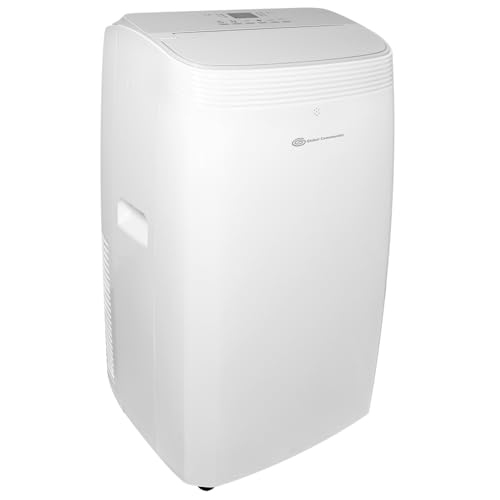
Global Commander Portable AC 12000 BTU — Leanest Specification Sheet
The Global Commander PAG-Y11KCO730C is the minimalist of this group, and there is a real argument for it. Its listing states 12,000 BTU with an 8.15K SACC figure — actually the highest SACC number among the budget portables collected here — and then largely stops talking. No app ecosystem, no voice assistant roll call, no lifestyle promises. For a buyer who has watched smart features inflate prices across the whole appliance aisle, that restraint is the point.
What does the stripped-back approach cost you in daily life? Mostly convenience. Scheduling and remote adjustments are limited compared with the connected picks around it, so the machine asks to be switched on when you are home and switched off when you leave. In a room this size that reaches temperature reasonably quickly, that discipline is workable; in a sun-baked top-floor flat that needs pre-cooling before you return, it is a genuine drawback worth weighing before the saving seduces you.
Treat this as the pick for straightforward spaces: a basement den that is used in the evenings, a large bedroom in a house where it supplements central air, a workshop room where the laptop-and-app layer would never be opened anyway. The cooling hardware underneath — compressor, hose, window seal — does the same physical job as its smarter rivals, and the stated SACC figure suggests it does that job efficiently. Just confirm the window kit matches your window style before ordering, because spare panels for lesser-known brands can be slower to source.
- Cooling rating: 12,000 BTU as listed
- SACC figure: 8.15K, the strongest honest rating in this budget set
- Format: floor-standing portable with exhaust hose
- Control approach: unit-led, without a heavy smart layer
- Colour: white cabinet as listed
- Best role: supplementary or single-room duty at this size
Strengths
- Highest stated SACC figure among these six picks
- No money spent on connectivity you may never use
- Simple operation suits guest rooms and occasional use
Trade-offs
- Limited scheduling compared with the WiFi models here
- Brand support network is thinner than the big names
- Listing detail is sparse, so check kit contents carefully
Best for: buyers who want cooling hardware only, in a room used mainly while someone is home to run it.
Not suited for: commuters who rely on pre-cooling a hot flat before arriving back each evening.

Humhold 12000 BTU Portable AC — Remote-Control Simplicity
Humhold’s 12,000 BTU portable occupies the middle ground this category needs more of: a floor-standing unit with a remote control, a recognisable mode set and no insistence that you create an account before the room gets cooler. The listing is brief — remote, floor-standing cooling — and the machine’s appeal is that brevity. Everything essential happens from the chair you are sitting in, which in a 500-square-foot living room is exactly where control should live.
The remote deserves more credit than reviewers usually give it. In a large room the portable often ends up parked by the only suitable window, which may be six metres from the sofa or bed. Walking over to adjust a dial several times an evening quietly trains owners to tolerate the wrong temperature; a remote removes that friction, and a machine that gets adjusted properly also gets switched off promptly, which is where the running-cost savings actually come from.
Where the Humhold asks for compromise is information. Its listing publishes less sizing detail than the BLACK+DECKER or DREO, so buyers should be conservative: this is a sensible 12,000 BTU-class machine for a 500-square-foot room with ordinary ceilings and some shading, not a promise for a glass-walled sun trap of the same area. Keep the hose run short and straight, seal the window panel edges with the supplied kit and tape if needed, and the physics will reward you.
- Cooling rating: 12,000 BTU as listed
- Format: floor-standing portable unit
- Control: remote control included as the primary interface
- Modes: cooling-led portable operation
- Placement: caster-style mobility typical of the format
- Listing style: concise — verify kit contents at checkout
Strengths
- Remote control makes large-room adjustments effortless
- No app or account required to use every core function
- Straightforward specification at a budget position
Trade-offs
- Published coverage detail is thinner than key rivals
- Fewer smart scheduling options for pre-cooling
- Single-hose efficiency limits apply on extreme days
Best for: living rooms and large bedrooms where the window sits far from the seating or the bed.
Not suited for: buyers who want published SACC data and app scheduling before they commit.

GrowthWing 12000 BTU Smart Portable AC — Smart-Home Value Pick
GrowthWing’s 12,000 BTU portable makes the connected case at a budget position: WiFi control, voice and remote operation, auto-evaporation and a maker-stated reach of up to 550 square feet, arranged in a 3-in-1 cabinet that cools, dehumidifies and fans. On paper it matches the BLACK+DECKER feature for feature while typically sitting in the same affordable band, which is why it belongs in any shortlist built around value rather than brand familiarity alone.
Auto-evaporation is the feature to linger on. Portables in humid weather collect condensate faster than owners expect, and a machine that disposes of most of that water through its exhaust keeps cooling through a muggy evening instead of stopping with a full tank. For a large room — where the unit runs longer cycles than it would in a small bedroom — that continuity is worth real comfort, and it removes the least pleasant chore of portable ownership.
The voice and app layer will divide readers. If your home already runs on a voice assistant, starting the cooling while your hands are full of shopping is genuinely pleasant. If it does not, the remote still covers daily use and nothing about the machine depends on the cloud. Judge the GrowthWing on its evaporation system and coverage claim first; treat the smart layer as a bonus that happens to be included rather than the reason for the price.
- Cooling rating: 12,000 BTU as listed
- Maker-stated coverage: up to 550 square feet
- Water handling: auto-evaporation reduces manual draining
- Modes: 3-in-1 cooling, dehumidifying and fan
- Control: WiFi app, voice control and remote
- Noise positioning: quiet operation claimed by the maker
Strengths
- Auto-evaporation suits long cycles in bigger rooms
- Full smart control set at a budget position
- Coverage claim matches the 500-square-foot brief directly
Trade-offs
- App setup adds a step before first use
- Lesser-known brand beside BLACK+DECKER and DREO
- Smart features add nothing if your home has no assistant
Best for: humid-climate buyers in larger rooms who are tired of emptying condensate tanks.
Not suited for: anyone who prefers appliances with no network features at all.

Wiytamo 12000 BTU Portable AC with WiFi — Family-Friendly Controls
Wiytamo’s 12,000 BTU portable is built around the small courtesies that matter in a family-sized room: WiFi control, a 24-hour timer, sleep mode and a child lock, wrapped into a 3-in-1 unit covering cooling, dehumidifying and fan duties. The child lock sounds like a footnote until a toddler discovers that the control panel makes beeps; in a 500-square-foot open living space where the machine sits within small-hand reach, it becomes a headline feature.
Sleep mode is the other grown-up touch. A big room cooled hard at bedtime often overshoots by 2 a.m., waking sleepers in a studio layout where the bed shares air with the machine. A sleep programme that eases the target temperature upward through the night keeps the room comfortable while trimming both noise and electricity — the two currencies a budget buyer is really spending. Pair it with the timer so the unit rests entirely during the empty morning hours.
As with the Humhold, the listing keeps some sizing detail to itself, so buy it for a room at this scale with reasonable expectations: ordinary ceiling height, curtains or blinds doing their share, doors to unused rooms kept closed. Within those honest boundaries the Wiytamo offers the most household-aware control set in this group, and for parents that may outweigh a rival’s marginally better published figures.
- Cooling rating: 12,000 BTU as listed
- Modes: 3-in-1 cool, dehumidifier and fan
- Timer: 24-hour scheduling for daily routines
- Sleep mode: gentler overnight temperature handling
- Safety: child lock on the controls
- Control: WiFi plus remote operation
Strengths
- Child lock suits open-plan family living spaces
- Sleep mode prevents the classic 2 a.m. over-chill
- Timer discipline keeps running costs predictable
Trade-offs
- Maker coverage detail is limited in the listing
- Smart setup required to use the full feature set
- Not the pick for sun-trap rooms at this exact size
Best for: parents cooling a shared living and sleeping space on a budget.
Not suited for: solo buyers who would trade every family feature for raw published output data.

DREO Portable Air Conditioner 515S 12000 BTU — Quietest Budget Route
The DREO 515S arrives with the most complete published arithmetic in this roundup: 12,000 BTU ASHRAE and 8,000 BTU under the DOE/SACC method, stated side by side by the maker. That pairing lets a careful buyer compare it directly with the BLACK+DECKER, and the near-identical honest figures confirm both machines belong in the same performance class for a room of this size. DREO then separates itself with drainage-free cooling — its design manages condensate so the owner is not ferrying water across the room mid-evening.
Drainage-free operation pairs naturally with the way this unit is controlled. App, voice and remote are all present, so the machine can be started during the commute, nudged from bed and silenced for a film without anyone crossing the room. DREO also positions the 515S as a quiet bedroom-capable machine, and while no portable is silent, a unit designed around lower disturbance suits the studio layout where the sleeper, the desk and the sofa all share one 500-square-foot volume of air.
Choose the DREO if your budget stretches to the top of this affordable band and you value the absence of chores. It asks for the same single-hose compromises as every rival here — keep the hose short, seal the window, close doors to rooms you are not cooling — but within those rules it is the most polished package in this set, and the one least likely to be replaced next summer by something better organised.
- Cooling rating: 12,000 BTU ASHRAE as listed
- DOE/SACC figure: 8,000 BTU, published by the maker
- Water handling: drainage-free cooling design
- Modes: cooling, fan and dehumidifier, 3-in-1
- Control: app, voice and remote all included
- Intended setting: bedroom-capable quiet positioning
Strengths
- Both BTU standards published for honest comparison
- Drainage-free design removes the worst portable chore
- Complete control set suits studio living
Trade-offs
- Sits at the upper edge of this budget group
- Drainage-free systems still need filter care
- Single-hose layout, like every pick here, wastes some cooled air
Best for: studio dwellers who want one machine to run all day with minimal intervention.
Not suited for: buyers chasing the absolute lowest purchase price regardless of features.
How Do the Six Compare on the Numbers That Decide a 500-Square-Foot Room?
| Pick | Badge | Honest output signal | Standout trait |
|---|---|---|---|
| BLACK+DECKER Smart Portable AC 12000 BTU BPACT12WT | Most Trustworthy Budget Pick | 8,000 BTU SACC published | Smart 3-in-1 from an established brand |
| Global Commander Portable AC 12000 BTU | Leanest Specification Sheet | 8.15K SACC stated | Hardware-first, minimal smart layer |
| Humhold 12000 BTU Portable AC | Remote-Control Simplicity | 12,000 BTU class, remote-led | No-account operation |
| GrowthWing 12000 BTU Smart Portable AC | Smart-Home Value Pick | Coverage stated to 550 sq. ft. | Auto-evaporation plus voice control |
| Wiytamo 12000 BTU Portable AC with WiFi | Family-Friendly Controls | 12,000 BTU class, timer-led | Child lock and sleep mode |
| DREO Portable Air Conditioner 515S 12000 BTU | Quietest Budget Route | 8,000 BTU DOE figure published | Drainage-free, app and voice control |
What Does 500 Square Feet Actually Demand From a Portable Air Conditioner?
Start with the load, not the label. A room of this size with an eight-foot ceiling holds about 4,000 cubic feet of air, and on a hot afternoon that air is being reheated constantly — through sunlit glass, through walls, by the people and electronics inside it. A portable has to remove heat faster than the room gains it, or the temperature plateaus several degrees above the thermostat setting and the machine runs all day without ever satisfying anyone. That plateau, not a breakdown, is what most disappointed portable owners are actually describing.
Ceiling height quietly rewrites the arithmetic. The same floor area under a ten-foot ceiling holds a quarter more air, and vaulted or open-to-stairs layouts borrow volume from the rest of the home. If your 500 square feet comes with tall ceilings, treat the room as effectively larger: favour the picks with published SACC figures at the top of this group, close doors aggressively, and consider whether a window unit — which avoids the single-hose penalty entirely — is permitted where you live.
Sun exposure matters as much as size. A shaded, north-facing 500-square-foot basement den may stay pleasant with any machine here, while a west-facing room with a wall of glass can defeat all six on the hottest afternoons. Curtains drawn before the sun arrives are worth more than a model upgrade; thermal blackout linings on the sun side can cut the load enough to move a borderline room back inside a portable’s honest reach. Buy the machine for the room as it behaves at 4 p.m., not as it measures on a plan.
Finally, remember that portable ratings assume the exhaust hose is doing its job. Every foot of unnecessary hose inside the room is a warm radiator undoing the compressor’s work, and every gap around the window panel leaks cooled air out and hot air in. The installation section below is therefore not housekeeping — it is half the cooling capacity you paid for, and it is entirely free.
Why Do Portables Carry Two Different BTU Numbers?
The older ASHRAE figure measures a portable’s cooling under laboratory conditions that flatter it, essentially crediting the machine with its full refrigerating effect. The SACC figure — seasonally adjusted cooling capacity — was introduced because single-hose portables create a subtle problem: they blow air out of the room through the hose, and replacement air gets pulled in from corridors, gaps and warmer rooms. Part of the cooling is spent chilling that incoming air. SACC attempts to price that penalty in, which is why it always reads lower.
Neither number is a lie, but they answer different questions. ASHRAE tells you the size of the refrigeration hardware; SACC tells you something closer to the effect on your room across a season. When a listing publishes both, as the BLACK+DECKER and DREO here do, comparison shopping becomes straightforward. When a listing publishes only the big number, assume the honest figure sits somewhere near sixty to seventy percent of it and size your expectations — and your room — accordingly.
This is also why a 12,000 BTU portable is the correct starting point for 500 square feet rather than overkill. On the honest scale these machines deliver roughly 8,000 BTU of seasonal effect, which matches guidance for a room of this size with average conditions. A 9,000 or 10,000 BTU portable that looks adequate by its headline would, on the same honest scale, be undersized for the brief — the classic false economy this guide was written to prevent.
Use the two numbers as a honesty test for brands generally. A maker willing to print the less flattering figure prominently is usually a maker whose coverage claims, noise positioning and mode lists can also be taken at face value. In a budget category crowded with optimistic cartons, that willingness is itself a product feature, and it influenced the ordering of the Quick Picks table above.
How Should You Install a Portable So a Big Room Actually Cools Down?
Position first: the machine belongs near the window it vents through, with the hose extended as little as possible and without tight bends. Every extra foot of hose radiates heat back into the room, so resist the temptation to park the unit across the space and stretch the hose to reach. If the only window is poorly placed, a shorter hose run to a less fashionable window beats a long run to the pretty one, every single time.
Seal the window kit like you mean it. The sliding panel fills most of the opening, but the edges are where cooled air escapes. Foam tape around the panel perimeter, and a check that the hose collar clicks fully home, can be the difference between a room that reaches its set point and one that hovers two degrees above it all evening. Slider windows need vertical panel orientation; casement windows need a fabric seal kit, which is a separate purchase worth ordering the same day.
Manage the room around the machine. Close doors to spaces you are not cooling, draw curtains on sun-struck glass before midday, and keep heat producers — ovens, gaming PCs, tumble dryers — in mind when you judge performance at dinner time. Give the portable clear space around its intake so it breathes room air rather than its own cooled output, and clean the washable filter every couple of weeks; a clogged filter quietly taxes both cooling and electricity.
Run it with intent. Start the machine before the room becomes uncomfortable, because pulling a hot room down takes far longer than holding a cool one steady. Use the timer or app scheduling on the connected picks to begin cooling thirty minutes before you arrive home, and let sleep modes handle the night. A portable used this way feels twice as powerful as the same machine switched on in desperation at the peak of the heat.
Which Running Costs Should a Budget Buyer Watch After the Purchase?
Electricity dominates. A 12,000 BTU portable draws roughly the power of a small kettle while its compressor runs, so the hours it runs matter more than small differences between models. The cheapest kilowatt-hour is the one the machine never uses: scheduling, honest sizing and good sealing all cut runtime, which is why this guide treats timers and window kits as budget features rather than accessories.
Filters are the second cost, mostly in effort. Every pick here uses washable filtration, so the expense is a few minutes at a sink each fortnight rather than replacement cartridges. Skip the chore and airflow falls, the compressor works longer for the same effect, and the electricity bill quietly absorbs your neglect. In dusty homes or rooms with pets, halve the interval and vacuum the filter between washes.
Water management is the third, hidden cost. Machines without auto-evaporation or drainage-free designs may need a shallow tray emptied or a drain hose routed on the most humid nights, and a unit that stops at midnight with a full tank delivers a warm, sticky 3 a.m. wake-up instead of a bill — but the comfort cost is real. If your climate is humid, weight the GrowthWing and DREO approaches heavily; if your summers are dry, the simpler machines lose nothing.
Finally, protect the purchase itself. A portable stored with a clean filter, drained tank and loosely coiled hose starts next summer as a machine you trust. Five minutes of end-of-season care is the difference between a three-summer appliance and a one-summer regret, and at this end of the market that lifespan, more than any single feature, defines what affordable really means.
How Does Living With a Portable in a Big Room Feel Day to Day?
The first week teaches you the machine’s geography. Cold air leaves the grille in a defined stream and pools where it lands, so the chair inside that stream feels arctic while the desk across the room merely improves. In a 500-square-foot space this gradient is unavoidable physics, and the fix is circulation rather than settings: a small fan on low, placed to push cooled air toward the far corner, flattens the gradient more effectively than dropping the thermostat another degree and paying for the attempt all evening.
Noise settles into the background of life in a way specifications cannot predict. The compressor’s start is the noticeable moment — a soft thump and a change of pitch — while the steady state becomes part of the room’s soundscape within days. What matters for harmony is placement: a portable standing on hard flooring against a bare wall broadcasts more vibration than the same machine on a rug in a furnished corner, and an evening spent experimenting with position pays off for the whole summer.
Mobility turns out to be a half-truth worth understanding. The casters roll beautifully on hard floors, and moving the unit between a daytime living area and a night-time bedroom is genuinely possible in a compact home. But the window kit must move too, and after the third relocation most owners settle the machine in one home and adapt their evenings around it. Buy a portable for the room where heat bothers you most, and treat any second room it can serve as a welcome bonus rather than the plan.
The other daily reality is the filter routine, which becomes as automatic as watering plants. A quick rinse, a shake, ten minutes of drying while you make tea — the chore is trivial precisely because it is frequent, and the machine rewards it with steadier airflow. Owners who describe portables as weak or wheezy by their second summer are very often describing a filter that has not seen a sink since spring, in a machine that is otherwise perfectly healthy.
Portable or Window Unit for a Room This Size — Which Saves More Money?
The honest comparison starts with efficiency. A window unit of similar honest output does not suffer the single-hose penalty, because its hot side lives outside the building and it does not exhaust room air to work. For identical comfort, a window machine usually runs fewer hours across a season. If your building allows window units and your window suits one, the arithmetic of pure cooling cost favours it, and no loyalty to the portable format should hide that.
The portable strikes back on everything surrounding the cooling itself. There is no lifting a heavy chassis into a frame, no bracket, no risk of a unit slipping, and no dispute with a landlord or housing association about objects protruding from windows. At the end of the season the portable rolls into a cupboard; the window unit needs storage space and a strong pair of arms. For renters, students and anyone in a building with window rules, those are not minor conveniences — they are the entire decision.
Money beyond electricity also differs. Portables concentrate their cost in the purchase; window units can add brackets, supports, professional installation in tricky frames and, in some rentals, permission fees or deposits. A fair budget comparison prices the whole first summer, not the ticket on the box. Priced that way, the gap narrows considerably, and for a one-room problem in a rented home the portable frequently wins the full accounting.
There is also the question of where you will live next year. A portable follows you to a new flat, a new city, a spare room at a relative’s house during a heatwave. A window unit fits the window it was bought for and may fit nothing in your next home. Buyers whose housing is settled can optimise for efficiency; buyers whose lives are in motion should weight the portable’s portability as the financial feature it genuinely is.
How Do Climate and Ceiling Height Change the 500-Square-Foot Calculation?
Humidity is the silent load. A compressor spends part of its capacity wringing water from the air, and in a muggy climate that share grows, leaving less capacity for temperature itself. This is why the same machine can feel ample in a dry continental summer and marginal in a coastal one at identical temperatures. Humid-climate readers should lean toward the picks with published SACC figures and serious water handling, and should run the dehumidify mode on sticky evenings when temperature alone is not the problem.
Dry heat creates the opposite profile: the machine’s full capacity lands on temperature, rooms pull down quickly, and condensate chores nearly vanish. In those conditions the simpler picks in this group lose their main disadvantage, and a budget buyer in an arid region can shop the range with more confidence, paying attention to sealing and scheduling rather than evaporation systems.
Ceiling height multiplies everything. Air is the thing being cooled, and a large room with eleven-foot ceilings holds almost forty percent more of it than the standard assumption. Tall rooms also stratify, with cooled air settling at ankle level while the thermostat height stays warm; a ceiling fan turning slowly in the correct direction is the cheapest capacity upgrade available to such a room, effectively enlarging whichever portable you choose.
Older housing stock adds one more variable: insulation and draughts. A modern flat holds its cooled air like a thermos, while a draughty period conversion leaks it through sash windows and floorboards faster than any portable can replace it. Draught-proofing tape and door sweeps cost very little and, in a leaky room, outperform the step up to a larger machine. Measure your room honestly, but weatherproof it before you blame the arithmetic.
What Should You Check in the First Evening Before Deciding to Keep It?
Treat the first evening as an audition with a script. Start the machine in the late afternoon, before the room peaks, and note the time it takes for the far corner — not the seat beside the grille — to feel genuinely comfortable. That single observation tells you more about sizing honesty than any carton claim, because it measures your room, your sun, your ceiling and your sealing work all at once.
Then test the living details. Run the television at normal volume and hold a conversation across the room; if both feel like work, experiment with placement and fan speed before blaming the model. Try the sleep routine that night rather than a month later, and check the condensate situation the next morning if your model collects water. Small annoyances discovered in week one are adjustable; discovered in week six, they become resentments.
Check the window kit after the first full run, while the machine rests. Panels can creep, collars can loosen as plastic warms and cools, and a gap that opens overnight quietly taxes every subsequent day. A strip of foam tape applied now, while you are paying attention, protects the whole season. Also confirm the filter slides out easily in the machine’s final position — a filter trapped against a wall is a filter that will not be washed.
Finally, do the arithmetic of your own home. Note the electricity meter reading across a typical evening’s run if you can, and translate it into your tariff. Budget ownership is a habit of small verifications like these; the buyers who perform them in the first week are the ones still satisfied in the third summer, because nothing about their machine’s behaviour comes as a surprise.
When Is a Second, Smaller Machine Better Than One Large Portable?
Some 500-square-foot problems are really two 250-square-foot problems sharing a doorway — a living room used by day and a bedroom used by night, in a home where the connecting door closes. One large portable must then be dragged between posts, window kit and all, or left serving whichever room matters more while the other swelters. In that layout, a smaller machine dedicated to the bedroom can cost less in total frustration even when the combined purchase price is similar.
The counterargument is efficiency and simplicity: one machine to maintain, one filter to wash, one window to seal. If your big room is genuinely one space — a studio, an open-plan living area, a single large bedroom — splitting the cooling across two small portables buys nothing and complicates everything. The deciding question is whether a closed door stands between your daytime and night-time lives.
There is a middle path many households discover by accident: the large portable lives in the main room, and on the very hottest nights its cooled air is borrowed by the bedroom through an open door and a corridor fan. It is imperfect, inelegant and, for the handful of brutal nights each summer, entirely sufficient. Not every problem deserves a second appliance; some deserve a fan and a pragmatic shrug.
Whichever route you take, decide it before ordering rather than after the first heatwave. Heatwaves are when stock vanishes, delivery slows and judgement wobbles. A buyer who has already mapped their rooms, windows and doors in spring chooses calmly from the full shelf — which is, in the end, the most affordable feature of all.
What Mistakes Turn a Good Budget Portable Into a Bad Purchase?
Buying by the headline BTU alone. Two machines can share a 12,000 BTU carton and differ meaningfully in SACC output; the honest figure, when published, is the one that predicts your August. When it is not published, discount the headline and be conservative about room size.
Stretching the exhaust hose across the room. A long, bent hose radiates heat and throttles airflow, taxing the compressor for a worse result. Short, straight and sealed beats long and convenient every time.
Leaving doors open to uncooled rooms. A portable sized for 500 square feet cannot quietly absorb the hallway, the kitchen and the spare room as well. Every open door is extra square footage you did not buy cooling for.
Judging the machine in its first twenty minutes. A hot room full of warm furniture takes time to pull down; the fair test is whether the space reaches and holds a comfortable temperature across a full evening, not whether the first blast feels arctic.
Forgetting the filter until performance fades. By the time cooling noticeably weakens, weeks of extra compressor runtime have already been billed. Put the wash on the same mental calendar as the bins and it stops being a problem.
Assuming affordable means disposable. These are real refrigeration appliances with compressors that reward basic care. Draining, cleaning and storing them properly is what turns a budget price into a genuinely low cost per summer.
Final Recommendation
For most readers the BLACK+DECKER BPACT12WT is the safest affordable answer: its published SACC figure and 550-square-foot coverage claim fit the brief without wishful thinking, and its smart scheduling helps the machine earn back its keep in shorter runtimes. Readers in humid climates should look hard at the DREO 515S and the GrowthWing, whose drainage-free and auto-evaporation systems remove the chore that most often makes owners give up on a portable mid-season. The Global Commander suits buyers who want hardware without an app, the Humhold serves anyone who simply wants a remote that works, and the Wiytamo is the family-room diplomat of the group.
To make the shortlist concrete: start with the BLACK+DECKER Smart Portable AC 12000 BTU BPACT12WT if published figures matter most to you, consider the DREO Portable Air Conditioner 515S 12000 BTU if drainage-free running suits your room, and weigh the GrowthWing 12000 BTU Smart Portable AC if auto-evaporation and voice control appeal.
Whichever of the six you choose, install it like the result depends on the sealing and the hose — because it does — and judge it across a full hot evening rather than a first impression. A big room cooled steadily, quietly enough to live with and cheaply enough to run daily is the real prize here, and it is the families who match the machine to the room honestly, rather than to the biggest number on the box, who end up sleeping coolest for the least money.
Frequently Asked Questions
Is a 12,000 BTU portable really enough for 500 square feet?
On the honest SACC scale these machines deliver around 8,000 BTU of seasonal cooling effect, which suits a room of this size with standard ceilings, ordinary insulation and managed sun exposure. Tall ceilings, walls of west-facing glass or open connections to other rooms push the load up; in those cases seal and shade aggressively, or consider whether a window unit is permitted, since it avoids the single-hose penalty entirely.
Why does my portable run constantly without reaching the set temperature?
Usually the room is gaining heat as fast as the machine removes it. Check the window seal for leaks, shorten and straighten the exhaust hose, close doors to uncooled spaces and clean the filter. If the room still plateaus a few degrees high on extreme afternoons, the machine is undersized for the real load — starting it earlier, before the room overheats, is the cheapest workaround.
Do I need to drain a portable air conditioner?
It depends on the design. Models with auto-evaporation or drainage-free cooling dispose of most condensate through the exhaust during normal use, though very humid spells can still require attention. Simpler machines collect water in an internal tank and will pause cooling when it fills. The product listing states which approach each model uses, and the reviews above flag it where the maker publishes it.
Can I use a portable air conditioner with a sliding or casement window?
Sliding windows work with the standard kit by mounting the panel vertically instead of horizontally. Casement windows, which crank outward, cannot seal against a rigid panel and need a fabric seal kit that zips around the hose; these are inexpensive and widely available, but order one with the machine rather than after it arrives. Always measure your window before ordering any portable.
How loud is a portable air conditioner in a living room?
Portables place the compressor in the room with you, so they are louder than window units of similar output and much louder than a split system. Expect conversation to adapt rather than stop; machines positioned for quiet or bedroom duty, like the DREO in this group, are designed to be less intrusive. Sleep modes help overnight by easing fan speeds once the room is cool.
What is the cheapest way to run a portable all summer?
Shorten its working day. Pre-cool with the timer so the machine holds a temperature instead of fighting a hot room, seal the window kit properly, keep the filter clean, and switch to fan mode when the evening air outside cools down. Honest sizing matters too: an undersized unit that never cycles off costs more to run than a correctly sized one that rests between cycles.
Related Guides
Cooling a large room connects naturally to the rest of our home coverage: renters will want our apartment-focused cooling guide, budget shoppers can apply the same value thinking to the kitchen, and readers who enjoy measurement-led buying will appreciate our lab-standards approach to countertop ovens — start with Best Air Conditioners for Apartments, Best Affordable Dishwashers, Best Air Fryer Toaster Ovens, Judged by Lab-Test Standards.



[…] with Best 12,000 BTU Portable Air Conditioners for rooms a window cannot serve, compare budgets in Best Affordable Portable Air Conditioners for 500 Square Feet, and finish the appliance round with Best ADA-Compliant […]