What's inside
- Key Takeaways
- Quick Picks
- What makes a Janome beginner-friendly in practice?
- Six beginner Janomes in one view
- Why does feed quality matter so much to a beginner?
- What should a Janome beginner’s first projects be?
- How do you thread and set up a Janome without tears?
- First-month mistakes Janome beginners can skip
- How does Janome’s beginner range feel different from other brands?
- What does a beginner actually learn in the first season?
- How should a beginner care for a Janome so it stays smooth?
- When should a Janome beginner consider a second machine?
- Which fabrics flatter a beginner Janome, and which test it?
- How do you choose between buying for now and buying for growth?
- What role do tutorial videos and diagrams play in learning?
- How should a beginner set up a sewing space around a Janome?
- Why do teachers trust this brand with beginners?
- Can one of these machines carry a beginner into selling their work?
- Final Recommendation
- Frequently Asked Questions
- Related Guides
As an Amazon Associate I earn from qualifying purchases. This post may contain affiliate links at no extra cost to you.
cottageverdict.com is reader-supported. When you buy through links on our site, we may earn an affiliate commission.
Janome has a reputation among sewing teachers that borders on folklore: the machines are smooth, the feeding is even, and beginners who learn on one develop calm hands. Folklore in a craft usually means a truth repeated by people who earned it the slow way, and this guide treats the reputation as a hypothesis to be checked against the listings rather than a conclusion to be decorated. This guide to the best Janome sewing machines for beginners tests that folklore against six current listings, all chosen because Janome itself frames them for new sewers — three carry the words “Easy-to-Use” in their titles, one is described as made with beginners in mind, and the set runs from a fifteen-stitch starter to a computerized model for the beginner who wants headroom. One clarification before we begin, because it prevents a common shopping confusion: Janome’s Easy-to-Use line has been sold in several colors over the years, and those colors are the same machine wearing different dresses. In this guide the colorway presented is the Purple Majesty; treat any other color you meet as a finish choice on a sibling listing, not as a different model competing for a separate place here.
Buying a first Janome is a calmer transaction than most. It helps to arrive with three small decisions already made. First, your honest project list for the coming season, written down rather than imagined. Second, your relationship with technology at the craft table — embraced, tolerated, or refused — because that single preference divides this guide’s ladder more cleanly than any specification. Third, your storage reality: a machine that lives out on a table will be used weekly, while a machine that must be fetched from a high shelf competes with every other claim on an evening, so choose a size and weight your actual life will fetch happily. Arrive with those three answers and the six reviews below stop being a comparison and become a confirmation. The range is compact enough to understand in one sitting, the models divide by clear questions — How many stitches? A needle threader or not? Dials or a computer? — and the listings state their essentials plainly. Order the exact model named in the title, note that one pick here is a licensed special edition whose finish is part of its identity, and keep the manual with the machine: Janome manuals are genuinely instructive, and a beginner who reads theirs is a beginner who threads correctly on the first try of every session.
Key Takeaways
- All six picks are Janome models whose listings address beginners or carry the brand’s Easy-to-Use designation.
- The MOD-15 and MOD-19 are the purest starters: fifteen and nineteen stitches on the same five-piece feed dog foundation.
- The Purple Majesty adds an interior metal frame, a bobbin diagram printed for learners, and tutorial videos.
- The Janome 2212 is the dial-driven traditionalist of the set, sold here with an exclusive bonus bundle.
- The MOD-30 is the step-up: computerized, thirty stitches, three one-step buttonholes, and drop feed for free-motion work.
- The Toile Romance is the same fifteen-stitch Easy-to-Use idea in a licensed Bridgerton-collection finish — choose it for love of the look, knowingly.
- Across the whole ladder, feeding quality and threading kindness matter more to a beginner’s progress than the stitch total at the top of the listing — a theme the reviews return to because first-year sewing proves it weekly.
Quick Picks
| Janome model | First-project fit | The beginner detail that counts |
|---|---|---|
| Janome Purple Majesty Easy-to-Use Sewing Machine | Garments, patchwork, light quilting | Interior metal frame, a bobbin diagram for learners, and tutorial videos pitched at beginners. |
| Janome MOD-19 Easy-to-Use Sewing Machine | The balanced starter | Nineteen stitches with an automatic needle threader over a five-piece feed dog system. |
| Janome MOD-15 Easy-to-Use Sewing Machine | The simplest start | Fifteen stitches, adjustable stitch length, and the same feed foundation as its bigger sibling. |
| Janome 2212 Sewing Machine | Learners who want dials | A long-running beginner model supplied here with an exclusive bonus bundle. |
| Janome Toile Romance Easy-to-Use 15-Stitch Sewing Machine | The romantic’s first machine | Fifteen stitches in an officially licensed Bridgerton-collection edition. |
| Janome MOD-30 Computerized Sewing Machine | Beginners planning to grow | Thirty stitches, three one-step buttonholes, drop feed, and accessories included. |
What makes a Janome beginner-friendly in practice?
Three things, all visible in these listings. A fourth lives underneath them: proportion. Nothing in the beginner range is oversized for its purpose — not the stitch libraries, not the machines’ physical presence, not the promises in their titles — and that proportion is itself a form of respect for the learner, whose confidence grows fastest when the tool’s scale matches the task’s scale. A beginner does not need to be impressed by their first machine; they need to be accompanied by it, and accompaniment is what these six listings, read carefully, are offering. The first is feeding: Janome specifies a five-piece feed dog system on the MOD models, and even feeding is the invisible quality that decides whether a beginner’s seams lie flat or wander — a new sewer cannot steer what the machine will not move evenly. The second is friction removal: an automatic needle threader on the MOD-19, a printed bobbin diagram on the Purple Majesty, tutorial videos aimed at learners. Beginners rarely quit over stitch quality; they quit over the small repeated annoyances, and this brand attacks those annoyances by name. The third is structure — an interior metal frame on the Purple Majesty — because a machine that feels solid teaches its owner to trust it at speed.
Our selection rule mirrored the Singer discipline used elsewhere on this site: the listing itself had to court the beginner. That rule produced a set with a genuine internal ladder — fifteen stitches, nineteen stitches, a dial classic, a special edition, a computerized step-up — and it kept out fine Janome machines whose listings speak to experienced sewers, however much we admire them. A beginner guide should be a ladder, not a catalogue, and every rung below is labeled with who should stand on it and who should climb past.
Notice, too, what the ladder implies about growth. A beginner who starts on the MOD-15 and falls in love with sewing has not bought a dead end; they have bought the first chapter of a brand whose range extends to the most specialized machines in this batch of guides, up to the single-stitch speed specialists in our roundup of Best Straight Stitch Sewing Machines. Brand fluency compounds: the bobbin logic, the feet fittings, the threading habits learned on a starter Janome remain useful capital for decades.

Janome Purple Majesty Easy-to-Use Sewing Machine — Garments, patchwork, light quilting
The Purple Majesty is Janome’s beginner machine wearing its heart on its sleeve — or rather, its instruction on its body. The listing names an interior metal frame, a bobbin diagram, tutorial videos, and design intent stated outright: made with beginners in mind, for garments, patchwork, and light quilting. That project list is the most honest sentence in any listing in this guide, because it draws the machine’s map precisely. Garments and patchwork are the twin hearts of home sewing; light quilting is the honest ceiling of a starter machine’s throat and feed; and a beginner whose ambitions match that map will find this machine composed, structured, and unusually well explained.
The bobbin diagram deserves its moment. Bobbin insertion is the step beginners get wrong most and understand least, and printing the correct path on the machine itself converts a manual hunt into a glance. Tutorial videos extend the same philosophy: the first hour with the machine is taught, not merely documented. As for the color — the Easy-to-Use line’s various colorways over the years are one model in different finishes, and we present the Purple Majesty as the line’s representative here; a beginner who meets another color elsewhere is looking at the same sewing proposition in a different dress, and should choose by availability and taste rather than imagine a mechanical difference that the listings do not claim.
- Positioning: Easy-to-Use, made with beginners in mind, per the listing title
- Structure: interior metal frame, per the listing title
- Learning aids named in the title: bobbin diagram and tutorial videos
- Named project territory: garments, patchwork, and light quilting
- Adopting the Purple Majesty: check price on Amazon for this colorway of the Easy-to-Use line
Strengths
- Metal interior gives a starter machine unusual composure
- On-machine bobbin diagram prevents the classic beginner fault
- Project territory stated honestly, including the light-quilting ceiling
Trade-offs
- Stitch count not given in the listing title; verify if the number matters to you
- Purple finish is a commitment of taste
- Light quilting is the ceiling — large quilts will outgrow it
Best for: beginners whose sewing will be garments and patchwork from the start. Not suited for: quilters planning large quilts, or buyers who dislike purple.
Janome MOD-19 Easy-to-Use Sewing Machine — The balanced starter
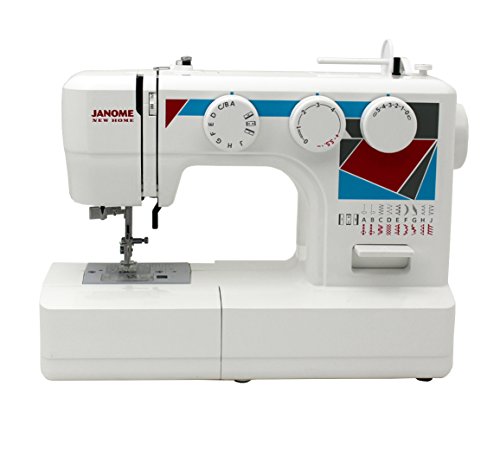
If the beginner Janome range has a sweet spot, the MOD-19 is standing on it. Nineteen stitches is a library a beginner can actually learn — every stitch will be used, none exists to decorate a specification sheet — and the automatic needle threader removes the task that makes new sewers feel clumsy in front of an audience. Underneath, the five-piece feed dog system does the quiet work: five contact points moving fabric in a straight, even line, so the beginner’s steering errors are the only errors in the seam, and those shrink weekly.
Choose the MOD-19 over its fifteen-stitch sibling when the extra stitches and the threader justify themselves in your life — if you wear glasses, sew in the evening, or simply know that threading friction is the sort of thing that would quietly reduce how often you sew. That self-knowledge is worth more than four stitches. Choose it over the computerized MOD-30 when you want the learning to happen through your hands and eyes rather than through a screen. The MOD-19 is the pick we would give a beginner of any age who asked for “the sensible one,” and its white, unshowy manner hides what teachers know: sensible machines produce the most sewing.
- Stitch library: 19 stitches, as stated in the listing title
- Threading: automatic needle threader, per the listing title
- Feed system: 5-piece feed dogs, per the listing title
- Positioning: Easy-to-Use line, per the listing title
- For the MOD-19: check price on Amazon under the MOD-19 Easy-to-Use listing
Strengths
- Automatic threader removes the commonest beginner friction
- Nineteen stitches is a learnable, usable library
- Five-piece feed supports straight, calm seams
Trade-offs
- No metal frame claimed in the listing
- Buttonhole style not specified in the title; check the manual
- Decorative ambitions will eventually want the MOD-30’s range
Best for: the majority of beginners, especially evening and glasses-wearing sewers. Not suited for: beginners who already know they want computerized range.

Janome MOD-15 Easy-to-Use Sewing Machine — The simplest start
The MOD-15 is the MOD-19 with the volume turned down: fifteen stitches, adjustable stitch length, and the same five-piece feed dog foundation, for the beginner who wants the fewest possible decisions between the box and the first seam. There is a real philosophy in that reduction. Every control a beginner does not have to understand is attention freed for fabric, hands, and seam — and fifteen stitches, honestly counted, cover the whole beginner repertoire of seams, hems, zigzags, and simple finishes with room to spare.
Adjustable stitch length is the feature to notice, because it is the adjustment beginners use most: longer for basting and topstitching, shorter for curves and delicate work, standard for the seams in between. A machine that teaches that one adjustment well has taught the core of machine sewing. The MOD-15 suits the youngest learners, the returning sewers re-entering after decades, and the household that wants a mending-and-making machine without a learning project attached. It is also the natural gift when the giver is unsure of the recipient’s commitment: enough machine to launch a real hobby, modest enough that an unlaunched hobby is no tragedy.
- Stitch library: 15 stitches, as shown in the listing title
- Adjustment: adjustable stitch length, per the listing title
- Feed system: 5-piece feed dogs, per the listing title
- Positioning: Easy-to-Use line, per the listing title
- Bringing home the MOD-15: check price on Amazon for the fifteen-stitch configuration
Strengths
- Fewest decisions between unboxing and sewing
- Same feed foundation as the MOD-19
- Adjustable length teaches the core adjustment early
Trade-offs
- No automatic threader named in the listing
- Fifteen stitches is a floor, not a playground
- Keen beginners may climb past it within a year
Best for: youngest learners, returning sewers, and simplicity-first households. Not suited for: beginners who want threading help or a wider library now.
Janome 2212 Sewing Machine — Learners who want dials
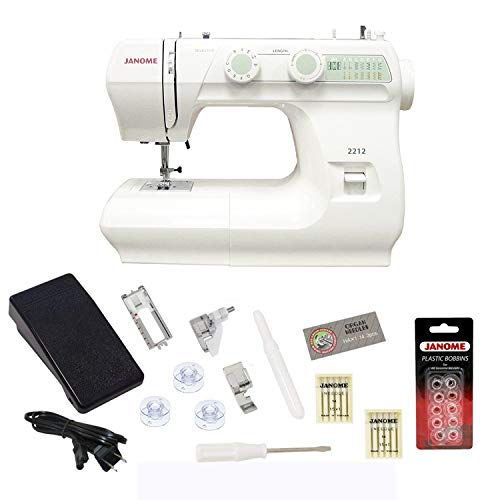
The 2212 is the elder of this guide — a Janome beginner model with a long service record in classrooms and first sewing corners — and this listing supplies it with an exclusive bonus bundle. We will be precise about what the listing title does and does not say: it names the model and the bundle, and it does not enumerate stitches or features, so neither do we. What can be said from the model’s long public life is the kind of machine it is: a dial-operated, front-loading beginner machine whose virtues are legibility and toughness, the machine a teacher can set right from across a room because every setting is a physical position.
That dial philosophy suits a recognizable learner — the one who distrusts menus, who wants to see the stitch selected rather than summon it, who expects a machine to be adjusted rather than configured. For that learner the 2212’s simplicity is not a lack but a match, and the bonus bundle in this listing sweetens the start with extras whose contents should be checked on the product page. Beginners comparing it against the MOD models are really choosing between two generations of the same kindness: the MODs polish the experience with feed refinement and, on the 19, a threader; the 2212 keeps the experience mechanical and transparent. Both roads reach sewing; pick the one your hands prefer.
- Model: Janome 2212, a long-running beginner model
- Bundle: exclusive bonus bundle included, per the listing title
- Stitch count and features: not stated in the listing title — read the product page for the full specification
- Control style: dial-based operation is this model’s established format; confirm current details on the listing
- For the 2212 bundle: check price on Amazon, where the bonus bundle distinguishes this listing
Strengths
- Proven beginner model with a long track record
- Dial operation keeps every setting visible and physical
- Bonus bundle adds starter value in this listing
Trade-offs
- Listing title omits specifications; research is on the buyer
- Older format lacks the MOD line’s refinements
- Bundle contents need verification before purchase
Best for: dial-minded learners and classroom-style beginners. Not suited for: shoppers who need every specification stated up front.
Janome Toile Romance Easy-to-Use 15-Stitch Sewing Machine — The romantic’s first machine
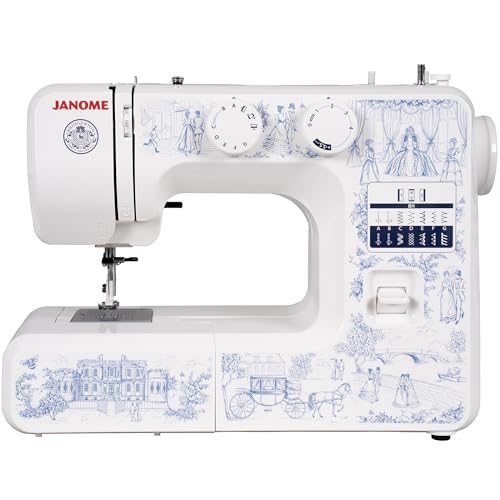
Some objects are bought with the heart first, and Janome has made that purchase respectable by building it on a sensible machine. The Toile Romance is an Easy-to-Use fifteen-stitch model issued as an officially licensed Bridgerton Collection edition — which means its sewing proposition is the proven starter format, and its distinction is the toile finish that turns the machine into a piece of the room’s décor. We present it without apology and without inflation: fifteen stitches is the MOD-15’s territory, and a buyer should choose this edition because living with a beautiful tool makes them sew more, which is a real effect and not a frivolous one.
The honest cautions are two. A licensed edition’s value lives in its finish and its collectibility, so buyers should expect to pay for romance rather than for additional sewing capability, and should weigh that premium with open eyes. And a special edition deserves gentler storage — a cover, a place of honor — because its surface is part of what was purchased. For the beginner who has been waiting for a machine that looks like their taste rather than their mother’s utility shelf, this is the pick, and there is no shame in the motive: the machine that delights its owner gets threaded, used, and loved, which is the entire point of a beginner machine. Households deep in home upkeep, meanwhile, divide their project lists between the sewing corner and heavier domestic machinery, a contrast our editors explore in Best High-Traffic Carpet Cleaning Machines for the floors beneath the sewing table.
- Stitch library: 15 stitches, as set out in the listing title
- Edition: officially licensed Bridgerton Collection, per the listing title
- Positioning: Easy-to-Use line, per the listing title
- Feed and threading details: not stated in the listing title — confirm on the product page if comparing against the MOD-15
- Reserving the Toile Romance: check price on Amazon for this licensed edition
Strengths
- A finish that makes the machine part of the room’s pleasure
- Built on the proven fifteen-stitch Easy-to-Use format
- Licensed edition holds gift and collectible appeal
Trade-offs
- Premium buys appearance, not extra capability
- Fifteen stitches remains a starter library
- Decorative finish asks for careful storage
Best for: romantics, gift buyers, and décor-conscious beginners. Not suited for: anyone chasing maximum specification per purchase.
Janome MOD-30 Computerized Sewing Machine — Beginners planning to grow
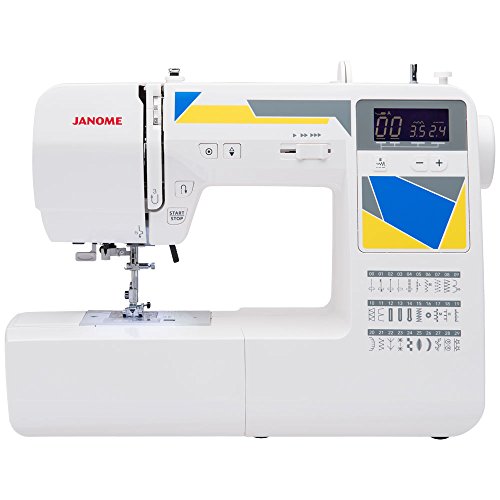
The MOD-30 is where this beginner guide deliberately breaks its own simplicity rule, because some beginners arrive knowing they will not stay beginners. It is a computerized machine with thirty built-in stitches, three one-step buttonholes, drop feed, and accessories included — a specification that reads like the second machine many sewers buy, offered here as a first machine for the ambitious. The three one-step buttonholes matter for garment learners, who will sew buttonholes in series rather than as occasional events; drop feed matters for the beginner already dreaming of free-motion quilting and darning; and the computerized setting memory matters for anyone whose sewing sessions are short and interrupted, because the machine remembers what the sewer would otherwise re-derive.
The cautions are the honest companions of ambition. A computerized machine asks its owner to learn an interface alongside the sewing, and beginners who are easily discouraged by screens should take the MOD-19 and be happy. Accessories included is a phrase to verify against the box contents, as always. But for the beginner who has researched, who has perhaps sewn on a borrowed machine and knows the hobby will hold, the MOD-30 collapses two purchases into one and keeps the Janome virtues — even feeding, calm manners — intact while doing it. It is the top rung of this guide’s ladder, placed there for climbers.
- Stitch library: 30 built-in stitches, as given in the listing title
- Buttonholes: 3 one-step buttonholes, per the listing title
- Feed: drop feed included, per the listing title
- Format: computerized; accessories included, per the listing title
- Stepping up to the MOD-30: check price on Amazon and review the included accessories list
Strengths
- Headroom that can serve a beginner for years
- Three one-step buttonholes suit garment learners
- Drop feed opens free-motion and darning work
Trade-offs
- Interface learning added to sewing learning
- More capability than a mending-only household needs
- Computerized format prefers stable power and dry storage
Best for: committed beginners and returning sewers buying once. Not suited for: beginners who want the simplest possible first month.
Six beginner Janomes in one view
| Model | Stitches per its listing | Signature help for learners | Climb here if… |
|---|---|---|---|
| Purple Majesty | Not stated in title | Bobbin diagram; tutorial videos; metal frame | Garments and patchwork are the plan |
| MOD-19 | 19 | Automatic needle threader | You want the balanced starter |
| MOD-15 | 15 | Adjustable stitch length; fewest decisions | Simplicity outranks everything |
| 2212 | Not stated in title | Dial operation; bonus bundle | You think in dials, not menus |
| Toile Romance | 15 | Licensed Bridgerton edition finish | Beauty motivates your sewing |
| MOD-30 | 30 | Drop feed; 3 one-step buttonholes | You are buying for growth |
Why does feed quality matter so much to a beginner?
Because a beginner cannot yet compensate for a machine’s faults, and uneven feeding is the fault that hides inside every other complaint. When fabric creeps, seams wander and the beginner blames their hands. When layers shift, the beginner blames their pinning. When the machine’s five feed points move the work in a calm, straight authority — as the MOD listings specify — the beginner’s only remaining variable is their own steering, which improves visibly week by week and teaches the right lesson: that sewing is learnable. Machines for beginners should be judged first by how honestly they feed, because feeding is the part of sewing the beginner cannot yet do for the machine.
This is also why the Purple Majesty’s metal frame and the whole range’s composure matter beyond their specifications. A machine that vibrates, walks, or flexes adds noise to every lesson. Janome’s beginner reputation rests on this quietness of operation — the sense that the machine is a steady table on which learning happens. Whichever pick you take home, test its feeding on two layers of cotton with a long seam and watch the edges: if they arrive together and the line runs true with light guidance, the machine is doing its half of the teaching contract.
What should a Janome beginner’s first projects be?
The same gentle staircase as any beginner’s, with Janome-flavored stops. A drawstring bag first, for straight seams and a finished object in an hour. A cushion cover next, for a closure and a household audience. Patchwork squares after that — the Purple Majesty names patchwork in its own brief — because piecing teaches seam allowance discipline better than any exercise, and a small quilted mat or table runner gives the beginner a finished piece of real beauty within the first season. Garments follow when the hands are ready: an elastic-waist skirt, pajama trousers, a simple top, each introducing one new skill and no more.
Keep the early fabrics honest — cotton, linen, light fleece — and let the machine’s feeding show you what it can do before asking it to handle stretch or slither. The MOD-30’s drop feed can wait for the free-motion chapter; the 2212’s dials will teach patience with settings; the MOD-19’s threader will quietly save a hundred small frustrations across the season. And when the sewing corner’s owner takes a break, it is usually to the kitchen, where small machines are also a philosophy — our roundup of Best Small Coffee Machines covers the countertop cousins of this guide’s compact thinking.
How do you thread and set up a Janome without tears?
Slowly, from the manual, with the presser foot raised — the raised foot opens the tension discs so the thread can seat, and skipping that detail causes more beginner misery than every other setup error combined. Follow the numbered path, use the Purple Majesty’s printed bobbin diagram if yours is that model, seat the bobbin so its thread unwinds in the direction the diagram shows, and draw the bobbin thread up before the first stitch. Then sew a test line on a folded scrap and look at both sides: loops underneath mean the top thread is not seated; loops on top mean the bobbin side wants attention. That two-sided diagnosis, learned once, serves a sewer for life on any machine.
The MOD-19’s automatic threader deserves a technique note: it works best with the needle at its highest position and a straight, freshly cut thread end, and it rewards a gentle hand over a forceful one. Beginners who master these small rituals in week one stop experiencing setup as a barrier and start experiencing it as the overture — two calm minutes that predict a good session. Write your machine’s happy settings on a card kept beneath it; future you, returning after a busy month, will be grateful.
First-month mistakes Janome beginners can skip
Comparing colorways as if they were models is the local one: within the Easy-to-Use line, finishes vary while the machine underneath stays the same proposition, so choose the color you can get and love, and spend the saved deliberation on fabric. Next is judging the MOD-15 as “lesser” for its fifteen stitches, when its library covers the beginner repertoire entire — the count is a personality, not a grade. Third is neglecting the test scrap, especially when changing from cotton to fleece or denim; thirty seconds of testing prevents the seam that must be unpicked from the real piece. Fourth is storing the machine without its cover in a bright, dusty room — a particular pity with the Toile Romance, whose finish is part of its value. All four mistakes are cheap to avoid and expensive only in regret.
How does Janome’s beginner range feel different from other brands?
Sewers who have tried several brands usually describe the difference in terms of temperament. A beginner Janome tends to feel unhurried and even — the feed takes the fabric at a pace the hands can learn, the machine’s sounds stay conversational, and the whole encounter encourages the slow, accurate habits that make good sewers. That temperament is not a specification; none of these listings can print it. But it is consistent with what the listings do print: feed systems specified by name, threading aids treated as headline features, a bobbin diagram printed on the machine, tutorial videos for learners. A brand that engineers the beginner’s first hour that carefully is a brand whose machines tend to feel calm in the hand, because calm was the design brief.
For a beginner choosing between brands without the chance to test-drive, that temperament argument is a legitimate tiebreaker — not because other brands are harsh, but because the first machine’s personality becomes the beginner’s idea of what sewing feels like. A calm first machine produces a sewer who returns to the table. The six picks here were also chosen to preserve that calm at different levels of ambition: even the computerized MOD-30, the range’s ceiling, keeps the beginner in its address rather than performing for experts. Growth, in this range, never requires surrendering the manners that made the start pleasant.
What does a beginner actually learn in the first season?
A curriculum hides inside ordinary projects. The drawstring bag teaches measuring, cutting, and the straight seam. The cushion cover teaches corners and closures. Patchwork teaches the seam allowance — that small, exact distance from needle to edge — until it lives in the hands rather than the ruler. The first garment teaches fit’s opening lesson: that a pattern is a hypothesis and the body is the editor. Repairs teach construction in reverse, because opening a failed seam shows how the garment was made better than any diagram. By season’s end the beginner has also learned the machine itself — its threading path by touch, its happy stitch lengths, the sound it makes when the bobbin runs low — and that fluency is the season’s real certificate.
Notice how little of that curriculum depends on stitch count, and how much depends on feeding, threading ease, and the willingness to sit down again tomorrow. That is the analytical spine of this guide’s ladder. The MOD-15 teaches the whole curriculum; the MOD-19 teaches it with less friction; the Purple Majesty teaches it with structure and printed guidance; the 2212 teaches it in the dialect of dials; the Toile Romance teaches it beautifully; the MOD-30 teaches it with a second year attached. Choose the teacher whose manner suits the student, and the curriculum takes care of itself.
How should a beginner care for a Janome so it stays smooth?
The brand’s smoothness is partly manufactured and partly maintained, and the maintained half is light work. Keep the bobbin area free of lint — cotton sewing, the beginner’s staple, sheds it generously — with a brush after every few sessions. Change needles on a project’s rhythm rather than a failure’s; a needle is the cheapest part in the system and the one whose dullness impersonates machine faults most convincingly. Keep the machine covered between sessions, especially the Toile Romance, and store it where household steam and garage damp cannot reach. Oil only as the manual directs for your model, because modern beginner machines vary in what they want, and the manual — which Janome writes well — is the authority.
One more habit protects both machine and sewer: end each session by sewing off onto a scrap and leaving the machine in a known state — needle up, presser foot down on the scrap, settings at your defaults. The next session then begins from order rather than archaeology, and beginnings are where hobbies live or die. A beginner machine kept this way will feel, years later, remarkably like the machine that came out of the box, which is the highest compliment domestic equipment can earn.
When should a Janome beginner consider a second machine?
When a specific, repeated frustration has a name. If large quilts keep defeating the work area, the second machine is about support and space, not stitches. If garments multiply and buttonholes become weekly events, a machine with more one-step variety earns its place. If decorated work starts calling — names on gifts, motifs on children’s clothes — the second machine may be an embroidery-capable model rather than another plain sewer. And if the beginner has become a teacher — of children, of friends, of a community class — the second machine is often simply a twin of the first, because teaching on identical machines is a kindness.
What should not trigger a second purchase is a vague sense that a real sewer would own more. The range in this guide already spans from fifteen stitches to a computerized thirty with drop feed, and most households’ sewing lives fit entirely inside that span for years. Buy the second machine when the work asks for it by name, and the first Janome — like the first sewing teacher most people remember — will be remembered as the machine that made all the later ones make sense.
Which fabrics flatter a beginner Janome, and which test it?
The flattering list is the beginner canon: quilting cotton with its crisp hand and visible weave, washed linen, chambray, light fleece, and the stable knits that forgive a new sewer’s pace. On these fabrics the range’s even feeding shows to full advantage — seams run true, edges stay together, and the finished objects look like the pictures that inspired them. Patchwork cotton deserves special mention because it is both a fabric and a training system: small pieces, straight seams, immediate measurement feedback. A beginner who pieces a dozen blocks on any pick here has completed a secret apprenticeship in accuracy.
The testing list is equally predictable: silk and satin that slide, jersey that stretches and curls, velvet whose pile records every pressure, and thick multi-layer assemblies that ask more authority than a starter frame claims. None is impossible — beginners sew all of them somewhere every day — but each adds a variable, and variables should be added one at a time, after the basics are reflexes. When the testing fabrics do arrive, slow down, lengthen the test-scrap ritual, and let the feed do the work your hands want to hurry. The machines will meet you more than halfway; they ask only that you not mistake a starter’s brief for a limitation of your own future.
How do you choose between buying for now and buying for growth?
By being honest about which kind of beginner you are, because both kinds are real. The exploratory beginner is testing a hypothesis about themselves — Do I enjoy this? Will I keep it up? — and for them the MOD-15 or MOD-19 is the wise purchase: complete, kind, and inexpensive enough that a hypothesis disproven is a small loss, while a hypothesis proven makes the upgrade a celebration rather than a correction. The committed beginner arrives with evidence — borrowed-machine hours, classes taken, a project list with dates — and for them the MOD-30’s headroom, or the Purple Majesty’s structure, converts that evidence into a single purchase that serves for years.
The error to avoid is buying for a fantasy self: the imaginary sewer who quilts weekly, sews wardrobes seasonally, and monograms gifts by the dozen, when the real self has ninety free minutes on Sundays. Fantasy purchases gather dust and guilt in equal measure. The real self, consulted honestly, picks the right rung of this ladder almost every time — and the ladder’s mercy is that every rung sews real things, so even a conservative choice is not a compromise, merely a beginning sized to the truth.
What role do tutorial videos and diagrams play in learning?
A larger one than tradition admits. Sewing was taught hand-to-hand for centuries because the knowledge lived in hands; video moves that knowledge into the beginner’s kitchen at midnight, pausable and rewatchable at the exact step where the hands hesitate. Janome’s inclusion of tutorial videos in the Purple Majesty’s brief, and a bobbin diagram printed on the machine itself, acknowledges where learning now happens — at the machine, in the moment, with the problem in front of you. A beginner should use these aids without a trace of embarrassment: watch the threading video while threading, glance at the diagram while loading the bobbin, and let the manual live open beside the machine for the first month.
The aids have a second function: they standardize the basics so the beginner’s questions, when they do reach a teacher or a forum, start from shared ground. “My bobbin is loaded as the diagram shows, and the underside still loops” is a diagnosable sentence; “it just won’t sew right” is not. Learning to describe a fault is part of learning the craft, and the machines in this guide — with their printed guidance and filmed companions — quietly teach that vocabulary from the first session. That is beginner-friendliness of a deeper kind than any stitch count.
How should a beginner set up a sewing space around a Janome?
The machine’s calm manners deserve a calm stage: a table that does not rock, light that arrives from the front or the side rather than from behind the sewer’s shadow, and a chair that puts the forearms level with the bed. Keep the beginner’s small universe within reach — scissors, seam ripper, pins, the spare bobbins, the manual — in one box or drawer, because a session that begins with a search begins with a small defeat. If the machine packs away between uses, give it a fixed home and a cover; the Toile Romance in particular should be stored like the decorative object it also is, where dust and sunlight cannot dull what its owner paid to enjoy.
Sessions have a geography too. Cutting wants the largest flat surface in the home; sewing wants the machine’s corner; pressing wants the iron’s station, and a beginner who sets up all three before starting a project discovers why experienced sewers move in a triangle. None of this requires a sewing room — it requires a household agreement that the dining table is a studio on Saturday mornings — and it converts the machine from an appliance stored somewhere into the center of a small, working territory. Beginners sew more in territories than in cupboards; arrange the territory and the machine will do the rest.
Why do teachers trust this brand with beginners?
Because a teacher’s scarcest resource is diagnostic time, and these machines spend it well. When thirty beginners sew at once, the faults that surface are threading, bobbins, and steering — and a machine with a printed bobbin diagram, a forgiving feed, and an available threader converts half of those faults into self-service. The teacher can then teach sewing rather than troubleshooting, which is the entire purpose of the class. The 2212’s long classroom life and the MOD line’s learner-first specification are two generations of the same trust, earned the slow way: by machines that behaved in rooms full of nervous hands.
There is a final, quieter reason. Beginners remember their first machine the way drivers remember a first car, and a brand that fills that memory with calm competence earns a loyalty that outlasts any single purchase. Janome’s beginner range seems designed with that memory in mind — no drama at threading, no wandering seams to explain away, no interface performing for an audience. Just a machine that sews straight while a person learns. For a first machine, there is no higher praise available, and this guide’s six picks were chosen because each of them, at its rung, deserves it.
Can one of these machines carry a beginner into selling their work?
Into the foothills of selling, yes. The first things sewers sell — tote bags, cushion covers, baby quilts, simple accessories, alterations for neighbors — live entirely inside the territory these machines claim, and the MOD-30’s polish or the Purple Majesty’s structure serve a small market stall as happily as a kitchen table. What selling adds is not difficulty but repetition and standards: the twentieth tote must match the first, seams must survive customers, and the machine’s consistency across a batch becomes a business asset. Even feeding and calm manners, this guide’s recurring themes, are precisely the qualities repetition rewards.
Beyond the foothills, honesty applies. A growing micro-business eventually wants speed, specialty machines, or a second workstation, and the beginner Janome retires into the honorable role of second machine — the one that hems, repairs, and prototypes while the specialist earns. Nothing in that arc diminishes the first purchase. Businesses founded on a beginner machine are a tradition in this craft, and the machine that taught the founder is rarely sold; it is kept, threaded, and pointed out to visitors. Choose your rung with that long story in mind, and even the simplest MOD-15 becomes what it was designed to be: a beginning that does not need to be outgrown to be outlived with affection.
Final Recommendation
Climb the ladder to the rung that matches your life. The MOD-15 is the purest start and the right gift when commitment is unproven; the MOD-19 is the balanced beginner machine we would recommend to the widest range of new sewers, its threader quietly earning its keep every session. The Purple Majesty serves the garment-and-patchwork beginner who values structure and on-machine guidance; the 2212 serves the dial traditionalist; the Toile Romance serves the beginner whose heart is part of the purchase, on a sound fifteen-stitch foundation; and the MOD-30 serves the beginner buying for the sewer they intend to become. Janome’s beginner range is a ladder with no wrong rungs — only rungs matched or mismatched to the climber — and the machine you choose from it will teach you calmly, feed your fabric honestly, and still be answering your sewing room’s needs when the first wobbly tote bag is a story you tell beginners of your own.
Frequently Asked Questions
Are the different colors of Janome’s Easy-to-Use machines different models?
No. The Easy-to-Use line has appeared in several colorways, and the color is a finish on the same underlying machine proposition. This guide presents the Purple Majesty as the line’s pick; if you meet another color in a store or another listing, evaluate it as the same class of machine and choose by availability and the finish you will enjoy living with.
MOD-15 or MOD-19: which should a beginner choose?
Choose the MOD-19 if the automatic needle threader will genuinely be used — evening sewing, glasses, impatience with fiddly tasks — and for its four extra stitches. Choose the MOD-15 for the simplest possible control set and the same five-piece feed foundation. Both teach sewing well; the difference is friction, not capability.
Is the MOD-30 too advanced for a first machine?
For a beginner who wants the gentlest first month, yes — take a MOD instead. For a beginner with some borrowed-machine experience, or a returning sewer buying once for years, the MOD-30’s thirty stitches, three one-step buttonholes, and drop feed make it a legitimate first purchase. The dividing line is appetite for learning an interface alongside the craft.
What does a five-piece feed dog system actually do?
It describes the feed mechanism that moves fabric under the presser foot: five contact segments working together to advance the material evenly. Even advancement is what keeps seams straight and layers together, and it matters more to a beginner’s results than stitch count, because a beginner cannot yet compensate for a machine that feeds crookedly.
Can these Janomes sew quilts?
Patchwork and light quilting are named in the Purple Majesty’s own brief, and the other picks handle small quilts, runners, and quilted projects comfortably. Large bed quilts will eventually argue for a bigger machine with more work support. Start with the sizes these machines call light, and the results will encourage rather than defeat you. Many lifelong quilters began exactly here, piecing on a starter machine at a kitchen table, and discovered the craft’s central secret early: a quilt is only ever one seam at a time, and a machine that sews that seam calmly and evenly is, for as long as the lesson lasts, the perfect quilting machine.
Is the Toile Romance a serious machine or a novelty?
Both, in the best sense: its foundation is the Easy-to-Use fifteen-stitch format, which is a serious starter specification, and its licensed Bridgerton finish is the novelty that makes it a joy to own and give. Buy it knowing the premium purchases beauty and collectibility, and it will sew as honestly as its plainer siblings.
How long will a beginner Janome last?
With the light maintenance rhythm described in this guide — lint kept out of the bobbin area, needles changed on schedule, a cover against dust — a beginner Janome can serve for many years, often long enough to teach a second generation of the household. Longevity in this class follows care more than price, and the dial models in particular have few systems that can age out. Buy it as a long companion rather than a disposable experiment, and treat it accordingly from the first week.
What if I cannot decide between two rungs of the ladder?
Decide by the friction you know you hate. If threading a needle at arm’s length already annoys you in hand sewing, the MOD-19’s threader settles the question. If you keep a tidy, analog household and screens at the sewing table feel wrong, the 2212 or a MOD settles it the other way. If the project list on your fridge says garments and patchwork, the Purple Majesty is speaking to you directly. Indecision between two good machines is usually the self asking which annoyance it would rather live without — answer that, and the ladder chooses its own rung. And remember that every rung here sews the same first drawstring bag equally well; the differences declare themselves over months, kindly, and none of them is a trap.
Related Guides
Beginners whose ambitions lean toward making clothes will find their next read in Best Sewing Machines for Dressmaking, where the garment brief takes over from the beginner brief. The machines in this guide will carry you a long way into that territory — far enough to know exactly which dressmaking features your own sewing actually needs. Start where you stand, sew the gentle staircase of projects, and let the machine you chose teach you what its successor — if one is ever needed — should be.


