What's inside
- Key Takeaways
- Quick Picks
- How Did We Choose These Dehydrators for Jerky?
- How Do the Six Jerky Dehydrators Compare at a Glance?
- What Does USDA Guidance Actually Say About Jerky Safety?
- Which Cuts of Beef Make the Best Jerky?
- How Should You Marinate Jerky for Flavour and Safety?
- Steel Trays or Plastic Trays: Why Does It Matter for Meat?
- Rear Fan, Bottom Fan or Twin Fans: What Changes?
- How Long Does Jerky Take to Dry, Really?
- How Do You Store Homemade Jerky So It Stays Good?
- Can These Machines Make Dog Treats and Fruit Leather Too?
- What Thickness Should You Slice Meat for Jerky?
- How Do You Know a Dehydrator Is Big Enough for Your Habit?
- What About Venison and Other Game Jerky?
- How Do You Clean a Dehydrator After a Meat Batch?
- How Do You Slice Meat Evenly Without a Slicer?
- What Role Does a Meat Thermometer Play in Jerky Making?
- How Do Sweet Marinades Behave Differently in the Dryer?
- How Should You Run a First Test Batch in a New Machine?
- What Is the Difference Between Jerky and Biltong or Dried Meat Snacks?
- How Do You Pack Jerky for Hiking, Travel and Gifts?
- How Does Weather and Kitchen Humidity Change a Batch?
- Which Jerky Styles Suit Beginners Best?
- What Mistakes Do Jerky Beginners Make Most Often?
- Final Recommendation
- Frequently Asked Questions
- Related Guides
As an Amazon Associate I earn from qualifying purchases. This post may contain affiliate links at no extra cost to you.
cottageverdict.com is reader-supported. When you buy through links on our site, we may earn an affiliate commission.
Where to buy: the six best food dehydrators for jerky below are sold through Amazon, and their names in the Quick Picks table, the detailed reviews and the comparison table link to the matching listing, where you can check price on Amazon and confirm tray counts, temperature ceilings and timer lengths before ordering. Jerky is the most demanding job a home dehydrator does, because meat brings fat, moisture and food-safety questions that apple slices never raise. A machine that dries herbs charmingly can still fail jerky by running too cool, drying unevenly between the top and bottom trays, or forcing you to babysit a timer that stops hours before the meat is done.
This guide judges every pick as a jerky machine first. That means stainless steel trays score heavily, because they scrub clean after marinade duty and do not hold flavours; rear-mounted fans score heavily, because horizontal airflow treats every tray alike; and a temperature ceiling matters in a way it never does for banana chips, because safe jerky making involves real heat. You will also find an honest safety section below, built around the USDA guidance that meat for jerky should reach 160°F, since a dehydrator alone is a drying tool and not a guarantee of a safe internal temperature.
Key Takeaways
- Stainless trays are the jerky tray: they release marinade residue under a brush and never carry last month’s flavours forward.
- Rear-fan machines dry tray to tray more evenly, so fewer pieces finish leathery while others stay bendy and damp.
- USDA guidance calls for meat to reach 160°F for jerky safety, a step covered plainly in the safety section below.
- Only the Magic Mill Pro here reaches 176°F; the other picks top out lower, which changes how you plan the heating step.
- A 48 hour timer matters because jerky batches, thick marinades and humid days regularly outlast short timers.
- Fat is jerky’s enemy in storage, so lean cuts, careful trimming and thorough drying matter more than any machine feature.
Quick Picks
| Pick | Badge | Why it earns its place |
|---|---|---|
| Magic Mill Pro Dehydrator | Best Overall for Jerky | A rear fan, seven steel trays and the highest ceiling here at 176°F make it the most complete jerky tool in the group. |
| Elite Gourmet 5-Tray Dehydrator | Best Gentle Starter | Five BPA-free trays and simple adjustable heat make it the friendly first dehydrator for small test batches of jerky. |
| 8-Tray Stainless Dehydrator 650W | Best Capacity per Shelf | Eight full-size steel trays and 650W of heat give big-batch jerky makers room to spread strips without crowding. |
| PSIIDAN 8-Tray Dehydrator | Best Roomy All-Rounder | Eight steel trays and a large drying space suit households splitting time between jerky, dog treats and garden produce. |
| Magic Mill 5-Tray Dehydrator | Best Mid-Size Steel Stacker | Five stackable steel trays with digital control and a 48 hour timer hit the middle ground for steady home jerky making. |
| HOPERAN 16-Tray Dehydrator | Best Maximum Capacity | Sixteen steel trays, twin fans and 800W make it the production machine for very large jerky and preserving sessions. |
How Did We Choose These Dehydrators for Jerky?
We started with tray material and refused to apologise for it. Jerky marinades contain salt, sugar, acids and oils that soak into plastic and linger, so five of the six picks use stainless steel trays, and the one BPA-free plastic design earns its place as the gentle introduction for occasional makers rather than as a weekly jerky workhorse. Tray size and count came next, judged by how much sliced beef a batch realistically holds without pieces overlapping, because overlapping strips dry into glued, uneven sheets.
Then we read the temperature dials with a safety eye. A dehydrator used for jerky should reach at least the mid-160s Fahrenheit at its ceiling so the drying environment stays properly hot, and we note each model’s stated range beside its review rather than hiding it. Fan position, wattage and timer length completed the picture: rear fans for evenness, enough wattage to recover heat after the door opens for a check, and timers that run far longer than any jerky batch should need. Noise claims and keep-warm modes were treated as comforts, welcome but never decisive.

Magic Mill Pro Dehydrator — Best Overall for Jerky
The Magic Mill Pro Dehydrator reads like a checklist written by someone who makes jerky monthly. Its fan sits at the rear and pushes air horizontally across seven full-size stainless trays, so the strip on the top shelf dries at nearly the same rate as the strip at the bottom, with none of the tray-shuffling that vertical airflow machines demand halfway through a batch. Six hundred watts gives it the muscle to hold temperature when the cabinet is loaded with cold, wet, marinated beef.
The headline figure is 176°F, the highest ceiling in this guide, and for jerky that headroom is practical rather than decorative: a hotter drying environment shortens the time meat spends in the lukewarm zone and gives you more control over finishing texture. The 48 hour timer comfortably covers the longest sessions, and the keep warm mode holds finished jerky gently instead of letting it sit cooling in a humid cabinet while you are out. ETL listing is a reassuring line for an appliance that runs unattended for hours.
If jerky is the main reason you are buying a dehydrator, this is the machine the rest of the guide is measured against. It costs more of your counter and your budget than the smaller picks, and it returns that investment every time a full batch comes out evenly dried, tray after tray, without rotation or guesswork.
- Airflow: 600W rear fan for even horizontal drying
- Trays: 7 full-size stainless steel trays
- Temperature range: 95 to 176°F, the widest here
- Timer: 48 hours, with keep warm and auto shutoff
Strengths
- Rear fan dries all seven trays at an even rate
- 176°F ceiling gives the most safety headroom here
- Steel trays scrub clean after sticky marinades
Trade-offs
- Seven loaded trays need real counter depth
- More machine than a twice-a-year jerky maker needs
- Keep warm is a holding aid, not a safety step
Best for: regular jerky makers who load full batches and value even drying. Not suited for: tiny kitchens drying only herbs and apple rings.
Elite Gourmet 5-Tray Dehydrator — Best Gentle Starter
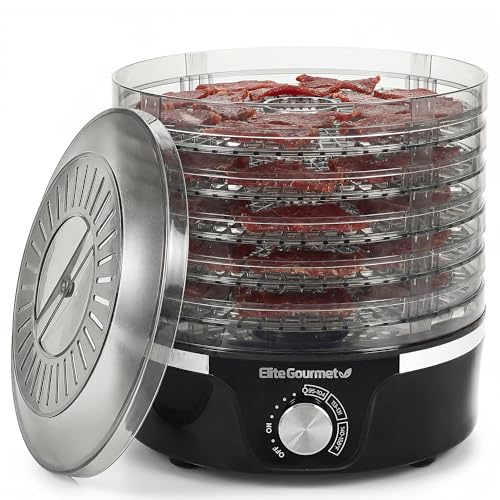
The Elite Gourmet 5-Tray Dehydrator is the dehydrator many people start with, and for learning jerky it has real virtues. The round stackable trays are 11.4 inches across, the controls are a simple adjustable dial rather than a digital panel, and the whole machine stores in a cupboard corner between projects. For a first batch, where the lesson is slicing thickness and marinade balance rather than volume, that simplicity keeps attention on the meat instead of the machine.
Honesty about materials belongs here: the trays are BPA-free plastic rather than steel, which is fine for fruit, herbs and vegetables, and acceptable for occasional jerky, but marinade flavours cling more than they do to steel and the trays ask for prompt, thorough washing after meat duty. Airflow in this stacked round format is less even than a rear-fan cabinet, so rotating trays once or twice during a jerky run is a sensible habit rather than a defect to hide.
Buy it as a teacher. It will show you whether your household eats jerky fast enough to justify a cabinet machine, and it remains useful afterwards for herbs and fruit even if a bigger steel model takes over meat duty. Households already certain about weekly jerky should skip straight to the stainless picks above and below.
- Trays: 5 trays of 11.4 inch diameter, BPA-free
- Controls: adjustable temperature dial
- Listing focus: jerky, fruit, herbs and vegetables
- Format: compact round stackable design in black
Strengths
- Simple dial controls keep the learning curve gentle
- Compact round body stores in a cupboard corner
- Fine for fruit and herbs between jerky experiments
Trade-offs
- Plastic trays hold marinade flavours more than steel
- Stacked airflow benefits from rotating trays mid-batch
- Five small trays limit batch size quickly
Best for: first-time jerky makers testing small batches and mixed drying. Not suited for: weekly jerky production or anyone set on steel trays.

8-Tray Stainless Dehydrator 650W — Best Capacity per Shelf
Capacity is the argument for the 8-Tray Stainless Dehydrator 650W, and it is a strong one. Eight full-size stainless trays swallow the output of a serious slicing session, letting you lay beef strips in single layers with air gaps instead of crowding them onto fewer shelves. Crowding is the silent cause of uneven jerky, so a machine that removes the temptation has done half the quality work before you even switch it on. The 650W heating output, the highest single-fan figure in this guide, helps the cabinet recover temperature quickly after loading.
The ceiling of 167°F sits in the normal jerky band: hot enough for the drying environment most recipes assume, though without the extra headroom of the Magic Mill Pro, which makes the separate heating step described in our safety section especially worth following. The 48 hour digital timer matches the Pro’s endurance, and digital control generally holds a steadier temperature than a simple dial across a long, unattended run.
Choose this one when your jerky making runs in big, planned waves: a hunt shared among friends, a beef purchase split with family, a season’s worth of hiking food made over one weekend. Its footprint is the price of that capacity, so measure the counter and the cupboard before it arrives, and plan where eight steel trays will drip-dry after washing.
- Trays: 8 full-size stainless steel trays
- Power: 650W, the strongest single-fan output here
- Temperature range: 95 to 167°F
- Timer: 48 hour digital timer
Strengths
- Eight steel trays end the crowding problem
- 650W output recovers heat briskly after loading
- Digital timer runs a full 48 hours
Trade-offs
- 167°F ceiling leaves less heat headroom than the Pro
- Large cabinet demands storage planning
- Big batches magnify any slicing inconsistency
Best for: big-batch jerky makers with counter room to spare. Not suited for: apartment cooks making a tray or two at a time.

PSIIDAN 8-Tray Dehydrator — Best Roomy All-Rounder
The PSIIDAN 8-Tray Dehydrator aims at the household that dries a bit of everything and a lot of jerky. Eight stainless trays give it the same uncrowded laying space as the other big cabinet here, and the listing’s own menu of uses, running from jerky and meat through dog treats, fruit, herbs and even yogurt, reflects how such a machine actually lives: beef strips in autumn, apple rings when the orchard glut arrives, herbs at summer’s end, and a steady side production of treats for the dog.
Its temperature band of 95 to 167°F covers the working range for nearly every home drying task, with the same note that applies to all the sub-176 models here: plan the USDA heating step for jerky separately rather than expecting the dryer alone to carry the whole safety story. Steel trays keep the mixed-use life hygienic, since a good scrub returns them to neutral between a marinated meat batch and a delicate herb one.
Pick the PSIIDAN when the dehydrator will be a shared family appliance rather than a single-purpose jerky altar. The capacity handles serious meat days, the trays clean back to neutral for produce days, and the silver cabinet looks at home on a working counter. Dedicated jerky perfectionists chasing the highest ceiling should still look at the Magic Mill Pro first.
- Trays: 8 stainless steel trays with large drying space
- Temperature range: 95 to 167°F
- Listing uses: jerky, dog treats, fruit, meat, herbs, yogurt
- Finish: silver cabinet styling
Strengths
- Eight steel trays give generous, uncrowded space
- Wide stated uses suit genuinely mixed households
- Steel cleans neutral between meat and produce
Trade-offs
- Same 167°F ceiling as most cabinet rivals
- Large body for kitchens that dry only occasionally
- Yogurt work needs suitable containers bought separately
Best for: mixed households drying jerky, produce and pet treats alike. Not suited for: jerky specialists who want the highest temperature ceiling.
Magic Mill 5-Tray Dehydrator — Best Mid-Size Steel Stacker
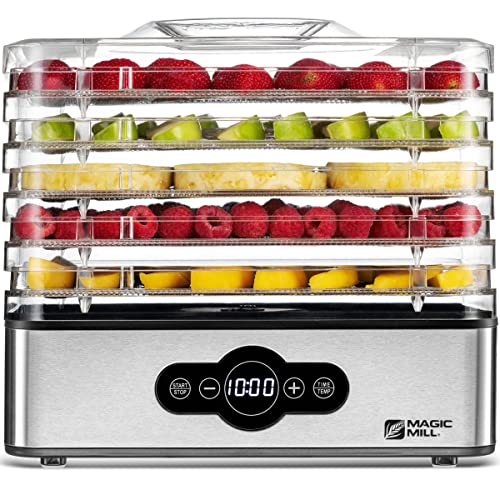
The Magic Mill 5-Tray Dehydrator occupies the sensible middle of this guide: steel trays like the big cabinets, a footprint closer to the starter machines. Five stackable trays hold a respectable jerky batch for a family, and because the trays are stainless, marinade duty does not perfume them permanently. Digital control of both temperature and time, with a 48 hour timer ceiling, gives it the set-and-supervise character that long jerky runs need, rather than the check-every-hour anxiety of short-timer machines.
Its maximum of 167°F matches the other mid-range cabinets here, adequate for the drying stage while the separate heating step in our safety section handles the USDA 160°F target with certainty. Stackable formats dry a touch less evenly than rear-fan cabinets, so a mid-run tray shuffle remains a good habit, especially when the bottom trays carry the wettest, thickest strips. None of that diminishes its value as the machine most households will actually use weekly.
Buy this Magic Mill when you want steel, digital control and a sane batch size without giving a whole counter bay to the appliance. It is the pick we would hand to a friend who has graduated from test batches, makes jerky a few times a month, and also dries fruit and dog treats in the same machine across the year.
- Trays: 5 stackable stainless steel trays
- Controls: digital timer and temperature adjustment
- Temperature: up to 167°F
- Timer: 48 hour maximum setting
Strengths
- Steel trays in a mid-size, storable body
- Digital control with a full 48 hour timer
- Handles jerky, fruit and dog treats in one machine
Trade-offs
- Stacked layout benefits from a mid-run tray shuffle
- 167°F ceiling, so plan the heating step separately
- Five trays fill quickly on very large batches
Best for: steady home jerky makers wanting steel without a huge cabinet. Not suited for: bulk makers who regularly fill eight trays or more.

HOPERAN 16-Tray Dehydrator — Best Maximum Capacity
The HOPERAN 16-Tray Dehydrator is less a kitchen appliance and more a small preserving station. Sixteen stainless trays spread across a twin-fan, 800W cabinet can take the slicing output of an entire beef round and still leave shelves for the fruit and herbs the listing mentions. Twin fans exist to keep air moving evenly through that tall stack, the failure mode of lesser big machines being a dry top, a damp bottom and a long afternoon of tray rotation. The maker quotes operation under 48dB, which matters when a batch runs overnight in a small home.
Included mesh screens and a fruit roll tray extend the machine beyond jerky into small herbs and purées, though jerky makers should note what the listing does not shout: with this much capacity, your limiting factor becomes slicing and marinating labour, not drying space. Temperature and timer are digitally controlled, and the same guidance about planning the USDA heating step applies here as to the other picks in this range class.
Choose the HOPERAN when jerky is a production event: club trips, market-garden gluts, a family’s year of trail food. Measure your storage honestly, because sixteen trays and a tall cabinet need a home, and be sure your household’s appetite justifies the scale. For the right kitchen it replaces two smaller machines and the scheduling headaches that came with them.
- Trays: 16 stainless steel trays
- Power: 800W across 2 fans
- Controls: digital temperature and timer control
- Extras: 2 mesh screens and 1 fruit roll tray included
Strengths
- Sixteen trays dwarf every other capacity here
- Twin fans keep a tall cabinet drying evenly
- Mesh screens and a roll tray broaden its uses
Trade-offs
- Tall cabinet and sixteen trays demand storage
- Capacity tempts batches bigger than your slicing time
- Over-specified for small weekly jerky making
Best for: production-scale jerky and preserving households. Not suited for: small kitchens or occasional single-tray drying.
How Do the Six Jerky Dehydrators Compare at a Glance?
| Pick | Badge | Distinguishing detail |
|---|---|---|
| Magic Mill Pro Dehydrator | Best Overall for Jerky | 600W rear fan, 7 steel trays, 95 to 176°F range |
| Elite Gourmet 5-Tray Dehydrator | Best Gentle Starter | 5 BPA-free round trays, dial control, compact stacker |
| 8-Tray Stainless Dehydrator 650W | Best Capacity per Shelf | 8 steel trays, 650W, 95 to 167°F, 48 hour timer |
| PSIIDAN 8-Tray Dehydrator | Best Roomy All-Rounder | 8 steel trays, 95 to 167°F, broad all-round brief |
| Magic Mill 5-Tray Dehydrator | Best Mid-Size Steel Stacker | 5 stackable steel trays, digital control, up to 167°F |
| HOPERAN 16-Tray Dehydrator | Best Maximum Capacity | 16 steel trays, 2 fans, 800W, mesh and roll trays |
What Does USDA Guidance Actually Say About Jerky Safety?
Food safety deserves plain language. USDA guidance for home jerky advises heating meat to 160°F internally (and poultry to 165°F) to destroy harmful bacteria, and it recommends doing that heating before drying, because bacteria can become more heat-resistant once dried. In practice many home makers boil strips in their marinade or heat them in an oven to reach that internal temperature, then dry them in the dehydrator until properly finished. A meat thermometer, not the dehydrator’s dial, is how you know the target was reached.
Look at the ceilings in this guide with that guidance in mind. A dial that reaches 176°F, like the Magic Mill Pro, gives the drying environment the most heat, but the temperature of the air is not the same as the internal temperature of a strip, especially early in drying when evaporation cools the meat. Treat the dehydrator as the drying tool and the heating step as the safety tool, use both, and your jerky routine stands on the same ground as the official advice. Cure salts in marinades add a further traditional layer of protection, though they do not replace heat.
Which Cuts of Beef Make the Best Jerky?
Lean is the rule, because fat does not dry the way muscle does and turns rancid in storage long before the meat itself gives up. Eye of round is the classic jerky cut: uniformly lean, easy to slice evenly and mild enough to carry any marinade. Top round and bottom round follow close behind, while flank steak makes rich, chewy jerky at a higher cost per batch. Avoid well-marbled cuts and trim every visible seam of fat you can reach, since even a thin fat stripe shortens a batch’s good life.
Slice with the grain for the traditional chew that tears in strips, or across the grain for a more tender bite that suits children and older teeth. Partially freezing the meat until it firms makes even slicing dramatically easier, and a consistent quarter-inch thickness is the quiet secret behind batches where every piece finishes at the same hour. Pieces of mixed thickness finish mixed, with thin edges snapping while thick centres still bend damply, so the knife work before drying matters as much as the machine you load it into.
How Should You Marinate Jerky for Flavour and Safety?
A working jerky marinade balances salt, something sweet, acid or savoury depth, and the aromatics your household loves, from black pepper and garlic to smoke and chilli heat. Salt does more than season: it draws moisture and firms the meat’s surface ahead of drying. Give strips several hours or an overnight rest in the marinade, refrigerated, turning them once so every piece meets the liquid. Before loading the trays, drain the strips and pat them dry; surface moisture is the enemy of a prompt, even start to drying.
Two habits separate careful makers from careless ones. First, use a fresh batch of marinade for the heating step if you boil strips in it, and never reuse marinade that held raw meat as a sauce afterwards. Second, write the recipe down, including weights and times. Jerky making improves by iteration, and the batch your family begs you to repeat is always the one whose proportions nobody recorded. Keep a small notebook by the dehydrator and your second year of jerky will be noticeably better than your first.
Steel Trays or Plastic Trays: Why Does It Matter for Meat?
Stainless steel trays earn their keep on meat days. Marinades are salty, acidic and oily, and steel releases their residue under hot water and a brush without absorbing colours or smells. A tray that dried teriyaki beef on Saturday can dry apple rings on Sunday without perfuming them. Steel also tolerates the hotter end of these machines’ ranges without complaint and survives being scrubbed firmly when sugars caramelise onto the mesh, as they do in sweet marinades.
Plastic trays, like the BPA-free set on the Elite Gourmet here, are lighter and cheaper, and for fruit, vegetables and herbs they are perfectly serviceable. Their weakness shows with repeated meat use: micro-scratches from knives and brushes hold onto flavours, and fatty residue needs prompt, thorough washing to avoid lingering smells. None of this makes a plastic-tray machine useless for jerky, especially for learners making small batches. It simply means steel is the material to choose when jerky is the main mission rather than an occasional guest.
Rear Fan, Bottom Fan or Twin Fans: What Changes?
Airflow geometry decides how evenly a cabinet dries. A rear-mounted fan blowing horizontally, as on the Magic Mill Pro, passes air across every tray in a similar stream, so pieces finish together and tray rotation becomes optional. Bottom-fan stackable designs push warm air upward, which historically leaves lower trays drying faster and asks the cook to rotate the stack partway through. Modern stackers narrow that gap, but for meat, where even finishing is a safety-adjacent quality issue, horizontal airflow remains the safer bet.
Twin fans, as fitted to the big HOPERAN, exist to serve height: sixteen trays are a tall order for a single fan, and splitting the work keeps the far shelves from lagging. Wattage plays a supporting role rather than the lead; it governs how quickly the cabinet returns to temperature after loading cold meat and how well it holds that temperature in a cool room. Judge a machine by airflow design first, ceiling second and wattage third, and you will rarely be misled by a spec sheet.
How Long Does Jerky Take to Dry, Really?
Thin beef strips at a hot setting commonly finish in a window of several hours, while thicker cuts, sweeter marinades and humid weather all stretch the schedule. Any guide that promises an exact hour is guessing at your kitchen. The honest method is to start checking before you expect doneness: take a piece out, let it cool for a few minutes, then bend it. Finished jerky bends and cracks, showing pale fibres, without snapping like a twig and without squeezing out moisture. A piece that bends like rubber needs more time; a piece that shatters was left too long.
This is where the 48 hour timers on most of these machines earn their place. They remove the risk of a short timer stopping the machine overnight or while you are out, letting a batch coast to a safe finish. Drying in two sessions with a pause is poor practice for meat, since strips sit warm and damp in between. Set the timer generously, check pieces as the window approaches, and pull trays piece by piece if your slicing produced a few thin runts that finish early.
How Do You Store Homemade Jerky So It Stays Good?
Cool finished jerky completely before sealing it, because warm pieces in a closed bag sweat condensation that undoes your drying work. Many experienced makers condition their jerky first: rest it in a loosely covered container for a day, letting moisture equalise between pieces, and return any piece that feels damp to the dryer for another spell. Only then does the batch go into airtight bags or jars, ideally with the air pressed out, stored somewhere cool and dark.
Lean, well-dried jerky keeps for a week or two at room temperature, longer in the fridge and longest in the freezer, and fattier batches should always take the cold route. Label every bag with the cut, the marinade and the date, because three brown bags of jerky look identical by week two. If a piece smells off, feels slimy or shows mould, discard the batch rather than picking around the problem; the ingredients were inexpensive and your household’s health is not. Good storage habits are the final step of the same care that slicing and heating began.
Can These Machines Make Dog Treats and Fruit Leather Too?
Yes, and for many households those side jobs justify the purchase between jerky seasons. Sweet potato slices, chicken breast strips dried thoroughly, and apple rings all come out of the same cabinets, and the HOPERAN even includes a fruit roll tray for purées. Keep one discipline: meat for pets follows the same temperature care as meat for people, and treats should be dried until properly hard, stored in the fridge and used within a sensible period rather than kept indefinitely in a treat jar.
Fruit leather rewards a fine purée, a thin, even spread and patience, since its centre dries last. Herbs want the cool end of the dial and a dark room afterwards to keep their colour. The all-round listings of the PSIIDAN and the smaller Magic Mill name these uses directly, and a machine that earns counter space across the calendar is a machine that gets used. Just wash steel trays well between a garlicky jerky batch and a batch of plain apple rings for a child, unless you enjoy experimental flavour combinations.
What Thickness Should You Slice Meat for Jerky?
A quarter inch is the home standard because it dries in a reasonable window while keeping a satisfying chew. Thinner slices, around an eighth of an inch, finish fast and crisp at the edges, suiting makers who like a snappier texture and shorter sessions. Thicker slices demand longer drying and more careful doneness checks, since their centres lag behind their surfaces, and they reward experienced makers rather than beginners. Whatever you choose, consistency within the batch matters more than the exact number on the ruler.
Practical slicing help is widely available: partially freeze the meat until it is firm but not solid, use your longest sharp knife in smooth strokes, and consider asking a butcher to slice a round for jerky when you buy it, a request they meet often. Some makers pound strips gently to even out thick spots. Lay pieces on the trays with small gaps between them, never overlapping, because touching pieces dry into a single sheet with damp seams. The machine can only dry the surfaces the air can reach.
How Do You Know a Dehydrator Is Big Enough for Your Habit?
Estimate your batch by weight, not by hope. A family that eats jerky as a weekend snack may dry a kilo or two of fresh beef at a time, which a five-tray steel machine handles with room to spare. Makers supplying hiking trips, hunting camps or a jerky-loving extended family think in multiples of that, and for them the eight-tray cabinets or the sixteen-tray HOPERAN stop being extravagance and start being scheduling sanity, since one loading replaces three sequential runs.
Remember that drying space is only half the capacity question; slicing, marinating and tray washing all scale with the batch too. A giant machine tempts giant batches, and a giant batch of mediocre jerky is worse than a small batch of excellent jerky. Grow into capacity: start with the size that matches your current appetite, learn your marinades on forgiving quantities, and let a proven habit, rather than a hopeful one, justify the tallest cabinet in this guide.
What About Venison and Other Game Jerky?
Venison makes superb jerky, being naturally lean, and hunters are among the most devoted dehydrator owners. The same disciplines apply with extra emphasis: trim meticulously, since game fat and silverskin carry strong flavours into the finished product, freeze game meat as directed by local guidance before use where that is customary, and follow the same USDA heating step to 160°F before drying. Rich, peppery marinades suit venison’s depth, and slightly thinner slicing helps its dense texture dry evenly.
Turkey and chicken jerky need the higher poultry target of 165°F at the heating step and benefit from very even slicing, because poultry’s texture varies across a breast. Fish jerky is a specialist project with its own brining traditions and short storage life, best attempted after beef has taught you your machine’s habits. In every case, game and poultry reward the even airflow of the rear-fan and twin-fan cabinets here, where a damp corner of the cabinet is not merely a texture flaw.
How Do You Clean a Dehydrator After a Meat Batch?
Start while the trays are merely warm. Steel trays go into hot soapy water and surrender marinade residue to a stiff brush; sugars that baked on may need a short soak rather than harder scrubbing. Wipe the cabinet interior and door with a hot, wrung cloth, paying attention to drips below the bottom tray, and wash any mesh screens or drip trays the model includes. Plastic trays deserve the same prompt attention, since their surfaces hold onto fatty films if they sit overnight.
Dry everything fully before reassembly and storage, because a closed cabinet stored damp develops the stale smell that greets your next batch of apple rings. Leave the door ajar for an hour after washing if your kitchen is humid. This ten-minute routine is the unglamorous reason experienced jerky makers’ machines last for years and their fruit never tastes faintly of teriyaki. Build the habit from the first batch and it never feels like a burden.
How Do You Slice Meat Evenly Without a Slicer?
A long, sharp knife and half-frozen meat will take you further than any gadget short of a true slicer. Freeze the round until it feels like firm sorbet, hard at the edges and just yielding in the centre, then slice in long strokes, letting the knife’s length do the work instead of sawing. Rest your guiding hand’s knuckles against the blade as butchers do, and check the first few slices against a ruler until your eye learns what a quarter inch looks like on meat rather than on paper.
Cut away any slice that comes off ragged or tapered and send it to a stir-fry bag in the freezer; forcing misfits into the batch guarantees uneven finishing. Some makers chill the sliced strips briefly again before marinating, which keeps them firm and separate when they meet the liquid. The ten unhurried minutes this takes are repaid at the end of drying, when every piece on the tray passes the bend test within the same half hour.
What Role Does a Meat Thermometer Play in Jerky Making?
A slim instant-read thermometer is the difference between following safety guidance and merely hoping you have. During the heating step, probe the thickest strip in its thickest spot and confirm the USDA target of 160°F for beef, or 165°F for poultry, before the batch moves to the dryer. Air temperature in an oven or dehydrator can read far higher than the centre of a cold, wet strip, especially in the first minutes, and the thermometer is the only witness that actually visits the centre.
The same tool settles arguments at the end of drying less directly: it cannot judge texture, but checking that a reheated sample is piping hot throughout is a sensible habit when serving jerky that has been stored for a while. Buy the thermometer before you buy a second dehydrator. It costs little, lives in a drawer, and converts the safety section of this guide from advice into a measurement you personally performed.
How Do Sweet Marinades Behave Differently in the Dryer?
Sugar changes a jerky batch’s personality. Sweet marinades baste the strips as they dry, producing a glossy, slightly tacky finish that many people love, but the sugars also darken quickly at the hot end of a machine’s range and can turn bitter if a batch is left long past doneness. Sweet batches reward a slightly lower drying temperature, closer checking in the final hour, and trays washed promptly afterwards, because baked-on sugar films harden into varnish on steel and plastic alike.
Honey, brown sugar and fruit juices each bring their own water content too, so sweet-marinated strips often need a little longer to reach the same dryness as a lean soy-and-pepper batch sliced identically. Judge them by the bend test, never by the clock their savoury cousins obeyed. Keep notes on which sweet recipe finished when; within a few batches you will know exactly how your machine treats sugar, and your holiday gift batches will come out glossy rather than scorched.
How Should You Run a First Test Batch in a New Machine?
Keep the first batch deliberately small and boring: one lean cut, one trusted marinade, one thickness, and half the trays empty. The emptiness is the lesson, because it lets you compare pieces from different shelves without the confusion of a full load, and you will learn where your particular cabinet runs hot or lazy. Check pieces hourly near the expected finish and pull them individually as they pass the bend test, noting which tray finished first.
Taste the results the next day rather than straight off the tray, since jerky’s flavour settles overnight and warm pieces always seem softer than they truly are. Write down the cut, the slice thickness, the marinade hours, the temperature setting and the drying window while the memory is fresh. A first batch treated as an experiment instead of a performance turns every later batch into an improvement rather than a repetition of beginner luck.
What Is the Difference Between Jerky and Biltong or Dried Meat Snacks?
Jerky is marinated and dried with heat, which is the tradition every machine in this guide serves. Biltong, its South African cousin, is cured with vinegar and spices and traditionally air-dried at cool temperatures without cooking, producing a softer, tangier slice that is usually cut thicker. The two are not interchangeable in method, and a dehydrator set to its lowest warmth with good airflow can approximate biltong conditions, but the safety approach differs and deserves its own research before you attempt it.
Other dried snacks sit nearby on the shelf: meat sticks are ground, seasoned and stuffed before drying, which any of these cabinets can finish after a proper heating step, while fruit leathers and vegetable crisps share the trays but none of the safety concerns. Knowing which tradition you are following matters because each carries its own rules. This guide’s advice, temperatures and timings are written for heated, marinated jerky first and foremost.
How Do You Pack Jerky for Hiking, Travel and Gifts?
Jerky earns its reputation on the trail because it is light, stable and dense with flavour, and good packing protects those virtues. Portion a batch into day-sized bags so the main supply is not opened and closed in damp air, press out excess air before sealing, and keep the bags somewhere shaded in your pack rather than against a sun-warmed panel. For longer trips, the freezer-to-pack approach works well: freeze portions and let them thaw gradually in the bag over the first days out.
Gift jerky deserves the same care with better presentation. Small labelled bags or jars, the cut and marinade named, the date written plainly, and a note to refrigerate after opening turn a homemade snack into something that looks considered rather than improvised. Include a sentence about how long you would keep it and err on the cautious side. The makers whose jerky becomes famous among friends are the ones whose packaging shows the same discipline as their drying.
How Does Weather and Kitchen Humidity Change a Batch?
A dehydrator does not work in a sealed world; it drinks your kitchen’s air and exhales it wetter. On a humid summer day the incoming air already carries moisture, so batches run longer and the last stage of drying slows noticeably, while a dry winter room with heating running can shorten the same recipe’s schedule. Makers who dry year-round learn to read the weather the way gardeners do, adding time in August and checking earlier in January rather than blaming the machine for obeying physics.
Placement helps. Run the dehydrator where air can circulate around it, away from a steaming kettle or a dishwasher venting its cycle, and never in a closed cupboard. If your home is persistently humid, the air-conditioned room is the kindest site for a long batch. Record the season beside the time in your notebook and patterns will emerge that no manual could have told you about your own kitchen.
Which Jerky Styles Suit Beginners Best?
Start with the forgiving classics: a soy, Worcestershire and black pepper beef jerky sliced a quarter inch thick teaches every core skill without exotic ingredients or delicate timing. Teriyaki follows naturally, adding sweetness and the lesson of watching sugars near the finish. Ground-meat jerky, formed with a jerky gun or rolled and cut, suits households that prefer a tender, uniform bite and makes excellent use of lean mince from your own grinder, though it needs the same careful heating step as whole-muscle strips.
Save the fiery and the experimental batches for your second month, when you know your machine’s pace and your household’s heat tolerance. A beginner who masters one reliable house recipe owns something more valuable than a folder of novelties: a batch that always works, that friends request by name, and that turns an inexpensive cut into a weekend ritual. Novelty marinades will still be there once the foundation is poured.
What Mistakes Do Jerky Beginners Make Most Often?
The gravest beginner mistake is treating the dehydrator dial as a safety guarantee and skipping the heating step that USDA guidance describes; the second is slicing by eye into mixed thicknesses, then wondering why half the batch snaps and half stays damp. Beginners also crowd trays, because a kilo of beef looks lonely spread out, and crowding seals pieces together with moist seams. Finally, many new makers seal warm jerky into bags immediately, trapping condensation that softens the batch and shortens its life within days.
A quieter mistake is marinade chaos: five unlabelled experiments, no notes, and no way to repeat the one everyone loved. Jerky improves like baking does, by measurement and records. Weigh the meat, write the marinade proportions, note the drying time and the verdict at tasting. Within three batches you will have a house recipe worth the notebook it lives in, and within a season you will understand your particular machine’s hot corners and habits better than any manual could teach you.
- Skipping the USDA heating step and trusting the dial alone.
- Slicing pieces in mixed thicknesses that finish hours apart.
- Crowding or overlapping strips so air cannot reach every surface.
- Bagging jerky while it is still warm and trapping condensation.
- Changing marinades without notes, then failing to repeat the winner.
Final Recommendation
For most jerky makers the Magic Mill Pro is the complete answer, with its rear fan, steel trays and 176°F ceiling; the two eight-tray cabinets trade a little ceiling for a lot of room, the five-tray Magic Mill is the tidy middle, the HOPERAN is production scale, and the Elite Gourmet remains the gentle way to learn. Whichever cabinet you choose, slice evenly, heat the meat as the guidance describes, and dry until the bend test says the batch is done.
Make your first batch smaller than your ambition, taste it critically with the notebook open, and let the second batch be the one you brag about, because jerky rewards the maker who treats it as a craft with a safety spine rather than a gadget trick.
Frequently Asked Questions
Is 167°F hot enough for making jerky?
It is hot enough for the drying stage that most home recipes assume, and several picks here top out at that figure. Safety, though, is about the meat’s internal temperature reaching the USDA target of 160°F, which is why this guide recommends a distinct heating step, such as heating strips in marinade or an oven, verified with a thermometer, rather than relying on the dryer’s air temperature alone. The 176°F ceiling on the Magic Mill Pro adds headroom but does not remove the value of that step.
Why does my jerky come out too salty or too bland?
Marinade strength and time work as a pair. Thin strips in a strong marinade need fewer hours than thick strips in a gentle one, and rinsing habits change the result as well. Pat strips dry without rinsing for full flavour, or rinse briefly for a milder batch, but change one variable at a time and record it. Remember that drying concentrates flavour, so a marinade that tastes balanced on raw meat will taste stronger on the finished jerky.
Can I dry jerky overnight while I sleep?
Plenty of makers do, and the long timers on these machines exist partly for that reason. Set the batch up so it will not over-dry before you wake: choose the thicker end of your slicing range, set a timer that ends near your waking hour, and place the machine where its warmth and hum disturb nobody. Check doneness in the morning with the bend test after a piece has cooled, and give underdone pieces more time rather than hoping storage will finish them.
Why did my jerky go mouldy in the jar?
Moisture is almost always the answer: pieces sealed before they were fully dry or fully cool release damp into the container, and mould follows. Condition the batch for a day, return any flexible, cool-feeling pieces to the dryer, and store only pieces that pass the bend test without squeezing out moisture. Fatty pieces shorten storage life too, which is why trimming before drying matters as much as anything the machine does.
Do I need curing salt in my jerky marinade?
Curing mixes containing nitrite are a traditional ingredient in many jerky recipes and contribute colour and an extra layer of protection against certain bacteria, and many makers use them as belt-and-braces alongside the heating step. They are not a substitute for reaching the USDA temperature target. If you use a curing mix, follow its maker’s proportions exactly, since more is not better with curing salts, and keep it clearly labelled and stored away from plain table salt.
Related Guides
Once a jerky habit takes hold, the neighbouring projects suggest themselves, starting with Best Food Dehydrator Machines for the wider drying repertoire beyond meat, continuing to the slicing and heating tools in Best 36 Inch Induction Cooktops for the stovetop heating step, and ending with the laundry workhorse reviewed in Best Washer Dryer Combos With Steam because preserving weekends generate towels at an industrial rate.


