What's inside
- Key Takeaways
- Quick Picks
- How did we separate six machines with near-identical headlines?
- How do the best countertop ice makers compare side by side?
- What is bullet ice, and is it the right ice for your drinks?
- Why does the basket not keep ice frozen — and what should you do about it?
- What does the water you use do to the ice and the machine?
- Where should a countertop ice maker actually live?
- How much ice does a household actually need in a day?
- What is the cleaning routine that actually happens in real houses?
- Should you buy an ice maker or keep using freezer trays and bags?
- How do you get the best-tasting ice from a countertop machine?
- What changes when the ice maker serves an office or a small business?
- When is a countertop ice maker the wrong purchase?
- Which ice maker mistakes shorten a machine’s happy life?
- Final Recommendation
- Frequently Asked Questions
- Related Guides
As an Amazon Associate I earn from qualifying purchases. This post may contain affiliate links at no extra cost to you.
cottageverdict.com is reader-supported. When you buy through links on our site, we may earn an affiliate commission.
Where to buy: every model below is sold through Amazon, and the names in the Quick Picks table and the detailed reviews link straight to its listing, where you can check price on Amazon and confirm the colour and included accessories before ordering. The best countertop ice makers all promise roughly the same headline — about 26 pounds of ice a day, first cubes in around six minutes — and that sameness is exactly why choosing between them confuses people. If the numbers match, what is left to choose? The answer is everything that happens around the numbers: how the machine behaves in a real kitchen, how its ice tastes on day thirty, how it cleans, carries, and copes with a party.
Understand one thing first and the whole category makes sense: these are ice makers, not ice keepers. The basket inside is insulated, not refrigerated, so finished cubes slowly melt back into the reservoir and are remade — a merry-go-round that keeps fresh ice available without a freezer’s running costs. Owners who expect a countertop machine to stockpile ice for a week misunderstand it; owners who want a drink’s worth of ice in six minutes and a party’s worth across an afternoon understand it perfectly.
The six machines here are all bullet-ice makers of similar output, separated by design, details, and temperament: a stainless Frigidaire with a household name behind it, two EUHOMY variants, a Silonn built to be carried, an Aeitto with an eight-cube cycle, and an Antarctic Star pitched at bars and camping trips. This guide separates them by the lives they suit, then explains the ice science, the water question, and the cleaning rhythm that decides whether any of them is still loved in its second summer.
Key Takeaways
- All six picks make bullet ice at about 26 lb per day with a first batch in roughly six minutes — the differences are design, cleaning, and handling, not output.
- The Frigidaire is the safe household name in stainless; the EUHOMY pair offer the strongest feature lists, including self-cleaning and two ice sizes.
- Countertop ice baskets are insulated, not frozen: ice slowly melts and recycles, so bag and freeze surplus if you need a stockpile.
- Bullet ice is hollow and quick-chilling, ideal for everyday drinks; it is not the dense, slow-melting ice that cocktail purists chase.
- Self-cleaning cycles matter more than any other feature over a machine’s life, because scale and biofilm are what actually kill these appliances.
- Place the machine where its side vents can breathe and its lid can open fully — under-cabinet squeezes are the category’s silent performance killer.
Quick Picks
| Pick | Badge | Reasons it earns its counter space |
|---|---|---|
| Frigidaire 26 Lbs/Day Portable Ice Maker | Best Trusted Name | The household-name pick: a stainless, compact 26 lb/day machine for buyers who want an established appliance brand behind a simple job. |
| Silonn Countertop Ice Maker with Handle | Best to Carry | A portable machine with a carry handle, self-cleaning, basket and scoop included, making nine cubes in six minutes up to 26 lbs a day. |
| EUHOMY Ice Maker Countertop 26 Lbs/24H | Best Feature Set | Nine cubes in six minutes, 26 lbs a day, self-cleaning, a carry handle, basket and scoop, and two sizes of bullet ice for home, kitchen, and office. |
| EUHOMY Countertop Ice Maker with Handle 26 Lbs | Best for Camping and RV | A handled, auto-cleaning portable making nine cubes in six minutes and 26 lbs a day, with basket and scoop, aimed at home, camping, and RV life. |
| Aeitto Ice Maker Countertop 26 Lbs/24H | Best Energy-Conscious | Eight cubes in six minutes, 26 lbs a day, two bullet sizes, auto-cleaning, and an energy-saving design in stainless for home, kitchen, and office. |
| Antarctic Star Countertop Ice Maker 26 Lbs/Day | Best for Bars and RVs | A fast six-minute cycle making eight bullet cubes in two sizes, with handle, self-cleaning, and basket and scoop, aimed at home bars and camping. |
How did we separate six machines with near-identical headlines?
Since output is effectively tied, we judged the ownership details. First, the cleaning story: does the machine run a self-cleaning cycle that flushes its internal lines, how completely does it drain, and can the basket and scoop go through a proper wash? Ice machines live wet, and wet appliances grow things; the models that make hygiene a button-press rather than a project scored heavily, because in real households the project version simply does not happen.
Second, the handling story. These machines move — to the garden for a barbecue, to a rental for a holiday week, to the utility room when the counter is needed for Christmas baking. Carry handles, sensible weight distribution, lids that stay shut in transit, and reservoirs that do not slosh their contents across a car interior all counted. Two of our picks are designed around that mobility; the others tolerate it.
Third, the small print of the ice itself: how many cubes per cycle, whether two sizes are offered, how the machine senses a full basket and a low tank, and how honestly the daily output figure is framed. Twenty-six pounds a day assumes a machine run around the clock in a cool room, and every maker here plays that game equally — so we rewarded the ones whose per-cycle speed and basket behaviour make the realistic output, across a waking day, the most useful.
We also considered what happens at the end of a machine’s day: how fully it drains for cleaning or storage, whether the lid seals well enough to travel with water inside — it should not be asked to — and whether the controls can be operated by a guest, a grandparent, or a teenager without a briefing. An ice maker is a household utility, and utilities are judged by everyone who touches them, not only by the person who chose them.

Frigidaire 26 Lbs/Day Portable Ice Maker — Best Trusted Name
Frigidaire’s name has been on cold appliances for a century, and this little countertop unit trades on exactly that reassurance. It makes the category-standard 26 pounds of bullet ice across a day, in a stainless finish that sits comfortably beside a fridge and a microwave without looking like a gadget that wandered in from a camping shop. For buyers who have been burned by anonymous appliances before, the badge is not vanity; it is a service network and a manual written by people who expect to answer for it.
In daily service it is the category’s plain-spoken version: fill the reservoir, switch it on, and collect the first bullet cubes within minutes, with the machine cycling quietly through the day. The stainless body wipes clean, resists the fingerprint archaeology that glossy black finishes collect, and suits kitchens where the ice maker lives out permanently rather than being fetched for occasions.
The trade-offs are the honest ones of a conservative design. You will not find the longest feature list here — the emphasis is on the core job rather than on app connections or novelty ice shapes — and bullet ice, as everywhere in this guide, melts faster than dense cubes in a long drink. Buy the Frigidaire when the decision you are really making is about trust and finish, and when the ice itself is a utility rather than a hobby.
It also suits the gift and first-apartment markets unusually well, because it asks nothing of its owner beyond water and an occasional clean, and it looks like it belongs in a kitchen from the day it arrives. Some appliances need to be explained to a household; this one simply starts making ice, which is a more persuasive argument than any feature list.
- Output: 26 lbs of ice per day
- Format: portable countertop, stainless finish
- Ice type: bullet cubes
- Operation: simple fill-and-run controls
- Brand: Frigidaire compact appliance range
- Suited to: permanent counter placement
Strengths
- Established brand with proper support behind it
- Stainless finish suits permanent kitchen duty
- Dead-simple operation for any household member
Trade-offs
- Feature list is conservative beside feature-led rivals
- Bullet ice melts faster than dense cube styles
- Basket is insulated, not refrigerated, as with all picks
Best for: households that want a known name and a kitchen-friendly finish.
Not suited for: feature hunters who want every mode and ice size available.
Ready when you are: Check price on Amazon for the Frigidaire ice maker.

Silonn Countertop Ice Maker with Handle — Best to Carry
The Silonn is designed around a handle, and the handle changes everything about how the machine lives. Most countertop ice makers are portable in the technical sense — they have no plumbing, so they can be moved — but they are awkward, lid-flapping armfuls. The Silonn is meant to be picked up: to the patio for a barbecue, into the car for a self-catering weekend, across the room when the counter is needed. Its 26 pounds a day and nine cubes in about six minutes match the category’s pace, so the mobility costs nothing in output.
Self-cleaning is the second half of its brief, and it matters more on a travelling machine than a static one, because a machine that visits rentals and campsites meets unfamiliar water everywhere it goes. A cleaning cycle that flushes the lines, plus a removable basket and scoop that wash properly, keeps the ice tasting of nothing — which is the highest compliment ice can earn — wherever the machine has been.
The compromises are those of its class rather than its design: bullet ice, an insulated basket, and a reservoir sized for a day’s rhythm rather than a wedding’s. Within the portable brief, though, it is the most completely thought-through machine here, the one whose product photos of picnics and RV counters reflect an actual design intention rather than a marketing hope.
It earns a particular mention for households that host outdoors. An ice maker that lives by the garden door during a barbecue, cycling cubes as fast as glasses empty, quietly abolishes the freezer-bag economy of party ice — no more bags splitting in the boot, no more lukewarm second round. When the party ends, the handle takes it back inside, and the self-cleaning cycle resets it for the week.
- Output: 26 lbs per day
- Cycle: 9 cubes in about 6 minutes
- Design: carry handle for portability
- Cleaning: self-cleaning function
- Includes: basket and scoop
- Suited to: home, kitchen, camping, RV use
Strengths
- Genuinely portable, not just technically movable
- Self-cleaning suits machines that meet varied water
- Fast nine-cube cycles keep parties supplied
Trade-offs
- Bullet ice is a fast melter in long drinks
- Reservoir rhythm suits a day, not a banquet
- Handle design prioritises mobility over countertop elegance
Best for: hosts, campers, and anyone whose ice maker will travel.
Not suited for: cocktail purists seeking dense, slow-melting cubes.
Ready when you are: Check price on Amazon for the Silonn ice maker.

EUHOMY Ice Maker Countertop 26 Lbs/24H — Best Feature Set
This EUHOMY is the feature-complete version of the standard formula, and its most useful feature is the one that sounds smallest: two sizes of bullet ice. The small cubes chill quickly and pack tightly into bottles and short glasses; the large ones last longer in a tall drink and suit the household’s everyday glasses better. It sounds like a gimmick until a household discovers it has a preference — most do, within a week — and then the size button becomes the machine’s most-pressed control after the power switch.
The rest of the specification covers the ownership bases with unusual thoroughness: nine cubes in about six minutes, 26 pounds across a day, a self-cleaning cycle, a carry handle, and the basket and scoop in the box. It is the machine for the buyer who compared six near-identical listings and wanted the one that had thought about the second month — the cleaning, the carrying, the different glasses — rather than only the first afternoon.
Nothing about it reinvents the category, and that is precisely its appeal. The bullet ice melts at the usual cheerful rate, the basket insulates rather than freezes, and the daily figure assumes a long day’s running. But as a single purchase that answers the standard questions before they are asked, it is the easiest of the six to recommend to a household that simply wants the ice problem solved.
Office kitchens deserve a specific mention, because this is the machine we would install in one. Colleagues will not read a manual, will not descale anything, and will absolutely notice if the ice tastes of the previous tenant — a self-cleaning cycle and dead-simple controls are the whole ballgame in a shared kitchen, and this model covers both without a fuss.
- Output: 26 lbs per 24 hours
- Cycle: 9 cubes ready in about 6 minutes
- Ice: 2 sizes of bullet ice
- Cleaning: self-cleaning
- Design: carry handle, basket and scoop included
- Suited to: home, kitchen, and office
Strengths
- Two ice sizes genuinely change the drinks
- Self-cleaning and handle complete the package
- Fast cycles suit shared and office kitchens
Trade-offs
- Bullet format still melts faster than dense cubes
- Daily output assumes near-continuous running
- Design is functional rather than decorative
Best for: households and offices wanting the complete standard package.
Not suited for: buyers seeking clear, slow-melting cocktail ice.
Ready when you are: Check price on Amazon for the EUHOMY 26 lb ice maker.
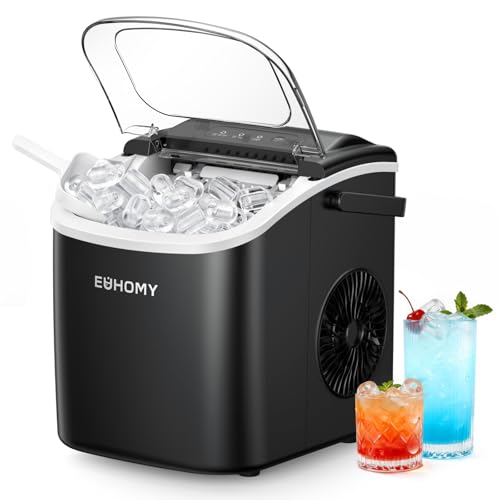
EUHOMY Countertop Ice Maker with Handle 26 Lbs — Best for Camping and RV
EUHOMY’s second entry in this list is the outdoors-leaning sibling: a handled machine with auto-cleaning, nine cubes in six minutes, and the same 26-pound daily rhythm, packaged in black and specified for the home-kitchen-camping-RV circuit. The differences from its stablemate are of emphasis rather than kind — this is the version whose design assumes it will be lifted, loaded, and used wherever a mains socket appears, from a motorhome’s galley to a garage workbench in July.
The auto-cleaning matters doubly in that life. RV tanks and campsite taps deliver water of variable character, and a machine that can flush itself on arrival, rather than carrying last month’s reservoir taste into this month’s lemonade, is a machine that keeps its welcome. The basket and scoop ride along in the box, the handle makes the loading honest work rather than a juggling act, and the whole unit stores in the kind of locker space these vehicles actually have.
Judged purely as a static kitchen machine, it gives a little ground to its sibling on ice-size choice; judged as the one to own if your summers involve wheels, it is the more sensible buy. Households should choose between the two EUHOMYs by itinerary rather than by specification, because the specifications are close and the intended lives are not.
It also makes a strong case as the second ice source for big households: the machine that lives in the utility room or the garden bar, switched on for gatherings and holidays, and forgiven its absence from the weekday kitchen. Not every appliance must earn a permanent counter place, and a handled, self-cleaning unit is unusually good at the guest role.
- Output: 26 lbs in 24 hours
- Cycle: 9 cubes ready in about 6 minutes
- Cleaning: auto-cleaning function
- Design: portable with handle, basket and scoop
- Colour: black
- Suited to: home, kitchen, camping, RV
Strengths
- Built for the mobile, socket-to-socket life
- Auto-cleaning handles variable water quality
- Easy to store and deploy for gatherings
Trade-offs
- Fewer ice-size options than its sibling model
- Bullet ice melts at the usual rate
- Black finish shows kitchen dust and fingerprints
Best for: campers, RV owners, and households wanting a movable second machine.
Not suited for: static kitchens that would rather have two ice sizes.
Ready when you are: Check price on Amazon for the EUHOMY handle model.

Aeitto Ice Maker Countertop 26 Lbs/24H — Best Energy-Conscious
The Aeitto’s distinguishing word is efficiency. Its cycle makes eight cubes in about six minutes rather than nine — a slightly smaller batch, produced by a machine tuned to sip rather than gulp, with the same 26-pound daily total reached across the day. For households that run an ice maker continuously through summer, that energy-saving temperament is a real, compounding virtue, the kind that never appears in a first-week review and dominates the second year’s opinion.
Otherwise it covers the modern checklist completely: two sizes of bullet ice, an auto-cleaning cycle, and a stainless finish that suits the home, kitchen, and office settings its maker names. The stainless body in particular separates it from the black-plastic crowd at this level, wiping clean and ageing gracefully in a way that matters for a machine that lives permanently beside the kettle.
The eight-cube cycle is the honest trade: at a party’s peak demand, each cycle delivers one fewer cube than the nine-cube machines, and a host refilling a big cooler will notice the arithmetic across an afternoon. For steady household use — glasses filled through the day rather than coolers filled at once — the difference dissolves into the machine’s rhythm and the efficiency remains. Choose it by your demand pattern, not by the cycle count alone.
It is also a thoughtful pick for smaller households that keep a machine running daily for two people’s drinks, where the big-output rivals spend their lives idling at capacity they never use. Matching a machine’s appetite to the household’s thirst is the quiet theme of this whole guide, and the Aeitto is where that theme becomes a specification.
- Output: 26 lbs per 24 hours
- Cycle: 8 cubes ready in about 6 minutes
- Ice: 2 sizes of bullet ice
- Cleaning: auto-cleaning
- Design: energy-saving, stainless finish
- Suited to: home, kitchen, office
Strengths
- Energy-saving design suits all-summer running
- Two ice sizes and auto-cleaning both included
- Stainless finish ages gracefully on the counter
Trade-offs
- Eight-cube cycles trail nine-cube rivals at peak demand
- Bullet ice remains a fast melter
- Efficiency virtues are invisible in the first week
Best for: steady daily users who run a machine all summer and count its appetite.
Not suited for: party hosts who need maximum cubes per cycle at peak moments.
Ready when you are: Check price on Amazon for the Aeitto ice maker.

Antarctic Star Countertop Ice Maker 26 Lbs/Day — Best for Bars and RVs
The Antarctic Star pitches itself at the sociable end of the market — home bars, RVs, camping trips — and its specification follows the pitch: eight bullet cubes in about six minutes, two sizes, a portable handle, self-cleaning, and the basket and scoop included, all in black. The six-minute cycle is the headline it leads with, and in a bar context the claim makes sense: the machine’s worth is measured in rounds kept cold, and cycle speed is the pulse of that service.
In a home bar, its virtues compound. Ice is the ingredient nobody plans and everybody needs, and a machine that starts producing within minutes of guests arriving rescues more evenings than any bottle. The two sizes cover short spirit glasses and long mixers; the self-cleaning cycle handles the machine’s long idle weeks between gatherings, which is when neglected ice makers develop the tastes that ruin a comeback.
The compromises mirror the category: bullet ice melts faster than the dense cubes a cocktail specialist would choose, and a machine aimed at occasions will spend much of its life waiting for one. But occasions are precisely where bought ice fails people — the forgotten bag, the petrol-station detour — and a countertop machine that lives with the bottles abolishes that failure mode entirely.
It also deserves its camping billing honestly earned: the handle, the compact black body, and the tolerance for being cleaned at the push of a button suit pitch-side life, where it will make the lemonade cold and the evening drinks civilised from a hook-up socket. Few appliances improve a campsite as disproportionately as a working ice supply.
- Output: 26 lbs per day
- Cycle: 8 bullet cubes in about 6 minutes
- Ice: 2 sizes of bullet ice
- Cleaning: self-cleaning
- Design: portable handle, basket and scoop included
- Suited to: home, bar, RV, camping
Strengths
- Fast cycles suit drinks-round service
- Home-bar and camping brief genuinely fits the design
- Self-cleaning copes with idle weeks between parties
Trade-offs
- Bullet ice is not the purist’s cocktail cube
- Occasional-use machines still need periodic cleaning
- Black body shows dust in a display bar setting
Best for: home bars, entertainers, and campers who host around drinks.
Not suited for: quiet households wanting a permanent, invisible kitchen fixture.
Ready when you are: Check price on Amazon for the Antarctic Star ice maker.
How do the best countertop ice makers compare side by side?
| Pick | Output | Cycle | Sizes | Standout trait |
|---|---|---|---|---|
| Frigidaire 26 Lbs/Day Portable Ice Maker | 26 lbs/day | Fast cycles | Bullet | Trusted brand, stainless |
| Silonn Countertop Ice Maker with Handle | 26 lbs/day | 9 in ~6 min | Bullet | Carry handle, self-cleaning |
| EUHOMY 26 Lbs/24H, Two Sizes | 26 lbs/24H | 9 in ~6 min | 2 sizes | Most complete feature set |
| EUHOMY 26 Lbs, Handle Model | 26 lbs/24H | 9 in ~6 min | Bullet | RV and camping focus |
| Aeitto Ice Maker Countertop 26 Lbs/24H | 26 lbs/24H | 8 in ~6 min | 2 sizes | Energy-saving, stainless |
| Antarctic Star Countertop Ice Maker 26 Lbs/Day | 26 lbs/day | 8 in ~6 min | 2 sizes | Bar and occasion focus |
What is bullet ice, and is it the right ice for your drinks?
Bullet ice is named for its shape: a hollow, rounded cylinder, frozen quickly around a chilled rod. The hollowness is the point and the limitation in one. A hollow cube presents a large surface area to the drink, so it chills fast — a warm lemonade is cold in a minute — but the same surface area melts fast, diluting as it goes. For everyday drinks, soft drinks, and the rapid turnover of a family kitchen, that trade is ideal. For a slow-sipped whisky, it is the wrong tool, and no machine in this guide pretends otherwise.
The quick freezing has a second consequence: bullet ice emerges softer and less densely frozen than the cubes from a freezer tray, and it chews pleasantly, which households with children and iced-coffee drinkers tend to count as a feature. It also releases from the machine in small, frequent batches, so the supply rhythm is a stream rather than a stockpile — six minutes to the first cubes, then a new handful every few minutes while the machine runs.
If your drinking life is mostly long, strong, and slow, the clear-ice machines in this site’s companion guide are your category. If it is family drinks, summer afternoons, and the constant small demand of a busy kitchen, bullet ice at 26 pounds a day is not a compromise at all — it is the correct ice, delivered at the correct pace.
Why does the basket not keep ice frozen — and what should you do about it?
New owners are often startled to find the day’s first cubes slowly shrinking in the basket, so the design deserves a plain explanation. Refrigerating the basket would require a second cooling system, doubling the machine’s size, cost, and power draw; instead, the basket is insulated, the meltwater drains back to the reservoir, and the machine remakes it. The system is a fountain, not a warehouse, and within a normal day’s drinking rhythm the supply feels endless precisely because it recycles.
Stockpiling, when you need it, is a two-step habit: let the machine run ahead of a party, bagging each basketful into the freezer, where the cubes freeze hard and keep. A few hours of that rhythm builds a party stockpile the machine alone never could, and the cubes emerge from the freezer denser and slower-melting than they went in, which drinks noticeably better. The machine makes; the freezer stores; each does the job it is good at.
Overnight, the choice is yours. Leave the machine running and it will cycle gently, remaking what melts; switch it off and the basket’s contents will be water by morning, ready to be remade at breakfast. Neither harms the machine. Households differ on the sound and the electricity; the ice, either way, is six minutes from fresh.
What does the water you use do to the ice and the machine?
Ice is frozen water with nowhere to hide, so the water’s character becomes the ice’s character. Heavily chlorinated tap water makes ice that perfumes a drink as it melts; hard water leaves mineral scale inside the machine’s pump and lines, slowing cycles and clouding cubes across a season. None of this is dangerous, but all of it is noticeable, and the fixes are proportionate: a simple filter jug for the reservoir improves flavour immediately in chlorinated areas, and regular descaling keeps hard-water machines at their rated pace.
Cloudiness deserves its own sentence, because owners mistake it for dirt. The white centre in home-frozen ice is trapped air and concentrated minerals pushed inward as water freezes from the outside — a physics souvenir, not contamination. It affects looks more than taste, and it is the reason the clear-ice category exists as a separate pursuit with separate machinery, covered in the companion guide to this one.
The reservoir itself needs a rhythm: fresh water in, stale water out. A machine left with the same water for a fortnight in a warm kitchen will eventually make ice that tastes of the fortnight. Empty, rinse, and refill when the machine has stood idle, run the cleaning cycle on the maker’s schedule, and the ice will taste of nothing at all — which, to say it once more, is the entire ambition.
Where should a countertop ice maker actually live?
Placement decides performance more than owners expect. These machines reject heat through side or rear vents while they freeze, so a unit wedged into a dead-air corner under a low cabinet recycles its own warm exhaust, cycles slower, and works harder for every cube. Give the vents a few inches of breathing room, keep the machine out of direct sun and away from the oven’s flank, and it will meet its rated pace without complaint. The lid also needs to open fully — measure the cabinet height with the lid up, not down, before assigning the spot.
Water logistics shape the second half of the decision. The reservoir is filled by hand, usually with a jug, so a home within a few steps of the sink saves a small daily friction that compounds across a summer. Drainage matters at cleaning time too: machines are emptied via a plug underneath or by tipping, and a spot where that operation can happen over the sink, rather than over the floor, will be appreciated at exactly the moment it matters.
Finally, consider the machine’s social life. An ice maker used for entertaining earns its place near the drinks, not exiled to the utility room; one used by children for summer drinks belongs where spills are cheap. The best spot is the one that matches the machine’s actual job in your house, with air to breathe and water within reach.
How much ice does a household actually need in a day?
The 26-pound headline invites a sanity check, because almost no household drinks 26 pounds of ice. A pound of ice is roughly a generous round for two or three tall drinks; a family of four, drinking iced water and soft drinks through a summer day, might work through four to six pounds. A barbecue for a dozen guests, with coolers and pitchers in play, can genuinely approach the machine’s full daily output — which is why the stockpile habit from the freezer matters for parties and is irrelevant for Tuesdays.
This arithmetic reframes the purchase kindly. You are not buying a daily quota; you are buying immediacy — ice in six minutes, in handfuls, whenever the day asks — with a ceiling high enough for the year’s biggest gathering if you start the machine in the morning. Every pick here shares that ceiling, so the household that agonises over daily output is agonising over the one number that does not separate them.
What does separate them, in demand terms, is cycle rhythm. A machine dropping nine cubes every six minutes restocks a busy round of drinks faster than one dropping eight, and a household of entertainers will feel that difference in the second hour of a party. Steady households will never notice it. Match the rhythm to the loudest day your kitchen honestly hosts, and the machine will feel generous rather than merely adequate.
What is the cleaning routine that actually happens in real houses?
Forget the manual’s full liturgy for a moment and consider the routine that survives contact with a real household, because a modest routine performed beats a perfect one abandoned. Ours is three-tiered. The daily tier is nothing but fresh water and a glance: if the machine ran yesterday and will run today, top it up and carry on. The weekly tier, for a machine in regular use, is the self-cleaning cycle or a vinegar-water flush, the basket and scoop through the sink, and a wipe of the lid’s underside, where condensation collects whatever the kitchen air carries.
The monthly tier is the descale, adjusted to your water: hard-water households monthly, soft-water households quarterly, always with the solution and method the maker specifies, followed by a plain-water cycle whose ice gets thrown away. That discarded first batch is the step people skip and then taste. The whole monthly ceremony takes less time than the machine takes to fill its basket, and it is the difference between a machine that tastes of nothing in year two and one that tastes of its own history.
Machines without a self-cleaning programme — the conservative designs here — simply move the weekly tier into the owner’s hands: a soft cloth, warm water, the reservoir rinsed rather than flushed. It is ten honest minutes. What no tier survives is neglect measured in months, after which biofilm in the lines becomes a project involving brushes and patience. The routine is cheap; the rescue is not.
Should you buy an ice maker or keep using freezer trays and bags?
Freezer ice has one towering advantage: it is already paid for. Trays cost pennies and a freezer is running anyway, so the honest comparison is not price but behaviour. Trays demand foresight — filled the night before, emptied into a bin, refilled — and they lend their flavours to whatever shares the freezer, which is why tray ice so often tastes faintly of frozen peas and good intentions. Bagged ice outsources the foresight to a shop and the storage to the same crowded freezer, and it arrives in quantities that melt in the bag across a party weekend.
The countertop machine’s case is the elimination of planning. Ice becomes a utility like tap water: unconsidered, immediate, and clean-tasting because it never lived beside the fish fingers. Households that entertain without warning, drink iced coffee daily, or have teenagers running a summer drinks economy will feel the difference weekly. Households whose ice use is a Sunday gin and tonic for two will not, and should keep their trays with a clear conscience.
There is a middle path many owners discover: the machine for the everyday rhythm, the freezer for the stockpile, exactly as the basket section of this guide describes. Once the two appliances are assigned their proper jobs, the question stops being which one wins and becomes why nobody explained the partnership sooner.
How do you get the best-tasting ice from a countertop machine?
Taste in ice is the art of tasting nothing, and it is achieved by controlling the three things that flavour it: the water, the machine’s cleanliness, and the ice’s age. Water first — if your tap water makes tea you can taste, it will make ice you can taste, and a filter jug is the whole remedy for most households. Bottled water works but teaches the machine’s owner an expensive habit; a jug filter delivers the same neutrality at a fraction of the ongoing cost.
Cleanliness is the second control, and its rule is rhythm rather than intensity. A machine flushed weekly never develops the biofilm that a machine scrubbed quarterly is fighting, and its ice stays neutral with a fraction of the effort. The scoop deserves its own mention: it should live outside the basket or in its holder, not buried in the ice, because hands touch scoops and ice is food. Every café observes this rule; every home should steal it.
Age is the third and least respected. Ice that has cycled in the basket for two days, melting and refreezing at the edges, picks up the kitchen’s ambient flavours and loses its clean snap. For a special occasion, run the machine fresh that morning and discard or demote yesterday’s basket to cooler duty. The difference between fresh ice and old ice in a good drink is not subtle, and it costs nothing but a decision.
What changes when the ice maker serves an office or a small business?
Shared machines live harder lives than domestic ones, and the buying criteria shift accordingly. Controls must be obvious to a rotating cast of users; the reservoir must be fillable without moving the machine; and the cleaning must be assignable — a named person’s Friday job — because in shared spaces an unowned routine is an undone one. The EUHOMY machines’ self-cleaning cycles and the Frigidaire’s simplicity are the two answers this list offers to that environment, arriving from opposite directions.
Output planning changes too. An office’s demand is spiked — a dozen drinks in the lunch hour, nothing at three — so cycle speed matters more than the daily total, and a freezer stockpile built during the quiet morning is the professional’s trick. Site the machine where the spike happens, near the drinks fridge and the kettle, with its vents honoured even in a crowded kitchenette.
Finally, shared machines justify a small stock of consumables kept with them: the maker’s descaler, a spare scoop, and a laminated card with the cleaning rota and the one-line instruction that prevents most faults — if it tastes odd, run the cleaning cycle and tell the person named on the card. An ice maker maintained by a system outlasts one maintained by goodwill, in offices as in houses.
When is a countertop ice maker the wrong purchase?
Three households should hesitate. The first drinks almost no iced drinks and knows it: for them the machine becomes a counter monument to an aspiration, and the freezer tray was never the problem. The second has no honest place to put it — no counter run with vent clearance and lid room — because a machine exiled to a cupboard between uses will be used exactly twice. Measure the home first; the category’s convenience evaporates when every session begins with fetching and plumbing-by-jug in a hallway.
The third household wants a freezer’s behaviour: a deep stockpile, rock-hard cubes, ice that waits a week without changing. That is a different appliance — a dedicated freezer or an undercounter unit with a refrigerated bin — at a different price and with a plumber in its story. Countertop machines are fountains, and buying one while secretly wanting a warehouse is the surest route to the disappointed review this category collects.
For everyone else — the iced-coffee mornings, the summer lemonade economy, the guests who arrive thirsty — the format’s bargain is exactly as advertised, and the six machines above are six temperaments of the same good idea. Choose by cleaning, carrying, and finish, because those are the qualities your household will actually live with after the identical headlines have faded from memory.
Which ice maker mistakes shorten a machine’s happy life?
Running the machine on stale reservoir water for weeks is the most common and the most forgivable-looking. The ice slowly takes on the taste of standing water and the kitchen itself, and owners blame the machine’s materials for what is really a refill overdue. Fresh water whenever the machine has stood idle, and a rinse of the reservoir at the same moment, keeps the ice neutral and the internal lines clean.
Blocking the vents to make the machine fit a prettier spot comes next. An ice maker suffocating in a corner cycles longer, freezes slower, and ages its compressor early — the daily output figure quietly halves and the owner concludes the model was oversold. Airflow is a specification; honour the clearances in the manual and the machine will honour its numbers.
Skipping descaling in a hard-water area is the slow killer. Scale coats the freezing rods and insulates the pump’s world, cycles stretch from six minutes to ten, and the machine labours audibly before it eventually faults. The self-cleaning cycles on most picks here handle the light work; a proper descale on the maker’s schedule, with the solution they specify, handles the rest. Twenty minutes a few times a year is the entire premium on this insurance.
Storing the machine wet is the final quiet error. A unit put away with water in its lines and a damp basket will greet its next season with smells that several cleaning cycles struggle to evict. Before any storage longer than a few weeks, drain it fully, run a cleaning cycle, dry the basket and interior with the lid open for a day, and store it that way — next summer’s first cube will taste like it should.
One more, learned from every shared household: do not let the scoop live buried in the basket, handled by everyone and washed by no one. Ice is food, the scoop is its serving utensil, and it deserves the same treatment as a spoon — a hook or holder outside the ice, and a wash with the weekly routine. The rule costs nothing and quietly separates the households whose ice always tastes clean from the ones who cannot work out why it does not.
And resist the temptation to run the machine on the garage floor during a heatwave because the kitchen felt crowded: garages run hotter than kitchens, dust finds the vents, and the machine’s output falls exactly when the party needs it most. A shaded indoor corner with breathing room around its vents will out-produce a heroic placement every single time, quietly, reliably, and entirely without complaint, all summer long, year after year, for as long as you own it.
Final Recommendation
For most kitchens, start with Frigidaire 26 Lbs/Day Portable Ice Maker if the brand and the stainless finish settle your mind, or with the feature-complete EUHOMY reviewed above if you want every modern convenience in the box. The carried, cleaned, and travelled brief belongs to Silonn Countertop Ice Maker with Handle, while EUHOMY Ice Maker Countertop 26 Lbs/24H is the office-and-everyday machine we would buy with a household’s money and defend without notes.
The remaining picks divide the specialist ground honestly: RV and camping mobility, an energy-conscious stainless design for all-summer runners, and a bar-focused machine for people whose ice demand arrives with guests. None of them will stockpile ice like a freezer or melt as slowly as a clear cube, and judged as what they are — fountains of fresh bullet ice, six minutes from a standing start — all six are genuinely good at it.
Pick the one whose daily temperament matches your house, give it air to breathe and fresh water to drink, and descale it before it asks twice. Do that, and the small daily luxury this category promises — ice that is simply always there, in summer, at midnight, whenever a drink wants it — will stop feeling like a luxury at all and become what it should be: part of how the kitchen works.
Frequently Asked Questions
How long does a countertop ice maker take to fill its basket?
The first cubes arrive in roughly six minutes on most picks here, and the basket fills progressively from there — expect a useful amount within the first half hour and a full basket across the following hours, depending on room temperature and how often the lid is opened. The 26-pound daily figure is a marathon number, reached by a machine left running around the clock, not a promise for the first hour.
Can I leave the machine running all the time?
You can, and many households do through the summer. The machine cycles as the basket empties and melts recycle, drawing modest power in the process. The conditions are housekeeping ones: keep the reservoir topped with fresh water, run cleaning cycles on schedule, and give the vents their clearance. Owners who prefer to switch off at night lose nothing but the standing supply — the first batch is only minutes away at breakfast.
Why is my ice soft or wet when it drops?
Bullet ice leaves the freezing rods as soon as it reaches size, so it arrives firm but not deep-frozen, and its surface carries a film of meltwater from the release. That is normal for the format. If you want harder cubes, transfer batches to the freezer for half an hour, where they freeze through and also become your stockpile. Persistently slushy output, though, usually means the room is hot or the vents are crowded — check the placement before blaming the machine.
Does the machine need a water line or drainage?
No — that is the format’s founding convenience. Every pick here fills by hand from a jug and drains by a plug or by tipping at cleaning time, so the machine can live anywhere with a socket. The trade for that freedom is the manual rhythm: refilling the reservoir and emptying it when the machine stands idle are the owner’s jobs, small and daily rather than plumbed and forgotten.
How often should I clean and descale it?
Run the self-cleaning cycle — where fitted — every week or two of regular use, wash the basket and scoop in the sink as you would any food container, and descale on the manufacturer’s schedule for your water hardness, which in hard-water areas usually means every month or two of daily running. Ice that develops any taste at all is the machine asking early; answer it then rather than at the fault stage.
Is bullet ice suitable for cocktails?
For most home cocktails, honestly yes: highballs, spritzes, and mixed drinks with a fast turnover are well served by quick-chilling bullet ice. The exception is the slow, spirit-forward drink — an old fashioned nursed for half an hour — where rapid dilution changes the drink’s balance as it sits. That is the clear-ice machines’ territory, and the companion guide to this one covers those models in detail.
Related Guides
If ice is only the beginning of the drinks project, these guides cover the neighbouring territory: Best Countertop Clear Ice Makers, Best Patio Grills, Best Kamado Grills.


