What's inside
- Quick Picks
- How We Chose These Picks
- Key Takeaways
- Detailed Reviews
- Comparison Table
- How to Choose an Enamel-Over-Iron Set
- Enamel Care: The Short, Complete Course
- Serving From the Pot: Enamel’s Table Manners
- Common Mistakes When Buying Porcelain Cookware Sets
- Final Recommendation
- Frequently Asked Questions
- Related Guides
As an Amazon Associate I earn from qualifying purchases. This post may contain affiliate links at no extra cost to you.
As an Amazon Associate, cottageverdict.com earns from qualifying purchases made through links in this guide — at no extra cost to you.
Where to buy: all six sets below are listed on Amazon, and you can reach any of them through the linked names in Quick Picks, the heading above each review, or the comparison table near the end. Do check price on Amazon before ordering and confirm colours on the listing page, because enamel shades render differently on every screen. Anyone searching for the best porcelain cookware sets needs the market’s central fact stated before any picks, so here it is, without decoration.
A solid-porcelain stovetop set is not what this market sells. Porcelain is a ceramic body — think teapots, oven dishes, bathroom sinks — and a full porcelain saucepan fleet for daily hob work essentially does not exist in this aisle, because solid porcelain is heavy, chip-prone at rims and handles, and no friend to induction. What the listings below actually sell is porcelain enamel: a porcelain-like enamel coating fused over a metal core. Five of the six sets wear that enamel over cast iron; the sixth, the Rachael Ray Cucina set, wears its enamel-style nonstick finish over an aluminium body. Every review on this page names the core and the coating separately, because calling enamel solid porcelain would be the one unforgivable sentence in a guide with this title.
Why does enamel over iron dominate the category? Because the pairing is genuinely excellent. Cast iron supplies the mass — heat held evenly, sears that do not flinch, ovens that simmer for hours at a murmur. The enamel supplies the manners — no seasoning, no rust, a surface that shrugs at tomato sauces and wine, and colours that let a Dutch oven serve at the table as the dish itself. The aluminium-bodied Cucina set trades some of that mass for lightness and easy handling, which is its own legitimate bargain, and its review treats it as the lightweight of the family rather than pretending it is iron in disguise.
The iron five divide by shape and shade. MAISON ARTS brings seven pieces in red with an induction-compatible Dutch oven at the centre. SearCook offers five pieces in navy blue, with sourdough baking named in its title. Hisencn’s seven pieces in green describe their coating as ceramic coated cast iron — wording this guide quotes exactly, since sellers name their enamels variously. The unbranded teal four-piece set itemises its contents with unusual precision, down to a 10.25-inch skillet and three oven sizes. Best Choice closes the iron family with six pieces in sage, including a grill pan with a press. Different picks, different facts from the iron-sets guide elsewhere on this site — nothing borrowed, everything titled.
Quick Picks
| Porcelain-enamel set | Badge | Why it is here |
|---|---|---|
| Rachael Ray Cucina 12-Piece Agave Blue | The lightweight | Twelve pieces of enamel-style nonstick over aluminium, glass lids, oven safe to 400°F. |
| MAISON ARTS 7 Piece Enameled Cast Iron Red | Red enamel all-rounder | Seven induction-compatible pieces in red, built around a durable enamel Dutch oven. |
| SearCook 5-Piece Enameled Cast Iron Set | Bread baker’s navy set | Five pieces for all stovetops, with sourdough bread baking named in the title. |
| Hisencn Enameled Cast Iron Set 7 Piece Green | Green, ceramic-coated wording | Seven heavy duty pieces, gas and induction compatible, with three lids in the count. |
| 4-Piece Enameled Cast Iron Set Teal | Most itemised contents | Four pieces fully sized in the title, no seasoning needed, oven safe to 500°F. |
| Best Choice 6-Piece Ceramic Coated Cast Iron | Grill pan with press | Six sage pieces including a 6Qt Dutch oven and a 10-inch grill pan with press. |
How We Chose These Picks
It is worth pausing on why this category confuses shoppers so reliably. The word porcelain carries the authority of the bathroom and the tea table — solid, white, kiln-fired things — and cookware marketing borrows that authority for coatings that share porcelain’s glassy nature without sharing its body. A guide’s job in such a category is translation, not amplification, which is why this page repeats its central fact in several forms: enamel over metal, named core, named coating, every time, until the translation becomes the reader’s reflex at any listing.
The first rule was the honesty rule: a set belonged here only if its construction fit the porcelain-enamel reality — enamel or ceramic-coated surfaces over cast iron, plus the one aluminium-bodied enamel-style set that anchors the lightweight end. Solid-ceramic bakeware and ordinary dark nonstick were both excluded, for opposite reasons: one is not stovetop cookware at all, and the other is not porcelain in any sense a buyer would recognise.
The second rule was separateness. This site publishes a separate guide to iron cookware sets, and the temptation to borrow its picks or its sentences was refused outright: different pool, different facts, different words. Where a set here resembles one there in family terms — enamelled cast iron is enamelled cast iron — the reviews below are built only from this set’s own title, its own colours, counts and claims.
The third rule concerned claim language. Titles here carry free-from wording — 100% PFOA-PFOS Free, PFA-Free, PFAS Free, non-toxic — and each instance is quoted in its review as the listing’s own language, never as this site’s certification. Physical facts, by contrast, are stated flatly where titles state them: the teal set’s skillet diameter and oven sizes, Best Choice’s 6Qt oven and grill press, the Cucina’s 400°F ceiling. The spec boxes record the gaps with the same plainness.
Key Takeaways
- Porcelain sets are porcelain enamel over metal — cast iron in five sets here, aluminium in the Cucina.
- Enamel over iron means no seasoning and no rust, with chip-aware handling as the standing price.
- Colours are real choices here: agave blue, red, navy, green, teal and sage across the six.
- The teal four-piece and Best Choice six-piece itemise contents best; the Cucina is the light-handling outlier.
- Free-from wording in these titles is the listings’ claim language, quoted as such throughout.
Detailed Reviews

Rachael Ray Cucina 12-Piece Agave Blue
The Cucina is this guide’s deliberate outlier: the porcelain-enamel idea executed over aluminium rather than cast iron, in a twelve-piece nonstick set whose title leads with its Agave Blue name, promises easy cleanup, includes glass lids, and sets an oven ceiling of 400°F. The title also carries the words lavender purple — a colour description at odds with its own headline shade — so the honest instruction is the one this guide gives everywhere: judge the colour from the listing photographs, not from the copy, and expect a blue-green family tone rather than a dictionary definition.
Aluminium changes the daily experience completely. These are pans a tired cook can lift one-handed, full of pasta water, without a forearm negotiation. They heat quickly, respond quickly, and forgive a distracted evening. What they do not do is hold heat like iron: a Cucina pan’s temperature dips when cold food lands and recovers by the burner’s effort rather than the metal’s stored wealth. For the saucy, eggy, vegetable-led cooking that fills most weeknights, that trade is invisible; for steakhouse searing, it is the whole story, and the iron sets below exist for exactly that reader.
Twelve pieces with glass lids is a complete starter architecture — the set a first flat or a holiday home can simply open and cook from. Easy cleanup, the title’s own promise, is the nonstick covenant: food releases, the sink forgives, and the evening shortens. The 400°F oven ceiling covers finishing and baking duties at moderate temperatures while staying honest about its limits; this is not the set for fierce broiler work, and its title does not pretend otherwise.
Place the Cucina correctly and it shines: it is the porcelain-look, easy-handling, easy-cleaning option for cooks who value lightness over mass. Ask it to be cast iron and it will disappoint; ask it to make Tuesday dinner pleasant and it will, for years.
Strengths
- Aluminium body keeps twelve pieces light enough for one-handed, full-pan lifts.
- Glass lids and easy-cleanup nonstick suit weeknight cooking and quick washing.
- Oven safe to 400°F is stated in the title, covering moderate finishing work.
Trade-offs
- No iron mass means no iron sear or long heat retention.
- The title’s colour words conflict — agave blue versus lavender purple — so verify visually.
- Nonstick surface follows coating care rules: gentle tools, no fierce empty preheats.
Listing facts for this pick:
- Construction: nonstick over aluminium (the family’s lightweight build)
- Pieces: 12
- Colour naming in title: agave blue; also the words lavender purple
- Oven rating: safe to 400°F
- Lids: glass lids stated
- Induction wording: not stated in the listing
There is a household this set serves better than any other in the guide: the one with a reluctant cook. A partner who finds iron intimidating, a teenager on first dinner duty, a grandparent whose wrists have opinions — all of them will actually use light, forgiving, easy-cleaning pans, and a set that gets used beats a superior set that gets avoided. Kitchens run on participation, and the Cucina is the participation choice, which is a more serious recommendation than it sounds.
Best for: cooks who prize light handling and easy cleanup over iron’s mass. Not suited for: searing devotees or anyone expecting cast iron performance from aluminium.
Check the colour on the Rachael Ray Cucina listing on Amazon before ordering.

MAISON ARTS 7 Piece Enameled Cast Iron Red
Now the iron heart of the guide. MAISON ARTS describes a seven-piece enamelled cast iron set in red — porcelain enamel over iron, in this guide’s framing — that is induction compatible, built around a durable enamel Dutch oven set, and carrying 100% PFOA-PFOS Free claim language, quoted here as the listing’s own words. Seven pieces is the classic enamel wardrobe: the great oven for slow work, companions for the hob, all in a red that has been the colour of serious Dutch ovens for generations.
Induction compatibility matters more for enamelled iron than buyers sometimes realise, because it confirms the base is built for modern glass — flat, magnetic, ready for the hobs these heavy pots will actually meet. A red Dutch oven on an induction hob, holding a braise at the barest simmer for an afternoon, is this category’s emblematic scene, and the set is clearly composed around it.
Durable is the title’s chosen adjective for the enamel, and durability in enamel means one thing above all: resistance to the daily knocks of a working kitchen. No enamel is chip-proof, and this review will not upgrade the adjective into a guarantee — but a maker who leads with durability is at least aiming at the right target. The usual enamel etiquette still applies: wooden or silicone tools, gradual heat, a cool-down before the sink, and storage that keeps rims from duelling.
Red, finally, is a table decision. The Dutch oven will serve from its own depths at the centre of the table, and red makes that arrival feel like an occasion without a single extra dish dirtied. Households that entertain around stews, braises and baked pastas will use that quality weekly.
Strengths
- Seven red enamelled iron pieces form a complete slow-cooking wardrobe.
- Induction compatible is stated, suiting modern glass hobs.
- Enamel surface needs no seasoning and ignores acidic sauces happily.
Trade-offs
- Contents are not itemised piece by piece in the title.
- Enamel chips remain possible despite the durable framing — handle with care.
- Iron weight applies in full; full ovens are two-handed lifts.
Listing facts for this pick:
- Construction: enamelled cast iron (porcelain enamel over iron)
- Pieces: 7
- Colour: red
- Hob wording: induction compatible
- Claim language in title: 100% PFOA-PFOS Free
- Oven ceiling: none stated in the listing
Think of the red oven across a year. In January it holds a bean stew that simmers all afternoon while the house does other things. In April it bakes a crusty loaf for a picnic. In September it takes the glut of tomatoes down to a sauce worth freezing. In December it arrives at the table as the centrepiece of a meal it also cooked. Seven pieces earn their keep in that rhythm — the oven as protagonist, the pans as a supporting cast that never has to audition. Households whose cooking has seasons will feel this set keeping time with them.
Best for: induction households wanting a red enamel fleet centred on a Dutch oven. Not suited for: rough handlers, campfire cooks, or buyers needing itemised contents.
View the seven pieces on the MAISON ARTS red set page on Amazon.

SearCook 5-Piece Enameled Cast Iron Set
Five pieces, navy blue, and a title with a baker’s heart. SearCook describes an enamelled cast iron cookware set with lids — a skillet, a frying pan, a saucepan and a Dutch oven — for all stovetops, carrying PFA-Free claim language, and named as suitable for sourdough bread baking. That last phrase is the set’s signature: an enamelled Dutch oven is the home baker’s essential vessel, trapping a loaf’s own steam under its lid for the crust that defines good sourdough, and this listing says so outright.
Navy blue is the quiet professional’s enamel — deep enough to hide the faint shadows of a working life, calm enough for any table. Five pieces is a considered edit rather than a compromise: two frying shapes for the daily rotation, a saucepan for the liquids, and the oven for bread and braises. Small households and couples who bake will recognise their kitchen in that list immediately.
All-stovetop compatibility widens the set’s world to gas, electric and induction homes alike, useful for renters whose next flat may change the hob. Enamel’s standard freedoms apply — no seasoning, no rust, acidic sauces welcome — with the standard cautions riding along: chips fear hard edges, and the coating prefers its heat gradual and its washing unhurried.
The set’s boundary is scale. Five pieces serve a focused menu beautifully and a banquet badly; there is one oven, and when it is baking bread it is not braising dinner. Households that routinely run two slow dishes in parallel should look at twin-oven thinking elsewhere, while the bread-and-braise household of two to four will find this set’s priorities exactly their own.
Strengths
- Sourdough bread baking is named in the title — a baker-focused Dutch oven set.
- Contents are itemised: skillet, frying pan, saucepan and Dutch oven with lids.
- All-stovetop compatibility suits renters and mixed-hob households.
Trade-offs
- Five pieces and one oven limit parallel slow cooking.
- Capacities are not given in the title, so bakers should verify the oven’s volume.
- PFA-Free wording is the listing’s claim language, quoted as such here.
Listing facts for this pick:
- Construction: enamelled cast iron (porcelain enamel over iron)
- Pieces: 5, with lids
- Colour: navy blue
- Hob wording: for all stovetops
- Named use: suitable for sourdough bread baking
- Oven volume: not given
The sourdough detail deserves one more paragraph, because it changes how the set should be judged. A Dutch oven used for bread lives a double life — preheated empty and fiercely, then shocked with cold dough, week after week. Enamel tolerates that ritual when the heating is gradual at the start, and the reward is a loaf with a crust no baking tray can produce. If bread is even a monthly ambition in your house, this set’s title is speaking directly to you, and its navy calm will look as good holding a rested loaf as it does holding a stew.
Best for: bakers and small households wanting one good oven plus daily pans in navy. Not suited for: large families or parallel-braise hosts.
Confirm the oven size on the SearCook 5-piece listing on Amazon.

Hisencn Enameled Cast Iron Set 7 Piece Green
Hisencn’s title performs a small naming ballet worth watching: it calls the set an enamelled cast iron cookware set of seven pieces — Dutch ovens at its centre — in green, and then describes the surface as ceramic coated cast iron, listing a sauce pan, a skillet and three lids, with heavy duty construction and gas and induction compatibility, under PFA Free claim language. Enamel, ceramic coating, porcelain enamel — sellers reach for neighbouring words for the same family of glassy coatings over iron, and this guide’s practice is to quote the title’s own term, ceramic coated, while placing the set where it belongs: among the coated-iron fleets of this porcelain guide.
Seven pieces with three lids is a well-mannered count. Lids are the pieces that decide whether two dishes can simmer at once, and three across a Dutch-oven-led fleet is generous. Green is the fresh note in a guide of reds and navies — a colour that suits plant-filled, light kitchens and photographs beautifully against wooden tables, while still being saturated enough to forgive the cosmetic record of regular use.
Gas and induction are both named, which covers the two hob families most enamel buyers actually own, and heavy duty matches the physical truth of coated iron: these are planted, substantial pieces that hold a simmer with authority. The enamel etiquette applies unchanged — soft tools, gradual heat, no cold-water shocks — and the green surface will reward it by keeping its gloss.
What the title leaves open is the size ladder: Dutch ovens plural are promised without capacities, so a baker or a big-batch cook should verify volumes on the listing page. Households cooking for two to five, though, will find the fleet’s shape — ovens, sauce pan, skillet, lids in triplicate — mapped closely onto a real week of dinners.
Strengths
- Seven pieces with three lids support genuinely parallel simmering.
- Gas and induction compatibility are both named in the title.
- Green coated iron offers a fresher colour than the category’s reds and blacks.
Trade-offs
- Dutch oven capacities are not stated, so batch cooks must verify sizes.
- The title mixes coating terms — enamelled and ceramic coated — which buyers should read carefully.
- Coated iron still chips under hard knocks despite the heavy duty framing.
Listing facts for this pick:
- Construction: cast iron, described in title as ceramic coated and enamelled
- Pieces: 7, including 3 lids
- Colour: green
- Hobs named: gas and induction compatible
- Build wording: heavy duty
- Oven capacities: not stated in the listing
Green also earns a word about light. In a north-facing kitchen, saturated green enamel holds its colour through grey mornings when paler finishes wash out, and under warm evening light it deepens rather than yellowing. A set is a visual fixture for a decade; choosing a colour that behaves well in your own light is the kind of detail that separates a purchase that keeps pleasing from one that quietly fades into the background of its own kitchen. Bring a cushion or a plant to the listing photographs and compare — the exercise sounds whimsical and works completely.
Best for: households wanting a green coated-iron fleet with lid depth for parallel cooking. Not suited for: buyers who need capacities in the title or who store pans carelessly.
Check volumes on the Hisencn green set page on Amazon.

4-Piece Enameled Cast Iron Set Teal
The smallest set in the guide carries the most precise title. This unbranded four-piece enamelled cast iron set in teal itemises everything: a 10.25-inch skillet, a 2QT saucepan, and Dutch ovens of 2.8QT and 4.8QT, with no seasoning needed, oven safety to 500°F, and induction readiness all stated. Four pieces, two of them ovens — a fleet shaped like a question: what if a kitchen’s heart is the oven, in two sizes, with a skillet and a saucepan in support?
The two-oven ladder is smarter than it first looks. The 2.8QT oven is the weeknight size — rice for two, a small braise, a side of beans — heating fast and washing easily. The 4.8QT is the weekend vessel: the loaf, the stew, the family curry. Owning both means the big pot stops being conscripted for small jobs, which is how heavy cookware earns a reputation for burden; sized correctly, iron’s weight is spent only where it pays.
No seasoning needed is enamel’s whole promise in four words, and the 500°F ceiling is the joint-highest oven figure in this guide, covering fierce bread finishes and gratin work. Induction ready completes a title that behaves like a specification sheet — a refreshing change in a category of adjectives, and a model of how much information a listing can carry when it tries.
The trade is breadth at the hob. One skillet and one saucepan will not run a three-pan weeknight for a family, and there is no frying pan distinct from the skillet in the count. This set suits oven-led cooks — bakers, braisers, small households — and pairs naturally with a household that already owns a favourite frying pan it refuses to retire.
Strengths
- Fully itemised contents with diameters and capacities — the guide’s clearest title.
- Two Dutch oven sizes match weeknight and weekend cooking precisely.
- Oven safe to 500°F and induction ready are both stated outright.
Trade-offs
- Only one skillet and one saucepan limit multi-pan weeknight cooking.
- Four pieces is a specialist fleet, not a from-scratch kitchen.
- Unbranded listing means the title carries the whole burden of trust — read it closely.
Listing facts for this pick:
- Construction: enamelled cast iron (porcelain enamel over iron)
- Pieces: 4
- Colour: teal
- Contents: 10.25″ skillet, 2QT saucepan, 2.8QT and 4.8QT Dutch ovens
- Oven rating: safe to 500°F; no seasoning needed
- Hob wording: induction ready
There is an economy argument for the small fleet that deserves air. Four well-chosen iron pieces, used constantly, will out-cook a twelve-piece fleet used rotationally, because constant use is what keeps a cook’s instincts sharp and a kitchen’s storage sane. The teal set is the guide’s wager on depth over breadth — two ovens you will know intimately, a skillet with no rival for your attention, a saucepan sized for real life. Minimalists who cook seriously, rather than minimally, are its natural owners.
Best for: oven-led cooks, bakers and small households wanting two right-sized Dutch ovens. Not suited for: families running three pans nightly or from-scratch kitchens.
Admire the precision on the teal 4-piece listing on Amazon.
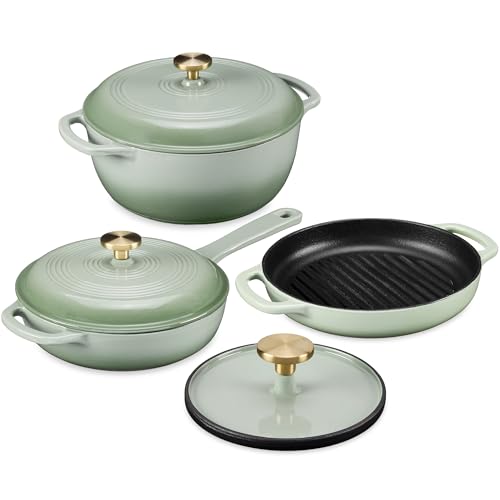
Best Choice 6-Piece Ceramic Coated Cast Iron
Best Choice closes the iron family with the set that brought a press. The title describes a six-piece cast iron cookware set, ceramic coated — the seller’s coating term, quoted exactly — in sage, non-toxic and PFAS Free in its claim language, heavy duty, gas and induction compatible, and itemised as a 6Qt Dutch oven, a 2Qt skillet with lid, and a 10-inch grill pan with press. That grill pan and press combination is unique in this guide: a weighted press for sandwiches, bacon and spatchcocked anything, bringing diner technique into the enamelled-iron world.
The 6Qt Dutch oven is the largest single vessel named in any title here — the batch cook’s size, the double-recipe chilli pot, the loaf-and-a-half baker. Paired with a lidded 2Qt skillet for the daily work and the grill pan for ridged drama, the six pieces cover a wide menu with no filler. Sage is the calmest colour in the guide, a grey-green that suits nearly every kitchen and hides a working life gracefully.
Gas and induction compatibility are both stated, which matters for a set this heavy: buyers should never have to guess whether a 6Qt iron oven will register on their glass hob. The ceramic-coated wording places the set in the same coating family as the Hisencn above, and the same care rules follow — gradual heat, soft tools, no thermal shocks, respect for rims.
Weight is the standing caution, amplified: a 6Qt iron oven full of stew is among the heaviest objects a home cook ever lifts, and it should be rehearsed with water before the first full batch. Households with the strength and the appetite, though, get a set whose ceiling — batch size, pressing, braising — is the highest in the guide.
Strengths
- 6Qt Dutch oven is the largest vessel named in any title in this guide.
- Grill pan with press adds a technique no other set here offers.
- Gas and induction compatibility are both stated for a heavy fleet.
Trade-offs
- A full 6Qt iron oven is a serious two-handed lift — rehearse with water.
- Six pieces lean specialist; there is no mid-size saucepan in the itemised list.
- Non-toxic and PFAS Free wording is the listing’s claim language, as quoted.
Listing facts for this pick:
- Construction: cast iron, ceramic coated (title’s term)
- Pieces: 6
- Colour: sage
- Contents: 6Qt Dutch oven, 2Qt skillet with lid, 10″ grill pan with press
- Hobs named: gas and induction compatible
- Build wording: heavy duty
The press, once owned, finds work everywhere: bacon that stays flat, sandwiches that fuse properly, a chicken breast that cooks evenly because the press keeps it in full contact with the pan, tofu that actually crisps. It is the kind of accessory buyers dismiss as a gimmick until the third use, after which it lives beside the hob permanently. Combined with the guide’s largest oven, it makes this the set for households whose cooking has ambitions — the ones feeding crowds, pressing paninis for a table of teenagers, and batching Sunday sauce in quantities that laugh at smaller pots.
Best for: batch cooks and press enthusiasts wanting the biggest oven and a grill press. Not suited for: cooks with limited lifting strength or small households cooking small.
Weigh the details on the Best Choice 6-piece page on Amazon.
Comparison Table
| Set | Core under the enamel | Count and colour | Anchor vessel | Title’s signature detail |
|---|---|---|---|---|
| Rachael Ray Cucina | Aluminium, nonstick | 12, agave blue | Full starter fleet with glass lids | Oven safe to 400°F |
| MAISON ARTS 7 Piece | Cast iron, enamelled | 7, red | Dutch oven set | Induction compatible |
| SearCook 5-Piece | Cast iron, enamelled | 5, navy blue | Dutch oven with lids | Sourdough bread baking named |
| Hisencn 7 Piece | Cast iron, ceramic coated per title | 7, green | Dutch ovens with 3 lids | Gas and induction named |
| Teal 4-Piece | Cast iron, enamelled | 4, teal | 2.8QT and 4.8QT Dutch ovens | Oven safe to 500°F |
| Best Choice 6-Piece | Cast iron, ceramic coated per title | 6, sage | 6Qt Dutch oven | Grill pan with press |
How to Choose an Enamel-Over-Iron Set
Before the core question, settle the vocabulary on the listing in front of you. If a title says enamelled, expect the glassy coating described in this guide; if it says ceramic coated about a cast iron set, expect a neighbouring coating with near-identical manners; if it says only nonstick, as the Cucina’s does, expect the lighter aluminium bargain. Reading the coating word first prevents the category’s most common disappointment — buying one family’s behaviour while expecting another’s.
Start with the core question this whole category hides: do you want iron’s mass at all? If your cooking is fast, light and weeknight-shaped, the aluminium Cucina’s easy handling may serve you better than any iron fleet, and choosing it knowingly is a success, not a compromise. If your cooking leans slow — braises, breads, beans, Sunday sauces — iron’s stored heat is the ingredient no burner can substitute, and the remaining questions are about shape and shade.
Do not skip the saucepan question while the ovens dazzle you. Morning porridge, reheated soup, a sauce for two — the small liquid jobs decide whether a set feels complete on ordinary days. The teal set answers with a 2QT saucepan, Hisencn names a sauce pan among its pieces, and SearCook includes one in its five; where a title is silent, as MAISON ARTS’ is, let the listing page confirm the support cast before you fall for the star.
Shape means ovens first. Count the slow dishes you cook weekly and size the fleet’s Dutch ovens against them: the teal set’s two-oven ladder for the oven-led kitchen, Best Choice’s single 6Qt giant for the batch cook, SearCook’s baker-focused five for the sourdough household. Skillets and saucepans support; ovens star. A set whose oven matches your most-cooked dish will feel custom-built, whatever its brand.
Households choosing between two finalists should cook the decision, at least on paper. Write your three most-cooked dishes and walk each finalist’s contents list against them: which oven takes the Sunday sauce, which skillet takes the morning eggs, which pan is left unemployed by all three dishes? The unemployed pan is the tiebreaker made visible — the set with fewer idle pieces is the set your kitchen is actually shaped like, whatever the counts claim.
Then verify the hob in writing. Induction is named for MAISON ARTS, the teal set, Hisencn and Best Choice; SearCook claims all stovetops; the Cucina’s title is silent, which aluminium nonstick shoppers on induction should treat as a question for the listing page. Heavy iron is the worst category in which to discover a compatibility surprise after delivery.
Gift buyers face a special version of this choice, because enamelled iron is a wedding-list classic. The safe gift is the mid-sized, mid-coloured set — a seven-piece in red or a five-piece in navy — sized for a household still discovering its batch habits. The brave gift is the colour the couple keeps pinning to their kitchen boards. Either way, include the care conversation with the present; enamel given with its manners explained is enamel that survives its first year in a new home.
Finally, choose colour as the long-term decision it is. Enamelled iron is a decade purchase; red will host a thousand dinners, navy will calm a thousand breakfasts, and teal, green and sage will live in your kitchen’s photographs for years. Pick the colour your future self will still enjoy, in the light your kitchen actually has.
Enamel Care: The Short, Complete Course
A short note on repairs, because enamel owners eventually ask. A tiny chip on an exterior rim is cosmetic — it can be left alone, watched, and kept dry. A chip on a cooking surface is a retirement conversation for that vessel’s starring roles, though the pot may live on for bread, where parchment stands between dough and surface. Bare iron forgives everything; enamel forgives almost everything except impact — knowing which kind of forgiveness your household needs is, once again, the family question in disguise.
Enamel asks for three habits and repays them with decades. Heat gradually — let the iron warm through rather than blasting a cold pot on maximum, because the coating and the core expand together only when they are allowed to. Cool before washing, for the same reason in reverse: a fierce pot under a cold tap is the classic crazing accident. And guard the rims, where enamel is thinnest, from taps, racks and neighbouring pans; most chips are born at edges, in sinks and cupboards, not on stoves.
One more care note belongs to the lids. Enamelled lids live dangerously — set down on counters, knocked against taps, stacked under pans. Their rims carry the same thin enamel as the pots’, and they meet the world first. Park lids on a cloth, store them upright where the cupboard allows, and never use a lid as a trivet for its own scorching pot. Small courtesies, repeated, are the entire difference between enamel that ages into patina and enamel that ages into damage.
Daily cleaning is gentle by design: a soak is permitted — a freedom bare iron never grants — a soft sponge does the work, and a paste of baking soda persuades the occasional stain on pale interiors. Store pieces with a cloth between them if they must stack. None of this is ceremony; it is simply the manners of a material that cannot heal itself, traded against a surface that never needs seasoning and never rusts. Most owners find the trade heavily in their favour by the second month.
Serving From the Pot: Enamel’s Table Manners
Children, incidentally, read enamelled pots correctly long before adults do: they see a beautiful heavy thing that must not be dropped and ask to help carry the light parts — the lid, the ladle, the bread board. A household that cooks together can assign enamel its proper roles by strength and age, with the iron ovens as the adults’ instruments and everything around them shared. Cookware that sorts a family into a working team has done more than cook dinner.
Something changes in a meal when the cooking vessel comes to the table. A braise served from its own red or navy depths stays hot through second helpings, carries the cook’s effort visibly to the diners, and saves a serving bowl from the washing-up. Enamelled iron was practically designed for this double duty — heavy enough to hold heat at the table, beautiful enough to deserve the place. Hosts should plan for it: a trivet that suits the table, a ladle that suits the pot, and a household agreement that the oven’s handles stay hot long after the food is served, because at the table, relaxed guests forget what cooks remember.
Second helpings are the practical test of all this. A stew that stays welcomingly hot in its iron oven gets eaten; a stew transferred to a bowl that cools by the minute gets left. Households watching food waste — and budgets — will find that serving from the pot quietly reduces both, because the meal remains appetising for the whole of its duration rather than only its first ten minutes. Beauty, heat and thrift turn out to be the same feature wearing three names.
The aluminium Cucina plays a lighter version of the same role — its pans are presentable and easy to carry, though they surrender their heat faster once off the hob, so serve promptly. Either way, the porcelain-enamel category quietly abolishes the transfer step that other cookware imposes, and households that entertain even casually will feel that abolition as a small luxury every single time.
There is a photographic truth here too, in an age when dinners get documented. Enamel’s saturated colours make ordinary food look abundant; a bean stew in a teal oven reads as a feast before anyone tastes it. Cooks are allowed to care about that. Appetite begins with the eyes, and a category that feeds the eyes first has earned its place at the centre of the table as well as the centre of the stove.
Common Mistakes When Buying Porcelain Cookware Sets
A planning mistake deserves a place beside the classic errors: buying enamelled iron for a hob it cannot meet. These are heavy, flat-based pots that reward glass and induction and tolerate gas happily, but a set ordered for a warped old electric hob or a camping stove it will never fit becomes furniture. Confirm the hob, the oven’s internal width — a wide Dutch oven with loop handles needs measuring against many ovens — and the shelf depth, in that order, before the colour seduces you into skipping all three.
The original mistake is the search itself: expecting solid porcelain. Buyers who carry that picture into this category misjudge everything — the weight, the care, the price — when the actual product, enamel over metal, is better suited to stovetops than the fantasy was. The second mistake is the mirror image: dismissing enamelled iron as merely coated, when the coating is precisely what makes iron livable for most households.
Another quiet error is storing enamelled pieces nested without protection because they feel indestructible. They feel that way because of the iron; the coating that gives them their manners is glass, and glass-on-glass stacking in a busy cupboard writes fine scratches that dull the gloss a little more each month. A folded cloth in each stored pot is the whole remedy, and households that adopt it keep showroom enamel for years while their neighbours wonder what the secret was.
A third mistake is borrowing facts across guides and brands — assuming the red set’s contents match another red set’s, or that a claim in one title follows the brand everywhere. This guide has kept six titles in six separate lanes for a reason, and checkout should too. The fourth is ignoring the lift: a 6Qt iron oven full of stew is a genuinely heavy object, and households should rehearse that weight honestly before the batch season arrives.
Final Recommendation
A word on sequencing for readers equipping a kitchen gradually: the Dutch oven is the piece to buy well first, whichever set supplies it, because it is the vessel that defines this category’s cooking. Skillets and saucepans can be supplemented from any material later; a great enamelled oven, matched to your hob and your batch size, is the anchor the rest of the kitchen arranges itself around. Choose the set whose oven you would save from a fire, and the supporting pieces will justify themselves in its orbit.
For most households drawn to this category, the MAISON ARTS 7 Piece Enameled Cast Iron Red is the balanced centre — seven pieces, induction-ready, enamel’s full convenience in the classic colour. Bakers and small households should lean to the SearCook 5-Piece Enameled Cast Iron Set or the twin-oven teal set, batch cooks to the Best Choice 6-Piece Ceramic Coated Cast Iron, and light-handling cooks to the Cucina without a moment’s apology. Buy the enamel for what it honestly is — porcelain’s beauty fused to metal’s strength — and the first time your Dutch oven walks from hob to table glowing like a centrepiece, you will understand why this category never needed to pretend to be anything else.
Frequently Asked Questions
Is there such a thing as a solid porcelain cookware set? Not for stovetop fleets in this market. Porcelain appears as enamel — a porcelain-like coating fused over cast iron or, in the Cucina’s case, an aluminium body — and that construction is what every set in this guide actually is.
Does enamelled cast iron need seasoning? No. The teal set’s title says it outright — no seasoning needed — and it is true of the whole enamel family here. The coating is the finished surface; your only duties are gradual heat and chip-aware handling.
Can I cook tomato sauce in enamelled iron? Happily. Acidic sauces are enamel’s home turf, unlike bare iron, where long acidic simmers can trouble the seasoning. This is one of the main reasons households choose the coated family.
What do the free-from claims in these titles mean? They are the listings’ own claim language — 100% PFOA-PFOS Free on MAISON ARTS, PFA-Free on SearCook, PFA Free on Hisencn, PFAS Free on Best Choice — quoted in this guide exactly as written, not as independent certification.
Why does the Cucina title mention two colours? Its headline names Agave Blue while its description also carries the words lavender purple. Treat the listing photographs as the authority on colour and the words as a reminder to look at them carefully.
Why do these sets cost more than plain nonstick fleets? Mass and process: a cast iron core, a fused enamel coating and the handling care both require. Priced per decade of service rather than per season, a well-kept enamelled set is among the most economical objects in the kitchen — the expensive version is the one replaced every few years.
Can enamelled iron be handed down like bare iron? Yes, with a different inheritance: where bare iron passes down its seasoning, enamel passes down its colour and its gloss, provided each generation keeps the chip rules. Many families own enamelled ovens older than the cooks using them, which is the category’s quietest and strongest advertisement.
What should I check in the first week with a new set? That every base sits flat and silent on your hob, that every lid seats without rocking, and that the great oven fits your oven — width, handles and all — with the door closed. A week-one audit catches the rare mismatch while returns are still painless, and it turns a delivery into a decision you have actually made.
Does enamel change how food tastes? Enamel is a neutral, glassy surface: unlike bare iron it contributes nothing to long acidic cooks and strips nothing from them, which is precisely why sauce-makers favour it. What changes the flavour is the iron beneath — even, patient heat — and the coating simply lets that heat meet the food without commentary.
How should enamelled sets be stored in a small kitchen? Lids upright in a rack or a door organiser, pots nested only with cloth between them, and the great oven given the lowest, strongest shelf you own. Small kitchens suit these sets better than their weight suggests, because the oven replaces several lesser vessels at once.
What is the first dish to cook in a new enamelled set? A slow one — a bean pot, a braise, a soup that simmers while you learn the set’s heat manners. Enamel rewards patience from the first day, and a gentle debut teaches you more about your hob-and-pot partnership than any amount of specification reading.
Is the Cucina really part of the porcelain family? By this guide’s honest definition, it is the family’s lightweight branch: an enamel-style nonstick finish over aluminium rather than enamel over iron. It is included because shoppers meet it in this aisle and deserve to have its difference from the iron sets stated plainly, not discovered after delivery.
Can I put an enamelled pot in the dishwasher? The titles in this guide do not make dishwasher promises for the iron sets, and this page will not invent one. Enamel’s friends are a soak, a soft sponge and an unhurried hand — a routine most owners come to enjoy as the quiet end of the cooking day.
Which colour shows wear least? Saturated mid-to-dark enamels — the reds, navies and deep greens of this guide — forgive the cosmetic record of cooking best, while sage and teal sit in the graceful middle. All enamel interiors tend toward the pale, where a baking-soda paste handles most staining without drama.
How do I lift a full Dutch oven safely? Two hands, both handles, forearms braced, and a clear, dry path to a prepared trivet. Rehearse the journey with water when the set arrives. Iron’s weight is manageable exactly in proportion to how deliberately it is handled, and the rehearsal is what turns a heavy pot into a familiar one.
Is enamel the same as the ceramic coating in other guides? They are neighbouring families of glassy coatings, and sellers use the words loosely — Hisencn and Best Choice titles here say ceramic coated about cast iron sets in a porcelain guide. This page quotes each title’s own term and groups the sets by their iron cores and coating behaviour, which is what will govern your cooking.
Can enamelled iron go on a campfire? This guide advises against it. Open flame is uneven and soot-heavy, and enamel is the family’s finished surface — keep these sets on hobs and in ovens, where their coating and colours stay as bought.
Related Guides
These guides continue the tour of coated and metal cookware families.
Best Lime Green Cotton Sheet Sets



[…] Best Porcelain Cookware Sets […]