What's inside
- Key Takeaways
- Quick Picks
- How Did We Choose the Best 60 x 30 x 14 Bathtubs?
- What Does 14 Inches Deep Really Mean for Your Bath?
- How Do You Measure an Alcove So the New Tub Actually Fits?
- Who Should Choose a Shallow Tub, and Who Should Not?
- What Does a Shallow Tub Do to Water, Heat and Time?
- How Do Materials Behave Differently at This Size?
- How Do the Six Compare at a Glance?
- What Do Landlords and Sellers See in This Size Class?
- How Do Children, Grandparents and Dogs Vote on This Size?
- How Do You Install a Shallow Alcove Tub Without Regrets?
- How Do You Keep a Shallow Tub Looking New?
- What Mistakes Do Buyers of This Size Keep Making?
- Final Recommendation
- Frequently Asked Questions
- Related Guides
As an Amazon Associate I earn from qualifying purchases. This post may contain affiliate links at no extra cost to you.
cottageverdict.com is reader-supported. When you buy through links on our site, we may earn an affiliate commission.
Where to buy: Four picks below are orderable on Amazon through their linked names — check price on Amazon and confirm the drain side against your alcove. Two further shallow-soak routes are covered in prose, because they travel through dealers rather than listings.
Three numbers brought you here, and the third one is the troublemaker. Shoppers hunting the best 60 x 30 x 14 bathtubs usually know what the first two mean — sixty inches long, thirty inches wide, the standard alcove footprint — but the fourteen is quoted two different ways by two different kinds of seller, and the difference decides whether your bath covers your knees. In this guide, fourteen inches means the tub’s overall height from floor to rim, the way the models below are specified. Your actual soaking depth is a different, smaller number, set by the overflow, and understanding that gap is the key to buying this size happily.
Here is the arithmetic nobody prints in the headline. The overflow drain sits a few inches below the rim, and water cannot rise above it, so a 14-inch-tall tub typically offers somewhere around nine to eleven inches of water over the basin floor once you are in it — a comfortable family bath, a fine shower base, and an honest compromise for anyone who finds deep soakers hard to climb into. This is the shallow-soak class, and it exists for good reasons: easier entry, faster fills, smaller water bills, safer bathing for children and for older knees.
Our four linked picks all live in or beside this footprint: two classic apron-front alcove tubs, an enamelled steel workhorse, and — for households who want their shallow alcove to double as a spa — a whirlpool-and-air model in the identical 60 by 30 outline. The two prose-only seats cover the shallow-soak tubs sold through legacy-brand dealer networks, discussed generically because their listings come and go too quickly to link with a straight face.
Read on for the depth arithmetic in full, the case for and against shallow bathing, and six routes into this footprint ranked by the households they serve. If you measure only one thing after finishing this page, make it your alcove — the rest of the decision tends to fall into place behind a trustworthy tape measure.
Key Takeaways
- The “14” in this size is rim height, not water depth; expect roughly nine to eleven inches of soak beneath the overflow.
- The Kohler Underscore leads for bathing comfort, squeezing a genuinely deep-feeling, lumbar-shaped soak out of the standard footprint.
- The American Standard Studio is the clean, modern apron-front default; the PROFLO Folsom is the enamelled steel value in the same outline.
- The WOODBRIDGE alcove model adds whirlpool and air systems to the exact 60 by 30 footprint for spa-minded remodels.
- Shallow tubs fill faster, use less hot water, and are kinder to children, older bathers, and anyone with a healing hip.
- Legacy-brand shallow soakers are dealer products; we cover them prose-only rather than linking to unstable pages.
Quick Picks
| Pick | Badge | Why it made the list |
|---|---|---|
| Kohler Underscore 60 x 30 Alcove Bath | Best soak in the size | Lumbar shaping and a deep-feeling basin that makes the standard footprint bathe above its class. |
| American Standard Studio Integral Apron Bathtub | Best modern default | Clean apron-front lines, trusted fit, and easy acrylic ownership in the exact 60 by 30 outline. |
| PROFLO Folsom Enameled Steel Bathtub | Best enamelled value | Porcelain enamel over steel: a hard, glossy, light tub built for three-wall alcove duty. |
| WOODBRIDGE 60 x 30 Alcove Whirlpool and Air Tub | Best spa upgrade | Whirlpool and air bathing with heated soaking, hidden inside the standard shallow footprint. |
| Legacy-Brand Shallow Alcove Soakers | Dealer route | The famous names sell refined 14-inch-class alcove tubs through showrooms rather than stable listings. |
| Low-Rim Builder Tubs Through Trade Counters | Prose-only basics | Plain, durable shallow tubs stocked for contractors, bought by part number instead of by webpage. |
How Did We Choose the Best 60 x 30 x 14 Bathtubs?
We treated the dimensions as a contract. Every linked pick had to honour the 60 by 30 alcove footprint — the part of the size that determines whether the tub fits your room at all — and sit in the shallow, roughly 14-inch height class that defines this search. Models that quietly stretched to 32 inches wide or towered several inches taller were excused, however good they were, because a size-specific guide that cheats its own numbers helps nobody.
Within the footprint, we ranked by what a shallow tub can still do well. Basin shaping matters more, not less, when depth is limited: a well-drawn lumbar slope and a long flat floor let a bather recline into the available water instead of perching above it. The Underscore’s first place is a shaping victory, and the Studio and Folsom earn their seats by executing the classic apron-front brief without fuss.
Material spread was deliberate. Acrylic, enamelled steel, and a jetted acrylic appliance give this narrow size class a real range of prices in tier terms, weights, and care routines, and the prose-only seats acknowledge the dealer channel where much of this size class is actually sold. Every pick also had to answer the shallow question honestly: who is better off with less depth, and the answer had to be a household we could picture, not a marketing segment.
Finally, we checked the unglamorous consistencies: integral aprons and flanges for watertight alcove work, drain handing clearly stated, and documentation a plumber can work from. In a size class bought mostly for replacements and rentals, boring reliability is a feature, and it weighed as heavily here as any curve of the basin.
We also made room for one unfashionable criterion: replaceability. Bathrooms outlive their tubs’ finishes, their owners’ tastes, and occasionally their owners, and a standard-footprint shallow tub can be swapped in a day by any competent crew when that day comes. Choosing this size is choosing to keep the house’s options open — a form of value that never appears in a features table and quietly dominates real renovation economics.
What Does 14 Inches Deep Really Mean for Your Bath?
Picture the tub in cross-section. Fourteen inches of rim height contains, from the floor up: the basin’s structure, the sloping floor of the bathing well, the water itself, and a safety margin of dry wall above the waterline called freeboard. The overflow — the drain opening high on the tub’s end wall — sets the water’s ceiling, and it must sit below the rim by enough margin that a bather climbing in, and displacing water upward, does not send a wave over the edge and down the apron.
So the honest soaking figure for this class is the distance from the basin floor to the overflow, and it lands around nine to eleven inches depending on the model. That is enough water to cover a reclining bather’s legs and hips, to float a small child under supervision, and to make a hot bath feel like a bath rather than a puddle — while leaving shoulders and chest above the line, which many bathers honestly prefer. Readers whose whole purpose is chin-deep immersion should treat this size class as a compromise and look at deep-soak models instead; this guide will not pretend otherwise.
Body displacement deserves its footnote here, because it flatters shallow tubs. A reclining adult displaces a surprising volume, raising the waterline by inches the moment they settle — which is why a tub filled to a modest depth while empty can feel generously deep once occupied, and why experienced bathers fill this class to an inch below where they actually want the water to rest.
What the shallow depth buys in return is considerable. The step over a 14-inch rim is the gentlest in the alcove world, manageable for children, grandparents, dogs, and adults recovering from the kind of surgery that makes a household rethink its bathroom. The tub fills in noticeably less time, asks proportionally less of the water heater, and drains quickly. As a shower base — the duty most alcove tubs actually perform — the low rim and broad floor are close to ideal.
There is also a safety ledger that rarely gets printed. Most household bathroom falls involve getting out of a wet tub, and every inch of rim height is an inch of climb negotiated with wet feet and tired legs. Fourteen inches is close to the height of a household step — a movement the body performs without thinking — while taller soakers ask for something nearer a climb onto a chair. For a house planning to age in place, that difference is not a detail; it is the decision.
One more consequence deserves naming: bathing children is simply easier in this class. A parent kneels at a lower rim, leans over less water, and lifts a slippery toddler across a shorter wall. Families shopping this size on purpose, rather than by default, usually cite bath night logistics first and price second — and they are right to.
How Do You Measure an Alcove So the New Tub Actually Fits?
Measure the alcove three times, in three places, because alcoves are rarely the rectangles their builders intended. Take the length at the floor, at rim height, and at the back wall; take the width at both ends; and check the walls for square with the longest level or straight board you own. A 60-inch tub entering a 59-and-three-quarter-inch reality is a problem discovered either now, with a tape, or later, with the tub already in the room — and those two discoveries have very different price tags.
Measure the journey as well as the destination. A 60-inch tub is an awkward object that does not bend, and the route from the delivery point to the bathroom — door widths, hallway turns, stair landings — deserves the same three numbers as the alcove itself. Alcove tubs are lighter than freestanding pieces, but length is its own obstacle, and a dry run with a cardboard template or even the empty shipping box settles arguments that opinions cannot.
Finally, measure the invisible: the drain’s position from each wall, the supply heights, and the floor’s level across the alcove’s full span. Manufacturers publish rough-in drawings for exactly this purpose, and comparing your alcove’s numbers against the drawing, line by line, is the single most reliable predictor of an installation day that ends with everyone still friends.
Keep the written numbers. A surprising share of renovation grief comes from measurements held in memory, where 30 inches quietly becomes 32 somewhere between the bathroom and the showroom. A phone photograph of the tape against the alcove, taken at each of the three heights, is evidence that survives the drive home and settles every subsequent argument without rancour.
Who Should Choose a Shallow Tub, and Who Should Not?
Choose shallow if your household showers daily and bathes socially — children, dogs, the occasional long soak with a book held safely above the waterline. Choose it if anyone in the house has knees, hips, or balance that argue with tall rims, or if the bathroom is small enough that a lower tub profile keeps the room feeling open. Choose it for rentals and guest baths, where versatility beats ceremony every time.
Think twice if soaking is a sacrament in your house. A dedicated bather who measures a tub by how completely it submerges them will feel the missing inches nightly, and no basin shaping fully compensates. Think twice, too, if the household is tall: long legs in a standard-length, shallow basin fold into arrangements that shorter bathers never notice.
The middle path, chosen by many households, is to let the second bathroom carry the deep tub and keep the hard-working hall bath shallow and practical. Where only one bathroom exists, the honest tiebreaker is frequency: count the showers and baths in a real week, and let the majority rule the rim height.
Renters of the future cast a vote too, if the house may ever be let: shallow alcove tubs photograph honestly, clean quickly between tenancies, and suit the widest range of occupants a landlord cannot choose. A deep soaker is a love letter to one household; this class is a well-run hotel’s answer, and both have their market — the skill is knowing which house yours is becoming.
There is a final, unfashionable voter: the cleaner. Shallow tubs are faster to clean than any rival in this guide — less wall to wipe, less depth to lean into, no machinery to babysit in four of the six picks. In a house cleaned by its owners on Saturday mornings, that vote is cast weekly and counted every time.
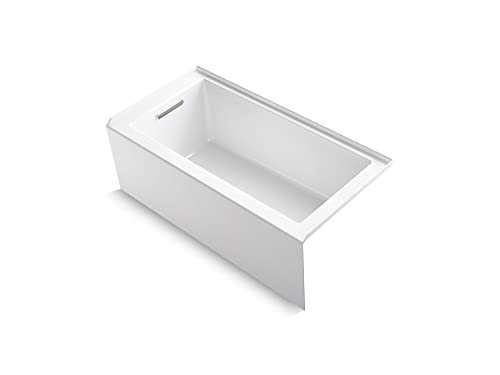
Kohler Underscore 60 x 30 Alcove Bath — Best soak in the size
Kohler designed the Underscore to answer an accusation: that alcove tubs cannot really soak. Its basin answers with geometry — a moulded lumbar curve that supports the lower back at a reclined angle, a long flat floor, and depth used where the body actually lies rather than wasted at the ends. In the shallow class it is the tub most likely to make a deep-soak sceptic concede that shaping can substitute for inches, at least most nights of the week.
The install story is properly Kohler: integral apron, integral flange, and a left-hand drain on this variant, with the mirror configuration existing in the same family. The flange matters more than its unassuming name suggests — it is the upturned lip that tucks behind your wall finish so shower water running down the wall lands in the tub instead of inside it — and its presence marks the difference between a replacement tub and a remodel-grade one.
Daily life in the Underscore is quietly luxurious. The reinforced acrylic feels planted, the basin rinses clean without ledges for grime to colonise, and the shower-over-tub routine it will mostly serve benefits from the broad, stable floor. If your alcove is fixed and your standards are not, this is the pick that respects both facts.
There is a small daily pleasure in the Underscore that spec sheets omit: the armrests. Kohler’s shaping gives the bather’s arms a natural shelf, which keeps a book, a phone, or a cup of tea out of the water and ends the one-handed balancing act that shallower-shaped rivals impose. It is the kind of detail that sounds like garnish until the first long bath, after which it reads as the entire point of buying a shaped basin rather than a rectangular one.
- Footprint: 60 by 30 inch alcove, integral apron
- Drain: left-hand on this variant
- Basin: lumbar-support shaping, long flat floor
- Flange: integral, for watertight wall junctions
- Material: reinforced acrylic
Strengths
- Best reclining comfort in the footprint
- Remodel-grade apron and flange details
- Strong brand support and documentation
Trade-offs
- Drain assembly commonly sold separately
- Premium tier within the alcove class
- Still a shallow soak by the numbers
Best for: alcove owners who refuse to surrender the soak. Not suited for: chin-deep immersion devotees.

American Standard Studio Integral Apron Bathtub — Best modern default
Every size class needs a default: the tub a sensible remodeler buys when the goal is a clean, correct bathroom without a research project. In this footprint that tub is the Studio. American Standard draws it with a smooth integral apron, a tidy rectangular basin, and proportions that sit comfortably in both traditional and contemporary rooms — a chameleon in the best sense, since an alcove tub should serve the room rather than star in it.
The acrylic construction keeps the Studio light for a two-person set and warm underfoot on winter mornings, and its surface care is the forgiving modern routine: soft cloth, mild cleaner, polish if life ever marks it. This variant carries the right-hand drain, and its documentation follows the brand’s usual thorough standard, which your plumber will appreciate more than any styling flourish.
Where the Studio wins its seat is the absence of drama across a decade of use. It does not ask for special cleaners, unusual parts, or a learning curve; it simply becomes the bathroom’s reliable basin for showers, baths, and everything between. Households renovating to sell, to rent, or to stop thinking about bathrooms for fifteen years should start their comparison here and make rivals argue their way past it.
The Studio also deserves credit for how it behaves at the edges of the market. Its dimensions are honestly standard — no surprise width, no proprietary drain position — so future parts, trims, and even a like-for-like replacement in twenty years follow ordinary channels. In a category where a remodel’s success is measured in decades of not thinking about it, that ordinariness is a designed feature, and experienced renovators recognise it on sight.
- Install: alcove with integral apron, 60 by 30 inches
- Drain: right-hand on this variant
- Material: acrylic, smooth contemporary profile
- Care: mild cleaners, polish-repairable surface
- Role: the low-drama default of the size class
Strengths
- Clean design that suits most rooms
- Light, warm, and easy to maintain
- Dependable brand documentation and parts
Trade-offs
- Basin shaping is plain next to the Underscore
- Acrylic surface dislikes abrasive cleaning
- Soaking depth is family-standard, not spa-deep
Best for: set-and-forget remodels, rentals, and resale prep. Not suited for: bathers shopping primarily for a deep recline.

PROFLO Folsom Enameled Steel Bathtub — Best enamelled value
The Folsom is the working tub of this guide: porcelain enamel fused over a steel shell, sized exactly 60 by 30 for a three-wall alcove, and built by a brand that sells to the people who install tubs for a living. Steel gives it the lightest carry of any pick here and a price tier, in plain words, at the friendly end of the enamel family — while the bathing surface itself is genuine glass, hard and glossy and indifferent to bath dyes.
Its character in use follows from the material. The basin feels firm and rings faintly brighter than heavier tubs when the shower runs; the enamel wipes bright with ordinary cleaners; and the shallower thermal mass means the shell warms quickly under the first fill. For the showers and family baths that dominate real schedules, the Folsom’s compromises barely surface, and its virtues — price, weight, durability of surface — surface daily.
This variant is the left-side drain model. Contractors favour tubs like this for a reason beyond price: dimensional consistency. When a remodel must proceed on a schedule, a tub that arrives exactly as specified, sets level without argument, and seals cleanly is worth more than a diva with better photographs, and the Folsom has built its trade reputation on precisely that reliability.
Owners refinishing a bathroom on a schedule develop a particular affection for the Folsom’s weight. It travels up stairs without a crew, waits in a hallway without blocking it, and can be repositioned during the dry fit by the same two hands that will set it permanently. Every remodel has a day when the plan changes at noon; a tub that can be moved by its installers rather than by a rigging team makes that day cheaper.
- Footprint: 60 by 30 inches, three-wall alcove
- Surface: porcelain enamel over steel
- Drain: left-side on this variant
- Weight: lightest pick in this guide
- Channel: professional brand, trade documentation
Strengths
- True enamel surface at a value tier
- Easy handling and predictable install
- Hard, stain-resistant bathing surface
Trade-offs
- Enamel can chip if struck hard
- Livelier acoustics than heavyweight tubs
- Plain, utilitarian styling
Best for: value-led remodels, rentals, and working family baths. Not suited for: design-led suites chasing a sculptural basin.
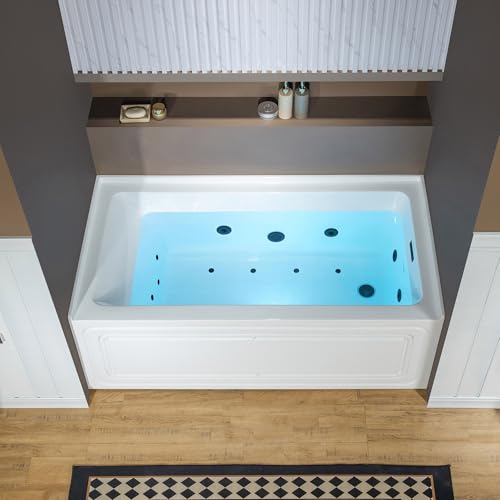
WOODBRIDGE 60 x 30 Alcove Whirlpool and Air Tub — Best spa upgrade
Nothing about this tub’s outline betrays its secret: it occupies the same 60 by 30 alcove, at the same family-friendly height class, as the plain tubs above — and inside it carries both a whirlpool system and an air bath, with heated soaking to hold the water at temperature while they work. It is the answer for the household that wants this exact footprint to behave, on demand, like a spa.
The dual systems divide the week gracefully. Weekday showers pass over silent machinery; a sore back gets the whirlpool’s directed pressure; a quiet evening gets the air system’s all-over fizz. The matte black trim and drain kit arrive included, in the contemporary finish, and the right-drain layout matches the most common alcove rough-in — though, as with every pick here, your own drain side must be confirmed before ordering, not after delivery.
The honest costs are electrical and procedural: a dedicated protected circuit, an access route for the pump and blower, and the discipline of the purge and cleaning cycles. Households willing to pay those costs get the most capable tub in this guide by a wide margin; households that would rather never think about their tub again should take the Studio and be happy. Both decisions are respectable — they are simply different households.
One more consideration tips many buyers: resale theatre. A jetted alcove tub in the hall bathroom photographs as luxury in a listing and surprises buyers pleasantly at viewings, because it upgrades a room they expected to be ordinary. If the house may be sold within the tub’s first decade, the WOODBRIDGE’s extra install cost often returns as perceived value far beyond a plain swap — provided the systems are maintained well enough to demonstrate proudly.
- Format: alcove, 60 by 30 inches
- Systems: whirlpool jets plus air bath, heated soaking
- Drain: right-hand, matte black trim and kit included
- Material: white acrylic
- Install: dedicated circuit and service access required
Strengths
- Full spa capability inside the standard footprint
- Heated water for genuinely long soaks
- Trim and drain kit included
Trade-offs
- Most complex and costly install here
- Systems require routine cleaning cycles
- Shallow basin remains shallow, jets or not
Best for: spa-minded alcove remodels with an electrician booked. Not suited for: anyone avoiding electrical work or maintenance routines.
Legacy-Brand Shallow Alcove Soakers — Dealer route
The famous plumbing names all catalogue a 60 by 30 alcove tub in this height class, often with the most refined basin shaping in the business — and they sell them the way they have for decades, through showrooms and plumbing merchants. Listings for these models flicker in and out of online availability with regional stock, so this seat is prose-only: a direction to travel, not a link to click.
What the dealer route returns for its premium tier is fit and finish you can inspect in person, basin shapes refined over product generations, and a seller who will stand in your bathroom, measure your alcove, and own the outcome. For a primary bathroom in a long-held house, that service is frequently worth more than the online saving, and the tubs themselves — enamelled or premium acrylic depending on the line — are as good as this size class gets.
Take this route when the remodel is already professionally managed, or when you have sat in the linked picks and found their shaping almost right. The dealer’s showroom is where “almost” gets resolved, with your own back as the measuring instrument.
Dealer tubs also tend to carry the strongest enamel and finish warranties in the class, administered by a business with a local address. In a purchase measured in decades, that address matters: the showroom that sold the tub will still be answering its phone when a trim piece needs replacing in year nine, and that continuity is a material part of what the premium tier buys.
Best for: professionally managed remodels and shape-picky bathers. Not suited for: midnight online ordering on a deadline.
Low-Rim Builder Tubs Through Trade Counters — Prose-only basics
The last seat belongs to the plainest citizens of the size class: the low-rim alcove tubs stocked by plumbing-supply counters for builders, landlords, and remodelers who need a correct 60 by 30 by 14-class tub without ceremony. They are bought by part number, delivered with the rest of the job’s materials, and chosen from specification sheets rather than lifestyle photography — which is why no stable consumer listing exists for us to link, and why this discussion is prose-only.
Their virtues are the contractor’s virtues: consistent dimensions, honest materials at the budget tier, and availability in quantity on a schedule. A housing provider replacing forty tubs across a portfolio does not need forty moments of delight; it needs one correct tub, forty times, and the trade counter is where that tub lives.
For a single home bathroom, this route makes sense when a trusted contractor is already sourcing the job, and it makes little sense as a solo expedition. The linked Folsom covers much of the same honest ground with the convenience of an actual listing, and it is where we would send most readers wearing this particular hat.
There is also a quiet sustainability argument at this counter. Builder tubs are stocked regionally, travel short distances, and are specified in repairable materials more often than their price suggests, because contractors dislike callbacks more than they dislike spending. A tub chosen by someone whose business depends on never hearing about it again is, on the evidence, a tub chosen well.
Homeowners can borrow the contractor’s test directly: ask of any finalist, “would the person installing this choose it for a house they had to warrant?” The hesitation or confidence in the answer is data, and in this size class — where products differ more in honesty than in concept — it is often the most useful data available.
Best for: contractor-sourced basics and multi-unit work. Not suited for: solo shoppers who want to browse and compare online.
What Does a Shallow Tub Do to Water, Heat and Time?
The shallow class is the quiet economist of the bathtub world. A fill that stops at ten inches instead of sixteen uses a substantial fraction less water, and every gallon not drawn is a gallon not heated, not held, and not paid for twice. In a household bathing children nightly, that difference compounds into the kind of utility saving that never appears in the tub’s price comparison but absolutely appears in the year’s bills.
There is a comfort footnote to the economics: shallow water cools at roughly the same rate as deep water, but it also reheats faster with a small hot top-up, so the long bather in a shallow tub spends less of the soak managing temperature than folklore suggests. The deep tub’s advantage is real but narrower than its reputation, and it belongs mostly to the first twenty minutes.
Time follows the same arithmetic. A shallow tub is ready while a deep soaker is still filling, which changes behaviour more than efficiency tables suggest: baths become spontaneous again. The parent who would not run a twenty-minute fill for a ten-minute toddler bath will run a seven-minute one, and the adult who treats a bath as a reward for finishing chores actually collects it. Appliances that get used are the only ones worth their footprint, and shallow tubs get used.
Water heaters notice the difference too. A modest tank that sulks at a deep freestanding fill handles the shallow alcove class without complaint, which means this size often avoids the hidden heater upgrade that ambushes bigger remodels. When a project budget is fixed, choosing the 14-inch class can be the decision that keeps the entire renovation inside it.
How Do Materials Behave Differently at This Size?
Shallow tubs live harder lives than deep soakers, because most of their hours are spent as shower bases: stood in, scrubbed often, and treated as flooring with a drain. That duty profile rearranges the material rankings. Acrylic’s warmth and repairability shine under daily traffic, and its one weakness — a tendency to flex in cheap, under-supported shells — is a construction question rather than a material verdict, answered by insisting on proper bedding at installation.
Enamelled steel answers the same duty with hardness. Its glass surface shrugs off the scouring enthusiasm of rental turnovers and family cleaning days, and its light weight makes it the easiest tub in this guide to install correctly — which matters, because correct installation is where shallow tubs succeed or fail. Its chip discipline is the standing caveat, and households that bathe dogs with metal leads or renovate around dropped tools should weigh it honestly.
The jetted acrylic of the WOODBRIDGE adds a third behaviour: a shallow basin that must also be a machine room. Its shell carries ports, lines, and machinery the plain tubs never dream of, and its long-term happiness depends on the unglamorous cycles — purges, flushes, filter habits — that this guide keeps mentioning because owners keep underestimating them. Bought by a household that enjoys machinery, it is the most fun per inch in the class; bought by one that does not, it is a plain tub with homework.
How Do the Six Compare at a Glance?
| Pick | Material | Character | Best quality | Watch out for |
|---|---|---|---|---|
| Kohler Underscore 60 x 30 Alcove Bath | Acrylic | Shaped soaker | Recline and lumbar comfort | Drain often separate |
| American Standard Studio Integral Apron Bathtub | Acrylic | Modern default | Clean looks, easy ownership | Plain basin shaping |
| PROFLO Folsom Enameled Steel Bathtub | Enamelled steel | Trade workhorse | Enamel surface, light weight | Chip care, brighter acoustics |
| WOODBRIDGE 60 x 30 Alcove Whirlpool and Air Tub | Acrylic, jetted | Spa appliance | Both jet systems, heated | Electrical work, upkeep cycles |
| Legacy-Brand Shallow Alcove Soakers | Enamel or acrylic | Dealer flagship | Refined shaping, service | Premium tier, showroom buying |
| Low-Rim Builder Tubs Through Trade Counters | Steel or acrylic | Contractor basic | Consistency and availability | No consumer listings |
Read down the character column and the guide’s argument makes itself: this humble size class contains a shaped soaker, a default, a workhorse, an appliance, a flagship, and a commodity. The dimensions are identical; everything that matters happens inside them.
If the table leaves you torn between the Underscore and the Studio, the tiebreaker is your back: bathers who soak weekly should pay for shaping, while households that shower daily and bathe monthly will never collect the Underscore’s advantage often enough to notice its absence. The Folsom enters when enamel or budget speaks loudest, and the WOODBRIDGE when the word “spa” has been said aloud in the house more than twice.
What Do Landlords and Sellers See in This Size Class?
Property professionals have a settled opinion about the 60 by 30 footprint, and it is affectionate. This is the tub that fits every replacement scenario they manage: it photographs as a proper bath, functions as the shower base tenants actually use, and can be sourced, delivered, and installed inside a single vacancy window. A portfolio manager’s ideal fixture is one that never generates a story, and this size class has built a decades-long career on exactly that.
Sellers hear the same logic from the other side of the transaction. A fresh, correct alcove tub in the hall bathroom signals a maintained house more loudly than a dramatic freestanding piece in the same room, because buyers read it as evidence about the plumbing they cannot see. The jetted WOODBRIDGE adds a flourish to that signal; the Studio and Folsom deliver it at the plain, persuasive tier; and the Underscore quietly upgrades the one room every buyer inspects with their shoes off.
None of this argues against buying for your own pleasure — it argues that in this size class, pleasure and prudence happen to coincide. The tub that serves your children tonight is the tub the next family will thank you for, and few renovation decisions anywhere in the house can say as much.
How Do Children, Grandparents and Dogs Vote on This Size?
Ask the household members who never read buying guides and their verdict is unanimous. Children climb a 14-inch rim without a hoist or a stool, sit in water deep enough to sail boats in and shallow enough for a parent to feel calm about, and exit without the full-body lift that taller tubs demand from a kneeling adult’s back. Bath night in a shallow tub is simply a shorter, drier production for the grown-up running it.
Grandparents vote with their knees. The step into this class is the lowest in the alcove world, the broad floor is the steadiest, and a grab bar added at remodel time completes a bathing arrangement that respects independence rather than threatening it. Physical therapists, consulted in spirit, would add that the shallow basin’s easier exit matters even more than its easier entry — nobody has ever been stranded by a low rim.
And the dog, bathed under protest in every household, is easier to lift, hold, and rinse at this height than over any taller wall. It is a frivolous criterion until the first muddy spring, after which it becomes, in many houses, the deciding one. A size class that serves the toddler, the grandparent, and the spaniel with the same rim has earned its popularity honestly.
How Do You Install a Shallow Alcove Tub Without Regrets?
Begin before demolition, with the drain. Photograph the existing tub’s drain side, measure the alcove stud to stud, and confirm the floor’s condition while the old tub is still a rumour. Replacement projects go wrong at this stage more than any other, usually because an assumption about handedness or width meets a wall that disagrees.
Set the new tub on a level, continuous support — a mortar bed or the manufacturer’s specified alternative — because a shallow basin used daily as a shower base will announce any flex as a creak within the year. Connect the drain and overflow, test-fill the tub before the walls close, and let it sit full while you inspect every joint from below or behind. Water is the only honest inspector a plumbing job ever gets.
One sequencing note separates smooth shallow-tub projects from ragged ones: the tub goes in before the wall finish, the wall finish before the fixtures, and the fixtures before anyone is allowed to declare the bathroom finished. Shallow alcove work tempts households to rush because the format is familiar, but the order of operations is the entire craft — respect it, and the simplest tub in this guide installs like it too.
Finish with the junctions: the integral flange behind the wall finish, the apron sealed at the floor, and silicone left undisturbed to cure for the full period the tube of sealant demands. Then run the shower for ten minutes and check again. A shallow alcove tub installed with this patience becomes the least interesting object in the house for fifteen years, which is the highest praise plumbing can earn.
While the walls are open, two small investments pay outsized rent: blocking for a future grab bar, placed where a hand naturally reaches during exit, and a shower valve upgrade, since the wall will not open again in this tub’s lifetime if the job is done right. Neither appears in the tub’s price, and both belong in its budget, because an alcove remodel is a once-a-generation chance to fix everything the tile has been hiding.
How Do You Keep a Shallow Tub Looking New?
Shallow tubs earn a particular kind of grime: because they work as shower bases, their floors collect the full traffic of the household — soap film, hard-water spotting, the faint grey of a thousand rinsed shampoos. The defence is rhythm rather than force. A squeegee or cloth pass after showers, taking ten seconds, prevents the build-up that otherwise demands a scrubbing afternoon, and a weekly wipe with a mild cleaner keeps the basin’s finish ahead of the water’s chemistry.
Match the effort to the material, as this guide has advised in every category. Acrylic wants non-abrasive everything and rewards it by staying glossy; enamelled steel tolerates a little more enthusiasm but should still never meet a scouring powder; the jetted WOODBRIDGE adds its own calendar of purges and flushes, which belong on the same weekly rhythm so none of them is ever a special occasion. Mats deserve a word too: a suction mat left permanently in place traps moisture against any surface, so lift it, rinse it, and let both it and the basin dry.
The seals are the tub’s true ageing point. Silicone at the apron and wall junctions works silently for years and then, in a single season, does not; inspect it each autumn, and renew any bead that has blackened, lifted, or cracked. Fifteen minutes with a sealant gun preserves the wall behind the tub, which is the one part of this installation nobody wants to meet again.
Overflow and drain trim deserve the same annual glance. They are the basin’s only moving-adjacent parts, they collect the residue that makes a clean tub look tired, and a wipe with the weekly cleaning keeps them bright enough that guests assume the whole bathroom is newer than it is — a small vanity, freely available to anyone with a cloth.
What Mistakes Do Buyers of This Size Keep Making?
The signature mistake is reading “14 inches deep” as a promise about water. Buyers who expect fourteen inches of soak meet the overflow at ten and feel cheated by arithmetic they were never shown; this guide has shown it, so choose with the real number in mind. The second mistake is its mirror image: dismissing the whole class as a paddling pool, when a shaped basin like the Underscore’s delivers a bath most households find entirely satisfying.
A related error is ordering by the old tub’s measurements instead of the alcove’s. The outgoing tub may itself have been a compromise squeezed into place by a previous remodel, and copying its dimensions inherits the squeeze. Measure the space, then the catalogue, in that order, every time.
Drain handing remains the alcove remodel’s reliable ambush — left and right are judged facing the apron, and a mirrored order means plumbing changes or a return. Third, shoppers forget the shower: most of these tubs will host a thousand showers for every fifty baths, so the basin floor’s stability and the wall junction’s waterproofing deserve more scrutiny than the brochure’s soaking photograph. Finally, jetted ambitions sometimes arrive without an electrician; the WOODBRIDGE’s systems are wonderful, and they are not optional about their circuit.
Final Recommendation
For most alcoves in this size, buy the Underscore and enjoy the best-shaped shallow soak in the business; buy the Studio when the project values calm over character, the Folsom when enamel and economy must share a sentence, and the WOODBRIDGE when the alcove is secretly a spa waiting for its circuit. The dealer and trade routes serve their households honourably in prose. Judge the fourteen inches for what it truly is — a gentler climb, a faster fill, a safer bath — and this unassuming size class will repay you every single morning, at the exact moment a taller rim would have asked your knees for an argument.
A closing word on confidence: this is the most standardised corner of the entire bathtub market, which means almost any competent installer has set a dozen of these and any plumbing counter stocks their parts. Buying inside the standard is not settling — it is choosing the deepest bench of experience, supply, and spare parts in the industry, and standing, quite literally, on the firmest floor available.
Frequently Asked Questions
Is a 14-inch tub too shallow for adults?
For soaking to the chin, yes; for the way most adults actually bathe — reclined, water over legs and hips, shoulders out — it is comfortable, especially in a shaped basin. Adults who bathe primarily to unwind rather than submerge rarely miss the extra inches, and many prefer the easier climb.
Tall adults should test with particular honesty, though: at this length and depth, a long frame folds rather than stretches, and a household of tall bathers may be happier treating the hall bath as the shower room and putting any deep tub elsewhere. The size class is a compromise, proudly made, and compromises fit some households better than others.
How much water does a 60 x 30 x 14 tub hold?
To the overflow, this class typically holds a few dozen gallons — noticeably less than deep soakers of the same footprint. Think in terms of baths per tank: a household heater that manages one deep fill and a prayer will usually manage the shallow fill, a second bath for a child, and the evening’s washing-up besides. The practical consequences are pleasant: faster fills, lower hot-water demand, and a bath that is ready before your patience runs out.
Can a shallow tub work well as a shower base?
It is arguably the best alcove format for it. The arrangement asks only for a sound flange seal and a curtain or screen with enough drop to respect the lower rim; everything else about showering over a shallow tub is easier than over its taller rivals, from stepping in with shampoo in hand to cleaning the walls afterwards. The low rim eases entry, the broad flat floor stands stable, and the apron and flange system is designed for exactly this double duty. Most alcove tubs live this life; the shallow class simply admits it proudly.
Why do listings disagree about what the 14 inches measures?
Because some quote overall height and a few quote water depth, and the two numbers differ by the overflow’s margin. Always look for the manufacturer’s “water depth to overflow” figure in the specification sheet; that is the number your bath will actually experience.
Is enamelled steel durable enough for a family bathroom?
Yes — its porcelain surface is the same glass used on far heavier tubs, and it resists stains and scratches admirably. Its discipline is impact: a hard strike can chip enamel, and chips should be sealed promptly. In ordinary family service, these tubs last for decades.
Does the jetted WOODBRIDGE fit the same alcove as the plain tubs?
Dimensionally, yes: it is a true 60 by 30 alcove model. The differences are behind the walls — a dedicated electrical circuit, access for its pump and blower, and the same careful waterproofing as any alcove install. Plan those, and the swap is footprint-for-footprint.
Can I put a shower over a 14-inch tub?
Absolutely — it is the arrangement this class was designed for. The low rim makes stepping in and out under the shower safer, the apron and flange manage the water, and a curtain or door contains the spray. Most of these tubs will spend most of their lives doing exactly this job.
Related Guides
Size is one lens; material is another — compare this footprint’s options in Best Acrylic Bathtubs, keep the wider bathroom honest with Best Bathroom Sinks by Verified Ratings, and, when the indoor projects are done, take the measuring tape outside to Best Stick Vacuums and Best Adjustable Vacuums for the rest of the house.


