What's inside
- Key Takeaways
- Quick Picks
- How Did We Organise a Category With Two Meanings?
- Deck Ovens at a Glance: Family, Supply, and Stated Size
- Why Does the Stone Deck Bake Pizza Differently?
- What Electrical Questions Must Be Settled Before Ordering?
- How Do You Run a Two-Deck Service Without Chaos?
- What Does Installation Day Actually Involve?
- Which Buying Mistakes Cost Commercial Operators the Most?
- How Should You Maintain Stones, Decks, and Cavities?
- What Does Deck Capacity Really Mean for a Menu?
- How Do Running Costs Compare Across the Six?
- Final Recommendation
- What Workflow Changes When a Kitchen Adds Its First Deck?
- How Should You Evaluate a Listing Like a Trade Buyer?
- What About Ventilation, Clearance, and the Inspector?
- Frequently Asked Questions
- How Do You Train Staff on a New Deck?
- What Happens During the First Week With a New Deck?
- Why Do Some Operations Choose Two Single Decks Over One Double?
- How Do the Two CROSSON Models Compare With the Two Countertop Kratos Models?
- What Is the Resale and Longevity Picture for Commercial Decks?
- Related Guides
As an Amazon Associate I earn from qualifying purchases. This post may contain affiliate links at no extra cost to you.
cottageverdict.com is reader-supported. When you buy through links on our site, we may earn an affiliate commission.
Where to buy: Every oven below is sold through its Amazon listing — use the links in the Quick Picks table and in each review to check price on Amazon, and verify the electrical specification on the listing with your electrician before any commercial oven is ordered.
Shopping for the best commercial deck ovens begins with a naming tangle that this guide will untangle in the first paragraph, because money is wasted when it is not. The words “deck oven” in current listings cover two genuinely different families. The first family is the countertop stone-deck oven: a compact electric box, one or two decks lined with a pizza stone, built for pizzas and bakery work on a counter — four of the six picks live here. The second family is the full-size single-deck convection oven: a floor-standing commercial range-oven whose “single deck” describes one large convection cavity, not a stone at all — the Kratos 29Y-057 is this guide’s clear example, and the TECHTONGDA triple-deck convection unit on wheels belongs to the same convection branch of the family tree. Neither family is misnamed exactly; the trade uses “deck” for both a stone shelf and a cavity level, and listings inherit the ambiguity. What matters is that you know which machine you are actually buying, so this guide groups the picks by family, states the distinction wherever a model is discussed, and reports voltage, wattage, and phase strictly as each title states them — 1-phase and 3-phase machines both appear below, and confusing them is an installation-day disaster that costs real money.
Key Takeaways
- “Deck oven” listings split into countertop stone-deck pizza and bakery ovens, and full-size single-deck convection ovens — this guide groups the picks that way.
- Electrical facts come only from the titles: the pool spans 120V and 240V, and both 1-phase and three-phase machines appear.
- The Kratos countertop pair cooks 18-inch diameter pizzas per their titles, in single-deck 120V and double-deck 240V forms.
- The CROSSON pair states its stones directly: a pizza stone in the 16-inch, and a 15mm thick pizza stone in the 18-inch.
- The TECHTONGDA is a triple-deck convection oven on universal wheels, stated at three-phase 220V and 19800 watts — a different species from the countertop stone decks.
- No deck temperature is claimed anywhere in this guide, because no title in the pool states one.
Quick Picks
| Deck oven | Badge | Why it is shortlisted |
|---|---|---|
| CROSSON Double Deck Countertop Pizza Oven (16 Inch) | Stone Deck, 120V | An ETL listed double deck 16 inch countertop oven with pizza stone, stated at 120V/3600W for restaurant use. |
| CROSSON Double Deck Countertop Pizza Oven (18 Inch) | Stone Deck, 240V | The 18 inch double deck with a 15mm thick pizza stone, stated at 240V/4500W and for commercial use only. |
| Kratos Double-Deck Countertop Pizza and Bakery Oven (29M-063) | Double-Deck Bakery | A double-deck countertop pizza and bakery oven that cooks 18-inch diameter pizzas, stated at 240V, 3200W. |
| Kratos Single-Deck Countertop Pizza and Bakery Oven (29M-062) | Single-Deck Starter | The single-deck sibling that also cooks 18-inch diameter pizzas, stated at 120V, 1700W. |
| TECHTONGDA Triple Deck Pizza Oven | Triple-Deck Convection | A stainless triple deck convection oven on universal wheels, stated at three-phase 220V and 19800 watts. |
| Kratos Single Deck Full Size Electric Convection Oven (29Y-057) | Full-Size Convection | The naming lesson in one machine: a single deck full size electric convection oven, stated at 240V, 1 Phase. |
How Did We Organise a Category With Two Meanings?
We verified the listings first — six machines, each matched to its maker’s title and image — and then refused to rank them as if they were one kind of thing. Instead, the guide is organised as two shortlists sharing a page. The stone-deck shortlist holds the four countertop machines: two CROSSON double decks and the two Kratos countertop ovens, all of them stone-or-deck pizza and bakery boxes in the classic mould. The full-size shortlist holds the TECHTONGDA triple-deck convection oven on wheels and the Kratos 29Y-057 single-deck full-size convection oven, machines that belong in a kitchen line, on the floor, doing convection work at commercial scale. Within each shortlist, the stated electrical facts do the ranking work an operator actually needs: voltage first, because it decides whether the machine can even be plugged into your building; wattage second, because it frames the circuit and the running cost; phase third, because three-phase supply is a different building conversation from single-phase. Pizza capacity, where a title states it — the Kratos pair’s 18-inch diameter — is reported in the maker’s own terms. Deck temperatures are nowhere stated in this pool’s titles, so this guide states none, and any seller conversation about temperature should happen on the listing and in the manual, not in a review’s imagination. Operators comparing high-throughput formats often also study Best Conveyor Pizza Ovens, the other commercial pizza architecture, and the deck-versus-conveyor decision is the real fork in this corner of the catalogue.
The stone-deck countertop family — the next four picks.

CROSSON Double Deck Countertop Pizza Oven (16 Inch) — Stone Deck, 120V
The smaller CROSSON opens the stone-deck family with a useful combination: an ETL listed commercial double deck 16 inch countertop electric pizza oven with a pizza stone, described as multipurpose and for restaurant use, stated at 120V/3600W. The ETL listing matters in commercial purchasing, because health and fire inspectors, landlords, and insurers all read certification marks, and an ETL listed machine arrives with that conversation half-won. Two decks at sixteen inches is the classic small-pizzeria and café configuration — one deck finishing while the other starts, pies rotating through a lunch service without a floor oven’s footprint or price of entry.
The electrical line deserves a careful read: 120V is the household-style supply, which widens where this machine can be installed, while 3600W at that voltage implies a serious dedicated circuit — a combination an electrician should confirm before the machine ships, not after. That is not a flaw; it is the physics of moving real deck heat on a 120V supply, and the title’s honesty in stating both figures is exactly what an operator needs. Multipurpose, in the title, points at the bakery side of the deck: flatbreads, reheats, and par-baked goods all live comfortably on a stone. For a café, food truck commissary, or small restaurant adding pizza to an existing menu, this is the stone-deck entry point of the guide.
Operationally, the sixteen-inch format has a menu consequence worth planning: it suits the personal-to-medium pie programme — lunch specials, café pizzas, bar pies — rather than the eighteen-inch family-pie trade. Operations that know their ticket is built on smaller pies will find the two decks generous; operations whose signature is a shareable large pie should start at the eighteen-inch models and not look back. Matching deck diameter to the menu’s actual centre of gravity is the cheapest performance upgrade in this entire category, because it costs nothing but honesty at the ordering stage.
- Family: countertop stone-deck pizza oven, double deck, 16 inch
- Certification per title: ETL listed
- Stated electrical: 120V/3600W per the listing title
- Deck: pizza stone per the title
- Where to buy: the CROSSON Double Deck Countertop Pizza Oven (16 Inch) listing on Amazon — check price on Amazon
Strengths
- ETL listing eases inspector and insurer conversations.
- Two decks suit a small service’s rhythm.
- 120V supply widens installation options, with an electrician’s confirmation.
Trade-offs
- Sixteen-inch decks cap the pie size below the Kratos pair’s stated 18 inches.
- High wattage on 120V demands a properly planned circuit.
- Countertop format still claims serious counter and clearance.
Best for: cafés and small restaurants adding stone-deck pizza on a 120V supply. Not suited for: operations built around eighteen-inch pies.
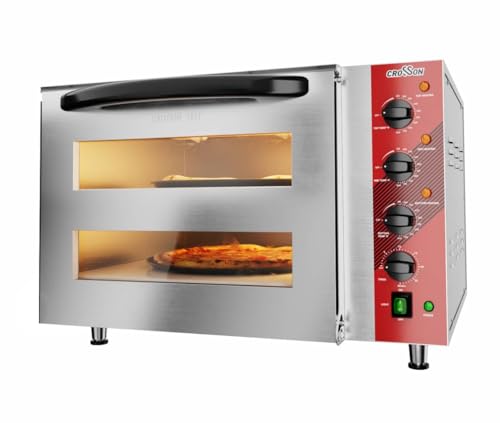
CROSSON Double Deck Countertop Pizza Oven (18 Inch) — Stone Deck, 240V
The larger CROSSON steps the same formula up: a commercial double deck 18 inch countertop electric pizza oven with a 15mm thick pizza stone, for indoor pizza bakery use, stated for commercial use only, at 240V/4500W. Two details separate it from its sibling. The first is the stone itself — 15mm thick, stated in the title, and thickness is not a vanity figure on a deck: a thicker stone stores more heat, recovers faster between pies, and irons out the temperature sag that a busy service inflicts on a thin deck. The second is the electrical step to 240V and 4500W, which is the conventional commercial route to that recovery — more power, delivered on the supply commercial kitchens are wired for.
The phrase “commercial use only” in its title should be taken at face value: this machine is specified, warranted, and priced as trade equipment, and a home buyer seduced by the stone should understand they are outside its intended brief. Eighteen inches matches the Kratos pair’s stated pie diameter, so the choice between this CROSSON and the Kratos double deck comes down to the stone specification, the stated wattage — 4500W here against 3200W there — and the terms on each listing. For a small pizzeria whose entire reputation rides on deck recovery during the Friday rush, the thicker stone and the larger power figure make this the stone-deck pick to beat.
The stone figure invites one more layer of thinking. Heat recovery is really a conversation about the rush: any deck bakes its first pie beautifully, because the stone starts full of stored heat. The question is the eighth pie, after seven cold doughs have drawn on the store. Thickness and wattage are the two levers that answer it, and this CROSSON pulls both — the thickest stated stone and the highest stated countertop wattage in the guide. An operator whose rush is real should weight those two numbers heavily; an operator whose service is a gentle all-day trickle can honestly save the difference and buy the steadier Kratos.
- Family: countertop stone-deck pizza oven, double deck, 18 Inch
- Deck: 15mm thick pizza stone per the listing title
- Stated electrical: 240V/4500W per the title; commercial use only
- Where to buy: the CROSSON Double Deck Countertop Pizza Oven (18 Inch) listing on Amazon — check price on Amazon
Strengths
- Thick stated stone favours heat recovery across a service.
- Eighteen-inch decks match the largest stated pie size here.
- 240V/4500W is a conventionally commercial power package.
Trade-offs
- Commercial-only framing excludes home installations by design.
- 240V supply must exist or be installed.
- Heavier commitment than the 120V sibling for a first deck.
Best for: small pizzerias and serious bakeries on a 240V supply. A poor fit for: home pizza enthusiasts, whom the listing itself excludes.

Kratos Double-Deck Countertop Pizza and Bakery Oven (29M-063) — Double-Deck Bakery
Kratos is a commercial-kitchen brand, and the 29M-063 presents itself in trade language: a commercial oven, double-deck countertop electric pizza and bakery oven, stainless steel, cooking 18-inch diameter pizzas, stated at 240V, 3200W. The pizza-and-bakery double naming is the pick’s identity — this is the deck for an operation whose day spans morning bakery work and evening pizza service, where the same decks that proof-bake rolls at dawn finish pies at dusk. Stainless construction, stated in the title, is the commercial default for a reason: it wipes down, it resists the kitchen’s atmosphere, and it reads correctly to every inspector who walks the line.
Its stated 3200W on 240V is the gentlest power figure among the double decks here, which frames the machine as the efficiency-minded double deck — less peak draw than the 4500W CROSSON, in exchange for recovery behaviour the buyer should weigh against their service volume. The model number, 29M-063, is worth using in every conversation with the seller and your electrician, because the Kratos countertop family includes the single-deck sibling below and the full-size convection machine further down, and precision about which Kratos you mean prevents expensive misunderstandings. For a bakery-café hybrid operation, this is arguably the most naturally matched pick in the guide.
The bakery half of its brief changes the daily texture of ownership: a pure pizza deck sits idle until the evening trade, while a pizza-and-bakery deck can earn from the morning — rolls, flatbreads, par-baked goods, reheated pastries — and idle equipment is the silent killer of small food businesses. When you cost the 29M-063, cost it across both services, because that is how its owners will actually use it. The same logic explains why its wattage can be gentler: bakery work and a blended service reward steadiness across a long day more than the violent recovery a pure pizza rush demands.
- Family: countertop deck pizza and bakery oven, double-deck, model 29M-063
- Stated capacity: cooks 18″ diameter pizzas per the listing title
- Stated electrical: 240V, 3200W per the title
- Construction: stainless steel per the title
- Where to buy: the Kratos Double-Deck Countertop Pizza and Bakery Oven (29M-063) listing on Amazon — check price on Amazon
Strengths
- Pizza-and-bakery brief suits hybrid operations.
- Stated eighteen-inch capacity across two decks.
- Moderate stated wattage among the double decks.
Trade-offs
- Lower stated power than the big CROSSON implies gentler recovery.
- No stone thickness stated in the title.
- Model-number discipline is essential when ordering parts or service.
Best for: bakery-café hybrids running morning bakes and evening pizzas. Not the right match for: maximum-throughput pizza-only services.

Kratos Single-Deck Countertop Pizza and Bakery Oven (29M-062) — Single-Deck Starter
The 29M-062 is the same Kratos idea at the entry scale: a commercial single-deck countertop electric pizza and bakery oven, stainless steel, cooking 18-inch diameter pizzas, stated at 120V, 1700W. Every figure there is a deliberate step down in commitment from its double-deck sibling — one deck instead of two, household-style voltage instead of 240V, and 1700W, a draw that ordinary commercial circuits accommodate without drama. Yet the pie size does not shrink: eighteen inches, the same stated diameter as the double deck, which means a small operation starts with full-size product and adds a second deck later only if the service outgrows the first.
This is the deck for the bar adding a pizza programme, the convenience operation upgrading from a domestic oven, the start-up testing whether pizza belongs on its menu at all. The single deck imposes a rhythm — one pie’s bake is the next pie’s wait — and for low-volume service that rhythm is not a limitation but a description of the day. Stainless construction keeps it in the commercial family for inspection purposes. When volume grows, the upgrade path within this very guide is obvious, and a starter deck that teaches the operation its true pizza volume before the big purchase is money spent in the right order.
There is a discipline the single deck teaches that money cannot buy later: menu honesty. With one deck, an operation learns its true bake times, its true ticket rhythm, and its customers’ true appetite for pizza, because nothing can be hidden inside spare capacity. Operations that start here and grow into a double deck buy the second machine with data; operations that start with the double often buy it with hope. If the business case for pizza is still a hypothesis, the 29M-062 is the cheapest rigorous test of it in this guide, and its gentle electrical appetite means the test can run almost anywhere.
- Family: countertop deck pizza and bakery oven, single-deck, model 29M-062
- Stated capacity: cooks 18″ diameter pizzas per the listing title
- Stated electrical: 120V, 1700W per the title
- Construction: stainless steel per the title
- Where to buy: the Kratos Single-Deck Countertop Pizza and Bakery Oven (29M-062) listing on Amazon — check price on Amazon
Strengths
- Full eighteen-inch pies on a gentle 120V, 1700W supply.
- Lowest-commitment entry to commercial deck baking here.
- Stainless commercial construction at starter scale.
Trade-offs
- One deck means one bake at a time.
- Busy services will outgrow it fastest of the six.
- No stone specification stated in the title.
Best for: bars, cafés, and start-ups proving a pizza programme. Poorly suited to: any service where two pies must bake at once.
The full-size convection family — the final two picks, grouped separately on purpose.

TECHTONGDA Triple Deck Pizza Oven — Triple-Deck Convection
The TECHTONGDA changes the scale of the conversation entirely, and its title says so: a commercial convection oven, stainless steel, electric, triple deck pizza oven with universal wheels, stated at three-phase 220V and 19800 watts, for restaurant kitchen bakery use. Begin with the family correction this guide promised: despite the pizza oven naming, the title itself calls it a convection oven, and its three decks are convection cavities in a floor unit on wheels — not three stone shelves. That makes it a high-capacity convection workstation that includes pizza among its work, movable on its universal wheels for cleaning and kitchen reconfiguration, which in a working line is a genuinely valuable trait.
Then face the electrical figure squarely: 19800 watts on three-phase 220V is industrial supply territory. This machine does not plug into a wall; it is wired into a building’s three-phase service by professionals, and the buyer for it is an operation with that service already present or planned — a production bakery, a commissary, a large restaurant kitchen. Within that world, three convection decks offer parallel production that no countertop can approach. Outside that world, it is simply not a candidate, and this guide’s grouping exists to make that boundary unmistakable before anyone falls in love with the capacity.
The wheels deserve a second thought, because in production kitchens mobility is hygiene: a line that can be pulled out, cleaned behind, and pushed back is a line that actually gets cleaned behind, and inspectors know the difference on sight. Three decks also change staffing — one operator can run staggered production across levels in a way that a single cavity never permits, which in a commissary setting is a labour argument as much as a cooking one. None of that rescues the machine for a buyer without three-phase power, but for the buyer who has it, the TECHTONGDA is not an extravagance; it is infrastructure.
- Family: full-size triple deck convection oven on universal wheels
- Stated electrical: three-phase 220V, 19800Watt per the listing title
- Construction: stainless steel per the title
- Positioning per title: restaurant kitchen bakery
- Where to buy: the TECHTONGDA Triple Deck Pizza Oven listing on Amazon — check price on Amazon
Strengths
- Three convection decks for parallel production.
- Wheels allow cleaning access and line reconfiguration.
- Stainless commercial construction at production scale.
Trade-offs
- Three-phase industrial supply is a hard prerequisite.
- Not a stone-deck oven, despite the pizza naming.
- Far beyond countertop scale, budget, and installation.
Best for: production kitchens with three-phase supply needing parallel convection capacity. A weak match for: anyone seeking a traditional stone deck for pizza alone.

Kratos Single Deck Full Size Electric Convection Oven (29Y-057) — Full-Size Convection
The 29Y-057 is the machine this guide’s introduction warned you about, in the best sense: a Kratos single deck full size electric convection oven, stated at 240V, 1 Phase. There is no stone in this story at all. “Single deck” here means one full-size convection cavity in a floor-standing commercial oven — the standard workhorse configuration of institutional kitchens — and “1 Phase” is its most useful stated fact, because full-size convection on single-phase 240V fits the electrical reality of many smaller commercial buildings that could never host the TECHTONGDA’s three-phase appetite. If your operation needs to roast, bake, and reheat at full pan scale, this is not the wrong oven for this guide; it is the guide’s reminder that deck terminology serves two masters.
Kratos’s trade framing applies: model number 29Y-057, to be used precisely in ordering and service conversations, distinguishing it from the 29M countertop decks above. The honest comparison for this machine is not against the stone decks at all — it is against other full-size convection ovens, judged on cavity, pans, and programme. It closes this guide because a buyer who arrives searching “deck oven” and actually needs this machine deserves to find it recognised and correctly described, rather than forced into a stone-deck purchase that would disappoint everyone.
Consider the buildings this machine quietly serves: school kitchens, church halls, small hotels, cafés with a back room and big ambitions — premises with single-phase service and full-size appetites. For them, the 29Y-057’s stated combination is not a compromise but an exact fit, and its presence in a deck-oven search is a reminder that the best purchasing guides correct the question as often as they answer it. If your real need is trays, pans, roasts, and reheats at scale, this is your pick in this guide, and no apology for the missing stone is required from anyone.
- Family: full-size single-deck electric convection oven, model 29Y-057
- Stated electrical: 240V, 1 Phase per the listing title
- Deck meaning here: one full-size convection cavity — no stone deck
- Where to buy: the Kratos Single Deck Full Size Electric Convection Oven (29Y-057) listing on Amazon — check price on Amazon
Strengths
- Full-size convection capacity for pan-scale production.
- Single-phase 240V suits many smaller commercial buildings.
- Trade brand with precise model identification.
Trade-offs
- Not a stone-deck pizza oven in any sense.
- Floor-standing installation, not a countertop purchase.
- No pizza diameter or deck figures stated in the title.
Best for: institutional and restaurant kitchens needing a full-size convection workhorse. Not suited for: pizza operations seeking stone-deck bake character.
Deck Ovens at a Glance: Family, Supply, and Stated Size
| Machine | Family | Stated electrical | Stated size |
|---|---|---|---|
| CROSSON 16 Inch | Stone deck, countertop | 120V/3600W | Double deck, 16 inch |
| CROSSON 18 Inch | Stone deck, countertop | 240V/4500W | Double deck, 18 inch, 15mm stone |
| Kratos 29M-063 | Deck, countertop | 240V, 3200W | Double-deck, 18-inch pizzas |
| Kratos 29M-062 | Deck, countertop | 120V, 1700W | Single-deck, 18-inch pizzas |
| TECHTONGDA Triple | Convection, floor | Three-phase 220V, 19800W | Triple deck, on wheels |
| Kratos 29Y-057 | Convection, full size | 240V, 1 Phase | Single deck, full size |
Why Does the Stone Deck Bake Pizza Differently?
A stone deck is a thermal battery. The stone absorbs heat while the oven idles and returns it directly into the base of the pie on contact, which is how a deck produces the leopard-spotted, crisp-bottomed crust that defines the style — the bottom cooks by conduction from the stone while the top cooks by the chamber’s radiant and ambient heat. That is also why stone thickness, stated at 15mm for the larger CROSSON, is a working specification rather than a detail: a thicker stone holds more stored heat and sags less when cold dough lands on it in quick succession, so the tenth pie of a rush bakes like the first. Convection ovens, including the two full-size picks here, cook by moving hot air, which is superb for evenness across pans and trays and produces a different crust character — excellent bread and roasts, but not the stone-kissed base a deck buyer is paying for. Neither physics is better in the abstract; they are different tools, and the entire organisation of this guide exists so that the buyer chooses the physics they actually want. Caterers scaling up for events sometimes explore the domestic end of this thinking too, the way a host might consult Best Camping Quilts for Women when outfitting a glamping weekend — different catalogue, same discipline of matching gear to the real job.
What Electrical Questions Must Be Settled Before Ordering?
Four, in order, and none of them optional. First, voltage: this pool alone spans 120V, 240V, and 220V three-phase, and a machine ordered against the wrong supply is an expensive ornament. Second, phase: the Kratos full-size states 1 Phase, the TECHTONGDA states three-phase, and phase is a property of your building’s service, not a setting on the oven — if you do not know which your building has, that is the first phone call. Third, circuit capacity: stated wattages from 1700W to 19800W translate into breaker and wiring requirements that an electrician must confirm against your panel, especially for the 3600W-on-120V CROSSON, whose combination deserves professional eyes. Fourth, the physical connection and placement: commercial ovens involve clearances, ventilation, and sometimes hardwiring, all governed by local code and all cheaper to plan than to retrofit. Bring the exact model numbers — 29M-062, 29M-063, 29Y-057 — to every one of those conversations, because in commercial equipment the model number is the specification.
How Do You Run a Two-Deck Service Without Chaos?
The two-deck rhythm is a small choreography. One deck runs hotter in the cook’s mind than the other — finishing and colouring — while the second holds the next pies at the earlier stage, and the operator rotates product through the pair in a steady loop rather than treating them as twins. Dough prep is timed to the decks, not the clock: a pie is stretched when a deck space is about to free, so nothing waits under sauce long enough to sog. The stone’s recovery is respected — a deck that has just given up its heat to three cold pies gets the next stretch of time, not a fourth pie and a complaint. This is where the stated differences among the double decks become operational: the thicker-stoned, higher-wattage CROSSON is built for a faster loop, the Kratos double for a steadier bakery-pizza blend. None of this requires genius, only the discipline to let the decks set the tempo, which is the first skill every deck operator learns and the last one they would give up.
What Does Installation Day Actually Involve?
For the countertop four, installation is placement plus power: a level, heat-tolerant counter with the manufacturer’s clearances, a confirmed circuit, and a first heat cycle run empty to season the stones and burn off new-machine odours before food ever enters. For the floor pair, add delivery logistics — door widths, the TECHTONGDA’s wheels helping only after the threshold is crossed — levelling, and professional connection to the building’s supply. Every machine in this guide should meet its inspector in a planned introduction, not a surprise: keep the listing’s stated certifications and specifications, ETL for the smaller CROSSON, available for that conversation. And every operation should plan the first service conservatively, because a new deck’s behaviour — its hot spots, its recovery, its timing — is learned across the first week of real pies, whatever any guide says.
Which Buying Mistakes Cost Commercial Operators the Most?
- Confusing the two deck families. Ordering a full-size convection oven expecting a stone deck — or the reverse — is the category’s most expensive misunderstanding; this guide’s grouping exists to prevent it.
- Guessing at phase. A three-phase machine in a single-phase building is a return, a restock fee, and a delayed opening; confirm the building first.
- Ignoring wattage at ordering time. The stated figures, from 1700W to 19800W, are circuit commitments — involve the electrician before the purchase, not after.
- Assuming a deck temperature. No title here states one; performance expectations should be set from the listing and manual of the exact model.
- Mixing up the Kratos models. 29M-062, 29M-063, and 29Y-057 are three different machines in two families; use the numbers.
- Buying capacity for the fantasy service. A single deck that matches your real volume beats a triple deck bought for a rush that happens twice a year.
How Should You Maintain Stones, Decks, and Cavities?
Stone decks ask for a dry discipline: crumbs and spills are brushed out when the deck cools, flour dust is swept rather than washed, and water is kept away from a hot stone, because a soaked, shocked stone is a cracked stone. Burned-on cheese and sauce carbonise and are scraped with the deck tools the trade has used forever — the stone seasons itself across a service life, darkening honestly, and an operator who expects a pristine stone forever has misunderstood the material. The convection pair live by the opposite regime: cavities that wipe and wash, racks that come out, and the TECHTONGDA’s wheels earning their keep every time the line is pulled forward for the deep clean. In both families, the door seals, hinges, and handles take the mechanical wear, and a weekly once-over with eyes and a cloth catches small problems while they are still small. Maintenance in commercial equipment is not a chore appended to the purchase; it is the difference between a five-year machine and a fifteen-year one, and it should be costed in labour when the business case is written.
What Does Deck Capacity Really Mean for a Menu?
Capacity in this guide is stated two ways — deck diameter for the countertop family, decks and cavities for the full-size family — and each maps onto a menu decision. Diameter decides the largest pie you can sell, which decides your price architecture: sixteen-inch operations sell a different menu from eighteen-inch ones, and the Kratos pair’s shared eighteen inches across both price points is a deliberate invitation to keep the menu constant while the volume grows. Deck count decides parallelism: how many bakes proceed at once, which is the true ceiling on a rush, far more than any single bake’s speed. Cavity count in the convection family decides programme breadth — how many different dishes at how many different settings can run through a service. An operator who translates their menu into these three questions — biggest item, parallel bakes, simultaneous programmes — will find that the six picks sort themselves with almost no further argument, because each machine in this guide is an unusually clear answer to one combination of the three.
How Do Running Costs Compare Across the Six?
This guide states no prices and invents no tariffs, but the stated wattages sketch the running-cost map honestly. A machine’s draw, from the 29M-062’s 1700W to the TECHTONGDA’s 19800W, is the ceiling of its appetite, not its constant consumption — decks cycle, stones hold heat, and a well-insulated cavity sips where a recovering deck gulps. The operator’s real levers are behavioural: idling discipline, because a deck held at temperature through a dead afternoon is burning money for the next pie’s benefit; batching, because a full deck costs barely more than an empty one; and matching machine to volume, because the most expensive watt is the one heating capacity the service never uses. The thicker stone of the big CROSSON is, in this light, an efficiency device as much as a performance one — stored heat is heat already paid for, returned to the product instead of the room. Discuss demand charges and tariffs with your utility and electrician using the exact stated figures, and the running-cost picture becomes a plan rather than a surprise.
Final Recommendation
Decide the family first, and the rest resolves. For stone-deck pizza and bakery work on a counter, the CROSSON 18 inch, with its stated 15mm stone and 240V/4500W package, is the performance pick for a pizza-led service; the Kratos 29M-063 is the bakery-hybrid pick at 240V, 3200W; the CROSSON 16 inch brings ETL listing and double decks to a 120V supply; and the Kratos 29M-062 is the honest starter, full eighteen-inch pies on 120V and 1700W. For full-size convection work, the Kratos 29Y-057 serves single-phase buildings and the TECHTONGDA serves three-phase production kitchens at a different scale entirely. Confirm voltage, phase, and circuit with your electrician, order by exact model number, and run the first week as an apprenticeship — because a deck oven, properly matched to its building and its menu, becomes the still, hot heart of a kitchen, the surface every pie in the house will cross, and the purchase the whole menu quietly reorganises itself around.
What Workflow Changes When a Kitchen Adds Its First Deck?
A deck reorganises the pass. Dough production moves earlier and becomes a batch discipline, because the deck rewards a queue of ready pies and punishes improvisation at the moment of the rush. The stretch station migrates to within an arm’s reach of the decks, the peel becomes the kitchen’s most handled tool, and one person’s role quietly becomes the deck itself — loading, turning, pulling, judging — while everyone else feeds that station. Tickets are read differently, in deck-time rather than clock-time. Kitchens that plan this reorganisation on paper before installation day glide; kitchens that let the deck surprise them spend a month discovering what a paragraph could have told them. The full-size convection pair reorganise differently — toward tray discipline, pan rotation, and programme scheduling — but the principle is the same: a new thermal centre of gravity moves the whole kitchen around it, and the wise operator plans the orbit rather than merely surviving it.
How Should You Evaluate a Listing Like a Trade Buyer?
Trade buyers read listings in a different order from home shoppers, and this category rewards their method. First, the electrical line, because it decides feasibility before desire gets a vote. Second, the certification and construction lines — ETL where stated, stainless where stated — because they decide the inspection story. Third, the capacity in the maker’s own terms, diameter or decks, matched against the menu. Fourth, the model number, recorded exactly, because parts, service, and warranty conversations will all be conducted in that number’s name. Only then do trade buyers consider the softer questions of brand and terms. Notice what is absent from that order: adjectives. Every pick in this guide was written to be readable in the trade order — family, supply, capacity, model — and a buyer who brings the same order to the listing pages will extract in five minutes what a casual reader misses in an hour.
What About Ventilation, Clearance, and the Inspector?
Commercial heat lives under rules, and the rules are local, so this guide speaks in principles rather than code citations. Decks and convection ovens alike need the clearances their manuals state, from walls, from combustibles, and from the equipment beside them; they contribute heat to the room that the room’s ventilation must be able to carry; and in many jurisdictions they sit under extraction requirements that depend on what is cooked and how much. The ETL listing on the smaller CROSSON is the kind of mark that smooths these conversations, and the paperwork from every listing in this guide should be kept for the inspector’s visit as carefully as the machine itself. The time to meet your inspector’s expectations is at the planning stage, with the stated specifications in hand — a truth every experienced operator learned exactly once, the expensive way, and now passes on for free.
Frequently Asked Questions
What is the difference between a deck oven and a convection oven?
In this category’s listings, a stone-deck oven bakes directly on a heated stone shelf, cooking the base by conduction, while a convection oven circulates hot air through a cavity. The full-size Kratos 29Y-057 and the TECHTONGDA are convection machines whose “deck” refers to cavity levels; the countertop CROSSON and Kratos 29M models are the deck-oven family’s pizza and bakery machines.
Can I run a commercial deck oven at home?
Read the titles: the CROSSON 18 inch states commercial use only, and these are trade machines with trade electrical demands. The 120V models still draw serious wattage — 3600W and 1700W as stated — and any installation, home or business, belongs in an electrician’s hands and under local code.
What does 1-phase versus 3-phase mean for my purchase?
It describes the electrical supply the machine is built for. The Kratos 29Y-057 states 240V, 1 Phase; the TECHTONGDA states three-phase 220V. Your building has one or the other (or both, in larger premises), and the machine must match it. If you do not know your supply, ask an electrician before ordering anything.
How hot do these decks get?
This guide does not say, because none of the six titles states a deck temperature. Temperature capability and control details live in the listings and manuals for each model, and an operator should confirm them there — inventing a figure in a review would be exactly the kind of claim this guide refuses to make.
Which pick suits a food truck or market stall?
Start with supply: mobile operations usually live on limited power, which points toward the gentlest stated draws — the Kratos 29M-062 at 120V, 1700W — and toward confirming what the vehicle’s or stall’s circuit can truly carry. High-volume operations planning their power properly might also weigh the efficiency thinking in Best Energy-Saving Air Conditioners when the same small space must be kept workable through a summer service.
How Do You Train Staff on a New Deck?
Deck skill is a small set of judgements taught by repetition: when a pie has taken enough bottom heat, when the deck needs a rest between loads, how a peel should move so a dressed pizza lands centred instead of folded. Sensible operations train on the quiet services, not the Friday rush, and let one experienced hand own the deck while others learn the feeding roles first. The convection pair train differently — programmes, pan rotation, load order — but the pedagogy is identical: the machine’s behaviour is learned across a week of real product, and a training plan that budgets that week produces operators, while a plan that assumes the machine teaches itself produces returns to the supplier. Write the house timings down as they are learned. A deck’s knowledge should live in the kitchen’s notebook, not in one employee’s memory, because staffs change and stones endure.
What Happens During the First Week With a New Deck?
Day one is heat and smell: the empty heat cycles that season stones and clear manufacturing residues, run with ventilation ready and no food anywhere near the machine. Days two and three are calibration at low stakes — test pies, test bakes, the crew learning where the deck runs fierce and where it runs gentle, because every deck has a geography and no two are identical. By midweek the machine joins a real but forgiving service, with the old method still warm in reserve. By the weekend, if the operation has been honest about the learning curve, the deck owns its station and the notebook holds its first page of house timings. Operations that skip the calibration days spend the same week learning the same lessons at full price, in front of paying customers. The week is not a delay to the purchase’s value; it is the purchase’s final component, and it cannot be shipped in the box.
Why Do Some Operations Choose Two Single Decks Over One Double?
It is a fair question raised by the Kratos pair’s structure, and it has real answers. Two singles can live in two places — a main kitchen and a satellite station — where one double cannot. Two singles fail independently, so a breakdown halves capacity instead of ending it. Two singles can also be bought in sequence, the second purchased with the first’s earnings and data. Against that, a double deck shares one footprint, one installation, and one station’s choreography. Neither arrangement is universally wiser; the choice is a fingerprint of the operation’s space, risk tolerance, and growth pattern, and the fact that this guide’s pool supports both arrangements within one brand family is a small gift to planners.
How Do the Two CROSSON Models Compare With the Two Countertop Kratos Models?
Since most stone-deck buyers will shortlist across these four, the cross-brand map deserves one clean paragraph. On supply, the pairs mirror each other: each brand offers a 120V route and a 240V route, though the numbers differ — CROSSON’s 120V machine draws a stated 3600W across two sixteen-inch decks, while Kratos’s 120V machine draws 1700W across one eighteen-inch deck; at 240V, CROSSON states 4500W with a 15mm stone at eighteen inches, Kratos states 3200W across two decks at eighteen inches. On identity, CROSSON leans pizza-first with stone specifications in the foreground, while Kratos leans pizza-and-bakery with model-numbered trade framing. There is no universal winner in that map — there is a match between an operation’s supply, service shape, and product, and the four machines divide those matches cleanly. Lay your own three facts — voltage available, pies per rush, bakery or pizza led — against the table in this guide, and the four resolve into one with unusual honesty for a commercial purchase.
What Is the Resale and Longevity Picture for Commercial Decks?
Commercial ovens are among the most durable objects in a kitchen: steel boxes, heating elements, stones, and controls, with no delicate electronics required by the concept itself. A stone deck’s working life is measured in many years of services, its stone darkening and its seals and elements asking for periodic attention rather than replacement of the whole. That durability cuts two ways for the buyer — a new machine is a long commitment to the right choice, which argues for the family-and-supply discipline this guide has insisted on; and the category holds its utility so well that a correctly chosen deck rarely becomes the purchase an operation regrets. Buy the machine your building can power and your menu can fill, maintain it with the dry or wet discipline its family asks, and it will outlast several generations of the menu printed above it.
Related Guides
There is a reason experienced operators speak about their decks the way sailors speak about boats — by name, with respect, and with a memory for every mood the machine has ever shown them. A deck is not rented capacity; it is a colleague with a temperature. Buy it as one, and the relationship tends to last exactly as long as the building’s lease, and often one kitchen longer.
Finally, keep the paperwork the way you keep the machine: the listing’s stated specifications, the certification details, the model number, and the electrician’s confirmation, filed together from day one. Commercial equipment lives a documented life — inspections, service calls, insurance renewals, and eventually a resale conversation all speak through that file — and the operation that can produce it in one motion is the operation that planned its purchase the way this guide has tried to teach: family first, supply second, capacity third, and adjectives last of all.
Bring the same discipline to the delivery appointment: a commercial oven arriving to a kitchen that has not cleared its path, confirmed its circuit, or planned its placement is a machine that will sit in a corridor while the service improvises around it, and first impressions between a crew and its new thermal centre matter more than anyone admits beforehand.
And one last operational truth, offered the way operators offer it to each other: the deck will teach your menu what it wants to be. Menus drift toward what the machine does gloriously and away from what it tolerates, and within a season the printed card will have quietly reorganised itself around the stone or the cavity you chose. Choose the machine whose glory matches the food you most want to serve, and that drift becomes the happiest force in the business.
A closing note on sequencing the purchase itself, because operators buy these machines in the wrong order constantly: building first, menu second, machine third. Confirm the supply your premises actually have, write the menu the machine must serve, and only then let the six picks compete — at which point, as this guide has tried to demonstrate, the competition is usually brief. The deck that survives that order of operations is the deck that will still look inevitable in five years, when its stone is dark, its crew is trained, and its pies are the reason the room is full.
If a commercial deck has you planning a serious cooking line at any scale, our guide to Best 48-Inch Dual-Fuel Ranges covers the largest domestic range format, a useful reference point at the boundary between home and professional kitchens.


