What's inside
- Key Takeaways
- Quick Picks
- How We Chose These Picks
- How Do the Six Compare at a Glance?
- What Actually Changes Between Ducted, Ductless, and Convertible Hoods?
- How Much Capture Does a Slim Under-Cabinet Canopy Really Achieve?
- Which Filters Suit the Way Your Household Actually Cooks?
- How Should a 30-Inch Hood Be Installed for the Best Result?
- What Noise Should You Expect, and How Do You Live With It?
- When Is a 30-Inch Hood the Wrong Purchase Altogether?
- How Do You Keep a 30-Inch Hood Performing Like New?
- What Should You Measure Before Ordering Any 30-Inch Hood?
- How Does a Range Hood Change the Rest of the Kitchen?
- Which Cooking Styles Push a 30-Inch Hood Hardest?
- What Does Living Without Any Hood Teach a Kitchen?
- How Should You Test a New Hood During Its First Week?
- Which Mistakes Make a Good Hood Seem Bad?
- Final Recommendation
- Frequently Asked Questions
- Related Guides
As an Amazon Associate I earn from qualifying purchases. This post may contain affiliate links at no extra cost to you.
cottageverdict.com is reader-supported. When you buy through links on our site, we may earn an affiliate commission.
Where to buy: all six hoods below are sold through Amazon, and every linked name leads to that model’s own listing, where current availability, finish options, and ducting accessories can be confirmed before you order. Shoppers comparing the best 30-inch range hoods quickly discover that width is the only thing these machines truly share. A 30-inch hood can be a slim under-cabinet panel that recirculates air through a charcoal pad, a dual-motor ducted unit strong enough for a wok burner, or a simple white box whose entire job is a light and a modest fan over a rental stove.
This guide treats the 30-inch class as what it really is: a family of different answers to one opening in your cabinetry. Some kitchens already have a duct running up through the cabinet and out of the roof, and those kitchens should use it. Others, especially apartments and older houses where the stove sits on an interior wall, have no practical route outside, and for them a convertible or ductless design is not a compromise so much as the only honest option. Between those poles sit the interesting questions — how much capture a shallow canopy actually achieves, whether baffle filters earn their keep over mesh, and how much noise a household will tolerate at dinner time.
So the six picks are deliberately mixed. There are high-airflow ducted models for people who sear, blacken, and stir-fry; a genuinely ductless Broan for kitchens with no duct at all; and middle-ground convertibles that can start recirculating this winter and gain a duct next spring when the remodel budget recovers. Read the class explainers after the reviews before deciding, because with range hoods the installation you can actually achieve matters more than any number printed on a carton.
Key Takeaways
- Thirty inches is a width, not a performance class — these six range from gentle ductless recirculation to a 900 CFM dual-motor ducted machine.
- Decide ducted versus ductless from your house, not from a ranking: an exterior wall or existing duct run makes ducted capture far more effective.
- Convertible models such as the SNDOAS and the COMFEE’ let a kitchen start without a duct and convert later, which suits phased remodels.
- Baffle filters on the AMZCHEF and EVERKITCH handle heavy grease better than mesh and go through a dishwasher cycle happily.
- The Broan 413001 is the honest rental answer — no duct, no conversion, just light, fan, and a washable charcoal path.
- Capture improves when the canopy covers the front burners, so mounting height and depth deserve as much attention as airflow figures.
Quick Picks
| Model | Badge | Why it earns a place |
|---|---|---|
| SNDOAS 30in Convertible | Most Flexible Starter | Convertible ducted or ductless running, rocker controls, and an LED light in a slim silver under-cabinet body. |
| AMZCHEF 750CFM | Serious Ducted Power | A 750 CFM ducted design with baffle filters, three outlet choices, and touch, remote, or gesture control. |
| COMFEE’ 30 Inch | Quiet Convertible Value | A slim convertible hood with a three-speed fan, reusable filter, bright LED, and a listed 65dB character. |
| Broan 413001 Ductless | True Ductless Specialist | A purpose-built non-ducted hood in white, with lights, from the ventilation specialist — no duct required, ever. |
| COSMO COS-5MU30 | Ducted Classic | A ducted under-cabinet hood from Cosmo’s Delta collection with button controls, reusable filters, and LED lights. |
| EVERKITCH 900CFM | Maximum Airflow | Dual motors and a 900 CFM rating with gesture and touch control, permanent filters, and top or rear venting. |
How We Chose These Picks
Selection started with the opening itself: every model had to fit a genuine 30-inch range gap and a standard under-cabinet or wall position above it, because a hood that demands cabinet surgery before it can be judged has already failed most households. From there we weighted the vent path most heavily. Kitchens divide sharply into those that can exhaust outdoors and those that cannot, so the shortlist deliberately spans ducted-only, ductless-only, and convertible designs rather than crowning six near-identical steel boxes.
Airflow claims were read sceptically and in context. A rating only means something alongside the duct it will breathe through, the filters it must pull across, and the cooking it will face, so we favoured models whose specification suited a recognisable household: the gentle Broan for a rental flat, the heavy EVERKITCH for a gas range that sees daily wok work. Controls, filter maintenance, lighting quality, and the realism of the noise figures all counted, because a hood is an appliance you interact with through steam, grease, and haste, usually with something already in the pan.
Three models frame the decision neatly. Start with the SNDOAS 30in Convertible if your venting future is undecided, step up to the AMZCHEF 750CFM when a real duct and smoky cooking are certainties, and consider the COMFEE’ 30 Inch where quiet, slim, everyday competence matters more than headline airflow.

SNDOAS 30in Range Hood Ducted Ductless — Most Flexible Starter
A convertible hood earns its place in a 30-inch roundup by refusing to force a decision on moving day. The SNDOAS can exhaust outside where a duct exists, or recirculate through filtration where none does, and that single trait maps onto how kitchens actually get renovated: the hood goes in with the cabinets now, and the duct, if one is ever cut, arrives during some later project. Its rocker button controls keep the interface deliberately plain — fan speed on one switch, light on another — which suits households that distrust touch panels coated in cooking film.
In daily cooking the two exhaust speeds cover the realistic span of a home stove. The lower setting handles a simmering pot of rice or a pan of eggs without drowning conversation, while the higher setting is there for the ten loud minutes when onions hit hot oil. The LED light throws a workable pool of brightness onto the front burners where most sautéing happens. Because the body is a shallow under-cabinet panel, capture depends on cooking toward the back burners for smoky work, a habit worth forming with any slim hood in this class.
Grease management follows the recirculating-friendly pattern: filtration that can be cleaned and reused rather than a sealed consumable, and a smooth stainless surface that wipes down without snagging a cloth. Installed ducted, the same machine becomes noticeably more effective, since steam and odour leave the house instead of being filtered and returned. That upgrade path is the real argument here — few budget hoods let a renter-friendly installation mature into a permanent one without replacing the unit itself.
Living with the SNDOAS day to day is an exercise in low friction. The rocker switches become muscle memory within a week — a thumb finds the fan before the pan is even smoking — and the unit asks for almost nothing beyond an occasional wipe of its silver shell and attention to its filter when cooking smells start lingering a little longer than they used to. In a small kitchen that restraint matters, because an appliance touched twenty times a day should disappear into routine rather than demanding a manual consultation. Its modest airflow also means it never bullies a small room: curtains stay still, the door does not tug against its latch, and a candle on the counter survives dinner. Households graduating from no hood at all will feel the improvement most sharply on fish nights and curry nights, when the following morning no longer announces yesterday’s menu to anyone entering the kitchen.
- Mounting: under-cabinet panel, 30-inch width
- Vent path: ducted outside or ductless recirculating
- Controls: rocker button switches on the front rail
- Fan: two-speed exhaust for light and heavy cooking
- Lighting: integrated LED over the cooking surface
- Finish: silver stainless steel, wipe-clean shell
Strengths
- Runs with or without a duct, so the installation can evolve
- Rocker switches stay usable with wet or greasy fingers
- Slim profile preserves headroom above the stove
Trade-offs
- Two speeds give less fine control than three or four
- Shallow canopy captures less from front burners
- Recirculating mode cannot remove heat or moisture
Best for: phased remodels and rentals that may later gain a duct run.
Not suited for: daily high-heat searing, which deserves a deeper ducted canopy.

AMZCHEF 30in Under Cabinet Range Hood 750CFM — Serious Ducted Power
Where the SNDOAS hedges politely between two venting worlds, the AMZCHEF commits to the ducted one and spends its budget on airflow. A 750 CFM rating in a 30-inch under-cabinet body is firmly in keen-cook territory, aimed at households where a cast-iron pan regularly reaches smoking point and where a fish supper should not perfume the bedrooms. Stainless baffle filters suit that workload: grease condenses on the baffle surfaces and drains rather than clogging a fine mesh, and the filters tolerate a dishwasher cycle when they start to look amber.
Three outlet configurations widen the installer’s options, letting the duct leave through the top or rear depending on where the existing run sits — a detail that can save an hour of cabinet surgery. Control arrives three ways, through the touch panel, a remote, or a wave of the hand, and the gesture option proves more than a gimmick when your palms are coated in marinade. A timer lets the fan clear the last of the steam after the burners go off, which is when a hood quietly earns its keep.
Power like this asks two favours in return. First, a duct of adequate diameter, because squeezing 750 CFM through a narrow or kinked run wastes the motor’s effort and adds noise. Second, a moment’s thought about replacement air in a tightly sealed modern house, since a strong fan depressurises a small kitchen faster than intuition suggests. Neither point is a defect; they are simply the terms on which genuinely strong extraction operates, and this model is honest equipment for cooks who accept them.
The AMZCHEF changes cooking behaviour in a way gentler hoods do not: once you trust the extraction, you sear harder. Steaks go into a properly smoking pan instead of a cautiously warm one, chillies get their moment in hot oil without a household evacuation, and the baffle filters take the punishment in stride, shedding grease into their channels rather than choking on it. The remote, which sounds like a flourish, earns its place during long reductions — the fan can be nudged up from the sofa during the five minutes a sauce finishes, without crossing a hot kitchen. Ownership does ask for a small ritual: baffles into the dishwasher on a regular rhythm, and a wipe of the touch glass when it starts missing presses. Kept on that rhythm, the machine’s performance in month twelve matches month one, which is the quiet test that separates serious extraction equipment from appliances built to impress in a showroom.
- Airflow: 750 CFM as listed, ducted installation
- Filters: stainless baffle set, dishwasher-safe
- Outlets: three venting configurations for flexible runs
- Controls: touch panel, remote, and gesture sensing
- Extras: timer function and LED task lighting
- Body: stainless steel under-cabinet construction
Strengths
- Genuine high airflow for searing and wok work
- Baffle filters shrug off heavy grease loads
- Gesture control answers messy hands mid-recipe
Trade-offs
- Needs a properly sized duct to deliver its rating
- Strong extraction can pull conditioned air from small homes
- Touch surfaces need regular wiping to stay responsive
Best for: keen home cooks with an existing duct and a smoky repertoire.
Not suited for: ductless kitchens, since this design is built around venting outside.

COMFEE’ 30 Inch Under Cabinet Range Hood — Quiet Convertible Value
Plenty of 30-inch kitchens need competence rather than theatre, and the COMFEE’ is pitched exactly at that sensible middle. It converts between ducted and ductless running, wears a slim stainless body that disappears under standard cabinetry, and keeps its noise manners civilised — the listing quotes 65dB, a figure that in practice means the fan can share a room with a podcast. A three-speed fan gives a genuine low for keeping a sauce warm, a middle for ordinary frying, and a top setting for the occasional smoky mishap.
The reusable filter is the running-cost story. Instead of a subscription to replacement pads, the filter comes out, gets washed, and goes back in, which suits a household appliance that should quietly serve for years. The LED light is bright enough to judge the colour of a roux without switching on the ceiling lights, and the whole front face wipes clean in one pass because there are no crevices collecting a week’s worth of aerosolised oil.
Judged as a ductless hood it does what physics allows: grease and much of the odour are captured, while heat and steam remain in the room, so cracking a window during a long boil still helps. Judged ducted, it becomes a tidy, quiet extractor for everyday cooking rather than a smoke-clearing event machine. Households whose cooking runs to soups, pasta, eggs, and the occasional burger will find its balance well judged, and its slimness flatters smaller kitchens where a deep canopy would loom.
What the COMFEE’ understands is that most cooking is undramatic, and it is tuned for the undramatic majority. Porridge, pasta, a tray of roasted vegetables, eggs any style — the middle speed and a washed filter keep the air pleasant and the cabinets free of that faint tackiness unventilated kitchens develop over a year. Its slimness also changes the feel of a small kitchen less than deeper rivals do; tall cooks keep their sightlines, and the space above the stove never turns into a looming shelf. Couples in open-plan flats will appreciate running it through a whole evening without raising their voices, and anyone replacing a deceased hood on a tight schedule will appreciate how undemanding the conversion options make the fitting. It is not the hood for a household that blackens fish weekly, and it does not pretend to be — its virtue is being exactly sufficient, quietly, for the cooking most homes actually do.
- Vent path: ducted or ductless convertible layout
- Fan: three speeds for simmer-to-fry coverage
- Noise: 65dB figure quoted in the listing
- Filter: reusable design, wash and refit
- Lighting: bright LED panel over the hob
- Profile: slim stainless body for standard cabinets
Strengths
- Convertible venting covers most kitchen situations
- Washable filter keeps running costs near zero
- Civilised noise suits open-plan living spaces
Trade-offs
- Not built for sustained high-smoke cooking
- Ductless mode leaves steam in the kitchen
- Slim canopy offers modest front-burner coverage
Best for: everyday family cooking in compact or open-plan kitchens.
Not suited for: restaurant-style heat or daily blackened dishes.
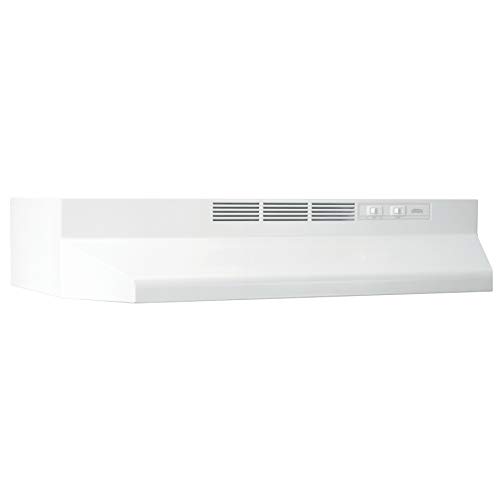
Broan-NuTone Ductless Range Hood 30in 413001 — True Ductless Specialist
Most hoods in this guide can work without a duct; the Broan 413001 simply never pretends otherwise. It is a non-ducted design from a company whose whole business is moving air around houses, and that focus shows in its priorities: a light over the stove, a fan to pull cooking fumes through filtration, and a white under-cabinet body that matches the appliances in the rentals and older kitchens where it will mostly live. There is no conversion hardware because there is nothing to convert — the installation is screws, power, and done.
That honesty defines both its appeal and its ceiling. Recirculation can trap grease and blunt odours, and for toast, eggs, pasta water, and gentle frying that is a real improvement over no hood at all, which is the actual alternative in most ductless kitchens. What it cannot do is export heat or humidity, so a long stock-making afternoon will still fog the windows. Owners who understand that bargain tend to be satisfied; owners expecting ducted performance from a ductless box are the ones who leave disappointed reviews of any model in this niche.
The white finish deserves a word, because stainless dominates this category to a fault. Plenty of kitchens — farmhouse styles, older white-appliance suites, bright rental units — look better with a white hood that recedes rather than a steel panel that announces itself. Broan’s parts ecosystem is another quiet advantage: filters and lamps for long-running Broan designs tend to remain obtainable years later, which matters for an appliance category people replace reluctantly and late.
There is a particular dignity in an appliance that does one modest job for a very long time, and the Broan is built in that tradition. Landlords fit them because tenants cannot really break the concept; owners of older houses fit them because the white box matches the kitchen they already have rather than the kitchen in a magazine. The light earns daily gratitude — many stoves in ductless kitchens sit in a gloom that makes judging a sauce genuinely difficult — and the fan, while never heroic, keeps a film of grease off the ceiling that would otherwise accumulate month by month. Expect to replace or refresh its filtration on a sensible cycle and to open a window during the year’s most ambitious cooking. Within those expectations the 413001 is almost impossible to regret, which explains why this pattern of hood has persisted in the Broan catalogue while flashier designs came and went around it.
- Vent path: non-ducted recirculation only
- Colour: white finish for white appliance suites
- Role: under-cabinet exhaust fan with lighting
- Filtration: ductless filter path for grease capture
- Brand: Broan-NuTone ventilation specialist range
- Install: simple mounting, no ductwork required
Strengths
- Purpose-built for kitchens with no duct route
- Fast, simple installation with no conversion parts
- White finish blends into traditional kitchen schemes
Trade-offs
- Cannot exhaust heat or moisture outdoors
- Capture suits light-to-moderate cooking only
- Fewer speeds and features than convertible rivals
Best for: rentals and older kitchens needing light and basic fume control.
Not suited for: anyone able to run a duct, who should buy ducted instead.

COSMO COS-5MU30 Ducted Under Cabinet Hood — Ducted Classic
The COSMO COS-5MU30 represents the traditional ducted pattern executed without fuss: a stainless under-cabinet body, physical button controls, reusable filters, and LED lighting, connected to a duct that carries the kitchen’s exhaust outdoors where it belongs. Cosmo’s Delta collection styling keeps the lines plain and architectural, so the hood sits comfortably in transitional kitchens that mix shaker cabinets with steel appliances. Nothing here chases novelty, and that restraint is the point — every element is a known quantity a homeowner can maintain for a decade.
Button controls deserve defending in a category drifting toward touch glass. A button can be found by touch while your eyes stay on a pan, works through a film of cooking vapour, and will not be confused by a wet fingertip. The reusable filters follow the same philosophy: remove, wash, refit, and the hood’s running costs stay at the price of detergent. Ducted exhaust means steam from a pasta pot leaves the building entirely, which keeps paint, cabinets, and window frames free of the slow moisture damage recirculation cannot prevent.
Choosing this model is really a statement that your kitchen has, or will get, a proper duct — and that you value straightforward controls over showroom features. It will not gesture back at you, and it does not offer a remote, but the fundamentals it covers are the fundamentals that determine whether a hood still satisfies in year six. For a renovation already opening the cabinet run for ductwork, it is the low-drama option that installers rarely complain about.
The COSMO rewards a household that thinks in decades. Buttons, washable filters, a duct, stainless steel — there is nothing in the recipe that dates quickly or depends on a fragile novelty, and a competent owner can maintain the whole machine with a screwdriver, a sink of hot water, and an afternoon’s patience every year or so. In use it has the calm of a well-plumbed appliance: steam from a rolling boil rises and is simply gone, the buttons answer instantly, and the lights make the back burners as legible as the front. It also suits cooks who dislike being managed by their appliances — no gestures to learn, no app to pair, no remote to lose down the side of a sofa. If the renovation is already paying for ductwork, the marginal cost of choosing this straightforward pattern over a recirculating compromise is small, and the benefit compounds every single day the kitchen is used.
- Vent path: ducted under-cabinet design
- Controls: push-button panel, tactile operation
- Filters: reusable set, wash to maintain
- Lighting: LED lights across the cooking surface
- Collection: Cosmo Delta styling in stainless steel
- Body: 30-inch width for standard range openings
Strengths
- Proper outdoor exhaust for steam and smoke
- Physical buttons work with messy hands
- Reusable filters avoid replacement purchases
Trade-offs
- Requires ductwork to function as intended
- No remote or gesture conveniences
- Styling is plain beside designer chimney models
Best for: renovations adding a real duct who prefer tactile controls.
Not suited for: kitchens with no possibility of an outside vent route.

EVERKITCH 30in Under Cabinet Hood 900CFM — Maximum Airflow
At the top of this class sits the EVERKITCH, whose dual motors and 900 CFM listing figure make it the strongest extractor in this particular six. Dual-motor layouts spread the work across two fans, which helps a wide canopy pull evenly from both sides of the stove rather than favouring the centre. Permanent filters, top or rear venting, dimmable lamps, and a timer round out a specification clearly aimed at households that cook ambitiously and often — the sort of kitchen where a hood is used twice a day, not twice a month.
Gesture and touch control headline the interface, and the dimmable lighting is more useful than it first sounds: full brightness for judging a sauce, low brightness for a midnight kettle without waking the house. The timer continues clearing air after cooking ends, which is when lingering odour otherwise migrates to soft furnishings. Rear venting matters in older kitchens where the duct already runs horizontally through the wall, sparing the installer a new vertical chase through the cabinet above.
A 900 CFM hood in a small, tightly sealed apartment deserves a caution rather than a celebration. Extraction this strong can back-draft other appliances in some homes and will always demand a duct sized for the job; throttling it through a skinny run produces noise without capture. Bought for the right house — a keen cook, a proper duct, a gas range with serious burners — it is the closest thing here to small-restaurant equipment. Bought for a bedsit, it is money spent on airflow the building cannot use.
Treat the EVERKITCH as a small piece of infrastructure and it makes sense. The dual motors pull from a wide frontage, so a stockpot at the left and a frying pan at the right are both inside the capture zone — a real advantage on the evenings when a full range is working and lesser hoods only clear the middle of the stove. The dimmable lamps change the room’s mood after service, dropping to a glow for a late drink at the counter, and the timer’s habit of running on after the burners die is the sort of detail owners mention unprompted. None of this excuses a lazy duct: give this machine a short, wide, smooth run and it will repay the effort with authority and relative calm; choke it and you have bought a very effective noise generator. The households that will love it know who they are — they own heavy pans, they cook from raw ingredients daily, and their previous hood was the bottleneck in the kitchen.
- Airflow: 900 CFM listing figure, dual motors
- Venting: top or rear duct connections
- Filters: permanent design for repeated washing
- Controls: gesture sensing plus touch panel
- Lighting: dimmable lamps with timer support
- Build: stainless steel under-cabinet body
Strengths
- Strongest extraction in this roundup
- Even pull across the full cooking width
- Dimmable light suits evening cooking
Trade-offs
- Oversized for small sealed flats
- Needs generous ducting to stay quiet
- Feature-rich panel needs regular cleaning
Best for: serious gas-range cooking with a properly sized duct.
Not suited for: tiny kitchens or homes with marginal ventilation paths.
How Do the Six Compare at a Glance?
Read the vent path column first and the airflow second. A modest ducted hood exhausts a steamy kitchen better than a powerful recirculating one, because only the ducted machine actually removes anything from the room. The table compresses each model to the facts that separate it from its neighbours.
| Model | Snapshot |
|---|---|
| SNDOAS 30in Convertible | Convertible under-cabinet hood, two speeds, rocker controls, LED light. |
| AMZCHEF 750CFM | Ducted 750 CFM, baffle filters, three outlets, gesture and remote control. |
| COMFEE’ 30 Inch | Convertible slim hood, three speeds, reusable filter, 65dB listing figure. |
| Broan 413001 Ductless | Non-ducted only, white finish, light plus fan, simplest install here. |
| COSMO COS-5MU30 | Ducted only pattern, button controls, reusable filters, Delta styling. |
| EVERKITCH 900CFM | 900 CFM dual motors, permanent filters, top/rear vents, dimmable lamps. |
What Actually Changes Between Ducted, Ductless, and Convertible Hoods?
A ducted hood moves air out of the building. Smoke, steam, combustion by-products from a gas hob, and most cooking odour travel up the duct and leave, which is why ducted extraction transforms a kitchen rather than merely improving it. The cost is construction: a route through a cabinet, wall, or roof, a cap outside, and a run kept as short and straight as the house allows. Every elbow and metre of narrow duct taxes the fan, so the installation quality can matter as much as the motor bolted beneath the cabinet.
A ductless hood filters and returns the same air. Grease is trapped, odour is blunted by carbon filtration, and the visible plume above a pan is broken up and dispersed — but heat and water vapour stay indoors, because there is nowhere else for them to go. Convertible hoods contain both possibilities in one body, shipping ready to recirculate and able to connect to a duct later. For many households the convertible is the pragmatic champion: it solves this winter’s cooking immediately and preserves next year’s better option without a second purchase.
How Much Capture Does a Slim Under-Cabinet Canopy Really Achieve?
Capture is a geometry problem before it is a motor problem. A shallow under-cabinet panel hovers close to the wall and covers the rear burners well, while a plume rising from a front burner — especially one nudged sideways by a draught from a door or window — can escape past the canopy’s front edge entirely. This is why experienced cooks slide a smoking pan to the back ring under any slim hood, and why mounting the unit at the lower end of its permitted height range improves results noticeably.
Depth and overhang are the quiet specifications in this category. A hood that projects further over the cooking surface catches more of the rising column before room air dilutes it, and a small lip or deeper well around the filters gives the plume a moment to gather instead of spilling. When you compare two 30-inch models with similar airflow, the one with the more generous canopy usually clears a kitchen more convincingly, whatever the carton numbers imply.
Which Filters Suit the Way Your Household Actually Cooks?
Mesh and layered aluminium filters catch grease by forcing air through a fine labyrinth; they are light, cheap, and effective until they clog, at which point airflow and capture both sag until the filter is washed. Baffle filters, fitted to the AMZCHEF here, work differently — the air changes direction sharply over steel channels, grease condenses and runs to a collection point, and performance holds up better under heavy, oily cooking. Baffles also shrug off the dishwasher, which matters because a filter that is annoying to clean quietly stops being cleaned.
Ductless running adds carbon filtration for odour, and carbon is a consumable however it is packaged: it saturates over months of frying and then merely occupies space. Households frying several times a week should budget attention, if not money, for that cycle. The honest summary is that filter choice follows cuisine — steaming and boiling households can ignore the subject, while a family devoted to crisped, spiced, and seared food should treat baffles as close to essential.
How Should a 30-Inch Hood Be Installed for the Best Result?
Begin with height. Manufacturers specify a mounting range above the cooking surface, and the lower portion of that range captures better provided it clears tall stockpots and the cook’s forehead. Mark the cabinet underside, confirm the mounting points land on solid material rather than a thin cabinet floor alone, and check the electrical supply route before lifting the unit into place — hoods are awkward, two-person lifts at exactly the moment you discover a cable is two inches short.
For ducted models, plan the run before buying fittings: smooth rigid duct where possible, gentle transitions instead of crushed flex, sealed joints, and a backdraft damper so winter air does not whistle down into the kitchen. For ductless models, installation is mercifully brief, but leave access to the filters — a hood whose carbon pads require a stepladder and a screwdriver will not receive them. Finish by testing with the smokiest thing you cook, not with a kettle, and adjust burner habits to what the canopy actually catches.
What Noise Should You Expect, and How Do You Live With It?
Hood noise rises steeply with fan speed, so the meaningful question is how loud the setting you will actually use sounds. A gentle simmer speed on any of these six can sit under conversation; the top setting of a powerful ducted model will not, and is meant for short, smoky intervals rather than an evening’s background. Listings quote figures unevenly — the COMFEE’ publishes 65dB, others leave the subject vague — so treat silence claims as marketing until the fan is over your own stove.
Installation choices change the soundtrack as much as motor design does. A duct with a sharp elbow sings, a loose mounting rattles, and a filter left greasy forces the fan to work harder for the same capture. Rubber isolation at the mounting points, tight fixings, and clean filters together can make an ordinary hood sound like a better one. In open-plan homes, a timer that lets the fan finish on low after cooking is worth more than a heroic top speed.
When Is a 30-Inch Hood the Wrong Purchase Altogether?
Sometimes the correct answer is a different appliance shape. A wide, high-output range — the sort with six burners and a griddle — overwhelms a 30-inch canopy no matter how strong its motor, because capture area, not airflow, becomes the limit; such cookers deserve a wider hood or a serious insert. Island hobs need ceiling-mounted extraction designed for access from all sides. And a kitchen with no cabinet above the stove and no appetite for a chimney model may suit a downdraft or a simple wall-mounted canopy better than anything in this under-cabinet-leaning six.
There is also the honest case of the household that barely cooks with fat or steam. If the stove mostly boils pasta water and reheats soup, even the modest Broan here is ample, and money saved on extraction is better spent on lighting or a quieter fridge. Matching the hood to the cooking — not to a neighbour’s renovation or a showroom’s drama — is the thread running through every recommendation in this guide.
How Do You Keep a 30-Inch Hood Performing Like New?
Maintenance divides into the weekly wipe, the monthly filter, and the annual look upwards. The weekly wipe is cosmetic but not trivial: a warm cloth with a drop of washing-up liquid across the canopy and controls stops the slow build-up that eventually turns a steel hood amber and sticky, and it takes ninety seconds while a kettle boils. The monthly filter wash is the performance item — grease-loaded filters strangle airflow quietly, and owners routinely rediscover a lost fan speed or two simply by degreasing the mesh or baffles they had forgotten existed.
Once a year, look at the parts you never see. Ducted owners should confirm the outside cap still swings freely and has not been claimed by nesting insects or a drift of leaves, and check that no joint in an accessible run has worked loose and begun venting into a cabinet void. Ductless owners should judge the carbon filtration honestly: when fried-food smells start surviving the night again, the pads have given what they had. Lights, too, deserve a glance — an LED that has dimmed or flickered changes how carefully you cook, because colour judgement at the pan depends on it more than most cooks realise.
What Should You Measure Before Ordering Any 30-Inch Hood?
Three measurements prevent nearly every failed purchase in this category. First, the true width of the opening and the cabinet run above it — a nominal 30-inch space in an older kitchen can be a half-inch shy, and hoods do not compress. Second, the distance from the cooking surface to the cabinet underside, checked against the manufacturer’s permitted mounting range for the exact model, because a hood that must hang too high will disappoint however strong its motor is. Third, for ducted plans, the diameter and route of the existing duct, photographed if possible, since adapters exist for honest mismatches but not for wishful thinking.
Beyond the tape measure, audit the electrical supply and the cabinet’s substance. Most under-cabinet hoods need a nearby supply, hard-wired or plugged depending on model and local code, and discovering the absence of one after the old hood is down turns a Saturday project into a week of takeaways. Particleboard cabinet floors may need a mounting rail or reinforcement for heavier dual-motor units. Finally, measure your tallest stockpot and your own forehead height at the stove — the mounting position must satisfy the specification, the pot, and the cook simultaneously, and it is far better to learn of a conflict from a tape measure than from a forehead.
How Does a Range Hood Change the Rest of the Kitchen?
A working hood quietly protects everything around the stove. Cabinets above and beside the hob stay free of the greasy film that unventilated cooking deposits a molecule at a time, paint keeps its colour instead of yellowing from below, and the ceiling escapes the faint constellation of splatter that eventually appears over an unhooded range. Window frames and blind slats in small kitchens benefit most visibly, because steam that is captured or exhausted cannot condense on the coldest surface in the room and feed the mildew that colonises sills in winter.
There is a social effect, too. Kitchens with effective extraction hold their gatherings better — guests linger near the cooking instead of retreating from the fug, and the cook is not exiled behind a wall of steam while everyone else talks in the doorway. Even the morning after improves: soft furnishings, coats on hooks, and the dog’s bedding all carry less of yesterday’s frying when the plume was caught at source. None of this appears on a specification sheet, yet owners consistently rank these background mercies above any single feature when a hood has been in service for a year.
Which Cooking Styles Push a 30-Inch Hood Hardest?
High, dry heat is the sternest test. Searing meat, blackening fish, tempering spices in oil, and wok cooking over a fierce burner all launch a fast, greasy plume that rises quickly and spreads as it climbs — exactly the load that separates ducted baffles from recirculating goodwill. Slow cooking is the opposite extreme: a braise or a stockpot produces volume rather than violence, mostly steam over hours, which a ducted hood removes steadily and a ductless hood can only stir around the room until a window takes pity.
Breakfast, surprisingly, troubles weak hoods more than dinner does. Bacon and fried eggs generate a fine, persistent aerosol in a small, cold morning kitchen, and the plume’s low starting temperature makes it lazier and more inclined to drift sideways out of a shallow canopy. Households that fry breakfast daily should weight capture geometry and filter quality more heavily than a household of evening salad-makers ever needs to. Matching the hood to your two or three most-cooked dishes — not to an imaginary banquet — remains the most reliable selection method in this entire category.
What Does Living Without Any Hood Teach a Kitchen?
Many readers arrive at this guide after months of cooking under a dead hood or no hood at all, and their kitchens carry the evidence. The underside of the cabinet above the stove is usually tacky to the touch, the ceiling paint has taken on a warmth of colour that stops abruptly at the picture rail, and the tops of high cupboards — the surfaces nobody wipes — hold a grey, greasy dust that explains where every fried egg actually went. A new hood does not undo that history in a day, but the first month is instructive: wipe a cabinet door weekly and watch it stay clean, and the value of capture stops being theoretical.
The lesson cuts the other way as well. A household that has managed cheerfully without extraction — cooking gently, opening windows, wiping surfaces — may genuinely need only the lighter end of this shortlist. There is no virtue in over-buying airflow you will never call on, and the money difference between the simplest ductless box here and the dual-motor flagship would stock a pantry handsomely. The right hood is the one matched to the evidence of your own kitchen walls.
How Should You Test a New Hood During Its First Week?
Do not judge the installation on a boiled kettle. Cook the smokiest ordinary meal in your repertoire — a pan of sausages, a seared steak, a tray of bacon — with the doors in their usual positions and the fan on the setting you would realistically choose, then walk the rest of the home while it cooks. Bedrooms and the hallway will tell you more about capture than standing at the stove will, because escaped cooking air announces itself everywhere except where you are watching for it.
Follow with a steam test on another evening: a large pot at a rolling boil, lid off, for ten minutes. Ducted owners should see the plume lean visibly toward the canopy and the windows stay clear; ductless owners should expect fogging and judge instead whether grease and odour are blunted compared with the old arrangement. Note which burner misbehaves, whether the controls stayed usable with cooking hands, and whether the noise at your chosen speed lets a conversation continue — those three notes, taken in week one, predict year five better than any first impression formed in a showroom.
Which Mistakes Make a Good Hood Seem Bad?
Most disappointing hoods were defeated by their installation or their expectations rather than their motors. The recurring errors are easy to avoid once named.
- Buying a ductless model and expecting steam to vanish, when recirculation can only filter grease and odour.
- Mounting the canopy at the very top of its height range for headroom, then blaming the fan for escaped smoke.
- Squeezing a powerful ducted hood through a narrow leftover duct run and living with the resulting roar.
- Never washing the filters, so capture fades month by month until the hood seems to have failed.
- Cooking everything on the front burners, outside the canopy’s most effective capture zone.
- Choosing by airflow headline alone while ignoring canopy depth, filter type, and control layout.
None of these require a different purchase to fix — a lower mounting, a washed filter, a back-burner habit, and a realistic brief transform the same machine’s reputation within a week.
Final Recommendation
For most 30-inch kitchens the SNDOAS convertible is the safest first answer, because it respects uncertainty: it works the day it is fitted, whatever the walls contain, and it improves the day a duct arrives. Kitchens with a duct and ambitious cooking should skip straight to the AMZCHEF for its baffles and airflow, or to the EVERKITCH where the range and the repertoire genuinely justify dual motors. The COSMO serves the same ducted brief with calmer controls, the COMFEE’ keeps everyday cooking quiet and slim, and the Broan remains the correct, unpretentious choice where no duct will ever exist.
Choose by vent path, then by cuisine, then by controls — in that order — and any of the six will feel well bought. A hood over a 30-inch stove succeeds quietly, clearing Tuesday’s onions without ceremony and asking only for a washed filter in return, and that modest, repeatable competence is worth more than any showroom flourish.
Frequently Asked Questions
Can a ductless hood handle frying at all?
Yes, within limits. Filtration traps much of the grease and softens odour, so ordinary frying becomes far less pervasive through the home. What recirculation cannot do is remove heat and steam, so a window opened briefly during heavy frying still helps any ductless setup.
Is converting a convertible hood later a difficult job?
The hood itself is designed for it — the conversion is mostly removing the recirculation path and connecting a duct. The difficult part is the duct run through the house, not the appliance, which is why convertibles suit phased renovations so well.
Why does my hood seem weaker on the front burners?
Because capture is geometric. A shallow canopy covers the rear of the hob best, and a rising plume from a front burner can drift beyond its edge. Sliding smoky pans to the back ring is the simplest performance upgrade available, and it costs nothing.
How often should range hood filters be washed?
Households frying several times a week should wash mesh or baffle filters roughly monthly; gentler cooking stretches that to a season. A filter that looks glossy with grease is already overdue, and airflow recovers immediately once it is clean.
Does a stronger fan always clear a kitchen faster?
Only when the duct and canopy let it. A powerful motor throttled by a narrow duct or a shallow canopy mostly makes more noise. Airflow, duct diameter, mounting height, and filter cleanliness work as a system, and the weakest element sets the result.
What lighting should a hood provide?
Enough to judge colour and doneness without the ceiling lights — every model here includes LED task lighting. Dimmable lamps, as on the EVERKITCH, add evening flexibility, but even a fixed bright LED transforms a stove that sits in the shadow of its own cabinets.
Related Guides
Ventilation settled, the rest of the kitchen and laundry plan may need the same treatment. Continue with Best 30-Inch Ducted Range Hoods, Best 24-Inch Stackable Washer and Dryer Sets, Best Affordable Hair Dryers for Curly Hair.


