What's inside
- Where to buy these picks
- Quick picks at a glance
- How these picks were chosen
- The six picks in detail
- Six spouted sets, side by side
- How do you choose a spouted saucepan set that fits your cooking?
- Why a spout changes straining more than pouring
- Caring for coated and steel spouts differently
- Pairs versus single pans: the storage and hob maths
- Pouring, liquid by liquid
- Reading these listings like a sceptic
- Lids, handles and the pour you actually make
- What a spouted set replaces in an ordinary kitchen
- A short history of the spouted pan, and why it returned
- One last check before the box is opened
- Seasoning the decision with your own menu
- Common mistakes
- Final recommendation
- Frequently asked questions
As an Amazon Associate I earn from qualifying purchases. This post may contain affiliate links at no extra cost to you.
As an Amazon Associate, cottageverdict.com earns from qualifying purchases.
Sauce that dribbles down the outside of a pan, soup that misses the bowl, gravy that lands half on the rim — these small messes are exactly why best cookware sets with pour spouts exist, and why the spout deserves more attention than it usually gets when a set is chosen. A shaped lip turns a saucepan into a controlled pouring tool: liquid leaves in a narrow stream, the rim stays cleaner, and straining pasta water or pan juices stops being a two-handed gamble over the sink. This guide compares six saucepan sets whose listings state a pour spout outright, in capacities from one quart up to three quarts, in nonstick and stainless steel, with and without steamers and strainer lids.
Read the six as a ladder of jobs rather than a ranking of brands. Small spouted pans melt butter, warm milk and reheat a single portion of soup; mid-size versions handle family sauces and boiled eggs; the largest here, at three quarts, suits a pot of oatmeal or a batch of rice pudding. Coating choice matters just as much as size, because a granite-style nonstick interior and a bare stainless interior behave differently with tomato sauce, caramel and dishwasher cycles. Every claim below traces back to wording in the listing title for that set, so where a title stays quiet about a detail, the review says so instead of guessing.
Where to buy these picks
All six sets are sold through Amazon, and each name below links to its detailed review further down the page. Order matters less than fit: buy the capacity you will lift most often, then check that the coating and hob compatibility suit your kitchen.
- Kordisen Sauce Pan Set Pour Spout Black — opens the list with a granite-coated pair in black, sized 1.5 and 2.5 quarts, aimed squarely at induction kitchens.
- SENSARTE Sauce Pan Set 1.5 & 2.5 Qt Pour Spout — matches the Kordisen sizes exactly but speaks a different language — sauciers, non-toxic wording and a PFOA-free claim.
- MICHELANGELO Saucepan Set Steamer Pour Spouts — breaks the nonstick pattern with 18/10 stainless steel, a steamer, strainer glass lids and a tri-ply base across 1 and 2 quart pans.
- Circulon A1 Straining Sauce Pan 2-Qt Pour Spout — stands alone as a single graphite 2 quart pan, but carries ScratchDefense, a tempered-glass lid and the group’s highest stated oven limit.
- Farberware Classic Straining Sauce Pan 3-Qt — closes the size ladder at 3 quarts in stainless steel, with straining in its name and a 350-degree oven limit in its title.
- AVACRAFT Saucepan 1.5 Qt Pour Spouts — finishes the six with a compact 1.5 quart stainless pan — glass strainer lid, five-layer capsule base and an ergonomic handle.
Quick picks at a glance
| Pick | Best for | Standout from the listing |
|---|---|---|
| Kordisen Sauce Pan Set Pour Spout Black | Everyday sauce work in two core sizes | Granite coating with a spout on each pan |
| SENSARTE Sauce Pan Set 1.5 & 2.5 Qt Pour Spout | Sauce-focused cooks wanting a matched pair | Sauciers named alongside the spout |
| MICHELANGELO Saucepan Set Steamer Pour Spouts | Steaming and straining in small stainless pans | Steamer insert bundled with strainer lids |
| Circulon A1 Straining Sauce Pan 2-Qt Pour Spout | One-pan households that strain often | ScratchDefense surface with a 400-degree oven rating |
| Farberware Classic Straining Sauce Pan 3-Qt | Batch sauces and grains in stainless steel | Largest capacity here, with dishwasher wording |
| AVACRAFT Saucepan 1.5 Qt Pour Spouts | Compact stainless cooking with one-hand pouring | 5-layer capsule base under a small steel pan |
How these picks were chosen
Selection began with one hard filter: the listing title had to name a pour spout or pour spouts directly. Sets that merely looked spouted in a photograph, or that used vague language about easy pouring without the spout itself, were set aside, because the whole point of this category is a rim engineered for a clean stream. Six sets from six different makers survived that filter, which keeps the comparison honest across brands rather than padded with colour variants of a single model.
Capacity came next. The six span 1 quart, 1.5 quart, 2 quart, 2.5 quart and 3 quart sizes, singly or in pairs, so most saucepan jobs a home cook actually repeats are covered. Material balance was deliberate too: three nonstick entries and three stainless steel entries, because readers split sharply on that question and a one-sided list would serve neither camp. Induction compatibility was recorded wherever a title states it, since a set that cannot work on an induction hob is useless to a growing share of kitchens, and extra equipment — a steamer insert here, a strainer lid there — was noted as a genuine differentiator rather than treated as decoration.
Finally, care instructions in the titles were weighed. Dishwasher-safe wording appears on some listings and not others, oven limits differ by a full fifty degrees between two of the stainless and nonstick entries, and one set leans on a branded surface technology. Those printed details, not marketing adjectives, drive the verdicts at the end of each review.
The six picks in detail

Kordisen Sauce Pan Set Pour Spout Black
Black cookware disappears into a modern kitchen until the moment it pours, and this Kordisen pair is built around that moment. Inside the box sit two lidded sauce pans, in 1.5 quart and 2.5 quart sizes, nonstick, with a pour spout, a granite coating and an induction saucepan design, and it states the coating is PFOA/PFOS free. Two sizes rather than one is the honest shape of saucepan ownership: the smaller pan lives on the hob for reheating and melting, the larger one comes out for sauces and grains, and both carry the shaped lip that defines this whole category.
- Sizes: 1.5 qt and 2.5 qt, each with a lid
- Surface: nonstick with granite coating
- Spout: pour spout named in the listing title
- Hob: described as an induction saucepan for small kitchens
- Coating claim: PFOA/PFOS free, per the listing
Strengths
- Two genuinely useful capacities in a single box
- Granite coating over a nonstick interior for easy release
- Induction wording removes hob guesswork
Trade-offs
- Black finish shows dried sauce splashes clearly
- No steamer or strainer accessory is mentioned
- Oven limit is not given in the listing title
Granite-style coatings earn their following through daily behaviour rather than drama: porridge slides out, cheese sauce rinses away, and a pan that washes in seconds gets used more often than one that demands soaking. Paired with a spout, that easy release matters twice — once when the sauce leaves the pan in a clean stream, and again when the residue left behind wipes off the lip without scrubbing at the channel. Kitchens cooking a lot of milk-based and egg-based food will feel this pairing most, because those are precisely the foods that punish a bare pan at both the pouring and the washing stage.
Capacity spacing deserves a word, because 1.5 and 2.5 quarts is a thoughtful gap. A full quart between pans means each has a clear job: the smaller for single servings, butter, chocolate and reheats; the larger for a sauce that must simmer and reduce without spitting over the rim. The listing frames the set for small kitchens, and the footprint logic supports that framing — two pans, nested storage, no third size competing for cupboard room. Induction cooks should still confirm base diameter against their smallest hob ring, since small pans on oversized rings heat unevenly regardless of compatibility wording.
Best for: a two-person kitchen reheating soup and simmering sauces on induction, in the 1.5 to 2.5 quart range
Not suited for: steaming vegetables, since no steamer insert appears in the listing
Check price on Amazon — the granite pair is the one to open first if black cookware suits your shelves.
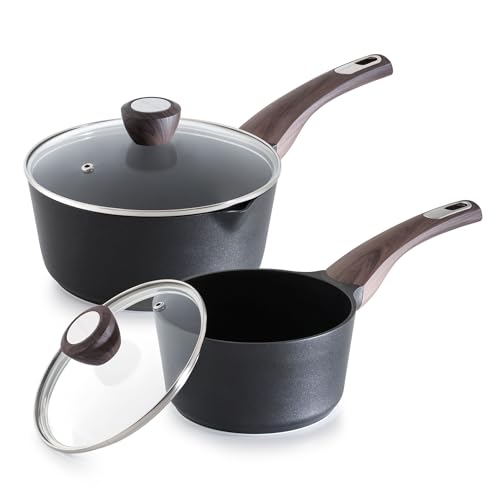
SENSARTE Sauce Pan Set 1.5 & 2.5 Qt Pour Spout
SENSARTE uses the word sauciers in its listing, and that single word signals intent: a saucier’s sloping profile exists for whisking and reducing, and adding a pour spout to that shape makes a pan designed for sauces in both the making and the serving. The set pairs 1.5 and 2.5 quart nonstick pans with lids, states a pour spout, describes the cookware as non toxic and PFOA free, and prints induction compatible in the title. On paper it is the most sauce-literate entry in this group of six.
- Sizes: 1.5 quart and 2.5 quart, with lids
- Surface: nonstick saucepan set
- Spout: pour spout stated in the title
- Hob: induction compatible, per the listing
- Listing claims: non toxic, PFOA free
Strengths
- Saucier framing suits whisked and reduced sauces
- Same practical size pairing as the Kordisen set
- Easy-clean wording matches the nonstick interior
Trade-offs
- No strainer or steamer function is claimed
- Dishwasher wording does not appear in the title
- Only two pans — no small 1 quart option for tiny jobs
Whisking is the hidden test of a saucepan, because a whisk in a straight-sided pan leaves a ring of unmixed sauce in the corner where wall meets base. A saucier profile softens that corner, and a cook making béchamel, custard or a pan gravy notices the difference within one recipe. The spout then completes the sequence: the finished sauce, already smooth from whisking, leaves the pan in a stream narrow enough to dress a plate rather than flood it. SENSARTE’s title leans into exactly that sequence, which gives this set a clearer culinary identity than a generic two-pan bundle.
Cleaning claims deserve their plain reading: the title says easy to clean, and a nonstick interior normally delivers that for sauces, though the spout channel itself still benefits from a bottle brush or a folded cloth after thick mixtures. Induction compatibility broadens the audience, and the non-toxic and PFOA-free wording answers the first question many coating shoppers ask. What the title does not promise is oven performance or dishwasher safety, so cooks who finish gratins under heat or who machine-wash everything should verify those two points on the product page before committing.
Best for: whisked sauces, custards and gravies in 1.5 and 2.5 quart batches on any common hob, induction included
Not suited for: a 1 quart melting job, because the smaller pan in this set starts at 1.5 quarts
Check price on Amazon — worth a look if your saucepan spends its life under a whisk.

MICHELANGELO Saucepan Set Steamer Pour Spouts
Steel changes the conversation, and this MICHELANGELO set is the point in the list where accessories arrive with it. The listing describes an 18/10 stainless steel saucepan set with a steamer, in 1 quart and 2 quart sizes, with steamer and strainer glass lids, pour spouts, a tri-ply base and induction compatibility. That is the longest feature list of any entry here, and it repositions two modest pans as a small system: sauce below, vegetables steaming above, and a strainer lid ready when the pasta water needs to leave.
- Sizes: 1 quart and 2 quart
- Material: 18/10 stainless steel
- Base: tri-ply, induction compatible
- Extras: steamer, strainer glass lids
- Spouts: pour spouts, plural, in the title
Strengths
- Steamer stretches two small pans into extra duties
- Strainer lids pair naturally with the spouts for draining
- Stainless build tolerates metal utensils and deglazing
Trade-offs
- Capacities top out at 2 quarts — smallest ceiling here
- Steel shows sauce residue more than a coated pan
- No dishwasher wording appears in the listing title
A steamer insert on a 2 quart pan sounds modest until a week of dinners tests it: broccoli for two, a handful of dumplings, green beans while the sauce simmers underneath. Small steaming is the kind most households actually do, and a dedicated large steamer often sits unused while a pan-top insert earns regular work. The tri-ply base matters here too, because steaming and sauce-making both punish hot spots — a thin base scorches the sauce below while the vegetables above cook unevenly, whereas a layered base spreads the hob’s heat across the pan floor.
The strainer glass lids complete a tidy loop with the spouts. Glass lets a cook watch water reach the boil and judge when potatoes are done, the strainer function opens a draining gap, and the spout directs the outflow. Being glass, those lids ask for a little respect — no thermal shock from a cold tap onto hot glass, and no oven assumptions, since the title prints no oven figure. Within those ordinary cautions, this is the most versatile small-pan arrangement in the six, bought at the cost of the smallest maximum capacity.
Best for: small households steaming vegetables over a 2 quart pan while a sauce cooks beneath
Not suited for: a family sauce batch beyond 2 quarts, which exceeds the larger pan in this set
Check price on Amazon — the steamer bundle makes this the busiest small set on the page.

Circulon A1 Straining Sauce Pan 2-Qt Pour Spout
Not every kitchen wants a set, and Circulon’s A1 entry argues for the single perfect pan instead. What arrives is one 2 quart nonstick straining sauce pan with a lid, finished in graphite, calling it an induction sauce pan with a pour spout, a tempered-glass lid and ScratchDefense, and it adds dishwasher safe wording plus an oven-safe limit of 400 degrees Fahrenheit. Two quarts is the workhorse saucepan size for one or two people, and straining is built into the pan’s name rather than offered as an accessory.
- Size: 2 quart, single pan with lid
- Surface: nonstick with ScratchDefense
- Lid: tempered glass
- Oven limit: 400 degrees Fahrenheit, per the title
- Care: dishwasher safe, per the title
Strengths
- Highest stated oven limit among these six
- Straining design suits pasta, potatoes and blanching
- Dishwasher wording simplifies the nightly routine
Trade-offs
- One pan only — no smaller partner for melting jobs
- Graphite is the sole colour the title offers
- Steel-tool freedom is narrower than bare stainless
ScratchDefense is Circulon’s name for a surface engineered to resist the scratches that ordinary nonstick accumulates, and its presence in the title signals where this pan expects to be judged: durability of the coating over years of spoons, stacking and washing. Treat the claim as the maker’s own, but note the supporting cast — dishwasher-safe wording and a 400 degree oven limit describe a pan intended to live a harder life than delicate coated cookware usually accepts. A pan that can start a sauce on the hob and finish it in a moderately hot oven covers gratins, baked dips and keep-warm holding without a transfer dish.
The straining identity shapes daily use more than the coating does. Two quarts of pasta for two drains through the spout side with the lid held offset, rice rinses without a separate sieve, and blanched peas tip straight into a serving bowl. Tempered glass in the lid lets the cook watch for the boil-over moment that starchy water loves. The honest limitation is arithmetic: one pan means sequential cooking on busy nights, so households regularly running two sauces at once should look at the paired sets instead.
Best for: one or two people draining pasta and vegetables from a single 2 quart pan, then finishing sauces in a 400 degree oven
Not suited for: running two sauces simultaneously, because this listing contains exactly one pan
Check price on Amazon — the single-pan route, for kitchens short on cupboard space.

Farberware Classic Straining Sauce Pan 3-Qt
Farberware’s Classic line has sold saucepans for generations, and this 3 quart stainless entry is the volume option in a list otherwise built around smaller pans. Farberware sells it as a stainless sauce pan with a lid, straining, at 3 quarts, promising easy straining and pouring from its pour spout, with oven safety to 350 degrees Fahrenheit and dishwasher-safe wording. Where the paired sets optimise for variety, this pan optimises for quantity: a full batch of oatmeal, a double recipe of tomato sauce, or potatoes for a family all fit under its lid.
- Capacity: 3 quart, one pan with lid
- Material: stainless steel
- Function: straining pan with pour spout
- Oven limit: 350 degrees Fahrenheit, per the title
- Care: dishwasher safe, per the title
Strengths
- Biggest capacity of the six listings
- Stainless body handles deglazing and metal tools
- Straining and pouring combined in one design
Trade-offs
- A full 3 quart pan is heavy to tilt one-handed
- Oven ceiling sits 50 degrees below the Circulon
- Too large for melting butter or a single egg boil
Three quarts changes what a saucepan is for. At this size the pan absorbs a litre of soup with room to stir, cooks rice for a family without the starch climbing the walls, and holds a double batch of sauce for freezing. The spout earns extra credit at this weight class, because tipping a large pan is exactly where an unshaped rim sheds liquid down the outside; a directed lip keeps the stream honest even as the angle steepens. Straining wording in the title extends the same logic to draining, which matters when the pan holds potatoes for six rather than pasta for two.
Stainless steel suits the batch role, since big acidic sauces and long simmers ask nothing a steel interior cannot give, and the dishwasher wording removes the one chore a large pan usually imposes. The 350 degree oven limit is the figure to respect — adequate for keeping a sauce warm or finishing a gentle bake, lower than the Circulon’s ceiling for hotter work. Weight is the standing caution: water alone at this capacity adds real load to the handle, so pour with two hands and let the spout, not wrist speed, control the flow.
Best for: family batches of sauce, oatmeal and grains at the full 3 quart size, drained straight from the pan
Not suited for: melting a knob of butter, where a 3 quart base spreads it thin and scorches it fast
Check price on Amazon — the batch cook’s pan; check the oven figure suits your recipes.
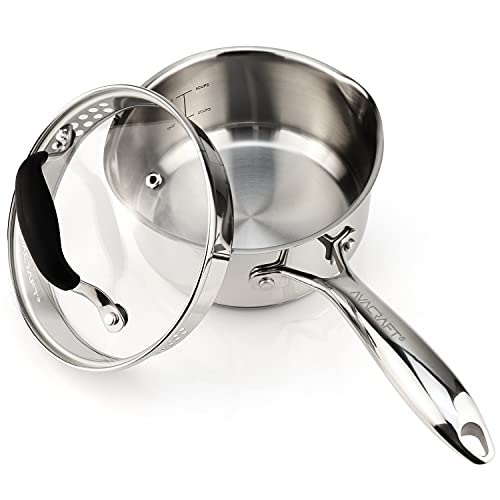
AVACRAFT Saucepan 1.5 Qt Pour Spouts
Small pans are bought carelessly and used constantly, which makes the engineering in this AVACRAFT listing worth a slower look. The title describes a 1.5 quart stainless steel saucepan with a glass strainer lid, built from 18/10 stainless steel over a 5-layer capsule base, with pour spouts, an ergonomic handle, induction compatibility, and oven-safe and dishwasher-safe wording. In a list where the small end is mostly nonstick, this is the small pan for steel loyalists — the reheating, egg-boiling, sauce-warming pan that can also drain its own contents.
- Pan size: 1.5 quart, sold singly
- Material: 18/10 stainless steel
- Base: 5-layer capsule base
- Lid: glass strainer lid
- Hob and care: induction compatible; oven safe and dishwasher safe per the title
Strengths
- Capsule base spreads heat in a small footprint
- Strainer lid plus spouts cover draining without a colander
- Ergonomic handle suits a pan that pours constantly
Trade-offs
- 1.5 quarts caps the recipe size firmly
- No second pan for parallel jobs
- Oven wording carries no temperature figure in the title
A capsule base on a 1.5 quart pan is not over-engineering; small pans suffer the worst hot spots in a kitchen because their bases sit inside a single hob ring’s uneven output, and milk or custard finds that hot spot instantly. Five layers, as the title states, give the heat somewhere to even out before it reaches the food, which is precisely the protection a small steel pan needs to behave as calmly as a coated one. The ergonomic handle pairs with that base in practice: a pan this size is lifted and tilted dozens of times a week, and handle comfort compounds across every one of those lifts.
The glass strainer lid turns the smallest pan here into a self-contained draining station for a portion of peas, a tin of beans being rinsed, or a couple of boiled eggs being cooled under the tap. Oven-safe and dishwasher-safe wording, both present in the title, round out a low-friction ownership story, though the absence of a printed oven temperature means the product page should settle that figure. Buyers wanting a pair should look at the Kordisen or SENSARTE sets; buyers wanting one small steel pan that does everything should linger here.
Best for: daily reheating, eggs and small sauces at 1.5 quarts on induction, drained through its own strainer lid
Not suited for: a soup batch for four, which simply does not fit a 1.5 quart pan
Check price on Amazon — small, steel and thoughtfully based; the compact closer to this list.
Six spouted sets, side by side
| Set | Sizes in the listing | Surface | Notable extra |
|---|---|---|---|
| Kordisen Sauce Pan Set Pour Spout Black | 1.5 qt and 2.5 qt | Nonstick, granite coating | Induction saucepan wording |
| SENSARTE Sauce Pan Set 1.5 & 2.5 Qt Pour Spout | 1.5 qt and 2.5 qt | Nonstick | Sauciers named in title |
| MICHELANGELO Saucepan Set Steamer Pour Spouts | 1 qt and 2 qt | 18/10 stainless steel | Steamer plus strainer glass lids |
| Circulon A1 Straining Sauce Pan 2-Qt Pour Spout | 2 qt single pan | Nonstick, ScratchDefense | Oven safe to 400 degrees Fahrenheit |
| Farberware Classic Straining Sauce Pan 3-Qt | 3 qt single pan | Stainless steel | Largest capacity in this list |
| AVACRAFT Saucepan 1.5 Qt Pour Spouts | 1.5 qt single pan | 18/10 stainless steel | 5-layer capsule base, ergonomic handle |
Two patterns stand out from the table. First, paired sets cluster at the smaller end, while the single pans carry the specialist roles — straining, steaming, or the biggest volume. Second, oven limits and dishwasher wording appear only on the single-pan listings, which makes those the easier buys for cooks who finish sauces under a grill or who refuse to hand-wash anything.
How do you choose a spouted saucepan set that fits your cooking?
Which capacity covers the jobs you repeat weekly?
Start from the pan you already reach for, not from the biggest recipe you cook twice a year. A 1.5 quart pan reheats soup for two, melts butter without scorching a wide base, and boils a couple of eggs; a 2.5 quart pan absorbs a family pasta sauce or a litre of custard with headroom to stir. Buying both sizes in one set, as the Kordisen and SENSARTE pairs do, covers the everyday middle ground in a single purchase. Reserve a 3 quart pan, the Farberware here, for households that cook grains, oatmeal or sauces in genuine batches, and remember that a full 3 quart pan of water is a serious lift at the sink — the spout helps, but wrist strength still counts.
Nonstick or stainless steel around the spout?
Nonstick interiors release milk, egg and sugary sauces with a rinse, which is why three of these six listings pair the spout with a coated interior: pouring and cleaning both get easier. The trade is delicacy — coatings dislike metal utensils and fierce heat. Stainless steel, used by the MICHELANGELO, Farberware and AVACRAFT entries, tolerates deglazing, whisking with metal tools and decades of scrubbing, and it browns fond for pan sauces in a way coated pans never quite match. Acidic tomato sauces sit happily in either, but a cook who makes caramel or reduces wine will usually be happier with bare steel, while a cook who warms porridge and custard daily will feel the benefit of nonstick every single morning.
Does your hob rule any set out?
Induction hobs need a magnetic base, and four of these listings state induction compatibility or induction suitability in their titles: Kordisen, SENSARTE, MICHELANGELO and AVACRAFT. Gas and standard electric hobs accept all six. If your kitchen runs induction, treat any title without that wording as a question to settle on the product page before ordering, because a beautiful spout is no compensation for a pan the hob refuses to heat. Glass-ceramic hobs add a gentler concern: a heavy capsule base, like the five-layer base on the AVACRAFT, sits flat and stable, which matters when you tilt a full pan to pour.
Strainer lid, steamer, or plain lid?
A strainer lid turns the spout into a draining system: hold the lid, tilt, and pasta or potato water leaves through the rim while the food stays put. The MICHELANGELO set builds this in with strainer glass lids and adds a steamer, which stretches two small pans into vegetable-steaming duty. The Circulon and Farberware pans are described as straining pans in their titles, pointing the same direction. A plain lid, by contrast, simply keeps heat and splashes in, which is all a sauce pan needs on sauce night. Decide by counting how often you drain small batches; daily drainers should pay for the strainer designs, occasional ones should not.
What will the spout actually be pouring?
Thin liquids — stock, milk, melted butter — pour cleanly from almost any shaped lip. Thick mixtures behave differently: a chunky tomato sauce or a lumpy gravy needs a wider, more open spout and a slower tilt, and it will still leave a trail if the pan is overfilled. Judge listings by the pairing of spout and capacity rather than by the spout alone, keep fill levels below the spout base for anything viscous, and test a new pan with water over the sink before trusting it with a white shirt and a pan of jus.
Why a spout changes straining more than pouring
Pouring gets the attention, but straining is where a spouted pan quietly earns its keep. Draining boiled potatoes in a separate colander means another item to wash, another transfer in which food escapes, and a cloud of steam in the face. A pan with a spout and a lid that can be held offset lets the water leave in a directed stream while the lid guards the opening, and the cook keeps both the food and the heat in the vessel. That is the design logic behind the straining language in the Circulon and Farberware titles and the strainer glass lids in the MICHELANGELO title: three different makers converging on the same kitchen problem from slightly different angles.
Technique still decides the result. Crack the lid a few millimetres on the spout side only, grip the handle and the lid knob together with a cloth, and tilt gradually so the stream stays thin. Rush the angle and the contents surge against the lid; keep the angle shallow and the water finds the spout channel first. Small pans strain best — a 1.5 or 2 quart pan full of new potatoes is manageable in one hand, while a brimming 3 quart pan deserves two hands and a slower approach. Cooks who blanch green beans, drain canned beans into the pan for rinsing, or tip the fat from browned mince will find the spout working several times a week, far beyond sauce duty.
Caring for coated and steel spouts differently
The spout edge is the thinnest, most exposed part of any of these pans, and it ages differently by material. On the nonstick entries — Kordisen with its granite coating, SENSARTE, and Circulon with ScratchDefense — the rim takes knocks from spoons, sink edges and stacked pans, so store them without nesting heavier cookware inside, and retire metal ladles in favour of wood or silicone near the lip. Circulon’s listing adds dishwasher-safe wording, which softens the routine, but hand-washing a coated pan still takes under a minute and treats the spout edge kindly.
Stainless spouts ask for almost the opposite regime. The MICHELANGELO, Farberware and AVACRAFT pans can be scrubbed, stacked and, where their titles say so, put through the dishwasher without anxiety; their spout edges may dull cosmetically over years yet keep pouring true. Heat tint around a steel spout is harmless discolouration, not damage. Oven limits in the titles — 400 degrees Fahrenheit for the Circulon, 350 for the Farberware — matter most at the handle and lid, so respect the lower figure even when the pan body looks indestructible. Whichever material you choose, dry the spout channel after washing: it is the spot where a drip hides, and on steel that hidden drip is where water marks begin.
Pairs versus single pans: the storage and hob maths
Two of these six listings sell pairs, four sell single pans, and the difference plays out in cupboards and on hobs rather than in specifications. A pair like the Kordisen or SENSARTE occupies two hob rings comfortably on a standard four-ring hob and nests or stacks into one cupboard footprint when the lids are inverted, which is why pairs suit small kitchens that cook two things at once — sauce on one ring, vegetables or a reheated side on the other. The cost is duplication of commitment: both pans share one material and one coating philosophy, so a kitchen wanting steel for searing and nonstick for custard cannot satisfy both wishes inside a single pair.
Single pans invert that logic. The Circulon, Farberware and AVACRAFT entries each do one job at one size, and a cook can assemble a mixed fleet across brands — a straining nonstick here, a large steel batch pan there — at the price of more boxes, more shelf decisions and no guarantee the lids share sizes. Hob maths matters too: the Farberware’s 3 quart base will claim a large ring and crowd its neighbours, while the AVACRAFT’s 1.5 quart footprint fits the smallest ring and leaves the hob free. Neither strategy is superior in the abstract; the right one follows from whether your cooking runs parallel dishes nightly or one careful pan at a time.
Pouring, liquid by liquid
Water-thin liquids forgive almost everything. Stock, milk and tea-water leave a spout in a clean thread at modest tilt angles, and the main risk is speed — pour too fast and even a good lip is overwhelmed. Medium liquids, meaning most sauces and soups, reward patience at the start of the pour, when the stream is forming, and a steady hand once it is established; a sauce with body will hold the channel shape a spout gives it, which is precisely why spouted pans flatter gravy and custard work. The cook’s part is to begin the tilt before the pan feels full in the wrist, because stopping a heavy pour mid-stream is harder than starting one gently.
Thick and chunky mixtures sit at the demanding end. A minestrone or a chunky tomato sauce moves reluctantly, bridges across a narrow spout and then releases in a rush, so wide, open spout designs and lower fill levels earn their keep, and a spoon guiding the first spoonful over the lip prevents the inaugural splash. Fat is its own case: tipping rendered fat from browned meat through a spout, ideally with a lid held as a guard, separates liquid from solids neatly, but the stream is hot, slippery and unforgiving of a rushed angle. Across all four categories the discipline is identical — dry the outside of the spout before pouring, because a wet lip invites the stream to cling and wander down the pan’s flank.
Reading these listings like a sceptic
Titles in this category reward a particular reading habit: separate what is measured from what is merely warm. Measured claims in these six listings include capacities in quarts, the Circulon’s 400 degree oven figure, the Farberware’s 350 degree figure and the AVACRAFT’s five-layer base count. Warm claims include phrases about easy cleaning and effortless pouring, which describe intentions rather than test results. Neither kind is dishonest, but only the first kind can be compared across brands, so a careful buyer builds the shortlist on measurements and lets the warm language break ties rather than make decisions.
Absences deserve the same attention as presences. When a title omits dishwasher wording, as several here do, the cautious assumption is hand-washing until the product page says otherwise; when a title omits an oven figure, the pan’s oven life stays unconfirmed rather than unlimited. One listing in this group prints a misspelling of compatible, a small reminder that titles are marketing documents written quickly, not engineering certificates. None of that diminishes the six pans — it simply assigns each claim the weight it can bear, and keeps the buyer’s expectations standing on the printed numbers that will still be true when the box is recycled.
Lids, handles and the pour you actually make
The spout gets the headline, but the pour a cook actually makes is a three-part system: spout, handle and lid working together. A handle that stays grippable when the pan is full decides how confidently the tilt begins; a lid that can be held offset with the same hand, or parked securely while the free hand steadies a bowl, decides whether straining is a one-person job. Glass lids, fitted to the MICHELANGELO, Circulon and AVACRAFT entries here, add visibility to that system — a cook can see the boil building and judge the moment to lift and tilt — while the solid lids on the nonstick pairs keep the arrangement simple and light. None of these listings prints handle materials or heat ratings for grips, so that tactile judgement belongs to the product page and, where possible, to holding the pan in a shop.
Weight distribution is the quiet partner of the same system. A capsule or tri-ply base concentrates mass low in the pan, which steadies it on the hob but adds heft at the exact moment of tipping; a lighter coated pan asks less of the wrist yet can feel twitchy when a sauce surges. The honest test is water: fill any new spouted pan to its working level, lift it over the sink, and pour slowly into a jug. Ten seconds of that tells a cook more about the partnership of handle, base and lip than any paragraph — including this one — and it costs nothing but a jug of water.
What a spouted set replaces in an ordinary kitchen
Consolidation is the unspoken promise of these six listings. A spouted saucepan with a strainer lid absorbs the work of a small colander for pasta and potatoes; a set with a steamer, like the MICHELANGELO, absorbs a separate steaming basket; a pan that pours cleanly retires the jug-and-funnel routine for stocks and sauces, and with it a measure of washing-up. Kitchens short on storage feel those absorptions most, because every absorbed tool is a drawer returned. The limit of consolidation is specialisation: no saucepan here replaces a stockpot for a double batch of soup, a frying pan for searing, or a dedicated milk pan’s tall sides for frothing, and a cook who expects one set to annex the whole cupboard will end up annoyed at a tool that only ever promised sauce work.
There is also a rhythm argument. Cooking flows better when the vessel that makes a sauce is the vessel that serves it, without an intermediate transfer cooling the food and dirtying a second container. A spouted pan moves from hob to table-side bowl in one motion, and the cook who has plated a sauce directly from the pan understands why this category persists across every cookware generation. Buy the set whose sizes match that motion in your own kitchen — the pair for parallel weeknight cooking, the single straining pan for pasta households, the big steel pan for batch Sundays — and the spout will stop being a feature and become simply how your pans pour.
A short history of the spouted pan, and why it returned
Spouts are older than the modern saucepan. Kettles, jugs and pouring vessels carried shaped lips for centuries before the straight-sided, flat-lidded sauce pan became the twentieth century’s default, and that default was a manufacturing convenience as much as a culinary choice: a plain rim is cheaper to roll than a formed lip. The spout’s return in listings like these six reflects home cooking’s changing centre of gravity — more sauces finished at home, more grains and pulses drained in the pan, more one-pot cooking where the vessel travels from hob to bowl without intermediaries. Makers did not rediscover the spout; cooks’ habits circled back to needing it.
That history also explains the feature’s uneven spread. Spouts appear here on saucepans and sauciers, the vessels whose contents are liquid or semi-liquid at serving time, and not on frying pans or stockpots in these listings, where volumes and solids make a lip impractical. The pairing with strainer lids in three of the six titles is the modern addition, turning a pouring aid into a draining system. Judged in that light, the question for a buyer is not whether a spout is a gimmick — centuries of kettles answer that — but whether your own cooking pours and drains often enough to justify choosing it deliberately, which for most sauce-making households it plainly does.
One last check before the box is opened
Returns of cookware usually trace back to a measurement nobody took, so take three now. Measure the diameter of the hob ring the new pans will use most, and compare it with the base of the smallest pan you are considering — a base far smaller than the ring wastes heat at the edges, while one far larger heats unevenly at the centre. Measure the cupboard or drawer where the set will live, lids included, because a pair that must be stored with lids ajar will annoy daily. Finally, lift a current pan filled with water to the weight of the largest candidate here — three quarts of water in the Farberware’s class — and make the pouring motion over the sink. If that motion feels secure, the size is right; if it feels ambitious, the 2 to 2.5 quart middle of this list is where your cooking will be happiest, and there is no virtue in owning capacity your wrists decline to use.
Seasoning the decision with your own menu
Write down the last five things you cooked in a saucepan before you order. If the list reads soup, sauce, rice, eggs and reheated curry, the paired nonstick sets match your menu’s centre of gravity. If it reads caramel, deglazed pan sauce, steamed vegetables and blanched greens, the steel entries with their strainer and steamer equipment are speaking your language. Menus do not lie about capacity either: five consecutive small jobs acquit the 1.5 quart pans, while a recurring Sunday batch convicts them of being a size too small. Let that honest list, rather than an aspirational one, cast the deciding vote between the six.
Common mistakes
Overfilling past the spout base. A pan filled to the brim pours from its whole rim, not from the spout, and the carefully shaped lip becomes decoration. Leave a clear gap between the liquid surface and the spout opening, especially with soups that swell as they simmer.
Buying capacity for the rarest recipe. A household that boils pasta sauce for two gains nothing from starting at 3 quarts; the big pan heats slowly, washes heavily and crowds a small hob. Match the set to the weekly routine and borrow a stockpot for the annual exception.
Ignoring hob compatibility until delivery day. Induction owners have the most to lose here. Four titles in this list state induction suitability outright; for any pan where the wording is absent, settle the question on the listing before the box arrives, not after.
Treating a strainer lid like a sealed lid. Straining works because the lid sits offset to open a gap at the spout. Clamp it fully shut and tilt, and pressure pushes liquid out around the entire rim. Practise the offset hold with cold water once, and the motion becomes automatic.
Scrubbing a coated spout with abrasive pads. The lip of a nonstick pan is where coating damage starts, because the edge is thin and exposed. A soft sponge and warm soapy water clear sauce residue from a spout channel; steel wool belongs on the stainless entries only.
Pouring thick sauces at full tilt immediately. Viscous mixtures move slowly, then suddenly. Begin at a shallow angle, let the stream establish itself through the spout, and increase the tilt in small steps — the shirt you save will usually be your own.
Final recommendation
Start with the SENSARTE pair if one purchase must cover the widest spread of ordinary saucepan work: its 1.5 and 2.5 quart combination mirrors the sizes most kitchens cycle through daily, the interior is nonstick for painless washing, and the title confirms induction suitability alongside its saucier wording.
Choose the Kordisen set instead when a granite coating and a black finish appeal and the same two capacities fit your hob, since its induction saucepan wording and PFOA/PFOS-free claim give it a slightly different emphasis from the SENSARTE pair. The MICHELANGELO set stands apart for cooks who steam: no other entry here bundles a steamer with strainer glass lids, and its 18/10 stainless build suits metal whisks and deglazing. Circulon’s single 2 quart pan is the pick for a smaller household that strains often and wants the highest stated oven limit in the group at 400 degrees Fahrenheit. Farberware’s 3 quart pan answers batch cooking, with the largest volume and a stainless body that shrugs off the dishwasher. AVACRAFT closes the list as the compact stainless option, its capsule base and ergonomic handle aimed at cooks who pour one-handed every day.
Sauce work rarely stays inside one pan category for long. Cooks weighing a countertop fryer for the same weeknight meals can compare Best Air Fryers with Filters, a guide centred on fryers and what their listings say about filtering cooking smells. When the sauce in the spouted pan is destined for mashed potatoes, Best Hand Held Blenders for Mashed Potatoes covers the immersion tools that mash and blend in the pot. And a kitchen that heats up during all this simmering may send you to Best Window Fans to Cool a Room, which compares window fans for pulling warm air out of a cooking space.
Frequently asked questions
Do all six sets work on induction hobs?
No — four titles state it directly. Kordisen, SENSARTE, MICHELANGELO and AVACRAFT all carry induction wording in their listings, while the Circulon title calls its pan an induction sauce pan as well. The Farberware title does not mention induction, so check its product page carefully if your hob is induction before ordering that one.
Which set is best for straining pasta and potatoes?
Three designs lean toward draining. MICHELANGELO includes strainer glass lids, Circulon is titled a straining sauce pan, and Farberware pairs straining wording with its 3 quart capacity for bigger batches. For a single portion of pasta, the Circulon’s 2 quart size is the easiest to control at the sink.
Can these pans go in the oven?
Two titles print limits: the Circulon states oven safe to 400 degrees Fahrenheit and the Farberware to 350 degrees Fahrenheit, while AVACRAFT states oven safe without a figure in its title. Where no temperature is printed, treat the product page as the authority rather than assuming a limit from the material.
Are the nonstick coatings described as free of PFOA?
Two listings say so in their titles: Kordisen states PFOA/PFOS free and SENSARTE states PFOA free. The Circulon title instead highlights its ScratchDefense surface. Claims belong to the listings themselves, and the reviews above report them as listing claims rather than independent test results.
What size saucepan gets used most in a small kitchen?
For one or two people, a 1.5 quart pan handles a striking share of daily work — reheating, melting, boiling eggs, warming milk — and a 2 or 2.5 quart partner covers sauces. That is why two of the six entries here are pairs built around exactly those sizes.
Measure your current saucepan, match its size to the pair or single pan above that mirrors it, and the spout will quietly remove a small daily mess you had stopped noticing.


