What's inside
- Where to buy these detachable-handle sets
- Quick picks for tight kitchens
- How these picks were chosen
- Six sets, handle by handle
- Set-by-set ledger
- How to choose a removable-handle cookware set?
- Lids, the unsung half of every set
- Decoding a piece count before it decodes you
- The stacking dividend, measured in cupboards
- Three surfaces, three temperaments
- Living with a clip-on handle: habits that make it work
- Moving house, merging kitchens, and other stack-friendly moments
- Common mistakes when buying detachable-handle cookware
- Final recommendation
- Frequently asked questions
As an Amazon Associate I earn from qualifying purchases. This post may contain affiliate links at no extra cost to you.
As an Amazon Associate, cottageverdict.com earns from qualifying purchases.
There is also the rental-deposit angle nobody mentions: in a rented kitchen, every centimetre of cupboard is borrowed, and the cookware that fits the borrowed space without forcing countertop overflow keeps the whole room calmer and cleaner. Students in halls, young professionals in house shares, and families between homes all cook under that borrowed-space rule, which is why detachable-handle sets have moved from camping novelty to mainstream first purchase in a single decade.
Cupboard space is the silent tax every cookware set collects, and handles are the worst offenders — a nest of pans that would stack neatly becomes a spiky tangle because each vessel drags a fixed handle into the pile. The best nonstick cookware sets with removable handle designs answer that tax directly: the handle clips on for cooking and comes off for storage, so pots and pans stack like plates, slide into ovens without a handle dictating the fit, and travel to RVs, campsites, and small apartments without wasting a cubic inch. Five of the six sets below pair that detachable-handle idea with nonstick or ceramic surfaces; the sixth, a tri-ply stainless set, keeps the removable handles and skips coating altogether, and its review says so plainly.
Piece counts range from a compact six to three different twenty-one-piece lineups, and piece count is the first honesty test in this category, because lids, handles, and utensils often pad the number. What matters is the mix: how many frying pans, how many saucepots, whether the set is stated as induction ready, oven safe, or dishwasher safe. Each title below answers some of those questions and leaves others open, and the reviews track exactly which is which. If your kitchen is small, your hob is induction, or your storage is a single deep drawer, this category was invented for you — read the stacking logic first and the colours last.
Where to buy these detachable-handle sets
Every set is sold through Amazon, with a purchase link inside its individual review.
- CAROTE’s twenty-one-piece set opens the list as the fullest nonstick package here, dishwasher and oven safe with induction readiness.
- Astercook’s pink ceramic twenty-one pieces deliver the same count in a ceramic finish with a colour statement.
- Xeeyaya’s sixteen pieces stake out the middle: stackable, nonstick, and named for induction, gas, RVs, and camping in one breath.
- ShanSon’s six-piece green set is the minimalist’s entry, the smallest count with the same removable-handle idea.
- MICHELANGELO’s fourteen-piece tri-ply set removes the coating question entirely — stainless steel, no coating, no PFAS, per its title.
- Umite Chef’s twenty-one-piece ceramic set closes the list with non-toxic, healthy positioning in the title’s own words and a frying pan set included.
Quick picks for tight kitchens
| Pick | Best for | Title highlight |
|---|---|---|
| CAROTE 21pcs Detachable Handle Non Stick | A full kitchen reset in one box | Stackable, dishwasher and oven safe, induction ready |
| Astercook 21 Pcs Ceramic Detachable Handle Pink | Ceramic fans who cook in colour | Ceramic, removable handles, oven safe, induction ready, pink |
| Xeeyaya 16 Pieces Removable Handle Set | Mixed hobs and mobile kitchens | Stackable nonstick for induction, gas, RVs, camping |
| ShanSon 6 Pieces Removable Handle Green | First kitchens and tiny cupboards | Six pieces, nonstick, removable handle, green |
| MICHELANGELO 14pcs Tri-Ply Detachable Handles | Cooking without any coating | Tri-ply stainless steel, no coating and no PFAS stated |
| Umite Chef 21Pcs Ceramic Detachable Handle | A big ceramic set with frying pans named | Nonstick ceramic, induction, dishwasher and oven safe |
How these picks were chosen
The entry rule was mechanical: the listing title had to state a removable or detachable handle. That single feature drives every benefit this category claims — stacking, oven transfer, compact storage — so a set that merely photographed with short handles did not qualify. Beyond the rule, the list was balanced across three axes. Coating philosophy: conventional nonstick, ceramic nonstick, and one uncoated stainless dissenter. Scale: six, fourteen, sixteen, and twenty-one pieces, so both minimalists and full-kitchen buyers see themselves. Hob coverage: induction readiness appears in most titles, gas is named by two, and the reviews preserve exactly which hob claims each title makes.
Durability expectations were deliberately not ranked, because no title here publishes a coating thickness, a warranty term, or a handle cycle rating — the figures that would let a reviewer separate the sets on longevity with a straight face. Their absence is itself information: this category competes on configuration and convenience, and anyone caring most about decades-long service should weight the uncoated steel pick accordingly, since its durability argument is written into its material rather than promised in marketing language.
One naming honesty note belongs here. This article’s library title mentions handle covers, but none of the six listing titles promises covers or protectors as a named component; what they promise is the removable handle itself. The reviews therefore discuss handles, stacking, and stated safeties, and do not invent accessories the titles leave unlisted. Piece counts are reported as the titles state them, with the standing caution that counts in this category traditionally include lids and handles — a caution applied evenly to every brand on the page. Kitchen planners working through a whole renovation can pair this guide with Best Enameld Cast Iron Kitchen Sinks, which covers the enameled cast iron sink options for the same remodel.
Six sets, handle by handle

CAROTE 21pcs Detachable Handle Non Stick
CAROTE’s set is the maximalist opening bid: twenty-one pieces of nonstick cookware with a detachable handle system, described as stackable and rated in the title for dishwasher and oven use, induction ready, and aimed at kitchens, apartments, camping, and RVs alike, with housewarming gifting mentioned. That breadth of stated use is the set’s thesis — one box that follows a cook from a first apartment to a camper van. The detachable handle is what makes the thesis plausible, because twenty-one fixed-handle pieces would defeat any small cupboard, while twenty-one handle-free vessels nest into a fraction of the volume. CAROTE has built a wide following in exactly this detachable niche, and this configuration is its fullest expression in the list.
Spec mini box — Pieces: 21, stated. Surface: non stick, stated. Handle: detachable, stated. Hob: induction ready, stated. Oven and dishwasher: both stated as safe. Handle count included in the set: the title leaves it open.
Strengths
- The most complete stated package here: stacking, induction, oven, and dishwasher all named in one title.
- Twenty-one pieces cover a whole kitchen’s vessel needs without a second purchase.
- Stated suitability for apartments, camping, and RVs matches the space-saving premise honestly.
Trade-offs
- Twenty-one pieces is a lot of cookware for a genuinely tiny kitchen, even stacked.
- The title does not say how many detachable handles are included, which affects two-pan cooking.
- Nonstick surfaces reward gentle utensils, a discipline some households will not keep.
The two-handle question deserves emphasis because it decides weeknight reality. Cooking rice in a pot while a pan fries beside it requires either two handles or constant swapping, and swapping a hot handle between vessels mid-service is nobody’s favourite task. The title’s silence on handle count means the full listing is essential reading before this set becomes a two-burner household’s only cookware. Where the set shines unambiguously is the reset scenario: a renter furnishing a kitchen from zero, a family equipping a holiday cabin, a couple merging two half-kitchens into one. In those moments a single coordinated box with stated induction, oven, and dishwasher credentials removes a dozen separate decisions. The housewarming framing in the title recognises the same moment from the giver’s side — this is cookware designed to be received as a complete answer.
Gifting logic follows the same completeness. A housewarming present that covers an entire kitchen spares the recipients the fragmented first year of borrowed pans and mismatched lids, and the title’s explicit housewarming mention shows the brand understands its own product’s social role. The camping and RV mentions extend the gift’s usefulness beyond the kitchen it was bought for — a set that can split, with a few pieces travelling to a caravan while the rest stay home, adapts as the household’s life changes. That adaptability is the deepest argument for the big detachable sets: they are not one fixed battery of pans but a pool of vessels that reconfigures around apartments, vehicles, and seasons, which fixed-handle sets simply cannot do.
Best for: a from-scratch kitchen or cabin needing one coordinated nonstick system with every stated safety. Not suited for: a two-burner cook who has not yet confirmed how many handles the box contains. Check price on Amazon and count the handles in the listing.

Astercook 21 Pcs Ceramic Detachable Handle Pink
Astercook matches CAROTE’s piece count with a different surface philosophy and an unapologetic colour. The title specifies a ceramic cookware set, non stick, with a detachable handle system described as removable handles, oven safe and induction ready, stackable, in pink, aimed at RV kitchens and pitched — with a wink — as a Father’s Day gift for men. Ceramic nonstick appeals to cooks who prefer its slick, light-coloured cooking surface and the way it presents food, and the pink finish makes the set a deliberate piece of kitchen personality rather than background equipment. The RV naming matters: ceramic sets with removable handles solve the caravan cupboard problem exactly as well as conventional nonstick does.
Spec mini box — Pieces: 21, stated. Surface: ceramic, non stick, stated. Handles: detachable and removable, stated. Hob: induction ready, stated. Oven: safe, stated. Dishwasher: the title makes no claim. Colour: pink.
Strengths
- Ceramic surface offers the nonstick experience in a light, presentable finish.
- Oven safety plus removable handles lets a pan move from hob to oven without its handle dictating shelf position.
- The full twenty-one-piece count means the colour commitment comes with complete coverage.
Trade-offs
- Pink is a long-term decor decision; the set will be the kitchen’s loudest object for years.
- Dishwasher safety is not claimed in the title, so hand-washing may be the expected routine.
- Ceramic surfaces generally ask for lower heat habits than steel, a learning curve for searing enthusiasts.
Colour in cookware is usually an afterthought, but a detachable-handle set changes the calculation: these vessels stack inside cupboards yet also travel to tables and ovens handle-free, so their colour is on display more than fixed-handle pans that live on the hob. Pink, chosen deliberately, can anchor a kitchen’s whole mood — cheerful, retro, unmistakably personal. Chosen accidentally, it can grate within a year. The Father’s Day line in the title is best read as the brand’s humour about that: buy the pink set for someone whose taste you actually know. Functionally, the set’s stated oven safety and induction readiness cover the two transfers modern cooking demands most, hob-to-oven for frittatas and gratins, and compatibility with the induction hobs spreading through renovated kitchens. Note the pool history recorded in the sources file: this pink variant is a colour sibling of a black Astercook set used in an earlier batch, listed here as its own ASIN and its own purchase.
Ceramic care is the Astercook’s unwritten chapter, and it is worth stating the general discipline plainly: ceramic surfaces reward preheating over moderate heat rather than blasting on maximum, wooden or silicone utensils over metal, and a soft sponge over scouring pads. Cooks who adopt those habits report ceramic pans staying slick and bright far longer than the category’s sceptics predict; cooks who treat ceramic like cast iron conclude the surface failed them. The pink finish raises the stakes slightly, since a light-coloured exterior shows scorch marks from gas flames more readily than black would — one more reason induction, which the title claims readiness for, is this set’s happiest home.
Best for: a ceramic-preferring cook whose kitchen welcomes pink and whose hob is induction. Not suited for: a dishwasher-dependent routine, since the title makes no dishwasher claim. Check price on Amazon and admire the pink ceramic finish.
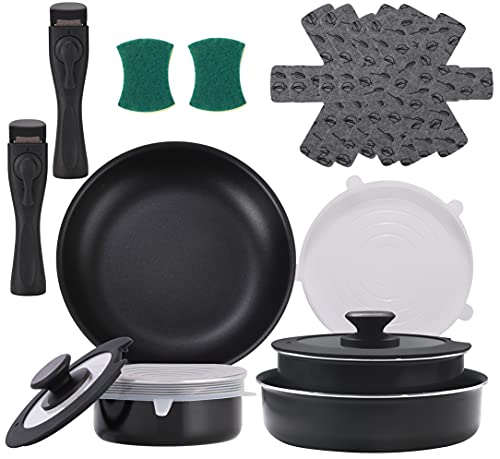
Xeeyaya 16 Pieces Removable Handle Set
Xeeyaya’s sixteen-piece set is the generalist of the six. Its title calls the cookware stackable and nonstick, names induction and gas together — a pairing worth noticing, since several rivals claim induction alone — and addresses RVs and camping with an explicit space saving promise. Sixteen pieces sits at the practical centre of the category: enough vessels for varied daily cooking, few enough that the stack remains a single manageable tower. For a motorhome kitchen or a boat galley, where every cupboard is measured in centimetres and the hob might be gas while the home kitchen runs induction, that dual-hob, space-first framing is precisely the brief.
Spec mini box — Pieces: 16, stated. Surface: nonstick, stated. Handle: removable, stated. Hobs named: induction and gas. Oven safety: unclaimed in the title. Dishwasher safety: also unclaimed.
Strengths
- Gas is named alongside induction, serving households whose hob is flame rather than glass.
- Sixteen pieces balance coverage against the storage the category promises to save.
- The space saving claim is printed in the title, aligning the marketing with the mechanism.
Trade-offs
- Oven safety goes unstated, so hob-to-oven recipes need verification before relying on them.
- The title does not enumerate which vessels the sixteen pieces comprise.
- Buyers wanting a ceramic surface should look to the Astercook or Umite Chef instead.
The gas mention deserves a moment, because induction dominates detachable-handle marketing to a degree that leaves gas cooks underserved. A removable handle on a gas hob brings a small extra consideration — the handle must sit clear of flame licking around a pan’s base — and a set that names gas in its title has at least considered that world. Xeeyaya’s camping and RV framing reinforces the point: portable and vehicle kitchens overwhelmingly burn gas. Sixteen pieces also splits the difference in the piece-count arms race sensibly. Twenty-one-piece sets impress on paper while duplicating sizes some cooks never touch; sixteen well-chosen vessels cover the daily repertoire of most households without the stack growing into a second tower. If your cooking life moves between a home kitchen and a vehicle or campsite, this is the set whose title was written about you.
There is a packing intelligence to sixteen pieces that deserves naming. In an RV cupboard, cookware must survive road vibration without rattling itself or its neighbours apart, and a tight handle-free stack is inherently quieter and more stable than a loose nest of handled pans. Owners often line the stack with cloth or felt between vessels — which may be what this article’s library title gestures toward with its mention of covers — but the titles themselves promise only the removable handles and stackability, so any protective layering is the owner’s sensible addition rather than a listed component. Xeeyaya’s set, sized between the minimal ShanSon and the maximal twenty-ones, is the one most likely to be bought specifically for a vehicle and then quietly promoted to the home kitchen as well.
Best for: a gas or induction household splitting cooking between home and an RV or campsite. Not suited for: signature dishes finishing in the oven, pending verification of oven safety. Check price on Amazon — sixteen pieces built for the road.
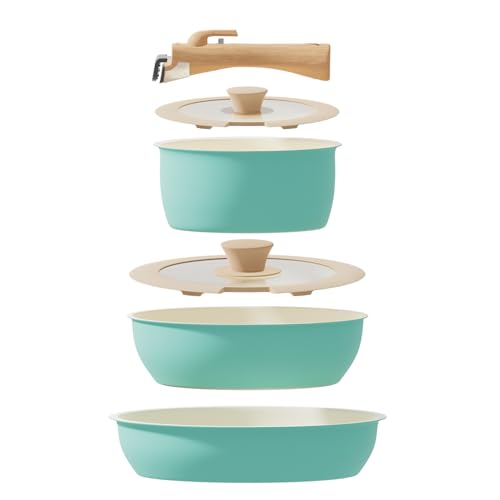
ShanSon 6 Pieces Removable Handle Green
ShanSon strips the concept to its essence: six pieces, non-stick, one removable handle system, stackable, for induction and gas, RVs and camping, in green. This is the set for the cook who looked at twenty-one-piece towers and thought — correctly — that three vessels do ninety percent of their cooking. A small set has a hidden virtue beyond price and space: every piece gets used constantly, so nothing sits at the bottom of a stack gathering dust and resentment. The green finish gives the minimal kit a deliberate look, and the title’s space saving language echoes the category promise at the smallest scale offered here.
Spec mini box — Pieces: 6, stated. Surface: non-stick, stated. Handle: removable, stated. Hobs named: induction and gas. Colour: green. Oven and dishwasher safety: neither is claimed in the title.
Strengths
- The smallest commitment in the list, ideal for first kitchens, studios, and dorm-adjacent living.
- Both induction and gas are named, matching the Xeeyaya’s hob generosity at a third of the count.
- A six-piece stack is the purest demonstration of why removable handles exist.
Trade-offs
- Six pieces will run out of vessels during any ambitious multi-pot meal.
- No oven or dishwasher claim appears in the title to lean on.
- Growing households will treat it as a starter and buy again within a few years.
Minimal sets teach an honest lesson about cooking repertoires. Most households rotate a frying pan, a saucepan, and one larger pot through nearly every dinner they make; the ShanSon simply refuses to sell them the other eighteen pieces. For a student flat, a single-person studio, or a campervan drawer, that refusal is respect for the buyer’s actual life. The shared removable handle across a tiny set is also less of a compromise than it would be in a big set, because small kitchens rarely run three vessels at full tilt simultaneously — and when they do, the cook is steps from the handle’s parking spot. Green will not suit every scheme, but at six pieces the colour commitment is small enough to be charming rather than risky. Buy it as the complete answer for a small life, or as the travel kit beside a full home set; do not buy it as the foundation of a family kitchen and expect it to stretch.
The green finish performs a small psychological service in a tiny kitchen: it makes the cookware look chosen rather than accumulated. Studio living often drifts into visual chaos because every object is visible from every seat, and a coordinated little set in a deliberate colour imposes a pocket of order on the shelf it occupies. Six pieces also wash up in minutes, which in a one-sink studio is not a trivial benefit — the ShanSon owner is never facing a mountain of soaking pans in the same basin they need for everything else. First-kitchen buyers should still think one step ahead: the set’s vessels will define their cooking habits, and a cook who discovers a love of elaborate Sunday sauces may add one large pot later rather than replacing the kit wholesale.
Best for: a studio, first flat, or campervan where three hard-working vessels cover the real repertoire. Not suited for: a family kitchen cooking four components of one meal at the same time. Check price on Amazon in green, built for small cupboards.
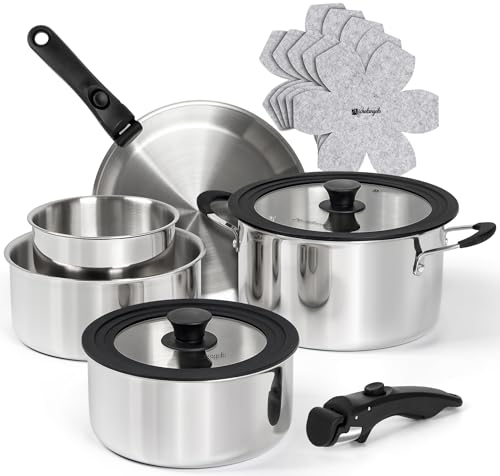
MICHELANGELO 14pcs Tri-Ply Detachable Handles
Every list benefits from a dissenter, and MICHELANGELO’s set dissents from this article’s own headline. The title describes fourteen pieces of tri-ply stainless steel cookware with detachable handles — and then states, in plain capitalised spirit, no coating and no PFAS. This is not a nonstick set, and it is reviewed here as the category’s control group: the same stacking, space-saving handle system, wrapped around vessels that will never release an egg by chemistry but will sear, deglaze, and outlast every coating on this page. The title targets RVs, small kitchens, and apartments, claims induction compatibility and oven safety, and pitches the stackable format at exactly the buyers the nonstick sets court.
Spec mini box — Pieces: 14, stated. Material: tri-ply stainless steel, stated. Coating: none — the title states No Coating and No PFAS. Handles: detachable, stated. Hob: induction compatible, stated. Oven: safe, stated.
Strengths
- Tri-ply construction brings the heat distribution serious cooks associate with premium steel pans.
- No coating means no coating lifespan; the surface in year ten is the surface from year one.
- Metal utensils, high heat, and deglazing are all back on the table without anxiety.
Trade-offs
- Eggs and fish will stick without fat and technique; this set does not forgive like nonstick does.
- Steel shows every scorch and rainbow stain, asking more of the cook’s cleaning habits.
- Fourteen steel pieces carry more heft in the stack than their nonstick equivalents.
The honest reason to include this set in a nonstick roundup is that many shoppers arrive at the category through the handle, not the coating. They want stacking first; the surface is a secondary preference they may not have examined. For those shoppers, the MICHELANGELO reframes the decision: if you cook with oil comfortably, sear often, and hate the idea of any coating wearing out, the same removable-handle convenience exists in permanent steel. The tri-ply claim matters because it addresses steel’s traditional weakness — hot spots — by layering conductive metal through the pan’s body. Small kitchens and RVs are named in the title, and steel suits vehicle life particularly well since it tolerates knocks that would chip ceramic. Treat this pick as the list’s longevity candidate: the set most likely to be handed down rather than replaced.
Technique is the toll steel charges, and it is worth describing honestly so the right buyers pay it gladly. Steel wants preheating before food arrives, a film of fat, and patience while a crust forms and releases on its own schedule; cooks who learn those three habits get searing and fond-building that no coating permits, plus pans that go under high heat without a second thought. The detachable handles add one steel-specific pleasure: a handle-free steel pan in a hot oven behaves like the cookware of restaurant kitchens, and the clip-on handle returns it to the table as serveware. Fourteen pieces is also a grown-up count — enough for serious daily cooking, without the duplication that pads the twenty-one-piece boxes.
Best for: a confident cook wanting detachable-handle stacking with a permanent, coating-free steel surface. Not suited for: a beginner whose breakfast is eggs and whose patience for sticking is zero. Check price on Amazon and examine the tri-ply build.

Umite Chef 21Pcs Ceramic Detachable Handle
Umite Chef closes the list with the third twenty-one-piece configuration, this time in ceramic with the title’s own health framing: non toxic, healthy induction cookware. The title also names a frying pans set within the twenty-one, a small act of enumeration the other big sets skip, and states dishwasher and oven safety together — the combination the Astercook’s title only half completes. For a cook whose decision tree runs ceramic first, full count second, and dishwasher third, this is the set that answers in order. The detachable handle system is present as the category requires, and the induction framing keeps it current for renovated kitchens.
Spec mini box — Pieces: 21, stated, with a frying pans set named in the title. Surface: nonstick ceramic, stated. Handle: detachable, stated. Hob: induction, stated. Oven and dishwasher: both stated as safe. Colour: the title names none.
Strengths
- Dishwasher and oven safety are both stated, the fullest care profile among the ceramic picks.
- Naming the frying pans inside the count gives buyers a clearer picture of the mix.
- Ceramic surface plus full piece count serves a whole-kitchen reset in one purchase.
Trade-offs
- The title’s healthy framing is the brand’s own language and should be read as positioning, not certification.
- Colour goes unstated, so appearance expectations rest on the listing photographs.
- Twenty-one pieces still demand the handle-count check before two-vessel cooking is assumed.
Umite Chef and Astercook invite direct comparison, since both offer twenty-one ceramic pieces with detachable handles and induction readiness. The titles separate them on care and colour: Umite Chef states dishwasher safety and keeps its colour unspoken, while Astercook leads with pink and leaves the dishwasher unclaimed. A nightly dishwasher routine should weight that difference heavily, because a set washed by hand against its owner’s habits becomes a set resented nightly. The frying pan enumeration also hints at a cookware mix tilted toward frying, which suits households whose cooking centres on the hob’s front burners — eggs, cutlets, stir-fries, pancakes — rather than long oven braises. As with the CAROTE, verify the handle count in the full listing, and this set stands as the ceramic completionist’s choice.
The non toxic and healthy wording in Umite Chef’s title reflects where many ceramic buyers begin: a wish to cook on a surface they feel uncomplicated about. This article records that wording as the brand’s own framing rather than endorsing or disputing it, because the honest comparison available from titles is about stated features — piece count, safeties, hob readiness — and on those measurable points the Umite Chef set is genuinely complete. A buyer motivated by surface peace of mind will find the ceramic field here offers two full-size choices, and the dishwasher claim is the practical tiebreaker between them for most households. Add the named frying pans, and the set sketches a clear portrait of its intended kitchen: busy, hob-centred, cleaned by machine, and unwilling to give up cupboard space to handles.
Best for: a ceramic-first household that runs the dishwasher daily and cooks heavily in frying pans. Not suited for: a buyer choosing by colour from the title, since none is stated there. Check price on Amazon and unpack the Umite Chef contents list.
Set-by-set ledger
| Set | Pieces | Surface per title | Safeties stated |
|---|---|---|---|
| CAROTE 21pcs Detachable Handle Non Stick | 21 | Non stick | Oven safe, dishwasher safe, induction ready |
| Astercook 21 Pcs Ceramic Detachable Handle Pink | 21 | Ceramic non stick | Oven safe, induction ready |
| Xeeyaya 16 Pieces Removable Handle Set | 16 | Nonstick | Induction and gas named |
| ShanSon 6 Pieces Removable Handle Green | 6 | Non-stick | Induction and gas named |
| MICHELANGELO 14pcs Tri-Ply Detachable Handles | 14 | Tri-ply steel, no coating | Oven safe, induction compatible |
| Umite Chef 21Pcs Ceramic Detachable Handle | 21 | Nonstick ceramic | Oven safe, dishwasher safe, induction |
How to choose a removable-handle cookware set?
How many handles does the box actually include?
Ask this before everything else, because none of the six titles states it and it governs daily cooking. One handle shared across a set is a storage triumph and a two-vessel bottleneck; two handles restore parallel cooking. The full listing for your finalist will show the handle count — check it against your busiest regular meal. If that meal runs a pot and a pan simultaneously every night, a one-handle set will frustrate you regardless of its other virtues, while a solo cook making one-pan dinners will never notice the limitation.
What does your heaviest cooking day look like?
Festive cooking is the stress test small sets fail and big sets justify. If your year includes a holiday where four vessels run at once and the oven holds a fifth, the twenty-one-piece tier earns its cupboard tower; if your heaviest day is a Sunday sauce and a pan of greens, the middle sets suffice and the ShanSon even survives it with planning. Buy for the heaviest day you host regularly, not the heaviest day you can imagine — imagination oversizes every purchase it touches.
Which surface matches your cooking habits?
Conventional nonstick forgives low-fat cooking and hurried mornings. Ceramic offers a similar release with a lighter-coloured surface that many cooks find more presentable, at the cost of stricter heat habits. Uncoated tri-ply steel, the MICHELANGELO’s path, forgives nothing and lasts forever, rewarding cooks who sear, deglaze, and scrub with commitment. Choose by the breakfast you actually cook: eggs daily points to nonstick or ceramic; steaks weekly points to steel. While the kitchen is being rethought end to end, the air in it matters too — Best Air Purifiers That Don T Produce Ozone examines purifiers whose titles address ozone directly, a relevant read for homes that cook with gas.
How deep is your storage, really?
Measure the cupboard or drawer before falling for any set, because stacking dividends assume a shelf height the tower can actually use. A twenty-one-piece stack needs a tall cupboard or a willingness to split it into two shorter towers; a six-piece stack fits almost anywhere, including the deep drawer many small kitchens substitute for cupboards. RV and campervan buyers should measure twice, since vehicle cupboards taper and curve in ways flat-pack home furniture does not. The set that fits your measured space beats the set that fits your imagined space, every time.
What will the set be washed in, and cooked on?
Match the title’s stated safeties to your appliances, not your intentions. Dishwasher households should shortlist the CAROTE and Umite Chef, whose titles claim dishwasher safety outright. Induction households are served by nearly every title here; gas households should note the Xeeyaya and ShanSon naming gas explicitly. Oven-finishing cooks need the words oven safe, which the CAROTE, Astercook, MICHELANGELO, and Umite Chef titles all provide. A set whose stated profile matches your kitchen’s actual machines will be used without friction for years.
Lids, the unsung half of every set
Lids rarely headline a cookware title, yet they decide how a set behaves on simmering day. A lid that fits two vessels doubles its value in a small stack; a set whose lids are counted in the piece total but fit awkwardly will annoy its owner weekly. None of the six titles itemises its lids, so the contents table in the full listing is where this quiet specification hides. Look for whether lids are shared across diameters, whether they stack flat or nest, and whether the largest pot’s lid also crowns the largest frying pan — a common and welcome economy in detachable sets. The stack you store includes the lids, after all, and a tower is only as tidy as its least stackable component.
Decoding a piece count before it decodes you
Since three of these sets claim twenty-one pieces and none itemises the count in its title, a decoding habit is essential. In this category a typical large count combines frying pans in two or three sizes, saucepans and a stockpot, their lids, one or two detachable handles, and sometimes utensils or protectors. The vessels a cook touches daily may number eight or nine inside a twenty-one-piece box — still a full kitchen, but a different mental picture from twenty-one pans. The right comparison between the CAROTE, Astercook, and Umite Chef is therefore not the shared number but the full listing’s contents table, read side by side: which diameters, which depths, how many lids fit how many vessels, how many handles. Ten minutes with those tables prevents the classic disappointment of a big box missing the one pot size your household uses nightly, and it converts an abstract count into a shopping decision grounded in your own menu.
The stacking dividend, measured in cupboards
The dividend also shows up at the table. A handle-free vessel is, in effect, its own serving dish: it leaves the oven or hob, receives the handle for the journey, and can set down among plates without a foot-long handle forcing the table layout around it. Hosts who serve family-style — gratins, baked pastas, skillet desserts carried straight to the centre — feel this benefit at every gathering, and it explains why so many detachable sets are photographed at tables rather than on hobs. Cookware that serves gracefully gets used for company; cookware that cannot leaves the host decanting and washing an extra dish.
It is worth visualising what detachable handles actually return. A conventional twelve-piece set with fixed handles occupies a cupboard in a sprawling single layer, because handles prevent nesting beyond pairs. The same vessels handle-free nest into a tower occupying roughly one large pot’s footprint, freeing the rest of the cupboard for the appliances and boards that currently live on the counter. In an RV the dividend is larger still, since cupboard volume there is measured against fuel and payload. The second dividend is oven geometry: a handle-free pan fits any oven shelf orientation and lets two pans share a rack that fixed handles would partition awkwardly. The third is washing: handle-free vessels sit flat in a sink or dishwasher rack. None of these dividends requires believing any brand’s marketing — they follow mechanically from the handle coming off, which is why this category keeps growing while flashier cookware trends fade.
Three surfaces, three temperaments
The surface question deserves a cooler head than internet debates usually give it. Conventional nonstick, represented by the CAROTE, Xeeyaya, and ShanSon, is the most forgiving surface for low-fat, low-attention cooking, and its weakness is lifespan under abuse: metal utensils, overheating empty pans, and abrasive cleaning all shorten its slick years. Ceramic, in the Astercook and Umite Chef, offers a similar release experience with a surface many cooks find more pleasant to look at and serve from; it asks for moderate heat discipline and tends to show its age through gradual loss of slickness rather than dramatic failure. Tri-ply steel, the MICHELANGELO’s answer, has no slickness to lose and no ceiling on heat or utensils, but demands technique for delicate foods. None of these is the correct surface in the abstract. The correct surface is the one matched to the cook’s real habits — and the most common buying error in this category is purchasing for the cook one aspires to be rather than the cook who actually makes Tuesday’s dinner.
Replacement thinking belongs in the same conversation. A nonstick or ceramic set is realistically a medium-term purchase whose hardest-working pan will tire first, while the steel set is a long-term one whose owner may never replace it. Households that cook daily and value perpetual egg release often accept the medium-term rhythm, refreshing a set every few years as a known cost of convenience. Households that hate rebuying anything lean steel-ward even at the cost of a learning curve. Both positions are rational; the titles here let you act on either without leaving the detachable-handle category, which is the list’s structural strength.
Living with a clip-on handle: habits that make it work
The detachable handle asks for one new habit and repays it daily. The habit is choreography: the handle lives in a known parking spot — a drawer slot, a hook, a magnetic strip — and returns there after every use, because a handle that wanders is a handle missing at the exact moment a pan needs lifting. Households that assign the parking spot on day one report the system feels native within a week; households that let the handle drift among drawers describe the category as fiddly, which is really a storage complaint in disguise. The second habit is the lock check, a thumb’s confirmation before any lift, as automatic as testing a car’s door handle. The third is thermal common sense: clip the handle on before the vessel gets too hot to approach, and remove it before oven time unless the listing says otherwise for your set. None of this is burdensome — it is the small ritual tax on a large space dividend, and most owners pay it happily once the first cupboard closes neatly on a full set.
Cleaning changes character too. Handle-free vessels stack in the sink and the dishwasher without the angular Tetris fixed handles impose, and the handle itself, detached, can be washed or wiped separately rather than soaking its joints in the pan’s bathwater. Over months this shows up as tidier cupboards and less clattering — the quiet, compounding benefits that never appear in a feature list but decide whether a set is still loved in its third year. When a set also travels, as the RV-named picks here are meant to, the same stacking discipline keeps road noise down and cupboard contents settled at the destination, which anyone opening a caravan cupboard after a mountain road will appreciate without further explanation.
Moving house, merging kitchens, and other stack-friendly moments
Detachable-handle sets reveal a second talent whenever a household relocates. Fixed-handle cookware is among the most awkward cargo in a move — bulky, clattering, impossible to pack densely — while a handle-free stack nests into a single box with the handles tucked alongside, arriving at the new kitchen as one tidy unit. The same logic serves the great kitchen merges of adult life: two partners combining households, a parent downsizing into a smaller flat, students pooling equipment for a shared house. In each case the question is not how much cookware exists but how much space it may occupy, and a stackable set answers with a fraction of the volume. Several titles here name exactly those moments — apartments, housewarming, small kitchens, RVs — which suggests the brands understand their own category’s deepest use case: cookware for lives in transition, where space is the scarcest ingredient and flexibility the most valuable one.
Common mistakes when buying detachable-handle cookware
- Counting pieces instead of vessels. A twenty-one-piece set is not twenty-one pans; lids and handles share the count, so read the mix, not the number.
- Assuming two handles are included. No title here states the handle count, and discovering a single handle during a two-pan dinner is a miserable surprise.
- Treating ceramic like steel. Ceramic surfaces ask for moderate heat and gentle utensils; searing habits borrowed from steel pans shorten their slick life.
- Calling the steel set nonstick. The MICHELANGELO title states no coating in plain words; buying it for egg release misunderstands the product entirely.
- Ignoring your hob in the title check. Induction compatibility is stated by most picks here, but gas is named by only two — flame cooks should shop those first.
- Storing the stack without a thought for the surfaces. Coated pans stacked bare can mark each other over months; a cloth layer between vessels is cheap insurance the titles leave to you.
- Losing the handle’s parking spot. A detachable handle without a fixed home becomes the drawer gremlin of the kitchen, missing precisely when a full pan needs lifting.
Final recommendation
If two finalists remain after the constraints have spoken, break the tie with your busiest ordinary meal. Picture it precisely — the vessels on the hob, the one finishing in the oven, the washing-up that follows — and walk each set through it mentally. The set that never asks you to improvise a handle swap mid-service, never sends a pan to the oven it is not stated to survive, and never leaves a vessel hand-washed against your routine is the set that will still be pleasing you when the novelty of stacking has faded into habit. Features on a title are promises about that meal; choose the promises your Tuesdays actually need kept.
Let your kitchen’s constraints rank the list. The fullest stated package is the CAROTE: twenty-one nonstick pieces with oven, dishwasher, and induction all named. Ceramic loyalists split by care routine — Umite Chef if the dishwasher runs nightly, Astercook if pink makes your kitchen happier and hand-washing is acceptable. Mobile and mixed-hob cooks belong with the Xeeyaya, minimalists with the ShanSon six, and confident searing cooks who want stacking without any coating should take the MICHELANGELO steel set and enjoy it for a decade. Whichever set you choose, confirm the handle count on the listing page before ordering, and if the same shopping trip includes the grill station, Best Smokeless Grills with Cover covers indoor grills whose titles state lids and smokeless designs.
Frequently asked questions
What utensils should be used with the nonstick and ceramic sets?
Wood, silicone, and nylon are the safe companions for any coated surface, and the habit matters more than the brand of spoon: a single metal spatula habit can age a nonstick pan faster than a year of careful cooking. Keep one wooden spoon parked by the hob as the default reach, and the discipline mostly keeps itself. The steel MICHELANGELO set is the exception that welcomes metal tools without concern, which is one of its quiet daily pleasures for cooks who hate policing their own utensil drawer.
Are detachable handles sturdy enough for a full pot?
The mechanism is the category’s core engineering, designed to lock for lifting and release for storage. The practical habit is to test the lock’s engagement before lifting a full vessel, every time, the same way you would check a pressure lid — a two-second ritual that becomes automatic. Owners who cook daily report the check disappears into muscle memory within the first month, no more conscious than testing a car door before driving off, and the handle’s grip security stops being a topic of thought at all.
Why does one set in a nonstick roundup have no coating?
Because the MICHELANGELO’s title states tri-ply stainless steel with no coating and no PFAS, and it earns its place as the removable-handle option for cooks who want stacking without any surface to wear out. It is labelled honestly in its review rather than dressed as nonstick.
Is a removable handle safe around children learning to cook?
The lock-check habit is the safety core: an engaged handle is a handle, and the mechanism is built for lifting full vessels. Teaching a young cook to confirm the click before lifting is a genuinely useful kitchen lesson, and the handle’s absence when detached removes the classic hazard of a handle sticking out over the counter’s edge waiting to be knocked — a point many parents count in this category’s favour.
Do the piece counts include the handles and lids?
In this category, counts traditionally include lids and handles alongside vessels, and none of the six titles breaks the count down fully. Treat the number as a size signal and read the full listing’s contents list before comparing two sets by count alone.
Can these pans go from hob to oven?
Four titles state oven safe outright: CAROTE, Astercook, MICHELANGELO, and Umite Chef. The removable handle is what makes the transfer graceful, since the vessel enters the oven handle-free and the handle clips back on for serving. No title here publishes a maximum oven temperature, so treat that figure as another full-listing check before the first high-heat roast, particularly for the coated sets whose finishes set the ceiling.
Can a detachable-handle set replace a full traditional set?
For most households, yes — that is the premise the big twenty-one-piece sets are sold on, and their stated hob, oven, and dishwasher coverage supports it. The cooks who should keep a traditional piece alongside are specialists: a beloved cast iron skillet or a vast stockpot for annual preserving may still earn separate space. Everyone else can let the stack take over the cupboard entirely, and most report the strangest side effect: cooking more often, because the friction of digging out a buried pan has quietly disappeared from the start of every meal.
How should the stacked pans be protected?
The titles promise stackability, not protective accessories, so any felt or cloth layers between vessels are the owner’s addition. Nonstick and ceramic owners commonly adopt that habit to keep surfaces from marking each other in the stack; steel owners can stack bare without a thought. It costs almost nothing and preserves the finish you paid for. Old tea towels cut into squares do the job perfectly well, which keeps the protection habit free and therefore likely to survive.
Which set suits an RV best?
Three titles name RVs directly — CAROTE, Astercook, and Xeeyaya — and the ShanSon’s six-piece stack suits a campervan drawer. Gas-hob RVs should start with the Xeeyaya, which names gas among its hobs. Weight also matters on the road, and while no title publishes a set weight, the smaller counts are the natural shortlist for payload-sensitive vehicles.
Measure your cupboard with a tape rather than a guess, count your burners, check the handle tally on the listing page, and then let the handle come off — the stack that results, sliding into space a handled set could never use, is the whole point of this category and the daily dividend it pays in calmer, tidier cooking.


