Our Top Picks



What's inside
- What a pulley system actually does to resistance
- The 1:1 ratio and direct load feel
- The 2:1 ratio and the halved, smoother pull
- Cable travel, carriage stroke, and running out of room
- Wall-mounted pulley towers
- Plate-loaded cable machines and how the iron goes on
- Selectorised stacks versus plates
- Functional trainer pulley stations
- Rack-attached pulley systems
- Pulley wheels: diameter, bearings, and the feel of smooth
- Cables: construction, coating, and honest lifespan
- Anchoring, frames, and the forces nobody sees
- Attachments: the handles that define the training
- Adjustability: pulley heights and carriage positions
- Setting up the four formats in real rooms
- Movement quality: what the spec sheet cannot say
- Maintenance: cables, wheels, and guides
- Safety when things go wrong
- Comparing the formats head to head
- A shortlist method that works on any listing
- Check prices on Amazon
- Disclosure
As an Amazon Associate I earn from qualifying purchases. This post may contain affiliate links at no extra cost to you.
A pulley machine looks simple from across the room: a cable, a wheel, a handle, and a stack of iron waiting to be lifted. That simplicity is deceptive. The moment you pull the handle, a chain of mechanical decisions starts expressing itself through your hands — how the cable is routed, how many wheels it turns, whether the load hangs directly from the carriage or passes through a moving pulley, and how firmly the whole frame is tied into the structure of your house. Two machines with the same headline load rating can feel entirely different, one crisp and direct, the other light and floaty, purely because of choices made inside the cable path.
This guide works through those choices in the order they matter for a home gym. It covers wall-mounted pulley towers, plate-loaded cable machines, the pulley stations built into functional trainers, and add-on pulley systems that bolt or strap onto a power rack you already own. The discussion stays with published specifications and manufacturer manuals: pulley ratios, cable travel figures, sleeve diameters, anchor hardware requirements, and the maintenance intervals makers themselves print. Where a number varies across the market, the range is given as a range, because a home buyer comparing spec sheets needs the spread, not a single invented figure.
What a pulley system actually does to resistance
Strip away the frame and upholstery and a cable machine is a device for redirecting force. You pull in one direction — down, across, up from the floor — and the weight rises vertically against gravity. The pulley itself does not care which way the handle points; it only changes the direction of the cable. That redirection is what makes a single weight stack or a pair of loading sleeves useful for dozens of movement patterns, from a downward press to a low row to a diagonal lift that starts at ankle height and finishes above the opposite shoulder.
What the pulley arrangement does change, beyond direction, is the relationship between the load you select and the resistance your muscles meet. A fixed pulley bolted to the top of a frame changes direction only, so the tension in the cable equals the weight hanging from it, minus small friction losses at each wheel. A moving pulley, one that rides on the carriage and travels with the load, splits the work between two cable segments, and that split halves the resistance at the handle while doubling the cable you must pull to move the load a given distance. Every ratio discussion in this guide traces back to that single mechanical fact.
Friction is the quiet third factor. Each wheel the cable bends around adds a small resistance of its own, and a long cable path through six or eight wheels will never feel quite as free as a short path through two. Manufacturers rarely publish friction figures, which is why the bearing type, wheel diameter, and groove profile covered later in this guide matter as much as the ratio printed in bold type. A machine can be mechanically honest on paper and still feel gritty if its wheels are small, its bushings are dry, or its cable coating has started to fray.
The 1:1 ratio and direct load feel
A 1:1 system connects the handle to the load with no mechanical advantage. Select or load fifty pounds and the handle resists with fifty pounds of tension, and one foot of cable pulled moves the carriage one foot. Most dedicated lat pulldown and low row machines are built this way, as are many plate-loaded pulley towers where a single cable runs from the carriage up over a top wheel and down to the handle. The appeal is honesty: the number on the plate is the number in your hands, which makes tracking progress across weeks straightforward and makes the machine easy to compare with free weight work.
Direct drive also means direct feedback. At 1:1, any unevenness in the cable path arrives at the handle undiluted. A slightly eccentric wheel, a cable that has taken a set from sitting coiled, or a guide rod with a dry patch will telegraph straight into the repetition. Owners of 1:1 machines tend to become attentive maintainers for exactly this reason — the machine reports its own condition honestly. The compensating virtue is response: the load starts moving the instant the handle moves, with no slack segment to take up, which suits heavy, slow pulling where you want the weight engaged from the first inch.
The trade-off appears at the top of the load range. Because there is no mechanical advantage, a 1:1 tower that must serve genuinely heavy rows and pulldowns needs a carriage and sleeves that physically hold the full weight, and the frame and anchors must react the full force plus the downward pull of the user bracing against it. Spec sheets for plate-loaded 1:1 units commonly list maximum sleeve loads in the region of two hundred to three hundred pounds total, and the structure behind those numbers — upright gauge, weld quality, anchor pattern — deserves as much attention as the figure itself.
The 2:1 ratio and the halved, smoother pull
Run the cable from a fixed anchor, down around a pulley on the moving carriage, and back up over the top wheel to the handle, and the arithmetic changes. The carriage now hangs from two cable segments, each carrying half the tension, so the handle feels half the loaded weight. Load one hundred pounds and the resistance at the grip is fifty. In exchange, the handle must travel two feet for every foot the carriage rises. Functional trainers are almost universally built this way, because the halving produces the light, fluid feel their designers want for fast, multi-directional movement.
That fluidity is not an illusion or a marketing gloss; it follows from the physics. The moving pulley averages out small irregularities between its two cable segments, and the effective inertia at the handle drops, so the load accelerates and decelerates with less of the surging that a direct system shows when a repetition changes direction. For rehabilitation-style work, for rotational patterns, and for any exercise performed at controlled but continuous speed, the 2:1 arrangement genuinely is the calmer tool. Spec sheets state the ratio plainly, and any buyer should confirm it before comparing load figures between machines, because a two hundred pound stack on a 2:1 trainer delivers the same handle resistance as one hundred pounds on a 1:1 tower.
The cost of the halving shows up in two places. First, maximum resistance: a 2:1 machine needs twice the iron to deliver the same working load, which is why functional trainers carry either generous stacks or long loading sleeves and still sometimes feel light to strong users on rows. Second, cable travel doubles, and travel is a finite resource set by the height of the machine. That interaction between ratio and travel is important enough to deserve its own section below, because it decides whether a tall user can finish a pulldown or a short user can complete a full press without the carriage striking the top stops.
Cable travel, carriage stroke, and running out of room
Travel is the distance the handle can move before something stops it — the carriage reaching the top of its guide, the cable fully unwinding from its path, or the handle meeting the frame. Manuals express it in different ways: as carriage stroke, as usable cable extension from the pulley exit, or as the distance between the carriage at rest and the bumper at the top of the rails. For a buyer, the usable cable extension is the figure that matters, because it must exceed the longest path your body asks the handle to follow.
Consider the pulldown, the movement that runs out of travel most often. The handle starts above head height and finishes at the upper chest, but the cable path is longer than that vertical drop suggests once a tall user sits on a low bench and reaches up at the start. On a 1:1 machine the carriage rises the same distance the handle falls, so a carriage stroke of around fifty to sixty inches — a common published band for full-height towers — covers most users. On a 2:1 machine the carriage only needs half that stroke for the same handle movement, which is precisely why compact functional trainers can be shorter than dedicated pulldown towers and still complete the movement.
The reverse problem belongs to 1:1 machines used for standing work from the low pulley. A face pull, a low-to-high chop, or a standing row from the floor position asks the handle to travel a long diagonal, and every inch of it lifts the carriage an inch. If the carriage tops out mid-repetition, the stop is abrupt and the load effectively becomes infinite for an instant — an unpleasant and occasionally cable-straining event. Manuals for better-documented machines list a maximum recommended handle excursion for exactly this reason, and owners learn to stand closer to the machine, shortening the diagonal, when a movement threatens the stops.
Ceiling height closes the loop. A tower’s overall height, commonly between eighty-two and ninety-four inches for full-size units, must clear not just the ceiling but the top of the carriage’s travel and, on some designs, the user’s head on a pulldown bench. Basements with duct soffits are the classic trap: the frame fits under the joists but the carriage and cable exit sit directly beneath a duct, and the last few inches of stroke become unusable. Measuring the room at the exact footprint, rather than at the room’s highest point, is the unglamorous step that prevents the commonest installation disappointment.
Wall-mounted pulley towers
The wall-mounted tower is the space miser’s answer: a vertical column or a slim pair of rails fixed to the wall, a carriage that slides on it, a top pulley arm, and loading sleeves or a selectorised stack low on the frame. Depths off the wall are often under a foot at the column itself, with the working footprint defined by the user standing in front of it rather than by the machine. For a spare room that must remain a spare room, or a garage bay that still receives a car, that shallow profile is the entire argument.
Everything about a wall tower depends on the wall. Manufacturer manuals for this class are unusually specific, and reading one before purchase is essential: they name the stud spacing the bracket pattern expects, the lag bolt diameter and length, the minimum embedment into solid timber, and the separate, stricter instructions for masonry. A tower rated for heavy loading typically spreads its anchors across two studs with a mounting plate or stringer, because a single stud asked to react both the hanging load and the outward leverage of a user pulling at an angle is being asked a great deal. The top bracket carries the worst of it — a downward pull at the handle, offset from the wall face, tries to rotate the column away from the wall at the top fixings.
Renters and owners of steel-stud or plasterboard-only walls should read those manuals as a filter, not a challenge. If the specified substrate is not what your wall is made of, the correct conclusion is that this machine is not for this room, and a freestanding or rack-mounted alternative belongs on the shortlist instead. Where the wall is suitable, the reward is a machine that feels unusually solid for its size, because a building’s structure is a far stiffer foundation than any freestanding frame of similar weight, and a well-anchored tower has none of the sway that light freestanding units show on heavy rows.
If you are furnishing the floor around a wall tower, the mat question matters more than it first appears, and our guide to floor coverings for low rooms walks through thicknesses that will not foul a low pulley at floor level — see best basement workout rugs for that comparison.
Plate-loaded cable machines and how the iron goes on
Plate loading is the default economy of the home gym: the plates already in the room, bought for a barbell, take a second job on the cable machine. A plate-loaded carriage carries one or two horizontal sleeves, and the user slides plates on and secures them with collars before each set. The obvious saving is the cost and shipping weight of a selectorised stack. The less obvious benefit is granularity — plates allow the small jumps that a home lifter’s own collection already supports, including fractional plates, whereas a stack moves in the fixed increments its plates were cast to.
Sleeve diameter is the first compatibility gate. Olympic sleeves accept plates with a two-inch centre hole, and most mid-market plate-loaded machines now use this standard, often with sleeves around nine to eleven inches of loadable length per side. Older and budget designs still appear with one-inch standard sleeves, which suit the thin plates sold with vinyl weight sets but cannot borrow from an Olympic collection. Some carriages split the difference with removable adapter sleeves that slide over a one-inch post to present a two-inch surface; manuals treat these as load-bearing parts, not accessories, and specify their own ratings, which are sometimes lower than the carriage rating itself.
Loadable length, not the headline maximum, is what strong users actually hit. Plates differ in thickness — a cast iron forty-five can be under two inches thick while a bumper plate of the same weight can exceed three — so the same sleeve that swallows three hundred pounds of thin iron may hold barely half that in bumpers. Buyers who train with bumpers should do the arithmetic from their own plate thicknesses against the published sleeve length before purchase, not after. Sleeve finish matters too: chrome and powder coat both wear where plate hubs slide, and a sleeve with a slight shoulder or stop ring keeps the innermost plate from grinding against the carriage frame through thousands of loading cycles.
Selectorised stacks versus plates
A selectorised stack replaces loose plates with a column of flat rectangular plates pierced by a selector rod; moving a pin changes the load. In a home setting the stack’s virtue is speed and tidiness: no plates to fetch, no collars, no iron stored on the floor beside the machine, and a partner can change the load mid-circuit in two seconds. Stacks also behave consistently on a 2:1 system, where the doubling of required iron would otherwise mean a great many loose plates for heavy work.
The costs are equally concrete. A stack machine ships at its full weight, often several hundred pounds, and the stack’s maximum is fixed forever — when the user outgrows it, some designs accept add-on plates that rest on top of the stack, but many accept nothing. Stack plates ride on guide rods and rely on the top plate’s bushings; a stack that has been dropped repeatedly, as happens when a user releases a handle mid-set, can chip plate edges and bend the selector rod, and replacement plates are model-specific parts ordered from the maker. Guide rod lubrication, usually a light silicone on a cloth at intervals the manual states, is the stack’s main recurring chore.
Functional trainer pulley stations
A functional trainer is two pulley stations sharing one frame: a trolley on each upright, each trolley carrying a pulley and adjustable through a tall range of heights, each connected to its own stack or loading carriage. The format’s defining number, after ratio, is the height adjustment range and the count of locking positions — published figures commonly run from around a dozen positions to more than twenty per side, spaced roughly two inches apart. Closer spacing matters most at the extremes: the difference between the lowest trolley position and floor level decides whether a low cable movement starts truly low or awkwardly at shin height.
Dual stations introduce a possibility single towers cannot offer: two cables at once. Pressing with a handle in each hand, performing a fly with both arms on independent loads, or setting the two sides to different heights for an asymmetrical pattern all require independent carriages, and the independence has a subtle benefit even for single-handle work — the unused side sits idle rather than adding its friction to the path. When both cables join to one bar for heavy work, some designs allow the trolleys to be linked to a single stack, and the manual’s load figures for linked versus single use differ; the linked figure is not simply double, because the bar, the trolleys, and the user’s own alignment become the limiting parts.
Width between the uprights shapes the trainer’s character. Wide frames, around fifty inches or more between pulley exits, let the cables angle outward naturally for presses and flyes and suit taller users. Narrow frames fit smaller rooms and keep the cables closer to vertical, which some users prefer for rows and pulldowns improvised at the centre. There is no correct width, only a match between the frame, the room, and the span of the person using it — but it is a dimension to check on the spec sheet rather than discover at assembly.
Core stability work pairs naturally with a dual station, since so many cable patterns brace the trunk while the arms move, and readers building out that side of their training can compare the vertical knee-raise stations in best captain chairs for exercise, which our editors placed alongside cable work for shared floor space planning.
Rack-attached pulley systems
The fourth family adds a pulley to a power rack rather than replacing it. These systems range from a simple strap-and-pulley kit — a loading pin hung from a cable that passes over a wheel clipped to the top of the rack — to engineered attachments with their own carriage sliding on a dedicated rail bolted inside the uprights. The strap kits cost little and store in a drawer; the engineered attachments behave like a permanent station. Both share one premise: the rack, already anchored or heavy with stored plates, becomes the structure the cable pulls against.
Compatibility here is a matter of millimetres. Upright cross-section — two-by-two, two-by-three, or three-by-three inches — hole diameter, either five-eighths or one inch on most modern racks, and hole spacing along the upright decide which attachments physically fit. Westside spacing, with holes one inch apart through the bench zone, appears on uprights rather than on pulley rails, but it signals the ecosystem a rack belongs to. Attachment makers publish compatibility tables by rack series, and those tables, not the headline description, are the document to trust. A carriage designed for a three-by-three upright will not clamp honestly onto a two-by-two, however persuasive the listing photograph.
Rack systems also inherit the rack’s stability limits. A pulldown performed on a light, unanchored rack with the load hanging from a top crossmember can tip or skate the whole structure, especially when the user pulls at an angle from outside the footprint. Manuals for rack attachments routinely require the rack to be bolted down, weighted with plate storage, or both, and specify a minimum rack weight. The loading pin format has its own quirk: a pin hung with plates swings like a pendulum when the handle is released carelessly, and the swing, not the lift, is what dents uprights and chips plate edges in home gyms. A short length of the user’s attention at the end of each set is the entire remedy.
Pulley wheels: diameter, bearings, and the feel of smooth
Every account of cable smoothness eventually arrives at the wheels. A pulley wheel does three jobs: it supports the cable in a groove, it turns with minimal resistance, and it keeps the cable tracking centrally so the coating does not saw against a flange. Wheel diameter influences all three. A larger wheel bends the cable through a gentler arc, which reduces the flexing fatigue in the cable’s strands and lowers the force needed to start it turning; published diameters on home equipment commonly run from about three inches on compact attachments to four and a half inches or more on the main top wheels of full towers.
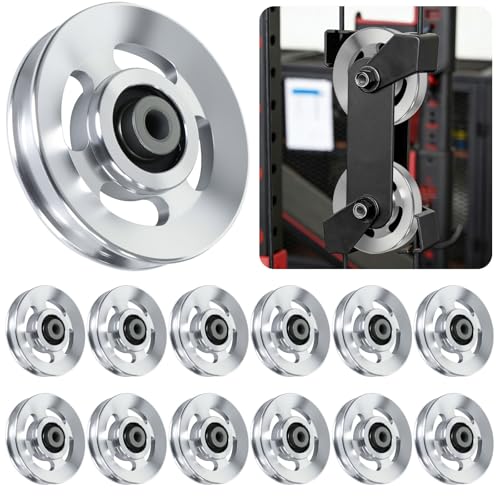
The centre of the wheel decides how it turns. Sealed ball bearings are the specification most buyers look for, and with reason: a bearing wheel spins freely under load, resists the side-to-side wobble that makes a cable wander in its groove, and asks for no lubrication across its service life. Bushing wheels — a plain sleeve rotating on a shoulder bolt — cost less and can feel perfectly acceptable when new and clean, but their friction rises as the bore wears oval, and the first symptom is a faint hesitation at the start of each pull that users often blame on the cable. Nylon wheels on steel bushings sit between the two in price and behaviour, and dominate the mid-market; aluminium wheels appear on premium units, valued for low rotational inertia and grooves that stay true.
Groove profile is the detail spec sheets mention least and owners feel most. The groove should cradle the cable’s coated diameter closely: too wide and the cable flattens and wanders, too narrow and the coating pinches and wears at the contact line. When a machine’s cable is replaced with a thicker aftermarket cable, a groove mismatch is the usual reason the new cable feels worse than the old one. Swivel housings add one more refinement — a top pulley that can rotate to face the direction of pull keeps the cable entering the groove squarely when the user stands off to one side, and fixed housings on machines used at angles are a known source of edge wear on both cable and wheel.
Cables: construction, coating, and honest lifespan
The cable itself is almost always a steel wire rope with a polymer coating. The core is a bundle of galvanised or stainless strands, commonly around three to five millimetres of steel, and the coating — nylon or PVC — brings the finished diameter to roughly five or six millimetres and gives the cable its smooth, quiet run through the grooves. The coating is a wear surface, not armour. Where the cable bends over the smallest wheel in the system, and where it passes any guide or exit eyelet, the coating thins first, and the bright line of exposed steel at a bend is the standard visual warning that replacement time is approaching.
Breaking strength figures for such cables are high — published ratings for quality gym cable run into the thousands of pounds — but the working limit of a machine is never the cable’s breaking strength. It is set by the weakest element in the chain: a crimped end fitting, the carriage weld, the anchor bolts, the frame. This is why the machine’s rated maximum load, not the cable supplier’s tensile figure, governs loading, and why a replacement cable must match the original’s diameter and end fittings rather than merely exceed its strength. End fittings vary — ball stops, thimble eyes, threaded studs — and the fitting, crimped under tons of pressure, is not a home workshop job; manuals direct owners to order the factory replacement cable by part number.
Cable length is a specification with consequences. A cable cut slightly long leaves the carriage resting above its bottom bumpers, so the load never fully settles and the first inch of every pull is slack take-up; a cable slightly short holds the carriage off its rest position under constant tension. Adjustable systems provide a threaded take-up at one end fitting, and manuals describe the target plainly: with the selector pin in the lightest position or the carriage unloaded, the top plate or carriage should sit on its rest pads with the cable just taut. Checking that adjustment after the first weeks of use matters, because new cables stretch measurably as their strands seat — a phenomenon the industry calls constructional stretch — and a cable adjusted perfectly at assembly can hang slack a month later.
Anchoring, frames, and the forces nobody sees
A cable machine at rest carries its own weight. A cable machine in use carries arguments. The user pulls down and toward themselves; the load pulls up; the frame mediates between the two and the floor or wall absorbs the difference. On heavy low rows the user braces their feet against a footplate and effectively tries to drag the machine across the room with every repetition, and on pulldowns the combined downward force at the seat can approach the user’s bodyweight plus the selected load. Freestanding machines answer with footprint, weight, and geometry: a wide base, a low centre of gravity, and often the user’s own mass on a seat tied into the frame.
Where a machine must be bolted, the manual’s hardware schedule is the authority — bolt diameter, grade, washer size, and the substrate it assumes. Concrete wedge anchors, lag bolts into timber studs, and through-bolts with backing plates are three different answers to three different structures, and none substitutes for another. Torque matters as well: an under-torqued anchor in a wall tower permits a flexing movement at the bracket that frets the bolt hole larger over months, turning a rigid mount into a loose one by slow degrees. Several manufacturers specify a re-check of anchor torque after the first month of use, an instruction buried in assembly manuals and widely skipped.
Frame construction sets the ceiling under all of this. Upright and column tubing on home machines is typically eleven or twelve gauge steel in two-inch or three-inch sections, with lighter fourteen gauge appearing on budget frames. Gauge alone does not make a frame strong — weld penetration, gusseting at the pulley arm root, and the triangulation of the base matter as much — but the combination of a high load rating with thin, small-section tubing and no gussets is a pattern spec readers learn to distrust. The pulley arm at the top of a tower is the most stressed member on the machine, cantilevered out over the user with the full cable tension arriving at its tip, and a visible gusset or a boxed arm section there is a reassuring piece of engineering honesty.
Sweat management sounds trivial until a cable session runs long, and the towels compared in best workout towels were assessed for grip on vinyl benches and handles, which is where a damp palm matters most during heavy pulling.
Attachments: the handles that define the training
A pulley machine without attachments is a potential, not a tool. The handle is where force meets the hand, and the collection supplied in the box shapes the first year of training on any machine. A typical bundle includes a long lat bar for wide pulldowns, a short straight bar for pressdowns and curls, a rope with two knotted ends for pressdowns and face pulls, a pair of single stirrup handles with rotating grips for unilateral work, and an ankle strap for cable work at floor level. Listings count these pieces proudly; the more useful question is how each is built.
Bar attachments should be judged by their knurling or moulded grip texture, the freedom of their centre swivel, and the rating of the eye or hook that meets the cable’s carabiner. The centre swivel matters more than it looks: a bar that cannot rotate as the cable twists will wind the cable up over a set, and a wound cable pulls unevenly. Rope attachments live or die by their end stops and the abrasion resistance of the braid where it passes through the centre mount. Stirrup handles divide into hard plastic, steel with rubber grips, and fabric strap designs; the fabric versions, often with a neoprene lining, conform to the hand and have become the default on functional trainers because they suit pressing as comfortably as pulling.
The carabiner is the smallest load-bearing part in the whole system and the one most often upgraded carelessly. Machines ship with a rated connector, commonly a steel carabiner or a quick link, and the manual’s load rating assumes a connector of at least that strength. Substituting a decorative or unrated clip from a hardware bin breaks the chain of ratings at its most stressed point. Owners who want faster changes between attachments sometimes fit a second rated carabiner so each handle keeps its own, a small expense that also removes the temptation to leave a handle clipped by a gate that has not fully closed — the half-latched carabiner being a classic cause of a handle parting company with the cable at the top of a pressdown.
Adjustability: pulley heights and carriage positions
The working height of the pulley exit decides which movements a machine can serve honestly. A fixed high pulley and a fixed low pulley cover the classic pair — pulldowns from above, rows and curls from below — and for many home lifters that pair, done well, is enough. An adjustable trolley that locks anywhere along the upright covers everything between: the mid-height start of a chest press, the hip-height origin of a standing cable pattern, the knee-height setting for a low row variation. Published trolley systems commonly offer positions numbered along the upright, and the numbering itself is a small ergonomic gift, letting a user record settings in a training log and return to them exactly.
The locking mechanism deserves scrutiny. A spring-loaded pin that engages a hole in the upright is positive and unmistakable; a friction clamp that squeezes the upright can creep under vibration if its pads are worn or oily. Better trolleys combine both — the pin carries the load, the pad removes the rattle. One-handed adjustment is more than a convenience on a dual trainer, where the user often holds a handle in the free hand; trolleys that need two hands and a jiggle to seat their pin get adjusted less often, and a machine that discourages adjustment quietly becomes a fixed-height machine with extra parts.
Bench pairing extends the question. A pulldown needs a seat at the right distance from the cable line, and a low row needs a footplate the user can brace against while seated on the floor or a low bench. Some towers integrate a seat and thigh pads; others assume a bench the owner supplies, and the geometry — whether the cable line falls over the bench’s centre when the bench is placed against the frame — is worth checking in the manual’s dimension drawings. A bench that must sit half off the frame’s footprint to align with the cable will rock, and a rocking bench under a heavy pulldown is a problem that announces itself at the worst moment.
Setting up the four formats in real rooms
Each format makes a different demand of the room, and the honest comparison is not footprint alone but working envelope: the space the user and the moving handles occupy. A wall tower’s envelope extends about four feet out from the wall for rows and standing work. A functional trainer’s envelope wraps around its front and sides, since handles travel outward as well as forward. A rack attachment’s envelope is the rack’s own, which is its great advantage — the cable work happens inside space already surrendered to lifting — but the user performing a pulldown in a rack shares that space with a barbell stored on the uprights, and most owners develop a ritual of moving the bar before cable work begins.
Freestanding plate-loaded towers sit between these patterns. Their frames commonly occupy around four feet by two and a half feet, weigh enough to stay put under honest loads, and ask for clear floor in front for a bench. In a single-car garage shared with storage, that footprint often fits along the side wall where a rack would block shelving. Ceiling clearance returns as a constraint: a tower tall enough for a full pulldown by a tall user may stand within a few inches of a garage door’s open track, and the door, not the ceiling, becomes the collision to plan around. Measuring with the door open is the version of the measurement that counts.
Flooring under the machine interacts with loading. Plates are carried to the carriage and occasionally set down hard; a floor that protects the slab and deadens the clang — stall mats or dense rubber tiles of three-eighths to three-quarters of an inch — also gives the frame’s feet a surface they cannot skate across. On carpet, a freestanding machine settles unevenly as the pile compresses under its feet, and a sheet of plywood beneath the frame, a remedy several manuals themselves suggest, spreads the load and restores a predictable stance.
Anyone training in a small shared room will end up rotating between stations in a tight footprint, and the soft kit kept within reach of the bench matters more than expected, which is why best microfiber gym towels belongs in the same planning conversation — microfibre cloths wipe down grips and carriage rods between sessions without leaving lint in the mechanism.
Movement quality: what the spec sheet cannot say
Two machines with identical ratios, loads, and travel can still pull differently, and the differences live in the accumulation of small things: the straightness of the guide rods, the truth of the wheel grooves, the cable’s suppleness, the carriage’s freedom from rocking in its track. A carriage that rocks a few degrees as it rises will bind alternately against its guides, producing a pulsing resistance that rises and falls through the stroke. Spec sheets do not list carriage play, but parts diagrams reveal the design intent — carriages carried on four wheels or on linear bearings along two rods are engineered against rocking in a way that a single glide block on a tube is not.
Starting resistance is another unlisted figure with daily consequences. Every system has a minimum useful load: below it, the carriage’s own weight and the friction of the path dominate, and the handle feel becomes vague. On a plate-loaded 1:1 tower the lightest possible load may be the bare carriage, often fifteen to twenty-five pounds, which is too much for some rehabilitative and rotator cuff patterns. A 2:1 trainer halves the carriage’s effective weight along with everything else, which is one reason trainers serve light, precise work better. Buyers whose training includes genuinely light cable work should ask what the carriage alone weighs — a figure manuals sometimes bury in the parts list as the carriage assembly’s shipping weight.
Noise belongs in this section because it is a quality-of-life specification in a house. Cable machines are among the quieter forms of resistance training, but a stack’s plates clink at the end of a set, a plate-loaded carriage rattles if its glide surfaces are loose, and a cable with a damaged coating ticks as the damaged section passes each wheel. In a home where training happens early, these sounds carry through floor joists. Machines with rubber bumpers at both ends of carriage travel, and stacks fitted with plate bushings that keep the plates from rocking on the selector rod, are audibly calmer, and none of that appears in a headline specification.
Maintenance: cables, wheels, and guides
Manufacturer manuals converge on a maintenance rhythm, and it is lighter than most owners fear and more specific than most owners follow. A monthly visual pass over the full cable length, run slowly through the hands with the machine unloaded, feeling for the catch of a broken strand or the roughness of a coating worn through. A quarterly check of wheel spin — each pulley should turn freely and silently when flicked — and of the fasteners at the pulley arm and carriage. A periodic wipe of guide rods with the lubricant the maker specifies, and nothing else: the wrong lubricant on a nylon glide or a stack bushing can swell the polymer or attract a paste of dust that grinds the rod’s finish.
Cable replacement is the one scheduled expense of ownership. Service life varies enormously with use — a cable in a busy household gym, bent over small wheels under heavy loads daily, lives a harder life than the same cable in a twice-weekly routine — and makers express replacement guidance as inspection-based rather than calendar-based for exactly that reason. The signs, in roughly the order they appear: coating worn to bright steel at the highest-bend wheel; a section of cable that has taken a permanent kink or a flat spot; frayed strands visible where the coating has split; a fitting showing hairline cracking at the crimp. Any one of these retires the cable. A cable is inexpensive beside the loads it carries, and the discipline of replacing on condition rather than on failure is the centre of cable machine safety culture.
Safety when things go wrong
The failure everyone imagines is the cable snapping under load, and the honest discussion of it is reassuring in one way and sobering in another. A cable that has been inspected and replaced on condition does not snap without having announced its decline through visible wear; sudden failure of a sound cable is rare enough that manuals treat it as a misuse case — a cable overloaded beyond the machine’s rating, damaged by a frame edge after misrouting, or substituted with an unrated hardware-store cable. The sobering part is that the consequences depend entirely on what the user is doing: a cable parting during a pressdown drops the load and startles; the same failure during a heavy pulldown, with the user’s face under the bar’s path, is a different event. Thigh pads, controlled eccentrics, and never placing any part of the body in the load’s drop path are the standing defences.
Other failures are more common and less dramatic. A selector pin not fully seated can walk out mid-set and unload one side of a movement. A collar left off a sleeve can let a plate slide and drop onto a foot. A trolley pin half-engaged can release under load and let the pulley exit drop a hole or two down the upright. Every one of these is a two-second check before the set, and the pattern across all of them is the same: cable machines fail at their interfaces — pins, collars, clips, anchors — far more often than in their members. The pre-set ritual of touching each interface is the cheapest safety equipment in the room.
Children and cable machines require a plain word. A stack or carriage left loaded, a handle left hanging at a tempting height, and a pin a small hand can pull are hazards a household gym must design out: unload the machine, park handles high or remove them, and store the selector pin out of reach if the room is shared with young children. Several manuals state this explicitly, and it belongs in any honest account of owning the equipment.
Comparing the formats head to head
Set the four families side by side and their personalities sharpen. The wall tower offers the smallest footprint and the stiffest feel per unit of floor, at the price of demanding a suitable wall and offering, in most designs, one cable path. The plate-loaded freestanding tower is the generalist: honest 1:1 loading, no wall required, a bench’s worth of extra floor. The functional trainer is the movement library, two adjustable 2:1 stations whose light, fluid resistance suits everything except maximal pulling, and whose stacks or sleeves set a ceiling that strong users should check against their ambitions before buying. The rack attachment is the economist’s choice, converting structure already owned into a cable station, with compatibility homework as its admission price.
Budget follows the same order, roughly ascending from strap kits through wall towers and plate-loaded frames to full trainers with dual stacks, though the plate-loaded trainer formats blur the line. The truer cost accounting includes the room: a machine that requires a wall to be opened and a stringer fitted, or a rack to be bolted and weighted, carries installation costs in time and hardware that never appear on its product page. Against that, the cost per year of a well-kept cable machine is low — a cable every few years, perhaps a wheel or a set of glide pads — because the design has so few parts that wear.
Longevity favours simplicity and parts availability. A machine whose cable, wheels, and bushings are standard sizes, or whose maker publishes a parts list with numbers a decade later, can be kept in service almost indefinitely. A machine built around a proprietary carriage extrusion or an unusual cable fitting is hostage to its maker’s continued interest. Buyers planning a ten-year gym — which is the right horizon for equipment of this kind — do well to download the manual and parts list before purchase and confirm that the wear items exist as orderable parts.
A shortlist method that works on any listing
Faced with a page of machines, a disciplined reader can cut the field quickly. Confirm the ratio first, and translate every load figure through it. Check travel against your own reach and the movements you actually train. Measure your room — ceiling at the footprint, wall construction, door swings — against the frame’s published dimensions. Verify plate compatibility against the iron already in the room, sleeve by sleeve. Read the anchor or stability requirements as a pass-or-fail gate, not a suggestion. Then read the manual’s maintenance pages, because a machine whose upkeep matches your habits will be maintained, and one whose upkeep does not, will not.
What remains after those gates is usually two or three machines, and the choice between them can honestly rest on feel, on the attachment bundle, on the height positions, on the small question of whether the trolley pin seats with a satisfying click. Those are legitimate grounds. The expensive mistakes in this category are never about the last few percent of smoothness; they are the machine that tops out on travel, the tower anchored into a wall that could not hold it, the sleeves that cannot take the plates in the corner. All of those are visible in documents published before purchase, which is the quiet theme of this entire guide: the information that protects a buyer is printed, free, and mostly unread.
Choose the format your room can hold honestly, load it within the rating its maker printed, inspect its cable the way its manual asks, and a pulley machine will repay the attention with the longest, quietest service of anything in the gym — the carriage rising and settling on its rods, season after season, asking for almost nothing but a wiped rod, a turned wheel, and a cable renewed before it ever has to ask twice.
Check prices on Amazon
Live listings for the shortlist in this guide are pulled from Amazon below, so prices and availability are always current at the moment you look.


Disclosure
Cable towers, racks and trainers reach this page through spec sheets and manuals gathered during our research, and the links that follow from here are how the site pays for that paperwork. As an Amazon Associate we earn from qualifying purchases. That arrangement never changes a ratio figure, a load rating or an anchor requirement printed above.