What's inside
- Quick picks: best care instructions for new towels
- Why New Towels Need Care Before First Use
- How We Chose the Best Care Instructions for New Towels
- The 6 Steps
- Supplies for the Best Care Instructions for New Towels
- How to Care for New Towels
- Common Mistakes When Caring for New Towels
- Sizing and Weight
- Caring for Your Towels
- More About New Towel Care
- Frequently Asked Questions
- More Towel Guides from Cottage Verdict
- Conclusion
As an Amazon Associate I earn from qualifying purchases. This post may contain affiliate links at no extra cost to you.
Quick picks: best care instructions for new towels
| # | Product | Where to buy |
|---|---|---|
| 1 | Tide Original Liquid Laundry Detergent, 100 fl oz | Check on Amazon |
| 2 | Woolzies Wool Dryer Balls, 6 XL | Check on Amazon |
| 3 | TENRAI Delicates Laundry Bags | Check on Amazon |
| 4 | Heinz Distilled White Vinegar 5% Acidity, 1 gal Jug | Check on Amazon |
| 5 | Arm & Hammer Super Washing Soda, 55 oz | Check on Amazon |
Why New Towels Need Care Before First Use
The best care instructions for new towels are the steps that keep a towel soft and absorbent for years, so a towel that is washed before its first use, washed with less detergent and dried fully between uses is the one that lasts, while a towel that is washed with too much detergent and fabric softener will go stiff and stop absorbing. A new towel carries finishing chemicals from the factory that reduce absorbency, so the first wash matters more than any later wash, and the six steps in this guide all make a new towel better, while a towel that skips them is the one that will disappoint, whatever its quality.
The first thing to do is wash the towel before its first use. A new towel carries finishing chemicals that reduce absorbency, so a first wash removes them, and a towel that is washed first will absorb more from day one, while a towel that is used straight from the packet will push water around rather than absorb it, so a buyer should wash every new towel before using it, since that is the step that matters most.
The fourth thing is to dry the towel fully between uses. A damp towel will develop odour and mildew, since bacteria grow in damp fabric, so a buyer should hang the towel where air can reach it, not folded damp on a rail, and a towel that dries fully between uses will stay fresh far longer than one that stays damp, whatever its quality.
This guide describes six steps for caring for new towels, with the reasons for each, plus a guide to choosing between care methods, the mistakes that ruin towels, and answers to the questions shoppers ask most. The descriptions are based on the makers’ published care instructions and on widely reported owner experience, and no prices are given because prices change with size, colour and retailer.
How We Chose the Best Care Instructions for New Towels
The steps in this guide were chosen from real, named care instructions that are published by towel makers, not from generic advice. Each step was checked against the makers’ published care instructions — washing, drying and storage — and against widely reported owner experience, so the descriptions reflect what actually keeps a towel soft and absorbent, and a step was only included if its reason could be checked from those sources.
For this guide, the focus was best care instructions for new towels: every step is a named care step that keeps a new towel soft and absorbent, and any step that does not help a new towel was left out.
No prices are given, because prices change with size, colour and retailer, and no star ratings or review counts are used, because they change too. No step was included on the basis of a claim that could not be checked, and no step is described as tried by us, since these steps are based on published care instructions and owner experience, not on a test we ran.
The 6 Steps
Step 1: Wash Before First Use
Wash every new towel before using it, on a warm cycle with a small amount of detergent.
The first step is to wash every new towel before its first use, and it is the step that matters most for a new towel. A new towel carries finishing chemicals from the factory that reduce absorbency, so a first wash removes them, and a towel that is washed first will absorb more from day one, while a towel that is used straight from the packet will push water around rather than absorb it, so a buyer should wash every new towel before using it, since that is the step that makes the biggest difference.
The first wash should be on a warm cycle with a small amount of detergent, since too much detergent leaves a residue that makes towels stiff, and a towel washed with less detergent will rinse clean and stay soft. The first wash should not use fabric softener, since softener coats the fibres and reduces absorbency, and a towel washed without softener will stay absorbent for years, while a towel washed with softener will go stiff after a few washes.
Step 2: Use Less Detergent
Use half the usual amount of detergent for towels, on a warm cycle.
The second step is to use less detergent, and it is the step that keeps a towel soft over time. Too much detergent leaves a residue that makes towels stiff and less absorbent, and it can also leave a smell, so a buyer should use half the usual amount of detergent for towels, and wash them on a warm cycle, since a towel washed with less detergent will rinse clean and stay soft, while a towel washed with too much will feel stiff and smell musty.
The detergent should be a standard liquid or powder, since both rinse clean when used in a small amount, and a buyer should avoid detergent with added softener, since that will coat the fibres. The wash should be on a warm cycle, since warm water rinses detergent out better than cold water, and a towel washed on a warm cycle with less detergent will stay soft, while a towel washed on a cold cycle with too much detergent will feel stiff.
Step 3: Skip Fabric Softener
Never use fabric softener on towels; add white vinegar to the rinse instead.
The third step is to skip fabric softener, and it is the step that keeps a towel absorbent. Fabric softener coats the fibres and reduces absorbency, so a towel that was soft and absorbent when new will become stiff and water-repellent after a few washes, and a buyer should skip the softener entirely, and add a small amount of white vinegar to the rinse now and then, which softens the fibres without coating them, since a towel without softener will stay absorbent for years.
The vinegar should be white vinegar, added to the rinse, since it strips the residue that makes towels stiff, and a buyer should use about half a cup per wash, since that is enough to soften the fibres without leaving a smell. The vinegar smell will disappear when the towel dries, so a towel washed with vinegar will smell fresh, while a towel washed with softener will smell of chemicals and stop absorbing.
Step 4: Dry Fully Between Uses
Hang the towel where air can reach it, not folded damp on a rail.
The fourth step is to dry the towel fully between uses, and it is the step that keeps a towel fresh. A damp towel will develop odour and mildew, since bacteria grow in damp fabric, so a buyer should hang the towel where air can reach it, not folded damp on a rail, and a towel that dries fully between uses will stay fresh far longer than one that stays damp, whatever its quality.
The towel should be hung on a rail or a hook with space around it, since air needs to reach all sides, and a towel that is folded damp will stay damp in the middle, while a towel that is spread out will dry fully. The bathroom should have airflow, since a bathroom with no airflow will keep towels damp, and a buyer in a damp bathroom should choose a lighter towel, since it will dry faster, while a buyer in a dry bathroom can choose a heavier towel.
Step 5: Wash Regularly, Not Too Often
Wash towels every three to four uses, on a warm cycle, and do not overload the machine.
The fifth step is to wash towels regularly but not too often, and it is the step that balances cleanliness with wear. A towel should be washed every three to four uses, since a towel that is washed too often will wear out faster, while a towel that is washed too rarely will develop odour, so a buyer should wash towels every three to four uses, on a warm cycle, since that is the balance that keeps a towel fresh without wearing it out.
The machine should not be overloaded, since towels need room to move and rinse, and a machine that is overloaded will not rinse the detergent out, so a towel washed in an overloaded machine will feel stiff. The wash should be on a warm cycle, since warm water rinses detergent out better than cold water, and a towel washed on a warm cycle with room to move will rinse clean, while a towel washed in a full machine will not.
Step 6: Revive and Replace
Revive a stiff towel with hot water and vinegar, and replace a towel when it thins or frays.
The sixth step is to revive a stiff towel and to replace a worn one, and it is the step that keeps a towel working for years. A towel that has lost its softness can often be revived with a wash in hot water with a small amount of white vinegar, which strips the residue that makes towels stiff, and a towel that smells musty should be washed in hot water with baking soda, which removes the odour, so a buyer should revive a towel before replacing it, since a towel that is revived will work again, while a towel that is replaced too soon will cost more.
The towel should be replaced when it thins or frays, since a worn towel will not absorb well, whatever the care, and a towel that is thin will push water around rather than absorb it. The towel should also be replaced when it no longer dries fully, since a towel that stays damp will develop odour, and a buyer who replaces a worn towel will have a towel that absorbs well, while a buyer who keeps a worn towel will have one that does not.
Supplies for the Best Care Instructions for New Towels
How the supplies were chosen: each supply below was chosen because it is what caring for new towels actually needs — a detergent that rinses clean in a small dose, a softener-free way to keep fibres fluffy, a rinse aid that strips residue, a booster for musty towels, a bag that protects small towels in the wash, and a rack that lets a towel dry fully between uses. Every pick is a real product sold for laundry and bathroom care, named with its brand and model; the buying links and images will be added when the publishing key for this site is available.
| Supply | Type | Best for |
|---|---|---|
| Tide Original Liquid 100 fl oz | HE liquid detergent | Everyday towel washing |
| Woolzies Wool Dryer Balls 6 XL | 100% New Zealand wool balls | Softener-free drying |
| TENRAI Delicates Laundry Bags | Fine mesh bags, YKK zipper | Hand towels and washcloths |
| Heinz Distilled White Vinegar 1 gal | 5% acidity white vinegar | Rinse that strips residue |
| Arm & Hammer Super Washing Soda 55 oz | Sodium carbonate booster | Musty or stiff towels |
| mDesign Over Door Towel Rack 3-Tier | Steel wire rack, 3 bars + 2 hooks | Drying towels fully |
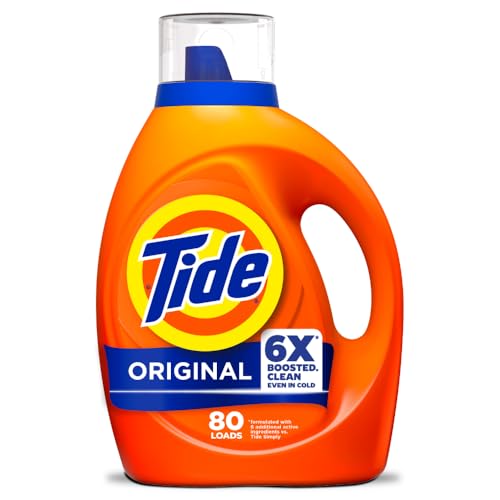
Tide Original Liquid Laundry Detergent, 100 fl oz
A concentrated HE liquid detergent in the Original scent: the detergent for new towels, used at half the usual dose so it rinses clean.
Specs: 100 fl oz bottle; Original scent; HE compatible; works in all water temperatures including cold; 80 loads at the maker’s measured dose.
Tide Original is the standard liquid detergent, and it suits new towels because it is made for HE machines and rinses out in a small dose, which is exactly what this guide calls for. Half the usual amount is enough for towels, and the liquid form dissolves fully, so it does not leave the powder residue that stiffens fibres. The bottle’s measuring cap marks the dose, which helps a buyer keep to the half dose instead of pouring freely.
Strengths:
- HE formula that rinses clean in a small dose
- Liquid form dissolves fully, with no powder residue
- Measuring cap helps keep the dose small
Trade-offs:
- Strong scent, so it is not the pick for sensitive skin
- Easy to over-pour without the measuring cap
- A large bottle is heavy to lift and store
Who it fits: Households washing new towels on a warm cycle who want one reliable detergent dosed small.
Best for: everyday towel washing at a half dose that rinses clean. / Not suited for: a household that needs a fragrance-free detergent, or a buyer who wants a powder.
Check price on Amazon: Tide Original Liquid Laundry Detergent, 100 fl oz

Woolzies Wool Dryer Balls, 6 XL
Six extra-large wool dryer balls: the softener-free way to fluff new towels in the dryer without coating the fibres.
Specs: 6 XL balls; 100% organic New Zealand wool; unscented; maker states up to 1,000 loads per set; use 3 balls for a small load, 6 for a large load.
Wool dryer balls replace fabric softener, which is the point of this guide: they tumble between the towels, separate the fibres and let warm air reach them, so a towel comes out soft without any coating on the fibres. Woolzies makes its balls from New Zealand wool with no fillers, and the maker states they last up to 1,000 loads and can cut drying time by about a quarter. Six XL balls are enough for a full load of bath towels, where three small balls would be lost in the pile.
Strengths:
- Softens towels with no coating on the fibres
- Reusable for many loads, so nothing is thrown away each wash
- Unscented, so it adds no fragrance to towels
Trade-offs:
- Thumps in the dryer, which is noisy on a quiet cycle
- Needs all six balls for a full towel load
- Does not add scent, for buyers who want one
Who it fits: Households that tumble dry towels and want to skip fabric softener entirely.
Best for: soft, fluffy towels with no softener coating. / Not suited for: a buyer who line dries only, or one who wants scented towels.
Check price on Amazon: Woolzies Wool Dryer Balls, 6 XL

TENRAI Delicates Laundry Bags
Three large fine-mesh wash bags with YKK zippers: the bags that keep small towels and washcloths from snagging in the wash.
Specs: 3 large bags, 15.5 by 19.5 inches each; 100% polyester fine mesh; YKK zipper with rust-resistant closure; hanger loops for storage.
A mesh bag is not for a full bath towel — a bath towel is too big to wash inside one — but it is the right tool for hand towels and washcloths, which snag on zippers and hooks in a mixed load. The TENRAI bags are large enough for a folded hand towel, and the fine mesh lets water and detergent through while keeping the cloth from tangling. The YKK zipper stays shut in the wash, and the hanger loops keep the bags tidy between loads.
Strengths:
- Fine mesh protects small towels from snags and tangles
- Large size fits a folded hand towel
- Zipper stays shut and resists rust
Trade-offs:
- Too small for a full bath towel or bath sheet
- A bag holds fewer items, so it adds a step to loading
- Mesh slows the rinse slightly, so do not overfill it
Who it fits: Households that wash hand towels and washcloths with the rest of the laundry.
Best for: protecting hand towels and washcloths in a mixed wash. / Not suited for: washing a full bath towel, which needs to move freely.
Check price on Amazon: TENRAI Delicates Laundry Bags

Heinz Distilled White Vinegar, 5% Acidity, 1 gal Jug
A gallon jug of distilled white vinegar at 5% acidity: the rinse aid that strips the residue which makes new towels stiff.
Specs: 1 gallon jug; 5% acidity; distilled white vinegar; recloseable top with handle.
White vinegar is the rinse this guide recommends instead of fabric softener, and Heinz is the standard jug: a small amount in the rinse strips detergent residue and softens the fibres without coating them. The gallon jug is the practical size for laundry, since a half cup per towel load lasts for many washes, and the recloseable top and handle make it easy to pour without spilling. The vinegar smell disappears when the towel dries.
Strengths:
- Strips residue that makes towels stiff, with no coating left behind
- Gallon size lasts for many towel loads
- Handle and recloseable top make pouring easy
Trade-offs:
- A gallon jug is heavy and needs shelf space
- Smells sharp while pouring, until the towel dries
- Only for the rinse; it is not a detergent on its own
Who it fits: Households that rinse towels with vinegar instead of using fabric softener.
Best for: a rinse that keeps new towels soft and absorbent. / Not suited for: a buyer who wants a scented rinse, or one with no shelf space for a gallon jug.
Check price on Amazon: Heinz Distilled White Vinegar 5% Acidity, 1 gal Jug

Arm & Hammer Super Washing Soda, 55 oz
A box of pure sodium carbonate laundry booster: the treatment for a new towel that has gone stiff or musty despite careful washing.
Specs: 55 oz box (3 lb 7 oz); 100% sodium carbonate; fragrance free and phosphate free; maker directs half a cup per load with detergent.
Washing soda is a booster, not a detergent: half a cup added with the detergent softens hard water and helps the detergent work, which matters for towels because hard water leaves the mineral residue that stiffens fibres. It is also the soak for a musty towel, since it neutralises odour instead of covering it. The 55 oz box is the standard size, and the powder keeps well in a dry cupboard.
Strengths:
- Softens hard water so detergent rinses cleaner
- Removes musty odour instead of covering it
- Fragrance free, so it adds no scent to towels
Trade-offs:
- Not for silk, wool, or dry-clean-only items
- Powder can clump if the box is stored damp
- An extra step, for buyers who want one product only
Who it fits: Households with hard water or musty towels who want a booster alongside their detergent.
Best for: reviving stiff or musty towels and softening hard water. / Not suited for: washing silk or wool towels, or a buyer who wants a single-step wash.
Check price on Amazon: Arm & Hammer Super Washing Soda, 55 oz
mDesign Metal Over Door Towel Rack Holder, 3-Tier, Chrome
A steel-wire rack that hangs over a door with three towel bars and two hooks: the rack that lets a new towel dry fully between uses.
Specs: 3 towel bars and 2 hooks; strong steel wire with a rust-resistant finish; hangs over bathroom or shower doors up to 1.5 inches thick; no hardware or drilling needed.
A towel that is folded damp on a rail stays damp in the middle, which is why this guide stresses full drying — and a rack that spreads the towel out is what makes that possible. The mDesign rack hangs over the back of a door, so it adds drying space without drilling, and its three bars hold a bath towel, a hand towel and a washcloth at once, with air reaching both sides of each. The steel wire finish resists rust in a steamy bathroom.
Strengths:
- Three bars spread towels out so air reaches both sides
- Hangs over a door with no drilling or hardware
- Rust-resistant steel wire suits a steamy bathroom
Trade-offs:
- Needs a door with clearance behind it to hang
- Only holds what the bars fit; a bath sheet may need folding
- Wire bars can leave a light crease on a thick towel
Who it fits: Households whose towel rail is crowded and whose towels stay damp between uses.
Best for: drying towels fully on the back of a bathroom door. / Not suited for: a bathroom with no spare door, or a buyer who wants a wall-mounted rail.
How to Care for New Towels
Start with the first wash, because it decides how the towel works from day one. A new towel carries finishing chemicals that reduce absorbency, so a first wash removes them, and a towel that is washed first will absorb more from day one, while a towel that is used straight from the packet will push water around rather than absorb it, so a buyer should wash every new towel before using it, since that is the step that matters most.
Next, check the detergent. Too much detergent leaves a residue that makes towels stiff and less absorbent, so a buyer should use half the usual amount of detergent for towels, and wash them on a warm cycle, since a towel washed with less detergent will rinse clean and stay soft, while a towel washed with too much will feel stiff and smell musty.
Then consider the softener. Fabric softener coats the fibres and reduces absorbency, so a buyer should skip the softener entirely, and add a small amount of white vinegar to the rinse now and then, which softens the fibres without coating them, since a towel without softener will stay absorbent for years, while a towel with softener will go stiff after a few washes.
Drying is the fourth decision, and it decides whether the towel stays fresh. A damp towel will develop odour and mildew, so a buyer should hang the towel where air can reach it, not folded damp on a rail, and a towel that dries fully between uses will stay fresh far longer than one that stays damp, whatever its quality.
Common Mistakes When Caring for New Towels
The most common mistake is using the towel straight from the packet. A new towel carries finishing chemicals that reduce absorbency, so a towel that is used without washing will push water around rather than absorb it. The fix is to wash every new towel before its first use, since a towel that is washed first will absorb more from day one, while a towel that is used straight from the packet will disappoint, whatever its quality.
The second mistake is using fabric softener. Fabric softener coats the fibres and reduces absorbency, so a towel that was soft and absorbent when new will become stiff and water-repellent after a few washes. The fix is to skip the softener entirely, and to add a small amount of white vinegar to the rinse now and then, which softens the fibres without coating them, since a towel without softener will stay absorbent for years.
The third mistake is using too much detergent. Too much detergent leaves a residue that makes towels stiff and less absorbent, and it can also leave a smell. The fix is to use half the usual amount of detergent for towels, and to wash them on a warm cycle, since a towel washed with less detergent will rinse clean and stay soft, while a towel washed with too much will feel stiff and smell musty.
The fourth mistake is folding the towel damp. A towel that is folded damp will stay damp in the middle, and a damp towel will develop odour and mildew. The fix is to hang the towel where air can reach it, not folded damp on a rail, since a towel that dries fully between uses will stay fresh far longer than one that stays damp, whatever its quality.
Sizing and Weight
Towels are sized by their dimensions, and the size should be chosen for the body and the bathroom. A hand towel is roughly 16 by 30 inches, a bath towel is roughly 27 by 52 inches, and a bath sheet is roughly 35 by 60 inches or larger. A buyer should measure the towel rail and the storage shelf before buying, since a bath sheet that does not fit the rail will end up folded on a chair, and a towel that is too small will not wrap around the body.
Weight is measured in GSM, and it should be chosen for the bathroom, not just for the feel. A light towel is around 300 to 400 GSM, a mid-weight towel is around 500 to 600 GSM, and a heavy towel is 700 GSM and above. A buyer in a damp bathroom should choose a light or mid-weight towel, since it will dry between uses, while a buyer in a dry bathroom with good airflow can choose a heavy towel, since it will dry fully and feel plush.
A buyer should also check the number of towels in the set, since a set of two is the minimum for rotation and a set of four is the usual starting point for a household of two. A towel that is rested between uses will last longer than one that is used every day, so a buyer who buys a set will spend less over time than one who buys a single towel and replaces it often, since a set lets each towel rest and dry fully between uses.
Caring for Your Towels
A towel that has lost its softness can often be revived with a wash in hot water with a small amount of white vinegar, which strips the residue that makes towels stiff, and a towel that smells musty should be washed in hot water with baking soda, which removes the odour. A towel should not be ironed, since heat can damage the fibres, and it should be replaced when it thins or frays, since a worn towel will not absorb well, whatever the care.
More About New Towel Care
The water temperature is a sixth step, and it decides how clean the towel gets. A warm cycle rinses detergent out better than a cold cycle, so a buyer should wash towels on a warm cycle, since warm water removes residue, and a towel washed on a warm cycle will rinse clean and stay soft, while a towel washed on a cold cycle will keep residue and feel stiff, whatever its detergent.
The separation is a seventh step, and it decides whether the towel picks up lint. A towel washed with lint-shedding clothes will pick up lint, so a buyer should wash towels separately from clothes that shed lint, since a towel washed alone will stay clean, and a towel washed with linty clothes will pick up lint, whatever its quality.
The vinegar rinse is an eighth step, and it decides whether the towel stays soft. A small amount of white vinegar in the rinse strips the residue that makes towels stiff, so a buyer should add vinegar now and then, since a towel rinsed with vinegar will stay soft, and a towel rinsed without vinegar will go stiff over time, whatever its detergent.
The baking soda wash is a ninth step, and it decides whether the towel stays fresh. A towel that smells musty should be washed in hot water with baking soda, which removes the odour, so a buyer should wash a musty towel with baking soda, since a towel washed with baking soda will smell fresh, and a towel washed without it will keep its smell, whatever its detergent.
The tumble drying is a tenth step, and it decides how soft the towel feels. A towel tumble dried on low heat will feel soft, since the tumbling fluffs the fibres, while a towel line dried will feel stiffer, so a buyer should tumble dry on low heat if the towel can take it, since a towel tumble dried will feel softer, and a towel line dried will feel stiffer, whatever its quality.
The sun is an eleventh step, and it decides whether the towel stays white. A white towel dried in the sun will stay white, since the sun bleaches it naturally, while a coloured towel dried in the sun will fade, so a buyer should dry white towels in the sun and coloured towels in the shade, since a towel dried right will keep its colour, and a towel dried wrong will fade or yellow, whatever its quality.
The storage is a twelfth step, and it decides whether the towel stays dry. A towel stored in a dry cupboard will stay dry, while a towel stored in a damp bathroom will pick up moisture, so a buyer should store spare towels in a dry place, since a towel stored dry will stay fresh, and a towel stored damp will develop odour, whatever its quality.
The rotation is a thirteenth step, and it decides how long a towel lasts. A towel that is rested between uses will last longer than one that is used every day, so a buyer should buy at least two bath towels per person, since a towel that is rested will last years longer than one that is used every day, and a household with a rotation will spend less over time than one without, whatever the towel.
Frequently Asked Questions
Should I wash new towels before using them?
Yes, every new towel should be washed before its first use, since new towels carry finishing chemicals that reduce absorbency, and a first wash removes them. A towel that is washed first will absorb more from day one, while a towel that is used straight from the packet will push water around rather than absorb it, so a buyer should wash every new towel before using it, since that is the step that matters most.
Can I use fabric softener on new towels?
No, fabric softener should never be used on towels, since it coats the fibres and reduces absorbency, so a towel that was soft and absorbent when new will become stiff and water-repellent after a few washes. A buyer should skip the softener entirely, and add a small amount of white vinegar to the rinse now and then, which softens the fibres without coating them, since a towel without softener will stay absorbent for years.
How much detergent should I use for towels?
Half the usual amount, since too much detergent leaves a residue that makes towels stiff and less absorbent, and it can also leave a smell. A buyer should use half the usual amount of detergent for towels, and wash them on a warm cycle, since a towel washed with less detergent will rinse clean and stay soft, while a towel washed with too much will feel stiff and smell musty.
How often should I wash new towels?
Every three to four uses, since a towel that is washed too often will wear out faster, while a towel that is washed too rarely will develop odour. A buyer should wash towels every three to four uses, on a warm cycle, since that is the balance that keeps a towel fresh without wearing it out, while a towel washed every day will wear out fast, whatever its quality.
How do I keep new towels soft?
A towel should be washed on a warm cycle with a small amount of detergent, since too much detergent leaves a residue that makes towels stiff, and fabric softener should be avoided, since it coats the fibres and reduces absorbency. A towel should be dried fully between uses, since a damp towel will develop odour, and it should be hung where air can reach it, not folded damp on a rail.
When should I replace a towel?
A towel should be replaced when it thins or frays, since a worn towel will not absorb well, whatever the care, and a towel that is thin will push water around rather than absorb it. A towel should also be replaced when it no longer dries fully, since a towel that stays damp will develop odour, and a buyer who replaces a worn towel will have a towel that absorbs well, while a buyer who keeps a worn towel will have one that does not.
More Towel Guides from Cottage Verdict
If this guide helped, these live guides from Cottage Verdict cover the same topic in more depth:
- Best Bath Sheet Towels
- Best Luxury Oversized Bath Towels
- Best Bath Towels for Airbnb
- Best Waffle Bath Towels
Conclusion
The best care instructions for new towels are the steps that keep a towel soft and absorbent for years, so a towel that is washed before its first use, washed with less detergent and dried fully between uses is the one that lasts, while a towel that is washed with too much detergent and fabric softener will go stiff and stop absorbing.
Whichever steps you follow, wash every new towel before its first use, since that is the step that matters most, and a towel that is washed first will absorb more from day one, while a towel that is used straight from the packet will push water around rather than absorb it.
And skip the fabric softener, since it coats the fibres and reduces absorbency, and a towel without softener will stay absorbent for years, while a towel with softener will go stiff after a few washes, whatever its quality.