What's inside
- Quick Picks
- How We Chose These Picks
- Key Takeaways
- Detailed Reviews
- Comparison Table
- How to Choose a Lightweight Beach Towel That Earns Its Pack Space
- How Do You Wash Microfiber and Flat-Weave Cotton Without Ruining Them?
- Common Mistakes When Buying a Towel for Travel
- What Does a Full Beach Day Ask of a Thin Towel?
- Which Towel for Which Kind of Swimmer?
- What Should You Check in the First Week of Ownership?
- How Long Will a Thin Towel Actually Last?
- Final Recommendation
- Frequently Asked Questions
- Related Guides
As an Amazon Associate I earn from qualifying purchases. This post may contain affiliate links at no extra cost to you.
As an Amazon Associate, cottageverdict.com earns from qualifying purchases made through links in this guide — at no extra cost to you.
Where to buy: all six towels in this roundup are sold on Amazon, and you will find each name linked in the Quick Picks table, again in its review heading, and once more in the comparison table further down, so from any point in the page you are one tap away from the listing itself, where you can check price on Amazon and confirm the exact size, print and pack count before you order. If you are hunting for the best lightweight beach towels, the honest starting point is that light is not one thing. A towel can be light because its cloth is a thin sheet of microfiber that folds to the size of a sandwich, or because it is a flat-woven cotton peshtemal in the Turkish tradition, or — in one case here — because a familiar ring-spun cotton towel simply trims the dimensions down. Those are three different answers to the same packing problem, and they feel different against wet skin, behave differently in sand, and age differently in the wash. This guide keeps the three families separate and tells you which family each pick belongs to before it praises anything else.
Start with the fibre split, because it decides almost everything else. Four picks lean synthetic or Turkish-flat-weave in spirit, but the precise division in this set is this: the cabanana, the DARCHEN two-pack and the TwoYek are microfiber, thin synthetic cloth that dries a body by spreading water across a huge surface area and then giving that water up to the air quickly. The BAY LAUREL and the Antfuny are Turkish beach towels, flat-woven cotton in the peshtemal manner, with the BAY LAUREL adding a travel bag to the package. The Utopia four-pack is the outlier and proud of it: 100% ring-spun cotton in a 30 by 60 inch format, the most traditional towel here, the heaviest of the six, and the one whose listing uses the words quick-drying in the ordinary cotton sense rather than the microfiber sense. Nobody should buy the Utopia expecting it to vanish into a tote pocket, and nobody should buy a microfiber sheet expecting the familiar hug of terry cotton. The reviews below judge each towel inside its own family first and against the whole group second.
Size is the second split. Beach towels earn the name by being bigger than bath towels, and this group runs large: 70 by 35 inches for the cabanana, a two-size DARCHEN pack pairing a 70 by 35 extra-large with a 63 by 32 large, 39 by 71 for the BAY LAUREL, 71 by 32 for the TwoYek, an extra-large blanket format for the Antfuny whose listing does not pin down inches, and 30 by 60 for each Utopia towel. Length matters if you lie on your towel; width matters if you wrap it; pack size matters if it travels. A towel can win one of those contests and lose the other two, and several picks here do exactly that. Read the dimensions in each spec box as the first fact, not the last.
A word about the phrase sand free, which appears in several of these listings. It is microfiber and flat-weave listing language, and in this guide it is always attributed to the listing rather than asserted as a laboratory result. The underlying behaviour is real enough to describe: dry sand rests on a smooth, tight surface instead of lodging inside terry loops, so a firm shake clears most of it. Wet sand clings to every cloth ever woven. When a review below says a towel sheds sand, it means that dry-sand behaviour, in those words, and nothing stronger.
Quick Picks
| Pick | Badge | Why it is here |
|---|---|---|
| cabanana Microfiber Beach Towel | Best Single Microfiber | One oversized 70×35 microfiber towel with a coconut tree print, thin and quick-drying in the listing’s own words. |
| DARCHEN Microfiber Beach Towels 2 Pack | Best Two-Size Pack | Two microfiber towels in two different sizes, 70×35 and 63×32, so one purchase covers two swimmers or two jobs. |
| BAY LAUREL Turkish Beach Towel | Best Turkish with Bag | A 39×71 flat-woven Turkish towel that ships with its own travel bag for tidy packing. |
| TwoYek Microfiber Beach Towel | Best Print | A 71×32 microfiber towel in a boho mandala print, thin and oversized for travel and pool days. |
| Antfuny Turkish Beach Towel | Best Blanket-Size Wrap | An extra-large Turkish towel the listing frames as part towel, part beach blanket for adults. |
| Utopia Towels Beach Towels 4 Pack | Best Traditional Cotton | Four 30×60 ring-spun cotton towels in blue, the familiar terry-style answer in a lighter class. |
How We Chose These Picks
We began with the listings themselves and nothing else. Every pick had to state, in its own title, the traits this keyword promises: a beach format, a lightweight or compact or thin character, and a size or pack count a buyer could plan around. Towels whose listings were vague about dimensions were not excluded automatically — the Antfuny is here despite giving no inches — but vagueness is recorded in the spec boxes as an honest gap rather than papered over with guesses. We then sorted the field by fibre, because comparing a microfiber sheet with a cotton peshtemal on absorbency alone produces nonsense: they absorb by different mechanisms, and a fair guide says so. Within each fibre family we looked for a distinct job. One single all-purpose microfiber towel. One pack that gives two sizes instead of two copies. One Turkish towel with a bag. One print-led microfiber. One oversized Turkish wrap. One cotton multipack for households that simply want cotton. Six picks, six jobs, no duplicates wearing different badges.
We also policed the language. Where a listing says sand free or quick dry, the review attributes the claim to the listing, because we are describing retail cloth from its stated facts, not reporting test-bench results. Where a listing is silent — a weight in grams, a GSM figure, a care instruction — the spec box says so in plain words, rotating the phrasing so the gaps read as information rather than boilerplate. And we kept one rule above all: the cotton four-pack would never be described as quick-drying in the microfiber sense, because its own listing’s quick-drying phrase belongs to the slower, familiar cotton world, and blurring that line is how buyers end up disappointed at a windy beach with a damp towel.
Key Takeaways
- Fibre decides behaviour: three microfiber picks, two flat-woven Turkish cotton picks, and one ring-spun cotton four-pack that plays by older rules.
- Every pick is oversized by bath-towel standards except the Utopia at 30×60, which is exactly standard beach size and heavier for it.
- Sand free is listing language for smooth cloth that releases dry sand on a shake; no towel in this guide defeats wet sand.
- The DARCHEN pack is the only one giving two different sizes, which quietly makes it the most flexible purchase here.
- Lightweight always trades something away: cushion, warmth, or the familiar terry feel. Each review names its pick’s trade plainly.
Detailed Reviews
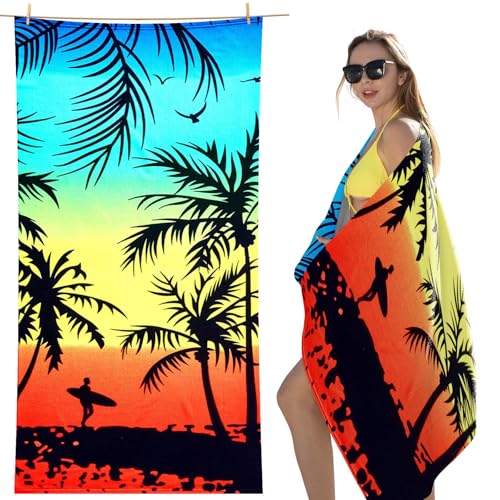
cabanana Microfiber Beach Towel
The cabanana is the straightforward answer: one towel, oversized at 70 by 35 inches, made of microfiber, printed with a coconut tree, and described by its listing as quick dry, lightweight and thin for travel. It suits the swimmer who packs a tote in the morning and wants the towel to be the least of the load — the person heading to a pool straight from work, the traveller whose beach is a train ride away, the parent who carries everybody else’s gear too and has quietly decided their own towel will weigh almost nothing. Microfiber’s feel is the first thing to accept. It does not grip water the way terry loops do; it skims and spreads it, and drying yourself becomes a press-and-blot motion rather than a rub. Most people adapt in one swim. The cloth then rewards them by drying itself fast on a rail or a chair back, so the towel that was soaked at noon is merely cool by the second swim, and by packing time it can go back into the bag without perfuming everything else in it.
At 70 by 35 the footprint is honestly generous. A tall adult can lie on it without heels in the sand, and the width wraps a waist or shoulders with cloth to spare. The coconut tree print does quiet practical work: it marks the towel as yours among a row of plain hotel whites, and a bold print hides the salt tide-marks and sunscreen ghosts that show mercilessly on pale solid colours. The listing also frames the towel as a pool towel and a piece of beach kit generally — beach essentials is its phrase — and that breadth is fair, because a thin microfiber sheet gets borrowed for picnics, for drying a dog, for a makeshift changing screen, in ways a heavy terry towel never does. What it will not do is cushion you. On pebbles or a hard deck it is a boundary, not a mattress, and in a cold evening breeze it offers a windbreak, not warmth. Buy it as travel equipment that happens to dry you, and it is excellent; buy it as a luxury wrap and you have misread the listing.
Strengths
- Genuinely oversized 70×35 footprint in a towel that still folds to almost nothing
- Microfiber gives the water up to the air quickly between swims
- Coconut tree print is easy to spot and forgiving of salt marks
Trade-offs
- Press-and-blot drying feels strange to lifelong terry users at first
- No cushioning over pebbles, boards or hard pool decks
- Sold as a single towel, so families buy one per person
- Cloth: microfiber, per the title
- Dimensions: 70 x 35 inches, as titled
- Print on this listing: Coconut Tree
- Character in the listing: quick dry, lightweight, thin
- Weight in grams: not stated in the listing
- Carry bag included: not given
Best for: solo swimmers and travellers who want one big towel that packs like a scarf. Not suited for: anyone who lounges for hours and judges a towel by its padding.
If that single-towel, small-packing brief sounds like your beach bag, review the price on Amazon and confirm the coconut tree variant before it goes in the cart.

DARCHEN Microfiber Beach Towels 2 Pack
Most two-packs are simply the same towel twice. The DARCHEN pack is more interesting: its title states two sizes in one purchase, an extra-large at 70 by 35 inches and a large at 63 by 32, both microfiber, both described as oversize quick-dry travel towels, with the listing’s sand free phrase attached. That asymmetry is the whole idea, and it maps onto real life better than a matched pair does. The bigger towel becomes the lounger and the wrap; the smaller becomes the swim towel, the kids’ towel, the one that lives in the gym bag or the car. Couples travelling with one shared suitcase get a towel each without doubling the packed bulk, because microfiber folds so flat that two of these occupy roughly the space of one folded terry towel. Households get a spare that is not a compromise. The pack suits buyers who think in systems — rotation, backup, one in the wash — rather than in single perfect objects.
The listing aims the pack at swimming pool use and at kids and adults alike, and the two sizes support that spread honestly: the 63 by 32 is a sensible child’s full towel and a perfectly good adult swim towel, while the 70 by 35 handles the lie-flat sunbathing duty. DARCHEN calls the towels compact and lightweight, which for microfiber of these dimensions is the expected and believable claim; the cloth’s thinness is the mechanism, not a mystery. The cautions are the family cautions of microfiber generally. The press-and-blot technique needs showing to children once, or they will rub, declare the towel broken, and steal yours. Two towels in one listing also means the print or colourway is the pack’s, not yours to mix, so look at the listing images if the household has strong towel-identity politics. And as with every sand free claim in this guide, treat the phrase as the listing’s description of how smooth cloth behaves with dry sand, not as a promise about wet sand after a toddler has finished excavating.
Strengths
- Two different sizes in one pack cover lounging and swimming at once
- Extra-large 70×35 towel matches the biggest singles in this guide
- A built-in spare makes rotation and laundry days painless
Trade-offs
- Colourway is fixed by the pack rather than chosen towel by towel
- Smaller towel is a swim towel, not a full adult lounger
- Microfiber technique needs one demonstration for younger users
- Cloth: microfiber, per the title
- Pack contents: 2 towels, as titled
- Sizes in the pack: 70 x 35 and 63 x 32 inches
- Listing language: sand free, quick dry, compact, lightweight
- GSM figure: none stated in the listing
- Separate carry pouches: not stated in the listing
Best for: couples, parents and system-minded packers who want two sizes handled in one order. Not suited for: buyers who want two identical oversized towels for two adults to lie on.
Pairs and spares are the point here, so find the price on Amazon if a big-and-little set matches how your household actually swims.

BAY LAUREL Turkish Beach Towel
The BAY LAUREL brings the oldest technology in this guide: a flat-woven Turkish towel, 39 by 71 inches, sold with a travel bag, and described by its listing as quick dry, sand free and lightweight. Flat cotton weave is the peshtemal idea — a smooth sheet of cotton with no terry loops — and it behaves differently from microfiber in ways some swimmers strongly prefer. It feels like cloth, because it is cloth: woven cotton with a familiar hand, no synthetic glide, no static crackle in dry air. It absorbs across its surface, asks for the same press-and-pat technique as microfiber, and then dries on a line with the unhurried reliability cotton has had for centuries. The 39-inch width is the widest single dimension in this guide alongside nothing else here, and width is the dimension that decides whether a wrap overlaps properly at the waist and whether two people can share the towel’s edge for a shoreline picnic. The travel bag is a small feature with outsized daily value: the towel returns to the suitcase in its own sleeve instead of shedding damp and sand across clean clothes, and at home the bag keeps it rolled and findable rather than lost in the linen press.
Who is it for? The traveller who refuses synthetic cloth on principle or on skin-feel, the swimmer who uses the same towel as a sarong, a picnic layer and a light evening wrap, and the gift buyer, because a towel that arrives with its own bag presents like a considered object. BAY LAUREL’s listing calls the towel large and oversized, and at 39 by 71 that is plain arithmetic rather than puffery. The honest cautions belong to cotton. A flat cotton sheet dries faster than terry and slower than microfiber, so on a trip with one towel and daily swims, hang it properly every time. It is also the towel most likely to be borrowed as a tablecloth, a baby blanket or a sofa throw, because woven cotton reads as a household textile rather than sports gear — flattering, but plan for it. And the listing’s sand free phrase deserves the same footnote as everywhere in this guide: smooth flat weave releases dry sand on a shake, which is genuinely useful, and wet sand still needs a rinse like it does on everything.
Strengths
- Widest wrap in the guide at 39 inches, with full 71-inch length
- Travel bag keeps a damp towel away from clean clothes
- Natural woven cotton feel for buyers who dislike synthetic cloth
Trade-offs
- Dries more slowly than the microfiber picks between swims
- Reads as a household textile, so it gets borrowed for other jobs
- Single towel with no pack option for outfitting a group
- Style: Turkish flat-woven beach towel, per the title
- Dimensions: 39 x 71 inches, as titled
- Included extra: travel bag, stated in the title
- Listing language: quick dry, sand free, lightweight, oversized
- Fibre percentage: not given
- Weight in grams: none stated in the listing
Best for: cotton loyalists and travellers who want a wrap, a towel and a picnic cloth in one roll. Not suited for: swimmers who need the absolute fastest dry between morning and afternoon sessions.
Cotton traditionalists should check price on Amazon, where the travel bag inclusion is spelled out on the listing itself.

TwoYek Microfiber Beach Towel
The TwoYek leads with its looks: a boho mandala print on an extra-large microfiber towel, 71 by 32 inches, described as thin, lightweight, sand free, super absorbent and quick dry, and aimed by its listing at travel, pool, swim, bath, camping and sports, for girls, women and adults. Treat the print as a feature rather than decoration, because on a beach a distinctive towel is a navigation aid. You spot the mandala from the water, the kids spot it from the ice-cream queue, and nobody at the next umbrella mistakes it for theirs. A mandala’s circular geometry also hides the visual noise of beach life — salt rings, sand shadows, a faint sunscreen handprint — far better than a pale solid does, so the towel looks composed on day four of a trip, not just day one. At 71 inches it is the longest towel in this guide by a hair, which tall swimmers will notice when they lie down and their heels stay on cloth; the 32-inch width is the trade, narrower than the cabanana and the BAY LAUREL, so as a wrap it overlaps less generously.
The listing’s suggested uses run wide, and the towel genuinely fits the wide life. Microfiber of this thinness rolls to a cylinder that disappears into a tote, a gym bag or a carry-on corner, and it dries fast enough to serve a morning pool session and an evening campsite wash with the same cloth. TwoYek calls it super absorbent; read that as the listing’s enthusiasm for microfiber’s spreading absorbency, the press-and-blot kind, rather than terry’s soak. The cautions: a print this recognisable is a commitment — you will see that mandala in every holiday photograph for years, which is either continuity or monotony depending on your temperament. The narrow-ish width makes it a better lounger and dryer than a sarong. And because the listing addresses it strongly toward women and girls, gift buyers should simply note the positioning and choose the print with the recipient in mind rather than assuming a neutral default. None of that dents its core case: the most recognisable towel here, at full oversize length, in the fastest-drying cloth family in the guide.
Strengths
- Longest footprint in the guide at 71 inches for tall loungers
- Mandala print works as a landmark and hides salt marks
- Thin microfiber rolls small enough for carry-on corners
Trade-offs
- 32-inch width wraps with less overlap than wider picks
- Bold print is a long-term visual commitment
- Positioned mainly toward women and girls in its listing
- Cloth: microfiber, per the title
- Dimensions: 71 x 32 inches, as titled
- Print on this listing: Boho Mandala
- Listing language: thin, lightweight, sand free, super absorbent, quick dry
- Pack count: single towel, per the title
- Carry bag included: not stated in the listing
Best for: tall swimmers and print lovers who want their towel findable from the water. Not suited for: buyers who need a wide wrap first and a lounger second.
Love the mandala or leave it — either way, check price on Amazon and look at the print at full size before deciding.

Antfuny Turkish Beach Towel
The Antfuny is the second Turkish towel in the set, and its listing pushes the format one step further: an oversized extra-large towel described as a blanket as well, aimed at vacation, pool and swim use and at travel and cruise accessories. That blanket word is the pick’s identity. A Turkish flat weave at blanket scale stops being merely something you dry with and becomes the base layer of a beach camp — spread for two people to sit on, thrown over shoulders when the boat turns for home, laid across a cruise-ship lounger so the whole chair is your territory. Like the BAY LAUREL it is woven cotton in the peshtemal manner, so expect the flat, smooth surface, the press-and-pat drying technique, the easy shake that clears dry sand (the listing says sand free; the guide’s footnote about listing language applies), and a dry time between terry and microfiber. Unlike the BAY LAUREL, its listing gives no dimensions in inches and includes no travel bag, and this guide will not invent either. Extra-large and XL are the listing’s own words; if your use depends on an exact footprint — a specific chair, a specific suitcase — the listing page is where that number must be confirmed before ordering.
Who does the Antfuny suit? Couples who share one towel-as-basecamp, cruise travellers whose towel doubles as an excursion blanket, and anyone furnishing a pool deck where a towel that reads as a textile looks better draped on furniture than a printed microfiber sheet. Its listing mentions vacation first, and that ordering feels right: this is holiday cloth, generous and unhurried. The cautions follow from scale and vagueness together. A blanket-size cotton towel is the bulkiest of the Turkish picks when rolled, still far lighter than terry but no longer invisible in a day bag. The absence of stated inches is a real information gap, recorded here rather than smoothed over. And a towel this large tempts people to use it as the group’s everything — picnic cloth, shade, wrap — which is fine, provided someone still has a dry corner left for the last swimmer out of the water. Assign roles before the first swim and the Antfuny is the social centre of the beach bag.
Strengths
- Blanket-scale Turkish cotton works as a shared base layer
- Flat weave shakes dry sand loose and packs flatter than terry
- Cruise and vacation framing matches its generous, social format
Trade-offs
- No dimensions in inches stated in the listing title
- Bulkier roll than the slimmer Turkish and microfiber picks
- Shared use can leave nobody with a dry corner late in the day
- Style: Turkish beach towel, per the title
- Format in the listing: oversized, extra large, blanket
- Listing language: quick dry, sand free
- Dimensions: not given in the listing title
- Travel bag: not given
- Fibre percentage: none stated in the listing
Best for: couples and cruisers who want one generous cotton cloth as beach basecamp. Not suited for: solo minimalists or buyers who need an exact measured footprint.
Sharing households can check price on Amazon, keeping in mind the listing describes size in words rather than inches.

Utopia Towels Beach Towels 4 Pack
Every guide needs the pick that respects the reader who simply wants a normal towel, and here it is: four towels, 30 by 60 inches each, in blue, made of 100% ring-spun cotton, sold by Utopia Towels for pool, bathroom and swim days. This is the heaviest option in the guide and the most traditional, and the review will not pretend otherwise. Ring-spun cotton in a standard beach format behaves the way beach towels have always behaved: it feels familiar the first time, it rubs dry instead of pressing dry, it gives some cushion on a lounger, and it takes its time drying afterwards. The listing calls the towels soft and quick-drying, and that second phrase needs the guide’s clearest footnote. Quick-drying here is cotton’s own listing language for a towel that is not unusually slow; it is not the microfiber meaning, where a thin sheet can be nearly dry in the time a cotton towel is still deciding. Anyone who buys this four-pack expecting microfiber turnaround will be disappointed, and the disappointment will be the guide’s fault if we blur it — so, unblurred: this pack trades speed for familiarity, deliberately.
What the pack does brilliantly is arithmetic and logistics. Four matching towels outfit a family, a guest room or a rental in one order, in a blue that reads clean at a pool and hides a multitude of holiday sins. At 30 by 60 each towel is a standard beach size — smaller than the oversize singles elsewhere here, large enough for an adult lounger with modest overhang. The listing also names bathroom use, and that dual citizenship is real: a household can run these as bath towels all winter and beach towels all summer, which no mandala-printed microfiber sheet will ever be asked to do. The trades are weight and dry time, plus the pack logic itself: four identical towels means marking ownership if that matters, and a full load of cotton is a real laundry event compared with rinsing two microfiber sheets. For a beach house, a family that swims at a lake cottage, or a host stocking a rental, those trades are usually worth it. For a backpacker, they are disqualifying, and the guide’s lighter picks exist precisely for that reader.
Strengths
- Four familiar cotton towels outfit a household in one purchase
- Ring-spun cotton rubs dry the way most people expect a towel to
- Works as bath towels at home and beach towels on holiday
Trade-offs
- Heaviest pack here and the slowest to dry of the six
- 30×60 is standard size, smaller than the oversized singles
- Four identical towels need marking if ownership matters
- Cloth: 100% ring-spun cotton, per the title
- Pack contents: 4 towels, as titled
- Size per towel: 30 x 60 inches
- Colour of this listing: Blue
- Listing language: soft, quick-drying (cotton sense — see review)
- GSM figure: not given
Best for: families, hosts and cotton traditionalists buying for a household, not a backpack. Not suited for: travellers counting grams or swimmers needing a fast turnaround.
Households buying in fours can check price on Amazon and confirm the blue colourway shown on the pack listing.
Comparison Table
Read this table by family first and dimensions second. A microfiber towel and a cotton towel with the same footprint are not the same object, and the pack counts change what a purchase actually solves.
| Towel | Cloth family | Footprint | You get |
|---|---|---|---|
| cabanana Microfiber Beach Towel | Microfiber | 70 x 35 in | 1 towel, coconut tree print |
| DARCHEN Microfiber Beach Towels 2 Pack | Microfiber | 70 x 35 and 63 x 32 in | 2 towels, two sizes |
| BAY LAUREL Turkish Beach Towel | Turkish flat-weave cotton | 39 x 71 in | 1 towel with travel bag |
| TwoYek Microfiber Beach Towel | Microfiber | 71 x 32 in | 1 towel, boho mandala print |
| Antfuny Turkish Beach Towel | Turkish flat-weave cotton | Extra large; inches not in listing | 1 towel in blanket format |
| Utopia Towels Beach Towels 4 Pack | Ring-spun cotton | 30 x 60 in each | 4 towels, blue |
How to Choose a Lightweight Beach Towel That Earns Its Pack Space
Begin with the trip, not the towel. A towel that flies in a carry-on, rides in a bike basket or lives in a gym locker must win on packed size, which points to microfiber or a slim Turkish flat weave. A towel that lives at a lake house, drives to the beach in a car boot and hangs on a hook between weekends can afford cotton’s weight, because it never has to justify its luggage space. Most disappointment in this category comes from buying the second kind of towel for the first kind of trip. Second, decide how you dry. If you are willing to learn the press-and-blot motion — and it takes one swim — thin cloth rewards you all summer. If you know yourself and you rub, buy cotton and accept the drying time; a towel that suits your habits beats a theoretically better towel that annoys you daily. Third, measure your lounger and your body, not the photograph. Seventy inches of length keeps heels on cloth for most adults; width above 35 inches wraps with overlap; a 30 by 60 standard towel is fine for sitting and drying and merely adequate for sprawling.
Fourth, count people before counting towels. A two-size pack like the DARCHEN solves a couple or a parent-and-child pair more cleverly than two identical towels, because the jobs differ. A four-pack solves a household. Singles solve a person. Fifth, treat every performance phrase on a listing as the listing’s own language until the cloth proves it in your hands: sand free describes how smooth surfaces treat dry sand, quick dry describes a relative pace within a fibre family, and super absorbent describes enthusiasm as often as capacity. The facts that cannot flatter are the dimensions, the fibre and the pack count, which is why this guide builds its spec boxes from those and marks everything else as language. Finally, plan the second towel. Any towel used daily on a trip needs a partner or a reliable line and breeze, whatever its fibre; the cheapest upgrade to any pick in this guide is a rotation of two.
One more choice hides inside the fibre decision, and it is about where the towel will dry for most of its life. A towel that dries indoors on a rail in a flat with no balcony lives a different life from one that dries on a line in sea air, and thin cloth’s advantage grows as the drying conditions worsen, because a single layer gives moisture a short path out in still air while a thick cotton towel can stay cool and damp at its core for a day. Buyers in small flats, on boats and in camper vans should weight the microfiber and slim Turkish picks more heavily than their instincts about natural fibre suggest, while buyers with a sunny line and a garden can let cotton’s slower pace cost them nothing. The towel does not know what a listing promised; it only knows the air you hang it in.
How Do You Wash Microfiber and Flat-Weave Cotton Without Ruining Them?
The two cloth families share one enemy and differ on almost everything else. The shared enemy is fabric softener, which coats fibres with a film that makes any towel — synthetic or cotton — behave as if it were lightly waxed, shedding water instead of taking it up. Skip softener for every towel in this guide and half of all towel disappointment disappears. Microfiber asks for a cool or warm wash, ideally apart from cotton lint-shedders, because its fine fibres pick up lint from terry loads and hold it; a microfiber towel washed with cotton towels emerges wearing a fuzz of someone else’s cloth and absorbs worse for it. Flat-woven cotton is hardier: warm water, ordinary detergent, line dry or low tumble, and it softens across the first season as the weave relaxes. Wash any new towel before its first swim, whatever the fibre, to clear loom and factory finishes that blunt absorbency. Rinse beach towels after salt and chlorine days when you can; salt stiffens cloth and chlorine shortens the life of dyes and fibres alike, and a thirty-second rinse at the beach shower is the cheapest care either family will ever get. Store towels dry and loosely rolled; a towel packed damp in a sealed bag will announce itself by smell within a day, and no fibre family is exempt from that arithmetic.
Common Mistakes When Buying a Towel for Travel
The first mistake is shopping by the word lightweight alone, without asking which fibre delivers it, so a buyer expecting cotton’s feel opens a microfiber sheet and feels cheated by a listing that actually said microfiber in its second word. The second is ignoring the second dimension: shoppers check length, buy a 71-inch towel, and discover its 32-inch width wraps them like a sash. The third is believing pack counts without reading sizes — two towels can mean two loungers or one lounger and one swim towel, and both are honest offers for different households. The fourth is packing a single towel for a week of daily swimming in a humid climate and blaming the cloth for a rotation problem. The fifth is washing microfiber with softener and terry in one hot load, a single cycle that attacks its absorbency from three directions at once. The sixth, and the most human, is buying the beautiful print for a shared household towel and then discovering that one person’s beloved mandala is another person’s reason to leave it in the bag. Match the towel to the trip, the fibre to the habit and the print to the people, and this small purchase stops generating small resentments.
What Does a Full Beach Day Ask of a Thin Towel?
Picture the working day honestly. In the morning the towel rides to the water rolled inside a tote that also holds a book, a bottle and lunch — a load a stack of terry towels would crowd out or turn into a second trip to the car. On the sand it marks territory at full size; wind-blown dry sand skates across a smooth surface instead of settling in, and a flick of one corner resets the cloth. After the first swim it dries you by pressing and blotting, then spends the interval over a rail, a chair back or an umbrella arm, where moving air through a single layer has it ready again well before a thick towel would be. Mid-afternoon is where thin cloth quietly wins: a terry towel still damp from the morning starts to smell like a harbour, while a towel that has dried twice in the sun does not. At packing time the shake happens, the roll happens, and the car boot inherits a fraction of the grit a terry day leaves behind. The day also exposes the limits without mercy. On shingle or hot concrete a single layer is a boundary marker, not bedding; experienced users fold the towel double under the hips or pair it with a thin mat. When the evening turns, the towel becomes a wrap or a windbreak and then admits its limit: it is not a blanket against real cold, except for the blanket-format Antfuny, which at least has the square footage to try. Judged across a whole day rather than across the first thirty seconds out of the water, thin cloth stops looking like a compromise and starts looking like equipment designed by people who actually carry their own gear.
Which Towel for Which Kind of Swimmer?
Match the person before the product and most of this guide’s choices make themselves. The daily lap swimmer who trains at a pool before work needs the towel that lives permanently in a gym bag and dries on a locker-room hook between dawn sessions; that is microfiber’s home ground, and the cabanana or the smaller DARCHEN towel serves it without a weekly laundry crisis. The family beach commander, who carries the umbrella, the cooler and the emotional weight of the outing, needs count and coverage: the Utopia four-pack for the household stock, perhaps with one DARCHEN pack layered on top for the travel days when cotton’s bulk stays home. The cruise passenger lives under luggage rules and balcony-rail drying conditions, which is the Antfuny’s stated territory and the BAY LAUREL’s too — flat cotton dries respectably in sea air, rolls into its bag or a corner of the case, and comes down to dinner as a wrap when the deck turns cool. The tall sunbather should read lengths before anything else and land on the TwoYek’s 71 inches or the BAY LAUREL’s 39-by-71 spread. The camper and festival-goer, whose towel must also be a changing screen, a picnic cloth and occasionally a pillowcase, belongs to the flat weaves and the big microfiber alike, because multi-use is where thin cloth quietly out-earns terry. And the buyer furnishing a rental property should think like the HAVLULAND shopper in reverse: matching, replaceable, quick between turnovers — the Utopia pack’s blue uniformity is a feature there, not a compromise, because a guest who stains one towel has stained a quarter of a set, not the set.
What Should You Check in the First Week of Ownership?
A towel tells the truth about itself quickly if you listen during week one. First, wash it before judging absorbency, then dry yourself after a real swim or shower and notice whether the second half of the job goes as willingly as the first; cloth that sulks on the second half will sulk all season. Second, time the dry honestly: hang the towel where it will actually live — the bathroom rail, the balcony, the locker hook — after a morning swim, and check it before the afternoon one. Listings speak in adjectives; your rail speaks in facts, and a towel that loses that race at home will lose it worse on a humid trip. Third, test the shake on dry sand or garden soil and watch what stays; smooth cloth should release nearly everything, and if it does not, the weave is looser than its description suggested. Fourth, measure after the first wash if size was the reason you bought it, because cotton in particular can relax or tighten by a small margin and a towel bought exactly at your minimum can end up under it. Fifth, look at edges and hems while the return window is open: flat weaves live or die at their borders, and a hem that is already travelling in week one will not improve in week ten. None of this requires expertise — only the willingness to judge a small, honest object by what it does in your hands rather than by the adjectives on its page.
How Long Will a Thin Towel Actually Last?
Thinness frightens buyers because we are trained to read weight as durability, and in this category the relationship is weaker than the instinct. A flat weave has no pile to crush, mat or bald, so its surface in year three often looks closer to new than a terry towel’s does, provided the weave was tight to begin with. The failure points are different and worth knowing: hems and edges take the strain on flat cotton, prints and dyes take the sun’s opinion on everything, and microfiber’s fine fibres slowly lose their split, thirsty structure if they are repeatedly cooked in hot washes or softened into a coated daze. Care decides most of the lifespan. A towel rinsed after salt days, washed cool or warm without softener, dried on a line and stored loose will outlast a neglected towel of twice its cloth weight, and the arithmetic is not close. Rotation matters as much as washing: two towels alternating dry fully between uses, rest their fibres and share the ultraviolet, while one towel worked daily is being aged by sun, salt and laundry at triple speed. This is the quiet argument for the packs in this guide — not abundance, but rest. Expect a well-kept pick here to serve several summers of regular use, and expect its retirement to be announced by fraying edges, a tired print or a permanent harbour smell that one vinegar wash cannot clear, rather than by the cloth suddenly giving up.
Final Recommendation
For one traveller packing light, start with the cabanana Microfiber Beach Towel: oversized, simple and genuinely small in the bag. Households and couples get more from the DARCHEN Microfiber Beach Towels 2 Pack, whose two sizes quietly cover two different jobs, while cotton loyalists should choose between the bagged, widest wrap of the BAY LAUREL Turkish Beach Towel and the honest familiarity of the Utopia four-pack. Pick the fibre that matches the trip you actually take, and the lightest towel in your bag will be the one that comes home sandy, sun-dried and already forgiven for being thin.
Frequently Asked Questions
Is microfiber or Turkish cotton better for a beach towel?
They win different contests. Microfiber packs smallest and dries fastest between swims, and its smooth surface releases dry sand on a shake. Turkish flat-woven cotton feels like natural cloth, wraps wider, and doubles as a picnic layer or sarong. Choose microfiber for travel weight, Turkish cotton for feel and versatility, and ring-spun cotton when you want the familiar terry-style rub and can accept slower drying.
What does sand free actually mean on these listings?
It is the listings’ phrase for how a smooth, loop-free surface treats dry sand: grains rest on top instead of lodging in pile, so shaking clears most of them. It does not mean wet sand falls off, and it does not mean a towel rinsed in the sea comes home clean. Let a sandy towel dry for a few minutes, then shake it hard before it goes near the bag.
How big should a lightweight beach towel be?
For lying flat, look for about 70 inches of length so heels stay on cloth; for wrapping, width near or above 35 inches gives real overlap. The 30 by 60 inch standard size dries and seats a person perfectly well but sprawls less generously. Pack size shrinks as cloth thins, so the largest footprints here still travel smaller than a standard terry towel.
Can one towel handle a week of daily swimming?
Only with disciplined hanging. Any cloth used every day needs moving air and a proper line or rail after each swim, and in humid weather even microfiber can lose the race by day four. Two towels in rotation is the honest answer for a swimming holiday, which is why the packs in this guide exist and why singles are best bought in pairs for trip use.
Why does my new towel push water around instead of soaking it up?
Two usual causes. New cloth of any fibre carries factory finishes that blunt absorbency until the first wash or two clears them. And microfiber in particular asks for a press-and-blot motion rather than a rub; rubbed, it skims. Wash before first use, skip softener, press rather than scrub, and the same towel usually behaves by the second swim.
Are these towels suitable for children?
Yes, with size matched to the child. The smaller towel in the DARCHEN pack, at 63 by 32 inches, is a sensible full towel for a child and a fine swim towel for an adult. Thin cloth also suits children practically: it is light for small arms to carry, dries fast between their six swims a day, and a distinctive print helps a child find the family base on a crowded beach.
One last packing note for the reader who travels with children and has learned it the hard way: assign each child a towel by print or colour at the start of the trip and let that assignment be absolute. The cabanana’s coconut tree, the TwoYek’s mandala and the DARCHEN pack’s two sizes all exist, in practice, to make that assignment possible — and a trip where every towel has an owner is a trip where the beach bag empties each evening without a single negotiation about whose damp towel is whose.
Related Guides
Three neighbouring guides continue from here — hair care after the swim, blankets for the dogs who join the trip, and footwear for the walk down to the water.
Best Hair Towels for Fine Hair


