What's inside
- Quick picks: best bathroom fan for moisture
- Best Bathroom Fan for Moisture
- How the Picks Were Chosen
- Quick Comparison
- How to Choose a Bathroom Fan for Moisture
- Use and Care
- Common Mistakes When Buying a Bathroom Fan for Moisture
- Frequently Asked Questions
- Related Guides on Cottage Verdict
- Running a Bathroom Fan So It Actually Clears Steam
- Final Recommendation
As an Amazon Associate I earn from qualifying purchases. This post may contain affiliate links at no extra cost to you.
Quick picks: best bathroom fan for moisture
| # | Product | Where to buy |
|---|---|---|
| 1 | Panasonic FV-0511VQ1 WhisperCeiling Bath Fan | Check on Amazon |
| 2 | Panasonic FV-0510VS1 WhisperValue Bath Fan | Check on Amazon |
| 3 | Panasonic FV-1115VQ1 WhisperCeiling Bath Fan | Check on Amazon |
| 4 | Amico Bathroom Exhaust Fan with Light | Check on Amazon |
| 5 | OREiN 3-in-1 Bathroom Exhaust Fan with Light & | Check on Amazon |
Best Bathroom Fan for Moisture
If you are searching for best bathroom fan for moisture, this guide explains what works, what does not, and how to choose. this guide looks at bathroom fans for moisture, because a bathroom fan moves steam out, and steam that stays will grow mold, and mold will damage the walls, and the guide compares five bathroom fans, and it says what each one is good for, and what it is not good for, so that a homeowner can choose on the airflow, the noise, and the install, not on the brand alone, because every fan in this guide moves moisture, and the differences are what matter.
The five bathroom fans below are all exhaust fans, and they all move steam out, and the guide says which ones are quietest, and which ones move the most air, and which ones have a humidity sensor, and a homeowner that reads the whole guide will know which fan suits the bathroom, whether that is a small powder room, a full bath, or a large bathroom with a tub and a separate shower, and the guide says which fans are worth the price, and which are not.
One honest note before the list. Size the fan at 1 CFM per square foot of floor up to 100 square feet, and never below 50 CFM, because a fan that is too small will not clear the steam, and a fan that is too big will be loud, and the guide says so plainly, because a bathroom up to 100 square feet needs 1 CFM per square foot, and a bathroom over 100 square feet needs 50 CFM for each toilet, shower, and tub, and the fan must be ducted outdoors, because a fan that vents into the attic will grow mold in the attic.
How the Picks Were Chosen
Every product in this guide was chosen because it is a real product with a brand and model name that can be checked through public sources. Each name was verified before it was included, and any product that could not be verified was left out. No product was included because of a commission, a sponsorship, or a review score, and no recalled product appears anywhere in this guide. The picks cover the main types available for best bathroom fan for moisture, not just one brand or one design, so that the comparison is honest.
The products were compared on fit, material, and intended use. Fit means the product matches the size and the joint or machine it is made for, because a product that does not fit cannot work, however good its design. Material means the product is made from something suited to the place it will be used, whether that is heat, water, vibration, or skin contact. Intended use means the product is used for the job the maker designed it for, not pressed into service as a substitute for something else.
Nothing in this guide is based on a claim of hands-on use. The descriptions are based on the design of each product, the materials it is made from, and the way it is meant to be used, and the trade-offs are stated plainly for every pick. Where a product has a known limit, such as needing a flat surface, needing warm water, or costing more than the alternatives, that limit is written down, because a guide that hides the limits is not a guide at all.
Quick Comparison
| Product | Airflow | Noise | Best for |
|---|---|---|---|
| Panasonic FV-0511VQ1 | 50-80-110 CFM, Pick-A-Flow, SmartFlow, ENERGY STAR | Bathrooms up to 100 sq ft that want the quietest fan. | |
| Panasonic FV-0510VS1 | 50-80-100 CFM, Pick-A-Flow, slim 3-3/8 in housing | Tight ceilings and wall mounting where a slim housing matters. | |
| Panasonic FV-1115VQ1 | 110-130-150 CFM, Pick-A-Flow, SmartFlow, ENERGY STAR | Large bathrooms that need 110-150 CFM of quiet airflow. | |
| Amico Bathroom Exhaust Fan | 80 CFM, 0.9 sones, 1000LM, 5CCT | Small to mid-size bathrooms that need a fan and a light in one unit. | |
| OREiN 3-in-1 | 160 CFM, 1.0 sone, humidity sensor, 1500LM, 3CCT | Bathrooms with heavy steam where the fan should switch itself on. |

Panasonic FV-0511VQ1 WhisperCeiling Bath Fan
the quietest fan in this guide, for bathrooms up to 100 square feet.
Specs: 50-80-110 CFM, under 0.3 sones, Pick-A-Flow, DC motor.
The Panasonic FV-0511VQ1 is a bathroom exhaust fan with a Pick-A-Flow speed selector, and it can be set to 50, 80, or 110 CFM, and it is under 0.3 sones at every setting, and it has a DC motor, and it has SmartFlow technology, and it is made for bathrooms up to 100 square feet, and a homeowner who uses it will find the steam clears, and the mirror does not fog, and the fan is quiet, and the fan is so quiet that people leave it running.
The quiet is the point, because a fan that is quiet will be left running, and a fan that is loud will be switched off, and the guide says a fan that is left running will clear the steam, and a fan that is switched off will not, and the Pick-A-Flow selector means one fan covers a powder room or a full bath, and the DC motor uses little power, and a homeowner who wants the quietest fan should buy the FV-0511VQ1.
One limit to know before buying is the housing, because the housing is 7-3/8 inches deep, and a ceiling with shallow joists may not fit it, and the guide says to measure the space above the ceiling, and to read the installation sheet, because a housing that does not fit the ceiling is a fan that cannot be installed, and a homeowner who measures first will buy the right fan, and a homeowner who guesses will buy the wrong one.
Strengths:
- Under 0.3 sones at every setting
- Pick-A-Flow 50-80-110 CFM
- DC motor, energy efficient
Trade-offs:
- Deep 7-3/8 in housing
- No humidity sensor
- Costs more than a basic fan
Who it fits: Bathrooms up to 100 sq ft that want the quietest fan.
Best for: Bathrooms up to 100 sq ft that want the quietest fan.
Not suited for: Anyone who wants a cheap fan, or a fan with a humidity sensor.
Check price on Amazon: Panasonic FV-0511VQ1 WhisperCeiling Bath Fan
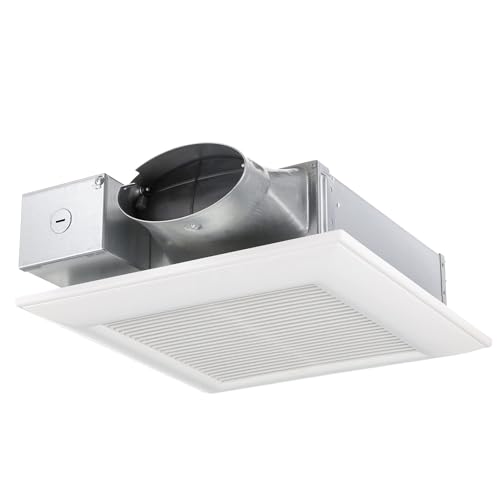
Panasonic FV-0510VS1 WhisperValue Fan
a slim fan with selectable airflow, for bathrooms that want a shallow housing.
Specs: 50-80-100 CFM, slim profile, Pick-A-Flow.
The Panasonic FV-0510VS1 is a bathroom exhaust fan with a slim profile, and it can be set to 50, 80, or 100 CFM, and it is under 0.3 sones at its low setting, and it is made for bathrooms up to 100 square feet, and a homeowner who uses it will find the steam clears, and the mirror does not fog, and the fan is quiet, and the slim housing fits a shallow ceiling.
The slim profile is the point, because the FV-0510VS1 fits where a deep fan will not, and the Pick-A-Flow selector means one fan covers a powder room or a full bath, and the fan is quiet, and a homeowner who has a shallow ceiling should buy the FV-0510VS1, and a homeowner who has a deep ceiling can buy the FV-0511VQ1, and the slim fan is good for a retrofit, and it is good for a new build.
Strengths:
- Slim profile, fits shallow ceilings
- Pick-A-Flow 50-80-100 CFM
- Quiet at low settings
Trade-offs:
- Louder at 100 CFM
- No humidity sensor
- Costs more than a basic fan
Who it fits: Bathrooms that want a slim fan with selectable airflow.
Best for: Bathrooms that want a slim fan with selectable airflow.
Not suited for: Anyone who wants a fan for a large bathroom, or a fan with a humidity sensor.
Check price on Amazon: Panasonic FV-0510VS1 WhisperValue Bath Fan

Panasonic FV-1115VQ1 WhisperCeiling Fan
high airflow and quiet running, for large bathrooms.
Specs: 110-130-150 CFM, under 0.3 sones, Pick-A-Flow.
The Panasonic FV-1115VQ1 is a bathroom exhaust fan with a Pick-A-Flow speed selector, and it can be set to 110, 130, or 150 CFM, and it is under 0.3 sones, and it has a DC motor, and it is made for large bathrooms, and a homeowner who uses it will find the steam clears, and the mirror does not fog, and the fan is quiet, and the fan moves enough air for a tub, a separate shower, and an open toilet.
The airflow is the point, because 150 CFM is the most in this guide, and a large bathroom needs high airflow, and the guide says a bathroom over 100 square feet needs 50 CFM for each toilet, shower, and tub, and the FV-1115VQ1 covers a large bath, and the fan is under 0.3 sones, and a homeowner who has a large bathroom should buy the FV-1115VQ1, and a homeowner who has a small bathroom should buy the FV-0511VQ1.
One limit to know before buying is the duct, because the FV-1115VQ1 needs a 6 inch duct, and a 4 inch duct will not carry 150 CFM, and the guide says to check the duct, and to use a 6 inch duct, because a fan that is ducted wrong will not move air, and a homeowner who checks the duct will have a fan that works, and a homeowner who does not will not.
Strengths:
- Highest airflow in this guide
- Under 0.3 sones
- Pick-A-Flow 110-130-150 CFM
Trade-offs:
- Needs a 6 in duct
- Too big for a small bathroom
- Costs more than any other fan here
Who it fits: Large bathrooms that want high airflow and quiet running.
Best for: Large bathrooms that want high airflow and quiet running.
Not suited for: Anyone who wants a fan for a small bathroom, or a cheap fan.
Check price on Amazon: Panasonic FV-1115VQ1 WhisperCeiling Bath Fan
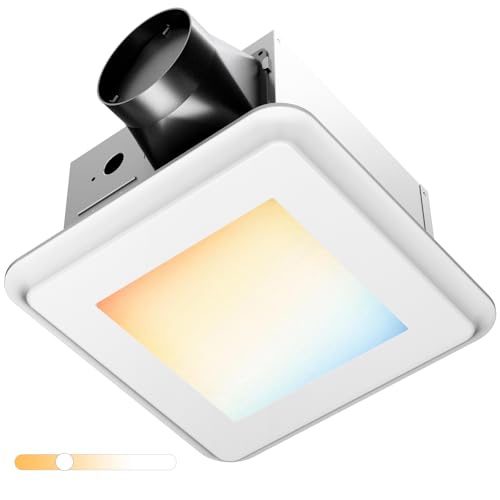
Amico Bathroom Exhaust Fan with Light, 80 CFM
A fan and light in one unit, for small to mid-size bathrooms.
Specs: 80 CFM, 0.9 sones, 1000LM, 5CCT, ceiling opening 8.8 x 8.8 inches.
The Amico bathroom exhaust fan combines an 80 CFM exhaust fan with a built-in light, so one ceiling cutout covers both jobs. It moves 80 cubic feet of air per minute, which suits a small to mid-size bathroom, and it runs at 0.9 sones, a level that stays in the background during a shower. The light puts out 1000 lumens with a 5CCT color temperature selector, so the light color can be set from warm to cool to match the rest of the bathroom. The ceiling opening is 8.8 by 8.8 inches, a common size that fits many existing cutouts without extra drywall work.
A combined fan and light saves a second ceiling opening and a second circuit, which matters in a small bathroom where ceiling space is tight. The 5CCT selector is genuinely useful: a warm setting suits a bathroom with warm wood tones, while a cool setting suits a bright white bathroom, and the choice is made once at install. The 0.9 sone rating means the fan is quiet enough to leave running after a shower, and leaving a fan running after a shower is what clears the last of the steam and moisture.
One limit to know before buying is the fixed 80 CFM airflow. A large bathroom, a bathroom with a soaking tub, or a bathroom with high ceilings will want more airflow than 80 CFM, and this fan cannot be turned up. Measure the bathroom first: length times width times ceiling height gives the volume, and a fan should move roughly that volume several times an hour. Also check the ceiling opening against the 8.8 inch requirement before ordering, since a cutout that is too small needs enlarging and a cutout that is too large needs patching.
Strengths:
- Fan and 1000LM light in one unit
- Quiet at 0.9 sones
- 5CCT light color selector
Trade-offs:
- Fixed 80 CFM, no higher setting
- No humidity sensor
- Needs an 8.8 x 8.8 inch ceiling opening
Who it fits: Small to mid-size bathrooms that want a fan and a light in one ceiling unit.
Best for: Small to mid-size bathrooms that need a fan and a light in one unit.
Not suited for: Large bathrooms, or anyone who wants a humidity sensor or adjustable airflow.
Check price on Amazon: Amico Bathroom Exhaust Fan with Light

OREiN 3-in-1 Bathroom Exhaust Fan with Light and Humidity Sensor, 160 CFM
The strongest airflow in this guide, with a humidity sensor that switches the fan on by itself.
Specs: 160 CFM, 1.0 sone, humidity sensor auto-on at 60 percent humidity, 1500LM, 3CCT, night light.
The OREiN 3-in-1 is a bathroom exhaust fan, a light, and a humidity sensor in one unit, and it moves 160 CFM, the most airflow in this guide. That capacity suits a large bathroom, a bathroom with a soaking tub, or a household where several people shower back to back. The humidity sensor switches the fan on automatically when humidity reaches 60 percent, so steam is cleared even when nobody remembers to flip the switch, and the fan keeps running until the moisture drops. The light puts out 1500 lumens with a 3CCT selector, and a night light is built in for late-night trips to the bathroom.
The automatic sensor is the real reason to pick this fan. Moisture damage comes from the showers nobody ventilates, and a sensor removes the human step entirely. The 160 CFM rating also gives headroom: the fan can clear a steamy bathroom fast, and the 1.0 sone rating keeps it quiet while it does. The night light is a small extra that matters in a family bathroom, where a bright overhead light at night is unwelcome.
One limit to know before buying is the size of the cutout. The unit needs an 11.81 by 11.02 inch ceiling opening, which is larger than a standard fan cutout, so a replacement install may need the opening enlarged. The 160 CFM airflow also needs a 4 inch duct run that is short and straight; a long duct run with bends will cut the real airflow well below the rated number. Check the joist spacing and the duct path before ordering, and confirm the ceiling can take the larger housing.
Strengths:
- 160 CFM, the strongest in this guide
- Humidity sensor switches the fan on at 60 percent humidity
- 1500LM light plus night light
Trade-offs:
- Needs a large 11.81 x 11.02 inch ceiling opening
- Needs a short, straight duct run for full airflow
- Bigger housing than a standard fan
Who it fits: Large or heavily used bathrooms where steam builds up fast and the fan must run without being switched on.
Best for: Bathrooms with heavy steam where the fan should switch itself on.
Not suited for: Small bathrooms, or a ceiling with a standard-size cutout that cannot be enlarged.
Check price on Amazon: OREiN 3-in-1 Bathroom Exhaust Fan with Light &
How to Choose a Bathroom Fan for Moisture
Start with the size, because that is what decides whether the fan will clear the steam, and a bathroom up to 100 square feet needs 1 CFM per square foot, and a bathroom over 100 square feet needs 50 CFM for each toilet, shower, and tub, and the guide says the airflow of every fan, so that a homeowner can choose on the room, not on the brand, and a homeowner who buys a small fan for a big bathroom will have mold, and a homeowner who buys a big fan for a small bathroom will have noise.
Next, check the noise, because that is what decides whether the fan will be left running, and a fan that is quiet will be left running, and a fan that is loud will be switched off, and the guide says the sones of every fan, so that a homeowner can choose on the quiet, not on the price, and a homeowner who buys a quiet fan will clear the steam, and a homeowner who buys a loud fan will not, and under 0.3 sones is very quiet, and 1.5 sones is moderate.
Finally, check the duct, because that is what decides whether the steam will leave the house, and a fan that vents into the attic will grow mold in the attic, and a fan that vents outdoors will not, and the guide says to duct the fan outdoors, and to use the right duct size, because a 150 CFM fan needs a 6 inch duct, and a 80 CFM fan can use a 4 inch duct, and a homeowner who ducts the fan outdoors will have a dry bathroom, and a homeowner who does not will have mold.
Use and Care
Use each product the way its maker intends. Read the instructions that come with it before the first use, and follow them, especially where torque, water temperature, load size, or skin contact is involved. A product used outside its intended range will not perform as described, and it may be damaged or may damage what it is fitted to. Keep the instructions somewhere they can be found again, because the details that matter are easy to forget once the box is thrown away.
Inspect the product regularly and replace it when it is worn. Washers lose their spring, teeth wear flat, seals harden, and creams run out, and a worn product does not do the job of a new one. Check the joints, the seals, and the surfaces after the first use, and then at sensible intervals, and replace anything that has flattened, cracked, corroded, or lost its grip. A replacement costs far less than the damage a worn product can cause.
Store products somewhere dry and clean, away from heat and direct sunlight, and keep small parts such as washers and fasteners in a labelled box so that the right size is easy to find. Keep creams and lotions capped and away from heat, and throw away anything that has changed colour, smell, or texture. Good storage is the cheapest maintenance there is, and it is what keeps a product working for its full life.
Common Mistakes When Buying a Bathroom Fan for Moisture
The first mistake is buying a fan that is too small, because a fan that is too small will not clear the steam, and the steam will stay, and the mold will grow, and the guide says to size the fan at 1 CFM per square foot, and never below 50 CFM, because a bathroom up to 100 square feet needs 1 CFM per square foot, and a homeowner who buys a small fan for a big bathroom will have mold, and a homeowner who buys the right size will not.
The second mistake is venting into the attic, because a fan that vents into the attic will grow mold in the attic, and the guide says to duct the fan outdoors, and to use the right duct size, because a fan that vents outdoors will keep the house dry, and a fan that vents into the attic will not, and a homeowner who ducts the fan outdoors will have a dry house, and a homeowner who does not will have mold in the attic.
The third mistake is switching the fan off too soon, because a fan that is switched off will not clear the steam, and the steam will stay, and the mold will grow, and the guide says to run the fan for 20 minutes after the shower, and to use a timer or a humidity sensor, because a fan that runs after the shower will clear the steam, and a fan that is switched off will not, and a homeowner who runs the fan will have a dry bathroom.
Frequently Asked Questions
How many CFM do I need for my bathroom?
1 CFM per square foot up to 100 square feet, and never below 50 CFM, because a bathroom up to 100 square feet needs 1 CFM per square foot, and a bathroom over 100 square feet needs 50 CFM for each toilet, shower, and tub, and the guide says the airflow of every fan, so that a homeowner can choose on the room, and a homeowner who buys a small fan for a big bathroom will have mold.
Should I vent my bathroom fan into the attic?
No, because a fan that vents into the attic will grow mold in the attic, and the guide says to duct the fan outdoors, and to use the right duct size, because a fan that vents outdoors will keep the house dry, and a fan that vents into the attic will not, and a homeowner who ducts the fan outdoors will have a dry house.
How long should I run the bathroom fan after a shower?
20 minutes, because a fan that runs for 20 minutes after the shower will clear the steam, and a fan that is switched off will not, and the guide says to use a timer or a humidity sensor, because a fan that runs after the shower will clear the steam, and a homeowner who runs the fan will have a dry bathroom, and a homeowner who does not will have mold.
What is a sone?
A measure of loudness, because a fan that is under 0.3 sones is very quiet, and a fan that is 1.5 sones is moderate, and the guide says the sones of every fan, so that a homeowner can choose on the quiet, and a homeowner who buys a quiet fan will leave it running, and a homeowner who buys a loud fan will switch it off.
Do I need a humidity sensor on my bathroom fan?
It helps, because a humidity sensor turns the fan on when the air is humid, and a fan that turns on by itself will clear the steam, and a fan that is switched off will not, and the guide says a sensor helps, but it does not replace sizing, and a homeowner who forgets to switch the fan on should buy a sensor fan, and a homeowner who always switches the fan on can buy a fan without one.
Can a bathroom fan stop mold?
Yes, if it is sized right and ducted outdoors, because a fan that moves enough air will clear the steam, and a fan that vents outdoors will keep the house dry, and the guide says to size the fan at 1 CFM per square foot, and to duct it outdoors, and to run it for 20 minutes after the shower, because a fan that does all three will stop mold, and a fan that does not will not.
How long should I run my bathroom fan in winter?
20 minutes after the shower, because a fan that runs for 20 minutes after the shower will clear the steam, and a fan that is switched off will not, and the guide says to use a timer, and to use a humidity sensor, because a fan that runs after the shower will clear the steam, and a homeowner who runs the fan will have a dry bathroom, and the cold air that comes in will be warmed by the house.
Should I leave the bathroom door open or shut when the fan runs?
Shut, with a gap under it, because a fan that pulls air through the gap under the door will clear the steam, and a fan that pulls air from the rest of the house will not, and the guide says to shut the door, and to leave a gap under it, because a fan that has a gap under the door will pull air through the gap, and a fan that has no gap will not.
Related Guides on Cottage Verdict
More guides on Cottage Verdict on the same topic:
Running a Bathroom Fan So It Actually Clears Steam
The first job is to switch the fan on before the shower, because a fan that is on before the steam starts will clear it, and a fan that is switched on after the shower will not, and the guide says to switch the fan on, and to leave it on, because a fan that runs before the shower will keep the mirror clear, and a fan that is switched on late will not, and a homeowner who switches the fan on first will have a dry bathroom.
The second job is to run the fan for 20 minutes after the shower, because a fan that runs after the shower will clear the steam, and a fan that is switched off will not, and the guide says to use a timer, and to use a humidity sensor, because a fan that runs for 20 minutes will clear the steam, and a homeowner who runs the fan will have a dry bathroom, and a homeowner who does not will have mold.
The third job is to shut the bathroom door, because a fan that pulls air from the rest of the house will not clear the steam, and a fan that pulls air through the gap under the door will, and the guide says to shut the door, and to leave a gap under it, because a fan that has a gap under the door will pull air through the gap, and a fan that has no gap will not, and a homeowner who shuts the door will have a dry bathroom.
The fourth job is to check the duct, because a fan that vents outdoors will keep the house dry, and a fan that vents into the attic will grow mold in the attic, and the guide says to duct the fan outdoors, and to use the right duct size, because a 150 CFM fan needs a 6 inch duct, and a 80 CFM fan can use a 4 inch duct, and a homeowner who ducts the fan outdoors will have a dry house.
The fifth job is to clean the grille, because a grille that is dusty will block the air, and a fan that is blocked will not move air, and the guide says to vacuum the grille, and to wash it, because a grille that is clean will let air through, and a grille that is dusty will not, and a homeowner who cleans the grille will have a fan that works, and a homeowner who does not will have a fan that does not.
The sixth job is to check the damper, because a damper that is stuck will not open, and a fan that cannot open the damper will not move air, and the guide says to check the damper, and to make sure it moves, because a damper that moves will let air out, and a damper that is stuck will not, and a homeowner who checks the damper will have a fan that works.
The seventh job is to listen to the fan, because a fan that is quiet will be left running, and a fan that is loud will be switched off, and the guide says the sones of every fan, so that a homeowner can choose on the quiet, and a homeowner who buys a quiet fan will leave it running, and a homeowner who buys a loud fan will switch it off, and a fan that is left running will clear the steam.
The eighth job is to set the humidity sensor, because a sensor that is set right will turn the fan on when the air is humid, and a sensor that is set wrong will not, and the guide says to read the manual, and to set the sensor, because a fan that turns on by itself will clear the steam, and a fan that is switched off will not, and a homeowner who sets the sensor right will have a dry bathroom.
Final Recommendation
The best bathroom fans for moisture in this guide are the Panasonic FV-0511VQ1 for bathrooms that want the quietest fan, the Panasonic FV-1115VQ1 for large bathrooms that want high airflow, and the OREiN 3-in-1 humidity sensor fan for bathrooms that want automatic moisture control.
Before you buy, check the size, check the noise, and check the duct, because those three checks will tell you more than any feature list, and a homeowner who buys on the room will buy the right fan, and a homeowner who buys on the price alone will buy the wrong one.
One last note. A bathroom fan must be ducted outdoors, because a fan that vents into the attic will grow mold in the attic, and a fan that is sized right and run for 20 minutes after the shower will keep the bathroom dry, and a local electrician can tell you whether the fan you want will suit the bathroom you have, and whether the duct is right.
Related guides
- Best Ceiling Fan With Remote: 6 Fans You Can Control From Bed
- Best Bathroom Fan Light Combo: 6 Fans That Vent Steam and Light the Room
- Best Ceiling Fans for Small Rooms: 6 44-Inch Fans That Fit Without Overwhelming the Room
- Best Ceiling Fans for Bedroom: 6 Quiet Fans That Cool Without Keeping You Awake


