What's inside
- Where to buy the six fans
- Quick Picks
- How these picks were chosen
- Six mechanisms, reviewed without embroidery
- The six titles, audited for the word that is not there
- How should a casement owner actually approach this?
- Why casement windows defeat ordinary window fans
- Common mistakes when fans meet awkward windows
- Final recommendation
- Ventilation thinking for rooms that run hot
- Noise, draughts and sleeping beside a window fan
- Seasonal storage and the second year
- Rental homes and the no-modification rule
- Energy and the open window: a brief sanity check
- Two windows, two households: worked examples
- What to ask the manufacturer: a short script
- The physics corner: pressure, paths and why direction is destiny
- A short history of the window fan, for context
- Children, pets and the guarded opening
- When the window is also the view
- Frequently asked questions
As an Amazon Associate I earn from qualifying purchases. This post may contain affiliate links at no extra cost to you.
As an Amazon Associate, cottageverdict.com earns from qualifying purchases.
Casement windows are the awkward customers of the window fan world, and pretending otherwise helps nobody: they crank outward on hinges, leaving no sliding sash track for a conventional fan to grip, no ledge for it to rest on, and most fan designs simply give up on them. Anyone searching for the best window fans casement windows can actually work with deserves a straight answer before a product list, so here it is. Not one of the six listings below mentions casement windows — or crank windows — anywhere in its title. No listing here states a casement fit for any pick in this article, and nothing here is described as designed for a casement window.
What this guide offers instead is the honest nearest ground, mapped carefully and labelled at every step so that no reader mistakes proximity for a promise. The fans below earn their places through mechanisms that speak to the casement problem indirectly: vertical fans built for sliding windows, whose sideways-opening geometry is the closest common relative of a casement’s swing; a low-profile transom fan that sits in a window opening without depending on sash tracks; and a twin fan specified for sliding windows up to a clearly stated width. Each review below names the mechanism its title actually describes and repeats the casement silence exactly where it belongs — in the open, in the spec box and in the verdict.
Why publish a list at all under these conditions? Because the alternative guides pretend, and pretending in print costs readers real money at real windows in real summer heat. A casement owner who buys a fan on a false promise of fit learns the truth at installation, on a hot afternoon, with a window standing open and a fan in hand that fits nothing. A casement owner who reads this list carefully learns which mechanisms might adapt to their opening, what each title genuinely promises, and exactly which question — will this fit my casement? — must be put to measurements and manufacturer documentation, calmly and in writing, before any money moves at all in any direction.
Where to buy the six fans
Every pick is an Amazon listing; the lines below stick strictly to what each title claims, and repeat the casement silence wherever a reader might otherwise be tempted to assume it away.
- AMCHIXIN’s vertical fan spans 15.7 to 17.7 inches, aligns with the top and bottom tracks of sliding windows, and runs exhaust only.
- shinic builds a vertical fan whose heads rotate through 180 and 90 degrees, with manual reversing and width adjustment up to 33.27 inches.
- QJSZMEI’s vertical model covers 31.5 to 33.5 inches of sliding window, installs without drilling, and retracts by 1.97 inches.
- GODNOEI matches that larger size band for sliding windows, adding stepless speed control and a waterproof claim.
- Vornado’s TRANSOM takes the low-profile route: four speeds, a remote control, reversible exhaust and a weather resistant case.
- BLACK+DECKER fields a 9-inch twin fan with a mechanical dial, removable legs and accordion expanders for sliding windows up to 33 inches wide.
Quick Picks
| Pick | Best for | Mechanism its title describes |
|---|---|---|
| AMCHIXIN Vertical Fan 15.7-17.7in Sliding Windows | Narrow vertical openings, exhaust duty | Vertical fit in sliding window tracks; exhaust only |
| shinic Vertical Rotatable Window Fan | Directing air up, down or outward in one unit | Rotatable fan heads; manual reversible; expanders |
| QJSZMEI Vertical Fan 31.5-33.5in Sliding Windows | Tall sliding openings without drilling | Vertical exhaust; retractable sizing; no-drill install |
| GODNOEI Vertical Window Exhaust Fan 31.5-33.5in | Fine-grained speed control in damp-prone rooms | Stepless control; waterproof claim; tool-free fit |
| Vornado TRANSOM Window Fan Black | Low-profile openings and remote-controlled use | Transom format; 4 speeds; reversible exhaust mode |
| BLACK+DECKER 9in Dual Window Fan BFW9M | Simple twin-fan duty with a mechanical dial | Twin heads; accordion expanders; removable legs |
How these picks were chosen
The selection began from the casement problem itself, in the room, at the window, rather than from the fan catalogue and its assumptions. A casement window opens by swinging or cranking outward; it offers no horizontal sash channel, no sliding panel to trap a fan against, and no ledge worth the name. Conventional twin fans, designed for double-hung sashes, dominate the market and were set aside as the least adaptable format — with one exception kept for its stated sliding-window width and expanders, clearly labelled.
Priority went to vertical fans for sliding windows, and the reasoning behind that choice deserves stating plainly, once and without decoration: a sliding window opens sideways, and its vertical track channel is the nearest common mechanism to the sideways geometry a casement presents. Four of the six picks are vertical designs. That is an argument about proximity of mechanism, not a claim of casement compatibility — the titles say sliding, and this guide says sliding, every single time, in every section, without exception.
The remaining two places in the six went deliberately to format diversity: a transom fan whose low, wide profile depends on the opening itself rather than on sash mechanics of any kind, and the BLACK+DECKER twin whose title explicitly addresses sliding windows up to 33 inches. Across all six, every stated size range, speed arrangement and installation claim was taken from the titles alone, checked twice against the listings as supplied, and the casement question was recorded identically for each of the six, in the same words, without softening: left unstated by every listing.
Six mechanisms, reviewed without embroidery

AMCHIXIN Vertical Fan 15.7-17.7in Sliding Windows
AMCHIXIN’s fan is the narrow specialist: a vertical unit spanning 15.7 to 17.7 inches, designed per its title to align with the top and bottom tracks of sliding windows, tool-free, with variable speed, for bedrooms, smoky spaces and hot areas. It runs exhaust only — a deliberate one-direction design. Casement fit is not stated in the listing, as with every pick here.
Listing details
- Size band printed: 15.7-17.7 inches, vertical
- Window type in the title: sliding windows, top and bottom tracks
- Airflow direction: exhaust only
- Speed control: variable speed
- Installation: tool-free
- Casement fit: not stated in the listing
Strengths
- A narrow vertical band suits slim openings the wider fans cannot enter
- Track alignment gives the unit a defined seat in sliding frames
- Exhaust-only clarity suits kitchens and smoky spaces where out is the point
Trade-offs
- Exhaust only means no intake mode for pulling cool evening air inward
- The narrow band excludes standard-width windows entirely
- Nothing in the title addresses casement or crank openings
Exhaust-only design is a philosophy worth respecting. A fan that only pushes air out creates negative pressure, and the room answers by drawing replacement air from every gap, doorway and cooler corner of the home. For smoke, cooking vapour and stale heat, that one-way commitment is exactly right, and it simplifies the machine: no reversing mechanism, no intake mode to seal imperfectly. Bedrooms and smoky spaces, both named in the title, are the rooms where stale air is the problem rather than the solution.
The track-alignment language is the most mechanically specific in this list. Top and bottom tracks are the channels a sliding sash runs in; a fan shaped to align with them borrows the window’s own structure for support and sealing. That is a genuinely considered approach to sliding windows — and it underlines, by contrast, the casement gap: a casement window has hinges and a crank, not tracks, so the very feature that seats this fan has nothing to engage in a casement frame.
Variable speed on an exhaust fan governs how aggressively the room exchanges air. At full draw, a bedroom clears cooking drift from the kitchen in minutes; at a murmur, it maintains freshness overnight without a draught. For the casement owner reading along, the transferable lesson is the size band: vertical fans exist at under eighteen inches, a scale that suits narrow openings of several kinds, provided the mounting question is separately solved.
Best for: narrow sliding-window openings needing dedicated exhaust with variable speed
Not suited for: any casement installation, since the title describes sliding tracks and states no casement fit
Check price on Amazon — the AMCHIXIN narrow vertical, for exhaust duty in slim sliding openings.

shinic Vertical Rotatable Window Fan
shinic’s vertical fan is the gymnast of the group: twin fan heads that rotate through 180 degrees plus 90 degrees, three speeds, manual reversing, rigid and accordion expanders, and width adjustment from 21.65 to 33.27 inches. Its title calls it a vertical window fan for home, kitchen and bedroom without naming a window type — silent on sliding as well as on casement, a point its title leaves open.
Listing details
- Width adjustment printed: 21.65 to 33.27 inches
- Fan heads: rotatable 180° plus 90°
- Speeds: 3 speeds
- Direction: manual reversible
- Sealing: rigid and accordion expanders
- Casement fit: the listing states none
Strengths
- Rotatable heads aim air where the room needs it, not only straight through the opening
- Manual reversing covers both intake and exhaust duties in one unit
- Two expander styles give options for sealing different frames
Trade-offs
- Manual reversing means walking to the fan and turning it — no remote flip
- The title names no window type, leaving fit questions wider open than rivals
- No exhaust-only or intake-only specialisation; it is a generalist
Rotating heads change what a window fan is for. A fixed fan ventilates; a fan whose heads sweep through wide angles also circulates, pushing air up toward a ceiling’s trapped heat or down across a bed. The 180-plus-90 rotation printed in the title describes heads that can face fully outward for exhaust, fully inward for intake, or angle between — a range that lets one installation serve a kitchen at noon and a bedroom at midnight with different aims.
Manual reversible is the honest counterpart to that flexibility. Reversing here is a physical act: the fan is turned or its heads rotated by hand. There is no button, and the title does not pretend otherwise. In practice, households set a direction per season or per time of day rather than flipping hourly, so the manual arrangement costs less convenience than it first appears — and it buys mechanical simplicity that tends to age well.
The expanders matter for the casement-curious reader most of all. Rigid and accordion expanders are sealing tools: they fill the gaps between fan and frame that would otherwise leak air and rattle. In an opening the fan was not precisely designed for, sealing is half the battle — though this guide repeats its refrain: expanders help a fan sit in an opening, and they do not convert a vertical fan into a casement fan. The title states no casement fit, and neither does this review.
Best for: rooms wanting directional, reversible airflow across a wide adjustable span
Not suited for: a stated casement or sliding fit, since the title names no window type at all
Check price on Amazon — the shinic rotatable, for aimed air and seasonal reversing in one vertical unit.

QJSZMEI Vertical Fan 31.5-33.5in Sliding Windows
QJSZMEI covers the tall end of sliding windows: a vertical exhaust fan for the 31.5 to 33.5 inch band, installed without drilling, with adjustable wind speed and a 1.97-inch retractable adjustment. Its stated rooms run from bedroom and bathroom to kitchen and office. As throughout this list, the listing claims no casement fit — its world is sliding windows, exhaust only.
Listing details
- Size band printed: 31.5 to 33.5 inches, vertical
- Window type in the title: sliding windows
- Airflow direction: exhaust only
- Installation: no drilling required
- Adjustment: 1.97 IN retractable; adjustable wind speed
- Casement fit: unstated in the title
Strengths
- The tall band serves large sliding openings the narrow AMCHIXIN cannot
- No-drilling installation suits renters and finished frames alike
- A retractable dimension fine-tunes the fit within the band
Trade-offs
- Exhaust only, again, rules out intake cooling duties
- The band is useless for standard or narrow windows
- Bathroom suitability is a title claim; no waterproof rating is printed
Size bands are the quiet grammar of this category, and this listing speaks the tall dialect. Thirty-one and a half to thirty-three and a half inches vertical describes the full-height sliding panels of modern patio-adjacent windows and large bedroom sliders. A vertical fan at this scale moves a room’s air through a tall column of opening, which suits exhaust particularly well: warm air stratifies high, and a tall exhaust meets it where it gathers.
No drilling required is a phrase with a specific audience. Renters forbidden from modifying frames, owners of new windows under warranty, and anyone whose frames are aluminium or uPVC rather than timber all need installation that grips without penetrating. Combined with the retractable adjustment — just under two inches of fine travel — the design aims to seat firmly by pressure and fit rather than by screws. The trade is vigilance: pressure-fit installations deserve a periodic check that the unit remains snug, especially after storms or a season of vibration.
The room list — bedroom, bathroom, kitchen, office — describes exhaust’s natural habitats: moisture, cooking vapour, stale work air. Note what the title does not print: no waterproof or ingress rating accompanies the bathroom mention, unlike the GODNOEI below, which claims waterproof outright. Claims in this guide are kept at title strength, and a room named is not a rating given.
Best for: tall sliding windows needing drill-free exhaust across bedrooms, bathrooms and kitchens
Not suited for: intake duties of any kind, since the design is exhaust only by its title
Check price on Amazon — the QJSZMEI tall vertical, for drill-free exhaust in large sliding openings.

GODNOEI Vertical Window Exhaust Fan 31.5-33.5in
GODNOEI matches QJSZMEI’s tall band — 31.5 to 33.5 inches, vertical, for sliding windows — and differentiates on control and environment: stepless speed control rather than fixed speeds, a waterproof claim, tool-free fitting, and the longest room list here, running from living room and bedroom through bathroom, attics, kitchen, office and garage. The listing states no casement fit.
Listing details
- Size band printed: 31.5 to 33.5 inches, vertical
- Window type in the title: sliding windows
- Speed control: stepless speed control
- Environmental claim: waterproof
- Installation: tool-free
- Casement fit: not stated in the listing
Strengths
- Stepless control dials in exactly the airflow a room wants, with no preset gaps
- A waterproof claim suits bathrooms, attics and garages where damp lives
- The room list is the broadest here, signalling whole-house intent
Trade-offs
- No reversing or intake mode is mentioned in the title
- The tall band excludes smaller windows outright
- Waterproof is claimed without a printed rating code in the title
Stepless control is the connoisseur’s option in fan design. Fixed speeds force a choice between too much and too little; a stepless dial finds the precise point where a bedroom exhaust is effective yet inaudible, or where a garage fan clears fumes without howling. In an exhaust-only context — this title describes an exhaust fan — that granularity is the difference between a fan that runs all evening and one that gets switched off for its noise and never switched back on.
The waterproof claim pairs logically with the room list. Attics bake and leak; garages breathe damp; bathrooms steam daily. A fan marketed across those spaces with waterproof in its title is making a construction claim the other verticals here do not make, and it is reported at exactly that strength: claimed in the title, with no rating code printed to grade it. Households placing any fan in a wet zone should still observe ordinary electrical sense, claim or no claim.
Tool-free fitting at this size deserves a practical note. A 33-inch vertical unit is a substantial object to seat by pressure and alignment; two people make the job calmer than one, and the first week’s snugness checks matter. None of that diminishes the design — it simply respects the physics of large fans in tall openings, which is the same respect this guide asks readers to bring to the casement question: fit is a physical fact, established by measurement, never by optimism.
Best for: tall sliding openings in damp or varied rooms, wanting stepless exhaust control
Not suited for: reversible intake-and-exhaust working, which the title never mentions
Check price on Amazon — the GODNOEI tall vertical, for stepless, waterproof-claimed exhaust at full height.
Vornado TRANSOM Window Fan Black
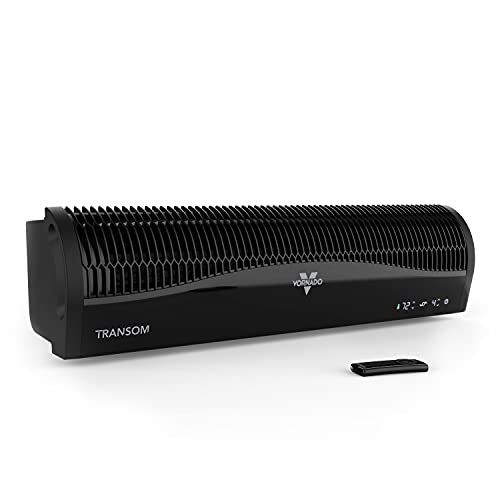
Vornado’s TRANSOM breaks the vertical pattern entirely: a low, wide transom-format fan with four speeds, a remote control, a reversible exhaust mode, a weather resistant case, in black, for whole-room use. Its title names no window type — not sliding, and not casement either. It is here because its profile answers a different geometry: the wide, shallow opening above a door or across a window’s lower band.
Listing details
- Format: transom window fan, low profile
- Speeds: 4 speeds
- Control: remote control included per the title
- Direction: reversible exhaust mode
- Case: weather resistant case; colour: Black
- Casement fit: no statement in the title
Strengths
- A remote control is unique here — direction and speed without leaving the chair
- Weather resistance suits an opening that faces the elements directly
- Four speeds give finer steps than the two- and three-speed rivals
Trade-offs
- No size range is printed in the title, so opening fit needs documentation
- The transom format assumes a wide, shallow opening many windows do not offer
- No expanders or sealing system is described in the title
The transom idea deserves unpacking, because it is the oldest idea in this list. Transoms — the horizontal openings above doors and within tall window assemblies — existed to move air through buildings before electric fans did. A fan built in that long, low shape sits where air naturally stratifies and spills, and it asks nothing of sashes or tracks. For the casement owner, that independence from window mechanics is the most interesting property in this entire article: a fan that does not care how the window opens, only whether a suitable opening exists. Interesting is not the same as confirmed — the title states no casement fit — but the mechanism is genuinely different in kind.
Remote control and reversible exhaust complete a convenience picture none of the verticals match. Reversing by button, from across the room, changes how a fan gets used: intake on cool evenings, exhaust after cooking, adjusted on impulse rather than by expedition. Four speeds refine the same idea. Vornado’s whole-room phrasing positions the unit as a room air manager rather than a mere hole-filler, and the weather resistant case acknowledges that its home is the building’s skin, rained on and sunned.
The missing size range is the listing’s one real frustration. Every vertical rival prints its band; the TRANSOM title prints none, so a buyer must take dimensions from the product documentation before judging any opening — casement-adjacent or otherwise. In a guide built on title evidence, that absence is recorded plainly, and it is the first errand this pick assigns its buyer.
Best for: wide, shallow openings wanting remote-controlled, reversible airflow in a weather resistant case
Not suited for: a printed size range for fit-checking, since the title omits dimensions entirely
Check price on Amazon — the Vornado TRANSOM, for low-profile openings and button-press reversing.

BLACK+DECKER 9in Dual Window Fan BFW9M
BLACK+DECKER closes the list with the traditional format, specified more carefully than most: a 9-inch dual window fan, twin fan heads, two speed settings, a mechanical dial control, removable legs, and accordion expanders fitting it for sliding windows up to 33 inches wide. Its title’s window claim is sliding — no casement fit is stated in its listing either, completing a clean sweep of six silences on the topic.
Listing details
- Fan size printed: 9-inch dual (twin heads)
- Speeds: 2 speed settings
- Control: mechanical dial control
- Window claim: for sliding windows up to 33 inches wide
- Sealing and stands: accordion expanders; removable legs
- Casement fit: not stated in the listing
Strengths
- A mechanical dial is operable by feel and immune to remote-loss
- Removable legs let the fan stand on a surface as well as sit in a window
- The 33-inch sliding width is stated outright, a clear fit boundary
Trade-offs
- Two speeds is the coarsest control ladder in this list
- The twin horizontal format is the least adaptable shape here for unusual openings
- No reversing mode is claimed in the title
There is a sturdy honesty in a mechanical dial. It clicks, it stays, it can be operated in the dark by a hand that knows it, and it will work in twenty years without a battery or a pairing ritual. The BFW9M’s title leads with its control because the control is the experience: two speeds, chosen physically. In a list full of stepless dials and remotes, this is the Luddite option, and many households — workshops, spare rooms, rentals — are quietly Luddite about exactly such appliances.
Removable legs widen the fan’s life beyond the window. Legs on, it stands on a sill, a workbench or the floor as a room fan; legs off, it seats in the window with its accordion expanders sealing the sides. That dual citizenship suits seasonal rhythms: window duty through summer, standing duty in a stuffy room when the window must stay shut. The title prints the sliding width ceiling — up to 33 inches — which is the kind of boundary statement this guide wishes every listing made.
As the traditional format, it also serves as the list’s control case. This is the fan shape the casement problem defeats most completely in its classic double-hung habitat; its presence here rests on its stated sliding-window specification and its expanders, and its review closes with the same sentence as the other five, because accuracy does not grade on a curve: casement fit is not stated in the listing.
Best for: straightforward twin-fan duty in sliding windows up to 33 inches, with standing use as a bonus
Not suited for: fine speed gradations, since two settings are the whole ladder
Check price on Amazon — the BLACK+DECKER twin, for dial-simple ventilation with a clearly printed width limit.
The six titles, audited for the word that is not there
| Fan | Window type its title names | Direction | Casement in title |
|---|---|---|---|
| AMCHIXIN | Sliding windows | Exhaust only | Not stated |
| shinic | None named | Manual reversible | Not stated |
| QJSZMEI | Sliding windows | Exhaust only | Not stated |
| GODNOEI | Sliding windows | Exhaust | Not stated |
| Vornado TRANSOM | None named | Reversible exhaust mode | Not stated |
| BLACK+DECKER BFW9M | Sliding windows | Not stated | Not stated |
That last column is the most important one in this article, and it is uniformly honest. Any guide that fills it with assumptions is selling something. This one instead offers mechanisms, measurements and a method — the method is the next section.
How should a casement owner actually approach this?
Measure the opening the crank leaves you
Open the casement fully and measure the clear aperture: width, height, and the depth of frame the fan could bear against. Compare those numbers with the printed bands of the vertical fans — 15.7–17.7 inches, the 21.65–33.27 span, the 31.5–33.5 band — and with the TRANSOM’s dimensions from its documentation. A fan that matches your aperture on paper has passed the first gate only; the mounting question remains, and it is physical, not rhetorical.
Decide whether exhaust or reversible matters more
Casement rooms often suffer most from trapped heat and cooking drift, which is exhaust work. Two of the verticals and the tall pair’s designs commit to exhaust only; the shinic and the Vornado reverse. If your room’s problem is expelling air, the exhaust specialists are simpler and often stronger in their one direction. If evenings bring cool outside air worth pulling in, reversing earns its complexity.
Interrogate the mounting, not the marketing
Ask of any candidate: what does it grip, seal against, or rest on? Tracks, expanders, pressure fit, legs — the titles name their mechanisms, and a mechanism that has a counterpart in your window is a candidate; one that does not is a return in waiting. Put the question to the manufacturer’s documentation for your exact window style, and treat any answer that will not commit as a no.
Keep the fallback honest
Sometimes the correct answer for a true casement is a fan that does not live in the window at all — a standing or tower unit near the opening, drawing on the same breeze without a fit battle. The BLACK+DECKER’s removable legs hint at that dual life. A guide that admits the fallback respects the reader more than one that forces a window fan into a window that refuses it.
Why casement windows defeat ordinary window fans
The conventional window fan evolved around the double-hung sash: two panels sliding vertically, a channel to sit in, a sash to lower onto the fan’s top edge as a clamp. Every element of that arrangement is missing from a casement. The casement’s sash swings outward on side hinges, driven by a crank; closed, it seals against compression weatherstripping; open, it vacates the opening entirely and leaves a frame whose inner faces offer no track, no ledge and no clamping partner. A fan dropped into that opening has nothing designed to hold it, and gravity is not a mounting system.
Sliding windows share more DNA with casements than double-hungs do: the opening is created by lateral movement, and the frame carries tracks along its sides or its top and bottom. Vertical fans exploit those tracks, standing in the channel the sash vacated. That is the entire logic of this list’s shape — four verticals for sliding windows, chosen because sideways geometry is the casement’s nearest neighbour in the window family, while never claiming the neighbour’s name.
The crank itself adds a final complication: hardware protrudes into the room and into the opening’s swing path, and screens on casements typically sit inside, where a fan would also want to be. Any adaptation attempt must reckon with the screen’s position and the crank’s sweep. None of the six titles addresses screens or cranks, which is one more reason their casement silence is total rather than partial — and why this guide treats manufacturer confirmation, for your specific window, as the only authority that can close the question.
Readers mid-renovation, choosing windows rather than adapting to them, may also be weighing the cooling side of the house — the room-by-room options gathered in Best Window Fans to Cool a Room cover the conventional formats this list had to set aside.
Common mistakes when fans meet awkward windows
Believing a title that whispers compatibility it never prints. If a listing wanted to claim casement fit, it could print the word. Six titles here print sliding, vertical, transom — everything except casement. Read what is printed, and let what is absent stay absent.
Ordering by the room’s size instead of the opening’s dimensions. A fan cools nothing from inside its delivery box. The aperture measurement comes first; every printed band in this list exists to be compared against it before any other virtue is weighed.
Forgetting the screen and the crank. Casement screens usually live indoors, exactly where a fan would sit, and crank handles sweep a real arc. A fit that works on paper can fail on both counts in the first minute of installation.
Assuming exhaust and intake are interchangeable needs. A steamy bathroom and a hot bedroom at dusk want opposite directions. Buying an exhaust-only fan for an intake problem — or the reverse — is a mismatch no mounting ingenuity can fix.
Treating expanders as universal adapters. Accordion and rigid expanders seal gaps; they do not create tracks, ledges or clamping sashes. Their presence improves a plausible fit. It cannot manufacture one.
Skipping the manufacturer’s answer. For an unlisted window type, the documentation and the maker’s own support answer are the only authorities. A retailer’s compatibility chart that lumps all windows together is marketing, not engineering.
Final recommendation
Begin by accepting the article’s central fact with good grace: no title here promises a casement fit, so no recommendation can either. What can be recommended is an order of investigation. Start with the vertical sliding-window fans, whose sideways mechanism is the closest common relative of your window’s geometry — the AMCHIXIN if your aperture is narrow and your need is exhaust, the shinic if you want reversible, directable air across a wide span, the QJSZMEI or GODNOEI if your opening is tall, choosing between them on drill-free fitting versus stepless, waterproof-claimed control.
Give the Vornado TRANSOM its own hearing if your window assembly includes a wide, shallow opening its low profile could occupy, since its format ignores sash mechanics altogether — and take its dimensions from documentation, because its title withholds them. Keep the BLACK+DECKER as the simple, dial-controlled option for any genuine sliding window in the home, where its title’s promise actually lives.
And hold the fallback without embarrassment: if measurements and manufacturer answers close every door, a standing fan beside the casement will move the same evening air with none of the fit risk. Ventilation problems in the rest of the house follow their own rules — the filtration questions in Best Furnace Filters 20x25x1 and the smoke-and-odour thinking in Best Air Fryers with Filters are the companion reads for readers working through the whole home’s air.
Ventilation thinking for rooms that run hot
A window fan is one move in a longer game against indoor heat. Exhaust works hardest when replacement air has a planned path: a door undercut, a second window cracked on the shaded side, a route that pulls air across the room rather than short-circuiting beside the fan. Intake reverses the logic, pressurising gently and pushing stale air out through the house’s leaks and vents. Either way, the fan’s printed direction — exhaust only, reversible, stepless exhaust — should be matched to the path the room can actually offer, which is a property of the house, not of the fan.
Timing multiplies whatever the fan provides. Exhausting during cooking and bathing removes moisture and vapour at their source, when they are concentrated and easy to capture. Intaking after sunset, when outside air drops below inside temperature, banks coolth in the room’s mass for the following day. The remote-controlled Vornado and the stepless GODNOEI serve these rhythms in different dialects — impulse adjustment versus set-and-hold precision — and the right dialect is the one your household will actually use at 11pm, tired, without a deliberation.
Noise, draughts and sleeping beside a window fan
A fan’s specification sheet ends where the bedroom begins, because the quality that decides whether a fan runs all night is its sound at the speed you actually use. None of these titles prints a noise figure, so this guide cannot rank them by loudness — another honest blank. What the titles do reveal is control granularity, and granularity is the sleeper’s friend: stepless control finds the quiet threshold precisely, four speeds offer more resting places than two, and a remote control means the 2am adjustment happens without a cold walk across the room.
Draught management is the twin concern. A fan exhausting at full draw pulls air across a bed whether the sleeper wants it or not; the shinic’s rotatable heads answer by aiming the stream, and the vertical fans answer by position, standing in the window’s column rather than blowing across the pillow. Households sensitive to moving air while asleep often discover that exhaust, paradoxically, feels gentler than intake at the same exchange rate, because the incoming air arrives diffusely through the room’s gaps instead of as a directed jet. That lived detail, unprintable in any title, is worth a first-night experiment before a fan’s position is declared final.
Seasonal storage and the second year
Window fans live hard lives at the building’s skin and then spend months in cupboards, and the titles hint at which designs tolerate the rhythm. Expanders and removable legs detach for storage; vertical units store flat against a wall; the Vornado’s weather resistant case suggests a unit less troubled by a damp garage corner than most. Whatever the design, the end-of-season ritual decides the second year’s performance: brush the blades and grilles free of the summer’s dust felt, wipe the expanders, coil the cord loosely, and store the fan where its plastic will not bake or freeze against a loft’s extremes.
Dust deserves its sentence because it is the silent tax on every fan in this list. A summer of exhaust work coats blades with the very material the fan was expelling, and a coated blade moves less air at the same speed while sounding rougher doing it. The clean fan of September, stored dry, starts the following May at full strength; the neglected one starts as a lesser fan and is often misjudged as worn out when it is merely dirty. No title here prints a cleaning regime, so this guide offers the generic one — soft brush, damp cloth, fully dry before storage — as housekeeping, not as a product claim.
Rental homes and the no-modification rule
A large share of awkward-window households rent, and renting redraws the fan question around reversibility. Drilling is out; permanent seals are out; anything that marks the frame is out. Read against that rule, the titles sort themselves freshly: no-drilling installation on the QJSZMEI, tool-free fitting on the AMCHIXIN and the GODNOEI, expanders that grip without penetrating on the shinic and the BLACK+DECKER. These phrases, minor beside wattage in a homeowner’s reading, become the headline features in a renter’s.
The casement renter faces the strictest version of the puzzle, because adaptation tricks that a homeowner might attempt on their own frames are unavailable. For that reader this article’s honesty matters most of all: the nearest mechanisms are mapped, the silences are labelled, and the standing-fan fallback is presented without shame. A tower fan beside an open casement, in a rental where nothing may be modified, is not a failed window fan purchase — it is the correct engineering answer to the constraints actually in force.
Energy and the open window: a brief sanity check
A window fan’s running cost is a rounding error beside air conditioning, which is the economic engine of the whole category — but the fan only saves energy when it substitutes for cooling rather than accompanying it. Running a compressor with a window open to a fan is the worst of both worlds. The disciplined pattern is climatic: fan alone through the mild hours and the night, sealed windows and cooling only when the day genuinely demands it. The reversible models serve the pattern best, intaking the cool night air that lets the following morning start ahead of the heat.
Exhaust fans pull a second, subtler duty in that economy: they remove moisture and cooking heat at the source, loads that would otherwise linger and tax the cooling system later. A bathroom exhausted for twenty minutes after a shower is a dehumidification job done by a small motor instead of a large one. None of the titles prints running costs, and this guide quotes none — the argument here is structural, about which machine does which job, and it holds regardless of the tariff on any particular bill.
Two windows, two households: worked examples
Picture a narrow bedroom slider in a rental flat, its vertical opening measuring just over sixteen inches, the tenant forbidden to drill. The printed bands do the shortlisting unaided: the AMCHIXIN’s 15.7–17.7 span is the only one that fits, its tool-free track alignment suits the tenancy, and its exhaust-only direction matches the room’s problem of stale, warm air. The example is tidy precisely because the measurement came first and the title’s claims were read at face value.
Now picture a farmhouse casement, wide and crank-opened, in a house its owners are restoring. The same discipline yields a different afternoon: the aperture is measured, the vertical bands are compared, the TRANSOM’s documentation is fetched for its missing dimensions, and the manufacturer of the closest vertical is asked, in writing, about the specific window. If the answers come back negative, the household buys a standing fan for that room and window fans for the sliders elsewhere in the house — a mixed fleet matched room by room to what each window actually is. That, and not a forced fit, is what success looks like under this article’s rules.
What to ask the manufacturer: a short script
Because casement fit lives or dies in documentation, the questions matter. Ask which window styles the fan is rated for, in those words, and whether casement or crank-opening windows appear in the manual. Ask what the fan bears against and what seals the sides in a frame without tracks. Ask the unit’s exact dimensions, including any parts that protrude into the room, where a crank handle needs its sweep. And ask whether installation in your window style affects the warranty. A maker who answers all four plainly has earned the sale if the answers are yes; a maker who answers with general reassurance has answered, too.
The physics corner: pressure, paths and why direction is destiny
Every fan in this list is a pressure device pretending to be a breeze. Exhaust lowers the room’s pressure slightly, and the house responds through its leaks; intake raises it, and the room exhales through the same leaks. Which strategy wins depends on where the leaks are. A room with a door undercut to a cool hallway exhausts beautifully, drawing the hallway’s air across the whole space. A sealed room with one window can barely exhaust at all — the fan strains against a vacuum of its own making — and in such a room, intake, or a second opening, is not a preference but a necessity. This is why the choosing section insists on the air path before the product: the same fan is a success in one room and a disappointment in another, with no defect in the fan at all.
Vertical placement adds a thermal subtlety. Warm air pools high; a tall vertical exhaust, like the 31.5-inch pair, draws from the layer where heat lives, while a low intake admits the coolest outside air at the level occupants occupy. The transom format exploits the same stratification from the opposite tradition, sitting high where buildings were designed to spill warm air. None of these effects appears in any title — they are the physics the titles’ shapes imply — and a reader who grasps them can predict a fan’s behaviour in a given room more reliably than any star-free spec sheet could promise.
A short history of the window fan, for context
The window fan predates residential air conditioning by decades, and its classic twin format was standardised around the double-hung windows of early twentieth-century housing — which is precisely why the format struggles today, in homes whose windows increasingly slide, swing or tilt instead. The vertical fans in this list are the category adapting in public: as sliding windows spread through post-war and contemporary building, manufacturers rotated the fan to stand in the sliding track. The transom fan is the other survival line, descended from the oldest ventilation architecture of all. Seen in that light, the casement gap is not a conspiracy against one window style but a lag — the market builds for the windows that dominate new construction, and casements, beloved and mechanically distinct, wait for a design generation that has not yet arrived in these listings. Until it does, measurement, mechanism-matching and manufacturer confirmation are the casement owner’s toolkit, and this article has tried to hand over all three honestly.
Children, pets and the guarded opening
Any fan seated in an opening a household shares with children or animals deserves a moment’s thought about grilles and reach. Window fans sit at exactly the height small hands explore and cats patrol, and the summer open window is already the household’s most negotiated boundary. The titles here do not print grille specifications, so this guide offers the standing household rules rather than product claims: site the fan where its intake side is not a climbing destination, keep cords routed out of reach and out of the crank’s sweep, and re-check a pressure-fitted unit’s seat after any small collision, because a fan nudged loose in its opening is a fan whose sealing — and safety margin — has quietly changed. None of this is a reason to avoid the category; it is the ordinary respect owed to a motorised appliance living in the room’s most public opening.
When the window is also the view
One cost no title mentions is the view. A fan occupying a window occupies the light and the outlook with it, and in a room whose casement frames a garden, that cost is real. The low-profile transom format minimises it by hugging the opening’s edge; the narrow AMCHIXIN surrenders the least glass of the verticals; the tall pair surrender the most and repay it in airflow. Households should weigh the exchange consciously, season by season — many accept a blocked window through the hot weeks as the price of sleep, then reclaim the view in autumn when the fan comes out and the room’s light returns. A purchase made with that rhythm in mind rarely breeds resentment; a purchase that discovers it in July often does.
Frequently asked questions
Is any fan in this list designed for casement windows?
No — and the article says so rather than implying otherwise. None of the six titles mentions casement or crank windows. The picks were chosen for the nearest mechanisms: vertical fans for sliding windows, a low-profile transom format, and a twin fan specified for sliding windows. Casement fit is not stated in the listing for any of them.
Why are sliding-window fans the suggested starting point for casement owners?
Because of geometry, not compatibility. Sliding windows open sideways and leave tracks that vertical fans are built to occupy; casements also open sideways, by swinging. That makes vertical sliding fans the closest mechanism to investigate and measure against a casement opening — with manufacturer confirmation still required before purchase.
Exhaust only or reversible — which suits a bedroom?
If the bedroom’s problem is stale, warm or smoke-drifted air, exhaust only serves well and simply. If cool evening air outside is the resource you want to harvest, a reversible model like the shinic or the Vornado TRANSOM earns its place. Many households exhaust by day and intake by night in summer, which argues for reversing.
What should I measure before ordering any of these?
The clear opening with the window fully open: width, height and usable frame depth, plus the screen’s position and the crank’s sweep on a casement. Compare against each title’s printed band — and for the Vornado, whose title prints no dimensions, take the figures from its product documentation first.
Can expanders make a fan fit a window it was not designed for?
Expanders seal and stabilise; they fill the gaps around a fan that basically fits. They cannot substitute for the tracks, ledges or clamping action a fan’s design expects. Treat them as finishing tools for a plausible fit, never as adapters that create one.
Measure the opening with the window standing fully open, honour what the titles print and what they pointedly do not, ask the manufacturer the plain questions in plain words, and let that documented answer — not hope, not a retailer’s chart, not a review’s enthusiasm — have the final say on whether any fan in this list earns a place in your casement.


