What's inside
- Where to buy these six filters
- Quick picks at a glance
- How these picks were chosen
- The six filters reviewed in full
- Side-by-side: the six panels on one table
- How do you choose a 20x25x1 furnace filter?
- What a MERV number is actually measuring
- Why actual size runs smaller than the name on the box
- Reading the seasons in a used panel
- Common mistakes with one-inch filters
- Final recommendation
- Questions households ask about this size
As an Amazon Associate I earn from qualifying purchases. This post may contain affiliate links at no extra cost to you.
As an Amazon Associate, cottageverdict.com earns from qualifying purchases.
A furnace filter looks like the simplest purchase in the whole house, right up until the wrong one is standing in the hallway. The slot says 20x25x1, the box says 20x25x1, and yet the panel in your hands measures a fraction under both numbers, because nominal sizing and actual sizing are two different languages. Choosing among the best furnace filters 20x25x1 is mostly a matter of translating between those languages, then deciding how much filtration your blower can honestly push air through. A MERV 1 panel and a MERV 13 pleated cartridge share the same nominal footprint, but they ask very different things of the system behind them, and they deliver very different air to the rooms in front of them.
The 20x25x1 size itself is worth a sentence of orientation, since it is among the most common residential filter dimensions in North American housing stock, fitted to the return of countless split-system furnaces and air handlers installed over the last four decades. That popularity is exactly why the size attracts so many competing cartons, and why a careful shortlist helps: the marketplace for this footprint is crowded with near-identical boxes whose real differences hide in the fractions of the actual size and the fine print of the rating scales.
Six filters earned a place in this roundup, spanning MERV 1 through MERV 13, pack counts of four and six, and three different actual-size footprints that all answer to the same 20x25x1 name. Every figure quoted below comes straight from the listing titles: the MERV rating, the pack count, the actual dimensions in inches, and any secondary rating such as MPR or FPR where the manufacturer prints one. Where a title stays quiet about a detail, the review says so plainly rather than filling the gap with a guess. Read the actual size on each pick before anything else, because a filter that is a quarter inch too wide does not become right through optimism.
Where to buy these six filters
All six picks are sold through Amazon, and each review further down carries its own purchase link beside the full discussion. A short orientation first, so the names mean something before the detail begins.
The Amazon Basics MERV 5 six-pack is the straightforward house-brand option, a mid-low rating in the largest pack size here, with an actual footprint of 19.75 by 24.75 inches. Filterbuy’s MERV 8 four-pack steps the rating up and adds an electrostatic pleated build made in the USA, though its actual panel runs slightly smaller at 19.50 by 24.50. Filtrete’s MERV 11 entry pairs its rating with an MPR 1000 figure and a stated three-month service life across four filters. BNX TruFilter carries the strongest headline numbers in the group, MERV 13 with MPR 1900 and FPR 12, again in a six-pack. Simply’s MERV 8 six-pack matches the Amazon Basics footprint exactly while sitting three MERV steps higher. Closing the list, the Filtrete MERV 1 six-pack is the basic panel of the set, the lightest filtration here and the thickest actual depth at 0.88 inches.
Quick picks at a glance
| Pick | Best for | Headline from the title |
|---|---|---|
| Amazon Basics 20x25x1 MERV 5 6-Pack | Stocking up on a gentle rating | MERV 5, six filters, actual size 19.75 x 24.75 x 0.75 in |
| Filterbuy 20x25x1 MERV 8 4-Pack | Electrostatic pleats, US-made | MERV 8 dust and allergy positioning, four-pack, made in USA |
| Filtrete 20x25x1 MERV 11 MPR 1000 4-Pack | Higher capture with a stated service interval | MERV 11, MPR 1000, three-month rating, four filters |
| BNX TruFilter 20x25x1 MERV 13 6-Pack | The strongest ratings in this list | MERV 13, MPR 1900, FPR 12, six-pack, made in USA |
| Simply 20x25x1 MERV 8 6-Pack | MERV 8 in a six-filter box | Merv 8, six pack, dust, pet and allergy control wording |
| Filtrete 20x25x1 MERV 1 6-Pack | Basic protection for the blower itself | 3M MERV 1, six-pack, actual depth 0.88 in |
How these picks were chosen
Eligibility started with the size string itself. A filter only entered this list if its listing title printed 20x25x1, because a roundup for one slot size collapses into uselessness the moment neighbouring sizes wander in. Three furnace-filter sizes appear across this batch of research, and the discipline of keeping them apart matters: a 16x20x1 or a 20x20x1 panel will not seal a 20x25x1 rack no matter how good its rating is. Within the size lock, the selection aimed for spread rather than sameness. Ratings run from MERV 1 to MERV 13 so that the trade-off between capture and airflow can be discussed honestly instead of pretending one number suits every furnace.
Pack count formed the second filter, in both senses. Four-packs and six-packs dominate this size on the marketplace, and both appear here, because the right box size depends on how often a household changes filters and how much storage the utility closet offers. Brand spread came third: two Filtrete entries made the cut only because they sit at opposite ends of the rating scale, MERV 11 pleated against MERV 1 basic, which are genuinely different products wearing one brand name. Actual dimensions were recorded for every pick from its own title, since those fractions decide whether the panel slides home or buckles. Secondary ratings, MPR from Filtrete’s system and FPR alongside it on the BNX carton, were noted where printed and left blank where the manufacturer chose not to publish one.
Change-interval honesty also shaped the shortlist. Only one title in the six, the Filtrete MERV 11, prints a service framing, three months, and the roundup treats that figure as that manufacturer’s guidance for that panel rather than a universal calendar. The other five titles leave timing unstated, and the reviews below respect the silence instead of borrowing the Filtrete figure across brands. Real intervals depend on the house: its occupants, its pets, its proximity to traffic, and whether the system runs a fan-only circulation mode that keeps pulling air through the media outside heating and cooling calls. A household running continuous fan circulation can halve the tidy calendar without anything being wrong.
Nothing in this selection rests on laboratory testing of these specific cartons, and no capture percentage appears anywhere below unless a listing title itself states a figure. Claims language in the titles, words like defense or control, is reported as the manufacturer’s own positioning. The reader’s job, guided by the sections after the reviews, is matching rating to equipment: older blowers and restrictive ductwork argue for the lower half of this list, while a modern variable-speed system in a house with shedding pets can justify the climb toward MERV 13.
The six filters reviewed in full

Amazon Basics 20x25x1 MERV 5 6-Pack
Amazon’s own label opens the list with the gentlest rating in a pleated-style carton: MERV 5, six filters, sized for AC and furnace duty according to the title. The actual panel measures 19.75 by 24.75 inches with a 0.75-inch depth, the joint-largest actual footprint in this group, shared only with the Simply entry further down. That footprint matters more than the brand does. A rack worn loose by years of slightly small filters lets air slip around the edges, and unfiltered bypass air defeats the purpose of any rating printed on the frame.
Rating: MERV 5
Pack count: 6
Actual size: 19.75″ x 24.75″ x 0.75″
Secondary ratings (MPR/FPR): none given in the listing title
Stated duty: AC furnace air filter
Strengths
- Six filters in one box stretches the interval between reorders for a household on a quarterly rhythm.
- The 19.75 by 24.75 actual footprint fills the nominal slot more completely than the smaller panels here.
- MERV 5 asks little of the blower, suiting systems that already work hard against long duct runs.
Trade-offs
- A MERV 5 rating leaves finer airborne material to pass through compared with the MERV 11 and MERV 13 picks.
- The title publishes no MPR or FPR figure, so cross-brand comparison rests on MERV alone.
- Six filters need dry storage space; a damp garage corner shortens a spare panel’s useful life.
Disposal and rhythm complete the ownership picture. A used panel goes out with ordinary household waste in most municipalities, and the change itself takes minutes: system off or fan paused, old panel out by its frame, new panel in with the arrow toward the blower, date written on the frame. Building the swap into an existing household rhythm, the first weekend of a month or the day the utility bill arrives, is what separates careful filter keeping from panels that quietly become restrictions. This carton, with six identical panels and no secondary scales to decode, is the easiest on the page to build that habit around.
Think of this carton as the maintenance baseline. Rental properties, second homes, and houses where the furnace predates modern high-static blowers all live comfortably at MERV 5, because the filter’s first job in those buildings is protecting the coil and the blower wheel from the coarse dust that cakes onto both. The title keeps its promises narrow: a rating, a count, a size, a duty. Households chasing pet dander capture will read further down the list, and rightly so, yet there is an honesty to a filter that does not dress a modest rating in aggressive language. Change frequency still governs results; a MERV 5 panel left in place for three seasons performs worse than its rating suggests, since loaded media raises resistance across the whole system.
One practical note on the shared footprint: because this panel and the Simply MERV 8 below it print identical actual dimensions, a household can trial the higher rating later without re-measuring the rack. That kind of quiet interchangeability rarely gets mentioned in filter shopping, and it is genuinely useful.
Storage shapes the real value of a six-pack more than shoppers expect. Six flat panels stack to roughly five inches of shelf, and they keep best standing upright in a dry closet rather than flat under paint tins in a garage where humidity swells the frame card. A household with a hall cupboard near the furnace closet will get through this carton exactly as planned. Where the only storage is a damp basement corner, the last two panels may warp before their turn arrives, which quietly converts a six-pack bargain into a four-pack at six-pack effort. Buy the carton size your storage can honour.
The MERV 5 rating also deserves a defence against the assumption that lower means careless. Coarse filtration at the return protects the evaporator coil, and coil cleanliness is where system efficiency is actually won or lost over a decade. A coil matted with the lint that a MERV 5 panel stops readily will cost more in lost heat transfer than the fine dust a stronger filter might have caught ever saves. For houses where the occupants report no particular dust sensitivity, this rating is not a compromise at all; it is the correct specification.
Best for: a 20x25x1 rack in an older furnace that needs a full year of gentle, low-resistance changes from one carton. Not suited for: a sealed 19.5-inch rack opening, where this panel’s 19.75-inch width will buckle instead of seating.
Check price on Amazon for the current six-pack carton details.

Filterbuy 20x25x1 MERV 8 4-Pack
Filterbuy builds its entry around an electrostatic pleated medium and a MERV 8 rating, with the title positioning the filter for dust and allergy defense and noting US manufacture. Four filters fill the box. The actual dimensions print smaller than the Amazon Basics panel above: 19.50 by 24.50 inches at the same 0.75-inch depth. A quarter inch of difference across both axes sounds trivial until a filter starts rattling in an oversized rack, so this is the pick where measuring your own slot first pays for itself.
Rating: MERV 8
Pack count: 4
Actual size: 19.50 x 24.50 x 0.75 in
Construction named in title: electrostatic pleated
Origin stated: Made in USA
Strengths
- Electrostatic pleating is named outright, giving the MERV 8 rating a stated mechanism rather than a bare number.
- MERV 8 sits at the balance point many residential systems were designed around.
- US manufacture is printed in the title, for the origin-conscious.
Trade-offs
- The smallest actual footprint in this list risks edge bypass in a rack built to the fuller 19.75-inch width.
- Four filters per box means more frequent reordering than the six-packs demand.
- No service-life figure appears in the title, leaving change timing to the household’s own schedule.
Electrostatic media carries one behavioural quirk worth knowing before the first panel goes in. The charge that helps the fibres attract fine particles gradually dissipates in humid service, so an electrostatic panel’s capture drifts downward over its life even before visible loading appears. That is not a defect unique to this brand; it is the physics of the treatment, shared by the BNX panel further down. It does argue for respecting change intervals on electrostatic filters rather than stretching them on appearance alone, since the surface can look acceptable while the charge that did the finer work has faded.
MERV 8 is where residential filtration starts doing visible work against the dust that settles on shelves a week after cleaning, and Filterbuy’s version leans on its pleated electrostatic construction to get there. Pleats multiply surface area inside the same one-inch frame, which is the only honest way a thin filter raises capture without strangling airflow outright. The allergy wording in the title is the manufacturer’s positioning, not a medical promise, and it should be read that way: the listing claims a defense orientation, and the rating behind it is a respectable mid-scale figure.
The four-pack count cuts both ways and deserves an honest sentence. Changed seasonally, four panels make a tidy annual supply with nothing left to store. Households on a monthly rhythm during a dusty summer will burn through the box before autumn and face the reorder sooner than expected. Neither pattern makes the carton wrong; they simply sort buyers by habit. Filterbuy also sells this size in other counts elsewhere in its range, but within this roundup the four-pack is the configuration under review, and its smaller panel is the fact to plan around.
Fit deserves a second paragraph because it decides this pick’s fate in real houses. If your current filter slides out with a whisper of clearance on every side, the 19.50-inch width is your panel. If the outgoing filter already fits snugly, this smaller footprint may leave a gap that whistles. Gaps matter disproportionately: air takes the easiest path, and a quarter-inch channel along one edge can carry a surprising share of total flow past the media entirely.
Best for: a rack that measures genuinely 19.5 inches wide, in a system wanting pleated MERV 8 capture across a four-filter supply. Not suited for: a full-width 19.75-inch rack, where the smaller panel leaves an unfiltered channel along the frame.
See the Filterbuy four-pack and its sizing notes via Check price on Amazon.
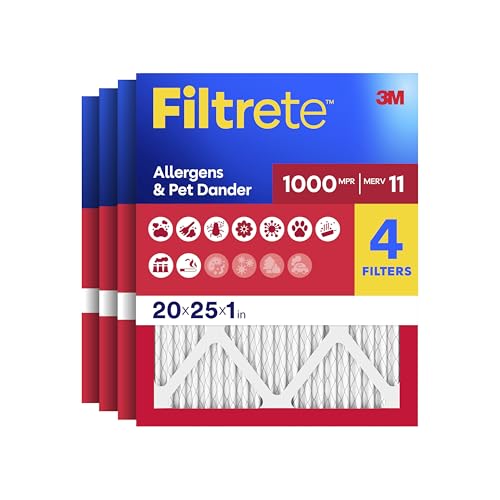
Filtrete 20x25x1 MERV 11 MPR 1000 4-Pack
Filtrete’s higher entry pairs MERV 11 with the brand’s own MPR 1000 scale, packs four filters, and prints a three-month service framing in the title alongside allergens and pet dander wording. The actual size reads 19.68 by 24.68 inches with a depth of 0.81 inches, a touch thicker than the 0.75-inch panels around it. That extra six-hundredths of an inch rarely troubles a standard rack, though a tight return grille with a shallow ledge deserves a test fit before the whole box is opened.
Rating: MERV 11
Brand scale: MPR 1000
Pack count: 4 HVAC filters
Actual size: 19.68 x 24.68 x 0.81 in
Service framing in title: 3-month AC/furnace filter
Strengths
- Dual rating scales, MERV 11 beside MPR 1000, let shoppers compare within and across brands.
- The three-month framing in the title sets a concrete change rhythm for a four-pack year.
- Pet dander is named in the title, matching the concern that pushes most households to MERV 11.
Trade-offs
- MERV 11 resistance can expose a weak blower, showing up as longer run times and uneven room temperatures.
- The 0.81-inch depth is the second thickest here and may pinch in shallow filter grilles.
- Four filters at a three-month cadence cover one year exactly, leaving no spare for a dusty renovation month.
Pet households should also think about where the dander load actually enters the system. Returns in hallways and living rooms collect the bulk of it, while a return isolated in a little-used room sees a fraction of the traffic. In a single-return house the panel choice is simple. In a two-return house where both returns share one filter rack, as many split-level layouts do, the MERV 11 panel serves both streams and its rating applies to the whole. Either way, the title’s decision to name pet dander explicitly makes this the pick whose marketing and whose physics point the same direction, which cannot be said of every carton in this category.
The jump from MERV 8 to MERV 11 is the jump most households actually feel. Dusting intervals stretch, the return-air grille stays cleaner longer, and the coil behind the filter accumulates its insulating blanket of grime more slowly. Filtrete, as 3M’s filtration brand, publishes its parallel MPR scale because MERV testing and its own microparticle measurement do not map one-to-one; treat MPR 1000 as a within-brand yardstick and MERV 11 as the cross-brand one. The title’s cleaner-air and reliable-airflow phrases are brand claims, and the useful reading is narrower: this is a high-capture one-inch filter that still presents itself as a residential product rather than a commercial cartridge.
The four-filter count interacts with that three-month framing in a way worth spelling out: the carton is a calendar. Open it in January and the last panel goes in during October, which gives the household a natural annual moment to reassess whether MERV 11 still suits the system. Compare that with a six-pack of a rating the blower dislikes, where the household feels obliged to finish the box. There is a modest virtue in a carton that ends before buyer’s remorse can compound, particularly for a first step up the rating ladder.
One caution belongs with any filter at this rating. A system that short-cycles or freezes its coil in summer may be telling you the media is too restrictive for its blower, and no filter upgrade fixes an undersized return. If the furnace was marginal before, trial a single MERV 11 cycle and watch run behaviour before committing the household budget to a year of them.
Best for: a healthy modern blower in a home with shedding pets, run on the three-month rhythm the title describes. Not suited for: a shallow grille ledge under 0.81 inches deep, or a furnace already freezing its coil on MERV 8.
The Filtrete MERV 11 carton is listed at Check price on Amazon.

BNX TruFilter 20x25x1 MERV 13 6-Pack
BNX TruFilter tops the rating ladder in this roundup. MERV 13 leads the title, backed by MPR 1900 and FPR 12, two further scales printed on the same carton, and the construction is electrostatic pleated with US manufacture stated. Six filters fill the box, and the positioning language names smoke alongside allergy and pet concerns. Actual dimensions print at 19.69 by 24.69 inches, 0.75 deep, landing within a whisker of the Filtrete MERV 11 footprint above.
Rating: MERV 13
Brand scales: MPR 1900 and FPR 12
Pack count: 6
Actual size: 19.69 x 24.69 x 0.75 in
Construction named in title: electrostatic pleated, Made in USA
Strengths
- Three published rating scales give the most complete comparison data of any pick here.
- Smoke is named in the title, relevant for homes downwind of seasonal wildfire drift.
- Six filters at a high rating removes the usual compromise between capture and carton size.
Trade-offs
- MERV 13 is the most restrictive rating in this list; marginal blowers will feel it first.
- High-capture media loads faster in dusty homes, so the six-pack may turn over quicker than planned.
- The title states no service interval, leaving the change schedule to pressure and appearance checks.
A note on expectations belongs here, because MERV 13 attracts buyers hoping for something close to a dedicated air purifier’s performance from the furnace alone. The furnace filter treats air only while the system runs, and in mild weather a system may sit idle for hours, during which this panel, however strong its rating, treats nothing at all. Households can run the fan-only circulation mode to keep air moving through the media, at some energy cost, and many smoke-season households judge that trade worthwhile. But the panel remains a whole-system filter working on the system’s schedule, and judging it against a continuously running room purifier misunderstands both devices.
MERV 13 is the threshold where residential filters begin catching a meaningful share of the fine fraction, the smoke-sized particles that sail through mid-range media. That is precisely why the title leads with smoke positioning, and precisely why the caution about blower capacity belongs in the same breath. A variable-speed ECM blower in a recent furnace generally shrugs at MERV 13 in a one-inch format. A twenty-year-old PSC motor working against undersized returns may respond with noise, heat-rise problems in winter, or a frozen coil in July. The filter is not at fault in that story; the match is.
Smoke positioning changes how this panel should be scheduled, too. Wildfire smoke arrives in episodes, not seasons, and a household in an affected region does well to keep one fresh panel in reserve rather than running the installed filter to its calendar limit. When a smoke week lands, swapping in the reserve panel at the start of the episode gives the system its best media for the days that matter, and the partly used panel can return afterwards if it still looks clean. The six-pack format makes that rotation painless in a way a four-pack cannot.
The triple-rating carton deserves a word of appreciation on purely practical grounds. Shoppers cross-compare MERV against the store-brand scales constantly, and a manufacturer that prints MERV 13, MPR 1900, and FPR 12 on one box saves the translation table entirely. Keep the household’s other filters in mind, though: mixing this panel into a multi-return house where the second return keeps an old MERV 5 panel creates two very different resistances on one blower, and the weaker path takes the air.
Best for: a recent variable-speed system in a smoke-prone region, changed on a disciplined schedule from a six-filter reserve. Not suited for: an ageing PSC blower that already strains against MERV 8, or a two-return house unwilling to match both panels.
For the BNX six-pack’s present carton terms, Check price on Amazon.
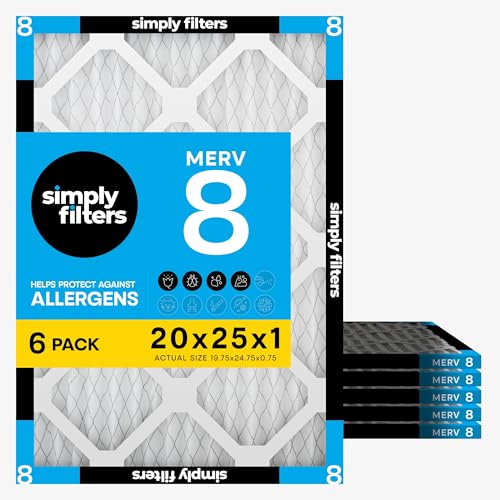
Simply 20x25x1 MERV 8 6-Pack
Simply’s entry pairs the MERV 8 rating with the largest carton on this page, six filters, and the joint-largest actual footprint, 19.75 by 24.75 by 0.75 inches. The title aims the filter at home AC, furnace, and HVAC duty generally, and closes with dust, pet, and allergy control wording. Where Filterbuy’s MERV 8 arrives as a four-pack on a smaller panel, Simply answers with volume and the fuller footprint, which makes the two MERV 8 picks less redundant than the shared rating suggests.
Rating: Merv 8 (as printed)
Pack count: 6
Actual size: 19.75″ x 24.75″ x 0.75″
Secondary ratings (MPR/FPR): none stated in the listing
Stated duty: home AC furnace and HVAC
Strengths
- The full 19.75-inch width seals racks that leave the smaller panels rattling.
- Six MERV 8 filters in one carton suit a two-month change rhythm.
- Pet wording in the title matches the most common reason for choosing MERV 8 over MERV 5.
Trade-offs
- No MPR or FPR figure is published, so fine comparison against Filtrete or BNX rests on MERV alone.
- The title names no pleat construction or electrostatic treatment.
- A six-pack of the wrong size is six mistakes; the title’s actual dimensions deserve a tape check first.
There is a quiet logic to this carton. MERV 8 is the rating most residential equipment manuals gesture toward, six is the count that turns filter changing into a twice-a-year errand rather than a standing subscription worry, and the fuller footprint suits the racks installed in the tract homes where 20x25x1 is the default size. The control language in the title is the brand’s own framing, and the honest translation is that MERV 8 media intercepts the coarse and mid-size fraction, pet hair and the larger dander carriers included, while the finest material continues through.
Change rhythm is where this carton quietly outperforms its rivals on the page. A six-pack at MERV 8 invites a two-month cadence, and two months is short enough that the media rarely reaches the heavily loaded state where resistance climbs steeply. Stretching a four-pack of stronger filters across a full year means spending the last month of each panel pushing air through a grey mat. Six mid-rated panels changed promptly can deliver cleaner real-world air than four high-rated panels changed late, a piece of arithmetic the rating printed on the frame never mentions.
Because this panel shares its exact actual dimensions with the Amazon Basics MERV 5 at the top of the list, the two cartons bracket a sensible experiment: run the gentler rating through the heavy heating season if the blower sounds strained, then step up to this one for the pollen months. Same rack, same fit, one variable changed. Few filter purchases offer a controlled trial that cleanly.
Best for: a full-width rack in a pet-owning home, with MERV 8 capture and a half-year of changes in one box. Not suited for: a 19.5-inch rack opening, where the extra quarter inch of width has nowhere to go.
The Simply six-pack can be reviewed at Check price on Amazon.

Filtrete 20x25x1 MERV 1 6-Pack
The second Filtrete on the page sits at the opposite pole from its MERV 11 sibling. This is a 3M MERV 1 panel, six to a box, an HVAC replacement filter whose actual size prints 19.69 by 24.69 inches with the deepest section here at 0.88 inches. MERV 1 is the floor of the scale, and the review treats it accordingly: this panel exists to keep lint, hair, and coarse debris off the equipment, not to polish room air.
Rating: MERV 1 (3M)
Pack count: 6
Actual size: 19.69 x 24.69 x 0.88 in
Secondary ratings (MPR/FPR): not given in the listing title
Stated duty: HVAC AC furnace filter replacement
Strengths
- Minimal airflow resistance of any pick here, kind to the weakest blowers and the longest duct runs.
- Six panels make frequent swaps cheap in effort during dusty projects like floor sanding.
- The 0.88-inch depth gives the media a sturdier frame feel than the 0.75-inch panels.
Trade-offs
- MERV 1 media passes nearly everything smaller than visible lint, including the pet dander the mid-list picks target.
- Fine dust reaches the coil faster, shifting the burden to coil cleaning over the years.
- The deeper 0.88-inch section is the likeliest here to foul a shallow grille ledge.
Every filter roundup needs its honest floor, and this panel is it. There remain real situations where MERV 1 is the correct engineering answer: a furnace in a dusty workshop building where the media clogs in a fortnight, a system whose return is so undersized that any pleated panel starves it, a renovation period when the filter is effectively a sacrificial screen changed weekly. In those houses, fitting a MERV 11 panel would not upgrade the air so much as punish the blower. The six-pack format supports exactly that high-turnover use.
The 0.88-inch depth cuts in an unexpected direction as well: the thicker section resists the bowing that thinner frames show when a strong blower pulls against a loading panel. In a high-velocity return, a bowed frame opens its crescent gap within weeks. This panel’s stiffer build holds its rectangle, which is why sacrificial duty during sanding or drywall work suits it; the debris load is heavy, the swaps are frequent, and a frame that stays square keeps the coarse fraction out of the ductwork it is there to guard.
What this panel should not be asked to do is stand in for room-air cleaning. Buying MERV 1 for a child’s bedroom return in the expectation of dust reduction ends in disappointment, because the physics of the rating never promised it. Read as equipment protection with a famous brand’s frame quality, the carton makes sense. Read as an air-quality product, it does not, and the title, to its credit, confines itself to replacement-filter language rather than capture claims.
Best for: a workshop furnace or renovation stretch needing sacrificial panels swapped often with almost no blower resistance. Not suited for: a bedroom return expected to cut visible dust, or a grille ledge shallower than 0.88 inches.
Find the Filtrete MERV 1 carton through Check price on Amazon.
Side-by-side: the six panels on one table
| Filter | Rating | In the box | Actual footprint | Extra scales printed |
|---|---|---|---|---|
| Amazon Basics MERV 5 | MERV 5 | 6 | 19.75 x 24.75 x 0.75 | — |
| Filterbuy MERV 8 | MERV 8 | 4 | 19.50 x 24.50 x 0.75 | — |
| Filtrete MERV 11 | MERV 11 | 4 | 19.68 x 24.68 x 0.81 | MPR 1000 |
| BNX TruFilter | MERV 13 | 6 | 19.69 x 24.69 x 0.75 | MPR 1900, FPR 12 |
| Simply MERV 8 | MERV 8 | 6 | 19.75 x 24.75 x 0.75 | — |
| Filtrete MERV 1 | MERV 1 | 6 | 19.69 x 24.69 x 0.88 | — |
Read the footprint column before the rating column. Three distinct actual widths serve one nominal size, and the panel that matches your rack’s true opening will outperform a higher-rated panel that leaks around its frame.
How do you choose a 20x25x1 furnace filter?
Start with the rack, not the rating
Pull the current filter and measure the opening itself with a tape, width, height, and the depth of the ledge it rests on. Compare that measurement against the actual sizes printed above rather than the nominal size on the old frame, because a previous owner may have been running an undersized panel for years. Note the airflow direction arrow on the old filter’s frame before discarding it; the new panel must point the same way, toward the blower.
Match MERV to the blower you own
Equipment age is the honest guide. Furnaces with variable-speed blowers and generous return ducting handle MERV 11 to 13 in stride. Older single-speed equipment, or any system that already sounds laboured, belongs at MERV 5 to 8 until a technician confirms static pressure headroom. The equipment manual, often available from the manufacturer’s documentation by model number, sometimes prints a maximum recommended rating; that figure outranks any roundup, this one included.
Decide the change rhythm before the pack size
A four-pack on a three-month rhythm is a year. A six-pack on a two-month rhythm is also a year. Pet density, nearby construction, and candle or fireplace use all shorten real service life below the tidy calendar, so households with two shedding dogs should plan the shorter interval regardless of carton size. Mark change dates on the filter frame itself with a pen; memory is the least reliable component in any HVAC system.
Plan for the dirtiest month, not the average one
Every house has a worst filtration month: the pollen peak, the wildfire week, the fortnight when the road outside is resurfaced, the renovation when drywall dust hangs in the air for days. Size the household’s stock and rating around that month rather than the gentle average. Keeping one stronger panel in reserve for the worst stretch, while running a mid rating the rest of the year, is a legitimate strategy the pack counts above support, since the footprints of the MERV 5 and MERV 8 full-width panels match exactly.
Weigh the secondary scales carefully
MPR belongs to Filtrete’s parent testing, FPR to a retail scale, and MERV to the industry standard method. They correlate loosely, never exactly. Use MERV for cross-brand decisions and the brand scales only to compare models inside one brand’s line, which is why the BNX carton’s decision to print all three is genuinely shopper-friendly.
What a MERV number is actually measuring
MERV stands for Minimum Efficiency Reporting Value, and the number compresses a laboratory test into a single figure a shopper can compare at a glance. In the standard test, the filter faces a controlled airstream carrying particles across several size bands, and instruments count how many particles of each band the media stops. The rating reflects the weakest bands, which is why the scale behaves conservatively: a filter earns its number on the particles it handles worst, not best. The bands span from the coarse fraction, lint and hair and the visible dust that settles on a bookshelf, down through the fine fraction that stays suspended for hours and travels deep into a house on every current of air the system moves.
That structure explains the shape of this list. The climb from MERV 1 to MERV 5 buys most of the coarse fraction. The climb from 5 to 8 adds a solid share of the mid-size material, the mould spores and larger pollen grains among them, in the language of the test bands rather than any promise about a particular home. The climb from 8 to 11 reaches further into the fine fraction, and 13 reaches further still, into the size range where smoke particles concentrate. Each step also adds resistance, because finer capture demands denser or more cleverly charged media in the same one-inch frame. Pleating is the industry’s main answer to that squeeze: folding the media multiplies its area, so air crosses a larger surface at lower speed, which raises capture while softening the resistance penalty. Electrostatic treatment, named in the Filterbuy and BNX titles, is the second answer, using charge on the fibres to attract particles that would otherwise thread through the gaps.
Two limits of the number deserve stating plainly. First, MERV describes a new filter in a test rig; a loaded filter in a real rack performs differently, usually capturing more and resisting more, until resistance dominates. Second, the rating says nothing about fit, and fit governs what fraction of air passes through media at all. A MERV 13 panel leaking a fifth of its air around the frame delivers less filtration in practice than a MERV 8 panel sealed tight. That is why this roundup prints actual dimensions with the same prominence as ratings, and why the choosing section begins with a tape measure rather than a number.
Why actual size runs smaller than the name on the box
Nominal sizing is a rounding convention the whole industry shares: a filter sold as 20x25x1 is manufactured a fraction under each dimension so it can slide into a rack built to the nominal opening. The fractions differ by brand, as the table above shows plainly, 19.50 inches at the narrowest and 19.75 at the widest for the same stated size. Neither extreme is a defect. Trouble starts when the pairing is wrong for a particular rack: too loose and air bypasses, too tight and the frame bows, opening a crescent gap along the bowed edge that bypasses just as effectively. The fix costs nothing but attention. Measure once, keep the number with the furnace paperwork, and order against the actual column forever after. Inheriting a home makes the first filter change a measuring exercise, since the size scrawled on a previous carton may itself have been a guess.
Rack construction varies more than the nominal system admits. Some furnaces hold the filter in a slot inside the blower cabinet, some in a dedicated rack at the return drop, and many homes rely on a filter grille in a hallway wall or ceiling, where the panel rests on a ledge behind a louvred door. Each arrangement tolerates dimensional slack differently. Cabinet slots are the least forgiving of excess width, since the panel must slide along tracks. Grille ledges forgive width but punish excess depth when the door’s retaining clips come into play. Knowing which arrangement your house uses turns the actual-size column of the comparison table from trivia into the deciding data.
Depth deserves the same respect. The 0.75, 0.81, and 0.88-inch sections in this list all answer to the name one-inch, yet a grille with a retaining clip set for the thinnest panel can refuse the thickest. If the grille door strains or the clip will not seat, the panel is wrong for that grille even when its face dimensions match.
Reading the seasons in a used panel
A removed filter is a record of the months it served, and learning to read it sharpens every future choice on this page. Uniform light grey across the whole face signals ordinary household dust and a change interval that suits the house. Dark streaks concentrated along one edge point to bypass, air that found a gap and carried its load past the media; the next panel needs a better seal, not a higher rating. A panel furred heavily on one half while the other half stays pale suggests uneven return flow, common where furniture crowds one side of a floor return. Pet households see a distinct mat of hair on the upstream face long before the deeper media loads, and for them the visible surface, not the calendar, is the honest gauge.
Season changes the reading as well. A winter panel in a gas-heated house loads steadily and predictably. A summer panel in a humid climate can grow a musty smell before it looks dirty, because the media sits in cool, damp airflow for months; smell alone justifies an early swap there. Pollen season writes itself in yellow-green dusting on the upstream face in spring. None of this requires instruments. It requires the thirty seconds of attention most panels never get on their way to the bin, and it converts filter changing from a chore performed blind into the cheapest diagnostic a heating system offers.
Common mistakes with one-inch filters
Ordering by the nominal size alone. The box name is a category, not a measurement. Every pick above prints a different actual footprint, and skipping the tape measure eventually produces a carton that rattles or bows.
Jumping three MERV steps at once. Moving from a MERV 5 panel to MERV 13 in a single change gives the blower no say in the matter. Step up one level, live with it through a full heating or cooling cycle, and watch run times before climbing again.
Installing the panel backwards. The frame arrow exists because the media is supported against airflow pressure from one side. A reversed pleated filter can deform under load, and a deformed filter seals badly at exactly the edges that matter.
Stretching a loaded filter to finish the season. A grey, furred panel is a restriction device, not a filter. The energy spent pushing air through it, and the strain on the blower, cost more than the panel being saved.
Mixing ratings across two returns. One MERV 13 panel and one MERV 1 panel on the same system do not average out. Air follows the easy path, so the coarse panel ends up carrying most of the flow and most of the dust reaches the coil through it.
Judging a fresh panel by the old one’s colour. Media colour varies by brand and treatment; some panels leave the factory off-white, others bright white, others faintly grey. A new panel that looks darker than the old brand’s fresh panels is not necessarily dirtier. Judge by weeks in service and airflow behaviour, not by comparing shades across brands.
Storing spares against the furnace itself. Heat cycling and the occasional drip from a condensate line age spare panels before they ever see airflow. The carton belongs in a dry closet, and the panel nearest the furnace should be the one already installed, not the reserve.
Final recommendation
For the largest number of 20x25x1 households, the Simply MERV 8 six-pack is the carton to start with: the fuller footprint seals the common rack, the rating matches what most blowers were built around, and six filters settle the chore for months at a time. Homes with a modern variable-speed furnace and a real smoke or dander problem should step straight to the BNX TruFilter MERV 13, accepting its faster loading as the price of the finest capture here. The Filtrete MERV 11 splits that difference elegantly where a three-month rhythm suits the calendar. Filterbuy’s electrostatic four-pack rewards the narrower rack that the fuller panels cannot fit, while the Amazon Basics MERV 5 keeps older equipment breathing easily. The Filtrete MERV 1 remains the specialist: renovation months, workshop furnaces, sacrificial duty. If your own reading list for the house runs wider than filtration, the guide to Best Oversized Cotton King Blankets covers the bedroom end of household textiles with the same measurements-first approach.
Questions households ask about this size
Can a 20x25x1 filter be washed and reused?
None of the six listings here presents its panel as washable, and pleated disposable media generally loses its electrostatic behaviour and pleat shape after washing. Treat all six as replace-on-schedule items and check the manufacturer’s documentation for the specific carton if reuse matters to you.
How often should a one-inch filter actually be changed?
The Filtrete MERV 11 title frames three months, and that is a fair ceiling for a one-inch panel in an average house. Pet-heavy homes, smokers, and houses near unpaved roads should halve it. A simple monthly glance tells the truth: if the surface has gone uniformly grey, its remaining life is short whatever the calendar says.
Does a higher MERV rating raise heating bills?
It can, indirectly, when the blower works longer against the added resistance, and the effect grows as the filter loads. A clean MERV 11 in a healthy system is a modest load; a clogged MERV 13 in a strained system is a real one. Change discipline matters more to the bill than the rating printed on a fresh panel.
Is it safe to run two different brands in sequence through the year?
Yes, provided each panel matches the rack’s actual dimensions and the rating stays within what the blower handles. Brands differ in frame stiffness and media, not in the interface with the furnace, which is purely dimensional. Many households run a gentler panel through the heating season and a stronger one through the pollen months; the only rule is changing one variable at a time so any change in system behaviour has an obvious cause.
What if my rack measures between two actual sizes here?
Choose the panel whose actual width sits just under your opening, and seal any remaining hairline gap with the foam tape sold for filter racks. Never force the wider panel: a bowed frame leaks more than a slightly narrow one resting flat. While the tape is out, the same measuring session can settle other household sizing questions; readers mid-renovation may also want the rundown of Best Metal Toasters for the counter, and catering-scale cooks can compare the Best Commercial Stick Blenders guide before equipping a big kitchen.
One last habit separates careful households from the rest: keep the outgoing panel for a day beside the new one. Comparing the two faces, the old panel’s load against the new panel’s clean media, calibrates the eye better than any printed schedule, and if the old panel looks barely used, the interval can stretch; if it looks matted, the interval was already too long.
Measure the rack once, write the true number on the furnace door, and every filter change after that becomes a two-minute job done right.


