What's inside
- Where to buy the six filters
- Quick Picks
- How these picks were chosen
- Six filters for the same slot, examined individually
- The six titles laid side by side
- Which grade should a 20x20x1 slot actually run?
- Nominal size, actual size, and why both are printed
- Common mistakes with one-inch furnace filters
- Final recommendation
- Changing day: a short ritual that protects the whole system
- Pleats, panels and electrostatic media: the constructions behind the titles
- Seasons in a filter’s year
- When the filter is not the problem
- Renters, landlords and the shared filter slot
- Reading a filter title the way a technician would
- The economics of a one-inch filter, honestly stated
- A note on disposing of the old filter
- Two homes, two right answers
- Frequently asked questions
As an Amazon Associate I earn from qualifying purchases. This post may contain affiliate links at no extra cost to you.
As an Amazon Associate, cottageverdict.com earns from qualifying purchases.
A furnace filter is the very cheapest working part in a home heating and cooling system, and the one most often bought slightly wrong. The best furnace filters 20x20x1 all share the same nominal footprint, yet the six listings below differ in filtration grade, in pack size, and — quietly, in the small print of each title — in actual dimensions that can vary by a quarter of an inch from brand to brand. That last small detail decides whether a filter slides home cleanly or leaves a gap that unfiltered air happily bypasses.
Every pick here prints the exact 20x20x1 nominal size in its title; nothing whatsoever was borrowed from the neighbouring 20x25x1 or 16x20x1 sizes, because a filter that almost fits is worse than useless — it gives the impression of filtration while air slips around the edges. Grades run from MERV 8 up to MERV 13, pack counts from two to twelve, and each listing aims its claims at a slightly different household: dust, pets, allergens, smoke, or some combination printed right on the box.
Filtration claims in this article are reported exactly as the listings state them, without addition or softening. A title that says a filter captures dust, lint and pollen is making the manufacturer’s claim, and this guide treats it exactly that way — as a statement about what the product is designed and rated to do under its test standard, not as a promise about any individual home or any individual’s health.
Our Top Picks
 Aerostar Air Filter 20x20x1 MERV 8 AC Filter6 PACK19.75 x 19.75 x 0.75 inches3.06 poundsCheck on Amazon
Where to buy the six filters
Each of these is an Amazon listing, summarised in one line here and examined properly in the reviews further down, with its printed actual dimensions kept beside its grade throughout for easy checking against your own rack.
- Amazon Basics leads with a MERV 11 six-pack that names dust, pet and allergen control in its title.
- Filterbuy carries the highest grade in the set, MERV 13, with smoke and allergy defence as its stated purpose.
- Aerostar keeps things at MERV 8 and talks about the everyday load: dust, lint and pollen.
- Filtrete sells a smaller two-pack at MERV 12 with its own MPR 1500 rating printed beside the MERV figure.
- Simply matches the MERV 8 and MPR 600 pairing in a six-pack aimed at dust, pet and allergy control.
- Filter King stretches the arithmetic furthest, bundling twelve MERV 8 filters into a single purchase.
Quick Picks
| Pick | Best for | What the title emphasises |
|---|---|---|
| Amazon Basics 20x20x1 MERV 11 6-Pack | Balanced filtration in a mid-size pack | MERV 11; dust, pet and allergen control; electrostatic |
| Filterbuy 20x20x1 MERV 13 6-Pack | The finest filtration grade in this group | MERV 13; smoke and allergy defense; made in USA |
| Aerostar 20x20x1 MERV 8 6-Pack | Everyday dust and lint duty | MERV 8 (MPR 600); captures dust, lint and pollen |
| Filtrete 20x20x1 MERV 12 MPR 1500 2-Pack | Trying a higher grade before committing to a big pack | MERV 12, MPR 1500; 3-month positioning |
| Simply 20x20x1 MERV 8 6-Pack | Pet households at a gentler grade | Merv 8, MPR 600; dust, pet and allergy control |
| Filter King 20x20x1 MERV 8 12-Pack | Stocking up for the year in one order | MERV 8; 12-pack; dust and allergy control |
How these picks were chosen
Size discipline came first and admitted no exceptions. A candidate had to print 20x20x1 in its own title, and all six survivors do. That rule sounds pedantic until you stand at a return-air grille with a filter that is a quarter-inch too wide; the titles here also print actual dimensions, and those figures were compared pick by pick because they are not identical across brands.
Grade spread came second. A useful shortlist for one filter size should show the realistic ladder a household might climb: MERV 8 for baseline dust control, MERV 11 and 12 in the middle, MERV 13 at the top of what these listings offer. Pack sizes were spread deliberately too, from a two-pack trial to a twelve-pack stockpile, since the cost rhythm of filter ownership is driven as much by how many arrive at once as by the grade on the frame.
Claims were recorded, not endorsed. Where a title names smoke, bacteria or viruses, the review repeats that as the listing’s stated territory. Where a title sticks to dust and lint, the review says so. No pick was credited with a capability its own title leaves out, and no health outcome is promised anywhere in this article — filters are described by their ratings and stated purposes, full stop.
Brand duplication was capped firmly, in the interest of showing genuinely different decisions rather than repeated ones in disguise. Several manufacturers sell the same size and grade in three different pack counts; only one configuration per model family was kept, so the six slots went to six genuinely different buying decisions rather than three decisions wearing different quantities.
Six filters for the same slot, examined individually

Amazon Basics 20x20x1 MERV 11 6-Pack
Amazon Basics occupies the sensible middle of this list: MERV 11 filtration, six filters in the box, and a title that names dust, pet and allergen control as its territory. For a household stepping up from whatever thin panel the builder installed, this is the listing that asks the fewest questions while still moving the grade meaningfully upward.
Listing details
- Nominal size in the title: 20x20x1
- Actual size printed: 19.75 x 19.75 x .75
- Rating: MERV 11
- Pack count: 6
- Media described as: electrostatic
- Stated territory: dust, pet and allergen control
Strengths
- MERV 11 sits in the productive middle — finer than basic dust grades without reaching for the top of the ladder
- Six filters give a household a real stock rather than a single trial
- Electrostatic media is named in the title, describing how the fibres attract particles
Trade-offs
- No MPR or FPR cross-rating is printed, so comparison against Filtrete’s scale stops at MERV
- The actual width runs a quarter-inch under nominal, worth checking against a snug filter slot
- No service interval is stated in the title
MERV numbers reward a moment of explanation, because they organise this entire article. The scale grades how effectively a filter captures particles across size ranges under a standard test; higher numbers capture finer material. MERV 11, where this Amazon Basics pack sits, is the grade many households land on when dust alone stops being the whole concern and pet dander and allergen-sized particles enter the picture — exactly the territory its title claims.
Electrostatic media deserves its own note. The fibres carry a charge that helps attract particles passing through, supplementing simple mechanical sieving. In practice it is one of the common constructions at this grade, and its presence in the title tells you the pack is a pleated electrostatic design rather than a flat fibreglass panel — a meaningful upgrade in both surface area and capture behaviour over the cheapest category of filter.
The actual size line is the detail to verify at home. Nineteen and three-quarter inches square is the standard interpretation of a nominal 20x20x1, and most slots are built expecting it. If your current filter measures noticeably smaller or the slot has been bent or lined, compare the printed actual dimensions of every pick here before ordering, because the Filterbuy below runs a full half-inch under nominal and the two can behave differently in the same rack.
Best for: a household with a dog or cat that wants MERV 11 filtration and half a dozen spares in the cupboard
Not suited for: a filter rack measured at a true 19.5 inches, where the Filterbuy actual size below matches more closely
Check price on Amazon — the Amazon Basics six-pack, for a straightforward grade step-up with stock to spare.

Filterbuy 20x20x1 MERV 13 6-Pack
Filterbuy brings the ceiling of this group: MERV 13, the grade its title aims at smoke and allergy defence, in an electrostatic pleated six-pack made in the USA. If your reason for reading a filter guide at all involves wildfire season, a smoker’s household nearby, or a determination to filter as finely as a standard one-inch slot allows, this listing is the one speaking your language.
Listing details
- Nominal size in the title: 20x20x1
- Actual size printed: 19.50 x 19.50 x 0.75
- Rating: MERV 13
- Pack count: 6
- Construction: electrostatic pleated HVAC filter
- Stated territory: smoke and allergy defense; made in USA
Strengths
- MERV 13 is the finest grade among these six listings
- Smoke appears in its stated purpose, which no MERV 8 title here attempts
- Pleated construction packs more media area into the one-inch frame
Trade-offs
- Its actual dimensions run the smallest here — a half-inch under nominal in both directions
- Finer filtration can ask more of older blowers; the title gives no airflow figures
- No secondary MPR rating is printed for cross-brand translation
Smoke is the particle challenge that separates grades most clearly. Smoke particles are fine, and fine particles are precisely what the jump from MERV 8 to MERV 13 is about under the rating system. Filterbuy prints smoke in its title where the MERV 8 listings print dust and lint, and that difference in stated territory is the honest summary of the grade gap: each listing claims the particle sizes its rating supports.
The pleated construction matters alongside the grade. Pleating folds a long sheet of media into the frame, multiplying surface area; more area means the same air can pass at lower resistance and the filter can hold more captured material before loading up. In a one-inch format, pleats are how a high grade stays practical at all, and the title’s explicit mention of pleated construction confirms this is that design rather than a flat panel wearing a big number.
Measure before you order this one. At 19.50 inches actual, it is the loosest fit in the group for a slot built around 19.75. Many racks have springs, clips or a door that take up the slack; some do not. A filter that rattles or sits crooked leaks air around its frame, and leaked air carries exactly the fine particles a MERV 13 purchase was meant to stop.
Best for: homes in smoke-prone regions wanting the finest one-inch filtration these listings offer
Not suited for: slots that cannot secure a filter measuring a half-inch under nominal size
Check price on Amazon — the Filterbuy MERV 13 pack, for the finest stated filtration in a one-inch frame.
Aerostar 20x20x1 MERV 8 6-Pack
Aerostar represents the honest baseline: MERV 8, a six-pack, and a title that talks about dust, lint and pollen — the unglamorous load that makes up most of what a residential filter ever catches. It also prints an MPR 600 equivalence beside its MERV figure, giving anyone familiar with the Filtrete scale a translation point the other MERV 8 listings mostly lack.
Listing details
- Nominal size in the title: 20x20x1
- Actual size printed: 19.75 x 19.75 x 0.75
- Rating: MERV 8, with MPR 600 also printed
- Pack count: 6
- Positioned as: AC, HVAC and furnace filter
- Stated territory: captures dust, lint and pollen
Strengths
- The dual MERV and MPR figures make cross-brand comparison easier than most listings allow
- Actual dimensions match the commonest interpretation of the nominal size
- Its stated territory is refreshingly modest — household dust, lint and pollen
Trade-offs
- MERV 8 will not address smoke-sized particles the way the MERV 13 listing claims to
- The title repeats its size and category phrases, but offers no service interval
- No electrostatic media claim is printed in the title
There is a real argument for MERV 8 as the correct default, and Aerostar’s title makes it by implication. The rating system’s middle grades capture the coarse and medium material that coats coils, soils ducts and shows up as dust on furniture. Protecting the equipment is the filter’s first job — a clogged evaporator coil costs more than any filter — and a MERV 8 changed on schedule protects equipment while asking little of the blower.
Lint deserves its moment, because it is the particle of laundry rooms and towel-heavy bathrooms, and it loads a filter faster than its weight suggests. A household whose return grille sits near a tumble dryer’s territory will recognise Aerostar’s stated trio — dust, lint, pollen — as a fair description of their actual air. Pollen, meanwhile, is the seasonal guest: a filter claiming pollen capture at MERV 8 is addressing the larger end of that family, honestly within its grade.
The printed MPR 600 equivalence is a small courtesy with real value. Retail shelves mix rating systems shamelessly, and a shopper holding a Filtrete box in one hand and this listing in the other can finally compare like with like. More manufacturers should print both scales; until they do, listings like this one make the translation for you.
Best for: equipment protection and everyday dust duty, with an easy rating translation for shelf comparisons
Not suited for: smoke-heavy air, where the MERV 13 Filterbuy above states the relevant claim
Check price on Amazon — the Aerostar six-pack, for plain dust, lint and pollen duty done at the standard actual size.
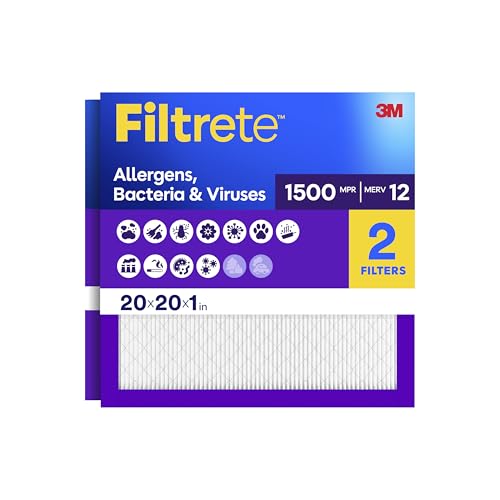
Filtrete 20x20x1 MERV 12 MPR 1500 2-Pack
Filtrete is the brand that built its own rating scale, and this two-pack shows both numbers side by side: MERV 12 and MPR 1500. The listing aims at allergens, bacteria and viruses in its stated territory, positions the filters as three-month AC and furnace filters, and sells them as a pair — the trial size of the group, for households that want to test a higher grade before stocking up.
Listing details
- Nominal size in the title: 20x20x1
- Actual size printed: 19.62 x 19.62 x 0.78 in
- Ratings: MERV 12 and MPR 1500
- Pack count: 2
- Service positioning in the title: 3-month filters
- Stated territory: allergens, bacteria and viruses; cleaner air, reliable airflow
Strengths
- Two rating scales printed together remove all guesswork about where this filter sits
- The pair format lowers the commitment for a first move up the grades
- A three-month positioning gives the clearest service rhythm stated in this list
Trade-offs
- Two filters is the smallest stock here; a year of three-month changes needs three purchases
- The actual thickness, 0.78 in, is the deepest printed — worth confirming in very tight racks
- Its stated territory is the broadest here, and like all such claims it is the listing speaking
Dual ratings are Filtrete’s signature, and they help decode the whole category. MPR — Microparticle Performance Rating — is the brand’s own scale, weighted toward the smallest particles; MERV is the industry standard. A filter printing MERV 12 beside MPR 1500 is telling you it performs at the upper-middle of both ladders. Shoppers comparing this pair against the MERV 13 Filterbuy should note how close the grades sit, and how differently the two brands talk: Filterbuy leads with smoke, Filtrete with allergens and microorganisms.
Those microorganism words require the usual care. The title states allergens, bacteria and viruses as the filter’s territory, meaning the rating covers particle sizes in those ranges under test conditions. That is a claim about filtration capability as designed and measured, reported here as the listing states it. What any filter does in a particular home depends on the system, the fit and the change schedule — which is why this article reports claims rather than converting them into promises.
The three-month positioning is the other genuinely useful datum. Most titles in this list leave the change interval unspoken; Filtrete prints its expectation, which lets a household plan the year: four changes, eight filters, four two-pack purchases — or a decision that a six-pack rival suits the rhythm better. Clarity about cadence is a feature, and it is oddly rare in this category.
Best for: a first step into higher filtration, bought as a pair with a printed three-month rhythm
Not suited for: a full year of changes from a single order, since the pack holds only two filters
Check price on Amazon — the Filtrete pair, for testing MERV 12 territory without stocking a cupboard.
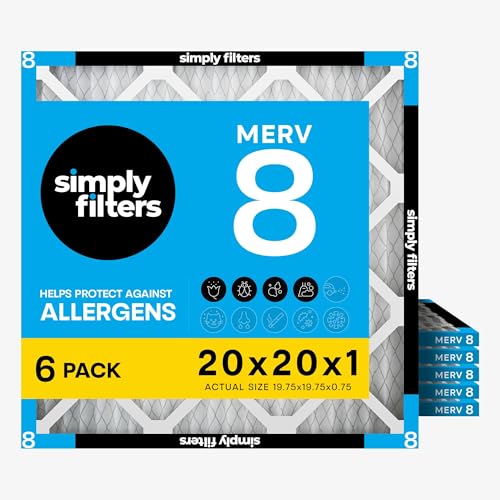
Simply 20x20x1 MERV 8 6-Pack
Simply pairs the same numbers as the Aerostar — MERV 8, MPR 600 — but aims its title at a different household: dust, pet and allergy control. Six filters arrive in the pack, the actual size matches the common 19.75-inch interpretation, and the positioning is unmistakably pet-forward within the limits of its grade.
Listing details
- Nominal size in the title: 20x20x1
- Actual size printed: 19.75 x 19.75 x 0.75
- Ratings: Merv 8 and MPR 600
- Pack count: 6
- Positioned as: furnace air filter for HVAC
- Stated territory: dust, pet and allergy control
Strengths
- Pet control is named in the title at a grade many pet homes actually run
- Both rating scales are printed, easing shelf comparisons
- Six-pack quantity suits a regular change rhythm without overstocking
Trade-offs
- Its grade matches the Aerostar exactly, so the choice between them rests on stated aims and price on the day
- No electrostatic construction is claimed in the title
- No change interval is printed
Pet hair itself is easy to filter — it is large. What a pet household really loads into the air is dander and the dust that rides on it, plus the sheer volume of hair that mats against a filter’s face and shortens its working life. A MERV 8 title claiming pet control is making a practical claim about that workload rather than a fine-particle one, and Simply’s phrasing stays within that honest territory: dust, pet and allergy control, at the grade printed beside it.
The identical ratings to the Aerostar invite the obvious question of why both are here. Because filter buying is not only about numbers. Brand availability fluctuates, pack pricing moves, and households develop loyalties from what their local shelves stock. Two listings sharing MERV 8 and MPR 600 with different stated aims — one talking lint and pollen, one talking pets — represent the real shelf choice a shopper faces, and pretending otherwise would make this guide less useful, not more rigorous.
Six filters at a typical quarterly rhythm is eighteen months of changes, which suits a pet household that changes more often during shedding season and relaxes in winter. The pack size quietly supports that flexibility better than a two-pack can, without committing to the Filter King’s full dozen below.
Best for: pet households running a MERV 8 rhythm who want pet control named on the box
Not suited for: fine smoke filtration, which sits in the MERV 13 listing’s stated territory instead
Check price on Amazon — the Simply six-pack, for pet-forward dust control at the familiar MERV 8 grade.

Filter King 20x20x1 MERV 8 12-Pack
Filter King closes the list with arithmetic: twelve MERV 8 filters, dust and allergy control in the title, and an actual size of 19.5 inches square. This is the stockpile purchase — one order that covers a year of monthly changes or two years of bimonthly ones, aimed at households that would rather store filters than remember to buy them.
Listing details
- Nominal size in the title: 20x20x1
- Actual size printed: 19.5 x 19.5 x .75
- Rating: MERV 8
- Pack count: 12
- Positioned as: AC furnace filters
- Stated territory: dust and allergy control
Strengths
- Twelve filters is the deepest stock in this group by a factor of two
- A single order removes a year of remembering from the household calendar
- MERV 8 keeps the blower’s job easy across all twelve changes
Trade-offs
- The actual size matches the Filterbuy as the smallest here — check the rack’s grip
- Storing twelve filters needs a dry, flat space where frames will not warp
- No MPR equivalence is printed alongside the MERV figure
Bulk buying changes the psychology of filter maintenance, and mostly for the better. The commonest failure in home filtration is not choosing the wrong grade; it is leaving any grade in place for nine months because the cupboard was empty and the shop trip kept slipping. A dozen filters in the house converts changing from a purchasing task into a pure maintenance task — walk to the cupboard, swap, done. Landlords with several units sharing this size will recognise the same logic at larger scale.
The grade choice pairs sensibly with the quantity. Twelve MERV 8 filters is a coherent strategy: baseline protection, easy airflow, frequent fresh media. It is the opposite philosophy from two MERV 12 filters changed quarterly, and neither is wrong — they weight equipment ease and change frequency differently against filtration fineness. This list deliberately contains both philosophies so the choice is yours rather than the guide’s.
Storage is the one discipline bulk demands. Filters should rest flat, dry and out of a garage’s damp corners, because a warped frame leaks at the edges and a damp filter is a poor thing to breathe through. Keep the dozen in a linen cupboard or a dry utility shelf, and the last filter of the twelve will fit as truly as the first.
Best for: households and landlords who change filters often and want a year of stock in one delivery
Not suited for: racks that need the 19.75-inch actual size to seal, since this pack prints 19.5 inches
Check price on Amazon — the Filter King dozen, for never facing an empty filter cupboard again.
The six titles laid side by side
| Filter | Grade(s) printed | In the box | Actual size printed |
|---|---|---|---|
| Amazon Basics | MERV 11 | 6 | 19.75 x 19.75 x .75 |
| Filterbuy | MERV 13 | 6 | 19.50 x 19.50 x 0.75 |
| Aerostar | MERV 8 / MPR 600 | 6 | 19.75 x 19.75 x 0.75 |
| Filtrete | MERV 12 / MPR 1500 | 2 | 19.62 x 19.62 x 0.78 |
| Simply | MERV 8 / MPR 600 | 6 | 19.75 x 19.75 x 0.75 |
| Filter King | MERV 8 | 12 | 19.5 x 19.5 x .75 |
Two patterns jump out of that grid. First, the grade ladder and the pack ladder run in opposite directions: the finest filters arrive in twos and sixes, while the dozen is a MERV 8. Second, actual size is not a constant — three distinct footprints hide under one nominal size, which is why measuring your slot appears in this article almost as often as MERV does.
Which grade should a 20x20x1 slot actually run?
What does the blower in your system tolerate?
Finer media resists airflow more than coarse media, and older or weaker blowers feel that resistance first. None of these titles prints airflow or pressure figures, so the listing alone cannot settle the question for a specific furnace. The safe pattern most households follow is to climb one grade at a time — MERV 8 to 11, say — and watch how the system behaves across a season, rather than leaping from a builder-grade panel straight to MERV 13.
What is actually in your air?
Match the grade to the load the titles describe. Dust, lint and pollen are MERV 8 territory in these listings. Pet dander pushes households toward the middle grades. Smoke is the claim only the MERV 13 title makes. Buying filtration for particles your home does not produce buys resistance without benefit; buying too little for smoke season leaves the real problem untouched.
How religiously will the filter be changed?
A finer filter changed late can underperform a coarser filter changed on time, because loaded media chokes airflow regardless of grade. Be honest about your household’s rhythm, then pick the pack that supports it: the Filtrete pair prints a three-month expectation, the six-packs support quarterly habits with stock to spare, and the Filter King dozen exists for people whose rhythm is frequent and whose memory prefers a full cupboard.
Does the actual size seal in your rack?
Pull the old filter and measure it, then compare against the actual dimensions printed above — 19.75, 19.62 or 19.5 inches depending on brand. A quarter-inch of slack can be managed with clips or a snug door in many racks; a visibly crooked or rattling filter cannot. Filtration that bypasses the frame is filtration you paid for and did not receive.
Nominal size, actual size, and why both are printed
The nominal size is the slot’s name, not the filter’s measurement. A 20x20x1 slot is a category, and manufacturers build filters slightly under it so they slide in and out without binding. That is why every title here carries a second, smaller set of numbers in parentheses. The variation between brands — 19.75 from Amazon Basics, Aerostar and Simply; 19.62 from Filtrete; 19.5 from Filterbuy and Filter King — reflects different frame designs and tolerances, not errors.
Thickness varies too, though less dramatically: three-quarters of an inch is the common figure, with Filtrete printing 0.78. A one-inch slot swallows all of these, but a rack with a tight retaining door can notice the difference. When a household switches brands and the new filter feels loose or the door strains, the actual-size lines in the titles explain why — and they are the first place to check before concluding a listing sent the wrong product.
The practical ritual is simple. When a new brand arrives, hold it against the old filter before unwrapping the whole pack. Confirm the footprint matches your rack’s expectations, note the airflow direction arrow on the frame, and write the change date on the frame’s edge with a marker. That ten-second habit, repeated across years of six-packs and dozens, prevents nearly every fit complaint this category generates.
Homes juggling several filter sizes should also keep the sizes separate in storage and clearly labelled, because a 20x20x1 and its near neighbours look identical at a glance in a dim utility room. Readers standardising a whole house may be comparing espresso equipment for the kitchen counter in the same project — Best Dual Broiler Espresso Machines for Start Up covers that very different kind of specification sheet.
Common mistakes with one-inch furnace filters
Ordering by nominal size alone and never reading the actual dimensions. The six titles above print three different real footprints under one nominal label. A household that has always bought the 19.75-inch interpretation can be surprised by a 19.5-inch brand, and the surprise arrives as a rattling, bypassing filter.
Leaving a filter in until it looks terrible. By the time a pleated filter is grey and sagging, airflow has been suffering for weeks and the blower has been working against a wall. The printed rhythm on the Filtrete listing — three months — is a saner trigger than appearance.
Installing the filter backwards. The frame carries an airflow arrow for a reason. Media is often layered or supported to face the airflow correctly; reversed, a filter can shed, bow or underperform. Thirty seconds of attention at the rack prevents a season of quiet inefficiency.
Jumping straight to the highest grade on an elderly system. MERV 13 is a legitimate choice with a stated smoke purpose, but on a weak blower it can starve airflow. Climbing one grade per season tells you how your specific furnace responds; the listings will still be there next season.
Storing spare filters in a damp garage. Bulk packs like the Filter King dozen only pay off if the last filter is as sound as the first. Moisture and crushed corners ruin frames quietly. A dry indoor shelf is part of the filtration system, in its own small way.
Assuming a bigger number on a different scale means a better filter. MPR 1500 and MERV 12 describe one filter on two scales. Comparing an MPR figure from one brand against a MERV figure from another, without translation, manufactures differences that do not exist and hides ones that do.
Final recommendation
For most households reading this guide, the Amazon Basics MERV 11 six-pack is the balanced answer: a genuine step up in grade, a sensible stock level, and stated territory — dust, pets, allergens — that matches ordinary homes. It asks nothing exotic of the blower and nothing heroic of the memory.
Two situations justify climbing higher. Smoke, whether from wildfire season or a nearby source, is the Filterbuy MERV 13’s printed reason to exist, and its pleated electrostatic construction suits the job. A household curious about the upper-middle grades without committing to a cupboard full can test the Filtrete MERV 12 pair for a season, using its printed three-month rhythm as the trial’s structure.
The MERV 8 trio splits by temperament. Aerostar is the translator’s choice, dual ratings and standard actual size. Simply speaks directly to pet households at the same grade. Filter King serves the stockpilers and the multi-unit landlords, twelve deep. And anyone furnishing beyond the utility room in the same season might keep Best Unfinished Nightstands on the list for the bedrooms while the filters handle the air.
Changing day: a short ritual that protects the whole system
Switch the system off at the thermostat or the service switch before opening the rack; a blower starting against an open, filterless slot pulls unfiltered air straight across the coil. Slide the old filter out slowly — a loaded filter sheds dust when it is yanked — and bag it where it stands if the household is dust-sensitive. Glance into the slot with a torch: leaves, insulation scraps and the occasional toy testify that the filter has been doing its job as the system’s only gatekeeper.
Seat the new filter with its arrow pointing toward the blower, confirm the frame sits square, and close the door or clips fully so the edges seal as designed. Write the date on the frame edge facing you. Then set the reminder for the next change before leaving the room — phone calendar, fridge note, or the next filter in the pack moved to the front of the cupboard as a physical prompt. Households running the Filter King dozen often keep one filter outside the pack, leaning by the rack, as the standing reminder that changing day is a swap, not a shopping trip.
Garage-side chores pair naturally with changing day, since both live on the same seasonal circuit; readers kitting out that space will find Best Garage Vacuums a useful companion read for the workshop end of the house.
Pleats, panels and electrostatic media: the constructions behind the titles
Three constructions hide behind the word filter in this category, and the titles here reveal more about them than a first glance suggests. The flat fibreglass panel — the cheapest object in home filtration — appears nowhere in this list; every pick is at least a pleated design, and two titles say so outright. Pleating folds media into a zigzag, and the geometry is the whole point: a 20×20 frame holding a pleated sheet may present two or three times the media area of a flat sheet in the same frame, which lowers the air’s speed through any given patch of media and raises the total dust the filter can hold.
Electrostatic media, named by Amazon Basics and Filterbuy, adds charge to the fibres so particles are attracted as they pass rather than relying purely on interception. It is a common and legitimate construction at the middle and upper grades. What a shopper should take from the word is not magic but maintenance: electrostatic capture works within the same change rhythm as any media, and no construction in these titles claims to be washable or permanent. Every pick here is a disposable filter on a replacement cycle, whatever its fibres do.
Frame quality is the invisible third construction. Cardboard frames dominate this price territory, and their weakness is moisture and rough handling — a softened frame bows under airflow and opens bypass gaps at the corners. The titles do not describe frame materials, so this guide cannot rank the six on sturdiness; the practical defence is the storage advice already given, plus a gentle hand on changing day. A filter is a precision fit made of humble materials, and treating it that way is most of its care regime.
Seasons in a filter’s year
Spring loads a filter with pollen, the particle Aerostar names outright. Homes that open windows invite the season in, and the filter becomes the house’s sieve for everything the garden produces. A fresh filter at the start of pollen season is worth more than a finer filter installed exhausted in autumn, which is why several households align one of their quarterly changes with the first warm weeks rather than with the calendar quarters.
Summer shifts the burden to runtime. Air conditioning runs the blower for long hours, total air volume climbs, and a filter that was adequate in spring can load surprisingly fast. Summer is also when a restrictive, overdue filter shows its cost: the system runs longer to do the same cooling, and the filter takes the blame that belongs to the calendar. The three-month rhythm printed by Filtrete maps neatly onto a summer of heavy use.
Autumn brings smoke in fire-prone regions — the season the Filterbuy MERV 13 title is written for — and the first heating cycles stir a summer’s settled dust through the ducts. Winter then seals the house, recirculating indoor air for months: cooking particles, pet dander, textile fibres. In a sealed winter home the filter is effectively the only air cleaning the house gets, and a midwinter change, often skipped because the cupboard is cold and the season is busy, is the change that matters most to indoor air. The twelve-pack household, stock already in hand, is the household most likely to actually make it.
When the filter is not the problem
A guide about filters should admit the limits of filters. Dust that reappears on furniture a day after cleaning may be entering through window seals, door gaps and attic hatches faster than any return-grille filter can collect it — the filter only cleans air that reaches the system. Rooms far from the return grille, with doors kept closed, exchange air slowly with the rest of the house and benefit least from any grade upgrade. And a system that short-cycles or struggles to hold temperature has mechanical questions that no MERV number can answer.
What the filter does govern is the air that passes through the equipment: the cleanliness of the coil, the load on the blower, and the baseline particle level of the circulated air. Judged on those duties, the differences among these six listings are real but bounded — grade, fit and change rhythm. That bounded honesty is why this article keeps returning to measurement and schedule rather than to ever-grander claims. The best filter programme is a fitting filter, at a defensible grade, changed before it becomes the problem it was installed to prevent.
Renters, landlords and the shared filter slot
A surprising number of 20x20x1 slots live in rental homes, where the question of who changes the filter is settled by lease, habit or nobody at all. Tenants who inherit a system should photograph the existing filter’s size and grade at move-in; that single picture prevents the commonest ordering error and establishes the baseline the property was handed over with. Landlords supplying filters in bulk — the Filter King dozen is shaped exactly for this — tend to get changes actually made, because a tenant with a filter in hand changes it, while a tenant told to buy one often does not.
Multi-unit buildings add a wrinkle: identical-looking slots in different units may hide different systems with different blower strengths, so a grade that suits one unit is not automatically right for all. Standardising the size and letting the grade vary by unit is the pragmatic pattern. The actual-size differences among these six brands also matter at scale — a property that standardises on one brand’s 19.75-inch interpretation should not casually substitute a 19.5-inch brand across twenty racks without checking how those racks grip.
For owner-occupiers, the rental lens still teaches something: treat the filter as a consumable with a supply chain, not as an appliance part. Whoever holds the stock controls the schedule. That is the deep reason pack size earned so much attention in this guide — the twelve-pack and the six-packs are not merely quantities, they are two different systems for making sure changing day happens.
Reading a filter title the way a technician would
A technician glancing at these six titles extracts a consistent set of fields: nominal size, actual size, grade on one or both scales, pack count, construction hints and stated territory. Anything outside those fields — service intervals, airflow data, frame material — is either printed, as Filtrete prints its three-month positioning, or absent, and absence should be read as absence rather than filled in by optimism. That discipline is the same one this guide applied when a title claimed bacteria and viruses: the claim was reported as the listing’s territory, neither amplified into a health promise nor dismissed, because the title is evidence of design intent and rating, and evidence is what a buyer actually has.
Two habits follow for any future filter purchase, including sizes this article does not cover. First, always find the actual-size parenthesis before comparing prices; two listings at the same nominal size may be selling meaningfully different fits. Second, translate every rating into one scale before ranking — MERV is the common currency here — because mixed-scale shelves are designed, intentionally or not, to make the biggest printed number win. A shopper who converts first and ranks second will rarely buy the wrong filter twice.
The economics of a one-inch filter, honestly stated
Filter pricing moves with promotions and pack sizes in ways this guide deliberately does not quote, but the structure of the cost is stable enough to reason about. The annual spend is the pack price divided by filters used per year, and filters used per year is set by your rhythm, not by the pack. A household changing quarterly uses four; a monthly changer uses twelve. That is why the Filter King dozen and the Filtrete pair can both be the economical choice for different homes — the dozen matches a monthly rhythm with one delivery, while the pair lets a quarterly changer trial a higher grade without paying to stock a cupboard at the new grade until the trial proves out.
The hidden costs sit outside the pack. An overdue filter taxes the blower and the coil; a poorly fitting filter wastes its own purchase by letting air bypass. Against those, the price differences among respectable brands at the same grade are small. The rational order of decisions is therefore fit first, grade second, rhythm third, and brand last — which is, not coincidentally, the order this article’s choosing section walks through. Shoppers who reverse that order, starting from a brand loyalty and forcing the rest to fit, are the ones who end up with a famous name rattling in the rack.
One more economic habit is worth adopting: when a pack arrives, write the intended change dates for every filter in it on the box. The box becomes the schedule, the schedule survives phone changes and forgotten apps, and the last filter’s date tells you when to reorder with weeks to spare. It takes a marker and twenty seconds, and it converts a pile of cardboard and pleats into a small, reliable system — which is all home filtration has ever needed to be.
A note on disposing of the old filter
The used filter leaves the house carrying everything it caught, which argues for treating it gently. Slide it into the bag the new filter came out of, or any bag that closes, before carrying it through living spaces; a loaded filter shaken in a hallway returns a portion of its catch to the air it just cleaned. Outdoor bins suit it better than kitchen bins, and hands should be washed after the swap as a matter of routine. Households in smoke regions, whose filters load with fine ash-like material, have the strongest reason for the bagging habit — the Filterbuy’s stated territory arrives in the home eventually, and changing day is when it is most concentrated and most mobile. None of this requires equipment beyond a bag and a minute of care, and it closes the loop on a task whose entire purpose is keeping particles out of circulation.
Two homes, two right answers
Consider a townhouse with a shedding dog, a ground-floor return grille and a furnace of middling age. Its air is a pet-and-dust story, its blower is not young, and its owners change filters when reminded. The Simply or Amazon Basics six-packs were practically described from this house: pet territory named, grade in the safe middle, stock enough that a reminder can be acted on the same day. Chasing MERV 13 here would buy resistance the blower does not need for particles the house barely produces.
Now consider a newer build on the edge of a fire-prone valley, sealed tightly, its owners meticulous. Smoke weeks define its filtration year, and its modern blower was specified with fine media in mind. The Filterbuy’s stated territory matches its problem almost word for word, and its owners’ habits support the discipline a finer filter rewards. Same slot size, same nominal label on the box — opposite correct answers, both reachable from the titles alone when the titles are read as evidence rather than as advertising.
Frequently asked questions
How often should a 20x20x1 filter actually be replaced?
The only interval printed in these titles is Filtrete’s three-month positioning, and it is a reasonable default rhythm for one-inch filters generally. Pet-heavy homes, dusty renovations and smoke seasons all shorten the sensible interval; a quiet household with a MERV 8 may stretch slightly longer. Inspect at the midpoint of any rhythm until you know your home’s loading rate.
Will a MERV 13 filter harm my furnace?
The listing prints no airflow data, so this guide cannot certify any individual system. Finer media resists airflow more, and systems with weak blowers feel it most. The cautious route is climbing one grade at a time and listening to the system across a season, or asking the technician at the next service visit, rather than leaping from the lowest grade to the highest in one order.
Why do two filters with the same nominal size measure differently?
Nominal size names the slot category; actual size is the manufactured filter, built slightly smaller to slide freely. Brands choose different tolerances — 19.75, 19.62 and 19.5 inches all appear under the 20x20x1 label in this list alone. Measure your old filter and compare against the actual figures printed in each title.
What is the difference between MERV and MPR?
MERV is the industry-standard scale grading capture across particle sizes. MPR is Filtrete’s own scale, weighted toward the finest particles. Two listings here print both — Aerostar and Simply pair MERV 8 with MPR 600, while Filtrete pairs MERV 12 with MPR 1500 — and those pairings are the safest translation points when comparing across brands.
Is a six-pack or a twelve-pack better value?
Value depends on rhythm more than arithmetic. A twelve-pack suits monthly or bimonthly changers and multi-unit homes; a six-pack suits quarterly changers who do not want two years of filters in a cupboard. Either way, a filter in storage only holds value if it stays dry, flat and unwarped until its turn.
Measure the slot, pick the grade your air and your blower agree on, keep spares where they stay dry, write the next change date somewhere the whole household can see it — and a 20x20x1 filter becomes the quietest, cheapest, most reliably kept habit in the whole house, season after season, year after unremarkable year.


