What's inside
- Where to buy these six
- Six mounted vacuums, summarised
- How these picks were chosen
- The numbers that exist, in one table
- How to choose a garage vacuum?
- Emptying, filters and the maintenance nobody advertises
- The garage vacuum as the house’s overflow cleaner
- Installing the bracket without regretting it
- Wet jobs, ranked by unpleasantness
- The two-minute clean, and why it changes garages
- Noise and neighbours in the attached garage
- Common mistakes
- Final recommendation
- What the titles leave out, collected in one place
- A season with a mounted vacuum, month by month
- Detailing interiors with a wall-mounted hose: a working routine
- The case for the second socket
- Frequently asked questions
As an Amazon Associate I earn from qualifying purchases. This post may contain affiliate links at no extra cost to you.
As an Amazon Associate, cottageverdict.com earns from qualifying purchases.
Garage floors collect a particular kind of filth: grit tracked in on tyres, leaves blown under the door, sawdust that drifts into every corner, and the occasional liquid disaster — a split coolant hose, a knocked-over paint tin, a car that comes home wearing half a flooded road. The best garage vacuums answer that mixture by living on the wall, permanently plumbed into the room’s habits, hose in reach, floor space untouched. All six machines in this guide are wall-mounted wet and dry vacuums, and that shared mounting is the point: a garage vacuum you must fetch from a cupboard, assemble and drag behind you gets used monthly, while one hanging beside the door gets used every time the car comes in.
Differentiation comes from reach, capacity and control. Hose length is the headline divide — VacuMaid’s GV50PRO arrives with a 50-foot hose, Giraffe Tools’ Grandstorm retracts 30 feet of hose back into its housing, and Shop-Vac splits the difference with two separate hoses of 18 and 7 feet. Tank sizes cluster tightly where stated: DEWALT and Shop-Vac and Vacmaster all sit at five or six gallons. Remote control appears twice, on the Giraffe and the Vacmaster, changing how a vacuum is started when your hands are full of car parts. Bissell, the category’s elder name here, adds a blower function and an auto tool kit to its Garage Pro.
Power figures need careful reading in this category, and the reviews below treat them cautiously: DEWALT prints 5 horsepower, Shop-Vac prints 5.5 HP, Vacmaster prints “5 PHP” — three wordings that are not one standard, compared here as printed claims rather than converted into a league table nobody could verify. What can be compared honestly is everything else the titles state: gallons, feet of hose, counts of attachments and nozzles, and the mounting format itself.
Where to buy these six
Links to each listing sit inside the individual reviews, and these short characterisations should help you arrive at the right one first. Bissell’s Garage Pro 18P03 is the detailing-leaning all-rounder: wall-mounted wet/dry vacuum and blower in one, with an auto tool kit included. DEWALT’s DXV06G brings the largest stated tank, six gallons, and a portable streak despite its wall mount. Shop-Vac’s 9522236 competes on equipment — two hoses, fourteen attachments — and on a compact, portable frame of mind. VacuMaid’s GV50PRO is the reach specialist, its 50-foot hose built for big garages and long driveways. Giraffe Tools’ Grandstorm is the tidy modern option, a retractable 30-foot hose with auto-rewind, six nozzles and a remote. Vacmaster’s VWMB508 keeps the brief minimal: five gallons, remote control, wall mount, wet and dry.
Six mounted vacuums, summarised
| Pick | Best for | Standout detail from the title |
|---|---|---|
| Bissell Garage Pro Wall-Mounted 18P03 | Vehicle detailing with one mounted machine | Wet/dry plus blower; auto tool kit included |
| DEWALT 6 Gallon Wall-Mounted DXV06G | Bigger spills and workshop debris | 6-gallon tank, 5 horsepower wording, portable |
| Shop-Vac 5 Gal Wall Mount 9522236 | Owners who use attachments constantly | Two hoses (18ft and 7ft); 14 attachments |
| VacuMaid GV50PRO Wall Mounted 50ft Hose | Long garages and driveway-side cleaning | 50 ft hose and tools included |
| Giraffe Tools Grandstorm Retractable 30FT Remote | Tidy garages that hate hose clutter | Retractable hose, anti-kink auto-rewind, remote, 6 nozzles |
| Vacmaster VWMB508 Wall Mount Remote | A simple brief with remote starting | 5-gal, 5 PHP wording, remote control wall mount |
How these picks were chosen
One rule governed selection and it admits no exceptions: the title had to describe a wall-mounted garage vacuum. Portable shop vacuums, however capable, were excluded — including respected names from this category’s past — because a keyword promising garage vacuums in this mounted class should be answered with mounted machines, and because the wall format changes daily behaviour in ways a canister on castors cannot imitate. Wet and dry capability was the second gate; garages produce both kinds of mess weekly, and a dry-only machine leaves the worst jobs undone.
Within those gates, contrast was pursued deliberately. Reach varies from Shop-Vac’s dual-hose arrangement to VacuMaid’s 50-foot single run. Control varies from wall switches to two different remote-control implementations. Included equipment varies from Bissell’s auto tool kit and Giraffe’s six nozzles to Vacmaster’s studied silence on the subject. Every figure quoted in the reviews — gallons, horsepower wording, hose feet, attachment counts — comes from the pick’s own title; where a title omits a figure its rivals print, notably hose length on the DEWALT and tank size on the Bissell and VacuMaid, the omission is flagged rather than filled from other sources.

Bissell Garage Pro Wall-Mounted 18P03
Bissell’s Garage Pro has been the reference shape for this category for years, and its title explains the formula plainly: wall-mounted wet and dry vacuum, blower function alongside, an auto tool kit included, and a pitch aimed at garage and vehicle detailing. The blower half deserves more respect than it usually gets. A garage vacuum that can reverse its personality — sucking grit from footwells in the morning, blowing leaves off the driveway apron and dust out of the workbench corners in the afternoon — covers two of the garage’s recurring chores with one mounted unit and one power point.
- Format: wall-mounted wet dry vacuum and blower, model 18P03
- Kit: auto tool kit included
- Mounting note from the title: wall-mount saves floor space
- Listing’s stated uses: garage and vehicle detailing
- Tank capacity: the title prints no figure
- Hose length: no length appears in the title
- Power wording: the title is silent on power
Strengths
- Blower duty doubles the machine’s usefulness across the garage’s week.
- An included auto tool kit matches the detailing work the title targets.
- Wall mounting keeps the unit ready at the door rather than stored away.
Trade-offs
- Capacity, hose length and power all go unstated, forcing document checks.
- Detailing focus may overserve a garage that mainly needs floor grit removed.
- Buyers comparing raw figures will find this title the quietest of the six.
Vehicle detailing is where a mounted vacuum’s convenience compounds. Interiors accumulate grit in footwells, crumbs in seat rails and dog hair woven into boot carpet; a hose that reaches the car from its wall bracket, with car-specific tools already in the kit, turns a monthly ordeal into a five-minute habit after a muddy weekend. The blower then dries what the wash started, chasing water from mirror housings and door shuts before it spots. None of that requires knowing the tank size to appreciate — but anyone planning to vacuum a double garage’s floor weekly should extract the capacity and hose figures from Bissell’s documentation before ordering, since this title leaves both blank.
Mounting position is the one decision this machine asks you to get right first time. Beside the pedestrian door serves the car best; beside the workbench serves the projects best; the Garage Pro’s detailing kit argues for the car. Dimensions from the full listing should precede the drill: Check price on Amazon and read them before choosing its wall.
Winter reveals a mounted vacuum’s less obvious talent. Road salt and grit arrive daily on tyres and boots from November onward, and a garage floor swept only in spring spends four months grinding that abrasive mixture under every footstep and tyre turn. A hose hanging by the door changes the rhythm to little and often: ninety seconds after the car parks, before the grit walks into the house on shoe soles. Bissell’s detailing kit suits that rhythm because the same crevice tool that serves seat rails serves the door threshold where salt collects. The blower, meanwhile, dries the washed car’s hidden water traps in the cold months when evaporation is slow and rust is patient — a seasonal argument no summer buyer thinks to make.
Best for: a two-car garage where interior detailing happens most weekends.
Not suited for: a long garage run measured in tens of feet — this title prints no hose figure at all.

DEWALT 6 Gallon Wall-Mounted DXV06G
DEWALT states three numbers and stops: six gallons, five horsepower, wall-mounted, with the word portable doing quiet but important work in front of them. The DXV06G’s six-gallon tank is the largest capacity printed among these six listings, which matters in a garage because wet/dry tanks fill with exactly the bulky, low-density debris — leaves, packaging, insulation offcuts — that makes small tanks feel smaller. Portable in a wall-mount listing implies the unit can lift away from its bracket for jobs beyond the hose’s patience, a flexibility the fixed installations here do not claim.
- Format: wall-mounted garage wet dry vacuum cleaner, DXV06G
- Tank: 6 gallons, largest stated in this group
- Power wording: 5 horsepower, as printed
- Portability: described as portable in the title
- Hose length: unprinted in the title
- Attachments count: the title names no number
- Blower function: no blower is claimed in the title
Strengths
- Six gallons swallows bulky garage debris between emptyings.
- A portable streak extends the machine beyond its bracket’s neighbourhood.
- DEWALT’s workshop ecosystem will feel familiar to owners of its tools.
Trade-offs
- Hose reach is unpublished in the title, a real gap for a mounted unit.
- No blower is claimed; leaf duty belongs to other picks.
- Attachment inventory must be confirmed from the documents.
Capacity planning deserves more thought than it gets. A six-gallon tank in a garage serving a woodworking bench empties on a rhythm set by shavings volume, not by dirt weight; the same tank under a car-detailing regime lasts weeks. Gardeners garaging mowers and strimmers add grass clippings that compact poorly and fill tanks deceptively fast. In each case the DEWALT’s extra gallon over the five-gallon rivals buys a margin of forgetfulness — the mid-job full tank, hose in hand and hands dirty, is the small humiliation this category exists to prevent, and capacity is the only defence.
The unprinted hose length is this listing’s one frustration, because a wall-mounted vacuum is its hose in daily experience. Prospective buyers should treat the figure as required reading in the full documentation and measure their own garage against it: bracket to farthest car door, plus working slack. That measurement deserves a number to meet: Check price on Amazon once the documents supply the hose figure.
Rental and shared-garage scenarios test the portable claim in DEWALT’s title. A tenant forbidden from permanent fixings still needs the bracket installed to use the mount, so portability here means something subtler: the unit can leave the wall for a borrowed workshop weekend, a house move, or a deep-clean day at a relative’s garage, then return. Contractors who garage their van at home may value that double life most, running the same machine on weekday jobsites and weekend driveways. The six-gallon tank supports the arrangement, since a machine that travels should not need emptying at every stop. Buyers in this position should confirm the bracket hardware and removal method in the documentation, because portable is a promise the title makes and the documents must explain.
Best for: a workshop garage generating bulky debris that fills small tanks mid-job.
Not suited for: a long single garage where the bracket must serve a car parked twenty feet away — reach is unconfirmed by this title.

Shop-Vac 5 Gal Wall Mount 9522236
Shop-Vac equips its wall mount like a tool chest: a five-gallon, 5.5 HP wet/dry vacuum, two separate hoses measuring 18 feet and 7 feet, and fourteen attachments and accessories, in a package the title calls compact and portable and aims at garage, car, workshop and jobsite alike. The dual-hose arrangement is the interesting idea. Rather than one compromise length, a long hose lives on the bracket for vehicle and floor work while a short hose handles bench-range tasks without eighteen feet of tubing coiling around the user’s ankles.
- Format: wall mount wet/dry vacuum, model 9522236
- Tank: 5 gallons
- Power wording: 5.5 HP, as printed
- Hoses: two separate — 18 ft and 7 ft
- Attachments and accessories: 14
- Listing’s stated settings: garage, car, workshop, jobsite
- Remote control: the title mentions no remote
Strengths
- Fourteen attachments is the richest equipment count in this group.
- Two hoses match two working distances instead of averaging them.
- Jobsite language signals a build intended to be knocked about.
Trade-offs
- Fourteen pieces need organised storage or they become fourteen strays.
- Five gallons is mid-pack against DEWALT’s six.
- No remote; starting means walking to the unit.
Attachments repay a moment’s taxonomy. Crevice tools reach the seat-rail channels where coins and grit retire; brush heads lift dust from dashboards and bench tops without scratching; wide floor nozzles make the weekly sweep a single pass per bay. A kit of fourteen will include some pieces a given owner never touches — that is the nature of kits — but the cost of a missing attachment is always paid mid-job, in improvisation, while the cost of a surplus one is a few centimetres of shelf. Garages with both a car habit and a bench habit extract the most from this breadth, because the two hoses and the tool count serve both territories without re-rigging.
Compact and portable, in the title’s own words, soften the permanence of wall mounting: this unit imagines being carried to a jobsite occasionally, then returned to its bracket. Households renovating room by room may value that double life more than any single figure in the specification. Garages splitting loyalty between car and bench describe this machine’s home ground: Check price on Amazon.
The jobsite word in Shop-Vac’s title invites a durability conversation the other listings avoid. Sites mean dust of the abrasive kind — plaster, concrete, tile grout — plus knocks in transit and colleagues who borrow without tenderness. A vacuum marketed for that world and hung in a home garage brings its toughness home as surplus, the way a commercial kettle outlasts a domestic kitchen. The fourteen attachments also read differently through jobsite eyes: duplicates and variants stop looking like excess when one crevice tool lives in the van and another on the bracket. Households mid-renovation, which is to say most households in rotation, will find this the most forgiving pick to own roughly.
Best for: a garage shared between car care and bench projects, with tools for both.
Not suited for: a minimalist who will store fourteen attachments in a heap — the kit’s value depends on keeping it organised.
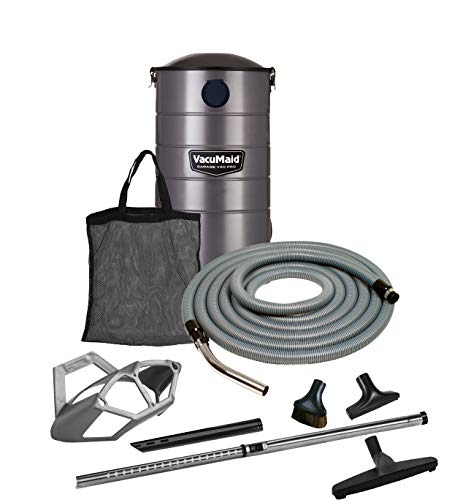
VacuMaid GV50PRO Wall Mounted 50ft Hose
Fifty feet of hose is the entire headline, and for the right property it is enough. The VacuMaid GV50PRO mounts on the wall, includes its tools, and then reaches further than any rival in this guide by a margin that changes what the machine is for: not merely the garage’s interior, but the driveway beyond it, the car parked outside because the garage is full of project, the second vehicle behind the first. Where a 7- or 18-foot hose defines a working circle around the bracket, fifty feet defines a working territory.
- Format: wall mounted garage and car vacuum, GV50PRO
- Hose: 50 ft, longest in this group by a wide margin
- Included: tools, per the title
- Tank capacity: absent from the title
- Power wording: omitted from the title
- Wet/dry capability: not stated in the listing title
- Remote control: not stated in the listing title
Strengths
- Fifty feet reaches cars that never enter the garage at all.
- One central unit can serve a three-bay garage from a single bracket.
- Tools are included, so the reach arrives ready to use.
Trade-offs
- The title does not claim wet/dry duty — verify before relying on it for spills.
- Fifty feet of hose is itself a storage and handling commitment.
- Capacity and power figures are absent from the title entirely.
Long hoses carry honest physics that a buyer should hear. Airflow loses energy along any hose’s length, and fifty feet of it asks more of a motor than eighteen does; without printed power figures, this guide will not pretend to rank the GV50PRO’s suction against rivals. What the length guarantees is access, and access has its own value hierarchy: a slightly gentler vacuum that reaches the car cleans it, while a stronger one that stops six feet short cleans nothing. Properties with deep garages, tandem parking or a workshop at the far end from the only sensible bracket should weigh reach first and interrogate the documentation for the power figures second.
Hose management at this length becomes a small craft: broad loops rather than tight coils, a route to the car that avoids dragging across gritty concrete edges, and a return path that does not cross the wet patch just cleaned. Households willing to learn that craft gain the closest thing this category offers to a central vacuum. Wet and dry capability tops the document checklist here: Check price on Amazon, with that question asked first.
Central-vacuum envy is the emotion this VacuMaid answers. Houses with built-in central systems spoil their owners: suction appears at a wall port, the dirt vanishes to a distant canister, no machine follows anyone around. A 50-foot hose from a single garage unit reproduces a surprising share of that experience for the garage, driveway and ground floor, at a fraction of the installation story. The comparison also sets the right expectation — central systems live or die on their pipe runs being planned, and the GV50PRO lives or dies on its bracket being placed where fifty feet fans out to cover the territory without stretching across the car’s roof. Spend the planning hour; it is the whole product.
Best for: a deep or three-bay garage, and cars habitually parked on the driveway.
Not suited for: a garage whose main enemy is liquid spills — wet duty is not stated in this title and must be verified first.

Giraffe Tools Grandstorm Retractable 30FT Remote
Giraffe Tools attacks the garage vacuum’s ugliest habit: the hose that lives in a tangled nest on the floor. The Grandstorm’s 30-foot hose retracts into its wall-mounted housing with an anti-kink auto-rewind, starts by remote control, and arrives with six nozzles for car detailing in a grey finish. Thirty feet sits between Shop-Vac’s long hose and VacuMaid’s expedition length — enough for a double garage and the car on the apron — while the rewind mechanism means those thirty feet vanish after use instead of colonising a corner.
- Format: retractable wall mount garage vacuum, Grandstorm
- Hose: 30 ft, retractable, anti-kink auto-rewind
- Control: remote control included
- Nozzles: 6, aimed at car detailing
- Capability: shop wet dry vacuum cleaner, per the title
- Colour: grey
- Tank capacity and power wording: both absent from the title
Strengths
- Auto-rewind ends the hose-storage problem that plagues the category.
- Remote starting suits hands-full moments mid-detail.
- Thirty feet covers a double garage without VacuMaid-scale hose handling.
Trade-offs
- A retraction mechanism is a moving part other picks do not ask you to maintain.
- Tank size goes unstated, complicating debris-heavy planning.
- Six nozzles is a detailing kit, narrower than Shop-Vac’s fourteen-piece spread.
Remote control sounds like a luxury until the first time both hands hold a trim panel or a wheel brush and the vacuum needs restarting; then it reads as ergonomics. The same logic governs the rewind. Tidiness in a garage is not vanity — a hose across the floor is a trip hazard in a room full of jacks, stands and rolling tool chests, and a hose stored inside its housing stays cleaner, unkinked and ready. Anti-kink construction matters at the bends near the car, where lesser hoses collapse and choke their own airflow at the exact moment the user leans into a footwell.
Detailing with six purpose-chosen nozzles covers the car’s geography well: crevices, vents, upholstery, boot. What the title does not give is tank capacity, so owners expecting to vacuum a season of leaves from a double floor should confirm volume in the documents. Tidiness problems that are secretly hose problems end here: Check price on Amazon.
Grey, the Grandstorm’s stated colour, is a small mercy in a room where everything shows dust. White housings in garages yellow and mark; black shows every pale dusting; grey splits the difference and hides a season of workshop film between wipes. The retractable format also changes who uses the vacuum: family members who would never wrestle a loose 30-foot hose into coils will happily pull out a self-rewinding one and let it swallow itself afterwards. Tools that only the household’s most patient member can operate are, in practice, tools that member uses alone — the Giraffe’s design quietly democratises the cleaning, which may be its most valuable specification of all, printed nowhere.
Best for: a double garage where the hose must disappear completely after every use.
Not suited for: a workshop generating tank-filling debris weekly — capacity is unconfirmed by this title.

Vacmaster VWMB508 Wall Mount Remote
Vacmaster’s title is the shortest of the six and still manages to state the essentials a garage buyer shortlists: model VWMB508, five gallons, “5 PHP” power wording, remote control, wall mount, wet and dry. The remote is the differentiator at this end of the list — the only other remote here belongs to the Giraffe, whose retractable hose commands a different kind of budget and complexity. A straightforward tank on a bracket, started from across the garage, is a proposition with its own clean logic.
- Format: remote control wall mount wet/dry vac, VWMB508 1101
- Tank: 5 gallons
- Power wording: 5 PHP, exactly as printed in the title
- Control: remote control
- Hose length: no figure is printed
- Attachments count: the title lists no number
- Blower function: no blower is named
Strengths
- Remote starting at a straightforward end of the category.
- Five gallons matches the group’s mainstream capacity.
- Wet and dry duty is stated outright, unlike one rival here.
Trade-offs
- Hose length is unpublished in the title; reach must be verified.
- Attachment inventory is likewise a document question.
- The “5 PHP” wording resists direct comparison with rivals’ HP claims.
That power wording deserves a sentence of honesty. Manufacturers in this category print horsepower figures arrived at by differing methods, and Vacmaster’s “PHP” — peak horsepower, as the trade generally reads it — cannot be lined up against DEWALT’s 5 or Shop-Vac’s 5.5 as though all three were weighed on one scale. The sensible buyer compares what is comparable: tank, hose, kit, control, and the physical evidence of the full listing. Judged that way, the VWMB508’s case rests on remote convenience wrapped around standard capacity, which is a case plenty of single garages will find sufficient.
Picture the single garage that is also a laundry overflow, a bike store and a freezer room. Space forbids a detailing empire; what fits is one bracket, one tank, a remote on a hook by the door, and a machine that starts without threading between the bikes. That is the household this Vacmaster describes. Hose length from the documents completes the picture: Check price on Amazon after that figure is known.
Simplicity ages well in garages, and the Vacmaster’s short specification hints at a machine with fewer ambitions to go wrong. No retraction mechanism, no blower plumbing, no fourteen-piece inventory to audit — a tank, a mount, a remote. For a garage attached to a holiday property or a rental, where the vacuum must survive unfamiliar users and long idle months, that restraint reads as reliability engineering. The remote’s battery becomes the one consumable to remember, and a spare kept in the kitchen drawer solves it. Buyers should still extract hose length and attachment details from the documents, because simple must never mean unknown; but once known, this is the pick least likely to surprise its owner in year four.
Best for: a compact single garage needing remote starts and standard capacity.
Not suited for: a buyer comparing motors by headline horsepower — the PHP wording here cannot be equated with rivals’ figures.
The numbers that exist, in one table
| Machine | Tank stated | Hose stated | Control | Kit stated |
|---|---|---|---|---|
| Bissell Garage Pro 18P03 | Not in title | Not in title | At unit; blower included | Auto tool kit |
| DEWALT DXV06G | 6 gallons | Not in title | At unit; portable | Not in title |
| Shop-Vac 9522236 | 5 gallons | 18 ft + 7 ft | At unit | 14 attachments |
| VacuMaid GV50PRO | Not in title | 50 ft | At unit | Tools included |
| Giraffe Grandstorm | Not in title | 30 ft retractable | Remote control | 6 nozzles |
| Vacmaster VWMB508 | 5 gallons | Not in title | Remote control | Not in title |
The gaps in this table are information, not carelessness: each “not in title” marks a figure the buyer must pull from that listing’s documentation before money moves.
How to choose a garage vacuum?
How far must the hose actually reach?
Walk the route before reading another specification. Stand at the bracket position, then pace to the farthest point the vacuum must serve: the far car door, the bench vice, the garage’s back corner where leaves settle. Add slack for working around a vehicle rather than merely touching it. That single measurement sorts this list ruthlessly — 50 feet for the VacuMaid, 30 retractable feet for the Giraffe, 18-plus-7 for the Shop-Vac, and document-checks for the three titles that print no length. A mounted vacuum with insufficient hose is furniture; with sufficient hose it is infrastructure.
Wet duty, dry duty, or the blower third option?
Garages flood in miniature constantly: the dripping underside of a rain-soaked car, a split washer hose, meltwater from a freezer defrost. Five of these six titles state wet and dry capability outright; the VacuMaid’s does not, and its review flags the verification rather than assuming. Blower duty, claimed only by the Bissell, suits garages whose debris is dry and mobile — leaves, dust, grass clippings — and whose owners would rather herd it out of the door than collect it. Decide which liquid and leaf realities your garage actually produces, then let that inventory, not a feature count, rank the six.
Where on the wall should a mounted vacuum live?
Bracket placement is a permanent decision disguised as a small one. Height should put the tank’s emptying point within comfortable lifting reach and the hose’s exit clear of door swings. The wall itself must carry the loaded weight — a full wet tank is heavy — so studs or proper masonry fixings are not optional garnish. Power needs a socket the cord reaches without crossing the car’s path. And the pedestrian door’s neighbourhood wins for car interiors, while the bench’s neighbourhood wins for project cleanup; households with both should place for the car and let hose length serve the bench, since cars cannot come to the vacuum.
Emptying, filters and the maintenance nobody advertises
A wall-mounted vacuum’s running costs are measured in attention rather than parts. Tanks that are emptied at two-thirds full keep suction honest and lifting manageable; a five-gallon tank brim-full of wet grit approaches the weight of a full suitcase, at bracket height. Filters clog fastest in garages that grind, sand or cut masonry, and a vacuum that seems to fade across a season is usually breathing through a felted filter asking for a clean or a change. Hose cuffs crack where they flex at the car door; storing the hose in broad loops, or inside a retractable housing like the Giraffe’s, postpones that day. None of the six titles specifies filter types or maintenance intervals, so those schedules belong on the document checklist beside hose lengths and capacities — five minutes of reading that decides whether year three feels like year one.
The garage vacuum as the house’s overflow cleaner
Mounted by an internal door, a garage vacuum quietly annexes jobs from the rest of the house. The porch and the patio fall inside a 30- or 50-foot hose’s territory; so do the utility room floor, the boot tray’s grit, and the annual horror behind the tumble dryer. Stairs leading down to the garage get vacuumed from below with an ease no upright manages. This annexation argues for sizing the purchase to the whole territory rather than the garage alone, and for choosing the bracket wall nearest the house door when car and house claims compete evenly. It also argues for the remote-control models more strongly than their titles know: a machine started from the doorway, hose already in hand, gets used for the two-minute jobs that constitute most of domestic cleaning.
Installing the bracket without regretting it
Installation day repays an hour of thought more than any other hour in a mounted vacuum’s life. Begin with the car parked exactly where it sleeps, doors opened to their full swing, because the bracket must serve that geometry and not the empty garage’s. Mark the hose’s likely path and look for what it will rub: door hinges, bike pedals, the corner of the freezer. Choose fixings for the actual wall — studs behind plasterboard, proper anchors in masonry — and remember the load is dynamic, since a full tank gets lifted off and swung during emptying. Power the unit from a socket that the car’s charging cable, the freezer and the vacuum will not fight over, and keep the cord’s run off the floor entirely. Finally, hang the remote, the crevice tool and the brush where a hand falls naturally at the door; accessories stored in a box across the garage might as well be accessories never bought. Every pick in this guide benefits from the same hour, and none of their titles can give it to you — it is the buyer’s own contribution to the specification.
Wet jobs, ranked by unpleasantness
Garage liquids form a hierarchy, and a wet/dry vacuum meets each rung differently. Meltwater and rain drippings are the gentle base: clean water, easily vacuumed, no aftermath beyond emptying. Muddy wash water follows, carrying grit that settles in the tank and argues for a rinse after emptying. Coolant and oil-contaminated spills sit at the top, demanding absorbent granules first, vacuuming of the residue second, and disposal according to local rules rather than the household drain. A mounted machine’s advantage across all three rungs is immediacy — the spill is attacked while it is a puddle, not after it has become a stain with a smell — and that immediacy is the real reason wet capability belongs in the selection gates for this category. Five titles here state it; verify the sixth, then mount whichever machine you choose close enough to the door that a spill’s first minute finds you already reaching for the hose.
The two-minute clean, and why it changes garages
Behavioural researchers of the household — a discipline this guide is inventing on the spot — would identify the two-minute clean as the mounted vacuum’s true product. A floor that gets vacuumed for two minutes after every muddy arrival never develops the geological layers that make spring cleaning a weekend. The enabler is friction, or its absence: no cupboard to open, no canister to assemble, no cord to unwind and rewind. The hose is there, the switch is there, the dirt is still loose and localised. Every design decision in this guide can be re-read through that lens. Remote controls remove the walk to the bracket. Retractable hoses remove the coiling penalty. Generous tanks remove the emptying interruption. Even the Bissell’s blower participates, clearing the doorstep zone in seconds. Buyers torn between two models should ask a single question — which machine will I actually start for a two-minute job at 9 p.m. in February — and buy the answer.
The two-minute habit also protects the cars. Grit left on a garage floor migrates into footwells on shoe soles, then grinds into carpet and scratches door sills as boots pivot. A floor kept at the two-minute standard starves that migration at its source. Detailers charge handsomely to reverse the process quarterly; a mounted vacuum prevents it nightly, which reframes the purchase price as prepaid prevention rather than equipment.
Noise and neighbours in the attached garage
Wet/dry vacuums are not quiet machines, and no title in this set publishes a sound figure, so this guide offers management instead of numbers. Attached garages share a wall with living rooms and often a bedroom above; a vacuum run at midnight will be heard through both. The courteous pattern is mechanical sympathy: full cleans in daylight hours, two-minute jobs at reasonable ones, and the door between garage and house kept shut while the motor runs. Mounting can help — a bracket on an external wall radiates less into the house than one on the shared wall, and anti-vibration pads behind the bracket, where the maker permits them, dull the structure-borne hum that carries furthest. Remote-control models add an unexpected courtesy: the user stands at the car rather than beside the motor, and perceived loudness drops with distance even when the machine’s output is unchanged.
Early-morning detailing before a trip deserves one specific warning. A vacuum started at dawn in a terraced street announces itself through every party wall, and the goodwill of neighbours is a resource gardeners and detailers both draw on all summer. The previous evening’s session, tank emptied and hose coiled, is the professional’s answer — another small way in which the mounted format, ready at all hours, tempts its owner into the one hour it should rest.
Common mistakes
Mounting the bracket where the car cannot be reached. Reach is measured to the far door of a parked car, not to the empty garage’s far wall. Park first, measure second, drill third.
Comparing horsepower wordings as if they were one standard. Five, 5.5 HP and 5 PHP arrive by different methods. Compare tanks, hoses, kits and controls — the figures that share definitions.
Assuming wet/dry from the category rather than the title. One pick here never states wet duty. Spills are the worst moment to discover an assumption was wrong.
Letting the tank fill to the brim before emptying. Suction fades, weight soars, and the eventual emptying becomes the job you postpone forever. Two-thirds is the working limit.
Storing a loose hose in tight coils on the floor. Kinks become permanent, cuffs crack, and the coil becomes a trip hazard among jacks and stands. Broad loops, a hook, or a retractable housing solve it.
Forgetting the filter until the suction vanishes. Grinding and sanding garages felt a filter in a single project weekend. Put the filter on the same calendar as the car’s service.
Garage evenings often end at the workbench rather than the car, and the pour-spout saucepans gathered in Best Cookware Sets with Pour Spouts belong to the other end of that same practical household — the kitchen that feeds the people the garage serves.
Final recommendation
Let reach cast the first vote. Deep garages and driveway-parked cars belong to the VacuMaid GV50PRO, subject to verifying its wet/dry status in the documents; double garages that prize tidiness belong to the Giraffe Grandstorm, whose retractable 30 feet and remote make the hose disappear. Give the detailing household the Bissell Garage Pro, blower and auto tool kit included, and give the debris-heavy workshop the DEWALT DXV06G for its six gallons and portable streak. The Shop-Vac 9522236 takes the vote where bench and car share one machine and fourteen attachments will all find work, while the Vacmaster VWMB508 closes the list as the compact garage’s remote-started, five-gallon answer.
Two of these six ask for document homework before their core figures exist at all, and that homework is not a defect to forgive but a step to schedule: hose length for the DEWALT and Vacmaster, wet/dry confirmation for the VacuMaid, capacity for the Bissell, Giraffe and VacuMaid. A buyer who completes it will never be surprised by the machine that arrives.
What the titles leave out, collected in one place
Frustration with missing figures runs through this guide’s reviews, so it is worth gathering the gaps honestly and explaining the discipline behind refusing to fill them. Tank capacity is missing for the Bissell, the VacuMaid and the Giraffe. Hose length is missing for the Bissell, the DEWALT and the Vacmaster. Power wording is missing for the Bissell, the VacuMaid and the Giraffe, and present-but-incomparable for the three that print it. Wet/dry capability is unstated only for the VacuMaid. Attachment counts exist only for the Shop-Vac and the Giraffe. A less careful guide would harvest these numbers from manufacturer pages and present a complete table; this one declines, because a buyer’s contract is with the listing in front of them, and figures sourced elsewhere describe versions and bundles that may not match the box that ships. The gaps are therefore printed as gaps, each with its instruction: open the documentation, find the figure, measure your garage against it. That is slower than trusting a table. It is also how the right vacuum gets bought the first time.
The pattern of omissions teaches its own lesson about the category. Brands print what flatters their design: reach specialists print feet, kit specialists print counts, capacity specialists print gallons, and everyone prints a power wording whose method stays private. Reading six titles together exposes the strategy, which is why comparison guides exist at all — no single listing will ever volunteer the column in which it loses. The table earlier in this article, gaps and all, is the honest map of that terrain.
A season with a mounted vacuum, month by month
Spring opens with meltwater, pollen and the winter’s accumulated grit leaving in the first deep clean; the tank empties twice that weekend and rarely again until autumn. Summer is detailing season — cars washed weekly, interiors vacuumed before the wash so grit never meets the sponge, the blower or a long hose earning its keep on driveways. Autumn tests capacity with leaves, which arrive daily, weigh nothing and fill everything; the six-gallon DEWALT and the two-thirds emptying rule both prove their worth in October. Winter returns to salt and slush, short frequent sessions, and gratitude for a remote start when the garage is cold enough to punish lingering. A machine that serves all four seasons without its owner rethinking the purchase has justified its bracket — and every pick in this guide, matched to its right household, is capable of exactly that unglamorous triumph.
Detailing interiors with a wall-mounted hose: a working routine
Order matters when a car interior meets a strong vacuum. Begin with the boot, where grit is loosest and the spare-wheel well hides a season of crumbs, then move forward through the rear footwells to the front, finishing with the driver’s mat — the dirtiest square foot of the car — so debris is never carried from a cleaned area into an uncleaned one. Pull mats out entirely and vacuum them on the garage floor, where the hose works flat and the mat can be beaten gently against the wall first to loosen what suction alone leaves behind. Seat rails and the gap beside the handbrake surrender their coins and crumbs only to a crevice tool worked slowly; rushing that pass redistributes more than it collects. Brush attachments lift dust from vents and switchgear without driving it deeper, and a final pass with a soft head over the dashboard leaves the interior looking detailed rather than merely emptied.
Pet hair deserves its own sentence in any honest routine, because it defeats ordinary suction by weaving itself into carpet pile. Short, overlapping strokes against the pile’s direction, with a stiff brush head, free most of it; the remainder yields to persistence rather than power. Households with dogs will judge every machine in this guide by this single test, whatever the brochures emphasise, and the detailing kits — Bissell’s auto tools, Giraffe’s six nozzles, Shop-Vac’s fourteen pieces — exist largely because car interiors present a dozen small geographies, each with a texture that rewards its own shape of tool.
The case for the second socket
One practical upgrade outranks every accessory in this category: a second power socket, professionally fitted near the bracket, reserved for the vacuum alone. Garages accumulate electrical tenants — freezer, battery conditioner, tool chargers, the door opener — and a vacuum that must borrow a socket through an extension lead draped across the floor loses the readiness that justified buying it. A dedicated socket keeps the cord short, off the ground and permanently connected, so the machine’s resting state is ready rather than nearly ready. Households planning the bracket position should plan the socket in the same conversation with their electrician, since moving either after the fact costs more than placing both correctly once. It is unglamorous advice, and it will improve daily life with any of these six machines more than a fourteenth attachment ever could.
One closing audit before any order is placed: pace the hose route in your own garage, note which figures your chosen title withholds, read those figures in the manufacturer’s documents, and confirm the wall can carry a full wet tank at the height you intend. Four small acts of diligence, performed once, separate a decade of service from a season of regret.
Gift purchases deserve a caution of their own in this category: a wall-mounted vacuum is a commitment to a particular wall in a particular garage, and the generous buyer should confirm the recipient’s space, wall construction and parking arrangement before wrapping anything. Chosen well, it is among the most used gifts a practical household can receive; chosen blind, it is the heaviest thing in the returns queue.
Frequently asked questions
Why insist on wall-mounted models for a garage?
Readiness. A mounted vacuum with its hose coiled beside the door gets used for two-minute jobs — the grit after one trip, the leaves after one storm — while a stored canister waits for a cleaning day that comes monthly. All six picks here share the format so the comparison stays inside it.
Is a longer hose always better?
Reach is better; length itself is a trade. Fifty feet serves three bays and driveways but demands more hose handling and asks more of a motor. Thirty retractable feet covers most double garages with far less fuss, and Shop-Vac’s split 18-and-7 arrangement covers two working distances elegantly. Measure your own route and buy the length it proves.
Can these machines really handle liquids?
Five of the six titles state wet and dry duty in so many words. The VacuMaid GV50PRO’s title does not, so its spill capability must be confirmed in the manufacturer’s documentation before it is relied on — the review above flags that rather than smoothing it over.
What does a remote control add in practice?
Starts without walking. Mid-detail, hands occupied, the Giraffe and the Vacmaster can be switched from where you stand. In garages where the bracket sits behind stored equipment, that convenience graduates from luxury to the feature that decides whether the machine gets used daily.
What else belongs on this household’s reading list?
The garage cook — every street has one, grill by the open door — will find the probe sets in Best Wireless Meat Thermometers 4 Probes directly relevant to weekend duty. And the percolators in Best Stainless Steel Elec Perc Coffee Makers answer the workshop’s other essential question, the one about coffee at seven in the morning.
Mount it where the car sleeps, size the hose to the farthest door, empty the tank before it begs, keep the filter breathing, and the garage, that hardest-working and least thanked room in the entire house, will stay cleaner than it has any right to be — not through any single heroic clean, but through the accumulation of two-minute ones, week after week, season after season, year after quiet, unremarkable, deeply satisfying year of faithful, uncomplaining service, in all weathers, for whoever in the household finally admits that the mounted vacuum by the door was the smartest purchase the garage ever received.


