What's inside
- Why loop pile changes the vacuum conversation
- Where to buy these six machines
- Quick picks at a glance
- How these picks were chosen
- The six reviews in full
- Side-by-side: mechanism, capacity, and reach
- Which cleaning style fits your Berber: suction, sweeping, or agitation?
- Reading vacuum titles when the word you need is missing
- Loop pile care between vacuum days
- Common mistakes
- Final recommendation
- Frequently asked questions
As an Amazon Associate I earn from qualifying purchases. This post may contain affiliate links at no extra cost to you.
As an Amazon Associate, cottageverdict.com earns from qualifying purchases.
Why loop pile changes the vacuum conversation
Berber carpet punishes careless cleaning. Its loops are not cut ends standing loose; each fibre bends back into the backing, so a snagged loop can pull, fuzz, or run in a way a plush carpet never would. Anyone shopping for the best vacuums for Berber carpets quickly discovers an awkward gap in the listings gathered here: none of the six machines below names Berber or loop pile in its title at all. That silence matters, and this guide treats it honestly rather than papering over it. No Berber claim in any listing is the starting point for every pick, so the real work becomes reading mechanisms — whether a brushroll can be switched off, whether suction arrives without a spinning bar, whether a tool head glides instead of digging — and judging which mechanism gives loop pile the gentlest plausible treatment.
Think about what actually touches the carpet. A powered brushroll beats and combs, which lifts grit from cut pile beautifully, yet those same bristles can catch a loop edge. Suction-only passes, a manual sweeper with no motor at all, or an upright whose brushroll shutoff is named right in the title each change the risk profile in different ways. Weight matters too, because dragging a heavy machine back over a delicate loop surface invites the operator to push harder and lean the head in. Hose reach matters because stairs and edges often get cleaned with attachments rather than the main floor head. Pet hair complicates everything, since Berber in family homes rarely stays pet-free, and most of these listings lean hard into pet-hair language.
So this is a guide about trade-offs under uncertainty. No pick earns a claim of being designed for Berber, because no title supports that sentence. Instead, each review explains what the listing does state — filtration, dust cup size, hose length, tool sets, modes — and then reasons carefully about how that stated hardware behaves on looped carpet. Where a listing leaves a question open, the review says so plainly. Readers who want certainty beyond mechanism reasoning should confirm with the manufacturer before buying, and that advice recurs throughout because it is the honest position for this particular keyword.
Where to buy these six machines
The Shark Navigator Lift-Away NV360 suits readers who want the one brushroll shutoff named in this line-up, wrapped in a lift-away upright with HEPA filtration.
Households drawn to a two-motor upright with a long hose and a green finish will find the Kenmore Bagless Upright DU2012 the more traditional full-size option here.
Anyone who prefers a corded stick that converts to a handheld for stairs should look closely at the Shark Rocket Pet Plus HV322 and its LED headlights.
Tight budgets and small flats point toward the Bissell Featherweight Stick 2033M, a featherweight stick that doubles as an electric broom.
Readers who want zero motor involvement on delicate loops can consider the Yocada Carpet Sweeper Manual, a hand-push sweeper that runs on elbow grease alone.
Deep carpet cleaning as the headline act defines the Shark CarpetForce EX501BRN, an upright built around carpets and area rugs with two modes.
Quick picks at a glance
| Pick | Best for | Standout from the title |
|---|---|---|
| Shark Navigator Lift-Away NV360 | Switching the brushroll off for gentler passes | Brushroll Shutoff plus Lift-Away Pod and HEPA |
| Kenmore Bagless Upright DU2012 | Full-size upright cleaning with hose reach | 2-Motor Power Suction and a 10-foot hose |
| Shark Rocket Pet Plus HV322 | Stick versatility across carpet and hard floor | XL Dust Cup, LED Headlights, handheld conversion |
| Bissell Featherweight Stick 2033M | Light daily pickups in compact homes | Featherweight stick and electric broom in one |
| Yocada Carpet Sweeper Manual | Motor-free sweeping of surface debris | Hand Push Non-Electric design for low carpets and rugs |
| Shark CarpetForce EX501BRN | Determined deep cleaning of carpeted rooms | DirtDisrupt Brushroll with Two Modes |
How these picks were chosen
Selection began with a blunt filter: every candidate had to be a dry vacuum or sweeper for carpet, not a wet carpet washer, because washing machines answer a different question than daily loop-pile care. From there, variety of mechanism drove the final six. One upright offers brushroll shutoff, one relies on twin motors and hose work, two are sticks at opposite ends of the weight spectrum, one removes the motor entirely, and one commits fully to an aggressive carpet brushroll. That spread lets a Berber owner choose a philosophy rather than a colour.
Filtration claims were recorded exactly as titles phrase them. The Navigator and the Kenmore both name HEPA or a HEPA filter; the other four listings stay silent on filtration grade, so their reviews refuse to upgrade them by assumption. Dust capacity was noted where stated — 0.9-quart on the Navigator, 2 litres on the Kenmore, an XL cup claimed for the Rocket — and left blank where a title prints no figure. Tool sets counted only when named: upholstery and crevice tools appear in some titles, a brush accompanies the Yocada, and the Bissell names a crevice tool.
Finally, every listing was checked for any mention of Berber, loop pile, or loop-friendly design. The count came back zero across all six. Rather than disqualifying the whole set — the search pool simply contains no title that makes that claim — the guide reframed each review around mechanism, gentleness, and explicit uncertainty. If a manufacturer later publishes loop-pile guidance for one of these models, that document would outrank the reasoning here.
One further selection principle deserves stating plainly: no machine was rewarded for promises its title does not make. Several listings gesture at deep cleaning or pet performance in language broad enough to mean almost anything, and those gestures were recorded as gestures. Conversely, modest listings that quantify something real — a hose, a cup, a filter grade — earned analytical attention proportional to their specificity. That discipline produces a guide where the humblest sweeper can outrank a flagship on a particular Berber question, which is exactly what honest comparison should occasionally do. Readers replicating this method on other machines they find in shops should apply the same rule: pay for stated mechanisms, discount adjectives, and treat silence about loop pile as a question to carry to the manufacturer rather than a gap to fill with hope.
The six reviews in full

Shark Navigator Lift-Away NV360
Among six listings that never mention loop pile, this Shark earns first position for a single stated feature: brushroll shutoff. Turning the rotating bar off converts the floor head into a suction-led cleaner, and suction-led cleaning is precisely the mode cautious Berber owners ask about, because nothing spins against the loops. The title also promises a Lift-Away Pod, meaning the canister section detaches from the floor head for portable work on stairs or upholstery, and swivel steering, which helps the head change direction without being muscled sideways across carpet fibres.
- Floor head modes named: carpet and hard floor cleaning, with brushroll shutoff
- Filtration wording: HEPA
- Dust cup capacity given: 0.9-Qt
- Colour and model: Blue, NV360
- Berber suitability not stated in listing
- Tools named: Upholstery and Crevice Tools
Strengths
- The shutoff gives an owner a deliberate gentle mode rather than a workaround.
- Lift-Away portability moves cleaning power to stairs without hauling the whole upright.
- Swivel steering reduces the sideways dragging that scuffs loop surfaces.
Trade-offs
- A 0.9-quart cup fills quickly in a shedding household, so emptying interrupts long sessions.
- HEPA wording appears without any sealed-system detail in the title.
- Nothing in the listing addresses loop pile directly, leaving the core question to mechanism logic.
Picture a living room where Berber runs wall to wall and a dog tracks in grit from the garden. With the brushroll off, the Navigator can work the traffic lane on suction, lifting surface grit without a spinning bar worrying the loops. Flip the pod free and the same machine handles the stair treads, where Berber often shows wear first, using the upholstery tool on the risers. The crevice tool reaches the skirting line where loop carpet meets the wall and crumbs collect. None of that makes the machine a Berber specialist; it makes it the most adaptable mechanism in this particular six.
On hard floors the shutoff matters again, since a stopped bar will not scatter debris across kitchen tile. Pet hair sits at the centre of the listing language — carpet and pet hair headline the title — so buyers whose Berber hosts a cat should read the claim as a manufacturer promise about hair pickup generally, not about loop safety. Used with patience, in straight passes, lifted at turns rather than twisted, the Navigator respects the carpet as well as any powered option gathered here.
A second consideration is resale of effort across a whole home: because the pod separates, one person can carry suction upstairs while the floor head waits below, turning a two-trip chore into a single circuit. For Berber laid through a hallway and three bedrooms, that circuit logic decides whether the deep pass happens monthly or quarterly. The swivel head also earns quiet praise on loop carpet laid in small rooms, where constant lifting to reposition would otherwise fatigue the operator into rushing the last quarter of the job, and rushing is when loops get twisted rather than cleaned.
Best for: owners wanting a stated brushroll shutoff plus lift-away portability in one upright. Not suited for: rooms needing a dust cup larger than 0.9 quart for uninterrupted whole-house sessions.
See the Navigator NV360 on Amazon

Kenmore Bagless Upright DU2012
Kenmore builds this upright around a phrase the other listings avoid: 2-Motor Power Suction. Two motors suggest suction strength that does not depend entirely on brushroll agitation, which is an interesting proposition for loop carpet, because strong airflow alone can pull grit from between loops. The listing calls the machine lightweight for a carpet cleaner, gives a 2-litre capacity, and stretches a 10-foot hose for reach. A HEPA filter is named outright, and two cleaning tools aimed at pet hair ride along.
- Motor description: 2-Motor Power Suction
- Capacity figure printed: 2 Liters
- Hose reach stated: 10 feet
- Filter type named: HEPA Filter
- Finish and model: Green, DU2012
- Berber suitability not stated in listing
Strengths
- Generous hose length turns edges, stairs, and upholstery into attachment work away from the main head.
- The 2-litre capacity outlasts the smaller cups elsewhere in this guide.
- Bagless design removes the recurring cost and hunt for replacement bags.
Trade-offs
- No brushroll shutoff appears in the title, so the floor head presumably keeps its bar active on carpet.
- Two pet-hair tools is a modest kit beside rivals listing upholstery and crevice pieces separately.
- Lightweight is claimed without a weight figure, leaving the promise unquantified.
The sensible way to use a DU2012 on Berber is to let the hose do delicate work and reserve the floor head for open areas where straight, unhurried passes are possible. Ten feet of hose reaches a full flight of stairs from a landing in many homes, and the pet tools concentrate suction on small patches — a favourite dog corner, the strip in front of a sofa — without rolling the upright head over those loops repeatedly. Airflow-led cleaning suits Berber theory well: grit sitting in the loop valleys gets drawn upward rather than beaten loose.
Where caution applies is the main head. Without a stated shutoff, an owner cannot confirm from the listing whether the brushroll can rest while suction continues. Anyone whose Berber is an expensive wool loop should treat that unknown seriously and ask Kenmore directly. For synthetic Berber in a busy rental or family room, where durability is proven and pet hair is the daily enemy, the calculus softens and the Kenmore’s capacity and reach become the story.
There is also a longevity angle to the Kenmore pattern. A conventional upright layout is the format independent repair shops know best, with belts, filters, and brush components following long-established conventions. For a household intending to keep one machine on Berber duty for many years, that familiarity can matter as much as any single specification. The green finish will divide opinion, yet colour fades from attention within a week while hose reach is appreciated at every single session, particularly on carpeted stairs where ten feet is the difference between finishing the flight and repositioning the base unit twice.
Best for: larger carpeted areas needing hose reach and a 2-litre bin. Not suited for: owners who require a confirmed brushroll shutoff before any powered head touches their loops.
Look over the Kenmore DU2012 listing

Shark Rocket Pet Plus HV322
Stick vacuums change the Berber equation through weight and control. The Rocket Pet Plus is a corded stick, so runtime never expires mid-room, and the title stresses lightweight handling in a Bordeaux finish. It converts to a handheld vacuum for pet hair, which means the motor unit leaves the stick and goes wherever the operator’s hand directs it. LED headlights sit at the floor head, an XL dust cup is claimed without a numeric size, and crevice plus upholstery tools are named for detail work on carpet, area rugs, and hard floors alike.
- Format: corded stick converting to handheld
- Surfaces listed: Carpet, Area Rug and Hard Floor
- Cup description: XL Dust Cup, numeric size absent from the listing title
- Lighting: LED Headlights
- Tools named: Crevice and Upholstery Tool
- Berber suitability not stated in listing
Strengths
- Corded power removes battery anxiety during a full Berber room clean.
- Headlights reveal grit lodged between loops that ceiling light hides.
- Handheld conversion cleans stair loops with a small tool instead of a wide head.
Trade-offs
- A cord trails behind every pass and needs managing around furniture legs.
- No brushroll shutoff is mentioned, so head behaviour on loops stays unconfirmed.
- XL is a relative claim; the title gives no litre or quart figure to compare.
On loop carpet, a light stick invites a lighter touch. The operator guides rather than pushes, and the head can be lifted and reset at each row end instead of being yanked around in an arc. Headlights earn their keep on Berber specifically because the loop texture casts tiny shadows; debris that blends into a beige loop field under room lighting shows up starkly in a low beam. The handheld mode suits the perimeter, where Berber meets skirting and where a full-width head tends to bang and scuff.
Pet positioning dominates the name itself — Pet Plus — so expect the tool tuning to favour hair. Hair on Berber sits on top of loops more than it buries, which plays to a stick’s quick-pass strengths. Still, the absence of any shutoff language means a cautious owner should test an inconspicuous corner first, watch for fuzzing, and adjust technique before committing to whole rooms.
Battery-free operation brings one more Berber-specific benefit: suction stays constant from the first lane to the last, whereas a fading battery quietly weakens extraction and tempts the operator to compensate with extra passes and downward pressure. Constant power keeps technique constant. The Bordeaux colourway is unusually visible against pale loop carpet, a trivial point until the stick is left lying across a hallway and a household member nearly trips; visibility, in a tool that lives outside cupboards, is a genuine if unglamorous safety property worth recording alongside the headline specifications.
Best for: smaller Berber homes wanting corded stick agility and stair-friendly handheld work. Not suited for: cordless cleaning, since the title specifies a corded stick design.
Check the Rocket Pet Plus details

Bissell Featherweight Stick 2033M
Bissell’s Featherweight makes the humblest pitch in this guide and, for certain Berber rooms, humility is a virtue. The title calls it a lightweight bagless vacuum and an electric broom, supplies a crevice tool, and assigns it to hard floors and carpets in a black finish, model 2033M. No filtration grade is claimed, no cup size is printed, and no pet-hair headline appears. What remains is a very light stick whose modest suction and simple head may suit frequent, gentle maintenance passes better than occasional deep assaults.
- Dual identity stated: stick vacuum and electric broom
- Accessory named: Crevice Tool
- Surfaces listed: Hard Floors and Carpets
- Filtration grade: absent from the title
- Cup capacity: no figure printed in the title
- Berber suitability not stated in listing
Strengths
- Featherweight handling encourages little-and-often cleaning, the rhythm loop carpet prefers.
- Electric broom simplicity means few settings to misconfigure before a pass.
- A crevice tool handles the edges where loop carpet traps crumbs against the wall.
Trade-offs
- Modest class positioning implies limited suction for grit deep in loop valleys.
- No HEPA claim appears, unlike the two uprights earlier in this guide.
- Bagless capacity goes unquantified, so emptying frequency is guesswork.
Consider the Featherweight as a maintenance instrument. A Berber hallway that collects daily crumbs responds well to a thirty-second broom pass every evening, and a machine this light actually gets taken out of the cupboard for that job. Heavy machines, by contrast, wait for a weekly session during which grit grinds deeper underfoot. The trade is obvious: surface litter vanishes easily, while sand worked down between loops may survive a light stick’s airflow.
Pairing strategies suit this pick. A household might keep the Featherweight for daily loop care and borrow or hire a stronger suction machine seasonally, accepting that arrangement rather than forcing one tool into both roles. In a studio flat with a single Berber rug over hard flooring, though, the Bissell alone could plausibly cover the whole brief, moving from board to rug without a mode change worth mentioning.
Flats with Berber in a single room will also appreciate how little storage the Featherweight claims: it hangs or leans in spaces where an upright simply cannot live, which means it stays within arm’s reach of the carpet it serves. Proximity drives frequency, and frequency is this machine’s whole cleaning strategy. Its electric broom identity also makes it the least intimidating tool in the guide for a child assigned a first cleaning chore, letting a household distribute the daily pass among several people instead of reserving it for one cautious adult with the instruction manual memorised.
Best for: daily surface maintenance of loop carpet in small spaces. Not suited for: sole-machine deep cleaning of large Berber rooms with heavy grit loads.
View the Featherweight 2033M on Amazon
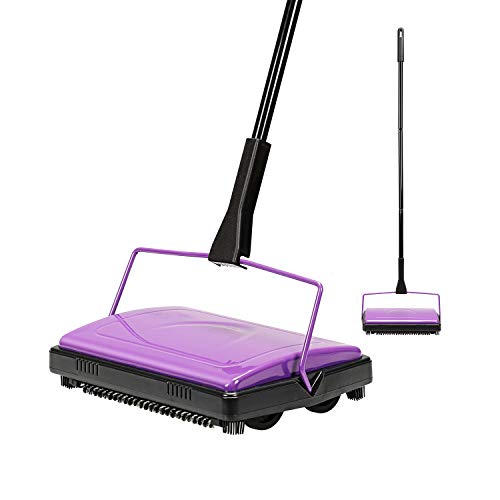
Yocada Carpet Sweeper Manual
Every other pick in this guide plugs in. The Yocada does not. Its title describes a manual household sweeper, hand push and non-electric, aimed at home and office low and undercoat carpets and rugs, gathering pet hair, dust, scraps, and paper rubbish, with a brush included. For Berber, that absence of motor and powered brushroll is the entire argument: a sweeper’s rotating mechanism, driven by the wheels as you push, works at walking pace under the operator’s complete control, and it can be stopped instantly by simply stopping.
- Power source: Hand Push Non-Electric, no motor
- Carpet types named: Low and Undercoat Carpets and Rugs
- Debris list: Pet Hair, Dust, Scraps, Paper Rubbish
- Included extra: a Brush
- Settings named: Home and Office
- Berber suitability not stated in listing
Strengths
- Zero powered agitation removes the snagging risk a spinning electric brushroll carries.
- Silent operation allows cleaning during calls, naps, or late evenings.
- No cord, battery, bag, or filter purchases follow the machine home.
Trade-offs
- Surface sweeping cannot extract grit settled deep between loops the way suction can.
- Human effort scales badly across several large carpeted rooms.
- Fine dust capture will trail any filtered vacuum in this line-up.
The Yocada’s honest niche is the in-between clean. Berber in a home office picks up paper scraps, crumbs, and tracked dust during a workday; pushing a sweeper over it for two minutes restores order without uncoiling a vacuum. The included brush helps tease debris from the sweeper’s own mechanism and from corners the body cannot enter. On low carpet — and Berber is typically low and dense — a sweeper’s wheels track predictably and its pickup stays consistent.
What it cannot do is substitute for extraction. Grit is abrasive, and grit left in loop valleys wears fibres from inside the pile. A household relying on the Yocada alone should schedule periodic suction cleaning by some other machine, treating the sweeper as the daily guardian and the vacuum as the monthly deep worker. Framed that way, its limitations become a rota rather than a flaw.
Apartment dwellers add another argument: a sweeper never trips a breaker, never needs a charging corner, and never announces itself through a wall to neighbours below. In thin-floored buildings, that social licence to clean at midnight after a spill is worth real money. The Yocada also travels well between floors of a house, carried by its handle up stairs that would make an upright journey a planned expedition. As the guardian layer of a Berber rota, it succeeds precisely by asking so little that it gets used daily, which is the frequency loop carpet quietly prefers.
Best for: motor-free daily sweeping of low loop carpet and rugs. Not suited for: extracting embedded grit, since a manual sweeper provides no suction at all.
Read the Yocada sweeper listing

Shark CarpetForce EX501BRN
CarpetForce arrives with the opposite temperament to the Yocada. The title promises a lightweight upright carpet and area rug cleaner with two modes, a DirtDisrupt Brushroll, Deep Clean Ultra positioning, and a dirt and odor remover angle. Every phrase leans toward vigorous carpet work. On cut pile that vigour is the point. On Berber loops, vigour demands respect: a brushroll designed to disrupt dirt is, by description, an assertive mechanism, and the listing says nothing about loop pile or a shutoff.
- Class: Lightweight Upright for Carpets and Area Rugs
- Modes counted: Two Modes
- Brushroll named: DirtDisrupt Brushroll
- Cleaning claim wording: Deep Clean Ultra, Dirt and Odor Remover
- Model code: EX501BRN
- Berber suitability not stated in listing
Strengths
- Two modes let an operator choose intensity rather than accepting a single setting.
- Carpet-specialist design concentrates engineering on the surface Berber owners care about.
- Lightweight upright handling tempers the aggressive brushroll with easier control.
Trade-offs
- DirtDisrupt language signals assertive agitation, the quality loop pile tolerates least.
- No shutoff is stated, so a suction-only mode cannot be confirmed from the title.
- Odor remover phrasing is a listing claim without supporting detail in the title.
Where might this machine fit a Berber home? Possibly on the area rugs layered over hard floors, or on a hard-wearing synthetic Berber in a playroom where ground-in dirt is the bigger enemy and the carpet’s warranty long ago expired. The gentler of its two modes — the title does not name them, so their character is unverified — would be the starting point, tested in a hidden corner. Delicate wool Berber, heirloom rugs, or any loop carpet with existing snags should steer toward the shutoff-equipped Navigator instead.
Honesty about fit is more useful than enthusiasm here. CarpetForce is included because Berber shoppers will encounter it in carpet-cleaner searches and deserve a clear-eyed reading: its stated strengths target deep soil removal, its stated design ignores loop pile entirely, and those two facts together define a cautious, limited role rather than a headline recommendation for this carpet type.
One more scenario deserves airtime: the ex-rental or newly bought home whose Berber arrives pre-loaded with years of someone else’s grit. In that rescue context, an assertive first campaign on the gentler mode, run slowly with frequent cup emptying, can be the pragmatic choice before settling into a gentler long-term rota. Judgement, not dogma, should govern that decision, and the test-patch ritual matters even more when the carpet’s history is unknown. After the rescue, many owners will still demote this machine to rug duty and promote a shutoff model for weekly care.
Best for: hard-wearing synthetic carpet needing assertive deep cleaning. Not suited for: delicate wool loop pile, given the DirtDisrupt brushroll and no stated shutoff.
Examine the CarpetForce EX501BRN
Side-by-side: mechanism, capacity, and reach
| Machine | Agitation story | Capacity or reach stated | Filtration wording |
|---|---|---|---|
| Shark Navigator Lift-Away NV360 | Brushroll with shutoff | 0.9-Qt cup; lift-away pod | HEPA |
| Kenmore Bagless Upright DU2012 | 2-motor suction emphasis; shutoff unconfirmed | 2 litres; 10-foot hose | HEPA Filter |
| Shark Rocket Pet Plus HV322 | Corded stick head; shutoff unconfirmed | XL cup, size unprinted | Not named |
| Bissell Featherweight Stick 2033M | Electric broom simplicity | Capacity unprinted | Not named |
| Yocada Carpet Sweeper Manual | Hand-push, non-electric | No cup figure; brush included | None — no airflow |
| Shark CarpetForce EX501BRN | DirtDisrupt brushroll, two modes | Capacity unprinted | Not named |
Reading across the rows, a pattern emerges that no single specification captures. The machines divide by how much mechanical action they bring to the loop surface. At one pole sits the Yocada, bringing none beyond a push-driven sweeper mechanism. At the other pole sits CarpetForce, advertising disruption. Between them, the Navigator’s shutoff lets its owner choose a pole per session, the Kenmore leans on airflow, and the two sticks trade power for lightness and control. Capacity follows a similar spread, though several titles withhold figures entirely, which itself tells a shopper where each brand expects attention to fall.
Filtration deserves the same cross-reading. Only the Navigator and Kenmore raise HEPA language. A reader comparing desk-sized air cleaning for a study might also browse Best Desk Air Purifiers for that separate corner of home air care, but for vacuum exhaust the honest summary is that four of these six listings simply do not discuss filtration grade, and no review above pretends otherwise.
Which cleaning style fits your Berber: suction, sweeping, or agitation?
Start with the loop itself
Run a palm across your carpet. Tight, low loops of synthetic fibre tolerate more than tall, loose wool loops, and a carpet already fuzzing at the edges is telling you its tolerance is spent. Match machine temperament to that evidence. Loose or wool loops argue for suction-led or manual cleaning; tight synthetic loops in a hallway can accept a careful powered head. Age matters too, because backing grows brittle and a vigorous head stresses the whole structure, not just the surface.
Decide how grit will leave the carpet
Grit removal is the non-negotiable part of Berber care, since trapped sand abrades fibres with every footstep. Suction extracts it; sweeping skims the surface; agitation loosens it for suction to capture but risks the loops. A rota combining methods often beats any single machine: manual or suction-only passes weekly, deeper extraction monthly. Readers planning whole-home automation around that rota may find Best Mapping Robot Vacuums worth reading for the scheduling side of floor care, though robot suitability for loops is a separate question this guide does not settle.
Weigh the room, not just the machine
A single Berber rug in a flat rewards a light stick. Four carpeted bedrooms reward capacity and hose reach. Stairs covered in Berber reward lift-away pods and handheld conversions because the alternative — balancing a full upright on a tread — is how both carpets and people get hurt. Pets rewrite the priority list toward hair tools and cup size. Write your room’s facts down before ranking these six; the ranking usually rearranges itself.
Account for who else uses the machine
A vacuum bought for careful Berber technique may also be driven by teenagers, cleaners, or guests who have never heard the loop sermon. Settings that reset to aggressive defaults after every switch-off are a hazard in shared households, while a machine whose gentle mode is a simple, obvious switch survives delegation better. Leave a note on the cupboard door if needed: which setting, which rooms, which rug is off limits. The Yocada and Featherweight sidestep much of this risk through sheer simplicity, one reason modest machines persist in homes that could afford stronger ones. Conversely, a two-mode specialist like CarpetForce demands a household briefing before its first unsupervised outing.
Think about noise, cords, and storage honestly
Berber often lives in bedrooms and studies where noise tolerance is low and cleaning happens in short gaps. A corded stick that is ready instantly may serve those rooms better than a louder upright dragged from a distant cupboard, even if the upright cleans deeper per pass. Cord length decides whether a room is one outlet or three, and each re-plugging break is a moment where a session gets abandoned half done. Storage footprint matters in flats where the vacuum lives in a wardrobe that also holds coats; a stick or sweeper disappears into that space while a full upright negotiates for it. None of these factors appears in a title’s headline claims, yet together they decide whether the chosen machine actually meets the carpet often enough to protect it.
Plan the test pass
Whichever machine arrives, give it an audition in a concealed patch: under a sofa, inside a wardrobe footprint. Work a square metre, then inspect at raking light for pulled loops or new fuzz. Check the cup for fibre — a little lint is normal, tufts are a warning. Only after that patch passes should the machine meet the open room. This ritual costs ten minutes and can save a carpet.
Reading vacuum titles when the word you need is missing
Berber shoppers face a peculiar literacy problem: the keyword that brought them here appears in none of the product titles. Learning to read around an absence is a transferable skill. Look first for control language — shutoff, modes, suction emphasis — because control lets you adapt a general machine to a specific carpet. Look second for what the title chooses to quantify: a brand confident about hose length prints ten feet; a brand vague about cup size prints XL. Quantified claims can be compared; adjectives cannot.
Notice also which surface words a title bothers to include. Carpet and hard floor suggests a head designed to transition; carpets and area rugs suggests specialisation; low and undercoat carpets, from the Yocada, suggests a height profile. None of these phrases secretly means loop pile, and treating them as code would be wishful thinking. They describe intended territory, and territory overlaps Berber without guaranteeing compatibility. The manufacturer’s manual, customer service line, or a retailer question page is where territory becomes confirmation — ask directly, in writing, before the return window starts.
Titles also reveal intended ownership through what they choose to bundle. A listing that names upholstery and crevice tools expects the machine to work beyond open floor; a listing that names nothing expects a simpler life. For Berber, bundled tools are not decoration, because attachment cleaning is the safest way to treat edges, stairs, and the strips beneath radiators where the main head cannot travel squarely. When comparing two otherwise similar machines, the one whose title equips it for attachment work gives a loop owner more gentle options per session. Likewise, a stated hose length can be checked against your own staircase before purchase with a tape measure and thirty seconds of arithmetic, converting marketing into a verified fit. These small, checkable details are the shopper’s compensation for the missing Berber sentence: they cannot prove loop approval, but they can prove reach, equipment, capacity, and control, and a machine that scores well on all four checkable axes is a far better bet than one that scores well on adjectives alone.
Loop pile care between vacuum days
Berber rewards prevention. Mats at exterior doors intercept grit before it reaches loops, and a no-shoes habit cuts the sand supply dramatically. Spills need blotting, never scrubbing, because scrubbing distorts loops permanently; work from the spill edge inward with a plain cloth and patience. Furniture feet spread weight that would otherwise crush loops into permanent dents, and rotating a rug twice a year evens the traffic pattern. Sunlight fades loop carpet unevenly where furniture shadows fall, so occasional rearrangement keeps colour honest.
Snags deserve a counterintuitive response: do nothing quickly. Never pull a snagged loop, since the pull can run along the row. Clip the raised loop level with the pile using small scissors, or tuck it back with a crochet hook if you have the skill, and keep the vacuum head away from that spot until it is dealt with. Households that also keep birds will recognise this patience principle from another chore entirely — gentle, source-level capture rather than aggressive disturbance — a theme explored in Best Air Purifiers For Bird Dander for the airborne side of pet keeping.
Seasonal planning changes the calculation again. Spring brings pollen and open-window grit; autumn brings leaf fragments and mud at thresholds; winter in colder regions adds road salt that dissolves, recrystallises inside loop valleys, and holds moisture against the backing. A Berber household benefits from mapping its vacuum rota to those seasons rather than running one unchanging schedule. Threshold zones deserve twice the attention of room centres during mud and salt months, while bedroom Berber, mostly exposed to bare feet and dust, can run a lighter programme. The machine that handles thresholds needs suction credibility; the machine that handles bedrooms needs only gentleness and quiet. Several households in this guide’s audience will sensibly assign different picks to different zones instead of crowning one winner for the whole home.
Storage and maintenance of the vacuum itself feed back into carpet safety. A brushroll wound with hair and thread behaves unpredictably, grabbing instead of gliding, so cleaning the bar of a powered head is loop-pile maintenance by proxy. Wheels deserve inspection too: a wheel with grit embedded in its tread scores fine scratches across hard floors and drags debris over carpet thresholds. Emptying a bagless cup before it passes its fill line keeps airflow honest, because a choked machine tempts its operator to press down and scrub with the head, exactly the motion loops hate. Filters on the two HEPA-named uprights should be maintained on the maker’s schedule, since a clogged filter quietly converts a strong-suction machine into a weak one and invites compensating force.
Technique deserves one more pass of detail, because method can redeem a middling machine and ruin a good one. Work in overlapping straight lanes, walking slowly enough that airflow has time to lift particles from between loops rather than skimming the crowns. Cross the room once with the grain of traffic, then again at a right angle on the gentlest setting the machine offers, because loop valleys run in rows and a second direction reaches grit the first direction shadowed. Around furniture, slow down further; Berber under sofas collects a distinct ecosystem of dust and crumbs that a rushed pass merely rearranges. On stairs, never balance a full upright on a tread: use the pod, the handheld conversion, the hose, or the sweeper, whichever tool the household owns, and keep one hand free for the rail.
Rental and borrowing form a quiet middle path many Berber owners overlook. If the household fleet is a Featherweight or a Yocada, a hired extraction machine twice a year — chosen carefully, tested in a corner, run on its gentlest carpet setting — can reset the grit level without a purchase. Conversely, owners of assertive uprights can borrow a neighbour’s suction-led canister for a delicate inherited rug rather than forcing their own machine into a role its title never promised. The principle is consistent: match mechanism to carpet, per task, and refuse to let ownership dictate method.
Finally, keep a small written log for an expensive Berber installation. Note the date of each deep clean, the machine and setting used, any snags found and where, and any spots treated. Patterns emerge from such notes that memory alone misses: a snag recurring near one door hinge points to a dragging door, not a vacuum fault; fuzz appearing only after a particular machine’s visits settles arguments about that machine. The log also becomes evidence if a warranty conversation ever turns to maintenance history. Five lines per session is enough, and the habit costs less time than one repair. Over a year those brief entries build the only reliable biography your carpet will ever have, recording which seasons stressed it, which machine behaved, and which corner keeps asking for attention first.
Common mistakes
Assuming a carpet headline equals loop approval. A title shouting about carpets may be imagining cut pile wall to wall. Without loop language, approval is your inference, not the maker’s promise, and inferences do not survive warranty disputes.
Running a brushroll over a visible snag. One pass can convert a single raised loop into a pulled run across the row. Stop, clip or tuck the snag, then resume with the spot marked mentally as fragile territory.
Twisting the head at the end of each pass. Pivoting a powered head while its bar spins grinds loops sideways. Lift, reposition, set down, then push — slower, duller, and dramatically kinder to the pile structure.
Letting grit live in the valleys. Owners frightened of agitation sometimes abandon deep cleaning altogether, and the trapped sand then saws fibres from below. Gentle suction on a schedule is not optional decoration; it is the carpet’s structural maintenance.
Judging a test by looking straight down. Damage hides under flat inspection. Kneel, put light at a low angle across the loops, and look for shine changes and fuzz halos — that raking view is where early harm announces itself.
Buying capacity by adjective. XL, generous, and roomy mean nothing across brands. Where a title withholds litres or quarts, assume the cup is small until a specification sheet proves otherwise, and plan emptying stops accordingly.
Ignoring the cup until suction fades. A bagless bin filled past its line strangles airflow gradually, so the machine seems merely tired while the operator unconsciously pushes harder and adds passes. On loop carpet that compensation is the damage pathway. Empty early, rinse filters on schedule where the maker allows it, and treat any sudden need for force as a maintenance signal rather than a cleaning challenge. The same logic applies to a sweeper whose collection chamber is packed: debris begins redepositing in a faint trail behind the machine, easy to miss on patterned Berber until the light catches it at an angle.
Storing the machine on the carpet it protects. A heavy upright parked for weeks on one Berber patch compresses those loops into a footprint that springs back slowly, if at all. Store on hard flooring where possible, or shift the parking spot regularly, and lift — never drag — the machine across loop pile when moving it to its cupboard, since dead weight on small wheels carves the very tracks the cleaning routine works to prevent.
Final recommendation
For most Berber owners reading a guide where no listing claims loop expertise, the Shark Navigator Lift-Away NV360 is the defensible first choice because its brushroll shutoff is stated, not hoped for, and its lift-away pod solves stairs without theatrics. The Kenmore DU2012 follows for households valuing hose reach and bin capacity, provided they accept the unconfirmed head behaviour. Stick fans should take the Rocket Pet Plus for corded stamina and headlights, while the Featherweight earns a narrower role as a daily maintenance broom. The Yocada sweeper is the gentlest daily guardian of all and the weakest extractor, a rota partner rather than a sole solution. CarpetForce closes the list as a specialist for robust synthetic carpet where deep soil, not delicacy, is the problem.
Pairing logic can refine that ranking for individual homes. A Navigator plus a Yocada covers the widest gentleness range in this guide: powered suction with the bar silenced for weekly work, silent sweeping for the daily crumb layer. A Kenmore plus a Featherweight splits duties by scale instead, the upright owning whole-room sessions and the stick patrolling the hallway between them. The Rocket stands alone most comfortably in smaller homes where its cord reaches every room from two outlets. CarpetForce pairs with nothing here because its role is occasional and conditional; buy it for a defined rescue job or a robust rug, not as a rota member. Whichever pairing emerges, write the rota down — which machine, which rooms, which setting, which day — because a Berber plan that lives only in one person’s head dissolves the first week that person travels.
Frequently asked questions
Can any of these six be called designed for Berber? No. None of the six titles mentions Berber or loop pile, so this guide describes each as carrying no loop-pile claim in its title and judges by mechanism instead of by a maker’s loop claim.
Why does brushroll shutoff matter so much for loops? A spinning bar can catch a loop edge and pull it. Switching the bar off leaves suction to do the work, removing that particular snag mechanism from the pass entirely.
Is a manual sweeper enough on its own? For surface litter, yes; for grit settled between loops, no. Sweepers skim, suction extracts, and Berber needs extraction on a schedule to stop abrasive wear inside the pile.
How should a new machine be introduced to Berber? Test a concealed square metre first, inspect under low angled light for pulled loops or fuzz, and check the cup for tufts of fibre before cleaning open areas.
What should you ask a manufacturer before buying? Ask directly whether the model is approved for loop-pile carpet, whether the brushroll can be disabled while suction runs, and whether loop damage is covered — and keep the written reply.
How often should Berber be vacuumed? High-traffic loop carpet benefits from gentle passes two or three times a week, with a deeper suction session weekly in homes with pets. The goal is removing grit before footsteps grind it in, using the mildest mechanism that still lifts debris from between the loops.
Does carpet age change the recommendation? Yes. Older Berber with brittle backing or existing fuzz should be treated as fragile regardless of its original grade: favour the sweeper and suction-led passes, avoid assertive brushrolls entirely, and shorten each session rather than pressing a tired carpet through a marathon clean.
Warranty paperwork deserves a mention before any purchase is finalised. Some carpet makers condition their pile warranties on approved cleaning equipment or methods, and a vacuum maker’s silence about loop pile can collide with a carpet maker’s strictness. Read the carpet warranty first — it is the more expensive document — and let its language veto any machine whose mechanism it excludes. Keep receipts, the test-patch habit, and that maintenance log together; documentation is the quiet machinery that protects a Berber investment when opinions differ about how damage happened.
Budget thinking should also count the whole system rather than the sticker moment. A modest stick plus a manual sweeper can together cost less than one premium upright while covering both the daily and weekly layers of Berber care more gently. Conversely, a single shutoff-equipped upright can replace a rota of lesser tools in a small home. Filters, belts, and bags where applicable belong in the arithmetic, as does the value of your own time spent emptying small cups. The cheapest machine that leaves grit behind is expensive in carpet years, and the priciest machine that fuzzes loops is the worst bargain of all.
What if a loop pulls despite careful technique? Stop cleaning that area, resist the urge to tug the raised loop back into line, and clip it level with small scissors or tuck it with a crochet hook. Mark the spot, keep powered heads away until the repair settles, and note the incident in the maintenance log so a pattern, if one develops, becomes visible early rather than after a run has travelled across the room.
Choose the gentlest mechanism that still extracts grit on schedule, and your Berber will repay that restraint with years of unbroken loops.


