What's inside
- A small machine for the air right around your desk
- Where to buy one of these six
- Quick picks compared
- How these picks were chosen
- Each purifier, examined closely
- Specifications in one view
- How do you match a purifier to one small desk?
- Placement physics for small purifiers
- Filter upkeep and the cost nobody prints
- Common mistakes
- Final recommendation
- Frequently asked questions
As an Amazon Associate I earn from qualifying purchases. This post may contain affiliate links at no extra cost to you.
As an Amazon Associate, cottageverdict.com earns from qualifying purchases.
A small machine for the air right around your desk
A desk is a microclimate. Dust settles on the monitor, pollen drifts through the nearest window, a colleague’s lunch reheats two desks away, and the air you actually breathe for eight hours is the cubic metre surrounding your chair. That is the territory of the best desk air purifiers: compact machines that sit beside a keyboard and filter the air in their immediate neighbourhood rather than pretending to service a whole floor. The six listings below span that territory unevenly, and the unevenness is informative. One names a modest 50 square feet of coverage; another claims 1076 square feet, a figure that belongs to a room machine wearing a compact body. Reading these titles critically — coverage, filter type, noise wording, power source — matters more than any single specification.
A note on language before the reviews begin. Everything these listings say about filtration is a manufacturer’s claim printed in a title: percentages, filter grades, and coverage areas are reported here as claims, attributed to the listings, never as promises about any person’s health. A purifier’s job, as described by its maker, is to draw air through a filter; what that means for an individual reader’s breathing is a question for the reader and, where relevant, their clinician. This guide sticks to hardware: size, filter wording, speeds, timers, noise figures as printed, and the practicalities of living with a small fan-driven box on a crowded desk.
Power sources divide the field immediately. USB-powered and rechargeable models travel between desk, car, and dorm; mains-style compact units stay put and run all day. Noise wording divides it again: two listings print a 22dB figure, others say quiet without a number, and one says nothing about sound at all. Filter vocabulary needs care as well — H13 HEPA, True HEPA, and HEPA-Type are three different phrases in these titles, and they are not interchangeable labels.
There is a temptation, when a category’s claims vary this wildly, to declare the whole shelf suspect and buy nothing. Resist it. The variation mostly reflects different honest products wearing similar costumes: a personal bubble filter, a dorm room unit, and a travel companion are genuinely different tools, and their titles — read slowly — say so. The shopper’s skill is translation. Fifty square feet translates to my chair and desk. Close to you translates to wherever I happen to sit. A four-figure area claim translates to a bedroom ambition that needs checking. Once translated, the six listings stop contradicting each other and start describing a small ecosystem of options, each coherent on its own terms. This guide’s reviews perform that translation pick by pick, keeping the original wording visible in every spec box so you can audit the translation yourself.
Where to buy one of these six
The ROSEKM Small Air Purifier Desk 50 Sq Ft is the pick for a single workstation, with H13 HEPA wording, a night light, and USB power in the box.
Portability defines the Pure Enrichment PureZone Mini Starlight Blue, a cordless True HEPA unit pitched at cars, school, and office use close to the user.
Commuters and dorm residents should examine the Homedics Personal Air Purifier USB, rechargeable, with HEPA-Type filter plus activated carbon and three fan speeds.
Readers wanting room-scale coverage claims from a compact body will gravitate to the VOOPNU Air Purifiers Bedroom 1076 Ft, with its timer, aroma feature, and 360-degree intake.
The Levoit Core Mini-P Black Desktop brings a fragrance sponge and a familiar name to the bedside-desk border, aimed at smoke, dust, and pet dander per its title.
Sleep-mode shoppers land on the AROEVE MK01A Bedroom and Desk, which prints a 22dB noise figure and 360-degree air inlets.
Quick picks compared
| Pick | Best for | Headline from its title |
|---|---|---|
| ROSEKM Small Air Purifier Desk 50 Sq Ft | One desk, honestly scoped | 50 Sq Ft, H13 HEPA, night light, USB cable and adapter included |
| Pure Enrichment PureZone Mini Starlight Blue | Carrying clean-air claims between places | Cordless True HEPA, portable, Starlight Blue |
| Homedics Personal Air Purifier USB | Rechargeable personal use in many settings | HEPA-Type filter and activated carbon, 3 fan speeds |
| VOOPNU Air Purifiers Bedroom 1076 Ft | Bedroom coverage from a compact unit | 1076 Ft² claim, 22dB quiet claim, timer and aroma |
| Levoit Core Mini-P Black Desktop | Desktop use with fragrance option | Fragrance Sponge, Core Mini-P, Black |
| AROEVE MK01A Bedroom and Desk | Nightstand duty with sleep mode | Sleep Mode Speed Control, 22dB Noise Level |
How these picks were chosen
The desk brief filtered for machines whose titles place them on or near a work surface: desk, desktop, personal, portable, dorm, car, or bedside at small scale. Six survived with distinct identities — a USB desk unit, a cordless portable, a rechargeable personal model, a compact bedroom machine with outsized coverage claims, a desktop unit with a fragrance sponge, and a sleep-mode bedside model. That spread covers the realistic ways people actually deploy small purifiers, which rarely match the marketing photograph.
Filter wording was transcribed, never upgraded. H13 HEPA appears once, True HEPA once, HEPA-Type once; the VOOPNU says High Efficiency Filter, the Levoit title names no filter grade at all, and the AROEVE title describes what the machine filters without naming a filter standard. Those distinctions are preserved in every spec box below because conflating them would mislead a careful shopper. Coverage figures were likewise kept as printed, from the ROSEKM’s modest 50 square feet to the VOOPNU’s 1076, with commentary about plausibility kept separate from the figures themselves.
Noise, power, and extras completed the picture. Printed decibel figures exist for two models; both say 22dB. USB power is explicit for the ROSEKM and the Homedics; cordlessness is explicit for the Pure Enrichment. Aromatherapy or fragrance features appear in four titles, night lights in two, timers in one. Each review weighs those stated extras against desk reality: cable reach, surface footprint, and whether a glowing, scented box helps or hinders concentration.
One more filter shaped the final six: each machine had to offer a reason to exist beside the other five. Two sleep-oriented bedside models might look similar in a spreadsheet, yet one prints its noise figure and names its recycled-standard credential while the other sells a fragrance sponge and explicit desktop naming — different shoppers, different winners. Duplication was treated as a flaw even when the duplicated machine was strong, because a buying guide that lists the same answer six times has quietly stopped guiding. The result is a set where your deciding factor — grade, noise, timer, carbon, cordlessness, fragrance — points at a different machine each time, which is the shape a useful shortlist should have.
Each purifier, examined closely
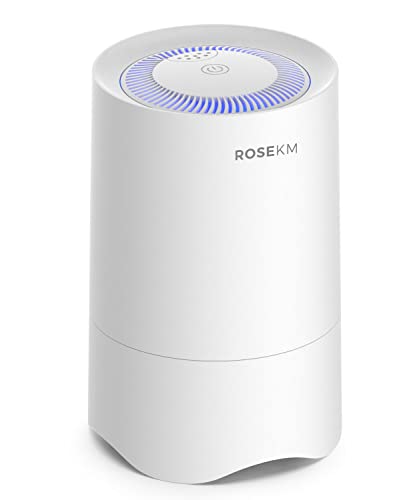
ROSEKM Small Air Purifier Desk 50 Sq Ft
ROSEKM’s title is the most desk-honest document in this set. It scopes the machine to a bedroom and desk, prints 50 square feet without inflation, names H13 HEPA filtration, and lists quiet operation, a night light, aromatherapy, one-touch control, low energy use, and a USB cable plus adapter in the box. Fifty square feet is roughly the air around a desk and chair, which is precisely the promise a personal purifier should make. The white finish and one-touch operation suit a work surface where fiddling with menus is unwelcome.
- Coverage printed: 50 Sq Ft
- Filter wording: H13 HEPA
- Power: USB Cable and Adapter Included
- Extras named: Night Light, Aromatherapy, One-Touch Control
- Energy note: Low Energy Use claimed
- Colour: White
Strengths
- Modest coverage claim matches the actual desk use case instead of overselling.
- Included adapter removes the hunt for a compatible USB power source.
- One-touch control keeps operation invisible during focused work.
Trade-offs
- Fifty square feet will not serve a whole bedroom by the listing’s own scoping.
- Quiet operation carries no decibel figure, so its loudness is unquantified.
- A night light on a desk unit may glow where a sleeper does not want it.
Desk placement rewards the ROSEKM’s restraint. It asks for a USB socket, a few inches of surface, and nothing else; the aromatherapy feature lets a user add scent at the desk, though colleagues in shared offices may vote against that experiment. The night light repositions the machine as a bedside hybrid, and in a dorm room that dual life is valuable — desk by day, nightstand by night, one purchase covering both posts. Energy use is claimed low without a wattage, so cost calculations stay approximate.
Filtration language is the headline: H13 HEPA is a specific grade designation, and the listing attaches it to a small white box for a single workstation. Whether that grade matters to a given reader depends on what they hope the machine will capture; the title frames the unit around bedroom and desk air generally rather than around any specific particle list. As a claim set, it is coherent: small area, named filter grade, simple control, travel-friendly power. Coherence is rarer in this category than it should be.
There is a psychological dividend to a machine scoped this precisely: expectations stay calibrated. Owners of room-scale purifiers often feel vaguely cheated when a large space still collects dust on shelves, because the brochure implied a transformation. A 50-square-foot promise invites a fairer test — is the air at my chair, where I sit for hours, being drawn through a named filter grade all day? Judged on that question, a small USB unit can satisfy completely while asking almost nothing in return: no floor space, no dedicated socket, no rearranging of furniture to honour its footprint.
Best for: a single desk or dorm workstation within the stated 50-square-foot scope. Not suited for: whole-room coverage duties beyond that printed 50-square-foot figure.
Inspect the ROSEKM desk purifier listing

Pure Enrichment PureZone Mini Starlight Blue
Pure Enrichment sells mobility. The PureZone Mini is cordless and portable, with a True HEPA filter, and the title aims it at cars, school, and office — the geography of a person whose desk changes daily. The listing claims the filter cleans air and eliminates 99.97 percent of dust, odors, and allergens close to the user; that percentage is the manufacturer’s claim, printed in its title, and the phrase close to you does important scoping work within it. Starlight Blue is the finish; the same model exists in other colours, but this listing is the blue one.
- Power style: Cordless, portable
- Filter wording: True HEPA Filter
- Claim as printed: eliminates 99.97% of Dust, Odors, and Allergens — a listing claim
- Settings named: Cars, School, and Office
- Scope phrase: Close to You
- Colour: Starlight Blue
Strengths
- Cordless design moves from car cupholder zone to classroom desk to office without a socket hunt.
- True HEPA wording is explicit, unlike several rivals here.
- Personal scope is honestly framed around the user’s immediate surroundings.
Trade-offs
- Battery runtime is absent from the title, leaving cordless endurance unquantified.
- No coverage area in square feet is printed, so room fit cannot be judged from the title.
- Speeds, timers, and noise figures go unmentioned in the listing title.
The mini format invites a particular routine: charge overnight, carry in a bag, set beside the laptop wherever the day lands. For a student rotating between library carrels or a consultant hot-desking across offices, that routine is the product. The car’s inclusion in the title is notable too — a cordless purifier can ride in a vehicle without draining attention on cables, though drivers should secure any loose object properly. Office use close to the user sidesteps the politics of shared air: nobody needs a facilities meeting to filter their own cubic metre.
Questions remain that the title cannot answer. How long a charge lasts, how loud the fan runs, and how large a filter sits inside are all decisive for satisfaction, and all require the full product page or manual. The 99.97 percent figure, as printed, describes the filter’s claimed performance against the named categories; it is not a measurement of any particular room. Shoppers comfortable verifying those gaps will find a distinctive tool; shoppers wanting everything specified upfront should look at the ROSEKM’s more complete title.
Hot-desking culture gives this model a second audience beyond students: the hybrid worker whose company assigns no fixed seat. Such a worker cannot install anything, cannot claim a socket permanently, and cannot leave equipment overnight in some buildings. A cordless personal unit that travels in the laptop bag is close to the only purifier format that fits that working pattern at all. The Starlight Blue finish even helps here, since a distinctive colour is harder to leave behind on a borrowed desk at the end of a long day than anonymous black plastic.
Best for: mobile users carrying one purifier between car, school, and office desks. Not suited for: fixed whole-room installation, given its cordless personal format and unprinted coverage area.
See the PureZone Mini in Starlight Blue

Homedics Personal Air Purifier USB
Homedics stacks settings the way airlines stack destinations: bedroom, home, office, car, travel, and dorm all appear in one title, attached to a USB rechargeable personal purifier in Sage Green. The filtration pairing is HEPA-Type filter plus activated carbon — two distinct elements, the carbon aimed at odours in the way carbon is generally used in such listings — and three fan speeds give the user a ladder between quiet and assertive. Personal is the operative word: this is a machine for one person’s immediate airspace, carried wherever that person settles.
- Filter pairing: HEPA-Type Filter and Activated Carbon
- Power: USB Rechargeable
- Fan speeds counted: 3 Fan Speeds
- Settings listed: Bedroom, Home, Office, Car, Travel and Dorm
- Coverage area: no square-foot figure in the title
- Colour: Sage Green
Strengths
- Rechargeable USB power suits travel and dorm life where sockets are contested.
- Three speeds let the user trade airflow against noise across a day.
- Activated carbon adds an odour-focused element the HEPA-only listings lack.
Trade-offs
- HEPA-Type is a looser phrase than True HEPA or H13 HEPA elsewhere in this guide.
- No coverage figure appears, so its effective territory must be inferred from the personal label.
- Runtime per charge is not printed in the title.
Desk reality for the Homedics is flexibility with homework attached. A student can run it in a dorm room, unplug it for a library session, and recharge from the same laptop ecosystem that powers everything else in the bag. The three speeds matter at a desk because meetings, calls, and deep focus each tolerate different fan volumes; the lowest speed during a video call and the highest during a lunch-hour room refresh is a plausible daily rhythm. Sage Green, a soft colour, sits calmer on a desk than glossy black tech usually does.
The filter wording deserves a shopper’s pause. HEPA-Type signals similarity rather than certification to the HEPA standard as other titles phrase it, and Homedics’ choice to print that phrase openly is at least transparent. Buyers for whom filter grade is the deciding factor should weigh the ROSEKM’s H13 wording or the PureZone’s True HEPA wording against this model’s convenience advantages. Convenience is not a consolation prize here — a purifier that travels gets used, and a used purifier filters more air than a superior one left at home.
Consider also the guest-room and hospital-visit scenarios that personal rechargeable devices quietly serve: a night in an unfamiliar room where the air smells of someone else’s cleaning products, or a long afternoon beside a relative’s bed. A small machine that runs from a USB battery pack asks nothing of the building and leaves with you. The three-speed ladder matters in those settings because unfamiliar rooms have unfamiliar acoustics; the user can feel for the highest speed the room’s silence tolerates rather than accepting a single fixed voice from the machine.
Best for: travellers, dorm residents, and car commuters wanting rechargeable personal filtration. Not suited for: a buyer requiring True HEPA or H13 wording, since this title specifies HEPA-Type.
Review the Homedics personal purifier

VOOPNU Air Purifiers Bedroom 1076 Ft
VOOPNU’s title reaches furthest. It claims a high efficiency filter, coverage of 1076 square feet, and targets pet hair odors, pollen, and smoke, with three speeds, a timer, an aroma feature, a 22dB quiet figure, and 360-degree intake in a compact black cleaner for home and dorm rooms. Two honest observations belong together: the coverage claim is bedroom-scale and beyond, while the body is described as compact — and the listing is title-silent about the word desk. Its presence in a desk guide rests on that compact footprint and dorm framing, and readers should hold both facts at once.
- Coverage claim printed: 1076 Ft²
- Filter wording: High Efficiency Filter
- Noise figure printed: 22dB Quiet — a listing claim
- Features named: 3 Speeds, Timer, Aroma, 360° Intake
- Desk mention in title: none — framed for bedroom and dorm room
- Colour: Black
Strengths
- A timer allows scheduled running that smaller rivals here do not offer in their titles.
- 360-degree intake frees placement from wall-facing orientation worries.
- The printed decibel figure gives noise shoppers a number to compare.
Trade-offs
- High Efficiency Filter is vaguer than the HEPA phrasings used by three rivals.
- Coverage of 1076 square feet from a compact body is a bold claim to verify on the product page.
- Nothing in the title scopes it to a desktop, so surface fit needs checking.
On a large desk or a dorm dresser, the VOOPNU behaves like a small room machine moonlighting at close range. The timer suits a student who wants the unit running through study hours and silent after lights-out without manual fiddling. Aroma functionality appears again here — a recurring theme in this category — letting the user scent the filtered air, a feature some desks welcome and open-plan offices should decline. The 360-degree intake means the machine can sit in a corner or against books without a favoured side.
Claim literacy matters most with this pick. A 22dB figure, as printed, presumably describes the quietest setting, as is customary; the title does not say which speed it belongs to. The 1076 figure presumably assumes particular air-change rates; the title does not state them. None of that makes the machine dishonest — it makes the title a summary, and summaries invite verification. Readers who verify and still like the package get the most feature-rich listing in this six.
Dormitory life specifically rewards the timer, because dorm schedules are chaotic and a machine that starts before its owner returns from lectures greets them with air that has been moving through a filter for an hour already. The compact body also respects the brutal geometry of dorm furniture, where every surface is contested by textbooks, kettles, and laundry. If the coverage claim proves optimistic on the product page, the machine still functions as an oversized desk unit; if it proves accurate, the owner has bought room capacity at a desk-unit footprint, which is why verification cuts both ways with this listing.
Best for: dorm and bedroom users wanting timer scheduling and all-around intake in a compact body. Not suited for: a small desk needing a verified desktop footprint, since the title frames it for bedroom use and prints no desk dimensions.
Look at the VOOPNU compact purifier

Levoit Core Mini-P Black Desktop
Levoit’s Core Mini-P wears its desk credentials in the title itself: Desktop appears as a named setting alongside home, bedroom, dorm room, and office. The listing says the machine filters smoke, allergies, pet dander, odor, and dust — reported here as the maker’s description of what the filter addresses — and adds a fragrance sponge, the feature that distinguishes this model in the line-up. The finish is black, the model is Core Mini-P, and notably the title names no filter grade, no coverage area, and no noise figure.
- Setting named explicitly: Desktop, plus Office and Dorm Room
- Distinctive extra: Fragrance Sponge
- Filter grade wording: no grade named in the title
- Coverage figure: absent from the listing title
- Noise figure: none printed in the title
- Model and colour: Core Mini-P, Black
Strengths
- Desktop is an explicit intended setting rather than an inference.
- The fragrance sponge lets scent be added or omitted at the user’s discretion.
- A small quiet positioning suits bedside desks in shared rooms.
Trade-offs
- Filter grade goes unnamed, so comparison against H13 or True HEPA rivals is impossible from the title.
- No coverage number is printed for sizing a room.
- Fragrance features can bother nearby colleagues or roommates if used thoughtlessly.
The Core Mini-P’s natural habitat is the hybrid desk-nightstand found in studio flats and dorms, where one surface does both jobs and a small black cylinder does not visually quarrel with either role. The fragrance sponge is genuinely optional in a way built-in aromatherapy sometimes is not: leave the sponge dry and the machine is simply a purifier; add fragrance when the room hosts guests. Small quiet positioning, as the title phrases it, fits that habitat, though quiet without a decibel figure remains a relative promise.
Shoppers who rank filter specification first will find this title frustrating, because Levoit has chosen to sell outcomes and settings instead of grades. That is a legitimate marketing choice and an incomplete shopping document at the same time. The remedy is the product page’s specification section, where filter composition is normally detailed. Until that check is done, the fair summary is: explicitly desktop-aimed, fragrance-capable, specification-light.
Black casings disappear against monitor arms and dark desk furniture, which is a real aesthetic argument in a studio where the workspace is also the living space and every object is on permanent display. The Core Mini-P’s restraint in its title — settings and outcomes rather than specifications — mirrors that design restraint. Some buyers will read the absence of a filter grade as a warning; others will read the explicit Desktop naming as the only claim they actually needed. Both readings are defensible, and the product page exists to settle which reader you are.
Best for: studio and dorm desk-nightstands wanting an explicitly desktop-aimed unit with optional fragrance. Not suited for: filter-grade comparison shopping, because the title names no grade to compare.
Check the Core Mini-P desktop listing

AROEVE MK01A Bedroom and Desk
AROEVE’s MK01A closes the set with the night shift in mind. The white unit pairs sleep mode with speed control, claims to filter smoke, pet dander, and dust, meets the Global Recycled Standard per its title, draws air through 360-degree inlets, prints a 22dB noise level, and includes an aromatherapy function. Bedroom and desk are both in its stated territory — the assignment framing for this guide describes it as a small desk and bedside class machine, and its title’s own scope supports that reading without promising a specific desktop footprint measurement.
- Modes named: Sleep Mode with Speed Control
- Noise figure printed: 22dB Noise Level — a listing claim
- Intake design: 360-Degree Air Inlets
- Standard mentioned: Meet Global Recycled Standard
- Extra named: Aromatherapy Function
- Model and colour: MK01A, White
Strengths
- Sleep mode plus a printed low noise figure suit nightstand placement.
- All-around inlets allow corner or shelf positioning without a favoured face.
- Speed control beyond the sleep setting gives daytime flexibility.
Trade-offs
- Filter grade is not named; the title lists what it filters rather than the filter standard.
- Coverage area in square feet is absent from the title.
- Aromatherapy may be unwanted in fragrance-free workplaces.
The MK01A’s day runs in two shifts. On a desk it can run a moderate speed through working hours, pulling air from every side regardless of how books and monitors crowd it. At night it drops to sleep mode on the nightstand, where the printed 22dB figure — the listing’s claim for its noise level — matters more than any filtration adjective. White casing suits bedroom furniture better than the black tech aesthetic of the VOOPNU and Levoit, a small point that decides real purchases in rooms where the machine is always visible.
The Global Recycled Standard mention is unusual in this category and worth noticing for shoppers who weigh materials alongside performance; the title asserts the machine meets it, and that assertion is reported here as printed. What the title withholds — filter grade and coverage — places the AROEVE beside the Levoit in the verify-on-the-page group. Its sleep credentials, though, are the most completely stated in the six: mode named, figure printed, inlets described.
Shared bedrooms add a negotiation dimension: one partner reads late, the other sleeps early, and a machine serving both must be quiet enough for the sleeper and present enough for the reader’s desk corner. Sleep mode with speed control is the only feature set in this six that directly addresses that negotiation, letting the household agree a nighttime setting rather than relitigating the fan nightly. The white casing helps the truce visually too, reading as bedroom furniture rather than office equipment when the lights are low and the room is trying to be a bedroom again.
Best for: bedside desks needing a stated sleep mode and a printed low noise figure. Not suited for: coverage-based sizing decisions, since the title prints no square-foot area.
Specifications in one view
| Model | Filter phrase used | Area or scope printed | Power or mobility |
|---|---|---|---|
| ROSEKM Small | H13 HEPA | 50 Sq Ft | USB cable and adapter included |
| PureZone Mini | True HEPA | Close to you; car, school, office | Cordless portable |
| Homedics Personal | HEPA-Type plus Activated Carbon | Personal; six settings named | USB rechargeable |
| VOOPNU | High Efficiency Filter | 1076 Ft² claim | Compact home and dorm unit |
| Levoit Core Mini-P | Grade unnamed | Desktop named; no area figure | Small desktop unit |
| AROEVE MK01A | Grade unnamed | Bedroom and desk; no area figure | Sleep-mode bedside unit |
The table exposes the category’s central shopping difficulty: no two brands report the same trio of facts. One prints area but not noise; another prints noise but not area; two print neither area nor filter grade. A shopper comparing across brands is therefore comparing documents as much as machines. The practical response is to decide which single fact matters most for your desk — a filter grade, a noise figure, a coverage scope, or cordless freedom — and let the listings that actually print that fact form your shortlist. Everything else is brochure weather.
Desk neighbours matter too. A purifier shares its surface with lamps, monitors, and paperwork, and its exhaust should not aim at your face or scatter documents. Readers furnishing the rest of a small workspace might also appreciate Best Blenders With Tampers if the desk in question is actually a studio kitchen counter pulling double duty, though blending and air filtering remain very different arts.
How do you match a purifier to one small desk?
Measure the territory honestly
Estimate the air you truly want the machine to work on. A personal bubble around one chair is a few dozen square feet of floor area; a whole bedroom is a different assignment. The ROSEKM’s printed 50 square feet matches the bubble; the VOOPNU’s claim addresses the room. Buying the bubble machine for the room disappoints, and buying the room claim for a tiny desk wastes surface. Pace out the room, do the multiplication, and write the number beside the listings before comparing anything else.
Choose your power arrangement
USB and rechargeable models plug into the ecosystem already on a desk — laptop ports, power banks, phone adapters — which suits renters and travellers. Cordless operation, the PureZone’s offer, removes even that tether for the length of a charge. Fixed compact units ask for a wall socket and repay with uninterrupted running. Count your free sockets and your tolerance for charging routines; the right answer is the one you will actually maintain in February, not the one that sounds elegant in the shop.
Decide what quiet must mean
Two listings print 22dB; treat that figure as the maker’s claim for a low setting and compare it against your environment — a silent bedroom at night reveals fan noise that a daytime office masks completely. Speed ladders help because they let the machine be assertive while you are out and gentle while you are present. If your desk hosts calls, prioritise the lowest setting’s behaviour over headline airflow, since a purifier switched off for every meeting filters nothing at all.
Check the footprint against your real desk
Titles in this set rarely print dimensions, which is a genuine gap for a product whose entire value depends on fitting a crowded surface. Before ordering, mark the machine’s likely spot with a sheet of paper cut to the size you can spare — beside the monitor, behind the laptop dock, on the return shelf — and live with that paper for a day. If the paper keeps getting buried under notebooks, the machine will too, and a smaller personal model will serve you better than a compact room unit. Depth matters as much as width: a cylinder needs less visual negotiation than a slab, and round footprints rotate into corners that rectangles cannot use.
Weigh fragrance with care
Four of these six titles offer aromatherapy or a fragrance sponge. At a home desk that can be a pleasure; in shared offices, classrooms, and clinics it can be an imposition, and some workplaces ban scent outright. Prefer designs where fragrance is optional and removable, and default to unscented running until you know your neighbours. The filter does its work either way. If scent is a genuine pleasure at your home desk, run it there and keep the office unit plain; the two-desk households discussed earlier can literally assign fragrance to the home machine and courtesy to the office one, which is the sort of small, deliberate split that keeps both environments pleasant.
Placement physics for small purifiers
Small machines obey the same airflow logic as large ones, compressed. Intake needs clearance: a unit shoved flush against a wall or a stack of files breathes its own exhaust and starves. The two 360-degree designs forgive placement sins more readily, since every side participates, but even they need a few inches of open air. Keep the outlet path unobstructed, avoid tucking the machine under a shelf lip that traps the rising filtered stream, and place it on the side of the desk where air naturally moves toward you rather than away — near a door’s draught line is usually wrong, beside the monitor usually right.
Height changes outcomes as well. Dust and hair settle downward; a purifier on the desk surface works the breathing zone, while the same machine on the floor works the ankle zone and the dust reservoir under the desk. For a desk brief, surface placement is the point of the product class. Just keep the machine out of the elbow arc and away from drinks, because a knocked-over cup is the most common cause of death for desk electronics of every kind. Readers thinking about airborne particles at whole-home scale, rather than desk scale, can continue with Best Air Purifiers For Vocs for that larger conversation.
Decide which desk the machine actually belongs to
Many readers now keep two workstations, one at home and one at an employer’s office, and the purifier decision splits accordingly. A fixed compact unit suits the home desk, where it can run all day and its filter calendar is yours to keep. The office desk argues for personal and portable: machines that need no permission, no facilities ticket, and no permanent socket. Some households solve the split with two different picks from this list — a scoped USB unit at home, a cordless carrier for the office — rather than forcing one model to live two lives. Others rotate a single rechargeable machine with their laptop. Either pattern beats buying a room machine for a desk problem at one site and nothing at all for the other.
Filter upkeep and the cost nobody prints
Every machine here depends on a filter that will load with captured material and need cleaning or replacement on the maker’s schedule. Titles rarely dwell on that schedule, yet it decides the second year of ownership more than any first-week impression. Before buying, find the replacement filter’s availability and the stated change interval for your chosen model; a purifier whose filter vanishes from sale becomes furniture. Pre-filters, where fitted, reward a monthly vacuum or rinse by extending the main filter’s working life.
Running costs stay modest for desk units — several titles claim low energy use — but the honest arithmetic includes filters, charging cables lost to travel, and the aromatherapy consumables if you adopt scent. None of these figures appears in the titles gathered here, which is precisely why this section exists: the purchase is the beginning of the expense, not its total. A machine you maintain beats a theoretically stronger machine you neglect, in air quality as in most domestic engineering. Maintenance also includes the humble exterior: dust the intake grille when you dust the desk, because a grille furred with lint is a pre-filter you never asked for, silently taxing airflow. Keep spare filters bought ahead when a model you own appears in a sale, since the week a filter expires is reliably the week it goes out of stock. And when a machine is eventually replaced, note what its filter looks like at the end — that grey record is the most honest report card the category ever issues, showing exactly what the device pulled out of the air you sit in, and it will teach you more about your own desk’s atmosphere than any advertisement in this guide.
Seasonal rhythms change what a desk purifier is asked to do. Spring and autumn load the air near open windows with pollen and leaf dust; winter seals the room and shifts the burden toward odours, cooking drift, and the stale accumulation of a closed space. A machine with a speed ladder and, where fitted, a carbon element adapts across those seasons better than a single-speed unit, because the user can respond to the season rather than the brochure. Filter changes timed to the start of the heavy season — fresh media entering the hardest months — extract more value from each filter than changes made by calendar habit alone.
There is also a etiquette of shared desks worth stating. In hot-desking offices, a personal purifier should leave with its owner, surfaces should be wiped as a courtesy, and fragrance should stay off entirely, since the next occupant never consented to your scent. In classrooms, teachers’ rules about desk objects outrank any product’s promise. None of this diminishes the category; it simply locates these machines where they belong, as personal tools with social edges, rather than as infrastructure. The listings that frame scope honestly — close to you, fifty square feet, personal — are quietly teaching that etiquette in their own wording.
Finally, manage expectations about dust on surfaces. A purifier filters air that passes through it; it does not reach out and lift settled dust from a bookshelf, and some particles will always land before they ever meet the intake. Desks under a purifier still need wiping, monitors still gather their grey film, and that is not evidence the machine failed. The realistic gain is in the moving air around your chair — the stream you breathe from — being drawn repeatedly through a filter while you work. Readers who accept that scope tend to keep their machines running for years; readers promised a dust-free room by implication tend to unplug theirs by March.
Cable management deserves a practical word for the USB-powered entries. A purifier tethered to a laptop port inherits the laptop’s movements; lift the computer and the purifier slides. A small powered hub or a phone adapter in a wall socket gives the machine an independent anchor and frees the port. Rechargeable models escape the tether but impose a rhythm: owners who charge during lunch keep their machines alive indefinitely, while owners who wait for the battery to die mid-afternoon tend to abandon the habit within a month. Build the charge into an existing routine — the kettle break, the commute, the overnight phone charge — and the machine stops being another device demanding to be remembered.
Second-hand and hand-me-down purifiers circulate widely in dorms and offices, and they deserve a sentence of caution. A gifted machine with an exhausted filter is a fan in a costume; price a fresh filter into any second-hand bargain and check that the model still has filters in production. The titles in this guide describe new listings, but the maintenance logic applies to any unit that lands on your desk by whatever route.
Common mistakes
Reading a percentage as a room promise. A filter claim such as 99.97 percent describes the filter medium’s claimed capture under the maker’s conditions, not the air of your particular office after an hour. Room results depend on airflow, runtime, and placement, none of which a single percentage captures.
Treating HEPA-Type as True HEPA. The words differ because the standards differ. Titles in this very guide use H13 HEPA, True HEPA, and HEPA-Type for three different machines; collapsing them into one idea erases information the makers themselves printed.
Buying coverage by the biggest number. The largest area claim in this set comes attached to a compact body and no desk mention. Area figures assume air-change rates that titles omit, so a modest, honestly scoped figure can describe a better desk fit than a heroic one.
Blocking the intake with desk clutter. A purifier wedged between files and wall is a fan recirculating its own output. Give every side the clearance the design expects, especially the all-around intake models whose selling point is exactly that breathing room.
Running fragrance in shared air without asking. Scent is the one purifier output your neighbours cannot ignore. In offices, classrooms, and dorms with shared air, unscented operation is the default courtesy, whatever the aromatherapy marketing suggests.
Forgetting the filter calendar. A loaded filter quietly throttles airflow until the machine is a ornament humming beside you. Mark replacement dates when the machine arrives, not when performance visibly fades.
Judging by the first hour. A purifier’s effect on a room’s air is cumulative and invisible; switching it off after one unimpressed hour tells you nothing except that marketing raised hopes no fan could meet. Give any model in this guide a fortnight of honest running at the desk before forming a verdict, and judge it on the air around your chair rather than on the whole building or on the silence of a showroom, where no machine ever has to compete with radiators, traffic, colleagues, kettles, printers, and the ordinary weather of a working day indoors.
Parking the machine behind the monitor. The dead zone behind a screen is where cables and dust gather, and a purifier exiled there filters the wall’s air, not yours. The breathing zone is in front of you; the machine belongs at the edge of that zone, visible enough that you remember to run it.
Final recommendation
Start with the ROSEKM if your brief is literally one desk: its scope is honest, its filter grade is named, and its power accessories are in the box. Take the PureZone Mini if your desk changes location daily and cordless carrying is the whole point. The Homedics suits travellers who value rechargeable flexibility and a carbon element over strict filter wording. Choose the VOOPNU when a dorm room, not a desktop, is the real assignment and a timer matters. The Levoit Core Mini-P fits desk-nightstand hybrids where optional fragrance appeals, and the AROEVE MK01A is the night-shift specialist with sleep mode and a printed low noise figure. Readers simplifying their mornings alongside their air might enjoy Best Simple Alarm Clocks as a companion read for the nightstand end of the desk.
Two of these machines will share many desks’ shortlists, so the tiebreakers deserve naming. Between the ROSEKM and the AROEVE — the two most desk-plausible titles — the decision is day versus night: the ROSEKM specifies its filter grade and its tiny territory, suiting a worker who wants defined filtration at a defined desk, while the AROEVE specifies its sleep behaviour and noise figure, suiting a reader whose desk becomes a nightstand at ten o’clock. Between the PureZone and the Homedics, the tiebreaker is filter wording versus carbon and speeds: the traveller who cares about the True HEPA phrase takes the first, the traveller who wants odour handling and a speed ladder takes the second. The VOOPNU and Levoit stand slightly apart, one a room-ambition outlier, the other a settings-led minimalist, and both reward a visit to their specification pages before money moves.
Frequently asked questions
How close should a desk purifier sit? Within arm’s reach of your chair is the design intent for personal models; their claims are scoped to the air close to the user, so a machine across the room is working outside its brief.
Do these machines replace a full-size room purifier? Only where a title claims room-scale coverage, and even then the claim deserves verification against the product page’s air-change assumptions. Most of this set is scoped to personal or small-space use.
What does a decibel figure in a title actually tell me? It tells you the maker’s claimed noise level, customarily at a low speed. It is comparable across listings that print it — two here print 22dB — but it is not a measurement of the unit on your desk at full speed.
Is aromatherapy part of purification? No. Aroma features scent the air the machine moves; filtration is the filter’s separate job. Titles list them as distinct features, and this guide treats them that way.
Which filter phrase is strongest in this set? H13 HEPA and True HEPA are specific standard-based phrases; HEPA-Type is a looser similarity claim; High Efficiency is vaguer still; and two titles name no grade at all. All are reported as the makers printed them.
Can a desk purifier run all day? The USB and low-energy designs here are plainly built for long daily running, and the timer-equipped VOOPNU can be scheduled either way. Long running is the normal use pattern for the class; the filter calendar, not the motor, is what needs watching.
What if my desk is in a large open-plan office? Then a personal model is the only realistic option, since the room’s air belongs to everyone’s systems and no desktop unit will govern it. Scope your expectations to your own seating area, exactly as the close-to-you listings frame it.
A closing thought on evidence: this category generates strong feelings and weak measurements in equal measure, because the thing being sold is invisible. The listings gathered here make their claims in writing, and writing can be checked — against the product page, against the manual, against the filter you eventually hold in your hand. Do that checking, keep the machine maintained and sensibly placed, and a desk purifier becomes what it should be: a small, honest appliance doing a defined job in a defined space, neither miracle nor ornament. It will not announce itself with drama; the best evidence of its work is mundane — a filter that darkens on schedule, a desk routine that includes switching it on without thinking, and air at your chair that has been quietly passing through media all day while you got on with the work the desk actually exists for.
Pick the machine whose printed claims match the size of your actual desk life, set it where it can breathe, keep its filter honest, and let the rest of the brochure go.


