What's inside
- Where to buy these dual boiler espresso machines
- Quick picks
- How these picks were chosen
- Each machine under the counter light
- Specification ledger: what each title actually publishes
- How to choose a dual boiler machine for a new operation?
- Grind settings, honestly counted
- What these titles cannot tell you, and where to verify it
- Why two boilers change a start up’s economics
- Setting up the counter: workflow before furniture
- Milk work: where the second boiler earns its money
- Common mistakes when equipping a first espresso counter
- Final recommendation
- Frequently asked questions
As an Amazon Associate I earn from qualifying purchases. This post may contain affiliate links at no extra cost to you.
As an Amazon Associate, cottageverdict.com earns from qualifying purchases.
Anyone pricing the best dual boiler espresso machines for a start up quickly discovers the gap this category fills. A single-boiler machine makes a young café or a serious home coffee bar wait: pull the shot, then wait for the boiler to climb to steam temperature, then purge and wait again before the next shot. A dual boiler design ends that queue by giving brewing and steaming separate boilers that hold their own temperatures at the same time, so milk can be textured while espresso extracts. For a start up — a fledgling café counter, a market stall, an office coffee corner, or a home barista business taking first orders — that simultaneity is the difference between a line that moves and a line that dissolves.
The six machines below all state dual boiler or double boiler in their listing titles; that phrase was the entry ticket, not a hope. Beyond it, they diverge sharply. Three carry built-in grinders with around thirty grind settings, one bundles a separate smart grinder, and two are grinder-free machines aimed at owners who already own a capable grinder. Portafilter size is stated as 58mm on two picks. PID temperature control appears on three titles. One lists a 2.8L water tank and a hot water outlet; another names a rotary pump and detachable PID. Read for the workflow you actually run: drinks per hour, milk ratio, counter depth, and whether grinding happens inside the machine or beside it.
Where to buy these dual boiler espresso machines
Each machine is sold through Amazon, with its own purchase link inside its review below.
- Gevi’s sterling silver machine opens the list because it pairs the dual boiler layout with a built-in burr grinder and a 58mm commercial portafilter.
- The Xutumm follows for counters wanting numbers: 20 bar on the title, PID control, a stated 2.8L tank, and a hot water outlet.
- Chefman’s Crema Deluxe states the dual boiler benefit in plain words — frothing milk and brewing espresso at the same time.
- Breville’s Dynamic Duo bundles its dual boiler machine with the Smart Grinder Pro as a separate unit.
- Diletta’s Alto in black is the compact statement of the group: PID, a shot timer, and adjustable OPV without a grinder attached.
- Rocket’s R58 Tune closes the list with a rotary pump and detachable PID for the most committed start-up counter.
Quick picks
| Pick | Best for | Headline from the title |
|---|---|---|
| Gevi Dual Boiler with Burr Grinder Sterling Silver | An all-in-one counter where a separate grinder has no home | Built-in burr grinder, 31 grind levels, 58mm commercial portafilter |
| Xutumm Dual Boiler 20 Bar PID 58mm | High milk-drink volume with a big tank | 20 bar, PID temperature control, 2.8L tank, hot water outlet |
| Chefman Crema Deluxe Double Boiler | Learning simultaneous brew-and-steam workflow | Double boiler wording, grinder included, 30 grind settings |
| Breville Dynamic Duo BEP920 Dual Boiler Bundle | A two-piece bench with a dedicated smart grinder | Dual boiler machine plus Smart Grinder Pro, stainless steel |
| Diletta Alto Dual Boiler Black | Shot discipline in a grinder-free setup | PID, shot timer, adjustable OPV, black finish |
| Rocket Espresso R58 Tune Dual Boiler | A flagship counter piece for a growing drinks list | Tune programming, detachable PID, rotary pump, stainless steel |
How these picks were chosen
The filter was literal: the listing title had to say dual boiler or double boiler. That rule excluded respected machines whose titles stay silent on boiler count, because a start up buying on a premise deserves the premise in writing. Within the six that qualified, the spread was organised around three questions a new operation must answer. Does grinding live inside the machine, beside it, or nowhere in the purchase? Does the title promise temperature control, through PID or programming? And does the machine expose the working details a small business leans on — tank size, portafilter diameter, a hot water outlet for americanos and tea, a shot timer for consistency across staff?
One naming trap needs flagging for searchers arriving from the library keyword: the word in this article’s title is a legacy catalogue label, while the technology under discussion is the dual boiler — two boilers, one for brewing and one for steam. Nothing in these six listings describes a broiling function, and no pick should be bought expecting one; the espresso meaning is the only meaning the products themselves support.
Claims were kept in their lane throughout. A title stating 20 bar describes the pump’s stated rating, not a promise about extraction quality, and grind settings counts describe adjustment range rather than grind quality. Where titles omit basics — tank size on most picks, dimensions on all six — the reviews flag the omission instead of filling it from general knowledge about the brand. A start up should budget from verified figures, and the discipline of saying “not stated” in a spec box is the same discipline that keeps a drinks menu honest. Founders still comparing gentler brewing methods for a slow bar can read Best Stainless Steel Elec Perc Coffee Makers afterwards, since that guide covers electric percolators, the low-pressure opposite of everything on this page.
Each machine under the counter light
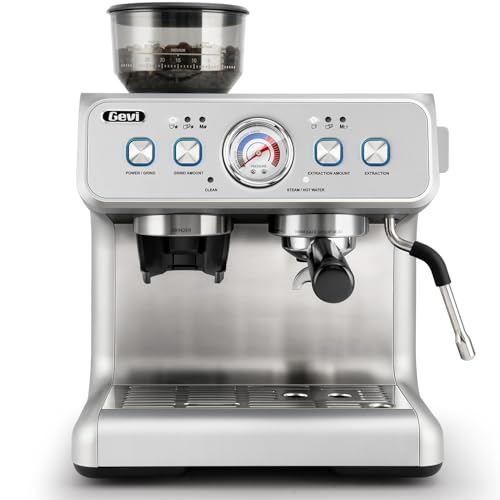
Gevi Dual Boiler with Burr Grinder Sterling Silver
Gevi’s proposition is consolidation. One sterling silver chassis holds the dual boilers, a built-in burr grinder with 31 grind levels, a stainless steel steam wand, and a 58mm commercial portafilter — the basket diameter that cafés standardise on, which matters to a start up because tampers, baskets, and distribution tools in 58mm are everywhere. For a first counter with limited width, folding the grinder into the machine removes a whole appliance, a whole power socket, and a whole cleaning station. The title aims the machine at home barista brewing, so a commercial café should calibrate expectations: this is prosumer equipment with commercial touches, positioned for a home barista or a very small operation rather than a high-street rush.
Spec mini box — Boilers: dual boiler, stated. Grinder: built-in burr grinder, 31 grind levels. Portafilter: 58mm, described as commercial. Steam wand material: stainless steel. Tank capacity: the title withholds it. Pump rating: no figure printed.
Strengths
- The 58mm portafilter aligns the machine with the café-standard accessory ecosystem from day one.
- Thirty-one grind levels give a new operator room to dial in beans of very different roasts.
- One chassis simplifies a start-up counter: fewer cables, fewer surfaces, one cleaning routine.
Trade-offs
- A built-in grinder is a single point of failure; if it falters, the whole station is compromised.
- The title omits tank capacity, so refill frequency during a busy morning stays unknown until checked.
- Home barista positioning in the title suggests modest duty cycles rather than all-day café service.
Think about dialling in on a machine like this. A start up typically opens with one house bean and one decaf, and 31 grind levels let the operator chase the extraction as beans age across the week — a notch finer on day five, back again with a fresh bag. The integrated grinder keeps that adjustment within arm’s reach of the portafilter, shortening the loop between tasting a sour shot and correcting it. The dual boiler layout then protects the correction work: steam demand from a run of lattes does not drag brew temperature around, so the shot you dialled at 8 a.m. behaves the same at 11. What the listing cannot tell you is shot-to-shot thermal data or grinder retention figures, and a careful buyer reads the full listing and manual for those before committing a menu to it. As a first serious station for a home-based coffee business or a tiny retail counter, though, the Gevi’s completeness is its argument: everything a beginner needs to practise the simultaneous brew-and-steam craft sits in one footprint.
Sterling silver as a finish choice is worth a sentence. It photographs brightly for a business building its social feed, and it shows coffee splashes honestly, which encourages the wipe-down habit that keeps a young counter looking professional. The stainless steel steam wand named in the title matters for the same hygiene reason: milk residue bakes onto wands within minutes, and a metal wand tolerates the firm wiping and purging routine that café work demands. New operators should build the purge-wipe-purge reflex from the very first drink, because the dual boiler’s gift of constant steam readiness also means constant temptation to skip the wipe. Gevi’s home barista framing also hints at warm-up expectations: prosumer machines typically ask for a patient heat-up while boilers and group stabilise, and a start up should schedule that warm-up into its opening routine rather than pulling sacrificial shots for the first customers of the day.
Best for: a first start-up counter or home barista business needing grinder, boilers, and wand in one sterling silver unit. Not suited for: a high-volume café floor, since the title positions it for home barista brewing. Check price on Amazon — grinder aboard, in sterling silver.
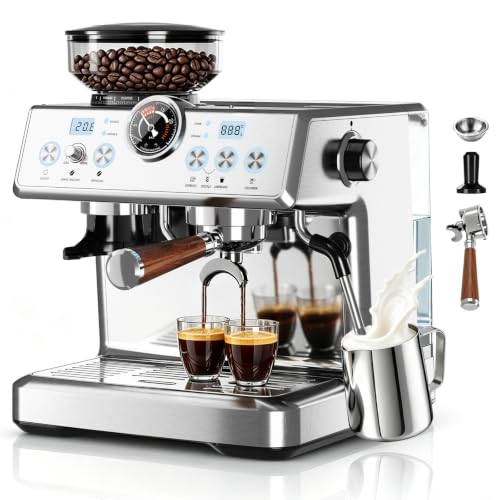
Xutumm Dual Boiler 20 Bar PID 58mm
The Xutumm listing is the most numerically forthcoming of the six. It states 20 bar, 31 grind settings, PID temperature control across dual boilers, a 58mm portafilter, a 2.8L tank, and a hot water outlet — a spec sheet that reads like it was written for a buyer comparing machines in a spreadsheet. The 2.8L tank is the operational headline for a start up: fewer mid-service refills, and a hot water outlet that turns the machine into the counter’s source for americanos, long blacks, and tea water without a separate kettle. PID control, meanwhile, is the consistency tool — the listing claims temperature control by name, which is what lets different staff members produce the same shot on different days.
Spec mini box — Boilers: dual boilers, stated. Pump rating: 20 bar, stated. Grinder: included, 31 grind settings. Temperature control: PID, stated. Portafilter: 58mm. Tank: 2.8L, with hot water outlet.
Strengths
- The stated 2.8L tank is the largest figure published among these six titles.
- A hot water outlet widens the menu beyond espresso-based drinks at no extra appliance cost.
- PID plus 58mm portafilter matches the consistency toolkit a small team needs.
Trade-offs
- The brand carries less long-term service recognition than the established names lower in this list.
- Twenty bar is a pump rating on paper; it says nothing by itself about extraction finesse.
- Steam wand details are absent from the title, leaving milk-work specifics to the full listing.
Consider the morning this machine is built for. A small bakery counter opens, the first orders are a latte, an americano, and a flat white in quick succession, and the workflow divides cleanly: shots pull on the brew boiler, the wand textures milk on the steam boiler, and the americano’s water comes from the outlet rather than a kettle run. The tank size stretches the interval before someone must stop and refill, which during a rush is worth more than exotic features. PID temperature control underwrites repeatability — the unglamorous quality that turns first-time customers into regulars, because Tuesday’s cappuccino matches Monday’s. A buyer should still interrogate the full listing for warranty terms and parts availability, since a start up cannot park its only machine for a month awaiting an obscure component. On stated specifications alone, however, this is the most completely documented workhorse in the six, and documentation is a form of respect for a business buyer.
The fresh grinding phrase in the title deserves unpacking. Grinding per drink, rather than pre-grinding a hopper’s worth into a doser, protects aroma in a way customers can genuinely taste in the first week of trading, when word of mouth forms. Combined with PID holding the brew boiler steady, the Xutumm’s story is freshness plus repeatability — the two qualities a new café can least afford to fake. The 58mm portafilter completes the triangle by letting the business buy the same baskets and tampers as the café across town, easing emergency borrowing and staff familiarity if a hire arrives from another shop. None of these virtues requires exotic skill to unlock; they compound quietly, drink after drink, which is exactly how a start up survives its first season: not with one spectacular cappuccino, but with five hundred identical good ones.
Best for: a small café or bakery counter running milk drinks and americanos from one station with a big tank. Not suited for: an operation depending on an established local service network named in the listing, which this title does not provide. Check price on Amazon and review the 2.8L tank layout.
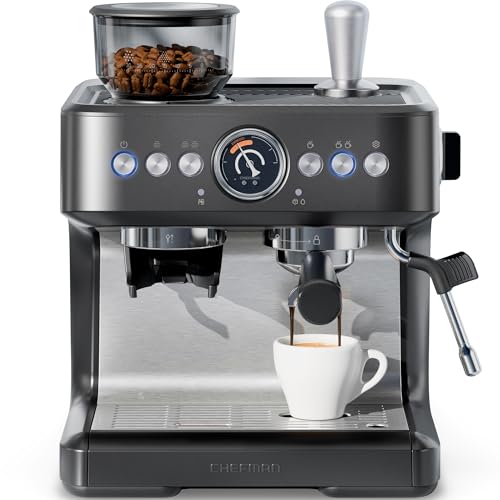
Chefman Crema Deluxe Double Boiler
Chefman’s title does something the others do not: it explains the benefit in the same breath as the feature. Double boiler, it says, means you can use the milk frother and brew espresso simultaneously — the entire dual boiler argument compressed into one clause. For a start up founder who is training a first employee, or a home barista graduating from a single-boiler machine, that plain-language framing signals a machine pitched at accessibility. The rest of the title supports the pitch: a coffee grinder is included, the steam wand is present, and 30 grind settings sit one notch below the Gevi and Xutumm counts. Professional coffee maker is the listing’s own positioning phrase, and like all such phrases it should be read as aspiration rather than certification.
Spec mini box — Boilers: double boiler, stated. Grinder: included, 30 grind settings. Steam: steam wand and milk frother both named. Portafilter size: left open by the title. Tank capacity: no figure offered. PID: unmentioned.
Strengths
- Simultaneous frothing and brewing is stated outright, so the core workflow promise is unambiguous.
- An included grinder keeps the purchase to a single box for a lean start-up budget.
- Thirty grind settings still span the practical range a new menu requires.
Trade-offs
- No portafilter diameter in the title means accessory compatibility needs confirming before ordering spares.
- Temperature control technology goes unnamed, so consistency tooling is unclear from the title alone.
- Chefman’s wider range is home-focused, which a commercial buyer should weigh for duty expectations.
The training angle deserves expansion, because start ups rarely fail on equipment and often wobble on consistency between people. A machine that states its simultaneous workflow plainly tends to come with controls arranged for legibility, and a new hire can be taught a simple loop: grind, tamp, lock, extract, texture during extraction, pour, wipe the wand, repeat. Thirty grind settings are entirely adequate for that loop; the difference between 30 and 31 settings is marketing arithmetic, not a drinks-quality boundary. The genuine unknowns sit elsewhere — portafilter size governs which spare baskets and tampers to stock, and the absence of named temperature control means the buyer should read the full listing to learn how the boilers are managed. Treat this pick as the approachable tutor of the six: it teaches the dual boiler rhythm with the fewest conceptual barriers, and a founder who masters workflow here can specify a future upgrade with precision.
There is a confidence dimension to the Crema Deluxe that spec tables miss. Many first-time founders have been intimidated out of the dual boiler category by machines whose panels read like aircraft cockpits, and they retreat to pod systems that cap their menu’s quality and margins. A machine that announces its core trick in plain language — froth and brew at once — lowers that psychological barrier, and the included grinder removes the second scariest purchase from the same week. The sensible way to use this pick is as a training platform with real commercial manners: learn service rhythm, learn milk texture, learn how regulars order, and let the machine’s limits, discovered through use, write the specification for whatever replaces it in year two. Equipment bought to teach is rarely wasted money in a business whose real asset is the founder’s palate and routine.
Best for: a founder training first staff, or a home barista stepping up to simultaneous steaming, on one included-grinder machine. Not suited for: a menu built around 58mm accessories, since this title leaves portafilter size unstated. Check price on Amazon and walk through the Crema Deluxe.

Breville Dynamic Duo BEP920 Dual Boiler Bundle
Breville’s Dynamic Duo takes the opposite architectural path from the all-in-one picks: the bundle pairs a dual boiler espresso machine with the Smart Grinder Pro as a separate appliance, both in stainless steel, under the model code BEP920BSS. Separation has real consequences for a start up. A standalone grinder can be upgraded, serviced, or replaced without touching the espresso machine; it can also serve a second station or a filter bar during a rush. The counter pays for that flexibility in width and in a second power lead. Breville’s name carries the longest track record in this list for prosumer espresso, and the bundle format acknowledges that serious beginners often prefer best-of-both over built-in convenience.
Spec mini box — Boilers: dual boiler, stated. Grinder: Smart Grinder Pro, separate unit in bundle. Model code: BEP920BSS. Finish: stainless steel. Portafilter size: missing from the title. Tank capacity: likewise unpublished there.
Strengths
- A separate grinder can evolve independently as the menu’s ambitions grow.
- Two dedicated appliances divide heat, vibration, and wear between two chassis.
- The bundle removes guesswork about grinder-machine pairing for a first purchase.
Trade-offs
- Two footprints demand the widest counter run of any pick here.
- Key figures — portafilter size, tank — are absent from the title and need the full listing.
- A bundle price structure means replacing either half later starts from separate-appliance money.
Workflow on a two-piece bench feels different in the hands. The grinder lives to the left, dosed and adjusted without leaning over a hot group head; the machine devotes its whole top surface to cup warming and its whole front to the shot. During a two-person service, one operator can grind and tamp while the other manages extraction and milk, a division of labour impossible on a single chassis. That is the start-up scenario this bundle quietly targets: not the solo home barista, but the small team. The stainless steel finish across both units keeps the bench looking unified in front of customers, which matters when the counter is the shop’s stage. Buyers should confirm the portafilter diameter and tank size in the full listing before ordering accessories, since the title spends its words on the bundle concept rather than dimensions. As a foundation purchase for a business expecting to grow staff before it grows premises, the Dynamic Duo’s separateness is a strategy, not a compromise.
Resale and redeployment thinking also favours the bundle. If the business outgrows the machine, a standalone Smart Grinder Pro can migrate to a filter station, a decaf role, or a second location, while an integrated grinder retires with its host. Start ups that treat equipment as a fleet rather than a single purchase tend to survive their growth spurts more cheaply. Breville’s broader ecosystem plays into this as well: accessories, spare parts, and community knowledge for a high-selling bundle are easier to source in most cities than for a low-volume import, and downtime is the expense a young café can least absorb. The title’s silence on tank and portafilter figures remains the homework item — a five-minute read of the full listing resolves both — but the architectural bet the bundle makes, separation over consolidation, is the most future-proof idea in this entire list.
Best for: a two-person start-up bench where grinding and extraction happen in parallel by different hands. Not suited for: a narrow galley counter, where two separate appliances will not fit side by side. Check price on Amazon to see both bundle pieces.

Diletta Alto Dual Boiler Black
Diletta’s Alto is the purist’s entry: a dual boiler machine in black whose title lists PID, a shot timer, and adjustable OPV, and pointedly includes no grinder. Those three control features form a coherent philosophy. PID manages brew temperature, the shot timer disciplines extraction time, and adjustable OPV — the over-pressure valve — lets an experienced operator set the maximum pressure the pump can apply to the puck. Together they describe a machine for someone who already owns a serious grinder and wants the espresso side to expose its variables rather than automate them away. For a quality-led start up, perhaps a roastery corner or a specialist bar inside another business, that exposure is the point: every drink can be tuned, logged, and repeated.
Spec mini box — Boilers: dual boiler, stated. Temperature control: PID, stated. Timing: shot timer, stated. Pressure adjustment: adjustable OPV, stated. Grinder: none included. Finish: black. Tank capacity: a figure for the full listing.
Strengths
- Adjustable OPV is a tuner’s feature rarely headlined at this level, enabling pressure experiments.
- A shot timer builds extraction discipline into every drink without a separate scale timer.
- Grinder-free pricing lets the budget flow to a grinder chosen independently.
Trade-offs
- A start up without a grinder must fund one separately before the first drink can be made.
- The title states no tank size or portafilter diameter, leaving basics to verify elsewhere.
- Manual variables reward skill and punish inconsistency in untrained hands.
Picture the Alto on a roastery counter where the beans change weekly. Each new roast arrives with unknown solubility, and the operator’s morning ritual — adjust OPV for a gentler ramp on a delicate light roast, watch the shot timer split the difference between blonding and bitterness, nudge PID a degree for a denser bean — is exactly the craft this feature set supports. The black finish keeps the machine visually quiet against bags of coffee and brewing gear, a backdrop rather than a billboard. The risk profile is equally clear: a start up hiring casual weekend staff may find exposed variables becoming exposed inconsistencies, where one operator’s tuned recipe is another’s mystery. The Alto therefore suits founder-operated counters, where the person who dialled the machine is the person pulling the shots. In those hands it offers the deepest control per feature listed anywhere in this six.
Logging is the Alto’s invisible accessory. A shot timer invites a notebook habit — dose, yield, seconds, taste — and a founder who logs for the first ninety days builds a recipe library that survives staff changes and bean changes alike. Adjustable OPV then becomes a documented variable rather than a fiddled knob: change it, log it, taste the difference across a week, keep or revert. This is laboratory method applied to a drinks menu, and it suits the kind of start up whose marketing story is precision itself, the bar that can tell a customer exactly why today’s Ethiopian tastes of apricot. The black finish supports that story visually, receding behind the coffee bags and the drinks, letting colour live in the cup rather than on the equipment.
Best for: a founder-operated specialty counter with its own grinder, chasing repeatable, tunable extractions. Not suited for: a first purchase with no grinder in the building, since none is included. Check price on Amazon to inspect the black Alto’s controls.

Rocket Espresso R58 Tune Dual Boiler
Rocket Espresso builds machines that look like they belong in Milanese cafés, and the R58 Tune’s title reads accordingly: dual boiler, Tune programming, a detachable PID, and a rotary pump, wrapped in stainless steel. Each element speaks to a start up intending to be taken seriously. A rotary pump runs quieter and is the pump style associated with plumbed, commercial-style installations; Tune programming suggests stored settings rather than one fixed behaviour; a detachable PID controller keeps the machine’s face clean while retaining temperature oversight. No grinder is included or mentioned, placing the R58 in the same bring-your-own-grinder camp as the Diletta, but with a more ceremonial presence — this is the machine customers photograph.
Spec mini box — Boilers: dual boiler, stated. Pump: rotary pump, stated. Control: Tune programming with detachable PID, stated. Finish: stainless steel. Grinder: none included. Tank and plumbing figures: the title is silent on both.
Strengths
- A rotary pump brings quieter operation suited to intimate café spaces where noise carries.
- Detachable PID keeps temperature control available without cluttering the machine’s classic face.
- Stainless steel construction presents a flagship image for a brand-conscious opening.
Trade-offs
- The title confirms no tank or plumbing specification, so installation planning needs the full listing.
- Programming depth adds a learning curve before the machine earns its keep in service.
- Flagship positioning implies flagship upkeep expectations in descaling and care.
Consider the acoustic reality of a small café. A vibration pump’s buzz cuts through conversation each time a shot pulls; a rotary pump’s lower hum lets a ten-seat room keep its murmur. For a start up whose concept is calm — a bookshop café, a gallery corner, a boutique hotel breakfast bar — that difference is atmospheric, not trivial. The detachable PID extends the same philosophy: control exists, but it steps aside visually when the shot is running, leaving polished steel to face the customer. Tune programming then serves the menu behind the scenes, letting the operator store behaviours for different drinks rather than re-deriving them per order. None of this makes drinks by itself, and the buyer must still verify water supply arrangements in the full listing, since rotary pump machines often assume installation options the title does not describe. As the aspirational anchor of this list, the R58 is the machine a start up grows into publicly: it signals permanence to landlords, lenders, and first-time customers alike.
Maintenance temperament completes the R58 picture. Machines built to this pattern reward owners who descale on schedule, backflush as routine, and treat gaskets as consumables rather than surprises. A start up adopting the Rocket should adopt its calendar too, pinning service tasks to the same weekly rhythm as bean orders and milk deliveries. In return, the machine offers the longest plausible service life of the six and a counter presence that ages gracefully — stainless steel develops a working patina rather than the tired look painted finishes acquire. For founders signing a multi-year lease, that durability narrative aligns the equipment’s lifespan with the business plan’s horizon, which is precisely the alignment lenders and landlords look for when a young café asks to be taken seriously.
Best for: an image-led café opening where quiet rotary-pump service and stainless presence justify a flagship. Not suited for: a pop-up stall needing stated tank figures and grab-and-go simplicity from the title alone. Check price on Amazon and study the R58’s profile.
Specification ledger: what each title actually publishes
| Machine | Grinder arrangement | Temperature control named | Figures published in title |
|---|---|---|---|
| Gevi Dual Boiler with Burr Grinder Sterling Silver | Built-in burr grinder | None named | 31 grind levels, 58mm portafilter |
| Xutumm Dual Boiler 20 Bar PID 58mm | Built-in grinder | PID | 20 bar, 31 settings, 58mm, 2.8L tank |
| Chefman Crema Deluxe Double Boiler | Built-in grinder | None named | 30 grind settings |
| Breville Dynamic Duo BEP920 Dual Boiler Bundle | Separate Smart Grinder Pro | None named | Model code BEP920BSS |
| Diletta Alto Dual Boiler Black | None | PID | Shot timer, adjustable OPV |
| Rocket Espresso R58 Tune Dual Boiler | None | Detachable PID, Tune programming | Rotary pump |
How to choose a dual boiler machine for a new operation?
Grinder inside, beside, or already owned?
Answer this first because it halves the list. Built-in grinders (Gevi, Xutumm, Chefman) minimise footprint and purchase complexity, ideal for solo counters and home-based businesses. A bundled separate grinder (Breville) buys upgrade freedom at the cost of bench width. No grinder (Diletta, Rocket) presumes you already own one worth pairing — or that your budget deliberately reserves serious money for grinding, which veterans consider the wiser spend anyway. A start up that cannot yet judge grinder quality should lean toward the bundled options, where the pairing decision has been made by the manufacturer.
What does the menu’s second page require?
Founders plan for espresso drinks and forget the second page: teas, americanos, hot chocolates, and the occasional request for plain hot water. The Xutumm’s stated hot water outlet serves that page directly. On machines without a stated outlet, the full listing decides whether hot water comes from the steam boiler through a dedicated tap or must be improvised — an operational detail that shapes how a small team handles non-coffee orders during a rush. A start up expecting significant tea trade should rank this detail higher than an extra grind setting.
How many milk drinks per hour must the workflow sustain?
Dual boilers remove the temperature seesaw, but workflow still bottlenecks at the human: one operator can only texture so much milk. Estimate your peak honestly — a school-run café and an office-block kiosk live in different worlds. Tank size becomes decisive at volume, which is why the Xutumm’s stated 2.8L matters; machines with unstated tanks need that figure hunted down before a high-volume commitment. While planning the wider premises, note that ventilation questions for roasting corners are covered by Best Window Fans Casement Windows, which examines window fans for tricky window types.
How much counter theatre does your concept need?
Some start ups sell speed; others sell ceremony. A commuter kiosk wants the fastest loop and the least visual fuss, favouring the complete stations. A slow bar inside a bookshop or roastery sells the sight of craft, and there the Rocket’s polished steel or the Diletta’s black minimalism become part of the product, justifying their grinder-free complexity. Decide which theatre you are staging before choosing the machine, because retrofitting atmosphere is harder than retrofitting a grinder. The machine will appear in every customer photograph of your counter whether you plan for that or not.
Which control features will your team actually use?
PID control earns its place when recipes must repeat across days and staff. A shot timer disciplines beginners beautifully. Adjustable OPV and programming reward a founder who tastes and logs every change. Buy the control set matching your team’s real habits, not the longest feature list: unused adjustability is just more settings to drift unnoticed. If the honest answer is “we are learning,” the Chefman’s plainly stated simultaneous workflow or the Gevi’s complete station will teach faster than a tuner’s machine.
Grind settings, honestly counted
Three titles in this list advertise grind ranges of 30 or 31 settings, and the numbers invite a misunderstanding worth clearing up. A grind setting is a position on an adjustment mechanism, not a unit of quality; what matters is whether the steps between positions are fine enough to move an extraction by a few seconds at a time, and whether the grinder holds its setting under daily use. Thirty-one fine steps outperform sixty coarse ones. Since no title here publishes step size or burr dimensions, the counts should be read as evidence of adjustability rather than a league table — the Gevi and Xutumm at 31 and the Chefman at 30 are, for menu purposes, equivalently equipped. The separate Smart Grinder Pro in Breville’s bundle and the absent grinders of the Diletta and Rocket underline the same lesson from opposite ends: grinding is half the craft of espresso, and any start up that treats it as an accessory will taste the error in every cup. Budget, bench space, and cleaning time for grinding deserve the same respect as the boilers that headline this category.
What these titles cannot tell you, and where to verify it
Honest shopping in this category means accepting that a listing title is an advertisement’s headline, not a datasheet. None of the six titles publishes machine dimensions, yet counter depth decides whether a start up can use the machine at all — measure your bench, then confirm the footprint in the full listing. Warm-up time, boiler capacities in litres for the brew and steam sides separately, and warranty length are likewise absent across the board. Those figures exist in manuals and full listings, and a business buyer should collect them into a single comparison note before ordering, especially where two finalists seem tied on headline features. The Xutumm shows how much a title can carry when a brand chooses: pump rating, grind settings, portafilter size, tank, and an outlet, all verifiable in one line. The Breville and Rocket titles, by contrast, sell architecture and experience, leaving arithmetic to the reader. Neither approach is dishonest, but they demand different amounts of homework, and the homework is not optional when the machine must earn money from its first weekend.
Service ecosystems form the other invisible specification. A start up in a major city can usually find a technician who knows Breville or Rocket equipment; a newer brand may mean shipping the machine or waiting on mailed parts. That reality does not disqualify the Gevi, Xutumm, or Chefman — their completeness per purchase is real — but it belongs in the decision alongside features, weighted by how catastrophic a two-week outage would be for your particular opening. A home-based business with a loyal pre-order list can absorb a pause; a leased kiosk paying daily rent cannot. Buy the machine whose failure you can survive, not merely the one whose success you can imagine.
Why two boilers change a start up’s economics
Energy behaviour is a quieter line in the same ledger. Two boilers held at temperature all day consume more standby power than one, and a start up should expect that cost as the price of readiness. Machines with programming, like the Rocket’s Tune system, may offer scheduling or eco behaviours, but the titles do not promise specifics, so treat any energy plan as a manual-reading exercise after purchase. The practical countermeasure is procedural: switch on for service windows, switch off overnight, and let warm-up time become part of the opening checklist alongside grinding fresh and purging the wand.
The arithmetic is about minutes. On a single-boiler machine, every milk drink carries hidden waiting: the boiler climbs from brew temperature to steam temperature, the operator purges, steams, then the system must cool back before the next clean extraction. Multiply that pause by a modest morning rush and the queue stretches by enough to cost repeat customers. Two boilers delete the pause entirely, because each holds its station temperature continuously. The second economic effect is quality stability: brew water no longer swings with steam demand, so the espresso base of a latte tastes like the espresso you dialled in, not like a compromise reached mid-rush. For a business whose reputation compounds drink by drink, that stability is revenue protection disguised as engineering. The trade is purchase complexity — more boilers mean more components to descale and eventually service — which is why the control and documentation differences among these six matter as much as their shared layout.
Setting up the counter: workflow before furniture
New founders arrange a café counter the way they arrange a kitchen, by where appliances look balanced, and then discover the workflow disagrees. Espresso service has a strict choreography — grind, distribute, tamp, lock, extract, steam, pour, serve, knock out, wipe — and the counter should be laid out in that order, left to right or right to left, with nothing crossing the path. Machines with built-in grinders compress the first three steps into the machine’s own footprint, which is why the Gevi, Xutumm, and Chefman suit improvised spaces like market stalls and converted retail corners. Two-piece and grinder-free setups demand a deliberate bench plan: grinder upstream, tamper mat beside it, machine at the centre of the run, milk fridge under the steam wand’s side, knock box within a step. Cups belong on top of the machine or immediately above the work zone, never across the room, because every crossing step multiplies across hundreds of drinks.
Power and water deserve the same forethought. Dual boiler machines draw serious current when both boilers and a pump run together, so the counter’s circuit should be assessed before opening day rather than after the first tripped breaker during a rush. Water quality is the slower, larger issue: scale forms inside boilers in proportion to the water’s mineral load, and two boilers double the surface area at risk. A filtration jug is a start; a small inline filter is better; what matters is choosing a system and logging its changes. Finally, leave a training margin in the plan. Every machine here can produce a menu’s worth of drinks, but the team needs unhurried hours to learn its particular grinder behaviour, steam power, and warm-up rhythm. Opening a start up on a machine nobody has practised on is the one equipment mistake no specification can rescue.
Milk work: where the second boiler earns its money
Most start-up menus are milk menus in disguise. Lattes, cappuccinos, and flat whites dominate early orders in most neighbourhoods, which means the steam boiler, not the brew boiler, sets the pace of service. A dual boiler machine keeps steam at full readiness while shots pull, so the operator can texture milk during the extraction’s thirty seconds and pour immediately — a rhythm that turns one pair of hands into a small production line. Learning that rhythm is a skill of its own: the pitcher goes on as the shot starts, the vortex forms while the crema builds, and both finish together. Machines differ in steam power and wand articulation, details the titles here mostly leave unstated, so a milk-heavy founder should study the full listings for wand design and boiler behaviour before choosing. What the titles do guarantee is the architecture that makes the rhythm possible at all. On a single-boiler machine the same drink requires sequential heating and cooling, and the queue math collapses by the fifth customer. That is why this category, rather than any single feature within it, is the real purchase.
Common mistakes when equipping a first espresso counter
- Reading a pump’s bar rating as a quality score. The Xutumm’s stated 20 bar is a maximum rating on paper; extraction happens in a narrower band, and grind, dose, and distribution decide far more about the cup.
- Forgetting the grinder budget entirely. Choosing the Diletta or Rocket without reserving money for a capable grinder leaves a precision machine fed by inadequate grounds.
- Skipping the tank question until opening week. Four of these titles omit tank capacity; a start up that discovers refill frequency during its first rush has planned badly, so verify the figure in the full listing.
- Assuming simultaneous means effortless. Brewing while steaming is a learned coordination; staff need practice hours on the machine before the menu depends on it.
- Ignoring the water. Boilers scale, and two boilers scale twice as enthusiastically; a filtration habit from day one protects every pick on this page.
Final recommendation
One more consideration before the shortlist hardens: growth rarely arrives as a smooth slope. A start up can sit at twenty drinks a day for months and then double in a fortnight after a single favourable review or a new office opening nearby. Machines with separate or upgradeable grinding absorb that jump gracefully, because the grinder is usually the first component to strain. All-in-one owners facing the same jump can add a standalone grinder later and demote the built-in unit to decaf duty, so no pick here becomes a dead end — but the Breville bundle and the grinder-free pair start from the architecture growth prefers. Whichever route you choose, keep the first machine even after upgrading: a backup during servicing is the cheapest insurance a young café can hold, and yesterday’s primary machine becomes tomorrow’s decaf station or market-stall unit.
Match the machine to the counter’s staffing, not to its dreams. A solo founder opening at home or in a tiny retail nook gets the most complete start from the Gevi, whose grinder, 58mm portafilter, and steam wand arrive as one station. Counters expecting americano and tea traffic should look hard at the Xutumm, the only title here publishing a 2.8L tank and a hot water outlet together. The Chefman suits learners and trainers, the Breville bundle suits a two-person bench planning to upgrade its grinder first, and the Diletta Alto rewards the founder-operator who will personally exploit PID, shot timer, and adjustable OPV. The Rocket R58 is the statement purchase for a calm, image-led room where a rotary pump’s manners matter. And when the café’s menu planning turns to proteins cooked low and slow, the companion guide Best Wireless Meat Thermometers 4 Probes covers four-probe wireless thermometers for the kitchen side of the operation.
Frequently asked questions
What does dual boiler actually allow that single boiler does not?
Simultaneous work at two temperatures. Brew water stays at extraction temperature while the steam boiler sits ready for milk, so drinks queue back to back without the heating and cooling waits a single shared boiler imposes on every order. The practical test is the second drink: on a dual boiler machine it starts the moment the first is served, with no purging ritual, no temperature surfing, and no apology to the next customer in line.
Is a built-in grinder good enough for a start up?
For a first menu, generally yes — the Gevi, Xutumm, and Chefman each offer around thirty grind settings for dialling in. A growing operation can later add a dedicated grinder and keep the built-in unit for decaf. What matters most in the early months is not the grinder’s ceiling but its consistency from one morning to the next, because a young menu is built on recipes the whole team can repeat without the founder standing over the bench.
Why do two titles omit tank size, and does it matter?
Listing titles are short, and brands spend the space on features. It matters operationally: tank capacity sets refill frequency during service. The Xutumm states 2.8L; for the others, read the full listing before purchase.
What is adjustable OPV, in plain terms?
It is a valve the operator can set to cap the pressure applied during extraction. The Diletta Alto headlines it because pressure shaping changes how a shot tastes, giving experienced hands another tuning dial.
Does a rotary pump matter outside a café?
For a home-based start up selling at markets, the Rocket’s rotary pump mainly brings quieter operation and a build style associated with plumbed installations. Verify the water arrangement in the full listing, because the title does not state whether a tank is included or what it holds.
How long should a start up expect one of these machines to serve?
Service life tracks maintenance more than brand mythology. A dual boiler machine that is backflushed routinely, descaled on schedule, and fed filtered water can anchor a small counter for years; the same machine neglected will protest within its first heavy season. Founders should write the cleaning rota before the drinks menu, because the rota is what the menu ultimately stands on. When volume outgrows a single group head, these machines retire gracefully into decaf, training, or market-stall roles rather than leaving the business entirely.
What should be bought alongside the machine?
At minimum: a tamper matched to the portafilter size where stated, milk pitchers, a knock box, cleaning detergent for backflushing, and a water filtration method. Owners of the grinder-free Diletta and Rocket must add a capable grinder to that list before anything else.
Can these machines handle a full café day?
Their titles position them from home barista up to professional-leaning use, not as high-volume commercial line equipment. A start up with modest drink counts fits them well; a busy high-street site should treat them as a first stage.
Two boilers, honestly specified and patiently practised on, turn a start up’s first frightening rush from a queue of apologies into a rhythm the regulars can set their mornings by, week after week, season after season.


