What's inside
- Where to buy
- Quick Picks
- How these picks were chosen
- Six machines, one mechanism, several vocabularies
- Which questions decide a semi-automatic purchase?
- The grinder question, taken seriously
- Learning the shot: the first month on any of these machines
- Counter space, water access and the geography of a coffee corner
- Maintenance: the calendar that keeps pump machines honest
- Beans are the variable no machine in this set can fix
- Accessories: what the box leaves for you to buy
- How to read owner opinion on machines like these
- Common mistakes
- Final recommendation
- FAQ
As an Amazon Associate I earn from qualifying purchases. This post may contain affiliate links at no extra cost to you.
As an Amazon Associate, cottageverdict.com earns from qualifying purchases.
A semi-automatic espresso machine hands the drinker the two decisions that define a shot — when the pump starts and when it stops — and automates almost everything around them. That middle ground is why the best espresso semi automatic machines attract people who have outgrown pod machines yet refuse the ceremony of a fully manual lever: the portafilter is loaded by hand, the extraction runs under pump pressure, and the person at the counter judges the pour. Six machines occupy that ground in this guide, though their titles describe it unevenly. Two listings use the words semi-automatic outright. The other four never print the label at all, and instead describe the machinery itself — pump systems, portafilters, built-in grinders, steam wands — so this guide writes about those four by mechanism, crediting them with the parts their titles name and with no label their titles withhold.
The set divides along two practical lines. The first is grinding: four of the six carry a built-in grinder in their titles, while the Mr. Coffee and, on the evidence of its title, the De’Longhi’s rival at the value end leave the grinding question structured differently — read each review for what its own title actually promises. The second line is milk: an automatic milk frother on the Mr. Coffee, a powerful milk frother on the De’Longhi, a heavy-duty steam wand on the Gevi, and Breville’s three machines leaving their milk arrangements largely to the reader’s knowledge of the range. Pressure appears once, as the Mr. Coffee’s 15-bar system. Boiler architecture appears once, as the Gevi’s dual boiler. Portafilter size appears once, as the Gevi’s 58mm. Those single appearances are not gaps in this guide; they are the titles talking, and the guide repeats them at exactly the volume the listings use.
Where to buy
Six machines, six different answers to how much of the espresso ritual should live inside one housing.
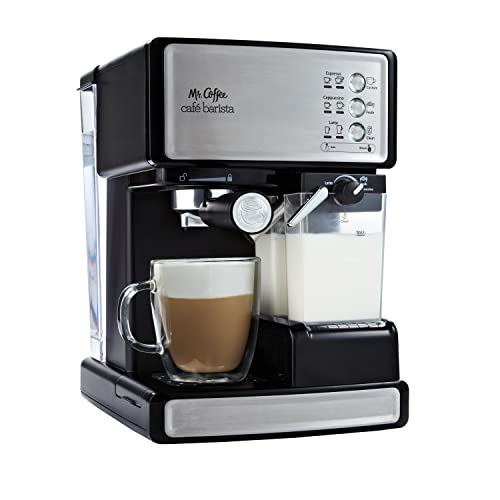
Mr. Coffee’s entry is the accessible door into the category: a stainless steel machine whose title states a 15-bar pump system, a semi-automatic 3-in-1 design, an automatic milk frother and a one-touch control panel.
Breville’s Barista Express Impress, model BES876 in brushed stainless steel, is one of only two listings here that print the semi-automatic label, and it pairs that label with a built-in grinder.
The Barista Pro BES878, also brushed stainless, is described by its own title as a manual coffee maker with a built-in grinder — wording this guide reports exactly, while noting the pump-and-portafilter mechanism underneath it.
Breville’s Barista Express BES870 in Black Truffle shares that manual wording and built-in grinder, differing from its Pro sibling in title chiefly by colour and model code.
De’Longhi’s La Specialista Arte Evo arrives with a coffee grinder, four preset recipes, a powerful milk frother and a barista toolkit included, under the maker’s claim of being the number one worldwide espresso machine maker.
Gevi’s dual boiler machine closes the set with the most workshop-minded title: a built-in grinder, a 58mm portafilter, thirty-one grind levels and a heavy-duty steam wand in silver stainless steel housing.
Quick Picks
| Pick | Best for | Highlight taken from its title |
|---|---|---|
| Mr. Coffee Semi-Automatic 15-Bar | A first pump machine with milk handled automatically | 15-bar pump, automatic milk frother, one-touch panel |
| Breville Barista Express Impress BES876 | The labelled semi-automatic with grinding built in | Semi-automatic in the title, built-in grinder |
| Breville Barista Pro BES878 | Breville’s manual-worded grinder machine in steel | Built-in grinder, brushed stainless steel |
| Breville Barista Express BES870 Black Truffle | The Express formula in a dark finish | Built-in grinder, Black Truffle finish |
| De’Longhi La Specialista Arte Evo | Preset recipes plus a toolkit in the box | 4 preset recipes, barista toolkit included |
| Gevi Dual Boiler Espresso with Grinder | Dual boiler hardware and a 58mm portafilter | Dual boiler, 31 grind levels, 58mm portafilter |
How these picks were chosen
Admission required a pump-driven machine worked through a portafilter by its operator — the mechanical definition of this class — evidenced in each title by the parts that perform it: a stated pump system, a named portafilter, or a maker’s own description of a machine built for pulling shots by hand. Fully automatic machines, which grind, dose, tamp and pour at one button press, were excluded even when famous; the De’Longhi Magnifica line failed this test at selection stage despite its maker’s presence elsewhere in the set. Pod machines failed it too, since a capsule removes the operator decisions the category exists to preserve.
Labelling honesty governed the writing that followed. Where a title prints semi-automatic, this guide uses the term freely. Where a title instead says manual coffee maker — as both the Barista Pro and the Barista Express BES870 titles do — the guide quotes that phrasing and describes the shared mechanism, because a review that upgrades a listing’s vocabulary is inventing a specification. Pressure figures, boiler counts, portafilter diameters and grind-level counts appear only for the machines whose titles state them, and each such figure is fenced to its own review.
Mr. Coffee Semi-Automatic 15-Bar
Mr. Coffee’s machine carries the fullest self-description in this guide relative to its station: an espresso and cappuccino machine in stainless steel, built around a 15-bar pump system, labelled semi-automatic in its own title, configured as a 3-in-1 espresso maker, and fitted with an automatic milk frother worked from a one-touch control panel. Every phrase there earns its place. The 15-bar figure is the only pressure number in the entire set, the 3-in-1 wording promises espresso, cappuccino and latte territory from one housing, and the automatic frother removes the single skill — steaming milk by hand — that frightens beginners away from this category altogether.
Listing-stated details — Pump: 15-bar pump system. Class as titled: semi-automatic 3-in-1 espresso maker. Milk: automatic milk frother. Controls: one-touch control panel. Finish: stainless steel. Grinder: none mentioned in the title.
Strengths
- An automatic milk frother lets a complete beginner produce cappuccinos without learning wand technique first.
- The one-touch control panel matches the machine’s role as a household appliance rather than a hobby bench.
- It is the only title here that states its pump pressure, giving shoppers a concrete figure to compare.
Trade-offs
- No built-in grinder is mentioned, so ground coffee or a separate grinder enters the budget and the counter plan.
- Automatic frothing trades texture control away; drinkers who want to pour latte art will outgrow the arrangement.
- The title gives no portafilter diameter, so accessory sizing waits on the product page.
Consider who this machine is engineered for: the household that drinks milk coffees daily and wants them from beans-and-pump machinery rather than pods, without converting a family member into a barista. The automatic frother is the honest centrepiece of that proposition. Hand steaming has a learning curve measured in weeks of split milk and scorched jugs; an automatic system collapses it into a button, accepting a ceiling on foam finesse in exchange for drinks that succeed on the first morning. For most family kitchens that exchange is correct, and the 3-in-1 wording signals that the machine knows its drinks menu is a household menu — espresso for one drinker, cappuccino for another, a latte for a third — rather than a purist’s single shot.
The one-touch panel deserves the same unpretentious reading. Machines in this guide with grinders and grind-level dials ask their owners to develop judgement; a one-touch panel asks only for a choice. There is no shame in that trade at this end of the category, and considerable wisdom in a maker stating it plainly. The discipline this guide applies to grander titles applies here too: the listing does not claim a grinder, a boiler configuration or a portafilter size, so none is credited — the machine competes on pressure stated, milk automated and operation simplified, and on those three legs it stands firmly.
Best for: a household wanting espresso, cappuccino and latte drinks from a 15-bar pump machine whose milk frothing is automatic and whose panel works in one touch.
Not suited for: a drinker set on hand-steaming milk with a wand, since this title specifies an automatic frother instead.
Check price on Amazon for the Mr. Coffee machine and its frother arrangement.

Breville Barista Express Impress BES876
The Barista Express Impress holds a distinction no other Breville in this set can claim: its title actually says semi-automatic, describing a machine for crafting café-quality lattes and cappuccinos at home, with a built-in grinder, finished in brushed stainless steel under model code BES876BSS. That single adjective matters to this guide’s bookkeeping, because it makes the Impress one of only two machines here whose class label comes from the maker rather than from the mechanism. The café-quality phrase, by contrast, is the title’s aspiration rather than a measurable specification, and it is reported in that spirit — a promise about lattes and cappuccinos, the two drinks the title names.
Details from the listing title — Model: BES876BSS. Finish: brushed stainless steel. Class as titled: semi-automatic espresso machine. Grinder: built-in. Drinks named: lattes and cappuccinos. Portafilter size and pump pressure: not given in the title.
Strengths
- The semi-automatic label is printed by the maker, removing all doubt about the machine’s intended class.
- A built-in grinder keeps beans, grinding and brewing inside one footprint and one purchase.
- Brushed stainless steel suits kitchens where the machine lives permanently on display.
Trade-offs
- The title states no pump pressure, leaving the headline number the Mr. Coffee prints for its own machine unanswered here.
- Milk arrangements are implied by the drinks named rather than described; no wand or frother type is specified in the title.
- Portafilter dimensions are absent from the title, so tamper and accessory sizing belongs to the product page.
The Impress name itself hints at the machine’s party trick — assistance with tamping, the step where beginners most often ruin a shot with uneven pressure — but the title provided to this guide does not describe that system, so the review notes the name and claims nothing beyond it. What the title does establish is a coherent proposition: a labelled semi-automatic machine with its own grinder, aimed at milk drinks, from the maker whose name recurs three times in this set. Households comparing within the Breville trio should start here if the class label itself is a buying criterion, because this is the one title among the three that supplies it.
Against the Mr. Coffee, the Impress trades stated pressure and automated milk for an integrated grinder and a maker’s label — a fair sketch of the category’s central fork, convenience of milk against freshness of grind. Beans ground seconds before extraction carry aroma that pre-ground coffee surrendered days earlier, and a household that drinks straight espresso will feel that difference more keenly than a household whose drinks arrive under steamed milk. The Impress is built for the former household that still wants its lattes, and its title, unusually, says so in the category’s own vocabulary.
Best for: a home barista who wants the semi-automatic label stated by the maker, a built-in grinder and a brushed stainless machine aimed at lattes and cappuccinos.
Not suited for: a buyer requiring pump pressure or portafilter size confirmed in the title before shortlisting, since this listing prints neither.
Check price on Amazon — the BES876 listing carries the tamping details its name promises.
Breville Barista Pro BES878
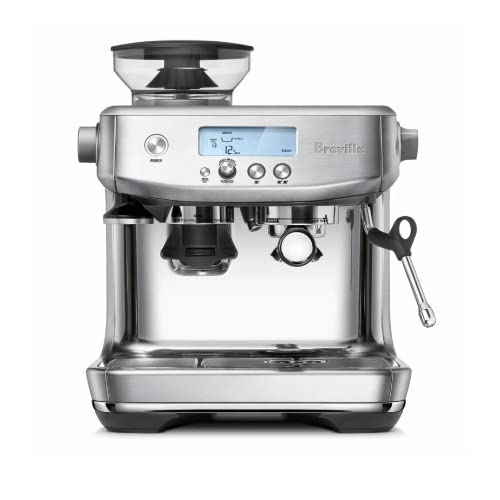
Breville’s own title for the Barista Pro calls it something this guide must quote before it characterises anything: a manual coffee maker with a built-in grinder, in brushed stainless steel, model BES878BSS, presented for pulling barista-quality espresso shots, lattes and cappuccinos at home. Manual is the maker’s chosen word here, and it would be a falsification to silently upgrade it. What can be said on mechanism — and it is the same mechanism the Impress’s title labels semi-automatic — is that a pump-and-portafilter machine of this layout leaves the shot’s start and stop in the operator’s hands while the pump supplies the pressure, which is the working definition this entire category runs on. The Pro therefore belongs in this guide by construction, carrying a title that describes it more conservatively than its sibling.
Stated in the title — Model: BES878BSS. Finish: brushed stainless steel. Maker’s wording: manual coffee maker. Grinder: built-in. Drinks named: espresso shots, lattes, cappuccinos. Boiler and pressure figures: none printed in the title.
Strengths
- A built-in grinder pairs fresh grinding with the shot-pulling routine in one brushed-steel housing.
- The Pro name and model code give buyers a precise rung in Breville’s ladder to research and compare.
- The title names the full household menu — shots, lattes and cappuccinos — rather than espresso alone.
Trade-offs
- The maker’s own title avoids the semi-automatic label, so class purists must judge by mechanism.
- No pressure, boiler or portafilter figures appear in the title for specification-led comparison.
- Two near-identical brushed-steel Breville titles in this set demand careful model-code checking at purchase.
Why would a maker call one machine semi-automatic and its sibling manual when both work through portafilters under pump pressure? Vocabulary in this category follows marketing generations more faithfully than engineering, and the honest response for a buyer is to shop the mechanism and the feature list rather than the adjective. On mechanism, the Pro is a hand-worked espresso machine with integrated grinding; on features as titled, it is the equal of the Impress minus the printed label and plus the Pro designation. Readers who find that equivalence confusing have understood the category correctly — the titles genuinely are inconsistent, and this guide’s refusal to smooth that over is deliberate.
The brushed stainless finish shared with the Impress means the Pro’s differentiation lives in details its title withholds — heating system, interface, steam performance — all of which belong to a product-page comparison between BES876 and BES878 rather than to invention here. What can be recommended without invention is the decision procedure: choose between these two by the specifics each listing publishes, weigh the grinder common to both as a settled benefit, and treat the label difference as a curiosity of copywriting rather than a difference in the cup.
Best for: a household content to judge by mechanism, wanting Breville’s Pro model with a built-in grinder in brushed stainless steel for shots, lattes and cappuccinos.
Not suited for: a buyer requiring the words semi-automatic in the maker’s own title, a condition only the BES876 and the Mr. Coffee satisfy in this set.
Check price on Amazon for the BES878 and compare its published specifications against the Impress.

Breville Barista Express BES870 Black Truffle
The second Barista Express in this guide is the BES870 in Black Truffle, model code BES870BTR, and its title walks the same path as the Pro’s: a manual coffee maker with a built-in grinder, offered for crafting café-quality espresso shots, lattes and cappuccinos at home. The Express name is the elder statesman of this category — the machine format that taught a generation of home drinkers to grind, tamp and pull — and this listing’s contribution to the set is that format in a dark finish, at a model number one digit family below the Pro. As with the Pro, the semi-automatic label never appears in the title, and as with the Pro, the machine’s place here rests on its portafilter-and-pump mechanism rather than on vocabulary.
Title-stated specification — Model: BES870BTR. Finish: Black Truffle. Maker’s wording: manual coffee maker. Grinder: built-in. Drinks named: espresso shots, lattes, cappuccinos. Pressure and portafilter data: not stated in the listing title.
Strengths
- The Black Truffle finish gives the Express format a low-glare, fingerprint-forgiving presence on the counter.
- A built-in grinder keeps the full routine — grind, dose, tamp, pull — inside one machine’s footprint.
- The Express model line carries a long ownership history that makes advice, parts and accessories easy to research.
Trade-offs
- Its title and the Pro’s title are close enough that a hurried buyer can order the wrong model code.
- No pressure figure is printed, although the machine’s class makes pump extraction a given rather than a specification.
- The dark finish shows pale coffee dust and floury grind scatter more visibly than brushed steel does.
Choosing between the BES870 and the BES878 on titles alone is an exercise in humility: both promise a built-in grinder, both name the same three drinks, both wear the manual wording, and they part company on finish, model code and the word Pro. The substantive differences between Express and Pro generations live in their listings — heat-up behaviour, interface, steam arrangement — and a buyer deciding between them should line those published specifications up side by side rather than inferring a hierarchy from a suffix. What the titles do settle is positioning within a household’s aesthetic: Black Truffle disappears into a dark kitchen scheme where brushed steel would glare, and for a machine that occupies prime counter territory for years, that visual fit is a legitimate deciding vote.
There is also a steadiness argument for the older model code. A format that has been sold for years accumulates a public record — owner threads, descaling advice, burr replacement stories — that a newer sibling cannot match, and for a machine whose ownership is measured in thousands of mornings, that record is a practical asset. The Express in Black Truffle is this guide’s recommendation-by-temperament for the buyer who values a known quantity wearing a quieter colour, and who is untroubled that the maker’s copywriters never granted it the category’s label. Coffee drinkers comparing machines with the wider countertop picture in mind may also want the sink-side companion read, Best Low Divide Kitchen Sinks, since espresso corners and prep sinks tend to be planned in the same renovation breath.
Best for: a household that wants the long-running Express format with a built-in grinder, finished in Black Truffle for a darker kitchen scheme.
Not suited for: a counter where pale grind dust will show on a dark finish all day, or a buyer short on the attention to distinguish BES870 from BES878 at checkout.
Check price on Amazon, and double-check the BES870BTR model code before ordering.

De’Longhi La Specialista Arte Evo
De’Longhi’s La Specialista Arte Evo enters under a banner claim — the maker styles itself the number one worldwide espresso machine maker, a ranking this guide reports as the listing’s own marketing — and then gets specific in ways its rivals do not: an espresso machine with a coffee grinder, four preset recipes, a powerful milk frother, and a barista toolkit included in the box. The preset recipes are the interesting phrase. A machine in this category lives by operator judgement, yet presets concede that some mornings judgement is scarce; four saved preparations let a household standardise its usual drinks while keeping the portafilter routine intact. The toolkit, meanwhile, acknowledges that this class of machine is worked with accessories, and supplies them rather than leaving a new owner to discover the omissions mid-shot.
From the listing title — Grinder: coffee grinder included in the machine’s description. Recipes: 4 preset recipes. Milk: powerful milk frother. Accessories: barista toolkit included. Class label: the title does not use the words semi-automatic. Maker ranking: claimed in the title as number one worldwide.
Strengths
- Four preset recipes give repeatable drinks on rushed mornings without surrendering the portafilter routine.
- A barista toolkit in the box removes the accessory scavenger hunt that usually follows a machine home.
- The powerful milk frother wording promises steam-side ambition aimed at milk-drink households.
Trade-offs
- The title never applies the semi-automatic label, so its class membership rests on mechanism, as with the two manual-worded Brevilles.
- Toolkit contents are not itemised in the title, leaving the box’s exact value to the product page.
- No pressure, boiler or portafilter figures are printed for specification-first shoppers.
The Arte Evo’s proposition is curation. Where the Gevi below competes on hardware vocabulary — boilers, millimetres, grind levels — De’Longhi competes on the completeness of the first week: grinder present, recipes preset, frother powerful, tools in the box. That is a shrewd reading of why home espresso machines get returned or abandoned; rarely for the quality of their best shot, often for the friction of their tenth. A toolkit’s presence also quietly teaches technique, since tools imply procedures, and a household that lays out the kit each morning is rehearsing the ritual that makes this category satisfying rather than merely caffeinating.
The maker’s number-one claim deserves its sentence of scepticism, applied evenly: it is a superlative printed by the seller, of the same family as the café-quality phrases in Breville titles, and it should weigh on a decision exactly as much as those do — as atmosphere, not evidence. The evidence in this title is the feature list, and on feature list alone the Arte Evo is the most accessorised offer in the set. Buyers whose kitchens already hold a scale, a tamper they love and a practised hand will discount the toolkit; buyers starting from an empty counter will price it properly, as several separate purchases folded into one box.
Best for: a household starting espresso from an empty counter, wanting a grinder, four preset recipes, a powerful frother and the working tools included from day one.
Not suited for: a specification-led buyer seeking pressure and portafilter figures in the title, since De’Longhi prints none of them here.
Check price on Amazon and read the toolkit’s itemised contents on the Arte Evo listing.
Gevi Dual Boiler Espresso with Grinder
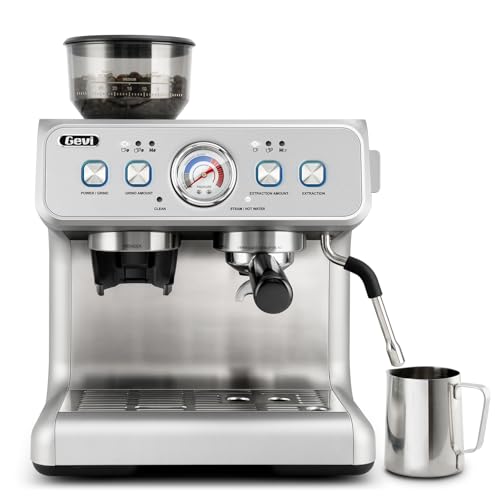
Gevi’s title reads like an engineer’s index card, and this guide means that as praise: a dual boiler espresso machine with a built-in grinder and a 58mm portafilter, described as a commercial-grade dual boiler brewer, offering thirty-one grind levels and a heavy-duty steam wand, housed in silver stainless steel and aimed at home baristas. Three of those facts are unique in this set. The dual boiler architecture — separate boilers for brewing and steaming, as the term denotes — appears nowhere else here. The 58mm portafilter diameter appears nowhere else here. The grind-level count appears nowhere else here. A buyer who shops by specification finally has specifications to shop by.
Stated by the title — Boilers: dual boiler, described as commercial-grade. Portafilter: 58mm. Grinder: built-in, 31 grind levels. Steam: heavy-duty steam wand. Housing: silver stainless steel. Pump pressure: not printed in the title.
Strengths
- Dual boiler architecture separates brewing from steaming, the hardware answer to back-to-back milk drinks.
- A 58mm portafilter matches the diameter around which the widest accessory ecosystem is built.
- Thirty-one grind levels give dialled-in adjustment a stated, countable range.
Trade-offs
- Commercial-grade is the listing’s characterisation, not a certification this guide can verify from a title.
- No pump pressure is printed, an odd silence in an otherwise specification-rich title.
- The hardware vocabulary signals a learning curve; this is the least appliance-like machine in the set.
Why does the dual boiler matter enough to headline a title? In single-boiler and thermoblock designs, brewing water and steam compete for one heat source, so the machine that has just pulled a shot needs a pause — or a temperature compromise — before it steams milk properly, and vice versa. Two boilers dissolve that queue: shot and steam stand ready simultaneously, which transforms the making of four cappuccinos for guests from a serial negotiation into a rhythm. Households that drink alone will rarely feel the constraint this design removes; households that entertain, or that run a two-person morning line of lattes, will feel it daily. The title’s home barista address is honest — this machine is pitched at people who will notice.
The 58mm portafilter compounds the enthusiast positioning, because baskets, tampers, distributors and funnels cluster around that diameter across the aftermarket; owning the common size turns every future accessory purchase into a shelf item rather than a search. Thirty-one grind levels, finally, should be read as range rather than virtue in themselves — what matters is whether the useful espresso window within those levels is fine-grained, a question for the listing and owner reports — but a stated range at least promises the adjustment exists in steps, not in a vague dial’s sweep. Gevi has written the title this guide wishes every maker wrote: nouns and numbers, each checkable, each fenced to this machine alone.
Best for: a home barista making milk drinks back to back, wanting dual boilers, a 58mm portafilter and a grinder with thirty-one stated levels.
Not suited for: a first-time buyer seeking one-touch operation, since every signal in this title points to hands-on technique.
Check price on Amazon for the Gevi dual boiler machine’s full specification sheet.
Six machines, one mechanism, several vocabularies
| Machine | Class wording in its title | Grinder | Milk arrangement as titled | Unique stated figure |
|---|---|---|---|---|
| Mr. Coffee Semi-Automatic 15-Bar | Semi-automatic | Not mentioned | Automatic milk frother | 15-bar pump system |
| Breville Barista Express Impress BES876 | Semi-automatic | Built-in | Implied by lattes and cappuccinos | None printed |
| Breville Barista Pro BES878 | Manual coffee maker | Built-in | Implied by lattes and cappuccinos | None printed |
| Breville Barista Express BES870 Black Truffle | Manual coffee maker | Built-in | Implied by lattes and cappuccinos | None printed |
| De’Longhi La Specialista Arte Evo | Not labelled | Grinder included | Powerful milk frother | 4 preset recipes |
| Gevi Dual Boiler Espresso with Grinder | Not labelled | Built-in, 31 levels | Heavy-duty steam wand | 58mm portafilter, dual boiler |
Read the class-wording column slowly, because it is the most instructive column in this guide: two labels, two manual descriptions, two silences, spread across machines that all brew through a hand-loaded portafilter under pump pressure. The vocabulary varies; the mechanism does not. Shoppers who internalise that single fact become immune to the category’s copywriting weather.
Which questions decide a semi-automatic purchase?
Do you want grinding inside the machine or outside it?
Four titles here build the grinder in, and the argument for integration is freshness with tidiness: beans ground at the moment of brewing, one appliance to house, one plug, one cleaning routine. The argument against is specialisation — a separate grinder can be upgraded, repaired or replaced without touching the machine, and can serve other brew methods on the side. The Mr. Coffee’s title, silent on grinding, leaves that entire decision to the household; the other five settle it by construction. Households that already own a capable grinder should notice that four of these six ask them to pay for a second one.
How will your milk get its texture?
The six titles describe three distinct milk philosophies. Automatic frothing, on the Mr. Coffee, removes technique from the equation and caps the result at the system’s judgement. A wand, on the Gevi, hands texture entirely to the operator, with the highest ceiling and the steepest first month. The frother wording on the De’Longhi sits between, promising power while leaving its exact working method to the listing. Households should answer honestly which philosophy matches their patience, because milk — not espresso — is where home machines are won and abandoned. The drinks themselves pair with the rest of the morning routine; readers setting up a full brew corner may find the stovetop companion piece, Best Stovetop Rice Cookers, an oddly relevant read for the neighbouring burner.
How many drinks in a row must the machine serve?
A solo shot before a commute stresses no machine in this set. Four lattes for visiting family stress every design whose brewing and steaming share one heat source, which is the queue the Gevi’s dual boilers exist to abolish. Between those poles sits the ordinary two-drink household, served adequately by everything here. Count your worst-case morning — guests, holidays, the weekend lie-in crowd — and let that count, not the average morning, arbitrate the boiler question.
Which numbers do you need before you can commit?
Make a list of the specifications your decision actually turns on, then notice how few of them these titles print: one pressure figure, one portafilter diameter, one grind range, one boiler count across six listings. Everything else — water tank capacity, dimensions, heat-up time, warranty — lives on product pages, and a disciplined buyer extracts it there rather than assuming category averages. The machines are not hiding their numbers out of malice; titles are simply short. But a purchase this durable deserves the longer documents.
The grinder question, taken seriously
Because four of the six titles fold a grinder into the machine, the integrated grinder deserves examination as a design philosophy rather than a checkbox. Integration collapses the espresso workflow into a single station: beans in a hopper above, grounds delivered at the portafilter, a counter wiped once. For small kitchens that tidiness is decisive, and for beginners it removes a whole category of mismatch — the grinder that cannot grind fine enough for espresso is a classic first-purchase error that an integrated unit, designed around its own brew group, cannot make in the same way. The costs are coupled fate and compromised specialisation: when an integrated grinder fails, the whole machine goes for repair, and its burrs were engineered to a price shared with pumps, boilers and housing.
Grind-level counts, where stated, should be read as a map’s legend rather than the territory. The Gevi’s thirty-one levels promise stepped, repeatable adjustment, which matters because espresso dialling-in is a diary-keeping exercise — a bean that sang at one setting on Tuesday wants a nudge finer by Friday as it ages — and steps let a household record and revisit settings exactly. Stepless dials offer finer nuance at the cost of that repeatability. Neither is printed for the Breville trio or the De’Longhi in the titles provided, so their adjustment styles join the list of product-page questions, alongside burr material and hopper capacity, that a thorough buyer carries into the listings.
Learning the shot: the first month on any of these machines
Every machine in this guide shares one curriculum, because the mechanism is shared. Week one teaches dose and distribution: the same beans, the same grind setting, shots that vary anyway, until the household discovers that the variable was the tamp or the levelling all along. Week two teaches the grind dial, as the first bag of beans ages and the shot that ran perfectly begins to hurry, demanding the small corrective nudge finer that separates people who keep a notebook from people who keep wondering. Week three teaches milk, on whatever arrangement the chosen machine provides — wand technique for the Gevi household, frother settings for the Mr. Coffee’s, and timing for everyone, since a shot waiting two minutes for its milk is a drink already declining.
There is a fifth week nobody schedules, and it arrives the first time a guest asks for something outside the repertoire — a long black, a flat white, a decaf after dinner. The semi-automatic format answers such requests gracefully, because a portafilter machine is a general-purpose instrument: swap the beans or the basket, adjust the pour, and the unfamiliar drink emerges from the same hardware that makes the house drinks. That generality is the quiet dividend of choosing mechanism over automation. A machine built around fixed drinks defends its menu; a machine built around a pump, a group head and a pair of hands defends nothing and can therefore attempt anything the beans allow. Households that entertain often should weigh that openness heavily, since guests rarely order from the repertoire, and the host who can improvise a credible long black from the same beans as the morning’s cappuccinos owns a genuinely social appliance rather than a personal one.
Week four is the honest one: the household discovers its actual repertoire. Most homes settle on two drinks made constantly and a third made for guests, and the machine that serves that repertoire gracefully — presets earning their keep in the De’Longhi household, dual boilers in the Gevi’s, the one-touch panel in the Mr. Coffee’s — reveals itself as correctly bought. The romance of the full café menu fades; the pleasure of the perfected house drink does not. Buyers should therefore weight their machine’s fit to two drinks above its theoretical range across twenty, a principle that flatters every machine in this set in a different way and condemns none of them.
Counter space, water access and the geography of a coffee corner
None of the six titles prints a dimension, a tank capacity or a weight, and yet those unpublished numbers will govern daily satisfaction more directly than several published ones. An espresso machine lives where it is used, and its home needs four things in reach: a socket, a sink for the drip tray and the milk jug, storage for beans away from the machine’s own heat, and headroom — hoppers and top-loading tanks both ask for vertical space that under-cabinet kitchens frequently refuse. Before any of these six is ordered, the intended corner should be measured in three directions and the winning listing’s dimensions checked against all three, because a machine that must be pulled forward daily to fill its tank will slowly train its household to resent it, and resentment is the true end of most home espresso experiments.
Water deserves its own paragraph in that geography. Espresso is mostly water, and the water’s mineral character writes itself into both the cup and the machine: hard districts flavour shots and fur boilers, and the dual boilers of the Gevi give scale two vessels to colonise instead of one. A household in a hard-water postcode should plan its water — filtered jugs, softened supply, a descaling rhythm — as part of the machine purchase rather than as a later discovery, whichever of the six it chooses. The titles are silent on filtration and tank design alike, so the product pages must answer for fill access, tank removal and any supplied filter before the corner is declared ready.
Noise belongs to that geography too, although no title here mentions it. A pump at full pressure and a grinder at full speed are brief but emphatic sounds, and in a small flat at six in the morning they carry through walls that a kettle’s murmur never penetrates. Households with sleeping children, shift-working partners or thin partition walls should treat the machine’s acoustic footprint as a real specification to research on the listing and in owner reports, and should plan the coffee corner’s position — away from bedroom walls where the layout allows — with the same care given to its socket and its sink.
Maintenance: the calendar that keeps pump machines honest
Pump espresso machines repay a small, regular maintenance liturgy and punish its neglect with a slowness that owners often misread as the machine dying. The liturgy has three tempos. Daily, it is the knock-out of spent pucks, a wiped steam path — wand machines like the Gevi’s ask for a purge and a cloth within seconds of steaming, because milk bakes onto hot steel with conviction — and a drip tray emptied before it becomes a pond. Weekly, it is the brew group rinsed and, where the machine’s design provides for it, backflushed with water so coffee oils do not accumulate into rancidity that no bean quality can outrun. Monthly and quarterly, it is descaling at the interval the local water hardness dictates, and grinder burrs brushed clear of the stale fines that otherwise season every shot with last month’s bag.
None of those tasks is described in the six titles, which is normal — titles sell the first morning, not the fortieth — but a buyer should extract each machine’s maintenance story from its listing and manual before purchase, because the designs differ in how graciously they accept care. Machines with accessible groups, removable tanks and honest drip trays get maintained; machines that hide their workings behind screws and sealed panels get neglected, and the difference shows in the cup within a season. The barista toolkit bundled with the De’Longhi hints at a maker thinking about this afterlife, though its contents, unitemised in the title, must be checked before that hint is banked. Ownership, in this category, is a subscription paid in small chores, and the households that thrive here are the ones that find the chores meditative rather than the ones promised there would be none.
Beans are the variable no machine in this set can fix
A final honesty belongs in every espresso guide: the machine is the smaller half of the drink. Beans bought stale, ground in advance or roasted to a uniform darkness will produce the same disappointing shot on the Gevi’s dual boilers as on the Mr. Coffee’s single pump system, because extraction machinery can only express what the coffee contains. The four integrated grinders in this set exist precisely to defend the bean’s contribution — grinding seconds before brewing preserves the aromatics that pre-ground coffee loses within the hour — but they cannot resurrect a bag that spent four months in a warehouse. Households new to the category should budget for fresh beans from a roaster who prints a roast date with the same seriousness they budget for the machine, and should expect the first month’s experimentation to be mostly about beans, not settings.
Roast level interacts with these machines in a practical way worth stating plainly. Very dark, oily beans — the traditional espresso roast of supermarket shelves — coat grinder burrs and portafilter baskets with a film that accelerates the maintenance calendar above, and their sheen in the hopper of an integrated grinder is a warning sign experienced owners recognise. Medium roasts are kinder to the machinery and, in the judgement of many home baristas, clearer in the cup. None of the six titles expresses a preference, and none should; but the household that understands its bean choice is also a machine-care choice has grasped the category’s deepest lesson, which is that espresso is a system — bean, grinder, machine, water, hands — and the six products reviewed here are only its most expensive component.
Accessories: what the box leaves for you to buy
Only one title in this set itemises help beyond the machine itself — De’Longhi’s barista toolkit — which makes the accessory question a genuine differentiator for the other five households. The working kit of a portafilter machine, beyond what any box may include, runs to a short and predictable list: a tamper matched to the basket’s diameter, a knock box or a sturdy alternative for spent pucks, a milk jug sized to the household’s usual drink, a scale accurate enough to weigh a dose, and cloths that live beside the machine rather than wandering the kitchen. The scale surprises newcomers most, yet it is the instrument that converts the first month’s guesswork into repeatable shots, because a dose weighed is a variable removed. Buyers of the Gevi can size its accessories from the title itself — 58mm is printed — while buyers of the other five must harvest the basket diameter from each listing before a single accessory is ordered, since a tamper a millimetre wrong is a paperweight with good intentions.
How to read owner opinion on machines like these
Every machine in this set will accumulate owner commentary in the wider world, and a disciplined reader can extract signal from it without importing other people’s kitchens. The most useful reports are the dated, specific ones: a household describing its drinks, its beans, its water and its maintenance rhythm gives a prospective buyer four coordinates to compare against their own, while verdicts unaccompanied by any of those coordinates — delight or fury alike — describe a situation that cannot be located. Complaints deserve taxonomy rather than tallying. A complaint about learning curve indicts the category, not the model; a complaint about a part, a seal, a tray or a grinder’s behaviour indicts something checkable; a complaint about delivery or packaging indicts neither machine nor maker. Sorted that way, a hundred mixed opinions resolve into a short list of questions to carry back to the listing, which is where this guide began: titles state a little, listings state more, and the buyer’s own household — its drinks, its counter, its patience — states the rest.
Common mistakes
Shopping the adjective instead of the mechanism. Two of these titles say semi-automatic, two say manual, two say nothing — over one shared portafilter mechanism. A buyer who filters by the word will discard machines identical in operation to the ones kept.
Double-buying a grinder. Four machines here include one. A household with a good standalone grinder should count that duplication as a cost, not a bonus, when comparing against the Mr. Coffee’s grinder-free title.
Judging milk arrangements by the drinks menu. A title naming lattes does not describe how the milk gets textured. Automatic frother, frother and wand are different ownership experiences wearing similar menus.
Treating a maker’s superlative as a test result. Number one worldwide and café-quality are claims printed by sellers. They set a mood; they settle nothing that a specification could not.
Ignoring portafilter diameter until accessories arrive. Only one title prints it — 58mm on the Gevi. Every tamper, basket and funnel bought for the other five must wait on their listings’ figures.
Buying for the dinner-party morning. Dual boilers earn their complexity in households that queue milk drinks weekly. A one-shot household pays for capacity it will use at Christmas and technique it must maintain all year.
Final recommendation
For the household entering this category, the Mr. Coffee is the gentle door: stated 15-bar pressure, milk frothed automatically, one touch between waking and drinking. For the label-conscious home barista, the Barista Express Impress is the set’s certified article, semi-automatic by its maker’s own title with a grinder built in. Between the Pro and the Express BES870, decide on their listings’ published specifications and on finish — brushed steel against Black Truffle — since their titles otherwise promise the same grinder and the same three drinks. The Arte Evo suits the from-scratch kitchen that values presets and a toolkit in the box, while the Gevi is the enthusiast’s clear address: dual boilers, a 58mm portafilter and thirty-one grind levels for households that serve milk drinks in procession.
Whichever machine lands on the counter, the category’s bargain is the same: your hands learn a small ritual, and the ritual pays you back every morning it is performed. Readers furnishing the rest of a compact coffee nook can round out the picture with Best Mini Espresso Machines, where the same mechanism shrinks for smaller counters.
FAQ
What makes a machine semi-automatic? The operator loads the portafilter and starts and stops the pump-driven extraction, judging the shot personally, while the machine supplies pressure and heat. All six machines here work that way by mechanism, whatever label their titles choose.
Why do two titles say manual instead? Breville’s titles for the BES878 and BES870 use the phrase manual coffee maker. This guide quotes that wording and includes both machines on their portafilter-and-pump construction, the same basis as their labelled siblings.
Is a built-in grinder always better? It is fresher and tidier, and four of these six include one, but it couples the grinder’s fate to the machine’s and duplicates any grinder a household already owns. The right answer depends on the counter and the existing kit.
What does a dual boiler actually change? On the Gevi, the only title claiming the architecture, separate boilers let brewing and steaming stand ready together, removing the pause between pulling shots and texturing milk when drinks are made in a run.
Which machine states its pressure? Only the Mr. Coffee, at 15-bar from its pump system. The other five titles print no pressure figure, so that specification must be read on their product pages rather than presumed.
Choose by mechanism, forgive the vocabulary, and the machine on your counter will teach your hands the rest.


