What's inside
- Where to buy these six stovetop rice pots
- Six rice pots at a glance, by material
- How these picks were chosen
- Compared: material, capacity and heat source
- How do you choose a stovetop rice pot that suits your cooking?
- The resting period: where stovetop rice is actually finished
- Water ratios are a starting point, not a law
- Common mistakes when cooking rice on the stovetop
- Final recommendation
- Stovetop rice pot questions, answered
As an Amazon Associate I earn from qualifying purchases. This post may contain affiliate links at no extra cost to you.
As an Amazon Associate, cottageverdict.com earns from qualifying purchases.
A stovetop rice pot is the oldest rice technology in the kitchen and, in the right hands, still the most instructive. There is no programme, no sensor and no beep: there is a pot, a lid, water, heat and a cook who learns the sound of a simmer. The best stovetop rice cookers reward that attention with things an electric countertop machine rarely offers — a crust when you want one, a pot that goes from hob to table without embarrassment, and a vessel that will outlive every circuit board ever soldered. They also punish inattention without appeal, which is why the material and the lid matter more in this category than in almost any other pot purchase.
The six listings divide by material into a small museum of rice traditions. Glass from Hario in Japan, earthenware from Kotobuki, enamelled cast iron from Le Creuset in Cerise, a dedicated gas-stove pot from Rinnai sized in the Japanese go measure, enamelled cast aluminium from Bobikuke in the Korean stone-pot tradition, and featherweight titanium from Valtcan built for a backpack as much as a kitchen. Each material stores and delivers heat differently, and those differences — not capacity, not colour — are what this guide sorts by.
Capacities, where the titles state them, run from the Rinnai’s 3 go (roughly three Japanese cups) through the Le Creuset’s 2.25 quarts and the Bobikuke’s 63 ounces to the Valtcan’s 2,000 millilitres. Two listings, the Hario and the Kotobuki, print no capacity at all, and their reviews say so rather than guess. Every pot here works on a hob of some kind; one, the Bobikuke, names induction in its title, and one, the Rinnai, is dedicated to the gas stove in so many words. Read the six as six answers to the question of what a rice pot should be made of, and the right one for your kitchen will identify itself.
Where to buy these six stovetop rice pots
Each pot below is sold through Amazon; the long reviews wait in the second half of the guide. These lines lead with material, because material is destiny in this category.
The Hario GNR-200 is the glass option: a Japanese rice pot with a heat-resistant glass lid that lets you watch the rice without lifting it and breaking the steam.
Kotobuki’s earthenware cooker is the traditionalist’s pot, a black clay vessel with a matte and cobalt blue spoke design, in the donabe spirit of gentle, retained heat.
Le Creuset’s rice pot is the heavyweight: enamelled cast iron at 2.25 quarts in Cerise, with a stoneware insert, built for the table as much as the hob.
Rinnai’s RTR-300D1 is the specialist appliance of the list — a pot designed for one job on a gas stove, sized at 3 go for small households.
Bobikuke’s Korean pot is enamelled cast aluminium at 63 ounces, styled as a stone bowl and named for induction, the lightest full-size feel in the set.
Valtcan’s titanium pot is the traveller: 2,000 millilitres, a locking lid, measurement marks and a stated weight of just 589 grams.
Six rice pots at a glance, by material
The best-for column names the cook each pot suits. The third column gives the material, because in this category the material is the specification that outranks all others.
| Pick | Best for | Material per the listing |
|---|---|---|
| HARIO GNR-200 Rice Pot Glass Lid | Learners who want to watch rice cook without lifting the lid | Glass lid with visible contents, made in Japan |
| Kotobuki Earthenware Rice Cooker | Traditionalists wanting clay-pot heat retention and table presence | Earthenware body, matte black with cobalt blue spoke design |
| Le Creuset Rice Pot 2.25 qt Cerise | Serious rice households wanting a lifetime pot with an insert | Enamelled cast iron, 2.25 qt, stoneware insert, Cerise |
| Rinnai RTR-300D1 Gas Stove Rice Pot | Small gas-stove households cooking rice for one or two | Dedicated gas-stove rice pot, 3 go capacity |
| Bobikuke Korean Rice Pot 63 oz | Induction households wanting stone-pot style without the weight | Enamelled cast aluminium, 63 oz, named for induction |
| Valtcan Titanium Rice Cooker Pot 2000ml | Campers and weight-watchers wanting one pot for trail and kitchen | Titanium, 589g, locking lid, measurement marks, 2,000ml |
How these picks were chosen
The entry condition was absolute and it eliminated most of the search results: the pot had to cook rice on a hob. Electric rice cookers — however excellent, and several famous names were among them — were excluded wholesale, because a guide to stovetop rice pots that pads itself with countertop appliances has answered a question nobody asked. Steamer pots that surfaced alongside them were excluded on the same principle: a vessel that steams other food is not a rice pot merely because rice can be steamed in it. What survived that filter was a small, genuinely hob-bound pool, and the final six were chosen from it by material, one pot per tradition, so that the guide compares philosophies of rice rather than six near-identical saucepans.
Material diversity was the organising rule: glass for visibility, earthenware for the clay tradition, enamelled cast iron for mass and evenness, a dedicated gas pot from a flame specialist, enamelled cast aluminium for the Korean stone-bowl shape at a carryable weight, and titanium for the trail. Where two candidates shared a material, the one whose title stated more — a capacity, a hob, an insert — was preferred, because stated facts are the currency this guide trades in. Two listings that print no capacity at all were nevertheless kept, since their materials are irreplaceable in the set, and their reviews mark the omission plainly.
Every fact in the reviews that follow is traceable to a listing title checked on 2026-11-27: capacities in quarts, go, ounces and millilitres are quoted in their original measures, hob claims are credited only where a title makes them, and no pot has been granted a compatibility, an insert or a dimension its maker did not print. The traditions behind the materials are described as traditions — the donabe’s resting heat, the dolsot’s crust — because that context is how a buyer chooses between six honest pots.

HARIO GNR-200 Rice Pot Glass Lid
Hario built its name on glass coffee equipment, and the GNR-200 applies the same philosophy to rice: a pot with a heat-resistant glass lid whose entire purpose, per the listing, is visible contents. That visibility is a teaching instrument. Rice cooks by absorption behind a sealed lid, and the first rule every rice cook learns is not to lift that lid and release the steam — a rule that collides head-on with a beginner’s need to know what is happening in there. A glass lid dissolves the collision: the bubbling’s vigour, the water’s disappearance, the moment the surface goes from soup to grains, all visible with the seal intact.
The listing describes the pot as a gift-grade object made in Japan, and prints no capacity, no material for the pot body itself beyond the glass of the lid, and no hob specification. Those silences matter and this review leaves them open: the product page must supply the size and the stove compatibility before the pot is ordered for an induction kitchen. What the title does establish is the concept — a rice pot designed around watching — and for the cook who is still calibrating water ratios, that concept is worth more than a litre of extra capacity.
Listing facts
- Format: stovetop rice pot, model GNR-200-B-W
- Lid: heat-resistant glass, with visible contents per the listing
- Origin stated in the listing: Made in Japan
- Capacity: the title publishes no size
- Pot body material and hob compatibility: the title names neither
- Positioning in the listing: gift
Strengths
- The glass lid teaches rice cookery faster than any timer — you learn the stages by seeing them once
- Steam stays sealed while you watch, so observation never costs the pot its cooking environment
- Japanese manufacture from a maker whose whole reputation rests on heat-resistant glass
Trade-offs
- No capacity in the title means household sizing must wait for the product page
- Glass, however heat-resistant, asks for kinder handling than any metal pot in this list
- Hob compatibility is unstated, a genuine question for induction households
Rice fails in two directions — soup or scorch — and both announce themselves visually first. Through the Hario’s lid you can watch the boil’s aggression and trim the heat before the foam climbs, and you can see the absorption complete itself, the surface pitting with steam holes, which is the oldest doneness signal in rice cookery. A novice with this pot gets in five batches the intuition that takes fifteen batches to build blind, and an experienced cook gets a quiet confirmation instrument for new rice varieties, whose water appetites always differ from the last bag.
The gift positioning in the title is worth taking seriously. A rice pot is an unusually good gift for a young cook precisely because it is a skill in object form, and the glass lid lowers the skill’s entry cost: the recipient who might have surrendered after two scorched bottoms instead watches, adjusts and succeeds.
Set the Hario against the Kotobuki below and the philosophy split is clean: glass and visibility against clay and trust. Neither is wrong. The Hario suits the cook who wants information; the earthenware suits the cook who wants the pot to hold heat like a hearth and forgives it for keeping secrets. What the Hario cannot claim from its title is size or hob range, and a buyer who needs either number today should extract it from the product page before the gift wrap comes out.
Best for: a cook still learning rice, or teaching it, who wants the process visible without breaking the lid’s seal
Not suited for: a purchase requiring a stated capacity and hob compatibility upfront — this title prints neither figure
Check price on Amazon for the lid that turns every batch into a lesson you can see.

Kotobuki Earthenware Rice Cooker
Kotobuki’s cooker is earthenware, and earthenware changes the terms of rice cooking. Clay heats slowly, holds heat long and treats the grains gently, continuing to steam the rice after the flame dies in a way thin metal never does. The listing names the model 190-808, describes a matte finish with a cobalt blue spoke design on black, and says nothing else — no capacity, no hob list, no lid description. It is the most reticent title in this six, and the pot it describes belongs to the donabe tradition, where the vessel is half cookware and half tableware, carried to the table and served from directly.
That tradition carries obligations a metal pot does not. Earthenware and open flame are old friends, but earthenware and thermal shock are enemies, and earthenware and induction hobs are strangers unless the product page says otherwise. None of that is in the title, which is why this review frames the Kotobuki as the gas-and-table choice it appears to be, while flagging hob compatibility as the first question for the product page. Buyers with ceramic or induction hobs should not guess at this one.
Listing facts
- Format: earthenware rice cooker, model 190-808
- Material stated in the listing: earthenware
- Finish described in the listing: matte with cobalt blue spoke design, black
- Capacity: the title publishes no size
- Hob compatibility: the title is silent on it
- Lid material: the title does not describe it
Strengths
- Clay’s heat retention keeps rice steaming and serving-hot at the table long after the flame is off
- The matte black and cobalt design is a serving piece, not a utensil to be hidden in a cupboard
- Gentle, even heating suits the slow absorption that gives clay-pot rice its texture
Trade-offs
- Earthenware is the most fragile material in this list and dislikes thermal shock and careless knocks
- Hob compatibility is unstated — induction owners in particular must verify before ordering
- No capacity is published, so household sizing waits on the product page
Clay-pot rice has a texture argument behind it that metal struggles to answer. The earthenware wall stores the flame’s energy and returns it evenly from all sides, so the grains at the edge cook at the pace of the grains in the middle, and the resting period — the ten minutes after the heat stops, when rice finishes itself — happens inside a vessel that is still radiating. Cooks who chase the slightly chewy, distinct grains of a good donabe batch are chasing exactly that thermal patience, and no programme on an electric machine simulates it, because the programme cannot change the pot’s physics.
The serving dimension is equally real. A black earthenware pot with a cobalt spoke pattern goes from flame to table mat without a decanting step, and rice served from its cooking pot stays hot through the meal in a way rice turned into a cold bowl never does. Households that eat rice as the centre of the meal, with dishes arranged around it, will feel this difference at every dinner; households that plate in the kitchen will feel it less, and should weigh the fragility accordingly.
Care is the price, stated plainly. Earthenware wants to heat gradually, to cool before washing, and to be stored where cast iron neighbours cannot strike it. It is the only material in this six that one careless moment at the sink can kill. Cooks who keep clay pots for decades treat those rules as ritual — but a buyer whose kitchen is a contact sport should take the Le Creuset or the Bobikuke instead.
Best for: gas-hob cooks who serve rice at the table and want clay’s retained heat and donabe character
Not suited for: induction kitchens and rough-and-tumble households — hob fit is unstated and clay forgives no knocks
Check price on Amazon if your table, not just your hob, has a place waiting for it.
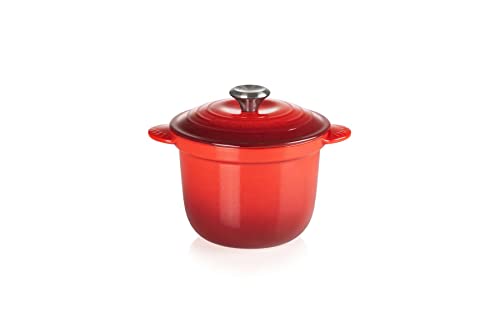
Le Creuset Rice Pot 2.25 qt Cerise
Le Creuset’s entry is the engineering answer to the rice pot question: enamelled cast iron, 2.25 quarts, in the brand’s signature Cerise red, sold with a stoneware insert. Cast iron’s mass is the point. A heavy pot does not flinch when the heat cycles, does not develop the hot spots that scorch a crescent into the bottom layer, and holds a simmer at the edge of stillness once it is set. The insert — a stoneware inner lid in the traditional rice-pot arrangement — presses gently on the cooking rice, discourages boil-over and helps the grains absorb evenly, which is the kind of detail that separates a rice pot from a saucepan with ambitions.
At 2.25 quarts, the size suits a household cooking rice as a daily staple for a family table: generous batches for dinner with tomorrow’s fried rice in mind, without the pot becoming a two-handed expedition. Cast iron’s other constant is weight, and the listing does not state it — expect the material’s usual heft and plan the cupboard shelf accordingly. The enamel surface, meanwhile, is what makes a cast iron rice pot practical: no seasoning ritual, no rust anxiety, and a surface that releases the prized bottom crust instead of welding to it.
Listing facts
- Format: enamelled cast iron rice pot with insert
- Capacity stated in the listing: 2.25 qt
- Insert described in the listing: stoneware insert
- Finish stated in the listing: Cerise
- Weight: the title publishes no figure
- Hob compatibility: not itemised in the listing title
Strengths
- Cast iron mass delivers the steadiest simmer in this list — the bottom layer’s best protection against scorching
- The stoneware insert is a purpose-built rice detail no saucepan improvisation replicates
- Enamel over iron removes the seasoning and rust chores raw cast iron would demand of a daily rice pot
Trade-offs
- Weight is the material’s tax: a full 2.25-quart iron pot is a two-handed lift for some cooks
- Enamel can chip if struck, asking for wooden or silicone tools and a trivet habit
- The capacity is fixed at family-batch size — a single-portion cook is better served by the Rinnai below
The crust question divides rice households, and cast iron is the crust material. When a cook wants the bottom layer to toast — the socarrat instinct, the nurungji instinct, every rice culture has one — the pot must hold fierce, even heat at its base without warping or spotting, and it must then release the crust in sheets rather than shrapnel. Enamelled cast iron is the only material in this six that does both halves of that trick confidently, which makes the Le Creuset the pick for households whose rice ambitions extend past plain steaming to pilafs, biryanis and the whole family of dishes where the pot is the technique.
Evenness is the quieter virtue. On a modest burner, a thin pot prints the burner’s ring onto the rice as a scorched circle with raw grains beyond it; a heavy base smears that ring into a uniform field. For a daily staple food, that reliability compounds: batch after batch lands the same, water ratios become knowledge instead of luck, and the cook stops thinking about the pot entirely. Expensive cookware earns its defence in exactly that disappearance, and a rice pot used three hundred times a year disappears faster than any other vessel in the kitchen.
The Cerise finish will divide readers: it is a kitchen commitment, visible from the doorway. What the listing supports is narrower and stronger — a stated capacity, a stated insert, a stated material with known physics. Households that cook rice daily and keep cookware for decades are the ones for whom those three facts justify the shelf space and the lift.
Best for: daily rice households that also chase crust dishes — pilaf, biryani, toasted-bottom rice — in one lifetime pot
Not suited for: cooks who struggle with heavy pans; a full cast iron pot at this size is the heaviest lift in this list
Check price on Amazon if rice is a daily staple and your cookware is bought by the decade.

Rinnai RTR-300D1 Gas Stove Rice Pot
The Rinnai’s title is written in the compressed English of a Japanese domestic listing, and it still manages to be the most specific brief in this six: a rice cooker dedicated pot, for the gas stove, cooking 3 go, model RTR-300D1. Rinnai is a gas appliance maker, and this is a pot designed by people who think about flame for a living — a dedicated vessel whose shape and base exist for one dish on one heat source. Three go is the Japanese measure of roughly three cups of uncooked rice, which cooks up into a batch sized for one to three people: the small-household specialist of this list.
Dedication is both the appeal and the boundary. A pot made for gas assumes a flame’s wraparound heat and a cook who will manage that flame through the batch’s stages. The listing does not state the pot’s material, its lid design or any compatibility beyond the gas stove it names, so electric and induction households should read the title as a polite refusal. Within its brief, though, a dedicated pot has a claim no generalist can match: every curve of it was decided by rice.
Listing facts
- Format: dedicated rice pot for gas stoves, model RTR-300D1
- Capacity stated in the listing: 3 go
- Heat source named in the listing: gas stove
- Maker: Rinnai, a gas appliance manufacturer
- Material: the title does not name it
- Lid and insert details: the title describes neither
Strengths
- A dedicated design from a gas specialist — the only pot here engineered around a single heat source
- The 3-go size ends the small-household problem of cooking a family batch for two people
- Single-purpose simplicity: no insert systems or programmes, just a pot shaped by one dish
Trade-offs
- Gas only, by its own title — households without a flame need not apply
- Material and lid construction go unstated, leaving durability questions to the product page
- The 3-go ceiling is a hard limit when guests arrive; this pot does not stretch
Small batches are where generalist pots fail quietly. A family-size pot asked to cook one cup of rice spreads it in a shallow layer that dries at the edges and sulks in the middle, and the cook concludes that small batches are simply worse. A pot sized for 3 go keeps a small batch at proper depth, with the steam environment scaled to the grains, and the result is that a person cooking for one or two eats rice as good as a family’s. That specialisation is the Rinnai’s entire argument, and for the single cook or the couple it is a strong one.
Gas cooking rewards a particular attentiveness that this pot presupposes: bring to the boil, drop to the lowest simmer, rest off the heat. On a flame, those stages are continuous and visible, and a dedicated pot’s base — shaped for flame spread — makes the low stage stable rather than sputtering. Cooks who learned rice on gas often resist every alternative for exactly this control, and the RTR-300D1 is the list’s concession that they may be right: it is not a compromise vessel but the home fixture of a whole rice culture.
The unknowns are material and longevity of supply. A listing that does not state its pot’s metal asks the buyer to trust the maker’s name, and Rinnai’s name is a reasonable thing to trust in gas — but replacement lids and long-term availability for an import-model pot are product-page questions worth asking before the purchase, not after a drop. Buy this pot for its brief, confirm its build, and it will do one thing at a level the multi-talented rivals do not attempt.
Best for: one- and two-person gas households tired of family-size pots ruining small batches
Not suited for: electric and induction kitchens — the title dedicates the pot to the gas stove in plain words
Check price on Amazon if your household’s rice batch is honestly measured in go, not quarts.

Bobikuke Korean Rice Pot 63 oz
Bobikuke’s pot is the diplomat of the list: a Korean stone-bowl silhouette — the dolsot shape that gives rice its famous sizzling crust — executed in enamelled cast aluminium at 63 ounces, in white, with induction named in its title. Cast aluminium is the compromise material with a genuine case: it spreads heat far more evenly than pressed metal, weighs a fraction of cast iron, and the enamel surface keeps it from reacting with the food or demanding seasoning. For households that love the stone-pot result but not the stone-pot lift, this is the pot that negotiates the peace.
The listing calls it a Dutch oven and rice pot both, and a Korean stone bowl besides — three names for one squat, lidded vessel. The word stovetop does not appear in the title; the pot’s hob credentials rest on its induction mention and its Dutch-oven class, and this review frames it accordingly, as a hob pot whose induction compatibility is its stated credential. At 63 ounces — a little under two litres — it sits in the same household band as the Le Creuset, sized for family batches with a lighter arm.
Listing facts
- Format: enamelled cast aluminium rice pot / Dutch oven with lid, White
- Capacity stated in the listing: 63 oz
- Style described in the listing: Korean stone bowl
- Hob credential named in the listing: induction
- Weight: the title publishes no figure
- Insert: none mentioned in the listing title
Strengths
- Stone-pot results without stone-pot weight — cast aluminium is the easy lift among the heavy-look pots
- Induction is named in the title, the clearest hob credential any pick here offers
- Enamel surface: no seasoning, no reaction, and a white finish that serves at the table
Trade-offs
- Aluminium’s heat retention cannot match cast iron or clay once the flame dies — resting rice cools sooner
- The triple naming (Dutch oven, rice pot, stone bowl) leaves its specialisation pleasantly vague
- Enamel over aluminium still chips under metal-tool abuse, despite the lighter body
Nurungji — the golden crust at the bottom of a Korean stone-pot rice — is the dish this shape exists for, and the Bobikuke’s cast aluminium base is a pragmatic route to it: enough thermal mass to toast the bottom layer evenly, in a pot a slight cook can lift one-handed even when full. Served in the pot, over a trivet, the rice keeps sizzling at the table, and the crust is scraped up and folded through at the end, which is the whole ceremony. An aluminium pot will not hold the ceremony’s heat as long as true stone, so the eating should be prompt — a constraint most households will experience as no constraint at all.
The induction naming deserves emphasis because it is unique in this list. Every other pick leaves its hob range to inference or to the product page; the Bobikuke prints induction in its title, which makes it the default shortlist-topper for induction households that have read this far. Combined with the Dutch-oven naming, it is also the most versatile vessel here — the pot most likely to be found cooking a stew on Tuesday after cooking rice on Monday — and versatility is a fair tiebreaker in a small kitchen where every pot must hold two jobs.
Where it concedes ground is retention and tradition. Clay and iron keep rice serving-hot through a long meal; aluminium hands its heat back faster, and purists after the exact dolsot experience will still want stone and accept its weight and care. The Bobikuke is for the household that wants ninety percent of that experience with fifty percent of the burden — a trade this review considers well judged, and one the listing’s own numbers support.
Best for: induction households wanting Korean stone-pot rice and a Dutch oven’s versatility in one light pot
Not suited for: long, slow table service — aluminium surrenders its heat faster than the clay and iron rivals here
Check price on Amazon if the stone-pot ceremony appeals but the stone-pot weight does not.

Valtcan Titanium Rice Cooker Pot 2000ml
The Valtcan closes the list by leaving the kitchen — or rather, by refusing to choose between the kitchen and the trail. It is a 2,000-millilitre titanium rice pot, Grade 1 titanium with no coating, a locking lid, measurement marks inside, and a stated weight of 589 grams that makes every other pot in this list feel like furniture. The listing names backpacking and home kitchen in the same breath, and the pot’s design serves both: the locking lid that keeps rice in a pack is the same lid that keeps a boil-over honest on a small stove, and the measurement marks that matter at a campsite, where no measuring jug exists, matter almost as much in a holiday-let kitchen.
Titanium’s physics must be stated plainly, because they cut against rice. Titanium conducts heat poorly compared with aluminium or iron, which means hot spots above the flame and a real scorch risk at the base if the heat runs high — the trail cook’s answer is low heat, patience and the pot’s own resting time off the flame. What titanium returns for that care is indestructibility at a feather’s weight, total corrosion resistance and a surface with nothing to flake, peel or season. It is the material of expeditions, and this pot is the list’s expedition member.
Listing facts
- Format: titanium rice cooker pot with locking lid
- Capacity stated in the listing: 2,000ml (67 fl oz)
- Material stated in the listing: Grade 1 titanium, no coating, PFAS-free
- Weight stated in the listing: 589g, described as ultralight
- Features named in the listing: measurement marks on the inner pot
- Brief named in the listing: camping cookware for backpacking and home kitchen
Strengths
- 589 grams for a two-litre pot — the only pick here a backpacker can carry without arithmetic
- A locking lid makes the pot transportable full or empty, a feature no kitchen-bound rival offers
- Uncoated Grade 1 titanium cannot rust, flake or wear out its surface — the pot is effectively immortal
Trade-offs
- Titanium’s poor heat spread scorches rice over high heat; this pot demands a low flame and patience
- Thin walls hold no heat for resting or table service — the rice finishes on the flame’s schedule
- Trail-first design omits the inserts and mass that kitchen purists prize in the Le Creuset and Kotobuki
Camp rice is a small miracle of morale, and it is harder than kitchen rice in every way: a temperamental stove, wind, no level surface, water carried on your back. The Valtcan’s details read as answers to that list — measurement marks because camp kitchens have no jugs, a locking lid because a tipped pot at a campsite is dinner on the ground, two litres because a hungry walker’s rice appetite is not a small-batch affair. In that environment its thin walls heat fast over a tiny stove, and the resting happens wrapped in a spare fleece.
At home, the same pot becomes the small kitchen’s second rice vessel: light enough to use without ceremony, big enough for guests, and indifferent to damp storage that would rust lesser metals. It should not be bought as a daily family rice pot in a settled kitchen, where mass and evenness — the Le Creuset’s whole argument — produce better rice with less vigilance.
The no-coating, PFAS-free statement in the title addresses a buyer anxiety the other listings leave alone, and on titanium it is a structural fact rather than a finish: there is nothing on the surface because the surface is the metal. For cooks stripping their kitchens back to materials that cannot degrade into food, this pot and the enamelled pair are the list’s answers, with the Valtcan the only one that also fits in a rucksack. Buy it for the trail and the spare-kitchen roles, respect its low-flame discipline, and it will outlast every other pot in this guide by decades.
Best for: backpackers, campers and small-space cooks wanting a two-litre rice pot that weighs less than the rice it cooks
Not suited for: set-and-forget kitchen rice — titanium’s hot spots punish a high flame and an absent cook
Check price on Amazon if your rice is cooked as often under a sky as under a ceiling.
Compared: material, capacity and heat source
Three facts organise these pots: what they are made of, how much they hold where the title says, and which hob they claim. The table keeps all three visible at once.
| Pot | Material, capacity and hob per the listing |
|---|---|
| HARIO GNR-200 Rice Pot Glass Lid | Rice pot with heat-resistant glass lid; visible contents; Made in Japan; capacity not stated in title |
| Kotobuki Earthenware Rice Cooker | Earthenware rice cooker, model 190-808; matte and cobalt blue spoke finish; capacity not stated in title |
| Le Creuset Rice Pot 2.25 qt Cerise | Enamelled cast iron rice pot, 2.25 qt; stoneware insert included; Cerise finish |
| Rinnai RTR-300D1 Gas Stove Rice Pot | Dedicated rice pot for gas stoves; capacity 3 go per listing; model RTR-300D1; material not stated in title |
| Bobikuke Korean Rice Pot 63 oz | Enamelled cast aluminium rice pot / Dutch oven, 63 oz; Korean stone bowl styling; induction named in listing |
| Valtcan Titanium Rice Cooker Pot 2000ml | Titanium rice pot, 2,000ml / 67 fl oz; Grade 1 titanium, no coating; locking lid; 589g; camping and home |
Capacity is the table’s patchiest column through no fault of the pots: two listings print none, and the four that do use three different measures — quarts, go, ounces and millilitres. Converted roughly, the Rinnai’s 3 go is the small batch, the Le Creuset, Bobikuke and Valtcan cluster around two litres, and the Hario and Kotobuki wait on their product pages. A buyer comparing sizes should convert first and shop second, because the measures are chosen by tradition as much as by marketing.
The hob column divides the list into the certain and the unstated. The Rinnai names gas, the Bobikuke names induction, and the other four leave compatibility to be confirmed — a gap that matters most for induction owners, whose hobs refuse more cookware than any other type. Material predicts much of it, but prediction is not a specification, and this guide has kept the distinction visible in every spec box.
How do you choose a stovetop rice pot that suits your cooking?
Electric rice cookers ask one question — how much rice? Stovetop pots ask three: what is it made of, what hob will it sit on, and how much attention will you honestly give it? The sections below take them in that order.
Which material matches the rice you actually cook?
Plain steamed rice, cooked daily, rewards evenness and mass: enamelled cast iron first, clay a close second. Crust dishes reward a base that toasts and releases — iron again, and the Bobikuke’s stone-bowl shape for the Korean style. Learning and teaching reward visibility, which only the Hario’s glass lid offers. Travel rewards the Valtcan’s titanium and accepts its hot spots as the fare. Material is not a quality ladder; each of these is the best answer to a different question, and the buyer’s job is to recognise their own question in the list.
If your wider kitchen planning is under way, the vacuum guide at Best Steam Vacuums covers the floor side of a kitchen that cooks rice daily — because a household that steams rice every night is a household whose floors meet their share of grains.
Does the pot fit your hob — in writing?
Gas takes everything in this list and is the only hob one pot demands outright. Induction is the strict gatekeeper: it wants magnetic bases, and only the Bobikuke claims it in its title. Electric ceramic sits between, accepting most metals while punishing warped bases. The discipline is simple: if the title does not name your hob, the product page must, and a pot bought on a material-based guess is a pot that may sit beautifully on a hob it cannot use. Earthenware deserves the extra question even on gas — its makers sometimes specify flame-spread limits that a listing title will never carry.
Workshop-minded readers equipping a whole house may also want Best Shop Vacuums For Dust Collection for the rooms beyond the kitchen, where the same buy-once logic applies to heavier machinery.
How much attention will you actually pay the pot?
Be honest, because the pots are priced in attention as much as money. The Rinnai and Kotobuki assume a cook who manages a flame through stages and rests the rice without peeking. The Hario forgives curiosity by making it harmless. The Le Creuset forgives distraction best of all — its mass smooths a late heat adjustment that would print itself on a thin pot’s rice. The Valtcan forgives nothing at high heat and everything at low. Choose the pot whose forgiveness matches your real kitchen behaviour on a tired Tuesday, not your aspirational Sunday self.
And for the carpeted rooms beyond the kitchen, where rice grains travel on socks like everywhere else, Best Vacuums For Berber Carpets handles the floor that catches what the table drops.
What size batch is your normal, not your feast?
Rice pots cook best in their middle register — neither a shallow scrape nor a brim-full load. The Rinnai’s 3 go is the honest small batch; the cluster around two litres covers family dinners; nobody in this list is a banquet pot, and a household that regularly cooks for eight should be looking at two pots or a different category. Size by the Tuesday batch and borrow capacity for the feast, because a pot used at its right depth three hundred times beats a feast-sized pot used badly every day.
The resting period: where stovetop rice is actually finished
Every tradition in this list agrees on one step that no listing prints: the rice finishes off the heat, resting under its lid while the grains equalise — wet centres firming, dry edges softening, the whole pot arriving at one texture. Ten to fifteen minutes of rest is worth more than any water-ratio precision, and it is where the materials part company one last time. Clay and iron hold the rest’s temperature inside the pot; titanium surrenders it and wants the pot wrapped; glass lets you watch the steam slow and stop, which is the rest announcing its own completion.
The cook’s discipline during the rest is simply absence. No lifting, no fluffing, no checking — the same sealed patience the Hario’s lid was designed to make bearable. Serve from the pot at the table where the pot allows it, as the Kotobuki and Le Creuset both invite, and the rest extends gracefully into the meal. Rice cooked this way explains why these six objects have outlived a century of electric rivals: the technique is the appliance, and the pot is its memory.
Water ratios are a starting point, not a law
New rice cooks hunt for the ratio — one to one, one to one and a quarter — as if a single number governed every grain. In truth the ratio belongs to the rice variety, its age, the pot’s seal and the cook’s heat. The practical method is a notebook: same rice, same pot, adjust by tablespoons across batches, and within a fortnight the number is yours. The Hario’s visible cooking shortens that fortnight; the heavy pots’ consistency makes the notes trustworthy.
Common mistakes when cooking rice on the stovetop
Stovetop rice fails in a small number of well-mapped ways. These five mistakes account for nearly every disappointing batch, and every pot in this list has watched a cook make at least one of them.
Lifting the lid to check
Every lift dumps the steam the rice is cooking in and resets the pot’s internal weather. The batch then needs more time, the cook lifts again to check whether the extra time worked, and the spiral ends in either soup or scorch. The Hario exists because this mistake is universal; for the other five pots, the discipline is a timer and trust — set both, and let the rest do what lifting never could.
Cooking the whole batch at a rolling boil
Rice wants a brief boil and a long, low simmer. A pot held at full boil agitates the grains into starch soup at the surface while the base scorches, and the wider the pot the worse the split. Bring it up, lid it, drop the heat to the lowest setting that still murmurs, and let absorption — not violence — do the cooking. Heavy pots forgive a slow hand here; titanium does not, which is its one real tuition fee.
Skipping the rest and serving straight off the flame
Rice served the moment the heat stops is two textures in one pot: wet grains over a firm base. The resting period is not a serving suggestion but the final cooking stage, in which the grains finish absorbing and the pot equalises. Ten minutes under the lid, off the heat, converts a mediocre batch into a good one more reliably than any other single change a cook can make.
Buying the pot before checking the hob
An induction hob under an earthenware pot is an expensive still life. Of this list, only the Bobikuke names induction and only the Rinnai names gas in their titles; the rest require the product page’s word. The mistake is made in the excitement of choosing a material and is discovered on the first night, which is why this guide repeats the check in nearly every review: hob first, material second, colour last.
Matching the pot to the feast instead of the week
A banquet-sized pot cooks a Tuesday batch badly — shallow, dry-edged, uneven — and a small pot simply refuses the feast. Households buy for the feast because it is vivid, and eat the Tuesday consequences three hundred times a year. Size for the ordinary batch, as the Rinnai’s 3 go does unapologetically, and solve the feast with a second pot or a borrowed one.
Final recommendation
For most kitchens, the Le Creuset is the pot this guide would hand over first: cast iron evenness, a stated 2.25-quart capacity, a stoneware insert that shows its rice intent, and an enamel surface that asks almost nothing in return. It is the daily driver’s pot, and daily is where rice pots earn their existence. The Bobikuke stands as its lighter, induction-named counterpart — the stone-bowl experience at a weight every cook can lift, with a Dutch oven’s second career included.
The specialists divide the remaining honours by devotion. The Kotobuki is for the cook who wants clay’s patience and a pot that belongs on the table; the Rinnai is for the small gas household whose batches are measured in go; the Hario is for the learner and the teacher, whose glass lid converts every batch into instruction. The Valtcan leaves the kitchen entirely and wins a different contest — the lightest two litres of rice capacity a walker can carry, in a metal that will outlive the trail.
Choose by material, confirm by hob, size by the ordinary week, and then give the chosen pot the one thing no listing can sell: a dozen batches of attention, after which stovetop rice stops being a technique and becomes simply how your house cooks rice.
Stovetop rice pot questions, answered
Is stovetop rice actually better than an electric cooker’s?
It is different in kind rather than simply better. A stovetop pot offers crust when you want it, a vessel that serves at the table, and no electronics to fail — at the price of attention an electric machine does not ask. Cooks who value the crust and the ritual choose the hob; cooks who value walking away choose the countertop appliance. This list exists for the first group, and its pots are judged on how honestly they serve that choice.
What does the Le Creuset’s stoneware insert actually do?
In the traditional rice-pot arrangement the listing describes, an inner stoneware lid sits over the cooking rice. It weighs the surface gently, discourages the boil from foaming over, and helps the grains cook in an even steam environment rather than a turbulent one. It is a small, physical solution to the two problems of stovetop rice — boil-over and uneven absorption — and its presence in the listing is a marker that the pot was designed for rice rather than adapted to it.
Can I use the earthenware Kotobuki on an induction hob?
The listing does not say, and this guide will not guess. Earthenware as a material class does not couple with an induction field unless it carries a magnetic base, which the title does not claim. Induction households should treat the Bobikuke — the one pick that names induction — as their confirmed route, and put the Kotobuki question to its product page before any order is placed.
Why does the titanium pot scorch more easily?
Titanium spreads heat poorly, so the metal directly above the flame runs far hotter than the metal an inch away, and rice sitting on that hot spot toasts while the rest is still absorbing. The management is technique rather than equipment: the lowest workable flame, a patient simmer and a full rest off the heat. Trail cooks accept the tuition because the same thin metal boils fast and weighs 589 grams; kitchen cooks with heavy alternatives rarely need to pay it.
What size pot does a family of four actually need?
Work from the uncooked batch. A family of four eating rice as the meal’s centre typically cooks two to three cups of raw rice, which lands in the two-litre class the Le Creuset, Bobikuke and Valtcan occupy. Households cooking rice as a side dish need less — the Rinnai’s 3 go covers one to three rice eaters — and households should size to the ordinary dinner, since every pot here cooks its best batch in its middle register rather than at its brim.
Pick the material whose behaviour you want to learn, give it a flame it was made for and a dozen patient batches, and the pot will repay you the way only the oldest tools in a kitchen can — by disappearing into the rice itself.


