What's inside
- Where to buy the six nightstands
- Quick picks overview
- How these picks were chosen
- Six bare-wood nightstands, reviewed
- One table for the bedside wall
- How do you choose an unfinished nightstand?
- Finishing bare wood: the short, honest method
- What bare wood does to a bedroom while it waits
- Matching two bedside stands when only one is bought today
- Bedside buying mistakes, collected
- Final recommendation
- Questions from the finishing bench
As an Amazon Associate I earn from qualifying purchases. This post may contain affiliate links at no extra cost to you.
As an Amazon Associate, cottageverdict.com earns from qualifying purchases.
The category also answers a frustration with modern furniture retail that has nothing to do with colour. Bedroom pieces increasingly arrive as flat-packed board with a photograph’s promise, and their surfaces cannot be renewed when life marks them. A solid wood stand bought bare inverts that bargain entirely: the surface is the buyer’s to create and, crucially, to recreate, since a finish that tires in five years can be sanded back and replaced in a weekend, returning the piece to the same open beginning it started from.
An unfinished nightstand is a piece of furniture sold as a beginning rather than an end. The wood arrives bare, sanded or ready for sanding, with no stain, no paint, and no varnish between the buyer and the grain, and the final colour of the thing is a decision the manufacturer has deliberately handed over. The best unfinished nightstands respect that handover: solid wood rather than a veneer over board, because a finish can only be as good as the surface it bonds to, drawers that run true before any finish touches them, and dimensions honest enough to plan a bedroom wall around. Five of the six listings below use the word unfinished in their titles outright. The sixth describes itself as ready to finish, the trade’s synonym, and this review uses the listing’s own phrase for it rather than tidying it into line.
The six span two Bonnlo models, one with a charging station and one deliberately small, a tall three-drawer pine piece from a maker called From the Tree, two entries from IC International Concepts, a one-drawer parawood stand with full dimensions printed and a three-drawer model in the ready-to-finish wording, and a VINGLI solid wood stand aimed at the same colour-it-yourself brief. Drawer counts, dimensions, and wood species appear below exactly as the titles state them; where a title gives no dimensions, the review says so and treats the manufacturer’s documentation as the source for the tape-measure facts.
Where to buy the six nightstands
All six are sold on Amazon, with the purchase link inside each model’s review. The short tour first.
Bonnlo’s charging-station model is the modern hybrid: solid wood, unfinished for colour DIY, 18.54 inches wide, with drawers and a place to charge the phone that otherwise colonises the top. From the Tree’s entry is the tall traditionalist, solid pine, three drawers, 26.8 inches high, with wooden pulls. IC International Concepts’ one-drawer stand is the fully specified classic, solid parawood on euro glides with a lower shelf and all three dimensions in its title. VINGLI’s entry is the compact solid wood option with drawers, in a light natural tone. Bonnlo’s second model is the small sibling, same unfinished DIY premise without the charging feature. The IC three-drawer closes the list in ready-to-finish language, solid wood with the deepest storage here.
Quick picks overview
| Pick | Best for | Headline detail in the title |
|---|---|---|
| Bonnlo Unfinished with Charging Station | Finishing a stand that also charges | Solid wood, 18.54″ W, charging station, drawers, unfinished for color DIY |
| From the Tree Solid Pine Tall Unfinished 3-Drawer | Height and three drawers in pine | Solid pine, 3 drawers, 26.8″ tall, wooden pulls, unfinished |
| IC International Concepts 1-Drawer Unfinished | A fully dimensioned classic | Solid parawood, euro glides, lower shelf, 19.5″W x 16.5″D x 23.5″H |
| VINGLI Unfinished Solid Wood Nightstand Single | Compact solid wood for a small room | Unfinished solid wood, drawers, light wood, for color DIY |
| Bonnlo Unfinished Small Nightstand | The simple small Bonnlo | Solid wood, small, drawers, unfinished for color DIY |
| IC International Concepts 3-Drawer Ready to Finish | Three drawers, trade wording | Solid wood, 3 drawers, ready to finish |
How these picks were chosen
Eligibility turned on two words in each title: a wood claim and an unfinished claim. Solid wood mattered because the entire premise of the category is finishing the piece oneself, and finishing exposes construction mercilessly; a stain that looks even on solid pine blotches on veneer patches and refuses to take on filler, while paint hides grain it cannot hide seams in. Every pick here claims solid wood in its title, with species named in three cases, pine, parawood, and the generic solid wood of the others. The unfinished claim appears as unfinished in five titles and as ready to finish in the sixth, a phrase the furniture trade uses for the identical state, bare wood awaiting the buyer’s finish.
Configuration spread came next. The list holds one charging model, two three-drawer models of very different character, a one-drawer with shelf, and two smaller drawer stands, because nightstand needs divide by what the bedside must hold: a reader’s stack and a lamp, a sleeper’s medical kit and water glass, a child’s treasures, a guest room’s bare minimum. Dimensions were recorded where printed and flagged where absent, since two of the six titles give no measurements at all, a gap the buyer must close with documentation before assuming a fit beside a tall bed. Set-of-two variants of these same models exist in the marketplace and were deliberately not mixed in; this roundup reviews single stands, and pairs built from them should be priced as two singles rather than assumed to match a set listing.
Price positioning was deliberately not used as a quality proxy during selection, and the roundup prints no prices at all under this site’s standing rule. In unfinished furniture the correlation between price and construction is weaker than in finished goods, because the buyer supplies the finishing labour that factories charge for; a modestly priced solid wood piece can outlast a costly finished one whose coating fails. Selection therefore rested on the claims that predict longevity, solid construction, named species where available, and coherent configuration, rather than on any tier the marketplace assigned.
Nothing here is described as pre-sanded to a particular grit or as finish-ready out of the box beyond what titles state, because none of the six titles makes such a claim. Buyers should expect the ordinary preparation the category involves, inspection, a light sanding, dust removal, and should treat any listing photograph of a coloured stand as an illustration of possibility, since the product that arrives is bare wood by definition.
Six bare-wood nightstands, reviewed

Bonnlo Unfinished with Charging Station
Bonnlo’s headline model fuses the category’s oldest idea, bare solid wood awaiting your colour, with its newest demand, a charging station built into the stand. The title states solid wood construction, an unfinished surface for colour DIY, a width of 18.54 inches, drawers, and positioning as nightstand, bedside table, or end table in natural wood. The charging feature is the detail to think through before finishing, because cables and finish interact: the station’s location decides where devices rest, and the finishing plan should protect the top surface accordingly, since that top will host a phone, a glass, and a lamp in daily negotiation.
Width: 18.54″ W
Material: solid wood, natural
Finish state: unfinished for color DIY
Features: charging station, drawers
Height and depth: not given in the listing title
Strengths
- The charging station answers the bedside’s real modern load instead of pretending phones sleep elsewhere.
- Solid wood takes stain, paint, or oil as the buyer chooses, with grain worth showing if stained.
- Drawers keep the charging clutter’s other half, cables and adapters, out of sight below.
Trade-offs
- Height is unstated in the title, so matching the top to mattress height needs the documentation before ordering.
- Electronics and a bare-wood top demand a thoughtful finish; an oil finish under a charging phone will mark faster than a film finish.
- The charging hardware’s specification, ports and power, is not described in the title at all.
Assembly state is a question the title leaves open, and it interacts with the finishing project in the buyer’s favour either way. A stand that arrives assembled can be inspected for drawer action immediately and finished as a whole. A stand that arrives flat-packed offers the finisher’s favourite opportunity: every component can be sanded and coated flat, before assembly, reaching surfaces that an assembled piece hides, and the finished parts then come together without a drop of finish bridging a joint that should move. The documentation will state which form this model takes, and the finishing plan should be written after that answer, not before.
The finishing decision for this particular stand deserves more thought than for any other pick here, because the top is a working surface in a way a traditional nightstand’s top is not. Devices arrive warm, glasses sweat, and the charging routine happens nightly in the dark by touch. A hard film finish, polyurethane or a hard-wax product per its own instructions, defends that surface in a way a simple oil cannot, and the time to choose it is before the stand is in service, since finishing a stand already wired into a bedside routine is a weekend of disruption. The drawers below give the project its reward: a bedside whose visible surface holds a lamp and a phone while everything else disappears.
Width at 18.54 inches sits comfortably in the standard bedside gap between bed and wall in most rooms, and the stand’s second career as an end table, which the title itself suggests, gives the purchase a fallback if the bedroom plan changes. Solid wood construction supports that second career; a piece worth finishing is a piece worth moving to another room rather than replacing.
Best for: a bedside that must charge devices nightly, finished by its owner in a hard-wearing top coat. Not suited for: ordering before the stand’s height is confirmed in the listing, or an oil-only finish planned under a charging station’s daily traffic.
Check price on Amazon for the Bonnlo charging model.

From the Tree Solid Pine Tall Unfinished 3-Drawer
From the Tree builds the romantic’s nightstand: solid pine, three drawers, unfinished, standing 26.8 inches tall, with wooden pulls. Height is the headline after the material. At 26.8 inches this stand meets modern mattresses, which sit far higher than the beds nightstands were originally scaled for, at a level where a book or glass can be reached without groping downward in the dark. Pine is the traditional furniture wood of farmhouse and cottage interiors, soft enough to work easily, characterful in grain, and honest about the knots it carries. Three drawers in a tall case give this piece the storage profile of a small dresser assigned to bedside duty.
Height: 26.8″ tall
Material: solid pine
Finish state: unfinished
Storage: 3 drawers, wooden pulls
Width and depth: not stated in the listing
Strengths
- The 26.8-inch height matches contemporary bed heights better than the low stands of older convention.
- Three drawers swallow the full bedside inventory, books, medication, chargers, and clutter alike.
- Wooden pulls keep the piece all-timber, ready to take the same finish as the case without a hardware decision.
Trade-offs
- Pine is soft; it dents under dropped objects and records bedside life more readily than hardwoods.
- Pine’s grain and knots blotch under stain unless a conditioner or gel stain is used, a step beginners skip.
- Width and depth are absent from the title, so the footprint beside the bed needs confirming in the documentation.
Knots deserve their paragraph in any pine review. Pine knots are resinous, and resin can bleed through paint and clear finishes months after application, printing a yellow-brown ghost of the knot onto the finished surface. The established defence is a coat of shellac-based sealer over each knot before the main finish, a step that takes minutes and prevents the one failure pine owners reliably regret skipping. Under dark stain, knots read as character and need no defence beyond the sealer’s insurance; under white paint, the sealer is the difference between a finish that lasts and one that freckles by spring.
Pine finishing deserves its own counsel, because pine is where unfinished furniture earns its intimidating reputation. The wood’s earlywood and latewood bands absorb stain at different rates, producing the blotchy reversal that disappoints first-time stainers. The established remedies are unglamorous and effective: a pre-stain conditioner, or a gel stain that sits on the surface rather than soaking in, or paint, which pine takes beautifully and which suits the cottage style the piece already suggests. A buyer planning a clear finish to show the grain should test on the back of a drawer front first, the traditional rehearsal space, before committing the top.
The tall case also changes the lamp equation. A lamp on a 26.8-inch stand beside a tall bed places its shade near pillow height, which is where reading light wants to be, and the three drawers below organise what a shallower stand would leave on the top. In a small bedroom, this piece can absorb the role of a lingerie chest as well, and pieces that do two jobs justify both their footprint and the weekend spent finishing them.
Best for: a tall modern bed in a cottage-style room, where three pine drawers replace a separate small chest. Not suited for: a low platform bed it would tower over, or a stainer unwilling to condition pine before colouring it.
From the Tree’s tall pine stand is listed at Check price on Amazon.

IC International Concepts 1-Drawer Unfinished
International Concepts writes the most complete title in the roundup, and the review can therefore be the most concrete. The stand is solid wood, unfinished, built of solid parawood, with one drawer running on euro glides, a lower shelf, and full dimensions: 19.5 inches wide, 16.5 deep, 23.5 high. Parawood, from the rubber tree, is the quiet workhorse of unfinished furniture, a dense, pale, fine-grained hardwood that takes paint and stain evenly and resists the blotching that pine is prone to. Euro glides name the drawer’s mechanism outright, a side-mounted runner system, so the buyer knows how the drawer moves before it arrives.
Dimensions: 19.5″W x 16.5″D x 23.5″H
Material: solid parawood
Finish state: unfinished
Storage: 1 drawer on euro glides, lower shelf
Maker: IC International Concepts
Strengths
- Every dimension is printed in the title, allowing an exact fit check against bed height and wall space.
- Parawood’s even grain is the most forgiving staining surface among the species named in this list.
- The lower shelf holds the book stack or basket that a drawer-only stand forces onto the floor.
Trade-offs
- One drawer is modest storage; the clutter-prone bedside will overflow onto the shelf and top.
- At 23.5 inches high, the stand sits low beside today’s tallest mattress-and-boxspring combinations.
- Euro glides are functional rather than luxurious, with a mechanical feel some buyers dislike.
Euro glides, named in the title, merit translation for buyers meeting the term for the first time. They are epoxy-coated steel runners mounted to the drawer’s sides and the case, a workhorse mechanism across European and unfinished furniture: smooth enough, durable, and replaceable with a screwdriver if a runner ever fails. They do not offer the soft-close theatre of premium undermount hardware, and they do not pretend to. On a nightstand drawer, which travels six inches a few times a day, the mechanism’s honest adequacy is the point, and its presence in the title lets the buyer stop wondering what hardware the price includes.
The shelf deserves a defence, because open storage at the bedside is unfashionable in the age of the hidden cable. A shelf takes the current book, the water carafe, the basket of night creams, in plain sight and instant reach, and for guest rooms it signals where things belong without a word of instruction. Combined with the single drawer for private items, the arrangement covers the bedside’s two real categories, things shown and things stored, with an economy the three-drawer towers cannot match for simplicity of line.
International Concepts has specialised in unfinished solid wood furniture for decades, and that specialisation shows in the title’s confidence: species, mechanism, shelf, and dimensions all stated, nothing left to adjectives. For a matched pair flanking a bed, a long-running model from a specialist maker is also the safest route to buying the second one later and having it match, in dimensions at least, since the finish will be the buyer’s own work in both cases.
Best for: a project that wants every measurement before ordering, on a parawood surface that forgives a first staining attempt. Not suited for: a bed standing higher than roughly 24 inches to its top surface, or a bedside inventory that needs more than one drawer and a shelf.
Find the IC one-drawer stand through Check price on Amazon.

VINGLI Unfinished Solid Wood Nightstand Single
VINGLI’s entry is the compact generalist: an unfinished solid wood nightstand for colour DIY, described as small, with drawers, in natural light wood, serving as bedside table or end table. The title gives no dimensions and names no species, two silences the spec box records, so this pick is bought on its configuration and premise, with the tape-measure facts referred to VINGLI’s documentation. Within those limits, the proposition is clear: a small solid wood stand, ready for the buyer’s colour, at the modest end of the category’s size range, for rooms where the bedside gap is narrow and the storage need is a drawer or two rather than a tower.
Material: solid wood, light wood tone
Finish state: unfinished for color DIY
Storage: drawers, per the title
Size description: small nightstand
Dimensions and species: not stated in the listing title
Strengths
- A small footprint suits the narrow bedside gaps of apartments and older houses.
- The colour-DIY premise is stated plainly, so the buyer and the listing agree on the project being bought.
- Solid wood construction keeps the finishing options, stain, paint, or clear coat, fully open.
Trade-offs
- No dimensions in the title means the fit check depends entirely on documentation before purchase.
- Unnamed species leaves stain behaviour unknown until the wood is in hand and a test patch is possible.
- Small stands offer small tops; a lamp and a book may be the whole capacity.
Single, in this listing’s language, simply distinguishes the lone stand from the set-of-two variant the same model is also sold as, and the distinction matters for the finishing plan. The pair decision should be made now rather than later, for the reason the mistakes section gives: two stands finished in one session from one batch of finish will match, while a second stand bought and finished next year will carry a visibly different tone beside the first, because both the wood and the finisher will have changed slightly. The single is the right purchase for a one-sided bed arrangement or a room that needs only one; the pair decision should not be deferred by accident.
The unknown species is worth a practical plan rather than anxiety. When the stand arrives, the rehearsal routine used by furniture finishers applies: sand a hidden area, the inside of a drawer or the back panel, apply the intended stain or paint there, and judge it dry before touching a visible surface. Unknown light woods in this category are usually cooperative under paint and moderately cooperative under stain, and where a precise stain colour is the goal, the test patch becomes the decision point, with paint as the honourable fallback if the grain refuses the colour.
Smallness itself is the feature in the rooms this stand suits. A bedside gap of a foot or so defeats most nightstands, leaving the floor to hold the book and the phone to charge on the carpet. A compact stand that genuinely fits the gap restores the bedside’s function, and its drawers, however modest, take the small inventory out of sight. In children’s rooms and guest corners, that restoration matters more than capacity records.
Best for: a narrow bedside gap in a small room, finished in paint or a tested stain. Not suited for: a fit that cannot be verified from the listing itself, or a top surface expected to hold a lamp, a carafe, and a stack at once.
See the VINGLI stand’s listing via Check price on Amazon.
Bonnlo Unfinished Small Nightstand
Bonnlo’s second entry strips the first one’s concept back to essentials: a small solid wood nightstand, unfinished for colour DIY, with drawers, in natural light wood, without the charging station. The relationship between the two Bonnlo models is the useful thing to understand. They share a maker, a material claim, and a finishing premise, and they divide on size and electronics. A household furnishing two different rooms, or two sides of one bed with different needs, can therefore stay inside one maker’s construction language while varying the specification, which makes for a more coherent house than mixing brands at random.
Material: solid wood, light wood
Finish state: unfinished for color DIY
Storage: drawers
Size description: small night stand
Dimensions: none stated in the listing
Strengths
- No electronics means nothing to date, fail, or dictate the finish; the stand is pure furniture.
- The small format fits guest corners and children’s rooms where the charging model would be wasted.
- Sharing a maker with the charging model lets a household match construction across rooms.
Trade-offs
- Dimensions are absent from the title, so bed-height matching needs the documentation.
- A small top crowds quickly once a lamp claims its share.
- Drawer count is described only by the plural in the title, leaving the exact configuration to the listing’s detail.
Two Bonnlo listings in one roundup also invite a comparison of intent that helps sort buyers. The charging model assumes a primary bedside in a connected household; this small model assumes a secondary bedside where furniture virtues dominate. Neither is the lesser product, and a household buying both, one for each context, gets a coherent pair of objects that share joinery language and finish beautifully to the same colour, unifying rooms that serve different purposes. That kind of quiet coordination is difficult to achieve by mixing makers, whose proportions and drawer arrangements rarely rhyme.
The absence of the charging station deserves a positive reading rather than a lack. A guest room stand should not bristle with ports for devices the host does not own; a child’s stand should be furniture first and a finishing project the family shares, painted in a colour the child chooses, which is precisely the colour-DIY invitation the title extends. Paint, on a small solid wood piece, is also the most forgiving first finishing project in this entire roundup: it hides grain questions, tolerates imperfect sanding, and can be renewed in an afternoon when tastes change, which in a child’s room they will.
Longevity planning favours pieces like this more than their modest size suggests. A solid wood stand finished in paint can be repainted across decades and owners, moving from nursery to guest room to hallway end table, accumulating the small repairs that wood accepts gracefully. That trajectory is the unfinished category’s deepest argument: the buyer is not purchasing a colour, which dates, but a wooden object, which endures, plus the standing invitation to recolour it whenever the room changes around it.
Best for: a child’s room or guest corner finished in a chosen paint colour, with drawers for the small inventory. Not suited for: a primary bedside needing device charging at the stand, or dimensions guaranteed by the listing before ordering.
Review the small Bonnlo at Check price on Amazon.
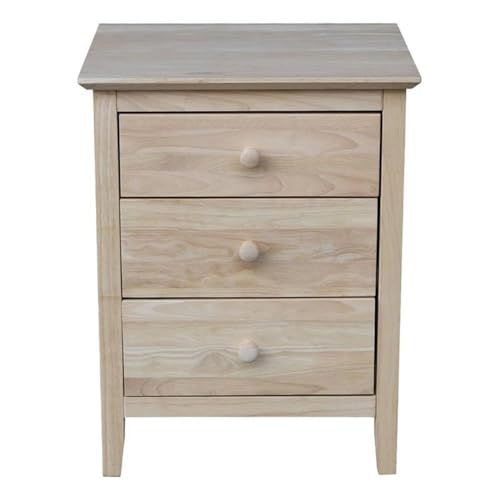
IC International Concepts 3-Drawer Ready to Finish
The closing pick returns to International Concepts with the deepest storage in the list and the roundup’s one vocabulary lesson. The title describes a solid wood nightstand with three drawers, ready to finish. Ready to finish is the furniture trade’s standard term for exactly the state the other five titles call unfinished: bare wood, awaiting the buyer’s chosen finish. This review uses the listing’s own phrase for the piece, because precision about wording is how shoppers find matching products, and because a buyer searching the ready-to-finish term should know it lands in the same category rather than a different one. No dimensions or species are printed in this title, a restraint opposite to its one-drawer sibling’s completeness.
Material: solid wood
Finish state: ready to finish (the listing’s own wording)
Storage: 3 drawers
Maker: IC International Concepts
Dimensions and species: not given in the listing title
Strengths
- Three drawers give the fullest bedside storage here alongside the pine tower, in a conventional case.
- A specialist unfinished-furniture maker stands behind the construction and the finishing premise.
- Solid wood throughout means every visible surface, drawer fronts included, takes finish evenly.
Trade-offs
- The title withholds dimensions and species, so the documentation carries the entire fit decision.
- Three drawers of unfinished wood are three drawers of sanding and finishing labour as well as storage.
- Buyers searching only the word unfinished may miss this listing’s equivalent claim entirely.
Drawer quality is where a three-drawer stand should be interrogated hardest, because three mediocre drawers are worse than one good one. The title states solid wood construction for the piece, and the questions for the documentation follow from that: whether the drawer boxes are wood or board, whether the runners are wood or metal, and how the drawer fronts attach. None of those answers is available in the title, and the review does not invent them. A buyer comparing this model against the pine tower should put the same questions to both listings and let the documentation, not the drawer count, arbitrate.
Three drawers change the finishing project’s scale, and the change should be planned rather than discovered. Drawer fronts can be removed and finished flat on a bench, which is easier and cleaner than working on an assembled case, and the case’s interior can be left bare or given a single clear coat to seal the wood against the odours drawers otherwise absorb from their contents over years. Sequencing the work, fronts first, case second, assembly last, finishes this piece in two relaxed sessions. Attacking it assembled, in place, in the bedroom, quickly teaches why the category has a dropout rate.
As the list’s closer, this model also frames the maker question. International Concepts appears twice in six picks with opposite documentation styles, one title exhaustive and one minimal, which is a reminder that a maker’s reputation and a listing’s completeness are separate variables. The construction confidence here rests on the maker’s specialisation in exactly this category; the fit confidence must be built by the buyer from the documentation, and the review keeps those two judgements separate, as it has throughout.
Best for: a storage-hungry bedside from a specialist maker, where the buyer will pull dimensions from the documentation before ordering. Not suited for: a project that needs its measurements inside the listing, or a schedule that wants the piece in service the same weekend it arrives.
Look at the IC three-drawer model through Check price on Amazon.
One table for the bedside wall
| Stand | Wood as titled | Storage | Dimensions printed | Distinguishing feature |
|---|---|---|---|---|
| Bonnlo Charging | Solid wood | Drawers | 18.54″ W only | Charging station |
| From the Tree Tall | Solid pine | 3 drawers | 26.8″ tall only | Height, wooden pulls |
| IC 1-Drawer | Solid parawood | 1 drawer + shelf | Full: 19.5 x 16.5 x 23.5 in | Euro glides, shelf |
| VINGLI Single | Solid wood | Drawers | None printed | Compact size |
| Bonnlo Small | Solid wood | Drawers | None printed | Small, no electronics |
| IC 3-Drawer | Solid wood | 3 drawers | None printed | Ready-to-finish wording |
The dimensions column is the table’s honest warning: only one of six titles carries the full set, so the documentation step is not a formality for the other five but the moment the purchase is actually decided.
Read across the storage column and a second pattern emerges: this category has quietly standardised on drawers over doors and open bases. No pick here hides its storage behind a cupboard door, and none offers the bare four-legs-and-a-top minimalism of a side table. The market has decided that a nightstand is a small chest first and a surface second, and the six titles agree. Where bedside style runs to the open and airy, even the shelf model here should be recognised as a storage piece, and the room’s visual weight planned accordingly.
How do you choose an unfinished nightstand?
Measure the bed before the wall
The governing measurement is the height of the mattress top, because a nightstand’s top should sit level with it or an inch or two above, so that a hand in the dark finds the surface where it expects it. The tall pine at 26.8 inches and the IC one-drawer at 23.5 inches bracket the common range; the other four picks require their documented heights to be checked against the same target. Width follows the gap between bed and wall or wardrobe, and depth should stay modest enough that the stand does not crowd the room’s walking line.
Decide the finish before the furniture
Stain, paint, and clear coat are three different purchases wearing one category name. Stain wants cooperative grain, parawood’s evenness or pine with conditioner, and shows the wood the buyer paid for. Paint forgives everything and suits small pieces and bold rooms. Clear finishes preserve the bare look with protection, the choice where the wood is liked exactly as it arrives. Choosing first also settles the preparation shopping: conditioner for pine, primer for paint, and the sandpaper sequence for all three.
Count what the bedside must hold
Inventory honestly: a bedside that must stage medication, water, a book, glasses, a phone, and a lamp needs drawers; the minimalist end of the scale needs a shelf and a surface. Three-drawer models exist for the first sleeper, the shelf model for the second, and the small stands for rooms where the inventory is a child’s or a guest’s. Buying storage that matches the inventory keeps the top clear, and a clear top is the difference between a nightstand and a pile with a lamp on it.
New bedside, or an heirloom in the making?
Budget thinking divides buyers usefully. A stand bought as a stopgap should be small, paintable, and cheap in effort, the VINGLI or small Bonnlo pattern, since its finish may never be renewed. A stand bought as the bedroom’s long-term furniture justifies the deeper projects, the three-drawer cases and the tall pine, because the finishing weekend’s labour amortises across decades of nightly use. Confusing the two intentions produces the category’s saddest outcome: an elaborate piece bought for a temporary room and never finished, or a slight piece asked to serve a primary bedside for twenty years.
Plan the finishing weekend
Every pick here is a project as well as a product. The work wants ventilation, a drop cloth, sandpaper in two grits, a tack cloth, the chosen finish, and drying time undisturbed by use. A stand finished on Saturday and loaded on Sunday carries fingerprints in its coat for years. Buyers without a workspace can still succeed on a balcony or in a garage corner, but should choose the smaller pieces and paint, the combination most forgiving of improvised conditions.
Finishing bare wood: the short, honest method
The process that serves every piece in this list has five stages, and none of them is optional. Inspection comes first: run a hand over every surface in raking light, mark dents and glue spots with pencil, and check drawer action before any finish makes a fault permanent. Sanding follows, working through the grits without skipping, because each grit exists to remove the previous one’s scratches, and finishing sanding at a finer grit than the stain can handle will also close the grain against colour, so follow the finish manufacturer’s own grit guidance rather than a general rule. Dust removal is the third stage and the one amateurs rush: vacuum, then a tack cloth, then patience, because dust nibs in a dried coat are forever.
Ventilation and temperature govern the work more than skill does. Finishes cure by chemistry that cold, damp air slows and dusty air ruins, so the finishing space wants moving air, moderate temperature, and a day without other dusty projects nearby. The garage during a woodworking session is the worst finishing room imaginable; the same garage, swept and settled overnight, is a good one. Beginners attribute most finishing failures to their own hands when the room was the culprit, and the correction costs nothing but scheduling.
Colour is the fourth stage, applied in thin coats with the grain, tested first on a hidden surface as the VINGLI review advises. Between coats, the manufacturer’s stated drying time governs, not the surface’s dry feel. The final stage is the protective top coat where the finish system calls for one, and the bedside top, which will host glasses and cups, argues for the most defensive version of whatever system was chosen. Bare wood left entirely unfinished is also a legitimate choice for a drawer interior or a rustic room, with the understanding that it will absorb marks and odours as the years pass; the category’s premise is choice, and informed bare is a choice, while accidental bare is merely a postponed project.
What bare wood does to a bedroom while it waits
There is an interim state every buyer of these six pieces will live in, the weeks or months between delivery and the finishing weekend, and it deserves honest description because it influences whether the project happens at all. Bare wood in a bedroom is pale, matte, and quietly present; it does not clash with anything, which is precisely the danger. A household can live comfortably beside an unfinished stand for a year, the urgency draining away, while the wood accumulates the rings, wax, and hand oils that will complicate the eventual finish. The stands in this list will tolerate a reasonable interim, but the top should be protected from the first night, a cloth, a tray, coasters, as if the finish were already precious, because the surface being protected is the one the finish must bond to.
The interim has one more use: it is a trial of the configuration. Living with the stand reveals whether the drawers suffice, whether the height truly matches the mattress in the dark rather than on the tape, and whether the lamp’s position works. A stand that fails the trial can be exchanged or reassigned before any finish makes it unmistakably yours, which is a flexibility pre-finished furniture never offers. Buyers should schedule the finishing weekend at the end of that trial, deliberately, with the lessons of the interim folded into the plan, a harder top coat where the water glass actually sat, a drawer organiser where the clutter actually gathered.
Matching two bedside stands when only one is bought today
Bedrooms change in stages, and the nightstand bought this year is often asked to find its twin next year. Unfinished furniture is uniquely kind to that staging, provided the finisher keeps records. The twin-matching discipline has three parts. First, buy from a model that remains in production, which favours the specialist makers and long-running lines in this list. Second, record the finish recipe as if it were a paint formula at a shop: product name, colour, number of coats, sanding grits, and the date, kept with the house paperwork. Third, keep the leftover finish, sealed, or accept that a later batch may differ slightly and plan the second stand’s finish as a deliberate near-match rather than a failed exact one.
Wood itself drifts as well, and honesty requires naming it: a stand that has lived a year in a sunlit room will have deepened in tone beneath its finish, and a freshly finished twin will look paler beside it for its own first year before the two converge. Bedrooms, which are rarely sunlit for long, forgive this more than most rooms. The practical conclusion is not to fear staging the purchase, but to stage it knowingly, with the recipe recorded and the expectation set. No pre-finished furniture offers even that much control, since a discontinued factory colour is simply gone.
Bedside buying mistakes, collected
Matching the stand’s height to the bed frame instead of the mattress top. Frames vary wildly; the sleeper’s hand travels to the mattress surface. Measure to the top of the mattress, with bedding compressed as it is in use, and compare that figure to the stand’s documented height.
Staining pine without a conditioner or a test. Pine’s blotching is the most documented disappointment in home finishing, and the remedies are cheap and known. The test patch on a hidden surface takes ten minutes and decides whether the project ends in pride or in paint.
Finishing the piece in the bedroom it will serve. Solvent and oil finishes need ventilation while they cure, and a curing stand cannot be used, moved, or slept beside comfortably. Finish where the air moves, and let the piece cure fully before it takes up bedside duty.
Assuming a pair will match because the singles do. Two bare-wood stands finished by the same hand in the same session will match; finished months apart from different finish tins, they may drift apart in tone. Pairs should be bought together and finished together, in one batch of mixed finish, for exactly this reason.
Ignoring the drawer’s interior. Raw drawer boxes absorb the smells of their contents and the humidity of the room. A single clear coat inside, or even a thorough waxing, keeps drawers fresher across years of storing linens and clothing at the bedside.
Choosing stain colour from the tin’s label photograph. The photograph shows the stain on the manufacturer’s chosen wood, under studio light. On your species, in your room’s light, the same stain reads differently, sometimes dramatically. The hidden-surface test is the only reliable preview, and skipping it is choosing blind.
Overloading a small stand’s top because the drawers filled. A compact stand is a system with a small capacity in every dimension. When the inventory outgrows it, the answer is a different piece of furniture or a ruthless edit of the inventory, not a teetering stack that ends in a spilled glass at 3 a.m.
Final recommendation
A word on ordering sequence for the whole list: because five of six titles leave at least one dimension to the documentation, the right order of operations is documents first, purchase second, finishing supplies third. The supplies should be bought after the wood is in hand and its species and test patch are known, not alongside the furniture on a guess. That sequencing costs a few days and saves the most common waste in this category, the wrong stain, the wrong conditioner, and the finish chosen for a wood the buyer had not yet met.
The IC International Concepts one-drawer is the safest recommendation in the list, because it is the only pick whose every important figure is printed in its title: parawood that finishes forgivingly, full dimensions that can be checked against the bed tonight, a drawer for the private inventory and a shelf for the visible one. The From the Tree pine tower is the character choice, tall and capacious, for a cottage room and a finisher willing to condition pine. Bonnlo’s charging model is the contemporary answer, provided its height checks out in the documentation and its top gets a hard finish. The IC three-drawer serves the storage-maximal bedside, the VINGLI the narrow gap, and the small Bonnlo the painted child’s room or guest corner. Bedroom projects tend to widen once they begin, and readers reworking the room’s airflow alongside its furniture can consult Best Window Fans Casement Windows before the paint dries.
Questions from the finishing bench
How long does finishing a nightstand actually take?
Active work is a few hours spread across two or three sessions: preparation and sanding, colour, and top coat, with drying intervals between that the finish manufacturer specifies. Calendar time is usually a weekend, most of it waiting. The three-drawer models sit at the long end of that range and the small painted stands at the short end, which is worth weighing when the piece is needed in service by a date.
Can an unfinished stand be used bare while the project waits?
Yes, with eyes open. Bare solid wood is fully functional furniture; it will simply take marks, rings, and odours that later finishing cannot entirely remove. A coaster discipline and a cloth under the water glass protect the top in the interim, and drawer contents should be lined if the interior is to stay fresh for its eventual coat.
Is parawood a real hardwood or a marketing term?
It is a real material with a plain origin: the timber of rubber trees at the end of their latex-producing life, milled into furniture lumber. It is dense, pale, and fine-grained, widely used in unfinished furniture precisely because it machines cleanly and finishes evenly. Its sustainability story, a plantation by-product given a second life, is a legitimate part of its appeal.
Should the inside of the case be finished too?
Interiors divide finishers. The case for sealing them: raw wood absorbs humidity and odours, and a sealed interior wipes clean. The case against: interior finishing doubles the labour on surfaces nobody sees, and traditional furniture often left interiors bare for exactly that economy. A middle path serves most owners: seal the drawer boxes lightly, since they hold clothing and linens directly, and leave the case’s hidden frame bare. Whichever path is chosen, decide before the first coat, because finishing an interior after assembly is misery.
What other projects pair with a bedroom furniture refresh?
The bedside is where a household’s devices and comforts gather, so the same project often touches cooking and climate gear elsewhere in the home; the probe-accurate cooking research at Best Wireless Meat Thermometers 4 Probes suits the celebratory dinner after the move, and the cookware comparison at Best Cookware Sets with Pour Spouts completes the kitchen side of a whole-home refresh.
One last encouragement for the hesitant finisher: the first piece is the hardest only in anticipation. Bare wood is a forgiving medium, sandpaper corrects enthusiasm, paint covers a multitude of learning, and a nightstand is the ideal scale at which to acquire the skill, large enough to matter, small enough to finish in a weekend, and used every single night thereafter as evidence that the skill was worth acquiring.
Keep the finish recipe with the house records when the work is done, alongside the paint colours and the appliance manuals; the next owner, or the same owner in ten years with a matching dresser in mind, will be grateful for the one page that turns a guessing game back into a formula.
And when the second nightstand eventually joins the first, stand back on the first evening and notice how the pair bookends the bed in a colour that exists nowhere else, because it was mixed, tested, and applied by the household itself; that small proprietary satisfaction is the dividend this whole category pays, and no factory finish at any price includes it.
Sand the rehearsal patch a fraction finer than instinct suggests, because the test only predicts the real surface when its preparation matches the preparation the visible wood will receive.
Label the underside of the top drawer with the finish date and recipe in pencil, the furniture maker’s traditional signature, so the record lives with the piece itself rather than in a file the house may lose.
Grain, glue lines, and drawer fit are all visible on a bare piece in a way no finished showroom model permits, which makes the unfinished stand the most honestly inspectable furniture purchase in the entire bedroom.
Buy the wood for the room it will become, finish it with patience, and the plainest piece in this list will outlast every pre-coloured rival it was ever compared with.


