What's inside
- Where to buy these picks
- Quick picks at a glance
- How these picks were chosen
- The six picks in detail
- Comparing the six steel bodies
- What should you check before a metal toaster earns counter space?
- Long slots versus four square slots
- Reading wattage and shade claims with a cool head
- Steel bodies and heat: what the housing does while you toast
- A week of breakfasts, machine by machine
- Cords, counters and other unglamorous checks
- Evenness, element layout and the two-slice test
- Buying for a household, not for a specification sheet
- Toaster longevity: what actually wears out
- The countertop neighbourhood a toaster lives in
- Gift logic, guest logic and the second toaster question
- What to do in the first week with a new toaster
- Common mistakes
- Final recommendation
- Frequently asked questions
As an Amazon Associate I earn from qualifying purchases. This post may contain affiliate links at no extra cost to you.
As an Amazon Associate, cottageverdict.com earns from qualifying purchases.
Plastic housings yellow, flex and hold onto old crumbs in their seams, which is why best metal toasters keep winning counter space in kitchens that toast every single day. A stainless steel body shrugs off the wiping that breakfast demands, holds its shape around hot slots for years, and looks at home beside steel kettles and cookers. This guide compares six toasters whose listings state stainless steel outright — five compact 2 slice models and one 4 slice long-slot machine — and separates them by the details their titles actually print: slot width, shade counts, wattage where given, crumb tray design and the small functions, from bagel settings to toast boost, that decide a weekday morning.
Toast looks simple until two slices emerge different colours, and the reasons usually hide in the specifications nobody reads. Slot width decides whether a thick bagel half or a slice of sourdough fits at all; shade ranges decide how fine the control is between pale and dark; a crumb tray decides whether cleaning is a ten-second slide or a shake over the bin. Every fact used below comes from the listing title of the toaster concerned, and where a title prints almost nothing — one entry here is famously terse — the review treats that silence honestly rather than filling it with assumptions.
Where to buy these picks
Each of the six is sold on Amazon, and the short notes below preview the full reviews further down. Households should start by counting slices at their busiest breakfast, because that single answer splits this list into five candidates and one.
- Hamilton Beach 2 Slice Stainless 22794 — leads with the longest function list of the compact models — bagel setting, Toast Boost, defrost, auto-shutoff and a slide-out tray.
- GE 2 Slice Stainless Steel Toaster — is the specification sheet of the group: 1,500 watts, seven shades and slots measured to the hundredth of an inch.
- Cuisinart CPT-160P1 2-Slice Stainless — trades function lists for design: a retro silhouette, a six-setting dial and a brushed stainless finish around 1.5 inch slots.
- bella 2 Slice Stainless Steel Toaster — says almost nothing and means it: a 2 slice toaster, extra wide slots, stainless steel — the minimalist entry of the six.
- Oster 2-Slice Stainless Steel Toaster — bundles one-touch bagel, defrost and cancel functions beside seven toast shades and an easy-clean crumb tray.
- Elite Gourmet ECT-3100 4-Slice Long Slot — doubles capacity and stretches the slots: four slices, 1.5 inch width, six browning levels, reheat and a built-in warming rack.
Quick picks at a glance
| Pick | Best for | Standout from the listing |
|---|---|---|
| Hamilton Beach 2 Slice Stainless 22794 | Mixed breakfasts with small items | Toast Boost for lifting short slices |
| GE 2 Slice Stainless Steel Toaster | Buyers who decide by printed numbers | Measured slots plus a stated wattage |
| Cuisinart CPT-160P1 2-Slice Stainless | Dial lovers and retro-styled kitchens | Brushed finish with a 6 setting dial |
| bella 2 Slice Stainless Steel Toaster | Simple, specification-light toasting | Extra wide slots with a bare-bones listing |
| Oster 2-Slice Stainless Steel Toaster | Frozen-bread homes running one-touch controls | One-touch trio with 7 shades |
| Elite Gourmet ECT-3100 4-Slice Long Slot | Families and long bakery loaves | Long slots plus a warming rack |
How these picks were chosen
The entry rule for this list was material honesty: the listing title had to state stainless steel, so the metal in the headline is a printed fact rather than a finish guessed from a photograph. Six models from six makers cleared that bar, and colour variants of the same model were excluded so the comparison stays between genuinely different machines. Five are 2 slice toasters, reflecting how most counters and most households actually work, and the sixth is a 4 slice long-slot design for families and for breads that refuse to fit a standard slot.
Within that frame, the titles were mined for the specifications that change breakfast. Slot dimensions appear in two listings — one prints 1.38 by 5.50 inches, another 1.5 inch slots — and extra-wide slot wording appears in several more. Shade control ranges from six settings to seven shades depending on the model, and one listing prints its wattage, 1,500 watts, which anchors the power conversation for the whole group. Crumb management splits between slide-out and removable or easy-clean trays, and special functions were logged exactly as titled: bagel settings, defrost, cancel, reheat, toast boost and a built-in warming rack each appear somewhere in these six listings, but never all in one machine — which is what makes choosing interesting.
The six picks in detail

Hamilton Beach 2 Slice Stainless 22794
Some toasters compete on power figures; this Hamilton Beach, model 22794, competes on the small frustrations of breakfast. Its listing describes a 2 slice toaster with extra-wide slots, a bagel setting, Toast Boost, a slide-out crumb tray, auto-shutoff and a cancel button, a defrost function and a stainless steel body. Read in sequence, those features describe a morning: frozen bread defrosted, a bagel toasted on its setting, a crumpet lifted clear by the boost, crumbs slid out afterwards, and a machine that switches itself off if the routine is interrupted.
- Format: 2 slice, extra-wide slots
- Body: stainless steel, model 22794
- Functions: bagel setting, defrost, cancel, auto-shutoff
- Retrieval: Toast Boost
- Crumb care: slide-out crumb tray
Strengths
- Broadest function list among the 2 slice entries
- Toast Boost solves the stuck crumpet problem
- Slide-out tray makes crumb emptying a seconds-long job
Trade-offs
- Shade range is not numbered in the title
- No reheat function is mentioned
- Slot dimensions are described, not measured, in the title
Toast Boost deserves explanation because its value is invisible in a showroom. Deep slots swallow short items — crumpets, small ends of a loaf, a single waffle — and retrieving them usually means fingertips near hot elements or a wooden tool kept specially nearby. A boost function raises the carriage beyond its resting height, presenting the item for a clean grip. Households that toast a variety of breads, rather than one uniform loaf, will use it weekly; households married to a single sliced loaf may never touch it, which is an honest split rather than a flaw.
The surrounding functions form a sensible safety and convenience net. Auto-shutoff matters in kitchens where breakfast collides with school runs and doorbells, and a dedicated cancel button beats wrestling a lever when a slice starts to scorch. Defrost extends the machine to freezer households, and the bagel setting directs extra attention to the cut side of a bagel half, the side that actually wants crisping. The title’s silence on shade numbers is the one gap: control granularity has to be judged on the product page, against rivals here that print six or seven steps openly.
Best for: households toasting crumpets, bagel halves and frozen slices in the same week, in a 2 slice steel body
Not suited for: four slices at once, since this is a 2 slice machine with no long slot
Check price on Amazon — start here if small-item retrieval is your breakfast bugbear.
GE 2 Slice Stainless Steel Toaster
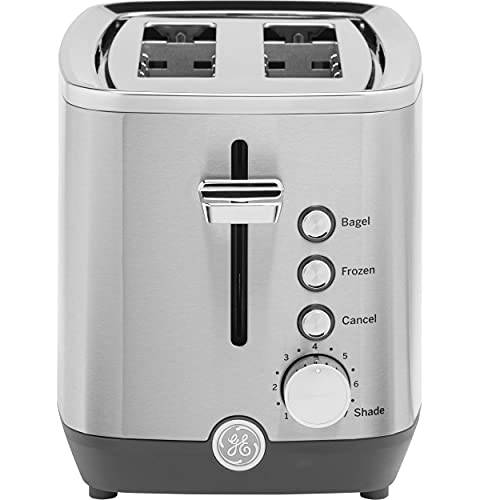
GE’s listing reads like an engineer’s answer to toaster shopping. It describes a 2 slice stainless steel toaster with extra wide slots and 7 shades, prints 1,500 watts with an even toasting claim, gives the slot dimensions as 1.38 by 5.50 inches, and adds a removable crumb tray, a statement that the slots fit bagels and waffles, and a defrost function. In a category where several rivals offer adjectives, this title offers measurements, and that alone will settle the choice for a certain kind of buyer.
- Layout: 2 slice, extra wide slots
- Power: 1,500 watts, per the title
- Slots: 1.38 x 5.50 in, measured in the listing
- Control: 7 shades
- Crumb care: removable crumb tray; defrost function included
Strengths
- Only listing here to print its wattage
- Slot dimensions remove the bagel-fit gamble
- Seven shades give fine browning steps
Trade-offs
- No bagel setting is named, only bagel fit
- No cancel button is mentioned in the title
- No reheat or boost function appears
Measured slots change the buying conversation from hope to arithmetic. A bagel half at home can be measured with a ruler in ten seconds and compared against 1.38 inches of width and 5.50 inches of length, and the same check works for a thick bakery slice. That verifiability is worth more than any number of extra-wide adjectives, and it is unique in this group — the Cuisinart prints a slot width, but only GE prints both dimensions. The fit claim for bagels and waffles then reads as a consequence of the measurements rather than a substitute for them.
The 1,500 watt figure pairs with an even toasting claim from the maker, and both should be read as the listing’s own statements. Power at that level suggests brisk browning, while evenness in practice still depends on bread and placement; what the number genuinely provides is a comparison anchor the other five listings withhold. Seven shades complete a control story aimed at households with strong and differing colour preferences. Missing from the title are a named cancel control and any bagel-specific cycle, so anyone cancelling mid-cycle often should verify the controls on the product page.
Best for: a two-slice household that measures its bagel halves and wants seven shade steps with a stated 1,500 watt output
Not suited for: lengthwise sourdough slices beyond the printed 5.50 inch slot length
Check price on Amazon — the numbers-first choice; bring a ruler to your bread bin.

Cuisinart CPT-160P1 2-Slice Stainless
Cuisinart’s CPT-160P1 makes the aesthetic argument in a group that mostly argues specifications. The listing describes a stainless steel 2 slice toaster with a 6 setting dial, model CPT-160P1, and characterises it as a retro design with 6 browning settings, 1.5 inch slots and a brushed stainless steel finish. That is a short title by the standards of this page, and its brevity is the point: a dial, a known slot width and a finish chosen to sit quietly in a kitchen that values how appliances look at rest, not only how they perform at breakfast.
- Format: 2 slice, model CPT-160P1
- Slots: 1.5 in wide, per the title
- Control: 6 setting dial, 6 browning settings
- Finish: brushed stainless steel
- Style: retro design, per the listing
Strengths
- Brushed finish hides fingerprints gracefully
- Dial control is glanceable and tactile
- Slot width is printed rather than implied
Trade-offs
- Function list in the title is the shortest here
- Crumb tray design goes unmentioned
- No wattage figure is published in the title
A dial earns loyalty that buttons rarely do. It shows its setting at a glance from across the kitchen, it can be nudged half a step by feel, and it returns to a household member’s preferred number without a display to cycle. Six settings across that dial cover the realistic browning range for ordinary bread, and the step size between settings is large enough that adjacent numbers produce visibly different toast — a quiet virtue, since dials with too many steps blur into sameness. The retro design language wraps that dial in a shape meant to be seen, which suits counters where the toaster never gets put away.
Brushed stainless is the pragmatic finish choice in this group. Polished steel photographs beautifully and then records every fingerprint and water spot; a brushed surface diffuses both, so the machine looks kept rather than handled. The 1.5 inch slot width is the widest single figure printed by any 2 slice entry here, edging the GE’s 1.38 inches for thick slices. What the title withholds — tray design, defrost, cancel, wattage — forms a longer verification list than its rivals carry, so design-led buyers should still spend two minutes on the product page confirming the daily mechanics.
Best for: a design-led two-slice kitchen using slices up to the printed 1.5 inch slot width, controlled by a dial
Not suited for: frozen-bread defrosting as a stated feature, since no defrost function appears in this title
Check price on Amazon — for counters where the toaster is part of the room’s look.

bella 2 Slice Stainless Steel Toaster
The bella listing is eight words of substance: a 2 slice toaster, extra wide slots, stainless steel. Where rival titles stack functions and figures, this one states the format, the slot claim and the material, and stops. That restraint can be read two ways — as confidence in a simple machine, or as a specification gap a buyer must close elsewhere — and this review holds both readings honestly. What is certain is the shape of the offer: a compact steel 2 slice toaster for households whose breakfast is a slice or two of ordinary bread, toasted without ceremony.
- Format: 2 slice
- Slots: extra wide, per the title
- Body: stainless steel
- Control range: not given in the listing title
- Functions: none stated in the listing title
Strengths
- Uncluttered proposition — format, slots, steel
- Extra wide slots cover bagels and thick slices in principle
- Nothing superfluous for a one-loaf household
Trade-offs
- Shade count is absent from the title
- Tray, defrost and cancel all go unmentioned
- No dimensions allow a measured fit check
Simplicity has a real constituency. A toaster with a short feature list has fewer modes to misunderstand, fewer controls for a guest or a teenager to set wrong, and a decision process at purchase that takes minutes. For a household toasting the same sliced loaf most mornings, the bella’s three stated facts — two slices, wide slots, steel body — genuinely cover the job description, and the extra-wide slot claim, while unmeasured, addresses the one fit question that matters for bagels and thick cuts. Buyers in that narrow, common situation are not settling; they are matching the machine to a stable routine.
The counterweight is verification burden. Every rival in this list prints at least a shade count, and most print tray and function details; the bella prints none, so the product page must supply browning range, crumb arrangements and controls before an informed order is possible. That is a five-minute task, not a disqualification, but it means this toaster should be bought deliberately rather than by default. Households with varied breads, frozen loaves or strong colour preferences will extract more value from the specified machines around it.
Best for: a one-loaf household wanting two extra-wide slots in a steel body and nothing more complicated
Not suited for: orders requiring the shade count and tray design in writing, since the title states neither
Check price on Amazon — the plain steel option; give its product page a careful read first.

Oster 2-Slice Stainless Steel Toaster
Oster’s entry organises breakfast around buttons that name their jobs. The listing describes a 2 slice toaster with extra wide slots in stainless steel, then specifies extra-wide slots again alongside one-touch bagel, defrost and cancel functions, 7 toast shades and an easy clean crumb tray. The repetition of the slot claim aside, the shape of the offer is clear: a compact steel machine whose controls are labelled by outcome, aimed at households that toast from the freezer as often as from the bread bin and want each mode a single press away.
- Capacity: 2 slices, extra wide slots
- Body: stainless steel
- Functions: one-touch bagel, defrost and cancel
- Control: 7 toast shades
- Crumb care: easy clean crumb tray
Strengths
- One-touch labelling suits shared and guest use
- Seven shades match the finest control here
- Defrost is a headline function, not a footnote
Trade-offs
- Slot width is claimed, not dimensioned
- No wattage appears in the title
- No reheat or warming feature is mentioned
One-touch controls change who can use a toaster well. A labelled bagel button removes the guesswork of compensating with the shade dial, a defrost button encodes the thaw-then-toast sequence the machine should run, and cancel sits ready for the slice that darkens faster than expected. In a household where different people toast with different confidence levels, that labelling consistency produces more even results across the week than a marginally better element would. Oster’s seven shades then fine-tune within each mode, giving the colour argument the same granularity GE offers.
The easy clean crumb tray phrase is doing quiet work in the title, because tray friction is the main reason crumb maintenance gets skipped. A tray described as easy to clean invites the weekly emptying that keeps a steel toaster smelling fresh. The gaps are the familiar ones in this group: no printed wattage, no measured slot, and no reheat for the slice that waited while eggs cooked. None of those gaps touches the core frozen-to-fresh routine this machine is built around, which is why it reads as one of the most coherent compact offers here.
Best for: households toasting frozen bread and bagels daily, wanting each mode on its own button across 7 shades
Not suited for: long artisan slices, which a standard 2 slice format cannot take whole
Check price on Amazon — the button-led pick for freezer-to-toast mornings.
Elite Gourmet ECT-3100 4-Slice Long Slot
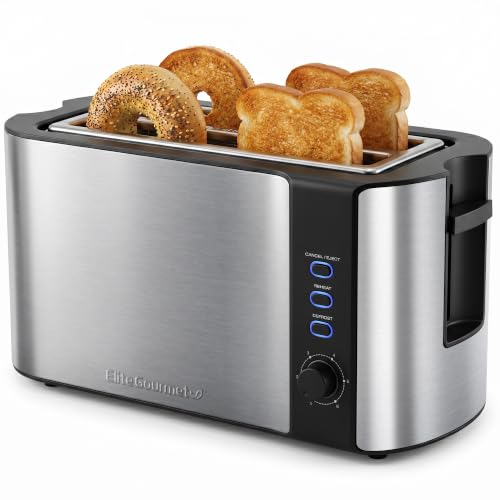
Every list has an outlier, and the ECT-3100 is this one: a 4 slice long slot toaster in stainless steel, model ECT-3100, where the other five are compact 2 slice machines. Its listing specifies 1.5 inch wide slots and 6 browning levels, then adds reheat, defrost and cancel functions, a built-in warming rack, and a fit claim spanning bagels, sourdough and Texas toast. The proposition is capacity plus geometry — more slices at once, and slots shaped for the long, wide breads that defeat standard toasters.
- Format: 4 slice, long slot, model ECT-3100
- Slots: 1.5 inch wide
- Control: 6 browning levels
- Functions: reheat, defrost, cancel
- Extras: built-in warming rack; body in stainless steel
Strengths
- Only 4 slice capacity in this group
- Long slots accept sourdough and Texas toast whole
- Warming rack handles croissants and rolls
Trade-offs
- Largest counter footprint of the six
- Six levels, not seven, of browning control
- Crumb tray design is not described in the title
Capacity is a quality-of-life feature disguised as a number. Four slices at once means a family’s toast lands together, eggs meet toast while both are hot, and nobody eats in shifts around a 2 slice bottleneck. The long-slot format delivers that capacity without the blocky footprint of a four-square machine, trading depth for length along the counter. Sourdough is the geometry’s showcase bread: a wide slice from a round loaf fits lying flat, browns in one cycle, and emerges whole rather than trimmed or doubled-toasted at one end.
The warming rack extends the machine beyond toast entirely. Croissants, yesterday’s rolls and a naan to accompany lunch all warm above the slots without being subjected to a browning cycle, and reheat performs the same rescue for toast itself. Six browning levels rather than seven is the modest concession, and in practice the difference between six and seven steps is smaller than the difference bread makes. Buyers should measure the counter run before ordering — length is this machine’s currency, and it spends more of it than any rival here.
Best for: families toasting four slices at once, including whole sourdough and Texas toast in 1.5 inch long slots
Not suited for: a short counter run, where this long-slot body will crowd out prep space
Check price on Amazon — measure your counter length, then let the big steel machine earn it.
Comparing the six steel bodies
| Toaster | Format | Browning control in the title | Signature extra |
|---|---|---|---|
| Hamilton Beach 2 Slice Stainless 22794 | 2 slice | Shade control not numbered in title | Toast Boost, bagel setting |
| GE 2 Slice Stainless Steel Toaster | 2 slice | 7 shades | 1,500 watts, measured slot dimensions |
| Cuisinart CPT-160P1 2-Slice Stainless | 2 slice | 6 setting dial | Retro design, brushed finish |
| bella 2 Slice Stainless Steel Toaster | 2 slice | Not stated in the listing title | Extra wide slots, minimal specification |
| Oster 2-Slice Stainless Steel Toaster | 2 slice | 7 toast shades | One-touch bagel, defrost and cancel |
| Elite Gourmet ECT-3100 4-Slice Long Slot | 4 slice long slot | 6 browning levels | Built-in warming rack |
Read down the browning column and a pattern emerges: the machines that print a number cluster at six or seven steps, while the two that stay silent force a buyer to judge control from the product page instead. The extras column shows the real spread of personalities — lifting help, raw wattage, retro styling, one-touch functions, sheer capacity — and no two rows argue the same case.
What should you check before a metal toaster earns counter space?
How wide do your usual slices run?
Measure the bread, not the marketing. A standard sandwich slice fits almost any slot, but bagel halves, thick-cut bakery loaves and Texas toast expose narrow slots immediately. Two listings here print figures — the GE’s slots measure 1.38 by 5.50 inches and the Cuisinart’s are 1.5 inches wide — while Hamilton Beach, bella and Oster all use extra-wide slot wording, and the Elite Gourmet stretches the idea lengthwise with long slots built for sourdough. If your household toasts artisan loaves more than sandwich bread, slot geometry is the first specification to settle, ahead of shade counts and styling.
Six settings or seven shades — does the extra step matter?
Only if your household argues about toast colour. Six browning levels, offered by the Cuisinart dial and the Elite Gourmet, already span pale to very dark in steps most people can distinguish. Seven shades, printed by GE and Oster, slice that range slightly finer, which helps when one person likes a shade between two standard steps. What matters more than the count is repeatability — a control that returns to the same colour at the same setting across a week — and that quality cannot be read from a title, so treat the printed number as a guide to granularity, not a promise of consistency.
Which functions will survive the novelty week?
Defrost earns its place in any house that freezes bread, because it adds a gentle thaw before the browning cycle instead of scorching a frozen slice outside while the middle stays cold; GE, Oster, Hamilton Beach and Elite Gourmet all print a defrost function. Bagel settings toast the cut side harder than the crust side and appear on the Hamilton Beach and Oster listings. Cancel is the quiet essential — every model here that lists functions includes it — while reheat, on the Elite Gourmet, rescues toast that sat while the kettle boiled. Toast Boost, unique to the Hamilton Beach in this group, lifts small items higher for retrieval, a small mercy for crumpets and small ends of loaves.
Where do the crumbs go, and how do they leave?
Crumbs decide whether a toaster stays pleasant in month six. Hamilton Beach specifies a slide-out crumb tray, GE a removable one, and Oster calls its tray easy clean; all three designs beat shaking a toaster upside down over the sink. The bella and Cuisinart titles stay silent on trays, and the Elite Gourmet title does too, so a tidy-minded buyer should confirm tray arrangements on those product pages. Whatever the design, empty the tray weekly in a busy house: a full tray insulates the base, holds stale smells, and in a metal-bodied machine left near the hob, it is simply hygiene deferred.
How much counter does a metal body deserve?
A 2 slice steel toaster occupies roughly a shoebox of counter and suits households of one to three, especially with toast made in relaxed sequence. The Elite Gourmet’s long-slot 4 slice format doubles capacity for families and for simultaneous breakfasts, but it claims a longer stretch of worktop and needs clearance for its warming rack in use. Measure the counter run honestly, including the space where plates land, and remember that a metal housing shows fingerprints under raking light — brushed finishes, like the Cuisinart’s, hide them better than polished ones.
Long slots versus four square slots
Most 4 slice toasters arrange four short slots in a block, but the Elite Gourmet in this list takes the other road: long slots that accept two ordinary slices end to end or one long slice of sourdough, a bagel pair, or a slab of Texas toast lying flat. That geometry changes what a family toaster is for. Bakery loaves sliced lengthwise, pitta breads and naan for a quick char, and the heel ends of a pan loaf all fit a long slot without trimming or turning, while a block toaster forces them into a second cycle with uneven results.
Long slots carry their own discipline. Two slices placed far apart in one long slot can brown at slightly different rates if the elements favour the middle, so centring slices matters more here than in a short slot that constrains position. The warming rack built into the Elite Gourmet’s title extends the format further, giving croissants and rolls a place to warm through without entering the slots at all. Households whose bread comes from a bakery rather than a sandwich loaf will find the long-slot argument persuasive; households toasting uniform sliced bread gain capacity but little else from the extra length.
Reading wattage and shade claims with a cool head
Only one listing in this group prints a power figure: the GE, at 1,500 watts, with even toasting claimed alongside. Wattage hints at how aggressively a toaster can brown, but it is a blunt instrument — element layout, slot spacing and the control’s timing shape the result as much as raw power, and a high figure guarantees nothing about evenness. The sensible reading is comparative modesty: where a maker prints watts, the number is verifiable and can be weighed; where the title is silent, speed claims should be discounted entirely and the choice made on slots, functions and build instead.
Shade language deserves the same calm treatment. Seven shades and six settings describe the dial’s divisions, not seven or six guaranteed colours, because bread moisture, sugar content and starting temperature shift the outcome at any fixed setting. Frozen bread at a middle setting emerges paler than fresh bread at the same setting, which is exactly why defrost functions exist. The practical habit is to standardise on your household loaf, learn its number on the dial through two or three breakfasts, and then trust the setting rather than the marketing — a routine that works identically on every machine in this list.
Steel bodies and heat: what the housing does while you toast
A toaster’s housing is not decoration around the elements; it is the part your hands, tea towels and wooden spoons meet while the inside glows. Stainless steel earns its place in that contact zone for three practical reasons. It does not soften or discolour at the temperatures a toaster’s exterior reaches during back-to-back cycles, it wipes clean of butter splashes and jam fingerprints without absorbing them, and it resists the dents that thin plastic shells collect in busy drawers and crowded counters. During a long session — the Elite Gourmet running four slices twice for a full house — a steel body will feel warm to the touch, which is normal conduction, but it keeps its shape and its footing while doing so.
Finish choice refines the ownership experience further. The Cuisinart’s brushed stainless scatters light along fine grain lines, so the smudges of daily handling blur into the surface instead of announcing themselves; a smoother polished steel, by contrast, shows every touch and rewards a weekly buff with a soft cloth. Neither finish changes browning, and buyers sometimes overweight this decision — yet the toaster is among the most visible objects in a kitchen, sitting at eye level on the counter all day, so choosing the finish you will enjoy looking at is a rational part of the purchase rather than vanity. What steel cannot do is cool the crumb tray or silence the lever; those remain design matters, settled model by model in the reviews above.
A week of breakfasts, machine by machine
Monday in most houses is sliced loaf and haste, and every machine here handles it; the differences surface as the week varies. Tuesday’s frozen bread separates the defrost-equipped four — Hamilton Beach, GE, Oster and Elite Gourmet — from the two whose titles never mention the function, because a proper defrost stage prevents the pale-centred, dark-edged result that a plain cycle gives a frozen slice. Wednesday’s bagels reward the Hamilton Beach’s named bagel setting and Oster’s one-touch equivalent, while the GE leans on its measured slot fit and the Cuisinart on its honest 1.5 inch width. Thursday’s crumpets and small ends belong to Toast Boost alone; no other listing here addresses retrieval at all.
The weekend redraws the map again. Saturday’s bakery sourdough fits whole only in the Elite Gourmet’s long slots, and its warming rack simultaneously brings croissants back to life, which is why that machine reads as a weekend appliance as much as a capacity one. Sunday’s leisurely second round — toast that waited and cooled — is reheat’s moment, again an Elite Gourmet title feature, though a brief low-setting cycle improvises the same rescue on any model. The bella’s week is the plainest: the same loaf, the same routine, no modes to choose, which for a stable household is not a limitation but a description of breakfast exactly as it happens. Matching a machine to your week’s actual variety, rather than to an imagined one, is the whole art of choosing here.
Cords, counters and other unglamorous checks
Three checks made before ordering prevent the low-grade annoyance that attaches to an otherwise good toaster. First, counter depth: a 2 slice steel machine still needs clearance behind it for its cord and for the heat plume above the slots, and the long-slot Elite Gourmet needs a run of worktop measured lengthwise, not guessed — tape the footprint out if the counter is shared with a kettle and a board. Second, socket position: toasters draw heavily for short bursts, and a machine that must live on an extension lead or be dragged forward daily will slowly migrate out of use; place the toaster where the socket already is. Third, crumb geography: a slide-out tray emptied over a bin two steps away gets emptied; a tray that requires carrying the whole machine gets neglected, so the Hamilton Beach, GE and Oster tray arrangements deserve weight in proportion to your household’s tidiness.
Cleaning rhythm completes the picture. Steel exteriors ask for a damp cloth and immediate drying to prevent water spotting, with the grain direction followed on brushed finishes. Slots should never meet a knife — the cancel function and an unplugged, cooled machine shaken gently over the bin handle stuck items — and the elements themselves need no cleaning at all. A toaster maintained on that light regime stays pleasant for years, which is the entire premise of buying the metal version in the first place: the housing will outlast several cycles of fashion, provided the small mechanics of trays, cords and counters were respected from the first week.
Evenness, element layout and the two-slice test
Every toaster in this list will be judged, sooner or later, by a private test its owner invents: two slices of the household loaf, side by side, compared edge to edge. Evenness in that test comes from element spacing, reflector condition and how centrally each slice sits in its slot, and none of those can be read directly from a listing title — which is why the titles’ verifiable contents, slot dimensions and control ranges, deserve the weight this guide gives them. A slot that centres a slice properly, as a correctly sized slot does, quietly improves evenness before any element switches on; a slice rattling in an oversized slot leans toward one element and browns in a gradient.
Owners can improve their odds with three habits. Centre each slice rather than dropping it against a slot wall. Keep the crumb tray empty, because a crumb layer insulates the base and subtly changes the thermal environment of the lower element. And run the household loaf through two calibration breakfasts at adjacent settings before declaring a machine uneven, since bread from the freezer, the bread bin and a fresh bakery bag will each present a different moisture load to the same setting. Judged after that calibration, the differences that remain between these six machines are the honest ones: capacity, geometry, functions and finish, which is where this guide has concentrated its comparisons all along.
Buying for a household, not for a specification sheet
Shared kitchens punish clever machines and reward legible ones. A dial like the Cuisinart’s announces its setting to everyone; Oster’s labelled one-touch buttons announce their purpose; both designs reduce the small frictions of other people’s breakfasts. The GE’s printed measurements serve a different household member — the one who buys the bread — by making fit a checkable fact at the shelf rather than a surprise at the counter. Hamilton Beach’s Toast Boost serves whoever toasts the crumpets. A good purchase conversation in a shared house is therefore not which toaster is best, but whose recurring frustration gets retired: the stuck small item, the frozen slice, the argued-over shade, the fourth person waiting.
Singles and couples face a simpler version of the same logic. Counter space is the scarcest resource in a small kitchen, and a compact 2 slice steel machine that is used daily beats a capacious one that must be fetched from a cupboard, because appliances that live out get used and appliances that travel get skipped. The bella’s entire proposition rests on that truth. Conversely, a family that regularly hosts brunch should weight the Elite Gourmet’s capacity and warming rack far above its footprint, because a toaster that cannot keep pace turns breakfast into a queue. The specification sheet informs the choice; the household’s actual mornings should make it.
Toaster longevity: what actually wears out
A steel housing will outlast almost everything inside it, so a metal toaster’s real lifespan is set by its moving and heating parts. The carriage latch takes a cycle of mechanical stress at every breakfast and is the classic first failure; treating it gently — letting the cancel function end a cycle rather than forcing the lever — is the single most effective longevity habit an owner has. Elements themselves are durable but dislike contamination: sugary glazes and cheese that drip onto an element bake into hotspots, which is why a toaster should never be asked to melt toppings inside the slots, a job the Elite Gourmet’s warming rack exists to do from above instead.
Crumbs are the slow enemy, again. A tray emptied weekly never becomes the compacted, heat-holding layer that stresses a base and taints the smell of fresh toast. Controls age by type: a simple dial, like the Cuisinart’s six-setting control, has little to go wrong beyond its markings fading, while multi-function button arrays trade some of that simplicity for their convenience. None of this argues against any machine here — it argues for buying the steel body with clear eyes, knowing the housing is a decade-long commitment and the habits around trays, latches and drips decide whether the rest of the machine keeps that appointment.
The countertop neighbourhood a toaster lives in
No toaster works alone. It negotiates counter territory with the kettle that fills beside it, the butter dish that must sit within spreading reach, and the board where slices wait their turn. Steel-bodied machines hold their own in that neighbourhood visually — they match the kettle and the cooker rather than clashing with them — but the practical negotiation is about heat and steam. A toaster’s plume rises straight up, so the underside of a wall cupboard directly above it takes daily warmth; a kettle’s spout should not vent across a brushed steel flank it will spot with scale. Arranging the trio so each appliance’s exhaust misses the others takes five minutes on the first day and pays back in finishes that stay clean-looking for years.
Gift logic, guest logic and the second toaster question
Toasters are given as gifts more often than most small appliances, and the steel versions in this list give well for a structural reason: a metal body reads as a durable, considered object rather than a disposable gadget, and it suits kitchens the giver has never seen because brushed or plain stainless collides with almost nothing. The safer gift profiles here are the legible ones — the Cuisinart’s dial for a recipient who dislikes menus of buttons, the Oster’s labelled one-touch functions for a home where manuals go unread, the GE’s measured slots for the bagel enthusiast whose halves are known to be thick. Whoever gives one should still confirm the recipient’s slice count and counter length through whoever shares their kitchen, because a 4 slice long-slot machine delivered to a one-person flat is generosity misaddressed.
The second toaster question arises in houses with a holiday let, a granny flat or a workshop kitchen, where a simple machine serves occasional use. That setting is the bella’s natural habitat: two slices, wide slots, steel body, nothing to configure and nothing to explain to a guest. Occasional use also changes the maintenance maths — crumbs sit longer between breakfasts, so a model whose tray slides out for a quick emptying between stays earns preference there too. Matching the machine to the setting, main kitchen or secondary, is the final refinement this guide offers: capacity and functions for the daily stage, simplicity and cleanability for the occasional one.
What to do in the first week with a new toaster
Treat the first week as calibration rather than judgement. Run the household loaf at the middle setting on day one and note the result on the box of the loaf itself, where the next buyer of bread will see it. Try the frozen setting, if the machine has one, on the same loaf from the freezer, and note that number too — two numbers, fresh and frozen, cover ninety percent of a household’s toasting life. Empty the crumb tray at the week’s end even if it looks innocent, partly to learn how the tray mechanism moves while it is still light, and partly to set the rhythm before the habit is needed. Wipe the steel once with a damp cloth and dry it immediately, establishing the grain direction on a brushed finish while the surface is still unmarked.
By the second week the machine should have disappeared into the routine, which is the true test of any appliance in this category. If a setting still surprises you, adjust the noted numbers rather than the machine’s reputation; bread changes with seasons and suppliers, and a toaster that is re-calibrated twice a year will seem consistent for a decade. Keep the noted numbers somewhere durable — a phone note, a card inside the bread bin — because the person who calibrated may not be the person toasting in six months, and shared knowledge is what turns a good machine into a good household appliance.
Common mistakes
Buying on shade count alone. Seven steps of an inconsistent control lose to six steps of a repeatable one every morning of the year. Treat the printed range as granularity, then judge the machine by slots, tray and functions that the title can actually support.
Assuming extra-wide means any bread fits. Wide is not long. A thick bagel half needs width; a sourdough slice needs length, which only the long-slot entry here provides. Match the slot shape to the loaf shape your household really buys.
Skipping the crumb tray for a month. Crumbs accumulate fastest in the first weeks when a new toaster is used constantly. A slide-out or removable tray takes seconds to empty; neglecting it dulls performance and leaves a stale smell around a steel body that otherwise wipes clean.
Toasting frozen bread on a fresh setting. Frozen slices need the defrost function that four of these listings provide. Browning a frozen slice directly chars the surface while the centre stays cold and doughy, and no shade adjustment fully compensates.
Cancelling by forcing the lever. Where a cancel button is fitted — and the function appears across these listings — use it. Hauling a carriage lever upward against its mechanism shortens the life of the latch, the part of a toaster that fails first.
Parking a steel toaster against the kettle’s steam. Metal housings tolerate heat well but water spots and limescale bloom on brushed and polished steel alike. Give the toaster its own dry stretch of counter and the finish keeps the look that justified buying metal.
Final recommendation
Give the GE the first look if specifications are how you decide: it is the only entry printing wattage, slot dimensions and a shade count together — 1,500 watts, slots measuring 1.38 by 5.50 inches, seven shades — which makes it the most checkable buy in the six.
Hamilton Beach answers with the friendliest small-item handling, since Toast Boost plus a bagel setting and a slide-out tray cover the fiddly parts of breakfast that bigger specifications ignore. Cuisinart’s CPT-160P1 suits the dial devotee: a retro silhouette, a brushed finish and contentment with six settings. The bella is the minimalist’s option, a steel 2 slice machine with extra-wide slots and almost no printed promises, bought on simplicity. Oster gathers the one-touch trio of bagel, defrost and cancel beside seven shades for households that run frozen bread daily. Elite Gourmet stands alone for capacity and loaf shape, its long slots, warming rack and four-slice format serving families and bakery bread that the other five cannot accommodate whole.
Breakfast appliances tend to share a counter and a routine. The same return-air grille that feeds your heating system needs a correctly sized filter, and Best Furnace Filters 16x20x1 compares the 16x20x1 options by rating and pack size. Cooks moving from toast to full brunch spreads may also be weighing pans, in which case Best Nonstick Cookware Sets Removable Handle Covers looks at detachable-handle sets that stack away neatly. And for the hob itself, Best Radiant Cooktops 36inch covers wide radiant cooktops and what their listings state about zones and power.
Frequently asked questions
Are all six toasters really metal bodied?
Every listing title here states stainless steel, which was the entry rule for the list. The Cuisinart specifies a brushed stainless finish and the Elite Gourmet names stainless steel alongside its model number, while the bella keeps the claim to a single closing phrase. None of the six titles describes a plastic housing.
Which toaster handles bagels best on paper?
Three listings speak to bagels directly. Hamilton Beach prints a bagel setting, Oster prints a one-touch bagel function, and GE states that its slots fit bagels and waffles, with measured dimensions to judge by. The Elite Gourmet also names bagels among the breads its long slots fit.
What does Toast Boost actually help with?
It appears only in the Hamilton Beach title, and it addresses retrieval: short items like crumpets and small loaf ends sit low in a deep slot, and a boost lifts them higher so fingers stay away from hot steel. It changes access, not browning.
Which model should a family of five start with?
The Elite Gourmet ECT-3100 is the only 4 slice machine in the group, and its long slots add sourdough and Texas toast to the family repertoire. Two-slice models can serve a family in sequence, but simultaneous breakfasts point firmly at the long-slot entry.
Do any of these toasters include a warming rack?
Only one title says so: the Elite Gourmet lists a built-in warming rack, intended for items like croissants that warm better above the slots than inside them. No other listing in the six mentions a rack.
Count tomorrow’s breakfast slices, measure your usual loaf against the slot figures above, and the right steel box for your counter selects itself.


