What's inside
- Key Takeaways
- Quick Picks
- How We Chose These Picks
- How Do the Six Compare at a Glance?
- Why Do Dual Controls Matter So Much?
- How Do You Test a New Toaster’s Evenness?
- What Do Bagel, Defrost, and Reheat Modes Actually Do?
- How Should You Care for a Toaster?
- How Does Power Sharing Work When All Four Slots Run?
- Which Breads Challenge a Toaster Most?
- What About Small Slices, Crumpets, and Other Awkward Loads?
- Toaster or Toaster Oven: Which Belongs on Your Counter?
- What Should Offices and Shared Kitchens Look For?
- How Energy-Efficient Is a Toaster, Really?
- How Do You Calibrate Your Household’s Shade Numbers?
- What About Long-Slot and Two-Slice Alternatives?
- Where Should the Toaster Live, and How Hot Does It Get?
- Which Mistakes Ruin Breakfast Most Often?
- Final Recommendation
- Frequently Asked Questions
- Related Guides
As an Amazon Associate I earn from qualifying purchases. This post may contain affiliate links at no extra cost to you.
cottageverdict.com is reader-supported. When you buy through links on our site, we may earn an affiliate commission.
Where to buy: the six toasters below are sold through Amazon, and the linked names in the Quick Picks table and the detailed sections lead to each model’s listing, where you can check price on Amazon and confirm slot dimensions and shade settings before ordering. The best 4-slice toasters earn their counter space at the most contested meal of the day, and this guide judges them on the only breakfast metrics that matter: four slices at once, browned evenly, at two different shades if the household demands it, without a wait or an argument.
A four-slice toaster is really two breakfasts sharing one body, which is why the defining feature of this class is not power but independence. Dual controls — two levers, two shade dials, two sets of preferences — turn a queue into a simultaneity: the sourdough devotee’s dark crunch and the white-bread traditionalist’s pale gold finish together, while the coffee is still pouring. Models without true dual control make four slices of the same compromise. The six below were chosen across that divide deliberately, from Cuisinart’s dual-control pair through Mueller’s wide-slot LED design and BLACK+DECKER’s family workhorse, to GE’s measured-slot newcomer and Amazon Basics’ budget statement of the category’s essentials.
Slot width is the second decision, and it has quietly become the first one for many households. Bakery loaves, bagels, thick artisan slices, and frozen waffles all measure wider than the sandwich bread this appliance was invented for, and a toaster whose slots reject your actual bread is a sculpture. Every pick section below therefore leads with what fits — extra-wide and 1.6-inch and 1.38-inch claims stated by the listings themselves — because in this category the tape measure is a cooking specification.
Key Takeaways
- Dual independent controls are the four-slice feature that changes mornings: two shades, two breads, one simultaneous round instead of a queue.
- Slot width decides what your household can toast at all — 1.6-inch slots take artisan slices and bagels that standard slots refuse.
- Shade settings are each maker’s private scale; seven settings on one toaster do not equal seven on another, so calibrate in week one.
- Bagel mode should toast the cut face harder than the crust, and defrost should add time rather than guesswork — both are listed features worth using properly.
- A removable crumb tray and a high-lift lever are the unglamorous features that decide whether a toaster is loved in year two.
- Four-slice capacity halves breakfast labour only if the elements brown evenly across all four slots, which is the test to run on delivery day.
Quick Picks
| Pick | Badge | Why it earns its place |
|---|---|---|
| Cuisinart CPT-180 4-Slice Toaster | Best Dual-Control Classic | Dual independent controls with six-setting browning dials and extra-wide slots in brushed stainless. |
| Cuisinart CPT-435 4-Slice Toaster with LCD | Best with Countdown Display | Seven shade settings, dual controls, and an LCD countdown so breakfast timing stops being guesswork. |
| Mueller UltraToast 4-Slice Toaster | Best for Artisan Bread | Extra-wide 1.6-inch slots, six browning levels, LED display, and defrost, reheat, and cancel functions. |
| BLACK+DECKER 4-Slice Toaster Extra-Wide Slots | Best Family Workhorse | Extra-wide slots, seven shade settings, a dedicated bagel mode, and a removable crumb tray. |
| GE 4-Slice Stainless Steel Toaster | Best Measured Slots | 1500 watts of even toasting, seven shades, and slots specified at 1.38 by 5.50 inches for bagels and waffles. |
| Amazon Basics 4-Slice Toaster | Best Budget Essential | Seven browning settings, extra-wide slots, 1500 watts, and cancel, defrost, and bagel buttons in black and silver. |
How We Chose These Picks
We required four real slots, a published slot-width or shade specification, and a feature set that could be verified from the model’s own listing — dual controls where claimed, bagel and defrost modes where claimed, crumb trays where claimed. The category is crowded with lookalike stainless boxes, so the shortlist deliberately spans its genuine design positions: the dual-control classics, the countdown-display moderniser, the widest-slot artisan specialist, the family workhorse with a named bagel mode, the newcomer that publishes its slot dimensions to two decimal places, and the budget baseline against which the others must justify themselves.
We weighted the morning evidence most heavily. A toaster is used in the day’s least forgiving fifteen minutes, by people who are not yet fully awake, so repeatability outranks novelty: the same shade from the same setting on consecutive mornings, levers that feel identical in week one and year three, and slots that centre a slice rather than leaning it against an element. Features that survive that scrutiny — dual controls, honest bagel modes, high lift for small slices — appear throughout these picks; features that merely photograph well do not.
Finally, we kept the set honest about what a toaster cannot do. None of these six bakes, roasts, or air fries, and none should be bought as a toaster oven substitute; the household that needs those functions has a different guide waiting in our Related Guides. What a great four-slice toaster does — bread, bagels, waffles, and pastries, four at a time, exactly as ordered — sounds narrow until you multiply it by a thousand breakfasts.
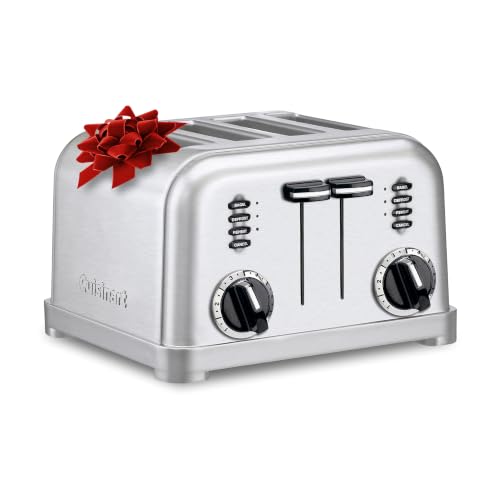
Cuisinart CPT-180 4-Slice Toaster — Best Dual-Control Classic
The CPT-180 is the design this category keeps returning to: four extra-wide slots arranged as two independent two-slice toasters sharing a brushed stainless body, each side with its own controls and its own six-setting browning dial. That independence is the whole argument. One side runs dark for the sourdough, the other pale for the white loaf; one side defrosts a frozen waffle while the other toasts fresh bread; a solo eater uses one side and leaves the other cold, halving the wear on the elements across the toaster’s life. No other feature in this guide changes as many mornings as that simple duplication of control.
Browning behaviour follows the classic pattern executed well: even colour across the slice’s face, shade steps that differ perceptibly from one another rather than clustering at the dark end, and repeatability that lets a household learn its numbers — a four for her, a three for him — and stop supervising breakfast. The extra-wide slots take bagels and thick-cut bakery slices without the squeeze-and-scrape that ruins crusts, and the stainless body wipes clean of the butter fingerprints that are a toaster’s natural patina. It is, deliberately, not the newest design here; it is the benchmark the newer ones are measured against.
What it lacks is display-era feedback: no countdown, no LED reassurance, just dials whose positions must be learned by eye. Households that toast in the dark of early shifts may prefer its sibling’s screen. Everyone else is buying the category’s most proven answer to its central question — how do two different breakfasts happen at once — answered with a simplicity that has kept this model in production while flashier rivals came and went around it.
- Controls: dual independent, one set per side
- Browning: six-setting dials on each side
- Slots: extra-wide, bagel and thick-slice friendly
- Body: brushed stainless steel
Strengths
- True two-breakfast independence in a single footprint.
- Shade steps that are distinct and repeatable morning after morning.
- Proven, unfussy design with nothing digital to fail.
Trade-offs
- No countdown display or timing feedback.
- Dial positions must be learned rather than read.
- Classic styling, for kitchens wanting a more modern face.
Best for: households of two-plus with different shade loyalties. Not suited for: anyone wanting a countdown screen or smart features.

Cuisinart CPT-435 4-Slice Toaster with LCD — Best with Countdown Display
The CPT-435 takes its sibling’s dual-control architecture and adds the one piece of information a morning actually lacks: time. Its LCD countdown timer shows the toasting cycle’s progress, which sounds like a garnish until a household discovers what it does to breakfast choreography — eggs timed to the toast’s last thirty seconds, coffee poured to land with the pop-up, a child’s departure coordinated to the minute. Seven shade settings, one more than the classic’s six, give slightly finer control at the pale end where differences are hardest to judge, and the dual independent controls keep the two-breakfast promise intact.
The countdown also disciplines the toaster’s other modes. Bagel and defrost cycles stop being leaps of faith when their remaining time is on a screen, and the whole household calibrates faster: a new loaf’s ideal setting is found in two mornings instead of a week of pale disappointments, because the display turns each cycle into data. Stainless construction matches the CPT-180’s kitchen presence, and the slot geometry serves the same bagel-and-bakery repertoire. If the classic is the category’s benchmark, this is the benchmark with instruments fitted.
Choose between the Cuisinarts on temperament. The CPT-435’s electronics are one more system than the CPT-180’s dials, and a household that keeps appliances for decades on principle may prefer the simpler machine; a household that runs its mornings like a railway will wonder how it ever toasted blind. Both judgements are respectable. Our own lean, for families with school-run timing and eggs to coordinate, is that the countdown earns its circuitry within the first fortnight of breakfasts.
- Display: LCD countdown timer
- Browning: seven shade settings
- Controls: dual independent, per the listing
- Specialty: stainless steel bagel toaster positioning
Strengths
- Countdown turns breakfast timing into coordination instead of luck.
- Seven shades give finer control at the pale end.
- Dual controls preserve the two-breakfast advantage.
Trade-offs
- Electronics add a failure mode the dial classic avoids.
- Display brightness may not suit every dark kitchen at dawn.
- Premium over the CPT-180 for information, not toast itself.
Best for: timed households coordinating eggs, coffee, and departures. Not suited for: minimalists who want dials and nothing else.

Mueller UltraToast 4-Slice Toaster — Best for Artisan Bread
Mueller’s UltraToast leads with the number artisan bakers actually shop by: slots 1.6 inches wide. That width swallows the thick, irregular slices that a bakery sourdough or a seeded farmhouse loaf produces — the slices standard slots either refuse or grip so tightly that one face scorches against the element while the other stays pale. The listing names the intended repertoire outright: artisan bread, bagels, and frozen waffles. Six browning levels, an LED display for feedback, and cancel, defrost, and reheat functions complete a specification aimed squarely at households whose bread comes from a bakery rather than a plastic bag.
Wide slots change toasting technique in one respect worth learning: a thin slice in a wide slot can lean, and leaning bread browns unevenly, so the self-centring behaviour of the slot guides matters — Mueller’s design addresses the geometry, and owners of wide-slot toasters learn to drop slices in flat rather than posting them at an angle. With that habit, the UltraToast’s extra width becomes pure advantage: crumpets sit properly, bagel halves toast without a squeeze, and the reheat function rescues a slice that popped while the kettle was still boiling, a small mercy every breakfast cook recognises.
The removable crumb tray deserves its sentence, because artisan bread sheds artisan quantities of crumbs — seeds, crust shards, the sourdough’s floury debris — and a tray that slides out beats the shake-it-over-the-bin ritual that coats a counter. Against the Cuisinarts, the Mueller trades the dual-dial heritage for width and display; against the budget pair below, it is the specialist’s premium. Households whose bread is worth toasting properly will find the specialisation justified every single morning.
- Slots: extra-wide 1.6 inches, the widest stated here
- Browning: six levels with LED display
- Functions: cancel, defrost, reheat
- Cleaning: removable crumb tray
Strengths
- Artisan slices and bagels fit without force or scorching.
- Reheat function rescues toast that waited for the kettle.
- LED feedback modernises shade calibration.
Trade-offs
- Thin slices can lean in wide slots if dropped carelessly.
- Six browning levels, one fewer than the seven-setting rivals.
- Specialist width is wasted on sandwich-bread-only households.
Best for: bakery-loaf households, bagel devotees, and crumpet people. Not suited for: thin-sliced sandwich bread traditionalists alone.

BLACK+DECKER 4-Slice Toaster Extra-Wide Slots — Best Family Workhorse
BLACK+DECKER’s entry is the family brief executed without flourish: extra-wide slots, seven shade settings, a dedicated bagel mode, and a removable crumb tray, in a toaster priced and built for households where breakfast is a production and the appliance is expected to survive it. The bagel mode earns its headline place because it does the job properly in principle — directing more heat to the cut face while treating the crust gently — which turns a bagel from a compromise (scorched top, cold bottom, or the reverse) into the thing a bagel is supposed to be: crisp where it was sliced, tender where it was not.
Seven shade settings across a family is not a luxury; it is conflict resolution, spanning the pale-gold child and the dark-crunch adult without either conceding. The extra-wide slots absorb the frozen waffles, toaster pastries, and thick slices that a family freezer and a family bakery run produce, and the crumb tray — in a household generating crumbs at industrial rates — is the difference between a toaster that gets emptied weekly and one that smokes by spring. BLACK+DECKER’s controls are the dial-and-lever vernacular of its class: nothing to learn, nothing to update, everything replaceable by feel in a dark kitchen.
What it does not offer is the Cuisinarts’ dual-control independence or any display feedback, so a two-shade household runs sequential rounds rather than simultaneous ones, and shade calibration is by eye and memory. For many families that is the right trade — one shade compromise, or rounds so fast the queue is theoretical — and the workhorse’s value tier makes the decision easier. This is the toaster we recommend when the brief is four hungry people, a freezer full of waffles, and no patience for appliance drama.
- Slots: extra-wide for bagels and thick slices
- Browning: seven shade settings
- Mode: dedicated bagel mode
- Cleaning: removable crumb tray
Strengths
- Bagel mode that treats cut face and crust differently.
- Seven shades span a whole family’s preferences.
- Built and priced for high-volume family mornings.
Trade-offs
- No dual independent controls for simultaneous shades.
- No countdown or display feedback.
- Plain controls, without reheat-style refinements.
Best for: families running waffles, bagels, and toast in volume. Not suited for: two-shade households wanting simultaneity above all.

GE 4-Slice Stainless Steel Toaster — Best Measured Slots
GE publishes the most precise slot specification in this guide — 1.38 by 5.50 inches — and that precision is a personality worth rewarding, because it lets a buyer measure their actual bread against the appliance before money changes hands. The 5.50-inch length is the sleeper figure: long slices from wide bakery loaves fail in toasters by length as often as by thickness, and a slot specified for both dimensions is a slot designed by someone who has met a real loaf. Around those slots sit 1500 watts of even-toasting power, seven shade settings, a defrost function, and a removable crumb tray, in stainless steel.
The 1500-watt figure places it at the category’s full-power class alongside the Amazon Basics, and GE’s claim is evenness — the quality that separates a toaster from a browning lottery. Evenness across four slots is the delivery-day test we prescribe for every model here, and a maker that headlines the word is inviting the test, which is the correct spirit. The defrost function handles the frozen waffle and the emergency bread-from-the-freezer with added time rather than a second manual cycle, and the seven shades give the household its full diplomatic range from pale to dark.
Against the field, the GE is the rationalist’s pick: no countdown theatre, no artisan branding, just measured slots, stated power, and the standard functions executed in stainless. Households that shop by specification — the ones who will actually measure their bread, and enjoy having done so — will find this toaster’s honesty about its dimensions the most persuasive paragraph in the category. It fits bagels and waffles per its listing, and it fits the loaves other toasters leave you to guess about.
- Slots: 1.38 by 5.50 inches, specified precisely
- Power: 1500 watts, even-toasting design
- Browning: seven shade settings
- Functions: defrost; removable crumb tray
Strengths
- Slot length specified, so long bakery slices can be checked in advance.
- Full-power class with evenness as the headline claim.
- Seven shades plus defrost cover the family repertoire.
Trade-offs
- Slots narrower than the Mueller’s artisan-grade 1.6 inches.
- No dual controls or countdown display.
- Newer design, with a shorter track record than the classics.
Best for: specification shoppers and wide-loaf households measuring first. Not suited for: the thickest artisan slices, which want the Mueller’s width.

Amazon Basics 4-Slice Toaster — Best Budget Essential
Amazon Basics’ toaster is the category reduced to its essentials and priced accordingly — and the surprise, on inspection, is how complete the essentials turn out to be: extra-wide slots for bagels and specialty breads, seven browning settings, 1500 watts, a removable crumb tray, and dedicated cancel, defrost, and bagel buttons, in a black and silver body. Read that list against the premium picks and the omissions are specific rather than sweeping: no dual independent controls, no countdown display, no artisan-slot width beyond the extra-wide class. Everything a single-shade household actually uses every morning is present.
That framing makes it the honest budget benchmark. A household of one shade — or a household willing to run two quick rounds — loses remarkably little here: the wattage matches the GE, the shade count matches the field’s best, and the bagel and defrost buttons cover the frozen and the round halves of the repertoire. Browning evenness in this tier should be verified with the delivery-day test like any other, and the build will feel lighter in the hand than a Cuisinart’s, but toast does not know what its maker cost, and a well-calibrated budget toaster produces a breakfast indistinguishable from a premium one.
We recommend it without condescension to three audiences: first-flat buyers furnishing a whole kitchen at once, spare-toaster households equipping a guest suite or a holiday let, and pragmatists who regard toasters as consumables and prefer replacing a budget unit in some future year to maintaining a premium one. The black and silver finish suits most kitchens, the footprint suits small counters, and the specification, honestly read, embarrasses several toasters that cost noticeably more while offering noticeably less.
- Power: 1500 watts
- Browning: seven settings
- Slots: extra-wide, for bagels and specialty breads
- Buttons: cancel, defrost, bagel; removable crumb tray
Strengths
- Full-power, seven-shade specification at a budget tier.
- Bagel and defrost buttons cover the whole routine repertoire.
- Black and silver finish blends into most kitchens quietly.
Trade-offs
- Single control set; two shades mean two rounds.
- Lighter build feel than the premium stainless models.
- No display, no dual controls, no frills of any kind.
Best for: budget buyers, first flats, and guest-suite spare duty. Not suited for: simultaneous two-shade households or display lovers.
How Do the Six Compare at a Glance?
| Pick | Controls | Shades | Slot story | Signature extra |
|---|---|---|---|---|
| Cuisinart CPT-180 4-Slice Toaster | Dual independent | 6 per side | Extra-wide | Proven classic design |
| Cuisinart CPT-435 4-Slice Toaster with LCD | Dual independent | 7 | Bagel-ready | LCD countdown timer |
| Mueller UltraToast 4-Slice Toaster | Single set, LED display | 6 | 1.6-inch extra-wide | Reheat function |
| BLACK+DECKER 4-Slice Toaster Extra-Wide Slots | Single set | 7 | Extra-wide | Dedicated bagel mode |
| GE 4-Slice Stainless Steel Toaster | Single set | 7 | 1.38 by 5.50 inches | 1500W even toasting |
| Amazon Basics 4-Slice Toaster | Single set | 7 | Extra-wide | Cancel, defrost, bagel buttons |
Why Do Dual Controls Matter So Much?
Because breakfast preferences are constitutional, not negotiable. In a dual-control toaster — the two Cuisinarts here — each side of the appliance is a sovereign toaster: its own lever, its own shade dial, its own defrost decision. The practical consequences compound quietly. Different breads finish together despite different densities. A second round for one person does not reheat the whole machine’s worth of elements. And when one member of the household leaves early, their side works alone while the other sleeps, an oddly domestic form of efficiency that single-control owners never get to experience.
The honest counterargument is complexity and cost: two control sets are two sets of dials to set wrong, and a household that genuinely eats one bread at one shade gains nothing but dials from the arrangement. That is why this guide keeps both architectures in the six rather than crowning one. Read your own breakfast honestly — if the phrase “not too dark” has ever been spoken in your kitchen with feeling, dual control is not a feature but a peace treaty, and the Cuisinart pair are its signatories.
How Do You Test a New Toaster’s Evenness?
With four slices of the same loaf, the same shade setting, and a phone camera. Toast a full load — all four slots, because a toaster can behave beautifully with two slices and disgrace itself with four, as the elements’ shared power and the slots’ positions interact — then lay the slices in slot order and photograph them. You are reading three things: face evenness within each slice, consistency between slots, and the top-to-bottom gradient that reveals how the elements are spaced. Repeat at a pale setting and a dark one, since evenness at medium can hide a hot slot that only declares itself at the extremes.
File the result mentally as your toaster’s map. Most four-slice toasters have one marginally stronger slot; knowing which it is lets you assign the fussiest bread to the calmest slot and the frozen waffle — the most forgiving load — to the fierce one. That small household knowledge, acquired in ten minutes on delivery day, is worth more across a toaster’s life than any single feature in this guide, and it is available to the budget Amazon Basics exactly as much as to the premium Cuisinarts.
What Do Bagel, Defrost, and Reheat Modes Actually Do?
Bagel mode changes the heat’s distribution, not just its duration: the cut face of a bagel wants direct, browning heat while the outer crust wants warming through, so a proper bagel setting — the BLACK+DECKER’s dedicated mode, the Amazon Basics’ bagel button — drives the centre elements harder than the outer ones. Used on ordinary toast it produces a one-sided result, which is the commonest mode mistake in the category. Defrost mode extends the cycle at gentler effective power so a frozen slice thaws through before its surface browns; without it, frozen bread emerges with the category’s signature failure, a dark crust wrapped around a cold, damp centre.
Reheat, the Mueller’s speciality, is the shortest and gentlest cycle: a brief warmth that revives a slice which popped up while its owner was pouring coffee, without advancing its colour. Cancel is the mode nobody lists as a feature and everybody uses — the mid-cycle rescue when a smell announces that today’s setting was yesterday’s bread’s setting. Together these four small programmes are the difference between a toaster that handles a real freezer and a real bakery run, and a toaster that handles only the idealised slice in its own brochure.
How Should You Care for a Toaster?
Empty the crumb tray on a rhythm, not on a symptom — weekly in a family kitchen, monthly in a quiet one — because crumbs are this appliance’s rust: they accumulate invisibly, smoke eventually, and flavour later toast with old breakfasts. Every pick in this guide offers a removable tray, which removes the last excuse for the upend-and-shake method that distributes crumbs across the counter and into the elements. Wipe the exterior with a damp cloth while the toaster is cool; stainless shows butter, and butter shows fingerprints, and a toaster lives where both are airborne.
Never retrieve stuck toast with metal, never toast anything coated, frosted, or buttered in a slot — toppings melt onto elements and become permanent seasoning of the worst kind — and give small slices the high-lift lever’s respect rather than tipping the whole appliance. A toaster’s elements are bare and its interior is a crumb museum by design; treated with the tray rhythm and the no-metal rule, any of these six should toast through years of mornings, and the failure that eventually retires it will more likely be a lever spring than a burnt element.
How Does Power Sharing Work When All Four Slots Run?
A four-slice toaster on a full load is an electrical negotiation. The elements draw from one supply, and in many designs the four slots share the available power in a way that makes a full load toast slightly slower than a half load at the same setting — the reason experienced households notice that the second pair, toasted alone, browns faster than the first four did together. The 1500-watt models here, the GE and the Amazon Basics, sit at the class’s full-power end, which is precisely about minimising that full-load slowdown. Dual-control models add a second subtlety: each side can be at a different point in its cycle, so the machine is rarely drawing its peak in both halves at the same instant.
The practical technique is modest. Set your shade by the load you usually run — if breakfast is always four slices, calibrate at four slices, not at one — and expect a solo slice to finish a breath quicker and darker than the map suggests. Households with older wiring should also notice that a toaster at full draw plus a kettle on the same circuit is the classic breakfast breaker-trip; stagger the kettle by two minutes and the problem evaporates. None of this is a defect in any pick here; it is the physics of heating four slots from one plug, and knowing it converts a mystery into a setting.
Which Breads Challenge a Toaster Most?
Sourdough first, for three reasons at once: it is thick, it is moist, and its slices are irregular, so it needs width, time, and evenness simultaneously — the combination the Mueller’s slots and the Cuisinarts’ repeatability were built for. Seeded and multigrain loaves toast unevenly by nature, since seeds and grains brown at different rates from the crumb; a slightly lower shade and a full cycle beats a fierce short one. Brioche and other enriched breads carry sugar and butter in the crumb itself, which caramelises fast — they want a paler setting than their colour suggests and a watchful eye, because the line between golden and burnt is a minute wide.
Gluten-free bread deserves its own paragraph, because it toasts differently in ways that frustrate new owners: denser, moister, and paler by formulation, it often needs a longer or repeated cycle to crisp, and it benefits from the defrost setting even when it is not frozen, as a gentle first pass that dries the crumb before the browning pass. Frozen waffles, finally, are the most forgiving load in the category — uniform, dry-surfaced, engineered for toasters — which is why this guide keeps prescribing them as the control group when a household is learning a new machine’s temperament.
What About Small Slices, Crumpets, and Other Awkward Loads?
The high-lift lever is the unsung hero of this category: it raises the carriage beyond its resting pop-up height so that a crumpet, a small end-slice, or a halved muffin can be retrieved with fingers rather than with the fork that safety rules forbid. When comparing models in person or in photographs, look for how far the lever travels past the top of its slot; that small travel is the difference between a toaster that handles the whole bakery and one that handles only the standard slice and strands everything smaller as a retrieval problem.
Crumpets toast best cut-side up toward the stronger heat, English muffins want a full cycle at a shade above your bread setting because their nooks hold moisture, and toaster pastries — the frosted kind — belong, strictly, to their own instructions and a watchful owner, since their fillings liquefy enthusiastically. The wide-slot models here earn quiet extra credit across all of these: awkward loads sit flatter, centre better, and emerge without the squeezed, scorched shoulder that a tight slot carves into anything wider than a sandwich slice.
Toaster or Toaster Oven: Which Belongs on Your Counter?
The honest answer depends on whether your mornings are a toast monoculture or a variety show. A dedicated four-slice toaster beats any toaster oven at the single task it exists for: it is faster to first slice, more even across four slots at once, simpler to clean of crumbs, and ready without preheat theatre. Households whose breakfast is toast, bagels, and waffles for several people will use a four-slice toaster daily and a toaster oven’s extra functions rarely — our compact oven guide exists for the other household, the one reheating pizza and roasting trays for two.
Counter economics settle many of these debates. One appliance that does the daily job perfectly usually beats one appliance that does five jobs adequately and one job — the daily one — slowly. The families who own both tend to arrive there by the route this guide’s Related Guides describe: the toaster first, because breakfast is non-negotiable, and the oven when reheating and small roasts outgrow the microwave’s compromises. Either way, the four-slice decision should be made on slots, shades, and controls, unclouded by functions a toaster was never meant to perform.
What Should Offices and Shared Kitchens Look For?
Durability of the obvious parts and a crumb tray that a rota can empty without tools. Shared kitchens multiply every domestic variable: unknown breads, unknown shades, users who will never read a manual and should never need to. The dial-classic CPT-180 and the workhorse BLACK+DECKER suit that world, because their controls explain themselves and their failure mode under abuse is a tired spring rather than a confused circuit board. A countdown display, delightful at home, becomes in an office merely another thing to be stared at while somebody else’s toast finishes.
The shared-kitchen rules are worth printing on the wall rather than the appliance: no buttered or frosted items in the slots, tray emptied on Fridays by whoever is rostered, stuck toast retrieved with wooden tongs kept beside the machine for the purpose. Offices that adopt those three rules keep a toaster for years; offices that do not go through toasters like stationery, and the difference is never the brand. It is the crumbs, the coatings, and the forks — the same trio this guide has been warning households about, wearing lanyards.
How Energy-Efficient Is a Toaster, Really?
Very, for its task, because it heats almost nothing but the bread. A toaster’s elements radiate directly onto the food from centimetres away, with no cavity of air to bring to temperature and no preheat to pay for, so a round of toast costs a few minutes of high wattage and nothing else. Against a toaster oven or a grill used for the same four slices, the dedicated toaster wins the energy comparison every time, and against the full-size oven it is not a contest at all. Households counting consumption can relax about this appliance: the kettle and the oven are where breakfast energy lives, and the toaster is a rounding error with excellent manners.
The efficiency has one caveat, which is behavioural rather than electrical. A toaster used for one slice at a time, four times in a morning, spends its energy on repeated element heat-ups and a family’s worth of waiting; the four-slice load it was designed for is both the fastest and the most efficient pattern. That is the quiet economic argument underneath this whole guide — capacity matched to the household is efficiency, and the four-slice toaster in a four-person kitchen is not an indulgence but the correctly sized tool, in energy exactly as in time.
How Do You Calibrate Your Household’s Shade Numbers?
With one loaf, one morning, and a notebook app. Toast single slices at consecutive settings from pale to dark, lay them in a row, photograph the gradient, and let each member of the household point at their slice. Write the results where the morning can find them — a card inside the cupboard door is the classic — because the entire value of a repeatable toaster is destroyed by a household re-deriving its preferences daily at 7 a.m. Repeat the ritual when the bread changes brands, since a denser loaf shifts every number by roughly a setting, and the photograph from the first calibration becomes the reference the new loaf is judged against.
Dual-control households calibrate each side separately, because the two halves of a toaster are siblings, not twins, and a four on the left may be a three-and-a-half on the right. That ten-minute investment is the whole secret behind households that describe their toaster as perfect: the machine was always adequate, and the calibration made it personal. It is also the fastest way to discover a genuinely faulty slot while the exchange window is still open, which makes the ritual a quality check wearing a breakfast costume — the most useful kind of check there is.
What About Long-Slot and Two-Slice Alternatives?
They exist for different breakfasts, and naming them clarifies what the four-slice format is for. A long-slot toaster takes two very long slices side by side — the format for the widest bakery loaves cut lengthwise — but serves a couple, not a family, and offers no simultaneity advantage at the school-run hour. A two-slice toaster is the right appliance for one person with standard bread and a small counter, and nothing in this guide should be read as talking that person into four slots they will never fill; an underused four-slice body is just a larger dust shelf with elements.
The four-slice format earns its existence at a specific household size and rhythm: three or more breakfasters, or two breakfasters with sovereign shade preferences and a dual-control model, or one very organised person batching toast for a table of guests. Outside those patterns the smaller formats win on footprint and price. Inside them, nothing else keeps up — which is why the category endures, why six credible versions of it fill this guide, and why the correct first question is never which toaster, but how many slices your ordinary morning truly is.
Where Should the Toaster Live, and How Hot Does It Get?
A toaster’s exterior warms in use — stainless models most noticeably, since metal conducts the interior’s heat to the surface — so its home needs a few inches of breathing room on the sides and, more importantly, nothing stored on top of it, ever. The classic kitchen accident in this category is the tea towel or the bread bag resting on a working toaster, and the prevention is a household rule rather than a feature: the toaster’s top is a surface that is sometimes hot, and it is treated as a hob ring that happens to have slots. Place the toaster where small hands cannot reach into its working area, where its cord does not cross the sink, and where crumbs falling during the tray ritual land on a surface that wipes clean in seconds.
Under-cabinet placement is common and acceptable with clearance respected, though a toaster run daily beneath a low cabinet will, over years, warm and faintly mark the cabinet’s underside in some kitchens; pulling the toaster forward for its morning shift, on a board or simply by its own feet, is the traditional courtesy. None of the six picks here is unusually hot-shelled for its class, and all of them reward the same placement logic: forward for work, breathing room always, nothing stored above, and a clear few inches between the slots and anything that melts, drapes, or forgets what a toaster is.
Which Mistakes Ruin Breakfast Most Often?
- Toasting buttered, frosted, or filled items in the slots, coating the elements in a glaze that smokes through every subsequent breakfast.
- Assuming shade numbers transfer between brands, then burning the first week of toast in a new toaster set to the old one’s number.
- Forcing an oversized artisan slice into a standard slot, where it leans, scorches on one face, and jams the lift mechanism.
- Fishing for a stuck slice with a fork while the toaster is plugged in, a habit safety warnings exist because of.
- Letting the crumb tray fill until it smoulders, then describing the toaster as having developed a burning smell.
- Running bagel mode for ordinary toast and wondering why one side of every slice stays pale.
Final Recommendation
Two-shade households should start and nearly finish with the Cuisinarts: the Cuisinart CPT-180 4-Slice Toaster for dial purists, the Cuisinart CPT-435 4-Slice Toaster with LCD for households that run on countdowns. Bakery households should measure their thickest slice and then look at the Mueller UltraToast 4-Slice Toaster, whose 1.6-inch slots were designed for exactly that loaf.
Families in volume will be happiest with the BLACK+DECKER’s bagel-mode workhorse manners, specification shoppers with the GE’s published dimensions, and budget buyers with the Amazon Basics’ startlingly complete essentials. Whichever lands on the counter, spend the first morning on the four-slice photograph test and the shade calibration — because a toaster you have measured becomes a toaster you can trust, and breakfast, of all meals, should run on trust rather than on hope and scraping.
Frequently Asked Questions
Is a 4-slice toaster better than two 2-slice toasters?
For counter space and a single appliance to clean, yes; for total independence, the pair of small toasters wins narrowly, since each has its own everything. The four-slice dual-control models here close most of that gap — two sovereign halves in one body — while using one socket and one footprint. The deciding factor is usually the counter: one appliance that fits beats two that crowd, and breakfast for four from a single lever-pulling station is a calmer production than two machines competing for the same sleepy operator.
Why does one slot toast darker than the others?
Element geometry and shared power make perfect equality rare: outer slots sit near the body’s insulation, inner slots share a wall, and a full load divides the current differently from a half load. A mild, consistent difference is normal and manageable once mapped — assign loads accordingly. A violent difference, one slot scorching while another barely colours, is a defect rather than a personality, and delivery week is when to discover it and exchange the unit rather than adapt your whole breakfast around a faulty element.
Can I toast frozen bread without a defrost mode?
Yes, with a two-stage workaround: run a short cycle at a low shade to thaw, then a normal cycle at your usual setting. It works, and it is also exactly the faff the defrost function exists to abolish — five of the six picks here include it in some form. Households that freeze bread as a system, which is most households with a bakery habit and a small kitchen, should treat defrost as a core feature rather than a bonus, because they will use it more often than any other button on the machine.
How wide a slot do I need for bagels?
Measure your bagel, halved, at its thickest — most commercial bagels sit comfortably in the extra-wide class all six picks occupy, while the hand-cut, bakery-bloated specimens argue for the Mueller’s 1.6 inches. Length matters too for sliced loaves, which is why the GE’s published 5.50-inch slot length is genuinely useful information. The general rule is to buy for the widest item you toast weekly, not the widest you have ever toasted: a slot sized for a monthly bagel is a slot that leans your daily bread for a year.
Do more shade settings mean better toast?
They mean finer steps, which help only if the steps are evenly spaced and repeatable — a well-made six, like the CPT-180’s dials, beats a vague nine whose settings cluster at the dark end. What actually improves toast is consistency: the same number producing the same colour on Tuesday as on Monday, with the same bread. Calibrate once, write your household’s numbers down if memories differ, and the setting count becomes what it should be — a minor specification rather than a deciding one.
How long should a toaster last?
Daily-use toasters in this class commonly serve for years, with lever mechanisms and springs the usual first tired components and elements rarely the cause of retirement. Crumb discipline extends life measurably, since a clean interior runs cooler and smells sweeter, and the no-metal, no-buttered-goods rules prevent the two classic element injuries. Buyers who keep the tray rhythm often find the toaster outlasts the kitchen’s colour scheme — at which point the replacement is chosen by the same tests this guide prescribes, and usually from the same shortlist.
Should I unplug my toaster between uses?
It is the cautious habit, and in households with small children, curious pets, or a toaster stored within reach of a cluttered counter’s traffic, it is a sensible one — a toaster draws no standby worth mentioning, so unplugging costs nothing but a second. Most toasters in this guide live plugged in on open counters without incident across years of breakfasts, and the more material safety habits are the crumb rhythm, the no-metal rule, and keeping the slots free of coated foods. Choose the unplugging habit if your kitchen’s traffic argues for it; it is cheap insurance and harms nothing.
Why does my toast curl or brown in stripes?
Curling is moisture leaving one face faster than the other, common with very fresh, soft bread and with slices stored against a cold surface; a slightly lower shade and a full cycle usually calm it. Stripes are the elements’ portrait — the glowing bars print their spacing onto bread that sits close or leans — and they fade when slices are centred in the slot and matched to its width, which is one more argument for the wide-slot models when your bread is wide. Persistent, dramatic striping on centred, standard bread suggests an element ageing unevenly, worth noting while the toaster is young enough to exchange.
Does a 4-slice toaster use more electricity than a 2-slice?
Per round of toast for a full house, less — because one heating cycle serves four slices instead of two cycles serving two each, and the elements’ warm-up cost is paid once. Per single slice, a four-slice run alone does spend more than a two-slice toaster would, which is why the dual-control Cuisinarts earn quiet efficiency credit: one side can work while the other stays cold, matching the machine’s appetite to the morning’s actual size. The household pattern decides the bill, as it decides everything else in this category, and the right-sized load remains the cheapest setting on any toaster ever made.
Related Guides
Breakfast is a system, and the toaster shares it with the rest of the counter. Readers building the whole station often continue with Best Industrial Vacuum Sealers for the freezer that feeds the defrost button, cool the morning sun’s side of the kitchen with Best 8,000 BTU Air Conditioners, and finish the small-appliance survey with Best 2-Drawer Dishwashers.



[…] The same evidence-first habit serves well in the kitchen, where our dishwasher and toaster guides separate published specification from brochure language — see Best 18-Inch Dishwashers, Best Apartment Dishwashers, Best 4-Slice Toasters. […]