What's inside
- Key Takeaways
- Quick Picks
- How We Chose These Picks
- How Do the Six Compare at a Glance?
- Why Does the Chamber Design Seal Liquids When Suction Sealers Cannot?
- How Do You Choose a Seal Bar Length and Bag Size?
- What Does a Production Session Actually Look Like?
- How Should Vacuum-Sealed Food Be Stored Safely?
- Why Do Sous Vide Cooks Prefer Chamber-Sealed Bags?
- How Do Hunters and Anglers Use These Machines?
- What Should a Small Food Business Consider Beyond the Machine?
- What Else Can a Chamber Sealer Seal?
- How Does the Cost Compare With an External Sealer Over Time?
- How Do You Get a Perfect Seal, Every Cycle?
- Where Should a Chamber Sealer Live?
- How Do You Plan Bag Inventory for a Season?
- Which Mistakes Cost Industrial Users the Most?
- Final Recommendation
- Frequently Asked Questions
- Related Guides
As an Amazon Associate I earn from qualifying purchases. This post may contain affiliate links at no extra cost to you.
cottageverdict.com is reader-supported. When you buy through links on our site, we may earn an affiliate commission.
Where to buy: the six machines below are sold through Amazon, and the linked names in the Quick Picks table and the detailed sections lead to each model’s listing, where you can check price on Amazon and confirm seal bar length, chamber size, and pump type before committing. The best industrial vacuum sealers are all chamber machines, and this guide starts there deliberately: when the work involves liquids, volume, or money, the chamber design is not the premium option but the correct one, and everything below follows from understanding why.
An external suction sealer drags air out of a bag through its opening, which means it cannot seal a bag of soup, marinade, or fresh meat juices without pulling liquid into its works. A chamber sealer inverts the physics: the whole bag sits inside a chamber, the air leaves the entire space at once, pressures equalise, and the seal bar closes on a bag whose contents — liquid included — never moved. That single difference explains the whole industrial category: restaurants sealing sauces, hunters processing a season in a weekend, small producers packing for market, and sous vide cooks who want a marinade to stay in the bag rather than in the machine.
The six picks divide by scale and pump philosophy. VacMaster’s VP210 is the established bench standard with a maintenance-free dry pump; its bigger sibling, the VP320, adds a half-horsepower oil pump and a 16-inch seal bar for genuine production work. Avid Armor’s USVX compacts the chamber idea for smaller counters, VEVOR’s 380W machine presses the price downward, Vesta Precision’s chamber detaches for washing and brings a mason jar kit, and Gasbye bundles a double seal and starter bags into a 5.3-quart chamber. Industrial, it turns out, is a spectrum — and the right point on it depends on your weekly volume, which is the number this guide will keep asking for.
Key Takeaways
- Chamber sealers seal liquids, marinades, and wet foods that defeat external suction machines, because the bag’s contents are never dragged toward the seal.
- Seal bar length is the capacity that matters: it sets the widest bag the machine accepts, from the USVX’s 10 inches to the VP320’s 16.
- Oil pumps pull harder and suit production duty but want oil changes; dry piston pumps, as in the VP210, trade some muscle for maintenance-free ownership.
- Chamber bags cost far less per bag than the textured bags external sealers require, so high-volume users recover a chamber machine’s price in bag savings alone.
- A double seal — two seal wires or a second pass — is cheap insurance on heavy, wet, or long-storage loads, and two of these six build it in.
- Vacuum sealing extends freezer life and prevents freezer burn, but it does not sterilise food; refrigeration and freezing discipline still apply in full.
Quick Picks
| Pick | Badge | Why it earns its place |
|---|---|---|
| VacMaster VP210 Chamber Vacuum Sealer | Best Bench Standard | A maintenance-free commercial chamber machine with a 10.25-inch seal bar for 10 by 13 bags. |
| VacMaster VP320 Chamber Vacuum Sealer | Best for Production Volume | A half-horsepower oil pump and a 16-inch seal bar for bags up to 16 by 18, built for meat and throughput. |
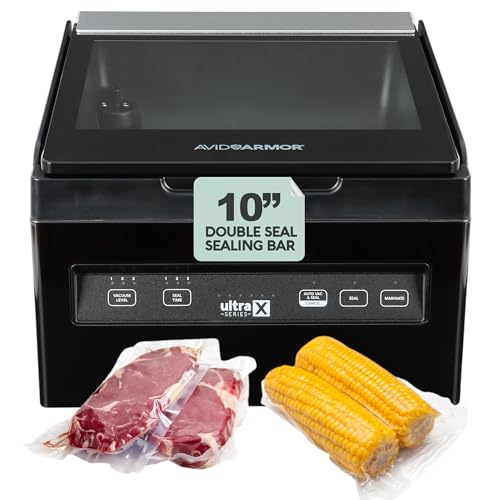
| Avid Armor USVX Chamber Vacuum Sealer | Best Compact Chamber | A 10-inch dual-wire seal bar in a compact body, made for soups, marinades, and sauces without mess. |
| VEVOR Chamber Vacuum Sealer 380W | Best Value Entry | 380 watts of pump power and an 11.5-inch sealing length in a compact commercial design for wet foods and meat. |
| Vesta Precision Chamber Vacuum Sealer | Best Washable Chamber | An 8.1-quart chamber that detaches for washing, a 12-inch seal bar, auto vacuum adjustment, and a mason jar kit. |
| Gasbye Chamber Vacuum Sealer 5.3QT | Best Starter Bundle | A 5.3-quart chamber, a replaceable 11.5-inch bar with double seal, and thirty pre-cut bags in the box. |
How We Chose These Picks
We required the chamber architecture without exception, because an industrial guide that included external suction machines would be answering a different question. Within the chamber world, each pick had to publish the specifications a production buyer actually plans around — seal bar length, the bag sizes it accepts, chamber volume where relevant, and pump type — and every figure in our pick sections traces to the model’s own listing rather than to a sibling machine or a dealer’s summary. The set then had to span the category’s honest range: the bench standard, the production flagship, the compact, the value entry, the washable-chamber innovator, and the bundled starter.
We weighted duty cycle as heavily as specifications. Industrial work is repetitive by definition — dozens of cycles in a session, hundreds in a season — so pump philosophy, seal bar construction, and the availability of a double seal matter more here than in any domestic category we cover. A machine that seals beautifully twice and overheats by the twentieth bag is a domestic appliance in a steel coat, and the picks below were chosen to avoid that impersonation, each at its own scale of work.
We also kept the guide honest about who should not buy any of these. A household sealing the occasional steak for the freezer is served by simpler machines at a fraction of the cost and counter space, and no chamber sealer’s virtues change that arithmetic. These six are for liquid, volume, and commerce — the marinade, the harvest, the market stall — and the sections below assume that reader throughout.

VacMaster VP210 Chamber Vacuum Sealer — Best Bench Standard
The VP210 is the machine the chamber category is measured against, and its specification explains why: a 10.25-inch seal bar accepting bags up to 10 by 13 inches, a chamber sized for the quart-and-gallon rhythm of serious home processing and small commercial prep, and a maintenance-free dry piston pump that asks for no oil, ever. That last point is the ownership headline. Oil pumps are stronger, as the VP320 below demonstrates, but they are also a maintenance relationship; the VP210’s dry pump trades a measure of ultimate vacuum for a machine that simply works, session after session, for owners whose processing days are busy enough without a pump service schedule.
Its working repertoire covers the industrial core completely: soups and sauces sealed without a drop migrating, marinades that stay in the bag and therefore in contact with the meat, bulk proteins portioned for the freezer with the flat, stackable geometry that only a chamber’s complete air removal produces. Sous vide cooks value that completeness — a chamber-sealed bag has no air pocket to float the bag or insulate a corner of the food from the bath. The 10 by 13 bag ceiling is the honest limit: wide cuts and whole large fish will argue for the VP320’s bar, and pretending otherwise would mislead exactly the buyers this machine otherwise serves perfectly.
Longevity is the quiet argument owners make for it. Chamber sealers in this class are built as bench equipment rather than as appliances — heavy lids, real seal bars, pumps designed for duty — and the VP210’s long presence in small restaurants, butcher counters, and serious home processing rooms is the track record the newer names in this guide are still earning. Buy it as the standard, size your bags to its bar, and the machine’s side of the bargain is measured in years of processing seasons rather than in warranty periods.
- Seal bar: 10.25 inches, for bags up to 10 by 13 inches
- Pump: maintenance-free dry piston, no oil changes
- Positioning: commercial chamber machine for food, liquids, sous vide
- Capacity class: quart and gallon rhythm, small commercial prep
Strengths
- Maintenance-free pump removes the category’s main ownership chore.
- Complete liquid sealing for soups, sauces, and marinades.
- Bench-equipment build with a long commercial track record.
Trade-offs
- Bag width ceiling excludes the widest cuts and whole large fish.
- Dry pump’s ultimate vacuum sits below oil-pump rivals.
- Bench footprint and weight claim permanent counter territory.
Best for: serious home processors and small kitchens sealing liquids weekly. Not suited for: production lines needing 16-inch bags or maximum vacuum.

VacMaster VP320 Chamber Vacuum Sealer — Best for Production Volume
The VP320 is what the category looks like when it stops compromising: a half-horsepower oil pump, a 16-inch seal bar accepting bags up to 16 by 18 inches, and a chamber built for the meat-and-volume work its listing names directly. The oil pump is the engineering headline — oil-sealed rotary pumps pull a deeper vacuum and sustain it across long production runs with the consistency that commercial packing actually requires, which is why serious throughput machines use them despite the maintenance they ask in return. When a session means a hundred bags rather than a dozen, that consistency is the difference between a packing line and a bottleneck with a lid.
The 16-inch bar redraws the menu of sealable things. Whole briskets, full racks, large fish, bulk trays portioned wide rather than long — the geometry that defeats a 10-inch machine simply fits here, and the 16 by 18 bag size turns the sealer into the packing department of a small food business rather than an accessory to one. Cycle after cycle, the production buyer is also buying time: a chamber cycle is measured in tens of seconds, and across a season’s processing the VP320’s combination of bag size and pump stamina is measured in days handed back.
The costs are stated as plainly as the virtues. Oil pumps want oil — checked, topped, and changed on schedule, with the machine’s performance quietly depending on the habit. The footprint and weight are industrial in the literal sense, a bench commitment rather than a cupboard appliance. And the price tier buys capability that a dozen-bags-a-month household will never invoice against itself. This is the pick for the smokehouse, the fishing operation, the market producer, and the hunting camp that processes for a community — buyers for whom sealing is not a kitchen task but a stage of production.
- Pump: half-horsepower oil pump
- Seal bar: 16 inches, for bags up to 16 by 18 inches
- Positioning: commercial production, meat and high volume
- Duty: built for long, repetitive packing sessions
Strengths
- Deepest, most sustained vacuum in this guide for production runs.
- Sixteen-inch bar seals cuts and trays smaller machines refuse.
- Genuine packing-department capacity for small food businesses.
Trade-offs
- Oil maintenance is a real, recurring ownership duty.
- Largest footprint and weight here; a bench, not a cupboard, machine.
- Capability far beyond occasional household sealing needs.
Best for: producers, processors, and high-volume meat and fish work. Not suited for: small kitchens or anyone sealing a few bags a month.
Avid Armor USVX Chamber Vacuum Sealer — Best Compact Chamber
Avid Armor built the USVX around a question the VacMasters do not ask: how small can a true chamber sealer become before it stops being one? The answer here is a compact body with a 10-inch seal bar and a dual-wire seal — two sealing wires laying down parallel seals in one cycle — aimed squarely at wet foods. The listing’s own language names soups, marinades, and sauces sealed without mess, plus sous vide and bulk storage, which is a precise description of the home processor’s actual week: a pot of stock portioned flat, chicken in marinade, a sauce base frozen in bags that stack like books.
The dual-wire seal deserves its emphasis, because seal failure is the category’s quiet catastrophe — a bag that looks sealed and admits air across a freezer month, discovered as freezer burn in February. Two parallel seals mean a flaw in one line still leaves the other holding, and on wet loads, where a droplet across the seal area is the classic cause of a weak closure, that redundancy is worth more than any display or programme. Combined with the chamber’s liquid manners, it makes the USVX the pick we would hand to the sous vide enthusiast whose bags must not float, leak, or fail quietly.
Compactness sets the boundaries, as it always does. The 10-inch bar matches the VP210’s bag class rather than the VP320’s, the chamber suits household and light-commercial volumes rather than production lines, and the machine’s virtues are precision and footprint rather than stamina across a hundred cycles. For the apartment processor, the small deli counter, and the serious home cook whose sealing is weekly and wet, those boundaries are drawn in exactly the right places — this is the chamber idea, fitted to a normal counter, without surrendering the physics that makes the idea worthwhile.
- Seal bar: 10 inches, dual-wire parallel seals
- Design: compact chamber body
- Specialty: wet foods — soups, marinades, sauces — per the listing
- Uses: sous vide and bulk storage
Strengths
- Dual-wire seal insures wet loads against the classic weak closure.
- True chamber liquid handling in a compact footprint.
- Sized honestly for weekly home and light commercial work.
Trade-offs
- Ten-inch bar excludes wide production bags.
- Not built for hundred-cycle production sessions.
- Compact chamber limits the tallest jars and bulkiest items.
Best for: sous vide cooks and home processors sealing liquids regularly. Not suited for: production packing or very wide cuts.

VEVOR Chamber Vacuum Sealer 380W — Best Value Entry
VEVOR’s proposition is the chamber threshold at its most accessible: 380 watts of pump power, an 11.5-inch sealing length — wider, note, than the VP210’s bar — and a compact design the listing positions for professional and home use alike, across wet foods and meat. That sealing length is the specification to respect, because it puts this value entry’s bag class above the bench standard’s, and for buyers whose work is portioned meat, meal prep, and market-day packing at modest volumes, the arithmetic of capability per cost is difficult to argue with.
The honest reading of a value-tier chamber machine is about duty expectations. A 380-watt pump in a compact body will seal the home processor’s session and the small vendor’s morning competently; what it should not be asked to do is impersonate the VP320 across an eight-hour production day. Cycle pacing — a breath between bags, attention to heat across a long run — is the technique that lets a compact commercial machine live a long life, and owners who grant it that rhythm generally report that the machine keeps its side of the bargain. The chamber physics, meanwhile, are identical in kind to the flagship’s: liquids stay put, marinades stay in, air leaves completely.
VEVOR’s broader catalogue position matters to the recommendation: this is a maker of workshop and catering equipment at aggressive prices, and the buyer is trading the VacMaster name’s decades of sealer-specific track record for a wider bar and a lower entry cost. For a first chamber machine — the purchase that teaches a household or a young food business whether chamber sealing is its future — that trade is rational, and the 11.5-inch bar means the lesson is learned at a genuinely useful bag size rather than on a toy.
- Pump power: 380 watts
- Sealing length: 11.5 inches
- Design: compact, for wet foods and meat
- Positioning: professional and home use, per the listing
Strengths
- Widest value-tier bar here, at 11.5 inches of sealing length.
- Full chamber liquid handling at an entry price point.
- Compact body suits small prep spaces and market stalls.
Trade-offs
- Compact pump asks for pacing across very long sessions.
- Shorter brand track record in sealers than VacMaster.
- Production buyers will outgrow its duty class.
Best for: first chamber buyers, meal preppers, and small vendors. Not suited for: all-day production packing lines.

Vesta Precision Chamber Vacuum Sealer — Best Washable Chamber
Vesta Precision’s V553 attacks the chamber category’s dirtiest secret — literally. A chamber that seals soups and marinades will, across a season, meet spills, and a fixed chamber can only be wiped and wondered about. This machine’s 8.1-quart chamber detaches for washing, and its 12-inch seal bar is washable as well, which converts the category’s most unpleasant maintenance into a sink job. Add auto vacuum adjustment, a commercial pump, dual sealing, and a mason jar kit in the specification, and the V553 reads as the precision-and-hygiene entry in a field that usually competes on muscle alone.
The mason jar kit deserves explanation, because it extends the machine beyond bags: jar sealing under vacuum suits dry goods, coffee, dehydrated produce, and the pantry half of a preserving household, and it is a capability none of the other five lists. Auto vacuum adjustment matters for delicate work — the machine moderating its pull so that soft items are sealed without being crushed is the difference between packing berries and packing berry paste. The 12-inch bar sits between the VP210’s and the VP320’s classes, a sensible middle for households and small producers whose widest regular bag is a gallon format.
Where the Vesta asks for judgement is in its priorities: it is the choice for buyers whose sealing life is varied — liquids, jars, delicate foods, sous vide — and whose hygiene standards are professional, rather than for buyers whose life is one product packed ten thousand times. A single-product production line should buy the VP320’s stamina; a varied, quality-obsessed kitchen or small-batch producer will find the V553’s washable chamber and gentle intelligence worth more than raw throughput, every working week of the year.
- Chamber: 8.1 quarts, detachable and washable
- Seal bar: 12 inches, washable, dual sealing
- Control: auto vacuum adjustment for delicate items
- Extras: mason jar kit included in the specification
Strengths
- Detachable, washable chamber solves the category’s hygiene problem.
- Auto adjustment seals delicate foods without crushing them.
- Mason jar capability extends the machine to pantry preserving.
Trade-offs
- Variety-focused design, not a single-product production tool.
- More components to wash, store, and keep track of.
- Twelve-inch bar still excludes the widest production bags.
Best for: varied small-batch producers and hygiene-first kitchens. Not suited for: single-product lines packing at maximum volume.

Gasbye Chamber Vacuum Sealer 5.3QT — Best Starter Bundle
Gasbye’s entry understands that a first chamber machine is bought by someone who also needs bags, confidence, and a first success — so the box includes thirty pre-cut vacuum bags alongside a 5.3-quart stainless chamber, an 11.5-inch replaceable sealing bar, and a double seal. The replaceable bar is the specification with the longest shadow: seal bars and their wires are wear components in every chamber machine, and a design that treats the bar as replaceable is designing for a service life rather than a warranty period. The double seal, as with the Avid Armor, insures wet and heavy loads against the single-line failure that ruins a freezer month quietly.
The 5.3-quart chamber defines the working class: meats, soups, sauces, and liquids in household and small-batch quantities, portioned into bags up to the bar’s 11.5 inches — the same sealing length as the VEVOR, in a bundle that starts working the day it arrives. Stainless construction suits the wet end of the repertoire and wipes down without ceremony. For the meal-prep household scaling up from an external sealer that choked on its first marinade, this is a complete, legible next step: chamber physics, double-seal insurance, bags included, no accessory shopping standing between the delivery and the first sealed stock.
Its boundaries are the starter class’s boundaries. Five quarts of chamber and a compact pump serve sessions, not production days, and the brand’s track record in this category is young beside VacMaster’s. Buyers who already know their volume is industrial should step directly to the VP320 and skip the apprenticeship. Buyers still proving their volume — the hunters with one season a year, the preppers building a freezer system, the sauce maker testing a market — will find the Gasbye’s bundle the lowest-friction route into chamber sealing that this guide can honestly recommend.
- Chamber: 5.3 quarts, stainless steel
- Seal bar: 11.5 inches, replaceable, double seal
- Included: thirty pre-cut vacuum bags
- Repertoire: meats, soups, sauces, liquids, per the listing
Strengths
- Starter bundle seals on delivery day, bags included.
- Replaceable seal bar designs for service life, not warranty life.
- Double seal protects wet and heavy loads from quiet failures.
Trade-offs
- Session-scale chamber, not a production-day machine.
- Young brand track record in the chamber category.
- Wide production bags exceed its bar, as with most here.
Best for: chamber first-timers, preppers, and small-batch sauce and meat work. Not suited for: established production volumes or 16-inch bag needs.
How Do the Six Compare at a Glance?
| Pick | Seal bar | Pump / chamber | Seal style | Built for |
|---|---|---|---|---|
| VacMaster VP210 Chamber Vacuum Sealer | 10.25 inches | Dry piston, maintenance-free | Single | Bench-standard weekly processing |
| VacMaster VP320 Chamber Vacuum Sealer | 16 inches | Half-horsepower oil pump | Single, production grade | Packing lines and big cuts |
| Avid Armor USVX Chamber Vacuum Sealer | 10 inches | Compact chamber | Dual wire | Wet foods and sous vide |
| VEVOR Chamber Vacuum Sealer 380W | 11.5 inches | 380W pump, compact | Single | Value entry, meat and wet foods |
| Vesta Precision Chamber Vacuum Sealer | 12 inches | 8.1 qt detachable chamber | Dual sealing | Varied work, jars, hygiene |
| Gasbye Chamber Vacuum Sealer 5.3QT | 11.5 inches | 5.3 qt stainless chamber | Double seal | Starters, bags included |
Why Does the Chamber Design Seal Liquids When Suction Sealers Cannot?
Because of where the air leaves from. An external sealer creates a pressure difference across the bag’s opening, and everything mobile in the bag — air first, then marinade, then the juices you cared about — travels toward that opening, into the seal area and often into the machine. A chamber sealer removes air from the entire space around the bag at once, so the pressure inside and outside the bag falls together; nothing is dragged anywhere, the liquid sits still, and when the chamber returns to atmospheric pressure the bag collapses evenly around its contents. The seal bar then closes on a dry, still bag mouth, which is why chamber seals on wet loads are reliable where suction seals on wet loads are a gamble.
The same physics explains the chamber’s other party pieces. A marinade sealed in a chamber bag surrounds the meat completely, with no air pocket holding it away from a surface. Delicate items can be sealed with the vacuum moderated — the Vesta’s auto adjustment formalises this — because the pressure is environmental rather than a tug at the opening. And jars can be vacuumed in the chamber, as the Vesta’s kit exploits, since the chamber treats a lidded jar the way it treats a bag. Once the principle is understood, the category’s premium stops looking like marketing and starts looking like physics charging rent.
How Do You Choose a Seal Bar Length and Bag Size?
Measure your widest regular item and add the bag’s seal margins — then be honest about the word regular. A hunter whose season produces two wide briskets and two hundred ordinary portions should not buy a 16-inch machine for the briskets; those two can be portioned, while the two hundred define the machine’s working life. Conversely, a fishmonger whose product is wide every day has no business with a 10-inch bar and a hopeful attitude. The bar lengths in this guide — 10, 10.25, 11.5, 12, and 16 inches — are therefore best read as business decisions expressed in metal.
Bag economics follow the same logic. Chamber bags are smooth, simple, and dramatically cheaper per unit than the textured bags external sealers require, and they are bought in the sizes your bar permits. Standardising on two bag sizes — a quart class and a gallon class matched to your machine — simplifies storage, speeds a packing session, and prevents the classic waste of sealing small portions in large bags. The Gasbye’s included thirty pre-cut bags are a starter’s version of that discipline; production buyers formalise it with cases of the two sizes their line actually runs.
What Does a Production Session Actually Look Like?
Staged, portioned, and rhythmic. The food is prepared and chilled — cold food seals better and safer, a point the food-safety section returns to — bags are filled to a consistent level below the seal area, and the operator works in a cycle of load, close, seal, stack that a chamber machine turns into a metronome. Flat stacking is the session’s quiet triumph: chamber-sealed bags of stock, sauce, or ground meat freeze into uniform bricks that tile a freezer without the air gaps and odd shapes that waste a third of most freezer volumes. Labels go on before filling, because a marker on a full, wet bag is a smear waiting to happen.
Pacing is the skill that separates a machine’s first season from its fifth. Even production chambers appreciate a rhythm rather than a sprint — lids closed without slamming, a moment between cycles on the longest runs, seal bars wiped when a spill crosses them rather than at the session’s end. The VP320 is built to be leaned on hardest; the compact machines reward the same rhythm at a gentler tempo. Either way, the operator who stages properly seals more bags per hour than the operator who hurries, because the chamber cycle is fixed and everything around it is workflow.
How Should Vacuum-Sealed Food Be Stored Safely?
With the understanding that vacuum is a preservative environment, not a sterilising one. Removing air slows oxidation, prevents freezer burn, and extends the quality life of refrigerated and frozen foods substantially — and it does not kill bacteria, does not make perishable food shelf-stable, and does not excuse warm storage. Sealed meats, soups, and sauces belong in the refrigerator or freezer exactly as unsealed ones do, with the vacuum buying time and quality rather than immunity. Food should go into the bag cold, be labelled with contents and date, and be thawed in the refrigerator with the seal cut to admit air once thawing begins.
Two disciplines deserve emphasis for industrial users. First, seal integrity is a safety feature: inspect bags before storage, reject any with a channel through the seal — the double-seal designs from Avid Armor, Vesta, and Gasbye exist to make that inspection boring — and re-seal rather than hope. Second, low-acid foods and garlic-in-oil style preparations demand particular respect under vacuum, since the airless environment favours specific risks that refrigeration controls; keep them cold, keep storage times conservative, and treat the vacuum as a quality tool layered on top of cold storage, never as a substitute for it.
Why Do Sous Vide Cooks Prefer Chamber-Sealed Bags?
Because water is an honest critic of air pockets. A bag with residual air floats, and a floating bag cooks unevenly — the exposed corner sits above the bath’s temperature while the submerged part cooks properly — and it insulates, since air between the bath and the food is a blanket the heat must cross. A chamber removes that air completely and evenly, so the bag sinks, clings, and presents the food to the water with nothing in between. Marinades complete the argument: in a chamber bag the liquid coats every surface under even pressure, which is why a thirty-minute chamber marinade behaves like a much longer conventional one.
The chamber also widens the sous vide menu itself. Liquids in the bag — a butter and herb bath for vegetables, a sauce the protein cooks in, a custard base in a jar under the Vesta’s kit — are ordinary chamber work and external-sealer impossibilities. Cooks moving from suction machines describe the change as the technique growing up: the sealer stops being the limiting step, recipes stop being screened for sealability, and the bath’s precision is finally matched by the bag’s. For a household whose sous vide is weekly, that is the entire case for the Avid Armor or the VP210, stated in one paragraph.
How Do Hunters and Anglers Use These Machines?
At the season’s peak, in volume, against the clock — which is to say, industrially. A deer or a boat’s limit becomes dozens of portions in an afternoon, and the chamber’s virtues align with the work precisely: complete air removal for a freezer life measured across the whole off-season, flat bags that tile a chest freezer to its corners, and seals that hold through months of frost where a weak closure would announce itself as a grey, burned patch on irreplaceable meat. The VP320’s bar exists for the wide end of this world — whole fish, large roasts, family-pack cuts — while the VP210’s maintenance-free manners suit the camp and the garage bench where oil changes would be nobody’s job.
Field discipline travels with the machine. Portions are chilled before sealing, bags are labelled with species, cut, and date before they are filled, and the day’s work is staged so the sealer’s rhythm never waits on the knife or vice versa. Processors who run that system describe the freezer as a ledger — flat, dated, stackable entries — and the alternative, a jumble of odd-shaped, half-aired bags, as the tax paid by every season before the chamber arrived. It is the most persuasive testimony in the category, because it is given in venison.
What Should a Small Food Business Consider Beyond the Machine?
Consistency, labelling, and the regulations of its jurisdiction, in that order of daily pain. A market product is judged by its hundredth bag, not its first, so the business case for a production chamber — the VP320’s sustained vacuum, the double seals on the smaller machines — is really a case for uniformity: every bag equally evacuated, equally sealed, equally presentable. Labels should carry contents, weight where required, dates, and storage instructions, applied before filling as the production section advises, because a packing line that stops to label wet bags is a line designed by optimism.
Local rules for selling vacuum-packed food vary and can be specific — some jurisdictions restrict which foods may be vacuum packed for retail, require particular labelling, or expect a food-safety plan for reduced-oxygen packaging — and this guide’s advice is to ask the local health authority before the first market day rather than after it. The machine choice supports compliance; it cannot create it. Businesses that treat sealing as one stage in a documented cold-chain process find inspectors calm and customers loyal, which is the industrial outcome all six of these machines, at their different scales, are ultimately for.
What Else Can a Chamber Sealer Seal?
More of the household than the kitchen. Dry goods are the pantry chapter — coffee beans held against staling, rice and grains bought in bulk and portioned against pantry moths, dehydrated produce from the garden sealed at the peak of its dryness. The Vesta’s jar kit formalises this half of the craft. Beyond food, the chamber’s gentle completeness suits documents and photographs for storage, silver against tarnish, camping kit compressed and waterproofed, and the first-aid and emergency supplies that preppers — the Gasbye’s natural constituency — rotate through sealed, dated, inspectable order.
Two cautions keep the versatility honest. Anything sharp needs its edges guarded or it will puncture its own bag from inside — bones are the classic case in the meat world, answered by bone guard material or a fold of extra film. And anything alive with gas — fresh bread still exhaling, fermenting foods — will inflate its bag and should be sealed with headspace expectations or not at all. The chamber is a general-purpose tool wearing a food badge; used with those two rules, its working life extends to every room of the house, which is how industrial equipment quietly becomes domestic infrastructure.
How Does the Cost Compare With an External Sealer Over Time?
The chamber costs more on day one and less on most days after. The arithmetic has three terms: the machine, the bags, and the failures. Bags we have covered — plain chamber film against textured external film is a per-bag saving that a volume user banks weekly. Failures are the undercounted term: every external seal lost to a marinade incident, every freezer-burned portion discovered too late, is food bought twice, and chamber sealing’s reliability on wet work deletes most of that ledger. The machine term is real and should not be waved away — a VP320 is a capital purchase — but it amortises across a service life measured in years of daily work rather than in a domestic appliance’s seasons.
The honest conclusion is volume-dependent, as everything in this guide has been. Below a modest weekly threshold, the external sealer’s cheap entry wins and the chamber is a cathedral built for a congregation of three. Above it — the processor, the producer, the sous vide household, the sauce maker — the chamber’s arithmetic overtakes, usually sooner than the buyer expected, and the machine that looked like the expensive option reveals itself as the one that was priced by the work rather than by the shelf it sits on.
How Do You Get a Perfect Seal, Every Cycle?
By treating the seal area as sacred ground. The top two inches inside the bag must stay clean and dry — fill with a funnel or a jug with a lip, wipe the interior mouth with a paper towel if anything splashed, and lay the bag flat across the bar without wrinkles, because a fold through the seal is a channel for air wearing a disguise. Liquids sit below the bar’s line with the bag’s mouth draped cleanly over it; solids are arranged so no corner or bone end presses into the seal zone. These are thirty-second habits, and they are the entire difference between a line of perfect seals and a freezer archaeology of failures discovered months apart.
Heat is the second variable. A seal bar run cycle after cycle grows hot, and film that sealed perfectly on the first bag can over-melt on the fortieth if the machine’s settings assume a cold start — production operators learn their machine’s drift and adjust seal time across a long session, or pace the rhythm as this guide keeps advising. Inspect the first seal of every session by tugging it and holding it to the light: a good seal is a uniform, translucent band; a milky, bubbled, or interrupted band is the machine asking for a setting change or a bar wipe, and it always asks politely at the start before it complains expensively at the end.
Where Should a Chamber Sealer Live?
On a bench it does not have to leave. These are heavy machines with lids that swing upward through a real arc, so the placement survey measures three things: a surface that takes the weight without flexing, headroom for the lid’s full opening plus the operator’s hands, and a working apron in front for staging bags, labels, and the product queue. A chamber sealer exiled to a low cupboard between sessions is a chamber sealer whose sessions quietly stop happening, which is why the compact Avid Armor, VEVOR, and Gasbye — machines a normal counter can adopt permanently — punch above their specifications in real households: the best sealer is the one that is already out when the stockpot comes off the stove.
How Do You Plan Bag Inventory for a Season?
By counting last season honestly and adding the growth you actually expect, because bags are cheap in cases and expensive in emergencies. The working method is to log one representative week — portions by size class, liquids by volume — and multiply by the season’s weeks, then round up to the case. Two size classes cover most operations, as the sizing section argues, and a third odd size bought for one imagined item usually retires unopened. Store the cases flat, dry, and away from heat, since film stored against a hot wall or in a damp cellar ages before it is ever filled, and rotate stock so the oldest case is opened first.
Pre-cut bags and rolls divide the constituency predictably. Pre-cuts, like the thirty in the Gasbye’s box, are speed: no measuring, no first seal to make, a rhythm a packing line can lean on. Rolls are economy and flexibility for the odd-shaped work — the whole fish, the long rack — at the cost of a cut and a seal per bag. Production users standardise on pre-cuts for the line and keep one roll for the exceptions; home processors often reverse the emphasis. Either way, running out of the right bag mid-season is the one inventory failure this category cannot improvise around, and the log-book week in spring is what prevents it in autumn.
Which Mistakes Cost Industrial Users the Most?
- Overfilling bags so liquid or food crosses the seal area, producing the weak seal that fails silently in the freezer a month later.
- Sealing warm food, which steams inside the bag, weakens the vacuum, and starts its storage life in the temperature danger zone.
- Buying a bar length for the largest item ever imagined rather than the largest item sealed weekly, and paying for the fantasy daily.
- Skipping an oil pump’s oil changes on a production machine, then blaming the pump’s declining vacuum on the machine’s quality.
- Treating vacuum sealing as sterilisation and storing perishables warm, the one mistake in this list with consequences beyond quality.
- Running a compact chamber at production tempo for hours, overheating a machine that pacing would have kept in service for years.
Final Recommendation
Let weekly volume choose the machine. The producer’s answer is the VacMaster VP320 Chamber Vacuum Sealer, whose oil pump and 16-inch bar turn sealing into a packing department; the serious weekly processor’s answer is the VacMaster VP210 Chamber Vacuum Sealer, the maintenance-free standard the category is judged by; and the varied, hygiene-minded kitchen’s answer is the Vesta Precision Chamber Vacuum Sealer, whose washable chamber and jar kit widen the craft beyond bags.
The Avid Armor serves the compact, sous-vide-centred counter, the VEVOR opens the chamber door at the widest value bar, and the Gasbye bundles a first season into one box. Whichever you choose, learn its rhythm on a pot of stock before the season’s meat arrives — because a chamber sealer mastered in a quiet week becomes, in the busy one, the calmest machine in the building, and calm, at production scale, is what quality actually looks like.
Frequently Asked Questions
Can a chamber sealer seal a bag of soup?
Yes — that is the design’s founding purpose. The soup sits in its bag inside the chamber, the air leaves the whole space without dragging the liquid anywhere, and the seal closes on a still, dry bag mouth. Chill the soup first, fill the bag below the seal line with room to spare, and freeze the sealed bags flat for the stackable bricks that make chamber ownership a freezer-organisation system as much as a sealing one. Every machine in this guide performs this task; it is the external suction design that cannot.
Are chamber bags really cheaper than external-sealer bags?
Substantially, and the difference compounds with volume. External sealers need textured, channelled bags to let air escape along the bag’s surface, and that texture is manufactured at a cost the buyer pays per bag forever. Chamber bags are plain smooth film, bought in bulk at a fraction of the per-bag cost, which is why high-volume users often find the chamber machine’s purchase price returned in bag savings alone across a few seasons — before counting the liquid capability that no external machine offers at any bag price.
Oil pump or dry pump: which should I choose?
Choose by duty and temperament. The oil pump in the VP320 pulls deeper vacuum and sustains production duty, in exchange for oil checks and changes that become part of the machine’s service rhythm. The dry piston pump in the VP210 asks for nothing and delivers slightly less ultimate vacuum, which most food work never notices. A production line should accept the maintenance as a cost of throughput; a weekly processor should accept the dry pump’s small compromise as the price of never thinking about oil. Both answers are respectable; the wrong answer is buying the oil pump and neglecting it.
Does vacuum sealing make food last forever?
No, and believing so is the category’s one dangerous myth. Vacuum sealing removes the air that drives oxidation and freezer burn, so frozen quality lasts far longer and refrigerated life extends meaningfully — but the food remains perishable, bacteria remain a refrigeration question, and dates and cold storage still govern safety. Treat the vacuum as a quality multiplier on top of proper cold storage, label everything with its sealing date, and rotate stock with the same discipline a professional kitchen applies, because that discipline, not the machine, is what makes a preserved-food programme safe.
Can I seal delicate foods without crushing them?
Yes, with a moderated vacuum — the chamber’s environmental pressure can be stopped early or adjusted, and the Vesta Precision builds auto vacuum adjustment in for exactly this purpose. Soft breads, berries, and baked goods are sealed to the point of air removal without the full collapse that an unmoderated cycle would impose, and items can also be frozen first and sealed solid, which preserves their shape completely. The technique is part of the chamber craft: full vacuum is a setting, not an obligation, and the skilled operator chooses the pull the food in front of them actually wants.
What maintenance does a chamber sealer need?
Less than its industrial looks suggest, but not none. Wipe the chamber and seal bar after wet sessions, inspect the seal bar’s wire and tape for wear — the Gasbye’s replaceable bar acknowledges this cycle honestly — keep the lid gasket clean so the chamber seals against the room, and service an oil pump’s oil on schedule where fitted. The Vesta’s detachable chamber turns the deepest clean into a wash rather than a wipe. Machines maintained on that light rhythm run for years; machines sealed shut over a spill and forgotten return the neglect with interest.
How long does one chamber cycle take?
Tens of seconds in this class — the chamber evacuates, the seal fires, the lid releases — with the exact rhythm varying by machine size and how deep a vacuum the load asks for. The figure that matters for planning is not the single cycle but the sustained rate across a session, where staging, labelling, and the operator’s rhythm dominate: a well-staged bench seals bag after bag at a pace that turns a season’s processing into an afternoon. Compact machines run the same physics at a gentler tempo, which is why this guide matches them to sessions rather than to production days.
Can I reseal opened bags, like snack or coffee bags?
The seal bar can close most plain film bags, and a quick reseal of a coffee or snack bag — heat only, no vacuum needed — is a legitimate parlour trick of chamber ownership, provided the film is a heat-sealable plastic rather than a foil-lined or paper construction that the bar cannot weld. Test on an unimportant bag first, keep the seal area clean of oils and crumbs, and do not expect a factory-grade result on films the machine was never designed for. For storage that matters, transfer the contents to a proper chamber bag and seal it under vacuum; the parlour trick is for the biscuit tin, not the freezer programme.
Related Guides
Sealing is the middle of a preservation system whose ends live elsewhere in the kitchen. Readers equipping the whole workflow often continue with Best 10,000 BTU Window Air Conditioners for the processing room’s comfort, plan summer capacity with Best 9,000 BTU Split System Air Conditioners, and finish the survey at the sink with Best 3-Rack Dishwashers.


