What's inside
- Key Takeaways
- Quick Picks
- How Did We Choose the Best Bath Towels for Travel?
- Comparison Table
- What Makes a Bath Towel Genuinely Travel-Ready?
- How Do You Pack and Dry a Bath Towel Across a Multi-Stop Trip?
- Which Size Should You Actually Buy?
- What Mistakes Do Travelers Make When Buying a Bath Towel for Trips?
- How Does a Travel Towel Behave at the Beach, the Pool, and the Gym?
- What Should You Look for in Edges, Loops, and Finishing?
- How Do You Wash a Travel Towel in a Hotel Sink Without Ruining It?
- Which Travel Towel Suits Which Kind of Trip?
- How Long Will a Travel Towel Last, and When Should It Be Replaced?
- How Much Should You Spend on a Towel That Lives in a Suitcase?
- What About Hygiene in Shared Bathrooms, Hostels, and Gyms?
- How Do You Choose Between One Towel, a Pair, and a Full Set?
- Final Recommendation
- Frequently Asked Questions
- Related Guides
As an Amazon Associate I earn from qualifying purchases. This post may contain affiliate links at no extra cost to you.
cottageverdict.com is reader-supported. When you buy through links on our site, we may earn an affiliate commission.
Where to buy: Each linked pick in this guide is sold on Amazon, where you can check price on Amazon and confirm the exact size and color before it goes in your cart. Travel towels are sold in confusing size ranges, so that last look at the dimensions matters more here than in most categories.
The hotel towel problem is familiar to anyone who travels with a routine. You arrive at a small guesthouse, a rented apartment, or a gym across town, and the towel provided is either doll-sized, scratchy, or still damp from the previous guest’s shower. The best bath towels for travel solve that problem without eating half a suitcase: they are genuine bath-size towels that fold down small, dry overnight on a hook or a chair back, and come home in the luggage without turning the whole bag musty. This guide is about ordinary trips — holidays, work travel, family visits, road trips with a gym stop — rather than wilderness weight counting.
That distinction shapes every pick below. A backpacking towel is judged gram by gram because it rides on your back for weeks. A travel bath towel is judged by how it behaves in a bathroom with no heated rail, how flat it packs beside shoes and chargers, and whether it still feels like a real towel against your skin after a long flight day. Most of the strong options here are microfiber, because microfiber absorbs several times its weight in water while packing to a fraction of cotton’s bulk. One cotton pick made the list for travelers who simply dislike the feel of synthetic fabric and accept the slower dry as the price of that preference.
There is also a courtesy argument for carrying your own towel that frequent guests understand instinctively. Staying with friends or family, you spare the household its thinnest guest towel and its laundry pile an extra load; at a small inn, you are insulated from whatever the linen service delivered that week. The towel in your bag is the one variable of the morning routine that travels with you unchanged, and on trips where beds, showers, and breakfasts are all improvisations, that small constancy is worth the trivial space it occupies.
Size is the trap in this category. Listings use words like “large” and “XL” for towels that barely wrap a waist, so each pick below is assessed on whether it can honestly do bath duty: cover the body, dry hair, and wrap up after a shower without a second towel. Where a set includes several sizes, we say which piece is the bath towel and which pieces are really hand or face towels wearing a travel costume.
Key Takeaways
- A travel bath towel earns its place by packing flat and drying overnight, not by being the lightest object in the bag.
- Microfiber dominates this category because it absorbs heavily for its packed size and releases water quickly on a hook.
- Check real dimensions before buying: honest bath coverage starts around 48 inches long, and 60 inches wraps far more comfortably.
- Sets that pair one bath towel with smaller pieces suit travelers who also want a separate hair or gym towel on the same trip.
- Cotton travel towels exist and feel familiar, but they dry slowly and should travel only where laundry or airy rooms are guaranteed.
- A hanging loop or snap loop is a small feature that decides whether a towel dries in a cramped bathroom or festers in the bag.
Quick Picks
| Pick | Badge | Why it made the cut |
|---|---|---|
| Rainleaf Microfiber Travel Towel | Best Overall for Trips | A proven microfiber bath towel at 48 by 24 inches that packs small, dries fast, and costs little enough to keep one in every bag. |
| 4Monster Quick Dry Travel Towel | Best With Its Own Case | The included case and carabiner keep a damp towel sealed away from clean clothes on the journey home. |
| OlimpiaFit Quick Dry Towel Set | Best Three-Size Set | Three sizes in one bag cover bath, hair, and face duty for travelers who dislike improvising with a single towel. |
| EPAuto Microfiber Travel Towel Set | Best Bath-Size Pair | The 60 by 30 inch main towel is genuinely bath-sheet territory, paired with a smaller 24 by 15 inch companion. |
| Sea to Summit DryLite Towel | Best Suede-Soft Finish | The ultra-suede surface feels closer to fabric and less like a chamois, which matters on longer trips. |
| Zumi Cotton Quick Dry Travel Towel | Best Cotton Option | Real cotton in a large, lightweight build for travelers who refuse microfiber’s glide and accept a slower dry. |
How Did We Choose the Best Bath Towels for Travel?
We started from the trip, not the fabric chart. Each candidate had to work in the situations travelers actually describe: a budget hotel with one thin provided towel, a vacation rental where the linen closet is a mystery, a gym shower far from home, a beach house shared with six people and two towel hooks. A towel that only performs on a backpacking trail, where every gram is argued over, was not automatically a good travel towel, because suitcase travel forgives a few extra grams and punishes a towel that feels like wiping down with a window cloth.
Packed size came next. We compared how small each towel folds or rolls relative to the coverage it delivers, because a bath towel that packs like a bath towel has failed its only assignment. Microfiber’s advantage is structural here: the fibers split during manufacturing into fine channels that hold water without needing loft, so the towel can be thin and still thirsty. Cotton cannot cheat physics that way, which is why the single cotton pick below is a deliberately lightweight weave rather than a plush bath towel pretending to travel.
Drying speed was judged in realistic conditions — hung over a shower rod or chair in a still room — rather than on a breezy line. Finally, we weighed the human factors: whether the surface drags unpleasantly on skin, whether the edges are finished well enough to survive repeated stuffing into bags, and whether the maker sells the towel in sizes that an adult can actually wrap in. Price was treated as tier positioning only; frequent travelers replace these towels often enough that mid-tier durability usually beats the cheapest option over a few years.

Rainleaf Microfiber Travel Towel — Best Overall for Trips
The Rainleaf has become the default recommendation in this category for a simple reason: it behaves predictably everywhere. The 48 by 24 inch size is honest bath coverage for most adults — not a wrap-and-tuck bath sheet, but enough to dry off completely and cover what needs covering between the shower and the suitcase. Rolled, it shrinks to roughly the footprint of a water bottle, which means it can live permanently in a carry-on, a gym bag, or the side pocket of a weekender without displacing anything you actually care about.
Absorbency is where expectations need calibrating. Microfiber does not blot the way terry cotton does; it works best with a patting, pressing motion, pulling water off the skin as the fine fibers split the droplets apart. Once you adjust the technique — about two showers’ worth of habit — the Rainleaf leaves skin properly dry, and it wrings out to a state that feels almost dry to the touch. Hung over a hotel shower rod, it is reliably ready again by morning, even in a steamy bathroom with the door closed.
The surface feel is the honest compromise. It has the slight drag common to microfiber, a sensation some people describe as the towel gripping skin rather than gliding. In exchange you get a towel that also handles beach days, pool decks, and impromptu picnic duty without complaint, and that shrugs off the sand and sunscreen residue that would ruin a good cotton towel’s absorbency for weeks.
- Fabric: microfiber
- Size listed: 48 x 24 in
- Color shown: Army Green, with other colors in the range
- Format: single towel
- Drying style: fast-drying, wrings out nearly dry
Strengths
- Packs to a fraction of its working size, so it can live in the bag full-time
- Dries overnight in still, humid bathroom air where cotton would stay damp
- Large enough for genuine bath duty rather than emergency-only coverage
Trade-offs
- The microfiber surface drags slightly on skin instead of gliding like terry
- At 48 inches it dries you fully but will not wrap and tuck on larger frames
- Needs the pat-and-press technique; rubbing briskly like cotton works poorly
Best for: frequent flyers, gym members, and road-trippers who want one dependable towel that is always packed. Not suited for: travelers who equate a towel with plushness and will resent anything that feels technical.
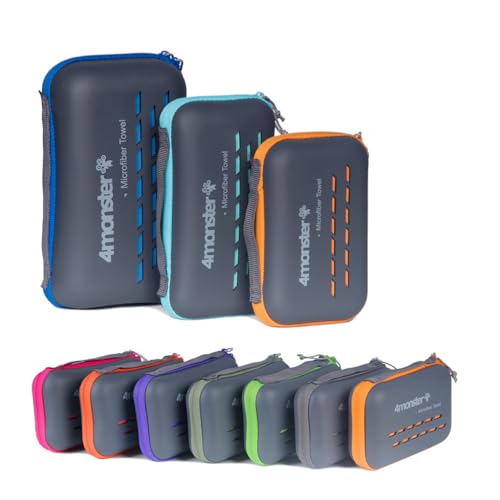
4Monster Quick Dry Travel Towel — Best With Its Own Case
The 4Monster’s distinguishing idea is not the towel but the container. It ships with a compact case and a carabiner, and that small bit of organization solves the least pleasant moment of towel travel: the last morning, when the towel is damp, checkout is in twenty minutes, and everything else in the bag is clean and dry. Sealed in its case and clipped to the outside of a backpack or weekender, the towel airs as you move instead of marinating against your clothes.
The towel itself is a quick-dry microfiber in the same family as the Rainleaf, absorbent and thin, with the same pat-don’t-rub technique applying. 4Monster sells the design in several sizes, so the listing deserves a careful read: choose the largest size if the towel’s main job is post-shower duty, because the smaller cuts in the range are really sport and hand towels. The case is sized to its towel, which keeps the packed bundle tidy rather than rattling around in a generic pouch.
On multi-stop trips the case earns its keep repeatedly. Clip the towel to a hostel bunk, a tent line, or the handle of your rolling bag in transit, and it keeps drying between stops instead of only when you remember to unpack it. Few travel products improve through a whole itinerary; this one does, because the problem it solves recurs every single day of the trip.
- Fabric: microfiber
- Included: storage case with carabiner
- Sizes: several in the range; pick the largest for bath use
- Format: single towel with case
- Drying style: fast-drying microfiber, hangs from the case loop
Strengths
- The case isolates a damp towel from clean clothes on travel days
- Carabiner lets the towel keep airing while clipped outside the bag
- Case is matched to the towel, so the packed bundle stays compact
Trade-offs
- Size names in the range run optimistic; verify dimensions before ordering
- The case adds a step to packing that minimalist travelers may skip
- Surface feel is standard microfiber, with the familiar slight skin drag
Best for: multi-stop itineraries, hostel and guesthouse stays, and anyone burned before by a damp towel in a closed suitcase. Not suited for: single-hotel trips where the towel can simply hang in one bathroom all week.

OlimpiaFit Quick Dry Towel Set — Best Three-Size Set
OlimpiaFit sells a small system rather than a single towel: three sizes of lightweight microfiber in one carry bag, sized for body, hair or gym, and face. For travelers who dislike using one towel for everything — a completely reasonable preference — this is the tidiest way to keep the roles separate without packing three full towels. The largest piece handles the shower, the middle one wraps hair or rides to the gym, and the smallest covers face washing and sink-side duty.
The division of labor also helps drying. Instead of one saturated bath towel doing every job, moisture spreads across three pieces, each of which dries faster than a single overloaded towel would. On a beach-and-sightseeing day the small towel goes in the daypack while the bath towel stays in the room, so the set adapts to the day instead of forcing one towel through every scenario.
The fabric is a smooth microfiber that feels a touch softer than the suede-style cloths, though it still rewards patting over rubbing. Edges are finished simply, and the whole set rolls into its bag at a size that disappears into a corner of a suitcase. Travelers who share — couples splitting the set between two bags, parents handing the mid-size to a teenager — get more flexibility here than from any single-towel pick in this guide.
- Fabric: microfiber
- Format: three towels in three sizes, with carry bag
- Roles: bath, hair/gym, and face sizes included
- Colors: several in the range
- Drying style: fast-drying; moisture split across pieces
Strengths
- Separate towels for body, hair, and face without packing three bath towels
- Spreading moisture across pieces shortens total drying time
- The set splits easily between two travelers or two bags
Trade-offs
- The largest piece is bath-adequate rather than generous on tall frames
- Three pieces mean three things to keep track of in shared bathrooms
- Smooth microfiber can feel slippery on wet skin until you adjust technique
Best for: travelers who keep towel roles separate, couples sharing one purchase, and beach trips with varied daily plans. Not suited for: solo minimalists who want exactly one object to wash, dry, and pack.
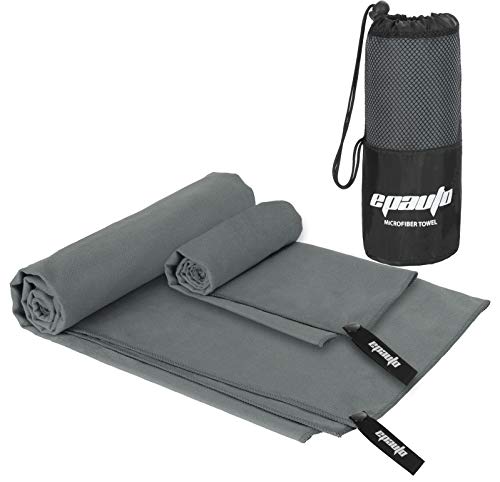
EPAuto Microfiber Travel Towel Set — Best Bath-Size Pair
EPAuto’s pair leads with the dimension most travel towels avoid: a full 60 by 30 inches for the main towel. That is the size of a proper home bath towel, wide enough to wrap and tuck, long enough for tall users to dry off without choreography. The second towel, at 24 by 15 inches, covers hair or hands. For travelers who have been disappointed by “large” travel towels that turned out to be glorified hand towels, this set is the corrective.
The trade is packed bulk. A 60-inch microfiber towel still folds far smaller than its cotton equivalent, but it will not vanish into a jacket pocket the way the Rainleaf nearly does. It suits checked luggage, car travel, and carry-ons with room to spare rather than the strictest personal-item-only packing. In return, the in-use experience is the closest to a home towel of any microfiber pick here, simply because coverage stops being a negotiation.
The gray colorway is a quietly practical choice for travel: it hides the faint grime that light towels pick up in transit, and it reads as unisex in shared bathrooms. Absorbency follows the microfiber pattern — strong, technique-dependent, and quick to recover after a wring-out over the tub.
- Fabric: microfiber
- Sizes listed: 60 x 30 in bath towel plus 24 x 15 in towel
- Color shown: Gray
- Format: two-piece set
- Drying style: fast-drying for its size class
Strengths
- Genuine bath-towel dimensions that wrap, tuck, and cover tall users
- The companion towel handles hair, freeing the big towel for the body
- Gray hides travel grime between laundry opportunities
Trade-offs
- Packed size is the largest of the microfiber picks here
- More fabric means a longer overnight dry than the compact picks
- Only the two pieces; no small face towel in the set
Best for: tall travelers, car trips, cruises, and anyone whose first complaint about travel towels is coverage. Not suited for: ultralight carry-on packers counting every cubic inch.

Sea to Summit DryLite Towel — Best Suede-Soft Finish
Sea to Summit comes to travel towels from the outdoor world, and the DryLite shows that heritage in its finish. The DRY+ microfiber has an ultra-suede surface that feels noticeably closer to cloth than the slick or grabby textures of cheaper travel towels. On a two-week trip, that difference compounds: the towel you use twice a day should not feel like equipment every single time.
The Large size shown here, in Sage Green, is cut for bath and beach use and packs down with the efficiency you would expect from a brand that also sells to backpackers. It absorbs well, releases water readily when wrung, and the suede nap gives it a slightly better glide on skin than standard microfiber, narrowing the technique gap for people switching from cotton for the first time.
Where the DryLite asks for care is in expectations of plushness. It is still a thin technical towel; the suede finish improves the hand feel, it does not create loft. Travelers who want their one luxury to be a thick towel should look at the cotton pick below and accept its slower dry. Travelers who want the most civilized version of a technical towel have found it here.
- Fabric: DRY+ microfiber with ultra-suede finish
- Size shown: Large
- Color shown: Sage Green
- Format: single towel
- Drying style: fast-drying, packable outdoor-grade build
Strengths
- Suede finish feels the most fabric-like of the microfiber picks
- Packs with backpacking efficiency despite bath-ready sizing
- Better skin glide narrows the adjustment period from cotton
Trade-offs
- Still thin and technical; no terry loft despite the nicer surface
- Sits in a higher tier than the budget microfiber picks
- Suede nap benefits from a proper wash before the first trip
Best for: longer trips, sensitive skin that dislikes standard microfiber, and travelers upgrading from a first cheap towel. Not suited for: buyers who want plushness above all and measure a towel by thickness.

Zumi Cotton Quick Dry Travel Towel — Best Cotton Option
Every category has its holdouts, and travel towels are no exception: some people simply will not use microfiber. The Zumi exists for them. It is 100 percent cotton in a large, lightweight build — a real towel with a familiar blot-and-rub feel, engineered to be thinner and quicker to dry than a standard bath towel so it can plausibly travel. In a rental house with a sunny balcony or a hotel room with a proper rack, it behaves beautifully.
Honesty about physics is required, though. Cotton holds water inside its fibers, not just between them, so even a lightweight cotton towel dries in hours where microfiber dries in a fraction of that time, and it packs at several times the bulk. Packed damp, it will scent a suitcase the way damp cotton always does. The Zumi is therefore a pick for trips with laundry access, airy rooms, or a car boot to air things in — not for one-night stands in windowless rooms.
Within those conditions it is genuinely pleasant: soft from the first use, increasingly absorbent over its first washes, and versatile across bath, pool, and boat duty. Travelers driving to a lake house or staying a week in one apartment will get more daily pleasure from this towel than from any technical cloth, and the gray colorway forgives the realities of travel laundry.
- Fabric: 100% cotton
- Build: large, lightweight quick-dry weave for cotton
- Color shown: Gray
- Format: single towel
- Drying style: quick for cotton; still slower than microfiber
Strengths
- Familiar cotton feel with normal blot-and-rub technique
- Large coverage that wraps like a home bath towel
- Softens and gains absorbency over its first several washes
Trade-offs
- Packs several times bulkier than the microfiber picks
- Dries slowly in humid or windowless rooms
- Must be fully dry before packing or it will scent the bag
Best for: road trips, week-long stays in one place, and committed cotton loyalists. Not suited for: fast multi-stop itineraries or humid climates without laundry access.
Comparison Table
| Pick | Fabric | Format | Packed size | Drying speed | Choose it if… |
|---|---|---|---|---|---|
| Rainleaf Microfiber Travel Towel | Microfiber | Single, 48 x 24 in | Smallest | Fast | you want one towel that lives in the bag |
| 4Monster Quick Dry Travel Towel | Microfiber | Single with case | Small, in case | Fast | damp-towel-in-luggage is your recurring problem |
| OlimpiaFit Quick Dry Towel Set | Microfiber | Three sizes with bag | Small as a set | Fast | you separate body, hair, and face towels |
| EPAuto Microfiber Travel Towel Set | Microfiber | Pair, 60 x 30 in main | Largest microfiber | Fast for its size | coverage matters more than packed bulk |
| Sea to Summit DryLite Towel | DRY+ microfiber, suede finish | Single, Large | Small | Fast | you want the most cloth-like technical towel |
| Zumi Cotton Quick Dry Travel Towel | 100% cotton | Single, large | Bulkiest | Slowest | you refuse microfiber and travel with laundry access |
What Makes a Bath Towel Genuinely Travel-Ready?
Three properties decide it, and marketing usually emphasizes the wrong one. The first is the ratio between working size and packed size: a towel earns its suitcase space only if it covers like a bath towel and packs like a hand towel. The second is drying speed in bad conditions — not on a clothesline in a breeze, but over a shower rod in a steamy room at midnight, because that is where travel towels actually dry. The third is tolerance for abuse: being stuffed damp into a bag, washed in unfamiliar machines, and hung from door handles, chair backs, and bunk rails for weeks at a time.
Notice what is not on the list: absorbency records. Nearly every microfiber towel absorbs plenty once your technique adjusts, and the difference between good and great absorbency matters far less on a trip than the difference between a towel that dries overnight and one that does not. A slightly less thirsty towel that is dry every morning beats a champion absorber that travels damp and comes home smelling like a swamp.
Attachment points deserve more respect than they get. A snap loop or hanging loop lets a towel dry from a hook, a branch, a car headrest, or a hostel bunk — all the places travel actually offers. Towels without any loop end up draped over luggage, where they dry slowly and slide onto floors. When two towels look equal on paper, choose the one with the loop.
How Do You Pack and Dry a Bath Towel Across a Multi-Stop Trip?
The routine that keeps a travel towel fresh is boring and absolute: wring it, hang it fully open, and never pack it damp if any alternative exists. Wringing a microfiber towel removes most of its water load immediately; hanging it unfolded, rather than folded over a rod, doubles the surface exposed to air and can cut drying time dramatically. In a shared bathroom, the towel goes over the shower door or on the hook nearest the window, not bunched on the counter.
On departure mornings, sequence matters. Shower first, breakfast second, pack last, so the towel gets every available minute of air. If it is still damp at checkout, the order of defenses is: hang it from the outside of the bag while in transit, use a ventilated case like the 4Monster’s, or isolate it in a separate washable pouch and hang it the moment you arrive. What you must not do is zip it into the main compartment against clean clothes and forget it for two days; that is how a whole bag acquires the swamp smell.
Laundry on the road resets everything. A travel towel washed and fully dried mid-trip returns to its first-day performance, so on trips longer than a week, plan one proper wash rather than heroic sink-rinsing. Sink washing works in a pinch — warm water, a drop of detergent, thorough rinsing — but detergent residue left in microfiber is the leading cause of a towel that stops absorbing, so rinse longer than feels necessary.
Which Size Should You Actually Buy?
Ignore the adjectives and read the inches. Around 48 by 24 inches is the threshold where a towel becomes a real bath towel for most adults: full drying coverage, modest wrap. At 60 by 30 inches you reach home-towel territory, with a wrap that tucks and stays. Anything marketed as a bath towel below roughly 40 inches long is a large hand towel with ambitions, useful for the gym or for hair, but not as your only towel on a trip.
Body size and trip style refine the choice. Petite travelers often find the 48-inch class generous and appreciate the smaller pack size, while tall or broad travelers should start at the 60-inch class and accept the bulk. Beach-heavy trips reward the bigger cuts, since the towel doubles as a lounger cover and a changing wrap; city trips with daily laundry reward the compact cuts, since a fresh towel is never more than a day away.
Hair changes the calculation for many travelers. Long or thick hair holds enough water to saturate the top third of a bath towel, leaving the rest of you to share what remains. A separate hair towel — the mid-size piece of a set, or any compact towel dedicated to the job — keeps the bath towel’s capacity for your body and lets the hair towel be wrung and hung independently. Travelers who blow-dry will not care; travelers who air-dry on a balcony with coffee will find the two-towel arrangement transforms the morning.
Sets complicate the math in a useful way. A three-size set whose largest piece is 48 inches may serve a traveler better than a single 60-inch towel, because the smaller pieces take over hair and face duty and leave the bath towel drier overall. Judge a set by its largest piece first, then by whether the smaller pieces match jobs you actually have.
What Mistakes Do Travelers Make When Buying a Bath Towel for Trips?
The classic error is buying by the word “large” instead of by dimensions, then discovering at the first hostel shower that the towel covers either the top half or the bottom half, but not both. The second error is packing a beloved home bath towel “just this once,” which costs a quarter of the suitcase and returns damp from every stop. Both mistakes come from shopping by feel instead of by the trip’s actual constraints.
Another common misstep is judging microfiber with cotton technique — rubbing hard, finding the drag unpleasant, and abandoning the towel after one shower. The pat-and-press method feels strange for exactly two showers and then becomes automatic. Relatedly, washing a new microfiber towel with fabric softener coats its fibers and can halve its absorbency; the first washes should be plain detergent only.
Finally, travelers underestimate the last-morning problem. Any towel can perform mid-stay, when it hangs in one bathroom for days. The towel earns its reputation on departure day and in transit. If your itinerary has many one-night stops, weight the picks with cases, loops, and the fastest drying times more heavily than in-use luxury.
How Does a Travel Towel Behave at the Beach, the Pool, and the Gym?
A travel towel rarely works only one job. At the beach, microfiber’s tight surface sheds sand instead of trapping it the way terry loops do, so a shake at the end of the day actually cleans it. That same smoothness makes it a poor sunbathing mat — it is a drying tool, not a blanket — and travelers who want one textile for both jobs should look at the flat-woven fouta style covered in a companion guide on this site. For pure drying after a swim, though, the travel towel’s quick recovery between dips is exactly right: wring it, drape it over a bag, and it is ready again in minutes.
At the pool, the advantage is discretion and rotation. A compact towel takes a fraction of a lane-end bench, dries between sessions, and does not return to your bag as a sodden brick. Swimmers who train daily often keep two in rotation, because even the fastest towel appreciates a rest day, and a pair of compact towels still packs smaller than one cotton bath towel. Chlorine is not kind to any fabric over a season, so a rinse in plain water after pool sessions extends the life of whichever pick you choose.
At the gym, the calculus is about the bag you carry all day. A towel that lives in a work bag from morning to evening must not scent the bag, which is another way of saying it must dry in a locker or draped over the bag itself between the workout and the commute. Microfiber’s speed is the whole argument here. The OlimpiaFit’s mid-size piece and the Rainleaf both fit this role well; the EPAuto’s big towel is the better choice only when the gym shower is your main daily shower, as it is for some van-dwellers and long-haul drivers.
What Should You Look for in Edges, Loops, and Finishing?
Travel towels fail at their edges first. A towel that is stuffed, wrung, and hung by one corner hundreds of times will fray where the finishing is weakest, so look for bound or overlocked edges rather than a raw cut hem, and for stitching that runs the full perimeter without gaps. Microfiber towels with heat-cut edges resist fraying well but can feel slightly stiff at the border; sewn edges feel softer and survive longer in machines. Either is acceptable; a towel already curling at the corners in its product photos is telling you something.
The hanging loop deserves a paragraph of its own because it is the feature travelers miss most when it is absent. A loop at the corner or midpoint lets the towel hang from hooks too small for draping, from bunk rails, from a car headrest post, from a branch at a campsite. Snap loops are better than sewn loops because they open to go around rails and towel bars that a closed loop cannot encircle. If a towel has no loop, a small carabiner clipped through a reinforced corner is the field repair, which is one reason the 4Monster’s included carabiner is more than a gimmick.
Color and pattern are finishing choices with practical weight. Mid-tone colors hide the gradual graying that travel laundry produces, while very dark towels show every fleck of sunscreen and lint. Patterns disguise staining best of all, which matters for a towel that will meet beach tar, gym floors, and picnic grass in a single trip. None of this is vanity; a towel that still looks clean gets washed appropriately, while a towel that looks grubby gets washed desperately and often, with harsh products that shorten its life.
How Do You Wash a Travel Towel in a Hotel Sink Without Ruining It?
Sink washing is a legitimate skill on longer trips, and microfiber forgives it as long as three rules hold. First, use very little detergent — a few drops — because microfiber’s split fibers trap soap, and trapped soap is the main reason a travel towel gradually stops absorbing and starts feeling slick. Second, rinse until the water runs completely clear and then once more; the extra rinse is the entire secret. Third, never add fabric softener or use dryer sheets when a machine is available, since both coat the fibers with a waxy film that defeats the towel’s design.
The washing itself is simple: fill the sink with warm water, submerge the towel, knead it rather than twisting it, and let it soak for ten minutes if it has been working hard. Drain, rinse under the tap while pressing the towel against the sink’s side, then roll it inside a dry provided hotel towel and stand on the roll — the oldest trick in travel laundry, and still the fastest way to extract water without a spin cycle. Hang the towel fully open afterward, ideally where air moves: near a window, under an air-conditioning vent, or over the shower door with the bathroom fan running.
Cotton travel towels tolerate sink washing too, but the drying math changes. The Zumi will need moving air and several hours, so sink-wash it on a stay-put day, not the night before a departure. If a trip involves frequent sink washing and fast turnarounds, that constraint alone justifies choosing microfiber, whatever your fabric preferences at home.
Which Travel Towel Suits Which Kind of Trip?
For the city break — trains, small hotels, museums, one bag — the Rainleaf is the natural fit, because the towel’s job is insurance against bad provided linen and it should cost almost no space. For the road trip, where the car forgives bulk and the towel may serve at lakes, campsites, and motels in one week, the EPAuto’s full-size coverage or the Zumi’s cotton comfort both make sense, chosen by whether your stops have laundry and air. For the beach holiday in a shared house, the OlimpiaFit set spreads across the week’s jobs and keeps one person’s towel from becoming everyone’s towel.
For the working trip with a gym habit, prioritize the fastest-drying pick you can hang in a locker or office, which points to the compact microfiber options and away from cotton entirely. For the long slow trip — a month in one or two rentals — the DryLite’s suede finish repays its higher tier every day, because the towel becomes part of your daily routine rather than emergency equipment, and small daily pleasures compound over thirty mornings.
For trips built around other people’s houses — holidays with family, staying with friends — bring the towel that dries on a hook without hogging the bathroom’s one rail, and offer it as a contribution rather than a criticism of the household linen. A compact microfiber towel draped over your own suitcase handle dries without colonizing shared space, and that small diplomacy is worth more than absorbency records.
How Long Will a Travel Towel Last, and When Should It Be Replaced?
A decent microfiber travel towel survives years of trips; the fabric does not rot, pill heavily, or lose its structure quickly. What fades first is absorbency, usually because of detergent buildup or softener coating rather than wear, and that decline is often reversible with a hot wash and a thorough double rinse. If a properly stripped and rinsed towel still skates water across your skin, the fibers themselves are done and replacement is honest rather than wasteful.
Cotton travel towels age more visibly: edges fray, the weave thins at the fold lines, and absorbency actually improves for the first dozen washes before beginning its slow decline. Replace a cotton travel towel when it dries you noticeably worse than it did new, or when it holds a stale smell after a proper hot wash and full dry — that smell means the fibers are harboring residue that washing no longer reaches.
Either way, a retired travel towel has honorable second careers: car drying, pet duty after muddy walks, gym-floor mop, or the emergency towel that lives in a vehicle’s trunk. Keeping the old towel in service somewhere beats binning it, and it keeps a proven spare in circulation for the day the new towel is left hanging in a hotel bathroom three hundred miles behind you.
How Much Should You Spend on a Towel That Lives in a Suitcase?
Travel towels sit in a forgiving price landscape, and the sensible way to think about tiers is by role rather than by quality labels. At the budget tier, simple microfiber towels like the Rainleaf deliver nearly all of the function — absorbency, speed, packed size — and their low commitment makes them ideal as a first purchase or as spares scattered across bags and vehicles. Losing one at a beach hotel is an annoyance, not an event. Most travelers should start here, because the category’s core technology is mature and cheap.
The mid and upper tiers buy refinement rather than transformation. The DryLite’s suede finish, the 4Monster’s fitted case, the EPAuto’s generous cut — each spends money on a specific friction: feel, organization, coverage. Those frictions are real, and if one of them matches your recurring complaint, paying for its solution is rational. What the upper tiers do not buy is a fundamentally different towel; no travel towel at any tier dries like cotton at home while packing like microfiber, because physics does not offer that product yet.
Cotton travel towels invert the logic: the Zumi costs more than basic microfiber and performs worse on the travel metrics, while performing better on the one metric money usually cannot fix — how the towel feels against your skin at 7 a.m. in a strange bathroom. If that feeling is the point of the purchase, the tier is justified. Judge every travel towel by the friction it removes from your own trips, and the pricing tiers sort themselves.
What About Hygiene in Shared Bathrooms, Hostels, and Gyms?
Bringing your own towel to shared facilities is partly a comfort choice and partly simple control: you know where your towel has been, how it was washed, and how long it hung damp. That control only holds if your own habits are sound. A personal towel draped over a communal rail for a week, or stuffed damp into a gym bag daily, quickly becomes the least hygienic object in the room, whatever its fabric. The discipline is the same as at home, compressed: full drying daily, a real wash weekly, and no sharing of the face end with the floor end — a reason some travelers fold a small mark or choose a towel with a distinct border to keep orientation straight.
In hostels, your towel is also a small piece of personal territory, and the compact picks here respect that: they hang from a bunk rail, dry in the dorm’s moving air, and pack away in seconds when you move on. In gyms with towel services, bringing your own still pays when the service towel is the size of a napkin or carries the faint perfume of industrial laundry. In all shared settings, a mid-tone or patterned towel reduces mix-ups, because the most common hygiene failure is not fabric at all — it is two travelers using each other’s identical white towels for a week without noticing.
How Do You Choose Between One Towel, a Pair, and a Full Set?
The single towel is the minimalist’s answer and the right one for travelers whose trips have a fixed rhythm: one shower a day, a bathroom to hang the towel in, a wash every week or so. It is also the easiest kit to maintain, because there is exactly one object to dry, wash, and remember. The Rainleaf and the DryLite are built for this pattern, and for business travel or short leisure trips it covers everything without a spare thought.
A pair — whether two singles or a sized set like the EPAuto’s — adds resilience. One towel can be in the wash, drying slowly, or assigned to the beach while the other handles the shower. Pairs suit longer trips and wetter itineraries: swimmers, surfers, and anyone whose towel works twice a day. The packed cost of a second microfiber towel is small, and the insurance it buys against a single point of failure is disproportionately large. Most two-week travelers end up here whether they planned to or not.
The full multi-size set answers a different need: separation of roles. Travelers who keep face, hair, and body textiles distinct — for skin care routines, for religious practice, for simple preference — get that separation without packing three bath towels, and families can divide a set across people. The OlimpiaFit is the expression of that idea in this guide. Choose the configuration by the failure you most want to avoid: no towel at all (buy a spare single), a damp towel at shower time (buy a pair), or one towel forced into every role (buy the set).
Final Recommendation
For most travelers, the Rainleaf is the towel to buy first: honest bath coverage, tiny packed size, overnight drying in real bathrooms, and a tier low enough that keeping one in each bag is painless. Step up to the Sea to Summit DryLite if the feel of standard microfiber is what has kept you from switching, and choose the EPAuto pair when coverage complaints have ruined previous purchases. The OlimpiaFit set suits travelers who run a system, the 4Monster suits travelers whose trips are chains of one-night stops, and the Zumi keeps cotton loyalists happy on slower itineraries with laundry access.
Buy one, take it on a short trip, and learn its technique before committing to a full travel kit — a towel understood is worth two towels guessed at.
One last piece of advice from hard experience: whichever pick you choose, wash it once at home and use it for a few ordinary showers before it ever meets a suitcase. That first wash clears manufacturing residue, the home trials teach you the patting technique in low-stakes conditions, and you will learn your towel’s real drying time in your own bathroom’s air. A towel you have already broken in travels like an old friend; a towel unboxed at the destination is one more unknown in a day that usually has enough of them.
Frequently Asked Questions
Can a travel towel really replace a hotel towel?
Yes, and that is its main purpose. A bath-size travel towel covers and dries an adult fully, so you are never dependent on what a rental or budget hotel provides. Travelers with sensitive skin or strong preferences about laundry products often find their own towel is the single easiest comfort upgrade on a trip.
Why does microfiber feel like it pushes water around instead of soaking it up?
Because the technique differs. Cotton absorbs by blotting and rubbing; microfiber absorbs when pressed and patted against wet skin, letting its split fibers pull water in. Rubbing a microfiber towel briskly mostly skates it across the surface. Two or three showers of adjusted technique usually end the complaint entirely.
How do I stop a travel towel from smelling after a few days on the road?
Dry it completely every day, wring it before hanging, and give it one real wash with detergent on any trip past a week. Odor in travel towels is almost always a drying failure, not a fabric failure: a towel packed damp for a day will smell, whatever it is made of.
Is one travel towel enough for a two-week trip?
For microfiber, usually yes, provided it dries fully each night and gets one proper wash mid-trip. Travelers who shower twice daily, or who also need a beach towel, do better with a set like the OlimpiaFit or a pair like the EPAuto, so no single towel carries every job.
Should I choose cotton if my trip includes laundry facilities?
It becomes a reasonable choice. With a machine wash and a real dry every few days, a lightweight cotton towel like the Zumi delivers the familiar feel many travelers prefer. Without laundry access, or in humid destinations, microfiber’s drying speed is the safer bet.
What is the difference between a travel towel and a backpacking towel?
Priorities. Backpacking towels are chosen by weight above all, because they are carried on the back for weeks. Travel bath towels are chosen by packed size, drying speed, and coverage, because suitcases forgive grams but not bulk or damp. Several picks here work for both, but the judging criteria differ.
Related Guides
If your trips lean further toward the trail, our guide to Best Backpacking Towels judges towels by carried weight first. For the flat-woven style many travelers pack as a second towel, see Best Fouta Bath Towels. Families heading into a first season of dance classes will find Best Ballet Slippers for Beginners a useful detour, and the all-purpose roundup in Best Absorbent Quick-Drying Towels covers quick-dry picks beyond the bathroom.


