What's inside
- Key Takeaways
- Quick Picks
- How Did We Choose These Backpacking Towels?
- How Do the Six Backpacking Towels Compare at a Glance?
- What Size Pack Towel Do You Actually Need?
- Why Does Microfiber Dominate the Trail, and Where Does It Fail?
- How Do You Keep a Pack Towel Fresh on a Long Trip?
- What Else Can a Good Pack Towel Do Around Camp?
- How Should You Pack and Store a Trail Towel Between Trips?
- How Do You Wash Properly When the Only Water Is a Mountain Stream?
- What Should Bikepackers and Paddlers Steal From This Guide?
- How Does Towel Choice Change on a Thru-Hike Versus a Weekend Trip?
- What Mistakes Do Backpackers Make When Buying a Trail Towel?
- Final Recommendation
- Frequently Asked Questions
- Related Guides
As an Amazon Associate I earn from qualifying purchases. This post may contain affiliate links at no extra cost to you.
cottageverdict.com is reader-supported. When you buy through links on our site, we may earn an affiliate commission.
Where to buy: All six towels below are listed on Amazon. Follow a linked name to check price on Amazon, confirm the exact size you are ordering, and inspect the carry case or stuff sack included before it goes anywhere near your pack.
A backpacking towel is judged in two places that never meet in a shop: the bathroom scale before a trip, and a damp campsite on the third evening, when everything smells faintly of woodsmoke and yesterday’s rain. The best backpacking towels survive both judgements. They pack down to almost nothing, drink a surprising amount of water off skin and hair, and then, crucially, give that water back to the air overnight on a guyline, because a towel that travels wet becomes a mildew experiment sealed inside your rucksack.
Fabric choice in this category is less varied than marketing suggests. Nearly every serious pack towel is microfiber, but microfiber is a family, not a single cloth: suede-finish cloths feel smooth and pack smallest, waffle and terry-loop versions grip water faster and feel more like a household towel, and ultralight weaves trade absorbency for a packed size closer to a paperback novel. The six picks below span that family deliberately, from a full-size recycled towel to an airy minimalist sheet that weighs about as much as the headlamp beside it.
Sizing is where beginners lose money. A towel too small turns every stream-side wash into a slow, chilly negotiation, while a bath-sheet-sized monster eats the pack space that should hold a warm layer. Most backpackers settle happily in the middle: a body towel wide enough to wrap the waist and long enough to matter, sometimes paired with a tiny hand cloth for cooking and condensation duty. Read each review with your own torso and trip length in mind, because the right answer for a weekend in the hills differs honestly from the right answer for a month on a long trail.
Key Takeaways
- Packed size and overnight drying matter more on the trail than raw absorbency; a towel must be dry by morning, every morning.
- Suede-finish microfiber packs smallest and feels smoothest, while looped or waffle surfaces pull water off skin noticeably faster.
- A body towel near forty-eight by twenty-four inches wraps most adults properly without swallowing half the rucksack.
- Ultralight towels reward disciplined minimalists and punish anyone who expects a long, luxurious dry after a lake swim.
- Hang the towel outside the pack at lunch stops; ten minutes of moving air prevents the stale odour that ruins week-long trips.
- A three-size set quietly solves several jobs at once: body, hair, and the small cloth that wipes pots and tent condensation.
Quick Picks
| Pick | Badge | Why it earns its place |
|---|---|---|
| Rainleaf Microfiber Towel 48×24 Army Green | Best All-Round Pack Towel | A forty-eight by twenty-four inch suede microfiber in army green, the balanced size and finish that most backpackers end up recommending. |
| Wise Owl Outfitters Camping Towel | Best for Mixed Camp and Travel | A quick-dry microfiber towel from an outfitter brand, offered in sizes that let travellers match the cloth to the trip precisely. |
| 4Monster Quick Dry Towel with Case | Best Carry Case and Organisation | A quick-dry microfiber towel sold with a compact case and carabiner, so the towel clips outside the pack and dries as you walk. |
| Sea to Summit AirLite Towel Large Picante | Best Ultralight Minimalist Pick | An ultralight, ultra-compact microfiber in the large size, absorbing several times its own weight while packing down to almost nothing. |
| Nomadix Ultralight Towel Barton | Best Full-Size Yet Featherlight | A thirty by fifty-four inch towel made with recycled materials, delivering bath-towel coverage at a pack weight that defies its dimensions. |
| OlimpiaFit Quick Dry Towel 3 Size Pack | Best Three-Size System | Three microfiber towels in graduated sizes with a carry bag, covering body, hair, and small camp jobs in one coordinated purchase. |
Trail badges below describe the trip each towel suits best. Thru-hikers counting grams and families car-camping beside a lake are both backpacking in spirit, but they should not buy the same cloth, and this table refuses to pretend otherwise.
How Did We Choose These Backpacking Towels?
We screened for the trail metrics first: packed dimensions, drying behaviour, and whether the listing states a real size rather than hiding behind adjectives. Any towel whose maker would not commit to measurements was set aside, because a backpacker planning around litres and grams cannot use poetry. Carry solutions counted too; a towel with a mesh bag, hanging loop, or carabiner arrives trail-ready, while a bare rectangle demands improvisation from day one.
Absorbency was weighed relative to mass, the only honest way to judge this category. A heavy towel that drinks more water is not automatically better out here; the question is how much drying each gram buys you, and whether the cloth releases that water again on a line strung between two trees. Listings claiming a multiple of the towel’s own weight in absorbed water were read as useful signals of intent, then tempered by weave type and size.
Finally, we favoured towels with a life beyond a single trip type. The best of these cloths serve at the gym in winter, on beach holidays, and in hostel bathrooms where the provided towel is theoretical. Versatility matters because most backpacking towels spend most of their lives somewhere else, and a purchase that only makes sense above the treeline is a purchase most households will quietly regret.

Rainleaf Microfiber Towel 48×24 Army Green — Best All-Round Pack Towel
Rainleaf’s towel occupies the sensible centre of this category and defends it well. Forty-eight inches of length wraps a waist with overlap and reaches properly down the back, while the twenty-four-inch width keeps the packed bundle closer to a water bottle than to a bedroll. The suede-style microfiber surface feels smooth rather than grabby against skin, which matters at the end of a long day when everything, including the hiker, is faintly abrasive.
Drying behaviour is where this towel earns its keep across a whole trip. Wring it firmly and it gives up most of its water immediately; hang it from a pack strap or a line and the thin, even weave releases the rest steadily, so by morning it is ready rather than merely less wet. That reliability compounds over a week. A towel that is ninety percent dry each dawn slowly ferries moisture out of your kit, while one that lags becomes heavier and less pleasant by the day.
The army green colourway is a practical choice disguised as a style one. It conceals the gradual greying that trail dust and stream water impart to pale fabrics, and it looks at home in camp rather than announcing itself across a valley. Rainleaf sells this cloth in several sizes, so households can standardise: this middle size for bodies, a smaller sibling for the cook kit, all in the same forgiving shade.
Choose it if you want one towel that behaves predictably everywhere. It will not win an ultralight contest, and it makes no attempt to feel like the plush cotton hanging at home. What it offers instead is the complete absence of towel drama across an entire trip, which experienced backpackers recognise as the highest praise this category can earn.
- Size: 48 x 24 inches
- Material: microfiber, suede-style finish
- Colour in this listing: army green
- Format: single body towel
- Role in the kit: default body towel for most trips
Strengths
- Balanced dimensions wrap properly yet pack to bottle size
- Thin even weave dries dependably overnight on a line
- Dark green hides trail grime between laundry opportunities
Trade-offs
- Suede finish feels less plush than looped microfiber
- A single towel means hair and body share one cloth
- Not the lightest option for gram-counting thru-hikers
Best for: Backpackers wanting one proven, mid-size towel for weekends through week-long trips.
Not suited for: Ultralight purists who measure their base weight in single grams.
Wise Owl Outfitters Camping Towel — Best for Mixed Camp and Travel
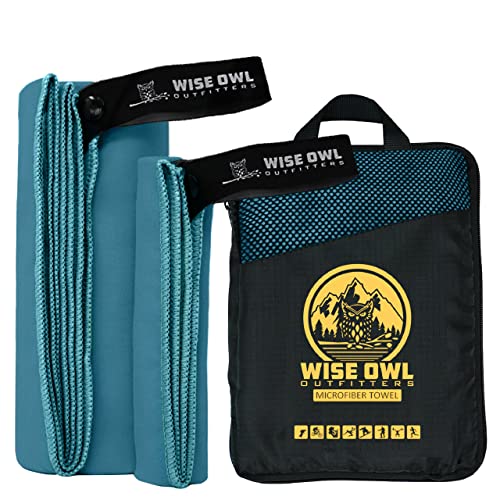
Wise Owl Outfitters built its name on hammocks and camp comfort, and its towel carries that sensibility: it is a cloth designed by people who clearly spend nights outside rather than merely shipping rectangles. The microfiber dries quickly, packs compactly, and comes in a range of sizes, so a buyer can choose a modest face-and-hands cloth for fastpacking or a generous body size for basecamp luxury without changing brands or fabric behaviour.
The surface sits between suede and terry in character, smooth enough to pack tightly yet textured enough to move water off skin without endless patting. After a swim, it performs the essential trail trick of working while damp: microfiber keeps absorbing even when it is no longer bone dry, so the second and third uses of the day remain effective, unlike cotton, which gives up once saturated. Hang it at lunch and it resets itself in the breeze.
Travellers beyond the trail will find this towel equally at home. Hostel bunks, overnight trains, and gym bags all reward the same traits, and the towel’s unassuming appearance suits shared spaces. Families equipping several people can colour-code by size or shade, a small organisational pleasure that prevents camp arguments about whose towel is whose, conducted at volume, in the dark, beside a lake.
Its honest limitation is that it does nothing extreme. It is not the absolute lightest, nor the absolute largest, nor the cheapest cloth on this page. It is instead the towel equivalent of a reliable hiking boot: chosen once, used constantly, and replaced like-for-like years later without a fresh round of research, which is how most outdoor gear should ideally be bought.
- Material: microfiber
- Sizes: multiple sizes on the listing; confirm before ordering
- Format: single towel
- Brand background: camping and hammock outfitter
- Role in the kit: camp, travel, and gym crossover
Strengths
- Size range lets each traveller match cloth to trip
- Keeps absorbing effectively even while already damp
- Understated look suits hostels and shared facilities
Trade-offs
- Size must be selected carefully on the listing page
- Mid-pack weight will not thrill ultralight hikers
- Single towel per purchase; sets must be assembled manually
Best for: Campers and travellers who want one dependable towel across many kinds of trip.
Not suited for: Buyers seeking an extreme specification in any single direction.
4Monster Quick Dry Towel with Case — Best Carry Case and Organisation
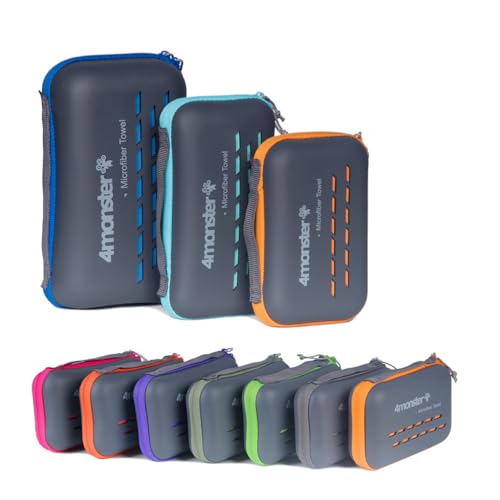
The 4Monster towel understands that a pack towel’s hardest problem is not absorbing water but storing itself afterwards. Its included case, fitted with a carabiner, turns the towel into an external passenger: clip it to a compression strap after a morning wash and it dries in the moving air while you hike, arriving at camp ready instead of marinating inside a stuff sack. That single organisational idea solves the mildew story that ruins so many trail towels by day four.
The cloth itself is a fast, light microfiber that absorbs enthusiastically and wrings out nearly dry, the correct temperament for a towel expected to work several times a day. Between stream washes, gym sessions in trail towns, and the occasional duty as an emergency layer between a wet jacket and a dry sleeping bag, it behaves like equipment rather than linen. The case also imposes packing discipline: the towel always returns to the same place, findable by touch in a dark tent.
Hikers who organise by systems will appreciate the colour and size options on the listing, which allow a household to run matching kits. Solo travellers benefit most from the clip-and-dry routine, since there is no partner’s pack to share the drying labour with. Even the carabiner, a trivial object, earns its grams by doubling as a line anchor when a towel needs hanging from a branch at camp.
The trade-off is that the case is one more component to keep track of, and hikers who simply stuff everything loose will lose it by the second trip. The towel also favours the smooth, quick end of the microfiber spectrum, so anyone hoping for a terry-like rub should look at the looped options instead. For system-minded backpackers, though, this is the most thoughtfully packaged towel in the guide.
- Material: microfiber
- Carry: compact case with carabiner included
- Format: single towel, sizes on listing
- Drying style: clips outside the pack while hiking
- Role in the kit: organised solo and system-based kits
Strengths
- Case and carabiner enable drying while you walk
- Wrings out close to dry for repeated daily use
- Consistent storage spot ends tent fumbling at night
Trade-offs
- Case can be lost by hikers who pack loosely
- Smooth surface will not satisfy terry loyalists
- External clipping exposes the towel to trail dust
Best for: Solo backpackers and organised travellers who dry gear on the move.
Not suited for: Anyone who dislikes managing a separate case for a towel.

Sea to Summit AirLite Towel Large Picante — Best Ultralight Minimalist Pick
Sea to Summit approaches the towel as an engineering problem in mass removal, and the AirLite is the result: a cloth so light and compressible that it disappears into a hip-belt pocket and is forgotten until the moment it is needed. The listing states it absorbs three times its weight in water, a figure that reframes expectations honestly, because an ultralight towel is a water-management tool, not a bathrobe. It moves moisture off skin efficiently, then releases it with embarrassing speed.
Using it is a technique worth learning. Pat and press rather than rubbing, working the cloth across the body in sections, wringing as you go. Minimalists master this in two washes and thereafter dry themselves perfectly well with a fraction of the fabric other hikers carry. The large size in this picante colourway gives enough cloth for a genuine body dry and a waist wrap for modest stream-side changing, which smaller ultralight squares cannot honestly offer.
Drying speed is the AirLite’s party trick. Spread over a tent or a warm rock, it can go from wrung-out to bone dry during a lunch stop, which transforms multi-day hygiene: the towel never accumulates the damp, sour backlog that plagues heavier cloths in humid forests. In desert and alpine conditions, where water is scarce and air is dry, it feels less like a compromise and more like the correct answer outright.
The compromises are real and should be bought knowingly. There is no plushness here, no lingering wrap of comfort after a cold plunge, and the cloth’s lightness makes it lively in wind when hung carelessly. It is a specialist’s towel. But for the hiker trimming every gram before a long trail, it removes weight without removing the ability to wash, and that is precisely the bargain ultralight gear is supposed to strike.
- Size: large, per listing
- Material: ultralight microfiber
- Absorbency claim on listing: absorbs 3x its weight in water
- Colour in this listing: picante
- Role in the kit: minimalist and long-distance kits
Strengths
- Packs to a fraction of conventional towel volume
- Dries completely during short stops in sun or wind
- Large size still wraps and covers credibly
- Technique-based drying becomes fast with practice
Trade-offs
- No plush comfort after cold-water swims
- Light fabric blows around when hung in wind
- Absorbency ceiling is lower than heavier towels
Best for: Thru-hikers and fastpackers trimming every possible gram.
Not suited for: Campers who treat the post-swim towel wrap as sacred ritual.

Nomadix Ultralight Towel Barton — Best Full-Size Yet Featherlight
Nomadix asks a subversive question: what if the pack towel were simply a real towel, full-sized at thirty by fifty-four inches, that happened to weigh almost nothing? The Barton answers it. Spread out, this is the coverage of a home bath towel, enough to wrap any adult completely, dry hair properly, and double as a beach blanket, picnic groundsheet, or improvised shade. Rolled or folded into a pack, it collapses to a volume that makes its dimensions seem like a printing error.
The recycled-materials construction is the brand’s founding argument, turning existing plastic into trail gear rather than demanding new resources. The resulting cloth has a smooth, almost silky hand quite unlike suede microfiber, sliding over skin and shedding sand and debris with a shake. At the beach or a dusty desert camp, that shake-clean behaviour is worth more than a marginal absorbency advantage, because grit carried into a sleeping bag taxes the whole night.
On the trail, the size opens tactics smaller towels cannot attempt. It becomes a changing screen, a ground cloth for sorting gear, a wrap for the cold ferry ride after a coastal hike. Each extra duty replaces another item, which is how a nominally larger towel can still reduce total pack weight. Hikers who travel with a partner often carry one Nomadix between two, a sharing economy that works precisely because there is so much cloth to share.
Its scale is also its caveat. In a small fastpacking sack, even a compressible thirty-by-fifty-four towel claims real estate, and solo minimalists will not use half its talents. The smooth surface absorbs a touch less greedily than looped microfiber on first contact. Buy it as a multi-tool that happens to dry you, and it delights; buy it expecting a conventional towel experience at conventional size, and its silky temperament may surprise you.
- Size: 30 x 54 inches
- Material: made with recycled materials, per listing
- Colour in this listing: Barton dark blue
- Format: single full-size towel
- Role in the kit: towel plus ground cloth, screen, and blanket duties
Strengths
- True bath-towel coverage at pack-towel weight
- Smooth surface shakes free of sand and grit
- Extra duties can replace other items in the pack
- Recycled construction lessens the footprint of the purchase
Trade-offs
- Footprint still challenges the smallest fastpacks
- Smooth hand absorbs less instantly than looped cloth
- Solo minimalists may never use its full versatility
Best for: Hikers and beach travellers who want one large cloth doing several jobs.
Not suited for: Fastpackers whose sacks have no spare litre for versatility.

OlimpiaFit Quick Dry Towel 3 Size Pack — Best Three-Size System
OlimpiaFit sells a system rather than a towel: three sizes of quick-dry microfiber in a single bag, sized for the three jobs that actually arise outdoors. The large cloth handles bodies after swims and showers, the medium manages hair and gym work, and the small one becomes the hardest-working item in the cook kit, wiping pots, drying hands, and mopping tent condensation at dawn. Buying the trio together ends the improvisation where one towel is asked to do everything and does the dirty jobs last.
Graduated sizing changes camp hygiene in a way single towels cannot. The small cloth absorbs the greasy, smoky tasks, keeping the body towel clean for skin; the medium keeps hair-washing from soaking the main cloth before bed. Each towel dries at its own station, clipped around camp like small flags, and the whole set still packs into a bag smaller than one cotton bath towel. For families, the sizes also assign naturally by person, ending towel disputes before they form.
The microfiber itself is the quick, smooth sort, chosen for drying speed over plushness, and it suits the system logic: everything must be dry by the time the bags are packed, or the system fails. Wring each cloth at night, hang them under the tarp edge, and by morning the set is reset. In humid conditions, spread them during the day’s first break; the discipline is light, and the payoff is a kit that never smells like a forgotten swimming bag.
The honest cost is total volume: three towels, however light, occupy more room than one minimalist sheet, and solo ultralight hikers should look at the AirLite instead. Groups, families, and comfort-leaning backpackers will draw the opposite conclusion. For them, this set replaces a towel, a hair cloth, and a camp rag in one purchase, and coordinated systems almost always outlast improvised ones on real trips.
- Format: 3 towels in graduated sizes
- Carry: bag included
- Material: microfiber
- Jobs covered: body, hair, and camp utility
- Role in the kit: complete towel system for groups and families
Strengths
- Separate cloths keep body towels away from greasy jobs
- Graduated sizes map neatly onto real camp tasks
- Whole set still packs smaller than one cotton towel
- Family members can claim sizes instead of arguing
Trade-offs
- Total volume exceeds a single ultralight towel
- Smooth microfiber feel will not please terry fans
- Three pieces mean three items to hang and track
Best for: Families, couples, and campers who like a cloth for every job.
Not suited for: Solo gram-counters who carry exactly one of everything.
How Do the Six Backpacking Towels Compare at a Glance?
Compare these by packed philosophy. Rainleaf and Wise Owl sell balanced dependability, 4Monster sells organisation, Sea to Summit sells absence of weight, Nomadix sells abundance of cloth, and OlimpiaFit sells division of labour. Your trip style, not any specification, should cast the deciding vote.
| Pick | Format | Material | Standout trait |
|---|---|---|---|
| Rainleaf Microfiber Towel 48×24 Army Green | Single towel, 48 x 24 in | Microfiber, suede finish | Most balanced trail towel |
| Wise Owl Outfitters Camping Towel | Single towel, sizes vary | Microfiber | Camp-to-hostel versatility |
| 4Monster Quick Dry Towel with Case | Single towel with case | Microfiber | Dries clipped outside the pack |
| Sea to Summit AirLite Towel Large Picante | Single towel, large | Ultralight microfiber | Smallest packed footprint |
| Nomadix Ultralight Towel Barton | Single towel, 30 x 54 in | Recycled materials | Full-size multi-tool cloth |
| OlimpiaFit Quick Dry Towel 3 Size Pack | 3 towels, graduated sizes | Microfiber | Complete three-job system |
What Size Pack Towel Do You Actually Need?
Measure yourself, not the marketing. A body towel must wrap your waist with a few inches of overlap if you intend to change beside streams or walk to a campsite shower block, and for most adults that means a width of at least twenty-four inches and a length approaching fifty. Smaller cloths dry a body perfectly well in sections, but they cannot wrap, and the difference between drying and wrapping decides many purchases once it is stated plainly.
Trip length bends the answer. On a two-night trip, a small towel’s limitations are a brief inconvenience; across two weeks, the nightly ritual of drying with an inadequate cloth becomes a genuine tax on morale. Conversely, a large towel’s packed bulk is paid every single day in the sack, while its comfort is collected only at wash time. Weigh those two ledgers against your own itinerary rather than copying a stranger’s packing list.
Consider also the second towel nobody lists: the small utility cloth. Condensation on tent walls, a spilled stove, wet boots at the vestibule, all demand a rag that is not your body towel. Whether it arrives inside a three-size set or as a cheap addition, planning for it separates tidy camps from damp ones, and it weighs almost nothing against the comfort it protects.
Why Does Microfiber Dominate the Trail, and Where Does It Fail?
Microfiber’s split fibres create enormous surface area in a cloth that weighs very little, which is why it absorbs multiples of its weight and releases water readily when wrung. Cotton, by contrast, holds water inside its fibres, dries slowly in still air, and grows heavier across a trip. Above the treeline, where every gram is carried uphill by your own legs, that physics settles the argument for nearly every backpacker who has tried both.
The failures are about feel and habit. Suede microfiber can feel draggy or strangely static against dry skin, and it picks up odours across a long trip if it is packed away damp even once. It also melts rather than chars near flames, so the towel should dry on a line, never draped over a stove or too close to the fire. None of these flaws is fatal; all of them are managed by the simple discipline of airing the cloth whenever the day pauses.
Care on returning home resets everything. Wash microfiber without fabric softener, which coats the split fibres and quietly strangles absorbency, and dry it fully before storing. A towel treated this way serves for years of trips; one stuffed damp into a garage bin between summers becomes the cautionary tale that convinces its owner, wrongly, that pack towels simply smell.
How Do You Keep a Pack Towel Fresh on a Long Trip?
Freshness is a drying schedule, not a product feature. The towel should be wrung after every use, hung at every halt longer than a snack, and clipped outside the pack whenever the weather allows, which is exactly the routine the 4Monster case is built around. Moisture that leaves the cloth daily never becomes the sour, sealed-in smell that greets hikers who store a damp towel in a waterproof sack for a week.
Washing on trail, when a trip runs long, means plain water and distance from streams: carry water away from the bank, rinse the towel, and hang it where breeze reaches. Save soap for town stops, where a sink wash restores the cloth completely. Rotating two smaller towels, as the OlimpiaFit system allows, halves the burden on each and gives every cloth a full rest day to dry to the core.
Odour, once established, is still curable at home. A hot wash, a vinegar rinse, and a full day of outdoor drying will rescue most trail towels, because the smell lives in residue rather than in the fibres themselves. Prevention remains cheaper: the hiker who airs a towel for ten minutes at lunch simply never meets the problem that the rescue wash exists to solve.
What Else Can a Good Pack Towel Do Around Camp?
A towel is quietly the most versatile rectangle in the pack. It becomes a pillowcase over a stuff sack of clothes, a sit pad on wet logs, a pre-filter for silty water before treatment, and a wrap that keeps a stove kit silent on the move. The Nomadix, with its full dimensions, extends this list to groundsheet and privacy screen; smaller cloths handle the humbler duties that arise hourly.
In emergencies the list grows serious: a towel pads a splint, shades a overheating companion, or signals from a hillside if its colour contrasts with the landscape. None of this justifies carrying a bath sheet into the mountains, but it does explain why experienced hikers resist cutting the towel from the kit entirely, however aggressively they trim elsewhere. Multi-use is the oldest weight-saving strategy in backpacking.
Back at home, the same cloths earn their storage space in gym bags, swim kits, and car boots. A purchase that serves fifty weeks a year in ordinary life and two weeks gloriously in the hills is easier to justify than specialist gear used once, which is why the balanced picks in this guide, rather than the extremes, tend to be the ones still in service five years later.
How Should You Pack and Store a Trail Towel Between Trips?
On the trail, the towel lives where air reaches it: clipped outside, riding under a lid strap, or loose in a mesh pocket, never sealed in plastic while damp. In camp it hangs from the line you pitch first, before the tent is even up, because those evening minutes of moving air are the driest the cloth will see. Building the towel into the camp routine, rather than remembering it occasionally, is the entire secret of arriving home with a fresh kit.
Between trips, wash it, dry it completely, and store it loosely rather than compressed in its stuff sack, since permanent compression tires any fabric and traps the last traces of moisture. A shelf or a breathable bag in a dry cupboard keeps it ready for years. Check it when packing for the next trip rather than the night before departure, and replacements become calm decisions instead of midnight emergencies.
How Do You Wash Properly When the Only Water Is a Mountain Stream?
Trail washing is an exercise in restraint and distance. Carry water well away from the bank in a bottle or bladder, wash behind a screen of the towel itself if the site is busy, and scatter the used water broadly on soil where it filters naturally. The towel makes this low-impact routine practical, because a good microfiber cloth lets a hiker feel genuinely clean with a litre or two rather than needing a full plunge, which matters in fragile alpine basins where lakes are not bathtubs.
Hair is the thirsty part of the operation. Most hikers on longer routes wash hair rarely, perhaps at town stops only, and use the towel daily for a body wipe-down that keeps sleeping bags fresher for far longer. This division of labour, modest nightly cloth work instead of occasional heroic bathing, is the actual hygiene system of long trails, and it is built entirely around a towel that dries fast enough to repeat the performance every single evening.
Cold water changes technique rather than standards. Warm the cloth against the skin first, work in sections, and dress each part of the body as you finish it, so no one stands wet in a mountain evening longer than necessary. The hikers who master this sectional method wash comfortably in conditions that send others to bed unwashed, and they sleep better for it, inside cleaner bags, for the whole length of the route.
What Should Bikepackers and Paddlers Steal From This Guide?
Cyclists and paddlers share the backpacker’s physics with one twist: their towels live in panniers and dry bags, sealed environments where a damp cloth turns quickly. For them, the midday airing stop is not a nicety but the whole system, and towels that clip outside luggage, like the cased 4Monster, suit the rhythm of riding better than cloths designed to ride inside a rucksack. Size shrinks too, since a rider’s wash is usually a face, hands, and legs affair at a tap or a riverbank.
Paddlers add sand and grit to the equation, which rewards the shake-clean smoothness of the Nomadix and punishes deep loops that harbour beach for weeks. A towel that doubles as a seat on a pebbly shore and a wrap for the paddle back to the car earns its waterproof-bag space three times over. Kayak campers in particular should read the size section above with their hatch dimensions in mind, because a towel that must fold to a precise brick is a different purchase from one that rides loose.
Both sports share the final lesson with hikers: the towel you already own and actually carry beats the theoretically perfect towel left at home. Every pick in this guide was chosen to be carried without resentment, which in the end is the only specification that separates gear from clutter across all three sports.
How Does Towel Choice Change on a Thru-Hike Versus a Weekend Trip?
A weekend trip forgives almost any towel, because home laundry waits at the end of it. A thru-hike forgives nothing: the towel must survive months of daily use, town laundries of varying kindness, and weeks where it is washed in sinks and dried on fences. Durability of edges and stitching, invisible in a shop, becomes the deciding trait by the second month, and brands with outdoor pedigrees, like Sea to Summit and Wise Owl in this guide, earn their following precisely there.
Weight tolerance also inverts across a long route. Weekend hikers happily carry a larger, more comfortable cloth for two days; thru-hikers, carrying every gram for thousands of miles, accept the AirLite’s technique-based drying as a fair trade. Neither is wrong, but copying a thru-hiker’s kit for a family weekend is as mistaken as copying a family kit for a thru-hike, and this guide separates the two philosophies deliberately rather than averaging them into a compromise nobody loves.
Replacement logistics complete the picture. On a long trail, a towel may be swapped at a town stop when its predecessor finally tires, which favours widely available models over exotic ones. The mainstream picks here can be re-bought mid-route with minimal drama, a practical virtue that ultralight forums undervalue and actual long-distance hikers quietly plan around from the start.
What Mistakes Do Backpackers Make When Buying a Trail Towel?
The classic error is buying by home standards: choosing the thickest, plushest cloth and discovering at the first hill that a towel can be a meaningful fraction of a day’s carried weight. Trail towels are thin on purpose, and their drying technique, patting and wringing rather than a luxurious rub, is part of the design. Judge them by morning dryness and packed size, the metrics that matter where they will actually be used.
The opposite mistake is ultralight bravado: packing a cloth the size of a handkerchief for a fortnight of lake swimming, then spending two weeks perpetually half-dry and quietly furious. Minimalism is a discipline, not a dare, and the AirLite in this guide is a large ultralight towel precisely because its designers know coverage cannot shrink indefinitely. Match the cloth to the trip you are truly taking, including the swims you are truly planning.
A third error is neglecting the drying system. Hikers buy an excellent towel, then store it in a sealed dry bag after the first use and blame the fabric for the smell that follows. The towel was never the problem; the storage was. Any pick here will stay fresh if it is aired daily, and nearly any towel will turn if it is sealed away wet, so build the hanging habit before blaming the gear.
Finally, many buyers forget the homecoming wash and store the towel as it left the trail. Trail dust, sunscreen, and stream minerals sit in the fibres all winter, stiffening the cloth and seeding the odour of the next trip. Ten minutes of laundry on return day is the cheapest performance upgrade in this entire guide, and it is the step most often skipped.
Altitude deserves a paragraph of its own, because towels behave differently in thin mountain air. Low humidity and strong sun can dry even a soaked microfiber cloth during a single rest stop, which tempts hikers to carry smaller towels on alpine routes, a temptation that is mostly justified. The counterweight is wind: at altitude the same breeze that dries the cloth tries to keep it, so the clipping discipline matters more, not less, precisely where drying is easiest.
Keep one small luxury in perspective: after the hardest day of the trip, standing beside dark water with a towel that still works, most hikers would trade several grams of theoretical savings for the simple completeness of feeling properly dry before sleep, and the balanced picks in this guide exist for exactly that honest, end-of-day moment on the trail, when the boots are finally off, the light is going, and being clean and dry feels like the whole reward for every single mile that the day demanded from your legs and your patience alike, right down to the last cold stream crossing of the evening before supper and sleep finally arrive for everyone.
Children on family backpacking trips change the towel census in ways solo logic misses. Young hikers get wetter, muddier, and colder faster than adults, and they lose towels with a creativity that borders on performance art. A bright, inexpensive-to-replace cloth per child, plus one adult towel kept in reserve, is the configuration that survives contact with reality. The graduated OlimpiaFit set maps onto a small family surprisingly well, with sizes descending by age almost as if the designers had watched a family campsite at bath time and taken careful notes.
Swimming holes and hot springs write their own towel requirements. Natural hot springs in particular reward a towel that can be wrung nearly dry and carried out without dripping through the pack for the walk back, and they punish cotton so completely that many regular soakers keep a dedicated microfiber cloth in the car for the purpose. The same towel then handles lake swims, river dips, and the opportunistic waterfall shower that no itinerary predicted, which is why a pack towel so often becomes the most-used item a hiker owns.
Finally, a note on lending, because camp towels are borrowed constantly and returned in every condition. A distinctive colour and a name written on the care label with a laundry marker are the two cheapest insurance policies in outdoor gear. The towels in this guide mostly offer colour choices for a reason, and the hiker who can identify their cloth across a crowded drying line at dusk is the hiker who still owns it at the end of the season.
One underappreciated duty is the towel’s role in foot care, the closest thing backpacking has to a medical discipline. Dry feet at night resist blisters far better than feet that sleep damp, and a few minutes with the towel after the boots come off is preventive maintenance of the highest order. Hikers who treat the evening foot dry as ritual, whatever the weather, walk further with fewer complaints than stronger hikers who skip it, and their towels earn a place in the kit on that evidence alone.
Rainy climates deserve a final word, because a week of drizzle defeats every drying schedule eventually. In sustained wet weather, the winning towel is the one that works best while permanently damp, which is microfiber’s quiet superpower: it keeps absorbing and never feels slimy the way saturated cotton does. Accept the damp, wring relentlessly, and take every ten-minute sun break as a gift, and even a Scottish or Pacific Northwest week stays hygienic enough to enjoy.
Hostel travel is backpacking’s urban cousin, and the towel logic transfers intact. A personal pack towel guarantees a dry, known-clean cloth in shared bathrooms from Lisbon to Hanoi, rolls into the corner of a carry-on, and dries overnight on a bunk rail where a cotton towel would still be damp at checkout. Travellers who adopt one rarely return to trusting accommodation linen, and the same towel then graduates to the trail without modification, which is why travel forums and hiking forums recommend such similar cloths.
Desert routes teach the opposite lesson from forests: water is carried, not found, and the towel becomes a conservation tool. A damp microfiber cloth provides a full-body refresh using a cup of water, and its rapid drying in arid air means it can serve again at the next camp. Hikers crossing dry country also discover the towel’s value as shade and as a wrap for a water bottle, small mercies that compound across a hot week in ways no specification sheet predicts.
Group trips benefit from a tiny piece of towel diplomacy: bring your own, in a colour nobody else chose. Shared towels breed both hygiene doubts and low-grade camp friction, while a personal cloth in a distinctive shade ends every dispute before it starts. Families standardising on one model in several colours, as several listings here allow, get the bulk-buying economy without the nightly negotiation, a combination that camp leaders have quietly relied on for decades.
Winter camping reverses the rules entirely. A damp towel left in a cold tent freezes into a rigid board by morning, and the correct winter routine is to dry the cloth against your own warmth in the evening, then store it inside the sleeping bag so it stays pliable. Microfiber tolerates this treatment far better than cotton, which is one more reason the fibre owns this category, and winter campers usually carry the smallest towel that can still do the job, since every frozen gram is carried twice in spirit.
Final Recommendation
For most backpackers, the decision resolves quickly. The Rainleaf is the towel to buy when you want the question closed: balanced size, dependable drying, no drama. The 4Monster suits hikers who live by systems and dry gear on the move, while the OlimpiaFit trio equips families and comfort-minded campers with a cloth for every job that camp invents.
Choose the Sea to Summit AirLite when the route is long and the gram count is sacred, and the Nomadix when one generous cloth must serve as towel, blanket, and beach headquarters in a single trip. On the last evening of a wet week, when the line sags with everyone’s gear and one towel still comes down dry, that is the towel its owner will recommend for the rest of their hiking life.
Frequently Asked Questions
Can a backpacking towel replace a bath towel at home?
It can, and many travellers use theirs at the gym and in guest bathrooms, but the experience differs: microfiber dries you by patting and pressing rather than by a plush rub. Households usually keep cotton for home comfort and let the pack towel serve travel, sport, and visitors. The Nomadix comes closest to home coverage, thanks to its full bath-towel dimensions.
How long should a microfiber pack towel last?
Years of regular trips, provided it is washed without fabric softener and stored fully dry. The fibres themselves are durable; what usually ends a towel’s life is ingrained odour from repeated damp storage, or a melted corner from drying too close to a stove. Treat the cloth kindly and replacement becomes a rare, almost nostalgic event.
Why does my pack towel feel like it pushes water around?
New microfiber sometimes carries a surface finish that resists the first few washes, and the rubbing technique that works with cotton performs poorly here. Wash the towel before its first trip, then pat and press in sections, wringing as you go. Absorbency improves noticeably across the first outings as the fibres settle into their working state.
Is one towel enough for a two-week trek?
For disciplined minimalists, yes, provided it is aired daily and washed at town stops. Most trekkers are happier with a body towel plus a small utility cloth, separating skin duty from cooking and condensation work. The three-size OlimpiaFit set formalises that arrangement, while a single large towel plus a bandana achieves a rough version of the same system.
Do pack towels work for long hair?
They work differently: microfiber will not wrap and hold like a cotton turban, but it wicks water from hair efficiently when pressed in sections. Hikers with long hair often choose a medium towel dedicated to hair, which is why graduated sets sell so well, or select a larger body towel and share its capacity between hair and skin in sequence.
How do I stop a light towel blowing away at camp?
Clip it, weight it, or hang it inside the tent vestibule on windy nights. Ultralight cloths like the AirLite are genuinely lively in a gale, and losing the towel over a ridge is a funnier story than it is an experience. A carabiner through a hanging loop, as supplied with the 4Monster, settles the matter for a few grams.
Related Guides
Round out your travel and camp kit with these companion guides from the same series: Best Bamboo Kitchen Towels Best 800 GSM Towels Best Absorbing Beach Towels Best Beach Slippers and Flip-Flops



[…] building a calmer, better-equipped family bathroom with these companion shortlists: Best Backpacking Towels Best 3-Fold Hand Towels Best Absorbent Thin Towels Best Muslin Swaddle […]
[…] your trips lean further toward the trail, our guide to Best Backpacking Towels judges towels by carried weight first. For the flat-woven style many travelers pack as a second […]