What's inside
- Key Takeaways
- Quick Picks
- How Did We Choose the Best Baby Hooded Bath Towels?
- Comparison Table
- How Do You Use a Hooded Towel Safely, Step by Step?
- What Size Hooded Towel Does Your Baby Actually Need?
- What Mistakes Do Parents Make With Baby Hooded Towels?
- What Does the Whole Bath-Time Routine Look Like Around the Towel?
- How Do You Choose a Hooded Towel as a Gift?
- What Happens to a Beloved Hooded Towel After It Is Outgrown?
- How Do Bath Towels for Babies Differ From Washcloths and Bath Sheets?
- How Do You Keep Baby Towels Soft Through Hundreds of Washes?
- What Should Parents of Twins or Close Siblings Do Differently?
- Why Do the Photographs Matter More Than Parents Expect?
- How Does the Season of a Baby’s Arrival Change the Choice?
- What Do Grandparents and Caregivers Need to Know About These Towels?
- Final Recommendation
- Frequently Asked Questions
- Related Guides
As an Amazon Associate I earn from qualifying purchases. This post may contain affiliate links at no extra cost to you.
cottageverdict.com is reader-supported. When you buy through links on our site, we may earn an affiliate commission.
Safety first, before anything else: a hooded towel is a bath-time wrap for the minutes after the water, used while an adult is holding or directly supervising the baby. It is not a sleep item. Babies should never sleep in a hooded towel, and no loose item — towel, blanket, or wrap — belongs in the crib of a baby under twelve months. With that frame clear, choosing the best baby hooded bath towels becomes a warm and simple pleasure: the right towel turns the chilly dash from tub to changing mat into the coziest minute of the day.
Why a hood at all? Because babies lose warmth quickly after a bath, and a wet head in a cool room is where the shivering starts. The hood solves the first thirty seconds — it covers the head gently while you wrap the body — and then goes on solving smaller things: it stays on a wiggly newborn better than a draped towel, it keeps the wrap together in your arms, and, if we are honest, it produces the bear-eared, bunny-eared photographs that families treasure long after the towel has been outgrown. Function first, photographs as a bonus, safety as the frame around both.
The six picks below span the real choices in this small category: bamboo-rayon softness, organic cotton in two-packs and singles, a larger organic wrap for toddlers, an embroidered animal design, a friendly budget cotton classic, and a plush organic option sized generously for the newborn-to-toddler span. Sizes run from about twenty-nine inches square to thirty-five, and that difference matters more than any print, because a hooded towel is outgrown on a schedule set by your baby’s growth chart. Each pick is judged on softness, absorbency, size, and how honestly it will serve the months it claims to cover — described qualitatively, as baby products should be, without medical promises of any kind. One more framing note before the picks themselves: babies differ, houses differ, and bath routines differ, so read the size and fabric notes against your own nursery rather than against an imaginary average one. The parent who knows their bathroom runs cold, their laundry runs twice a week, and their baby is tracking tall will choose better from this list than any ranking can choose for them — the ranking is a map, and your household is the territory it describes.
Key Takeaways
- A hooded towel is for supervised post-bath minutes only — never for sleep, and never left loose in a crib with a baby under twelve months.
- The hood’s job is warmth and wrap security in the first minute out of the water, when babies chill fastest.
- Size decides lifespan: squares near thirty inches suit newborns, while thirty-five-inch wraps follow a child into toddlerhood.
- Organic cotton and bamboo-rayon are the softness leaders; both are described here qualitatively, with no medical claims attached.
- Buy at least two: one in use, one in the wash, because bath time does not consult the laundry schedule.
- Animal-ear hoods are a delight and a distraction — choose the towel for fabric and size, and let the ears be the bonus.
Quick Picks
| Pick | Badge | Why it made the cut |
|---|---|---|
| HIPHOP PANDA Hooded Baby Towel Bear | Best Overall Softness | A thick two-layer bamboo-rayon towel with a bear hood, sized thirty inches for the newborn and infant months. |
| Burt’s Bees Baby Hooded Towels 2-Pack | Best Organic Pair | Two organic cotton knit-terry hooded towels, so the rotation problem is solved inside a single purchase. |
| KeaBabies Organic Hooded Baby Towel Uria | Best for Toddlers Too | A larger organic cotton wrap whose sizing is aimed from newborn through the one-to-three toddler years. |
| TBEZY Baby Hooded Towel Bunny | Best Gift Appeal | A thick cotton towel with a bunny design that photographs beautifully and wraps a newborn completely. |
| Hudson Baby Animal Face Hooded Towel Elephant | Best Budget Classic | The friendly elephant-face cotton towel that has wrapped a generation of babies at a gentle price tier. |
| Natemia Organic Cotton Hooded Baby Towel | Best Generous Size | A plush organic cotton towel at thirty-five inches square, the largest wrap in this roundup. |
How Did We Choose the Best Baby Hooded Bath Towels?
Safety framed the selection before softness did. Every pick is a bath towel — a flat wrap with a hood, meant for the supervised minutes after bathing — and nothing in this guide is presented as sleepwear, swaddling equipment, or a crib item. Within that frame, we judged the towels on the qualities a parent actually feels at the tub’s edge: how the fabric meets wet, delicate skin; how fast it takes the water off; whether the hood stays placed on a moving baby; and whether the square is large enough to wrap the child you have now and the one arriving in six months.
Fabric came next, judged qualitatively as baby fabrics should be. Organic cotton knit terry offers the classic combination of softness and absorbency with a familiar wash routine. Bamboo-derived rayon brings a silkier first touch that many parents prefer for newborn weeks. Plush woven cotton at higher weights gives the warmest wrap for cool houses. We describe these differences in the language of hand feel and behavior, not in clinical terms, because a towel’s job is comfort after a bath, and comfort is what parents can verify the first evening they use it.
Size received unusual weight in our scoring, because it is the specification parents most often misjudge at the registry stage. A twenty-nine-inch square is perfect for a newborn and small for a nine-month-old who kicks; a thirty-five-inch wrap feels generous on day one and perfect in year two. The picks span that range deliberately, and each review states plainly which months the size serves best, so a gift-buyer can match the towel to the baby rather than to the photograph.
Finally, we favored towels that respect a parent’s laundry reality: machine washable without ceremony, sturdy at the hood seam where the tugging happens, and available in pairs or easy multiples. A hooded towel is used daily and washed constantly; the ones that survive that rhythm with their softness intact are the ones still being recommended at the second child.

HIPHOP PANDA Hooded Baby Towel Bear — Best Overall Softness
The first thing a parent notices is the hand feel, and this towel wins the category on it. The fabric is a two-layer construction in rayon made from bamboo, listed at a substantial 500 GSM, and it meets wet skin with a smooth, almost cool softness that cotton takes several washes to approach. Bamboo-rayon also drinks water eagerly, which matters in the specific choreography of a newborn bath: one hand supports the baby, the other manages the towel, and a fabric that absorbs on contact — rather than needing to be rubbed — makes the whole transfer calmer for everyone involved.
At thirty by thirty inches, the wrap is honestly sized for the newborn and infant stage: enough to cocoon a small baby completely, with the bear-eared hood sitting where a hood should. The two-layer build gives the wrap a reassuring weight in a cool bathroom; babies come out of warm water into room air and register the change immediately, and a substantial towel shortens that protest. Parents bathing a baby in a warm room in summer may find it the warmest option here, which is a preference, not a flaw — this is the towel for the household that runs cool and the baby who arrives in winter.
Registry logic favors it as well: it is the towel grandparents pick up and immediately understand. Wash it with the baby laundry on a gentle rhythm, keep it for bath time only, and store it with the bath things — never in the crib, per the rule that frames this whole guide. As a first hooded towel for a first baby, it sets the standard the others in this roundup are measured against.
- Material: rayon made from bamboo, two-layer
- Weight: 500 GSM per maker
- Size: 30 x 30 inches
- Design: bear hood
Strengths
- Silkiest first touch in the roundup, lovely against newborn skin.
- Two-layer thickness wraps warmly in cool rooms.
- Absorbs on contact, which simplifies the one-handed lift from the tub.
Trade-offs
- Thirty-inch size is outgrown sooner than the larger wraps here.
- Warmest option may be more than a summer baby needs.
- Bamboo-rayon prefers a gentler wash rhythm than hard-working cotton.
Best for: newborns and winter babies whose parents prize softness first. Not suited for: families wanting one towel to last deep into toddlerhood.

Burt’s Bees Baby Hooded Towels 2-Pack — Best Organic Pair
Burt’s Bees Baby builds this towel from organic cotton in a knit terry, and sells it the way experienced parents would tell you to buy it: in a two-pack. That count is the review’s headline, because the single most common hooded-towel failure is not fabric or size — it is the evening the one towel is in the laundry and bath time arrives anyway. Two towels end that story permanently. One wraps tonight’s baby; the other is clean, folded, and waiting, and the rotation sustains itself through the hectic months when laundry runs on instinct.
The knit terry itself is the classic baby-towel texture: soft loops, honest absorbency, and a forgiving hand feel that improves across the first washes as the cotton settles. At twenty-nine by twenty-nine inches, these are newborn-sized wraps, snug and manageable in the early months when a huge towel is mostly extra fabric to wrangle one-handed. The organic cotton sourcing suits the many households that prefer certified fiber against newborn skin — stated here as a materials preference, plainly, the way parents actually weigh it.
There is also a steadiness to buying from a baby brand with a long memory: the sizing is honest, the hood is placed where small heads actually are, and the towels are made to be washed the way baby laundry is washed, constantly and without ceremony. For a registry, this two-pack is the recommendation we would underline — the gift that quietly covers a daily need for the whole first season, in organic cotton, with the backup built in.
- Material: 100% organic cotton knit terry
- Size: 29 x 29 inches
- Count: 2 hooded towels
- Care: machine washable with baby laundry
Strengths
- Two-pack builds the essential rotation into one purchase.
- Organic cotton knit terry is soft, absorbent, and wash-forgiving.
- Newborn sizing is easy to manage in the early, one-handed weeks.
Trade-offs
- Smallest squares in the roundup; toddlers will outgrow the wrap.
- Knit terry is lighter than the plush options for cold rooms.
- Plain styling leaves the animal-ear charm to other picks.
Best for: registry buyers and newborn parents who want organic cotton with a backup. Not suited for: anyone shopping primarily for the toddler year.

KeaBabies Organic Hooded Baby Towel Uria — Best for Toddlers Too
KeaBabies designs against the category’s quiet disappointment — the towel outgrown at eight months — by sizing this organic cotton wrap for the long run, aimed by the maker at newborns through toddlers of one to three years. The Uria design keeps the styling gentle and gender-neutral, and the cotton is organic, which places this pick at the intersection most modern parents are shopping for: certified fiber, honest size, no visual noise. A larger wrap on a newborn means more fabric to fold and tuck in the first weeks; the same wrap at eighteen months is simply a towel that still works, and that trade favors the patient buyer every time.
The absorbency is the straightforward cotton kind, and the wrap’s extra area earns its keep at toddler scale, when bath time involves a wet, standing, opinionated person who must be enveloped quickly before the escape attempt. The hood, sized with the same generosity, still sits properly on a toddler’s head — the detail that decides whether the post-bath wrap stays a wrap or becomes a cape in a hallway chase. Parents of tall babies, and parents buying once for a sibling sequence, will find this the most economical shape in the guide despite its premium-tier positioning.
Care is the baby-laundry standard: machine wash, dry, repeat, with the organic cotton holding its softness well across the rhythm. As with every towel here, its home is the bathroom hook and the linen shelf — used at bath time under your hands and eyes, stored away from the crib. Buy it as the long-service towel of the set, and pair it with a newborn-sized favorite for the earliest weeks if your budget enjoys the belt-and-suspenders approach.
- Material: 100% organic cotton
- Sizing: aimed at newborn through toddler (1–3 years) per maker
- Design: Uria, gentle neutral styling
- Care: machine washable
Strengths
- Generous sizing serves from newborn baths to toddler stand-up wraps.
- Organic cotton with calm, giftable styling.
- Hood proportions still work at toddler scale.
Trade-offs
- Extra fabric takes practice to manage on a tiny newborn.
- Single towel; the rotation needs a second purchase.
- Premium positioning among baby towels.
Best for: parents buying once for the whole baby-to-toddler span. Not suited for: gift-buyers wanting the tiny, perfect newborn cocoon specifically.

TBEZY Baby Hooded Towel Bunny — Best Gift Appeal
Some towels are bought by parents; this one is bought by everyone who loves a baby from a slight distance — the shower guests, the grandparents, the colleagues signing a card. The bunny design does what the best baby gifts do: it makes the giver smile in the store and the parents smile at the tub, and then, crucially, it performs. Under the ears is a thick, soft cotton towel that wraps a newborn fully and absorbs like it means it, because a gift towel that only photographs well is a card, not a towel.
The thickness deserves emphasis, since animal-design towels sometimes treat the fabric as an afterthought to the face. This one is built plush, giving the post-bath wrap real warmth in the transfer from tub to mat, and the cotton construction keeps the laundry simple — baby loads, ordinary rhythm, no special handling. The bunny’s ears, like all hood ornaments, are for the supervised bath-time minutes and the photographs that follow; the towel then goes to its hook or shelf, with sleep time belonging to a bare, safe crib and nothing loose in it.
Who should buy it? The shower guest who wants the present opened with a sound. The photographer-parent who knows exactly which frame is going on the wall. And, less obviously, the parent of a bath-resistant toddler, for whom a beloved bunny waiting at the tub’s edge has ended more negotiations than any bath toy in the house. Charm, in a nursery, is a functional specification — it just has to arrive attached to a genuinely good towel, as it does here.
- Material: cotton, thick construction
- Design: bunny animal hood
- Sizing: newborn-focused wrap
- Care: machine washable
Strengths
- Bunny design delivers the category’s best gift and photo appeal.
- Thick cotton wraps warmly and absorbs thoroughly.
- Beloved-character effect can ease bath-time resistance in toddlers.
Trade-offs
- Newborn-oriented sizing will be outgrown on the usual schedule.
- Design-forward styling may not match every nursery’s palette.
- Single towel; a working rotation needs a plainer partner.
Best for: shower gifts and parents who want bath time to feel like an occasion. Not suited for: minimalists stocking a purely functional rotation.

Hudson Baby Animal Face Hooded Towel Elephant — Best Budget Classic
Hudson Baby’s elephant towel is the one many parents receive before they have opinions about towels, and it earns that ubiquity honestly. The cotton is soft and serviceable, the elephant face on the hood is friendly rather than fussy, and the whole thing is priced at the gentle tier where buying two or three — for home, for the grandparents’ house, for the diaper bag’s just-in-case — requires no deliberation at all. In a category where premium picks cluster, a reliable classic at an accessible tier is not a compromise; it is infrastructure.
The wrap is sized in the one-size newborn tradition, which means it cocoons a small baby sweetly and serves the infant months well before the toddler outgrows it. The cotton terry absorbs properly, washes without instructions worth reading, and holds up through the constant cycling that baby laundry imposes. Nobody will mistake its hand feel for the bamboo-rayon luxury at the top of this guide, and that is fine: its virtues are availability, price tier, and the elephant, whose trunk has presided over more first baths than any other animal in the nursery.
For many households this becomes the workhorse rotation — several elephants deep — while a premium towel handles the photographs and the grandparents’ visits. That division of labor is a time-honored nursery economy, and it respects both budgets and babies. Keep them, like all towels here, in their proper place: at the bath, in your arms, and afterward on the hook — never in the crib, where nothing loose belongs while a baby under twelve months sleeps.
- Material: cotton
- Design: elephant animal face hood
- Sizing: one size, newborn and infant focus
- Positioning: budget-friendly tier
Strengths
- Accessible tier makes a multi-towel rotation painless.
- Soft, washable cotton that handles constant baby laundry.
- Elephant design is a proven nursery favorite.
Trade-offs
- Hand feel is pleasant rather than luxurious.
- One-size wrap is outgrown as the toddler year arrives.
- Thinner than the plush picks for cold-room wrapping.
Best for: building an affordable rotation across home and grandparents’ houses. Not suited for: a single heirloom towel meant to serve for years.
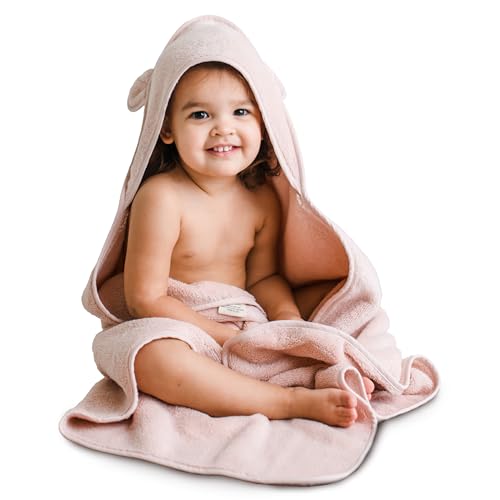
Natemia Organic Cotton Hooded Baby Towel — Best Generous Size
Natemia cuts its organic cotton towel at thirty-five by thirty-five inches — the largest square in this roundup — and weaves it plush, at a listed 450 GSM. The combination defines the pick: a big, soft, organic wrap that swallows a newborn completely and still has honest work to do when that newborn is a tall two-year-old standing on the bath mat, dripping and delighted. Parents who have watched a smaller towel become a shoulder accessory by month nine will understand exactly what the extra inches are for.
The organic cotton’s hand feel is the plush-cotton kind, dense and warm, and the maker positions the fabric as gentle on sensitive skin — a comfort description we are glad to pass along in those qualitative terms. Absorbency is thorough, as expected from the weight, and the wrap’s drape is substantial: this is the towel that makes the post-bath cuddle feel like being tucked in, for the supervised minutes on the changing mat while lotion and pajamas are organized. In a cool house, or with a baby who takes baths in the evening before the heating catches up, that warmth is the whole ballgame.
The trade is the newborn learning curve — thirty-five inches is a lot of towel around a seven-pound person, and the first wraps involve folding and tucking until the technique settles. Most parents report the technique settles in a week, after which the size is pure advantage. Buy it as the anchor towel of the nursery, the one that will still be on the hook when the others have been promoted to doll duty, and wash it with the confidence that good organic cotton rewards.
- Material: 100% organic cotton
- Weight: 450 GSM per maker
- Size: 35 x 35 inches
- Care: machine washable
Strengths
- Largest wrap here, serving newborn through toddler without a size upgrade.
- Plush organic cotton gives a warm, substantial post-bath cuddle.
- Thorough absorbency suited to evening baths in cool houses.
Trade-offs
- Generous fabric takes practice to wrap neatly on a tiny newborn.
- Heavier towel takes longer to dry on the line.
- Premium-tier positioning for a single towel.
Best for: parents who want one plush organic towel that lasts the whole span. Not suited for: anyone wanting the lightest possible newborn cocoon.
Comparison Table
| Pick | Material | Size | Count | Strongest use |
|---|---|---|---|---|
| HIPHOP PANDA Bear | Bamboo-rayon, 2-layer | 30 x 30 in | 1 | Newborn softness |
| Burt’s Bees Baby 2-Pack | Organic cotton knit terry | 29 x 29 in | 2 | Registry-ready rotation |
| KeaBabies Uria | Organic cotton | Larger wrap | 1 | Newborn to toddler span |
| TBEZY Bunny | Cotton, thick | Newborn wrap | 1 | Gifts and photos |
| Hudson Baby Elephant | Cotton | One size | 1 | Budget rotation |
| Natemia Organic | Organic cotton, 450 GSM | 35 x 35 in | 1 | Longest service life |
How Do You Use a Hooded Towel Safely, Step by Step?
The routine is simple, and its safety lives in the sequence. Before the bath ends, lay the towel open on the changing mat or across your forearm, hood at the top, within reach of the tub. Lift the baby out with both hands as you always do, lay them onto the towel, bring the hood gently over the head, and wrap the sides across the body. The whole transfer happens in your arms and under your eyes, on a surface, in the warm room — the towel is part of a held, supervised moment from first touch to last.
Then the towel’s shift ends on schedule. Once the baby is dry, the towel comes off and the ordinary routine continues: diaper, pajamas, the evening’s next chapter. The towel goes to its hook to dry or to the laundry basket if its turn is up. What it never does is travel into the crib, the bassinet, or any sleep space, and it is never left draped over a sleeping baby as a blanket substitute. Babies under twelve months sleep safest on a bare, flat surface with nothing loose around them, and a hooded towel — however soft, however beloved — is a loose item the moment bath time ends.
A few smaller habits complete the picture. Check the hood’s fit as the baby grows; a hood that has become snug belongs to a towel that has been outgrown, and outgrown towels retire to hand-drying and doll duty. Keep bath time itself supervised in the ordinary, total way — a towel is never a reason to step away from water with a baby in it. And wash new towels before the first bath, to clear manufacturing softness and wake the absorbency, so the first wrap performs the way the photographs promise.
What Size Hooded Towel Does Your Baby Actually Need?
Think in growth stages rather than in ages printed on tags. The newborn stage — small, curled, entirely held — is served beautifully by the twenty-nine- and thirty-inch squares, which wrap without excess fabric bunching under a tiny back. The sitting stage, roughly the second half of the first year, is where those squares start to feel like napkins on a determined, kicking person, and the larger wraps begin their long usefulness. The standing stage, the toddler who exits the bath under their own power and opinions, needs the thirty-five-inch class or a towel explicitly sized toward toddlerhood, like the KeaBabies in this guide.
Gift-buyers should size for the stage after the one they can see. A towel given at a shower will meet a newborn for a few months and then, if it is generously cut, a baby with a personality; the larger wraps are the gifts still in service at the first birthday party. Parents buying for a known baby can be more precise — measure the child against the towel the way you would a coat, remembering that a wrap needs overlap to stay a wrap on a moving body.
Twins and siblings compress the arithmetic kindly: the larger towels serve both the new baby and the toddler sibling whose own towel is in the wash, which is one more argument for keeping at least one generous wrap in any house with more than one small person in it. Size, in this category, is kindness with a tape measure.
What Mistakes Do Parents Make With Baby Hooded Towels?
The serious mistake comes first, because it is the one this guide opened with: treating the towel as a sleep or crib item. It is neither, ever. The everyday mistakes are gentler. Buying exactly one towel, and discovering the laundry gap at the least convenient bath of the week. Choosing by the animal’s face alone and ending with a square too small for the baby it must wrap by winter. Washing a new towel in a heavily fragranced load and wondering why the first bath smells like a perfume counter — baby textiles deserve the household’s gentlest detergent routine, and new towels deserve a wash before they ever meet skin.
Parents also under-use the hood’s real function, draping the towel like a blanket and letting the hood flap loose while the wet head chills; place the hood first, then wrap, and the design does its work. And they hang onto outgrown towels in the bath rotation out of sentiment, wrestling a nine-month-old into a newborn square while the toddler-sized towel sits folded. Sentiment belongs in the photograph album — and the outgrown towel, retired to drying little hands, will feature in plenty of those too.
What Does the Whole Bath-Time Routine Look Like Around the Towel?
The towel is one actor in a small production, and the production runs better when every prop is placed before the water runs. The tub, filled and checked. The towel, opened on the mat with the hood at the far end. Pajamas, diaper, and lotion laid in the order they will be needed, because a wet baby in your arms is a countdown, and the parent who arranged the stage in advance is the parent whose baby never has to wait, chilly and indignant, while a drawer is hunted through. This is the unglamorous truth behind every serene bath photograph: the serenity was set up at the five-minute mark, before anyone got wet.
During the bath, the towel waits — and its waiting place matters. Draped over the side of the tub it risks a splash-soaking that halves its usefulness; laid on the mat or a nearby stool, it stays dry and ready. Some parents warm the towel in the dryer for a few minutes before an evening bath in a cold house, a small luxury that babies register immediately and that costs nothing but foresight. The water time itself belongs to the baby and the watching adult, undistracted, with the towel playing no part until its cue.
After the wrap comes the sequence the towel makes possible: a dry baby, a calm change, the lotion, the pajamas, the feed or the story, and a towel hung over the rail to dry before it joins the laundry rhythm. Houses with a second bathroom or a grandparent rotation keep a towel staged in each location, because the routine’s calm depends on the towel being where the bath happens, not where it was last folded. When the production runs this smoothly a few dozen times, bath time stops being a task in the day and becomes one of its reliable pleasures — the part of early parenthood people describe, later, with genuine nostalgia and only slight exaggeration.
How Do You Choose a Hooded Towel as a Gift?
Match the gift to the giver’s distance. Close family — grandparents, the aunt who will be there weekly — can give the anchor towels: the organic two-pack, the generous Natemia, the ones that will work daily and be remembered accurately. Their gift will be used three hundred times, and its quality will be a standing message. Shower colleagues and wider circles do better with the joyful singles: the bunny, the bear, the elephant, whose charm in the opening moment is part of the present, and whose daily usefulness then quietly exceeds the occasion.
Ask, when you can, what is already registered, because nurseries drown in newborn-sized everything. A giver who deliberately chooses the larger wrap — the towel for month eight rather than week one — often becomes the family’s favorite strategist by autumn. Pair the towel with nothing elaborate: a small note saying it was chosen to last is worth more than a basket of extras. And if the family is expecting a second child, the long-size organic picks are the rare gift that acknowledges the whole road, sibling baths included, rather than just the arrival.
Presentation has one safety footnote that good givers observe gracefully: present the towel as the bath-time luxury it is, and let any card mention the cozy post-bath wrap rather than anything about sleeping. The parents will handle the rules; the giver’s job is the warmth. A hooded towel given well is remembered at every bath for years, which is a remarkable return on a square of cotton and a pair of ears.
What Happens to a Beloved Hooded Towel After It Is Outgrown?
It gets promoted, in the way of all nursery textiles that survive. The first promotion is to hand and face duty at the toddler’s own sink, where a familiar towel makes the new routine of washing up feel continuous with the baths it used to end. The second is to the dress-up and doll economy, where a hooded towel becomes a cape, a blanket for a bear, a roof for a block tower — the hood that once kept a newborn warm now keeps a story going. The third, for the towels with the deepest family history, is the memory box, folded once and kept with the hospital bracelet and the first shoes.
Siblings reset the clock entirely. A towel that wrapped the first baby wraps the second with a patina no new purchase can imitate, and many of the picks in this guide — the organic cottons especially — are built to survive exactly that relay. Parents shopping for a first child with a second in mind should weight durability accordingly: the per-bath cost of a well-made towel across two childhoods becomes very small, and its sentimental interest compounds at a rate no savings account offers.
There is a practical coda. Keep one outgrown towel in the car. It will dry a rained-on toddler, cushion a sleeping — in the car seat, properly buckled, with the towel as a lap layer under supervision and never near an infant’s sleep space — passenger’s dropped bottle, and mop the inevitable spill, all with the softness of a fabric that has been washed two hundred times. Nursery textiles earn their retirement slowly, and the hooded towel, of all of them, has usually earned it best.
How Do Bath Towels for Babies Differ From Washcloths and Bath Sheets?
The nursery’s cloth family has three members, and confusing their jobs is a common registry error. The washcloth is the in-bath tool: small, soft, used in the water for washing, and needed in numbers — a stack of them, rotated daily. The hooded towel, this guide’s subject, is the after-bath wrap: large enough to envelop, hooded for the head’s warmth, used for minutes and then hung to dry. The bath sheet and the ordinary family towel belong to the adults’ side of the bathroom, and while a soft one can pinch-hit for a baby in a pinch, it lacks the hood’s placement and the manageable square that makes the newborn transfer graceful.
Budget follows the division. Spend the deliberate money on the hooded towels, which are few and long-serving; buy washcloths in generous, replaceable stacks; and let the adults’ towels remain the adults’. Households that blur the categories end up washing bath sheets daily for a nine-pound person and running out of washcloths by Thursday — a small chaos that a clear-eyed registry prevents in one pass. The companion guide to baby towels and washcloth sets, linked below, covers that side of the drawer in full.
How Do You Keep Baby Towels Soft Through Hundreds of Washes?
Baby towels live the most laundered life in the house, and their softness at month twelve is decided by habits set in week one. Wash them with the baby’s own laundry, in the gentle detergent the household already uses for small clothes, and resist the urge to add softness chemically: fabric softener coats towel fibers and steadily dulls the absorbency that bath time depends on, so the softest-feeling towel in the store can become the worst-performing one in the drawer. If a towel ever feels less thirsty than it should, a plain hot wash with an extra rinse is the traditional reset, clearing residue and restoring the fibers’ appetite for water.
Drying decides the rest. Towels dried completely — in a dryer run to the end of its cycle, or on a line with air moving — stay sweet and supple; towels pulled early and folded damp stiffen and sour in the drawer, and no fabric, organic or otherwise, forgives that rhythm for long. Shake each towel out before drying to open the loops, a five-second gesture that keeps terry and knit textures lofty instead of matted. Between baths, hang the towel spread on its hook rather than bunched, so yesterday’s damp is gone before tonight’s bath begins.
Retire honestly at the end. A baby towel that has thinned, roughened, or lost its hood seam’s integrity has finished its nursery service, however beloved; demote it to the household rag tier and let a fresh one take the bath. The picks in this guide were chosen to make that day arrive late — but when it arrives, the memory box, not the tub, is where the veteran belongs.
What Should Parents of Twins or Close Siblings Do Differently?
Double the rotation, differentiate the towels, and size up early. Twins turn bath time into a relay — one baby wrapped and warm while the second is lifted out — and the towel count that serves a singleton collapses immediately; four hooded towels is the twin household’s true minimum, with six as the comfortable number. Differentiation matters as much as depth: assign each baby a design or color from the first week, not from fussiness but because it simplifies everything from laundry sorting to the grandparents’ confidence at bath time. The animal designs in this guide — bear, bunny, elephant — were practically invented for this assignment.
Siblings close in age create the other version of the problem: a toddler who still claims a hooded wrap and a newborn arriving to claim one too. This is the scenario the generous sizes were born for. The toddler keeps the big organic wrap that still fits; the newborn takes the smaller squares; and on the evenings when both towels are somehow in the wash, the big one serves the baby in a pinch far better than a small one serves the toddler. Households expecting this overlap should buy size the way they buy shoes for growing feet — with the next stage already in view.
Why Do the Photographs Matter More Than Parents Expect?
Because bath time is where early parenthood keeps its evidence. The first year moves at a speed that memory cannot hold unaided, and the hooded towel — bear ears on a three-month-old, bunny ears at the first birthday’s eve — becomes the recurring costume in the photographs families actually print. This is not a frivolous consideration smuggled into a buying guide; it is the reason the design picks in this roundup were held to a performance standard rather than dismissed as decoration. A towel that will appear in a decade of albums should also, on each of those evenings, have dried a baby well.
Choose the design with the long album in mind. A classic animal in a calm color photographs as beautifully at month two as at month twenty, while a loud novelty print dates its pictures by the season. Photograph the ordinary baths, not just the milestones; parents consistently report that the unposed Tuesday wrap, mid-yawn, is the frame that ends up meaning the most. And when the towel is finally outgrown, one last photograph — the toddler holding the tiny square that once wrapped them whole — closes the series with the gentle joke every family album deserves.
How Does the Season of a Baby’s Arrival Change the Choice?
A winter baby meets cold air at every bath, in houses where the bathroom is the last room to warm, and for that baby the plush, thick picks — the two-layer bamboo-rayon, the dense organic Natemia — are not indulgences but the difference between a contented wrap and a protest. A summer baby, bathed in a warm room and dressed in a single layer afterward, may be happiest in the lighter knit terry of the Burt’s Bees pair, which wraps without overheating the parent doing the holding, either. Season is a soft variable, easily overridden by a house’s own climate, but registries built months ahead benefit from asking the question while the answer is still a choice.
There is a second seasonal rhythm: the laundry’s. Winter towels dry slowly on indoor racks; summer towels crisp on the line in an hour. Households washing through a damp winter should hold the deeper rotation, because a towel still damp at bath time is a towel out of service. The count advice in this guide — two minimum, three comfortable, four for twins — assumes a dryer or a forgiving climate; adjust upward for the house with neither, and the system will hold through February as gracefully as through July.
What Do Grandparents and Caregivers Need to Know About These Towels?
That the routine they remember has one rule stated more clearly now: the towel is for bath time, in arms, and the crib stays bare. Grandparents who raised babies in an era of crib blankets and bumper pads are not careless for finding the modern rule surprising; they are simply working from an older edition, and the kind way to update the edition is to make the bath routine itself the shared ritual — the grandparent who runs the bath, places the hood, and does the wrap becomes the rule’s most natural keeper. Caregivers and sitters deserve the same clarity in the household’s own words: towel on the hook, baby dried and dressed after the bath, nothing extra in the sleep space, ever.
The practical handover is simpler. Show any caregiver where the towels live, which ones belong to which child, and what the laundry rhythm is — because a sitter who cannot find the clean towel will improvise with whatever is nearest, and improvisation is what systems exist to prevent. A labeled hook and a folded spare do more for a baby’s bath-time consistency than any product upgrade in this guide. The towels themselves, soft and hooded and faintly ridiculous in the best way, will handle the rest of the introduction on their own.
Final Recommendation
For most nurseries, the answer is a pairing: the Burt’s Bees Baby two-pack as the organic cotton rotation that never leaves you towel-less, plus one towel chosen for your baby’s particular story — the HIPHOP PANDA for newborn softness, the Natemia or KeaBabies for the long size, the TBEZY bunny for joy, the Hudson Baby elephants for a budget rotation across two houses. Keep them all where they belong, at the bath and in your arms, and let the crib stay bare and safe. Years from now, one of these towels will be a flat, soft square in a memory box, and it will have earned its place there one warm, supervised bath at a time — which is, in the end, the only way anything in a nursery earns anything at all.
Frequently Asked Questions
Are hooded towels safe for newborns?
Yes, for their intended use: wrapping a baby after a bath while an adult holds and supervises them. The safety rules are about what happens next — a hooded towel is never a sleep item, it should never be left in a crib or sleep space, and babies under twelve months should sleep on a bare surface with nothing loose around them. Used at bath time and stored away afterward, a hooded towel is a warm, ordinary part of the routine.
How many hooded towels should I register for?
Two is the working minimum — one in use, one in the wash — and three gives a household comfortable slack. A two-pack covers the minimum in a single gift, and many families add one larger towel for the toddler stage, which together carries a child from the first bath to the last hooded wrap.
What is the difference between bamboo-rayon and cotton baby towels?
Hand feel and behavior. Rayon made from bamboo tends to feel silkier and cooler at first touch and absorbs very quickly, while cotton — especially organic knit terry or plush weaves — feels familiar, warms up in your hands, and tolerates the most vigorous laundry rhythm. Both are sound choices; the preference is usually settled by whichever a parent reaches for twice.
When will my baby outgrow a hooded towel?
When the wrap stops wrapping: typically, newborn-sized squares serve the early months, while larger wraps around thirty-five inches, or designs sized toward toddlers, remain useful into the second and third years. The hood’s fit is the tell — when it sits snug and the sides no longer overlap on a standing child, the towel has been outgrown and can retire to hand duty.
What should I look for in the hood itself?
Placement and proportion. The hood should sit at the corner or center-top of the square so it lands on the baby’s head without twisting the wrap, and it should be roomy enough to cover a wet head without pressing — a hood that fits at month one and still fits at month ten is the mark of a towel sized with growth in mind. Check that any ears or decorations are securely stitched, and run a hand inside the hood before the first use to feel for rough seams; the inside of the hood touches the softest skin on the baby’s head, and it should feel as gentle as the rest of the towel.
Can a hooded towel be used at the pool or beach for a baby?
Yes, as a wrap for the supervised minutes out of the water — drying off, warming up in your arms, shading the short walk back to the chairs. The same boundaries travel with it: it is not a flotation aid, not a sleep wrap for a stroller nap, and not a substitute for the shade and supervision that water settings demand. Many families keep one older, outgrown-rotation towel as the designated pool towel, since chlorine and sunscreen are hard on fabrics and the nursery set deserves protection from both.
How should I wash baby hooded towels?
With the baby laundry, in a gentle detergent routine, and dried completely before folding away. Wash new towels before the first use to remove manufacturing finishes and lift absorbency. Avoid heavy fabric softener, which coats fibers and dulls the absorbency the towel was bought for, and check hood seams occasionally, since that is where the tugging concentrates.
Related Guides
The nursery’s towel story continues in Best Baby Towels for the broader baby towel and washcloth picture, in Best 100% Turkish Cotton Bath Towels for the grown-ups’ side of the linen closet, and in Best Absorbent Dog Towels for the other small, wet family member. For the bath itself, see Best Baby Bathtubs for Infants.



[…] wardrobes in Best Affordable Towels when the whole cupboard is due, plan the nursery shelf with Best Baby Hooded Bath Towels for the smallest bathers, and set the palette for it all with Best Bath Mats by Color […]
[…] gear is a system, and the towel’s neighbors matter: see Best Baby Hooded Bath Towels for the household’s gentlest towels, Best Bath Towels for Airbnb Hosts for high-turnover […]