What's inside
- Key Takeaways
- Quick Picks
- How We Chose These Picks
- What Makes Turkish Cotton Different from Ordinary Cotton?
- How Do the Six Turkish Cotton Picks Compare Side by Side?
- How Should You Judge a Turkish Cotton Towel Before It Arrives?
- How Do You Wash Turkish Cotton Without Ruining Its Absorbency?
- Which Turkish Cotton Towel Suits Which Kind of Bathroom?
- How Does Density Change the Way a Turkish Towel Behaves?
- What Do Hems, Bands, and Finishing Details Tell You?
- What Mistakes Do People Make When Buying Turkish Cotton Towels?
- How Should You Build a Turkish Cotton Rotation That Lasts?
- Why Do Some Turkish Towels Feel Softer in the Shop Than at Home?
- How Do Turkish Cotton Towels Behave Across the Seasons?
- Final Recommendation
- Frequently Asked Questions
- Related Guides
As an Amazon Associate I earn from qualifying purchases. This post may contain affiliate links at no extra cost to you.
cottageverdict.com is reader-supported. When you buy through links on our site, we may earn an affiliate commission.
Where to buy: Every set below is sold on Amazon. Follow a linked pick name to its listing to check price on Amazon, confirm the current colour and pack contents, and read the care label before you order.
There is a particular disappointment that only towel shoppers know: a bath towel that feels magnificent in the store photograph and arrives thin, scratchy, and strangely reluctant to move water off skin. The search for the best 100% Turkish cotton bath towels exists to end that disappointment, because genuine Turkish cotton, spun from long-staple fibres grown in the Aegean region, produces loops that are both softer and more durable than the short-staple cotton in bargain towels. This guide keeps the promise in the title strict. Every linked pick here is a full Turkish cotton product, not a blend wearing a Turkish label, and each one earned its place on fibre honesty, absorbency, drying behaviour, and how the set is actually composed for a real bathroom.
Why does the long staple matter so much? A cotton fibre is a tiny tube, and longer tubes spin into smoother, stronger yarn with fewer exposed ends. Fewer exposed ends means less lint in the first washes, a surface that stays silky instead of turning wiry, and loops that keep standing up to drink water year after year. Short-staple towels can feel plush on day one because the yarn is fluffy with loose ends, but those ends are exactly what sheds, mats, and thins out by the second winter. Turkish cotton’s reputation is not marketing poetry; it is geometry you can feel with wet hands.
One warning before the picks: the words “Turkish style,” “Turkish inspired,” and “made with Turkish cotton” are not the same claim as 100% Turkish cotton. Some towels weave a Turkish cotton face over a cheaper ground weave, and some blends add polyester for speed of drying at the cost of that pure cotton hand feel. Each review below notes the set makeup honestly, flags where a listing’s own wording deserves a second read on the product page, and tells you which bathrooms each towel genuinely suits. If you only remember one rule, remember to read the fibre line, not the headline.
Key Takeaways
- Long-staple Turkish cotton stays softer and sheds less than short-staple cotton because its longer fibres spin into smoother, stronger yarn.
- The American Soft Linen white six-piece set is the easiest starting point for a household replacing everything at once.
- Chakir’s oversized 30 by 60 inch four-pack suits tall bathers who find standard bath towels end mid-thigh.
- Expect a few lint-heavy first washes with any genuine Turkish cotton towel; that early shedding settles quickly.
- The California Design Den set is the pick when certified organic fibre matters more than maximum plushness.
- Skip fabric softener with these towels, because coating residue quietly strangles absorbency over time.
Quick Picks
| Pick | Badge | Why it made the list |
|---|---|---|
| Cotton Paradise Turkish Towel Set Beige | Best warm-neutral full set | A complete six-piece bathroom wardrobe in a forgiving beige that hides hard-water dulling gracefully. |
| American Soft Linen Turkish Bath Towels Gray 4PC | Best bath-only gray four-pack | Four generous bath towels in a modern gray for households that buy hand towels separately. |
| American Soft Linen Turkish Towel Set White 6PC | Best classic white set | The balanced all-rounder: bath towels, hand towels, and washcloths in bleach-friendly white. |
| Chakir Turkish Linens Bath Towels White 4-Pack | Best straightforward bath towels | Four honest white bath towels with no filler pieces, for stocking a family bathroom quickly. |
| Chakir Turkish Linens Bath Towels 30×60 4-Pack | Best extra-large Turkish towels | A longer, wider cut that wraps taller and broader bodies without the usual shortfall. |
| California Design Den Organic Cotton Bath Towel Set | Best certified organic set | GOTS-certified organic Turkish cotton for shoppers who read fibre sourcing as carefully as softness. |
How We Chose These Picks
The first filter was the strictest: the listing had to present the towel as 100% Turkish cotton, full stop. Products describing themselves as Turkish-style, or quietly blending in synthetic fibre, were set aside no matter how plush their photographs looked. That single rule removed a surprising share of the market, which tells you how loosely the word Turkish gets used on towel packaging.
Next came construction. We favoured double-stitched or firmly hemmed edges, because the hem is where towels die first, unravelling into fringe nobody ordered. We looked for loop density that promises real absorbency rather than a lofty pile that collapses when wet, and we treated the grams-per-square-metre figure stated by each listing as a feel forecast: the sets here cluster in the comfortable middle-to-upper band where a towel feels substantial without taking two days to dry on a rail.
Set composition mattered as much as cloth. A six-piece set with washcloths serves a family bathroom differently from a bath-only four-pack, and pretending otherwise helps nobody. We deliberately kept both shapes in the lineup, plus one oversized option and one organic option, so the right answer depends on your household rather than on our ranking. Finally, we weighed colour honesty: white sets you can bleach back to brightness, gray and beige sets that forgive the gradual dulling hard water causes, each with its own maintenance personality.
Care demands were the last lens. Turkish cotton rewards simple habits and punishes a few common ones, so we favoured towels whose care instructions are ordinary machine washing rather than a ritual. Everything below survives a normal laundry routine, provided you keep softener out of the drum and give the loops a proper tumble or a breezy line to dry on.
What Makes Turkish Cotton Different from Ordinary Cotton?
Start with the plant. Turkish cotton grows in a warm, dry climate that lets its fibres develop longer than most cotton regions allow, and length is the whole story. When those long fibres are spun, the yarn needs less twist to hold together, so the finished loop stands softer against skin while resisting the pilling that makes ordinary towels feel like sandpaper by their second year. Run your palm across a good Turkish towel and a bargain towel side by side and the difference is not subtle: one glides, the other drags.
Absorbency follows from the same structure. A towel dries you through its loops, thousands of tiny cotton straws pulling water off skin by capillary action. Longer, intact fibres keep those straws open and thirsty. Short fibres break, the loops crush flat, and the towel starts pushing water around instead of drinking it, which is the moment most people wrongly blame their detergent. Turkish cotton simply postpones that decline for years.
There is also a density sweet spot worth understanding. Very light Turkish towels dry fast but can feel insubstantial, while extremely heavy ones feel like hotel luxury and dry like a blanket in winter. The sets in this guide mostly sit where a family bathroom wants to live: heavy enough to feel generous, light enough to dry overnight on a heated rail or a well-placed hook. That balance, more than any single number, is what separates a towel you love in February from one you loved in the shop.
Finally, honesty in labelling matters because the premium is real. Genuine Turkish cotton costs more to grow and spin, so the market tempts sellers into blends and vague wording. Certifications such as OEKO-TEX, which several picks below carry, speak to chemical safety in production rather than fibre origin, so read them as a bonus, not as proof of the cotton claim itself. The fibre percentage line is the proof. Every linked pick here states its claim plainly enough to check on the listing before you buy.

Cotton Paradise Turkish Towel Set Beige — Best warm-neutral full set
Six pieces arrive in this Cotton Paradise set: two bath towels, two hand towels, and two washcloths, all in a warm beige that flatters the wood, stone, and brushed-metal finishes most bathrooms already have. The listing states 600 GSM and 100% cotton with OEKO-TEX certification, and the hand feel matches that paperwork: dense without being stiff, with a loop that feels combed rather than fuzzy. Beige is a strategic colour, not a compromise. It hides the slow gray dulling that hard water and body oils impose on white towels, and it forgives the occasional tinted product splash that would spot a paler cloth.
In daily use the bath towels cover an average adult properly and drink water in the unhurried, thorough way mid-weight Turkish cotton does. They are not the fastest driers in this lineup, so a crowded rail in a steamy bathroom will leave them faintly cool by evening, but on a heated rail or a door hook with air around them they reset overnight without complaint. The hand towels are generously sized for a sink-side cloth, and the washcloths carry the same loop quality rather than the thinner weave some brands substitute in the small pieces.
- Fibre: 100% Turkish cotton, OEKO-TEX certified per listing
- Density: 600 GSM as stated by the seller
- Set: 2 bath towels, 2 hand towels, 2 washcloths
- Colour: warm beige across all six pieces
- Care: machine washable; avoid fabric softener
Strengths
- Complete bathroom wardrobe in one purchase, nothing else to match later
- Beige tone ages gracefully in hard-water homes
- Small pieces woven to the same standard as the bath towels
Trade-offs
- Mid-weight cloth dries slower than lightweight rivals in humid rooms
- Beige limits you if your bathroom scheme later turns cool gray or stark white
- First washes release noticeable lint, as honest long-staple cotton does
Best for: households furnishing a warm-toned bathroom in one order who want matching pieces throughout. Not suited for: anyone set on crisp white they can bleach, or bathrooms with no airflow where towels must dry in hours.
Check price on Amazon.

American Soft Linen Turkish Bath Towels Gray 4PC — Best bath-only gray four-pack
American Soft Linen sells this set as four bath towels and nothing else, a format more households should consider. Many of us already own hand towels we like, and paying for washcloths we never use is its own small waste. These arrive in a composed mid-gray, sized at 27 by 54 inches per the listing, at a stated 600 GSM in 100% Turkish cotton with OEKO-TEX certification. Gray is the diplomat of towel colours: it sits calmly beside chrome, black fittings, white porcelain, and most tile choices made in the last twenty years.
The cloth feels plush in the structured way, loops standing close together rather than blooming into fluff. Water uptake is immediate, the kind where one pass down an arm finishes the job instead of smearing moisture sideways. Because all four pieces are bath size, laundry maths gets simple: two in use, two in the wash, a rhythm that suits couples and small households well. The gray also hides the faint shadowing that repeated washing prints onto white towels, so the set looks newer for longer with less effort.
- Fibre: 100% Turkish cotton, OEKO-TEX certified per listing
- Density: 600 GSM as stated by the seller
- Set: 4 bath towels only, 27 x 54 inches each
- Colour: gray across all four pieces
- Care: machine washable; tumble dry low
Strengths
- Bath-only format avoids paying for pieces you will not use
- Gray conceals wash wear and hard-water dulling effectively
- Four identical towels simplify rotation and laundry planning
Trade-offs
- No hand towels or washcloths included for a full bathroom reset
- Mid-gray can read cool under warm bathroom lighting
- Plush loops want a proper tumble dry to stay lifted
Best for: couples and small households replacing bath towels only, in modern gray bathrooms. Not suited for: anyone furnishing a bathroom from empty rails who needs the matching small pieces included.
Check price on Amazon.

American Soft Linen Turkish Towel Set White 6PC — Best classic white set
If the phrase Turkish towel set calls one picture to mind, it is probably this one: bright white cloth, six pieces, everything matching. American Soft Linen builds it from two bath towels at 27 by 54 inches, two hand towels at 16 by 28, and two washcloths at 13 by 13, in 100% Turkish cotton at a stated 600 GSM with OEKO-TEX certification. White is the demanding choice and the forgiving one at once. It shows every mark, yet it also accepts a hot wash and an oxygen bleach reset that returns it to something close to new, a trick no dyed towel can copy.
The balance across the three sizes is what earns this set the all-rounder label. The bath towels carry enough density to feel like a treat after a winter shower, the hand towels are thick enough to serve guests without embarrassment, and the washcloths hold their edges through repeated wringing. Households running a guest bathroom, a rental, or a family bathroom with high turnover will appreciate that the whole set can be laundered together in one white load, no sorting diplomacy required. This is the set to buy when you want the decision finished.
- Fibre: 100% Turkish cotton, OEKO-TEX certified per listing
- Density: 600 GSM as stated by the seller
- Set: 2 bath towels 27 x 54 in, 2 hand towels 16 x 28 in, 2 washcloths 13 x 13 in
- Colour: white across all six pieces
- Care: machine washable; white-safe brightening allowed
Strengths
- Full three-size wardrobe that launders as a single white load
- White accepts hot washes and brightening resets coloured towels cannot
- Even quality across bath, hand, and face sizes
Trade-offs
- White shows makeup, hair dye, and hard-water shading fastest
- Two bath towels may be thin cover for a busy family bathroom
- Needs the no-softener rule respected to keep loops thirsty
Best for: households wanting one classic set for a main or guest bathroom with simple all-white laundry. Not suited for: homes with tinted products and hard water where white upkeep becomes a weekly chore.
Check price on Amazon.
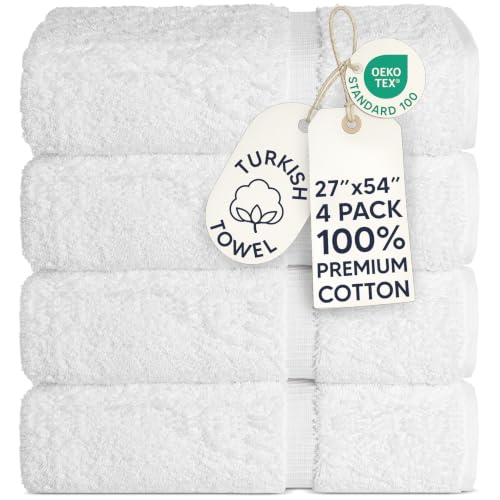
Chakir Turkish Linens Bath Towels White 4-Pack — Best straightforward bath towels
Chakir Turkish Linens keeps this offer admirably plain: four white bath towels, 27 by 54 inches, 100% cotton, OEKO-TEX certified, no decorative banding shouting for attention and no filler pieces padding the count. Plainness is a virtue in a family bathroom. These are towels you can hand to children, guests, and teenagers with equal calm, wash hot when illness passes through the house, and replace one at a time years later without hunting for a discontinued pattern.
The cloth sits in the hospitable middle: soft enough that nobody complains, structured enough that the towels do not feel precious. Absorbency is brisk, and the white takes the full laundry arsenal when life gets messy, from hot cycles to brighteners. Buying bath towels in a uniform four-pack also solves the slow drift every linen cupboard suffers, where three generations of towel coexist and nobody reaches for the thin old one at the bottom. Retire the drift, start the matched set, and the morning routine quietly improves.
- Fibre: 100% Turkish cotton, OEKO-TEX certified per listing
- Set: 4 bath towels, 27 x 54 inches each
- Colour: white across all four pieces
- Edges: hemmed for everyday durability
- Care: machine washable; hot white washes tolerated
Strengths
- Uniform four-pack ends linen-cupboard mismatch
- White cloth accepts the full hot-wash and brightening routine
- Unfussy design suits family and guest bathrooms alike
Trade-offs
- No smaller pieces for sinks or faces in the pack
- White demands more upkeep in hard-water homes
- Utilitarian styling will not anchor a styled guest bathroom
Best for: families stocking a busy bathroom with matching, hard-working white bath towels. Not suited for: shoppers wanting a styled set with hand towels and washcloths in the same box.
Check price on Amazon.

Chakir Turkish Linens Bath Towels 30×60 4-Pack — Best extra-large Turkish towels
Standard bath towels are cut for a statistical adult who is shorter and narrower than many actual adults. Chakir answers with a 30 by 60 inch towel, six extra inches of length and three of width over the common 27 by 54, in the same 100% Turkish cotton and OEKO-TEX certified cloth as its standard sibling. Those inches change the experience completely. The towel wraps fully around broader shoulders, tucks and stays tucked, and gives tall bathers coverage past the knee instead of a drafty mid-thigh hem.
Size brings honest costs. A bigger towel holds more water, weighs more when wet, takes more rail and more machine room, and dries a little slower than its standard twin. For the bather who has spent years making do with a towel that never quite closes, those costs read as trivial. For a small bathroom with one narrow rail serving four people, they may not. Four towels in the pack keep rotation sane, and the white colour keeps the laundry simple: one hot white load, everything reset together.
- Fibre: 100% Turkish cotton, OEKO-TEX certified per listing
- Set: 4 bath towels, 30 x 60 inches each
- Colour: white across all four pieces
- Coverage: oversized wrap for taller and broader bodies
- Care: machine washable; allow extra drying room
Strengths
- Genuine wrap-and-tuck coverage for tall or broad bathers
- Same trusted Chakir cloth in the larger cut
- Four-pack supports a two-in-use, two-in-wash rhythm
Trade-offs
- Heavier when wet and slower to dry than standard size
- Takes more rail space and washer capacity per load
- Oversize can swamp smaller bathers and small bathrooms
Best for: tall and broad adults tired of towels that never quite wrap. Not suited for: compact bathrooms with limited rail space or small washing machines already running full.
Check price on Amazon.

California Design Den Organic Cotton Bath Towel Set — Best certified organic set
Some shoppers read a towel listing the way others read a food label, and this set is written for them. California Design Den builds its six-piece set, two bath towels, two hand towels, and two washcloths, from GOTS-certified organic Turkish cotton in a soft light beige. GOTS certification tracks the fibre through growing and processing with rules on chemicals and labour, which is a different and deeper claim than a towel simply calling itself natural. The result is a set whose sourcing story is documented rather than decorative.
The cloth itself leans lighter and quicker than the plushest sets here. The listing emphasises quick drying and absorbency in balance, and that is the honest trade organic shoppers usually accept gladly: a towel that feels fresh and clean in hand, dries without sulking in a humid bathroom, and gives up a little of the heavy hotel hug to get there. Light beige keeps the set warm in tone and forgiving in upkeep. If your household chooses organic food, low-impact detergents, and natural fibres as a matter of course, this is the towel set that belongs on your rail.
- Fibre: GOTS-certified organic Turkish cotton per listing
- Set: 2 bath towels, 2 hand towels, 2 washcloths
- Colour: light beige across all six pieces
- Character: lighter, quicker-drying hand feel
- Care: machine washable; gentle detergents suit the fibre story
Strengths
- Documented organic certification rather than vague natural claims
- Quicker drying suits humid bathrooms and busy households
- Complete three-size set keeps the bathroom coordinated
Trade-offs
- Lighter hand feel gives up some hotel-style plushness
- Organic certification carries a premium over conventional sets
- Light beige still shows dark hair dye and makeup marks
Best for: sourcing-conscious households wanting certified organic Turkish cotton throughout the bathroom. Not suited for: shoppers whose first priority is maximum plush weight at any sourcing cost.
Check price on Amazon.
How Do the Six Turkish Cotton Picks Compare Side by Side?
| Pick | Set shape | Colour | Character | Choose it if |
|---|---|---|---|---|
| Cotton Paradise Turkish Towel Set Beige | 6-piece full set | Beige | Balanced plush | Your bathroom is warm-toned and you want everything in one order |
| American Soft Linen Turkish Bath Towels Gray 4PC | 4 bath towels | Gray | Plush, modern | You need bath towels only and like a contemporary gray |
| American Soft Linen Turkish Towel Set White 6PC | 6-piece full set | White | Classic balanced | You want the traditional all-white bathroom reset |
| Chakir Turkish Linens Bath Towels White 4-Pack | 4 bath towels | White | Straightforward, hard-working | A family bathroom needs uniform towels that wash hot |
| Chakir Turkish Linens Bath Towels 30×60 4-Pack | 4 oversized bath towels | White | Generous wrap | Standard towels never quite close around you |
| California Design Den Organic Cotton Bath Towel Set | 6-piece full set | Light beige | Lighter, quicker | Certified organic sourcing leads your decision |
How Should You Judge a Turkish Cotton Towel Before It Arrives?
Read the fibre line first and the marketing second. The listing should say 100% Turkish cotton, or name Turkish cotton as the full fibre content, in the specifications rather than only in a headline. Then look at the stated density with fresh eyes: figures around the middle of the range promise the plush-yet-practical balance most bathrooms want, while extremely high numbers promise luxury that arrives with slow drying attached. Neither is wrong; they are different mornings.
Check the dimensions against your own body and your own rail. A 27 by 54 inch bath towel serves most adults adequately, a 30 by 60 transforms the experience for taller frames, and neither helps if your rail only fits a folded towel in a steamy room with no airflow. Measure the rail, honestly assess the ventilation, and let the room vote. Towels fail more often from room mismatch than from cloth quality.
Consider the set arithmetic of your household. Count bathers, showers per day, and laundry days per week, then buy enough bath towels that nobody ever faces the damp one. For most homes that means at least two bath towels per regular bather. A beautiful set of two serving four people will disappoint by Thursday no matter how fine its cotton is, while a sensible four-pack quietly succeeds for years.
Finally, plan the first wash before the towels arrive. New Turkish cotton carries finishing treatments from manufacture that blunt absorbency until they wash out, and the loops shed loose fibre in the first few cycles. A first wash in warm water with a modest amount of detergent, no softener, and a thorough dry sets the towel up to perform as designed. Judged after that wash, a genuine Turkish towel shows you exactly what you bought.
How Do You Wash Turkish Cotton Without Ruining Its Absorbency?
The routine is simple, and the enemies are few but sneaky. Wash Turkish cotton in warm water with a moderate measure of detergent; more detergent does not mean cleaner towels, because residue left in the loops glues them shut. Every few washes, a cup of white vinegar in the rinse helps strip accumulated residue and hard-water minerals, returning the loops to their thirsty state without any specialty product.
Fabric softener is the famous villain, and dryer sheets are its accomplice. Both coat fibres with a slick film that water then slides off instead of soaking into, which is the opposite of a towel’s job. If your Turkish towels ever start pushing water around, a hot wash with vinegar and no detergent usually strips the coating and revives them. Prevention is easier: keep softener in the cupboard for clothes that need it and out of the towel load entirely.
Dry them thoroughly, every time. A towel put away faintly damp will smell musty within a day and teach the whole cupboard the odour. Tumble drying on a moderate heat keeps loops lifted and soft; line drying works beautifully in dry, breezy weather but can leave dense Turkish cotton a little stiff in still, humid air, in which case ten minutes in the dryer after the line softens the hand feel again. Shake each towel out before drying, a small habit that opens the loops to the air.
Wash new towels separately for the first few cycles, since the early lint release is real and will coat darker laundry if given the chance. Wash whites with whites to protect the brightness you paid for, and keep dyed sets together for the same reason in reverse. None of this is fussy; it is five small habits standing between a towel that lasts six good years and one that disappoints in six months.
Which Turkish Cotton Towel Suits Which Kind of Bathroom?
Bathrooms differ more than towel marketing admits, and matching the cloth to the room prevents most disappointments. Consider the small ensuite first: one rail, a shower that steams the mirror daily, and no window. In that room, drying behaviour outranks plushness, so the lighter organic set or a mid-weight set used in strict rotation serves best, because a towel that never fully dries will smell before it wears out. Give that room two towels per person minimum and a hook with genuine airflow, and Turkish cotton rewards you.
The family bathroom is a throughput problem wearing a tile costume. Four or more showers a day, towels grabbed by whoever is late, and laundry run in heroic weekend loads all favour the straightforward Chakir four-pack or the American Soft Linen white set, cloth that tolerates hot washes, forgives rough handling, and matches itself so nobody fights over the good towel. Durability of hems and indifference to mixed loads matter more here than the last degree of softness.
The guest bathroom plays a different game: low use, high impression. Towels there can lean plusher because they dry undisturbed for days between guests, and a set like the Cotton Paradise beige or the classic white six-piece photographs beautifully against a styled room while still working honestly when a guest actually showers. Buy the full set here, because guests notice missing washcloths more than hosts expect.
A children’s bathroom deserves its own honest paragraph, because the priorities reorder themselves completely there. Towels will be dropped on wet floors, used to mop up toothpaste incidents, and occasionally pressed into service as superhero capes, so the winning qualities are toughness, hot-wash tolerance, and easy replacement rather than showroom softness. White Chakir towels fit that brief gracefully, since bleach and hot water are already the native language of a children’s laundry routine. Turkish cotton’s durability is the point in this room: loops that survive being wrung by small, determined hands without shedding their edges in the first school term. Buy the four-pack, keep two in rotation per child if the budget allows, and let the towels be towels rather than heirlooms. Children also dry themselves imperfectly and slowly, and a genuinely absorbent cloth quietly compensates for a thirty-second drying effort in a way thin towels never do.
Then there is the tall-person bathroom, which is any bathroom where one bather has been quietly underserved for years. The oversized Chakir towels exist for that room, and their effect is out of proportion to their modest difference on paper. If one member of the household is well over six feet, or simply broad, an oversized four-pack will be remembered as the best bathroom purchase of the year. Rooms, like towels, should be judged by the bodies that actually use them.
How Does Density Change the Way a Turkish Towel Behaves?
The grams-per-square-metre figure printed on listings is a density measure, the weight of one square metre of the cloth, and it predicts three things at once: how plush the towel feels, how much water it can hold, and how long it needs to dry. Most of the sets in this guide state figures around the middle of the commercial range, which is no accident. That band is where a towel feels like a treat and still behaves like a tool.
Below that band, towels feel brisk and athletic. They dry a body adequately, dry themselves quickly, and suit gym bags, small rails, and humid climates. Above the band, towels become an embrace: heavier in the hand, slower across the skin, magnificent after a cold morning shower, and demanding in the laundry. They need space, air, and time, and they punish a steamy bathroom by staying damp and eventually smelling of their own luxury.
Density also interacts with loop length. Two towels of equal density can feel quite different if one carries longer, softer loops and the other packs its weight into a tight ground weave. This is why the number alone never settles a purchase, and why this guide treats it as one specification among several. Long-staple Turkish cotton makes its density feel softer than the same figure in ordinary cotton, because the loops themselves are smoother against skin.
A practical test once your towels arrive: weigh the dry towel in your hands, use it for a week of real showers, and note two moments, the first pass across your back and the state of the towel the following morning. A well-matched density aces both moments. If the first pass disappoints, the towel is too light for your taste; if the morning towel is still cold and damp, it is too heavy for your room. Either verdict is useful information for the next purchase, and neither means the cotton failed you.
What Do Hems, Bands, and Finishing Details Tell You?
Turn any towel over and the edges confess its quality. Towels die at their borders first, where the weave meets the hem and the daily wringing concentrates its force. Double-stitched or densely overlocked hems, like those on the better sets here, hold the perimeter together through hundreds of washes, while a single loose stitch line begins unravelling into fringe within a season. When a listing mentions reinforced hems, that unglamorous line is worth more than any poetic claim about softness.
Decorative dobby bands, the woven strips near each end of many Turkish towels, serve a structural purpose beyond looks: the flat band interrupts the loops and gives the towel a section that folds and hangs neatly, and it provides a visual top and bottom that keeps a rail looking orderly. Bands also reveal dye honesty. On a genuinely well-made towel the band is woven in, not printed on, and its colour matches the body exactly on both faces.
Labels deserve a glance too. A care label that admits the full fibre content, states wash temperatures plainly, and matches the listing’s claims is a small certificate of a serious maker. Vague labels and missing fibre percentages echo the same vagueness you were warned about in online listings. The towel in your hand should tell the same story as the page that sold it.
Finally, judge the first dry by hand before the first wash. A quality Turkish towel feels cool, dense, and slightly springy, with loops that recover when pressed. A towel that feels puffy but weightless is often loft without substance, air whipped into short fibres that will flatten by spring. Your palm, honestly consulted, is a better instrument than any photograph.
What Mistakes Do People Make When Buying Turkish Cotton Towels?
The commonest mistake is trusting the word Turkish alone. Turkish-style towels, Turkish cotton blends, and towels merely finished or packaged with a Turkish theme all borrow the reputation without the fibre. The correction takes ten seconds: find the fibre percentage in the specifications and require the full claim. If the listing will not state it plainly, the towel is telling you something.
Chasing maximum density is the second trap. A very heavy towel photographs like luxury and behaves like a commitment, drinking a full washer’s worth of room, drying slowly, and staying faintly damp in humid bathrooms until it smells. Most households are happier one step down in weight, with a towel that still feels generous and actually dries between showers. Match the weight to your climate and your rail, not to a hotel memory.
Buying too few towels is the quiet third error. Two beautiful bath towels for a household that showers daily becomes a laundry emergency rota, and towels washed in a panic too often, or used damp too often, age fast. Buy the rotation first and the upgrade second: enough sound towels beats a tiny set of perfect ones. The fourth mistake is the first-wash verdict, judging a towel straight off the shelf before its finishing treatments wash out and its loops open up. Wash it twice, then judge.
How Should You Build a Turkish Cotton Rotation That Lasts?
A rotation is the unglamorous secret behind every towel cupboard that works. The principle is simple: no towel should be used two days running if you can help it, and none should be washed so relentlessly that its loops never rest. Cotton fibres, like the people using them, recover with a day off. A towel hung to dry fully, rested a day, and used again on the third day will outlast a towel in daily service by a margin that surprises most households when they first try the system.
Work out your household’s arithmetic honestly. Count the people who shower daily, add any regular guests whose visits you can predict, and double the bath towel count. A couple needs four bath towels as a working minimum and six for comfort; a family of four needs eight and will bless ten. Hand towels follow a faster rhythm because sink-side cloth stays damper, so one in use and one in the wash per sink is the floor. Washcloths are cheap in space and laundry, and a small stack ends the temptation to press a hand towel into face duty.
Buy the rotation in matching sets where you can, as this guide’s picks allow, because matched towels simplify everything downstream: one wash routine, one folding size, one rail appearance, and no archaeological layers in the cupboard. When a towel eventually thins after years of service, demote it deliberately to floor duty, pet duty, or the car boot, and replace it within the set. Planned demotion keeps the cupboard honest, while unplanned accumulation is how households end up owning nineteen towels and liking three of them.
Storage finishes the system. Fold Turkish towels in thirds lengthwise so the loops are not crushed flat at the fold, stack them with air around the pile rather than wedged into a sealed box, and keep the cupboard door’s occasional opening as part of the ventilation plan. In humid climates, an entirely closed, packed linen cupboard can stale even clean towels, so leave the top of each stack breathing room. These are thirty-second habits, and they protect an investment that should serve the better part of a decade.
Reassess once a year, ideally when you already have the cupboard open for another reason. Hold each towel to the light: thinning patches show as bright spots where the loops have worn away. Sniff the folded stack after a week of storage; a stale note that survives washing means residue build-up, answered by a hot vinegar wash before you blame the cloth. A rotation reviewed annually never collapses all at once, which is the real goal: no morning when every towel in the house is simultaneously tired.
Why Do Some Turkish Towels Feel Softer in the Shop Than at Home?
The gap between shop softness and home softness confuses many buyers, and it has an innocent explanation. Manufacturers finish new towels with softening treatments that make the cloth feel extraordinary under showroom lights and in listing photographs. Those treatments are temporary by design, washing out across the first few cycles, at which point the towel’s true hand feel, the one determined by its fibre, announces itself. Genuine long-staple Turkish cotton passes this test gracefully, because its softness lives in the yarn itself rather than in a coating.
Short-staple towels fail the same test dramatically. Their showroom plushness is mostly loose fibre ends and finishing chemistry, and both depart quickly, leaving the wiry, thinning cloth that sends people shopping again within the year. This is the economic heart of the Turkish cotton argument: you are not paying for a softer first week, you are paying for a fifth year that still feels like the first month. Judged across its whole life, the honest towel is usually the cheaper one.
Your own laundry can widen or narrow the gap. Hard water deposits minerals inside the loops over time, stiffening any cotton towel, Turkish included. The occasional vinegar rinse, or a wash with a water-softening routine your machine’s manual approves, keeps the cloth closer to its natural hand. Heat discipline matters too: scorching dryer settings make cotton brittle at the surface, while a moderate tumble keeps loops springy. None of this requires specialty products, only the same restraint the care section recommends.
Set your expectations by the second wash, not the first touch. After two honest laundry cycles, a Turkish cotton towel has shed its showroom costume and stands revealed: loops open, absorbency at full strength, softness of the durable kind. If it delights you then, it will go on delighting you. That second-wash standard is the fairest judging rule in this entire guide, and applying it will save you from both false disappointment and false romance.
How Do Turkish Cotton Towels Behave Across the Seasons?
Winter is Turkish cotton’s showcase season. Stepping from a hot shower into a cold bathroom is the moment a dense, long-staple towel earns its keep, wrapping warmth around shoulders while it drinks, and the mid-weight sets in this guide are built precisely for that moment. In heated homes the same towels dry reliably overnight on a rail warmed by the room, so winter asks nothing special of them beyond the usual no-softener discipline.
Summer tests the opposite virtue. Humid air slows every towel’s drying, and a heavy cloth in an unventilated bathroom can carry a faint coolness into its second day that owners misread as a quality problem. The answer is rotation and air rather than replacement: more towels in play, a window cracked after showers, a fan if the room has one. The lighter organic set in this lineup naturally suits steamy climates, while the plushest sets simply ask for a longer bench of spares behind them.
Hard-water regions add their own seasonal wrinkle, because heating systems run longer in winter and mineral deposits accumulate faster in the loops. The vinegar rinse habit matters most exactly then. Towels that stiffen by February usually need descaling, not replacing, and owners who learn that distinction save themselves a needless purchase every few years.
Across all seasons, the constant is that Turkish cotton ages slowly and honestly. It does not pill into unsightliness by spring or thin into transparency by autumn when it is genuine long-staple cloth, washed with restraint and dried with air. Season-proof is too strong a claim for any fabric, but a well-chosen set from this page asks only small seasonal courtesies in exchange for years of mornings that begin with a towel worth reaching for.
Final Recommendation
For most bathrooms, start with the American Soft Linen white six-piece set: it covers bath, hand, and face in one honest Turkish cotton purchase, launders as a single load, and balances plushness against drying speed the way daily life actually demands. Warm-toned rooms should take the Cotton Paradise beige set instead, and tall bathers should not hesitate over the oversized Chakir four-pack, because coverage you have been missing for years is worth more than any marginal softness contest. Sourcing-led shoppers have a clear answer in the California Design Den organic set.
One last piece of buying discipline is worth stating plainly: purchase the whole rotation in a single order when you can, rather than adding towels month by month. Towels bought together age together, wash together, and present a matched rail every morning, while piecemeal buying recreates the layered cupboard this guide has been arguing against. If the budget will not stretch to the full rotation at once, buy bath towels first, since they carry the daily experience, and add the matching hand towels and washcloths at the next opportunity while the same set remains in production.
Whichever set you choose, wash it before first use, banish softener from its loads, and give it air to dry in, and the cloth will repay those small courtesies for years. A towel is the first fabric that touches you every morning, and it deserves to be chosen like it matters, because in the small hours of an ordinary day, it quietly does, every single ordinary morning.
Frequently Asked Questions
Is Turkish cotton really better than Egyptian cotton for bath towels?
Both are long-staple cottons with excellent reputations, and a well-made towel in either fibre will serve beautifully. Turkish cotton tends to balance softness with quicker drying, while Egyptian cotton often leans denser and heavier. Choose by construction, stated density, and your bathroom’s drying conditions rather than by origin loyalty alone.
Why do my new Turkish towels shed so much lint at first?
Loose fibre ends from spinning and weaving release during the first several washes; this is normal for genuine long-staple cotton and settles noticeably after three or four cycles. Washing new towels separately at first keeps that lint off your other laundry while the cloth finds its finished state.
How can I tell a blend from a true 100% Turkish cotton towel?
Read the specifications section of the listing for the fibre percentage, not the headline or the lifestyle photographs. A true full-fibre product states 100% Turkish cotton plainly. Wording such as Turkish-style, cotton-rich, or Turkish cotton blend signals a different cloth, which may still be pleasant but is not the product this guide set out to find.
Do Turkish cotton towels need special detergent?
No specialty detergent is required. Use a moderate amount of ordinary detergent, skip fabric softener and dryer sheets, and add white vinegar to the rinse occasionally to clear residue and mineral build-up. The special part is restraint, not expense.
How long should a good Turkish cotton towel last?
With the simple care routine in this guide, a quality Turkish cotton towel typically serves several years of regular use before its loops thin noticeably. Rotation helps: towels rested between uses and washed in sensible loads age far more slowly than a single overworked favourite. When a towel finally does thin, it still works well as a hair towel, a floor cloth after baths, or a backup in the car, so the purchase keeps giving value long after its finest years on the main rail have passed.
Are white Turkish towels a mistake in a hard-water home?
They are a commitment rather than a mistake. Hard water gradually grays white cloth, but hot washes and oxygen brighteners restore much of the brightness, a rescue dyed towels cannot accept. If that upkeep sounds tiresome, beige or gray sets from this guide hide the same effects gracefully.
Related Guides
Round out the linen cupboard by comparing Best 3-Fold Hand Towels for the sink-side drawer, browse Best Absorbent Thin Towels if drying speed ever outranks plushness in your bathroom, plan a paper-free reset with Best Alternatives to Paper Towels for the kitchen, and start the whole towel shelf from the sheet end with Best Bath Towel Sheets when you are ready to size up.



[…] Complete the picture of the hard-working laundry room and the linens it serves: proceed to the high-capacity portable machines in Best Portable Washing Machines and Compact Washers Best Gas Dryers With Moisture Sensors Best 110V Hot Tubs Best 100% Turkish Cotton Bath Towels. […]