What's inside
- Where to buy these small freestanding tubs
- Quick picks at a glance
- How these picks were chosen
- The six small freestanding tubs, reviewed one by one
- Side-by-side comparison
- How to choose a small tub that bathes big?
- The Japanese soaking idea, taken seriously
- Small tubs and the people who share them
- Where small tubs earn their keep: five real rooms
- Installation at small scale: easier, not effortless
- Common mistakes when buying a small freestanding tub
- Heat in a small volume: the compact warmth advantage
- Styling a bathroom around a small sculptural tub
- What to confirm on the listing before a small tub is ordered
- The shower question, answered fairly
- A decade with a small tub: how the choice ages
- Final recommendation
- Frequently asked questions
As an Amazon Associate I earn from qualifying purchases. This post may contain affiliate links at no extra cost to you.
As an Amazon Associate, cottageverdict.com earns from qualifying purchases.
Small bathrooms are usually given a shower and an apology. This guide exists because a growing family of compact freestanding tubs refuses that sentence: the best small freestanding tubs run from just 35 to 47 inches, and they deliver real bathing — deep, hot, unhurried — by rethinking posture instead of merely shrinking a standard tub. Four of the six below build a seat into the design, turning length into depth; three draw on the Japanese soaking tradition, where immersion matters more than extension; and two are built from stone resin for bathers who want substance at small scale. One boundary is policed throughout: nothing in this guide is a 54-inch or larger tub wearing a ‘small’ label, because at that point the word stops meaning anything a small bathroom can use.
The six divide by philosophy as much as by inches. The GDFStudio and the two MEDUNJESS models seat the bather in acrylic; the SJ Star and Jane seats nobody and trusts depth and stone resin instead; the FerdY keeps the classic oval recline at 47 inches; and the closing solid-surface model combines seat, stone resin and the guide’s only stated water depth. Every dimension, seat and material quoted comes from the listing titles, and absences — a seat not mentioned, a drain not described — are flagged in the reviews rather than filled in by imagination. For the floor-level comforts that complete a small home, readers may also enjoy Best Floor Cleaning Slippers, a guide with its own respect for compact living.
Where to buy these small freestanding tubs
All six tubs are available through Amazon, each with its own sentence. GDFStudio’s 43-inch rectangle brings a built-in seat and a pop-up drain in gloss white acrylic. MEDUNJESS’s 39-inch model seats the bather with an integrated slotted overflow and cUPC certification. Its 35-inch sibling is the Japanese soaking specialist, the smallest tub in the guide. SJ Star and Jane offer 39 inches of stone resin deep soaking in matte white, without a stated seat. FerdY’s Shangri-La stretches to 47 inches as a classic oval with a matte black drain. The closing 39-inch solid-surface model unites a built-in seat, stone resin and a published water depth of 21.77 inches.
Quick picks at a glance
| Pick | Best for | Standout detail from the listing title |
|---|---|---|
| GDFStudio 43 Inch Acrylic Freestanding Bathtub | Compact rectangle soaker with a built-in seat | 43-inch acrylic freestanding bathtub with built-in seat, rectangle soaker, chrome overflow and pop-up drain, gloss white |
| MEDUNJESS 39 Inch Free Standing Tub with Seat | 39-inch seated soaker with cUPC certification | 39-inch acrylic free standing tub with seat, small soaking tub, integrated slotted overflow and drain, cUPC certified |
| 35 Inch Japanese Soaking Tub with Seat | The smallest pick: a 35-inch Japanese soaker | 35-inch acrylic free standing tub with seat, small Japanese soaking tub, MEDUNJESS, integrated overflow and drain, cUPC certified, gloss white |
| SJ Star and Jane Japanese Soaking Tub 39 Inch | Stone resin Japanese soaker in matte white | Solid surface Japanese soaking tub, 39-inch small freestanding bathtub, stone resin deep soak, matte white, compact modern design |
| FerdY Shangri-La 47 Inch Bathtub | The largest ‘small’ pick: a classic 47-inch oval | 47-inch acrylic freestanding bathtub, small classic oval soaking tub, matte black drain, minimalist linear overflow, cUPC certified |
| 39 Inch Japanese Soaking Bathtub Solid Surface | Solid surface with seat and a stated 21.77-inch water depth | 39-inch Japanese soaking bathtub with built-in seat, solid surface matte white stone resin, sitting deep soaker, 21.77-inch water depth |
Two questions organise that table: does it seat you, and what is it made of? Answer those and the six sort themselves — acrylic and seated, stone resin and deep, or the one classic oval that declines both fashions.
How these picks were chosen
Size discipline came first, and it was absolute: every pick measures between 35 and 47 inches in its own title, because a guide for small bathrooms that smuggles in standard tubs betrays its reader in the first table. Within that band, the selection privileged designs that solve the compact problem intelligently — built-in seats that convert length into depth, Japanese soaking proportions, integrated overflows that protect deep fills — over tubs that are merely short.
Specification honesty was the second filter. Titles that state their seats, their certifications, their overflow designs or, in one exemplary case, their water depth were credited in full, and titles silent on a feature were reviewed with that silence recorded in the spec box, so a buyer who needs a seat never mistakes an unseated tub for a seated one. Material range completed the set: acrylic for lightness and accessibility at three price-conscious sizes, stone resin for density and presence at two, so that the small-tub decision includes the same material dignity as any flagship bathroom decision.
The six small freestanding tubs, reviewed one by one

GDFStudio 43 Inch Acrylic Freestanding Bathtub
The GDFStudio opens this guide to small freestanding tubs with the feature that defines half the list: a built-in seat, inside a 43-inch acrylic rectangle soaker finished in gloss white with chrome overflow and a pop-up drain. The rectangle shape is the first thing to notice in a category of ovals — straight sides use a small bathroom’s footprint with architectural efficiency, sitting happily against a wall line while remaining a freestanding object. The seat changes the bathing posture entirely, turning the tub into a deep, seated well of water rather than a short imitation of a long bath.
Mini spec box
- Length: 43 inches
- Seat: Built-in seat, stated in the title
- Shape: Rectangle soaker tub
- Material: Acrylic
- Hardware: Chrome overflow and pop-up drain
- Finish: Gloss white
Strengths
- Built-in seat gives the compact soak a defined, supported posture
- Rectangle geometry fits small bathrooms and alcove-like corners gracefully
- Pop-up drain and chrome hardware arrive specified in the title
Trade-offs
- 43 inches is seated bathing only; there is no stretched position to discover
- Acrylic’s lightness is a virtue for installation but feels less substantial than stone resin
- Gloss white shows every mark until it is rinsed, as gloss does
A seat inside a small tub is not a consolation prize; it is a different bathing philosophy with real advantages. Seated deep soaking immerses the torso in a column of water that a shallow recline never reaches, uses less water than a full-length fill to achieve it, and gives older bathers and anyone with limited mobility a stable, dignified position with an easier exit. The GDFStudio’s rectangle form supports that philosophy by keeping the interior space honest — no oval curves stealing inches from the corners. For a compact ensuite or a converted small bathroom, this is the pick that treats smallness as a design brief rather than a budget verdict.
Consider also who else a seat serves. Children bathe at seat height with less depth around them, supervised, which many parents find easier to manage than a cavernous full-size tub. Anyone recovering from a leg injury, anyone who showers seated and wants the bath equivalent, anyone who simply likes to sit in hot water and read with the book held clear — the seat is working for all of them. A feature described in four words of a title turns out to organise the tub’s whole social life, and this model states it plainly alongside its drain and finish, which is how compact tubs should be sold.
Best for: small bathrooms wanting a seated, deep soak in a crisp rectangle form. / Not suited for: bathers who measure a bath by the ability to lie flat.
See the GDFStudio 43 seated tub on Amazon
MEDUNJESS 39 Inch Free Standing Tub with Seat
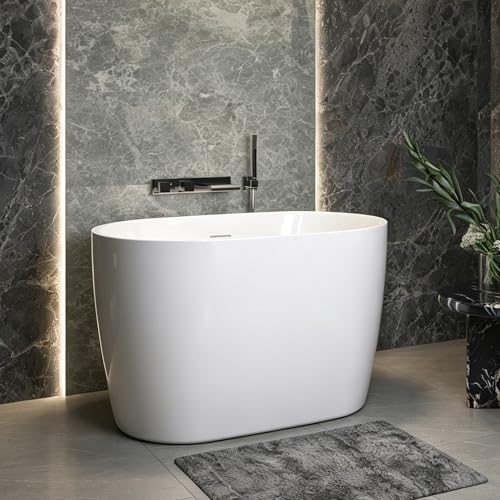
At 39 inches, the MEDUNJESS is a tub that fits where tubs are not supposed to fit, and its title equips it properly for the job: acrylic construction, a seat, an integrated slotted overflow with drain, and cUPC certification stated outright. The slotted overflow is a detail worth pausing on — a slot rather than a round fitting gives the tub a clean, minimal face and handles overflow along a line, a contemporary touch that suits the small modern bathrooms this tub will inhabit. Certification, meanwhile, is the grown-up feature: in a category sold on photographs, a stated cUPC mark speaks to tested plumbing substance.
Mini spec box
- Length: 39 inches
- Seat: Seat included, per the title
- Material: Acrylic
- Overflow and drain: Integrated slotted overflow, with drain
- Certification named: cUPC certified
- Format: Stand alone small soaking tub
Strengths
- 39 inches opens freestanding bathing to genuinely tiny bathrooms and ensuites
- A seat is included, keeping the deep seated soak at this compact scale
- cUPC certification and an integrated slotted overflow are both stated in the title
Trade-offs
- The smallest-but-one footprint here demands a seated bathing style
- Acrylic at this size is highly portable in feel; those wanting heft should look at stone resin
- The title gives no hardware finish, so check the listing if matching metals matter
The engineering question for a 39-inch tub is whether it can deliver depth, because length has surrendered. A seat is the answer this design gives: by raising the bather, the water can surround the body deeply without the tub becoming a narrow well you descend into, and entry and exit stay graceful. The integrated overflow supports deeper fills safely, which is the whole game at this scale. Judge the MEDUNJESS as a precision instrument for small rooms — a studio flat’s ensuite, a loft’s second bathroom, a garden room conversion — where its footprint can be the difference between having a bath and not having one, and where its certification and integrated fittings show the smallness was engineered rather than merely shrunk.
There is a water-economics footnote that compact seated tubs rarely get credit for. A deep fill in a 39-inch seated tub can use markedly less water than a modest fill in a standard reclining tub, because the seated body’s column is narrow; across a year of frequent bathing, that difference is measured in real money and real boiler time. Frequent short soaks — the athlete’s twenty minutes, the end-of-day decompression — are exactly the pattern this tub serves best, and households whose bathing looks like that may find the smallest pick in the guide is also the most rational one they could buy.
Best for: the smallest bathrooms that still deserve a real, certified, seated soaking tub. / Not suited for: reclining bathers or anyone wanting stated hardware finishes in the title.
Look at the MEDUNJESS 39 seated tub on Amazon

35 Inch Japanese Soaking Tub with Seat
Thirty-five inches is the smallest footprint in this guide, and the design knows exactly what tradition it belongs to: a Japanese soaking tub, in acrylic, with a seat, integrated overflow and drain, cUPC certification and a gloss white finish, from MEDUNJESS. Japanese soaking culture never worshipped length; it worshipped depth, heat and the seated immersion of the whole body, ideally after washing. This tub is that philosophy at apartment scale — a compact well of hot water you sit inside, up to the shoulders, in rooms where a conventional bath would consume the entire floor plan.
Mini spec box
- Length: 35 inches
- Seat: Seat included, per the title
- Style: Japanese soaking tub
- Material: Acrylic
- Overflow and drain: Integrated overflow and drain
- Certification and finish: cUPC certified, gloss white
Strengths
- The smallest footprint here, bringing a true soak to rooms no other pick can enter
- Japanese soaking format prioritises depth and immersion over length
- Seat, integrated overflow and cUPC certification are all stated in the title
Trade-offs
- 35 inches is unapologetically a one-posture tub: seated, upright, immersed
- Acrylic construction keeps it light rather than monumental
- Tall bathers should picture the seated geometry carefully before committing
Depth is this tub’s entire argument, and it is a strong one. Immersion to the shoulders in a small column of water produces the enveloping warmth that bathers actually seek, often more completely than a long, shallow recline where knees and chest break the surface into the cool air. The seat positions the body in that column; the integrated overflow protects the deep fill; the small volume fills fast and heats cheaply. In a tiny bathroom — a converted closet ensuite, a studio, a narrowboat or cabin, a small home’s only bathroom — this tub converts an impossible amenity into a daily ritual. It asks only that the bather surrender the idea that a bath must be horizontal, an idea that much of the world’s bathing history never held.
The Japanese format also brings a bathing order worth adopting: wash first, then soak in clean hot water that stays clean, shared sequentially by a household if custom allows, and never fouled by soaps. A small tub makes that discipline practical, because the fill is quick and the water is precious enough to respect. Owners of tubs like this often describe a conversion experience — the soak becomes a deliberate, meditative ten or twenty minutes rather than a sprawled half hour — and the compactness that looked like a compromise in the listing becomes the ritual’s frame. If your bathroom is small and your intentions are serious, this is the guide’s most philosophical pick.
Best for: the tiniest spaces and bathers who embrace deep, seated, Japanese-style soaking. / Not suited for: anyone whose definition of a bath requires lying down.
Check the 35-inch Japanese soaker on Amazon

SJ Star and Jane Japanese Soaking Tub 39 Inch
SJ Star and Jane bring the premium material to the Japanese format: a 39-inch solid surface stone resin soaking tub in matte white, described as a deep soak design for small bathrooms. Stone resin changes a compact tub’s character completely — dense, cool, sculptural, with the thermal mass to take the chill off nothing and give warmth back slowly. One precision matters in this review: unlike the three picks above it, this title does not mention a built-in seat, so the deep soak here is achieved by the tub’s own depth and proportions rather than by a stated seat, and buyers for whom a seat is essential should register that difference clearly.
Mini spec box
- Length: 39 inches
- Style: Japanese soaking tub, deep soak
- Material: Solid surface stone resin
- Finish: Matte white
- Seat: No seat is mentioned in this listing title
- Design framing: Compact and modern, for small bathrooms
Strengths
- Stone resin solid surface is the most substantial material in this guide
- Matte white compact form reads as a designed object in a small room
- Deep-soak Japanese proportions suit the seated, immersed style
Trade-offs
- No seat is stated in the title, unlike the three picks before it
- Stone resin’s weight demands floor and delivery planning even at 39 inches
- The title names no drain or overflow specifics, which the listing must supply
This is the connoisseur’s compact tub, bought for material as much as for bathing. In a small bathroom, every object is close to the eye, and a stone resin matte form rewards that scrutiny in a way lightweight acrylic cannot: edges look carved, the surface drinks light softly, and the whole piece reads as furniture. The deep-soak geometry delivers the immersion the Japanese format promises, with the resin’s mass steadying the water’s temperature across the soak. What it asks in return is logistics — weight respected, floor considered, drain details confirmed on the listing — and a bather happy to soak deep without a stated seat, using the tub’s own floor and walls as the posture. For design-led small bathrooms, that trade will look very fair.
There is a quiet thermal point in stone resin’s favour at this scale. A compact tub’s water volume is small, so the shell’s behaviour matters proportionally more: a massive wall that warms through early in the soak and then holds its temperature protects a small fill from the rapid cooling that thin shells permit. Combined with the deep, low-surface-area geometry of the Japanese format, the material completes a coherent warmth strategy that needs no insulation claim to be real. Buyers choosing between this and the seated acrylic models are choosing between two honest philosophies — posture by seat, or immersion by depth and mass — and the guide’s recommendation is simply to choose the one your body believes.
Best for: design-led small bathrooms wanting stone resin depth and matte sculpture. / Not suited for: buyers who need a stated built-in seat or stated drain details in the title.
View the SJ stone resin soaker on Amazon

FerdY Shangri-La 47 Inch Bathtub
The FerdY Shangri-La is the boundary case that proves this guide reads its own definitions: at 47 inches it is the largest tub here, still honestly small beside the 59-to-72-inch models of other guides, and shaped as a classic oval rather than a seated well. Its specification is design-literate — acrylic body in modern white, a matte black drain, a minimalist linear overflow, cUPC certification — the monochrome palette of a contemporary small bathroom. No seat is mentioned, because the oval’s offer is different: a compact reclining soak, knees up, in the traditional Western posture at a reduced scale.
Mini spec box
- Length: 47 inches
- Shape: Classic oval
- Material: Acrylic
- Hardware: Matte black drain with minimalist linear design overflow
- Certification named: cUPC certified
- Colour: Modern white
Strengths
- Classic oval reclining posture for bathers who will not convert to seated soaking
- Matte black drain and linear overflow give a designed, monochrome finish
- cUPC certification is stated, and 47 inches still fits genuinely small rooms
Trade-offs
- At 47 inches it is the least compact pick here, so the tiniest rooms should measure twice
- No seat, so deep immersion relies on the oval’s own depth
- Matte black hardware starts a finish commitment for the room’s other fittings
Every category needs its traditionalist, and the FerdY is this one’s. It accepts a smaller version of the familiar bath rather than reinventing bathing around a seat, and for many buyers that familiarity is the entire requirement — a child who bathes lying down, a reader who props a book on raised knees, a household that simply wants its bath to be a bath, only shorter. The design details lift it above the generic: black against white is a confident, current combination, the linear overflow keeps the silhouette clean, and certification underwrites the style. In small bathrooms with a monochrome scheme, this tub will look less like a compromise than like the room’s thesis statement.
The 47-inch oval also serves a transitional purpose in real homes: the bathroom too small for a standard tub but too important for a shower-only surrender — the family bathroom of a small house, the ensuite of a converted bedroom. In those rooms the FerdY’s posture familiarity matters socially, because guests and children use it without instruction, and its water volume stays modest enough for ordinary boilers. If the seated Japanese format is a philosophy, the compact oval is a negotiation, and most households, most of the time, live by negotiations. This pick honours that reality with better design detailing than the negotiation usually receives.
Best for: small bathrooms wanting a familiar reclining soak with monochrome designer detailing. / Not suited for: the very smallest rooms, or bathers seeking a seated deep soak.
See the FerdY Shangri-La 47 oval on Amazon

39 Inch Japanese Soaking Bathtub Solid Surface
The final pick assembles everything this guide has taught into one 39-inch object: a Japanese soaking bathtub with a built-in seat, in solid surface matte white stone resin, described as a sitting deep soaker — and it does something no other title here attempts, stating its water depth outright at 21.77 inches. That number is the most useful specification in the entire line-up, because depth is the variable compact bathing lives by, and here it is published rather than implied. Seat, stone resin, stated depth: the checklist of the previous five reviews, completed in a single tub.
Mini spec box
- Length: 39 inches
- Seat: Built-in seat, stated in the title
- Material: Solid surface stone resin
- Water depth stated: 21.77 inches
- Style: Japanese sitting deep soaker
- Finish: Matte white
Strengths
- A stated 21.77-inch water depth lets buyers verify the deep soak instead of imagining it
- Built-in seat and stone resin combine the guide’s two compact philosophies in one design
- Matte white solid surface gives the premium, sculptural finish
Trade-offs
- Stone resin weight requires the usual floor and delivery diligence
- 39 inches remains a seated, single-posture bath
- The title names no drain, overflow or certification details, so the listing must confirm them
Specification honesty deserves its reward, and this tub earns a long look on the strength of that depth figure alone. Twenty-one-plus inches of water in a seated tub means immersion approaching the shoulders for many adults — the full Japanese promise, quantified. The seat makes that depth accessible rather than vertiginous, and the stone resin shell gives the small, deep fill a massive, temperature-steadying wall. Together the three features answer the three questions this guide has asked of every pick: how do you sit, what is it made of, and how deep is the water really? Buyers who have read the previous five reviews will recognise this as the synthesis model, priced and weighted accordingly.
It is also the natural choice for the bather converting a very small room into a deliberate bathing sanctuary — the project where the tub is not an appliance but the room’s purpose. Matte stone resin photographs and feels like a spa’s material, the seat enforces the unhurried posture, and the stated depth guarantees the immersion the sanctuary exists for. The homework is the familiar pair: confirm the drainage and certification details on the full listing, and plan the floor and the route for a dense object. Do those two things and this compact tub will deliver, daily, the deepest argument in this guide for the proposition that small was never the opposite of luxurious.
Best for: buyers wanting the complete compact specification — seat, stone resin and a published depth. / Not suited for: anyone needing drain and certification details stated in the title, or a reclined posture.
Look at the 39-inch solid surface soaker on Amazon
Side-by-side comparison
| Pick | Length | Seat or material note | Best for |
|---|---|---|---|
| GDFStudio 43 Inch Acrylic Freestanding Bathtub | 43 inches | Built-in seat, stated in the title | Compact rectangle soaker with a built-in seat |
| MEDUNJESS 39 Inch Free Standing Tub with Seat | 39 inches | Seat included, per the title | 39-inch seated soaker with cUPC certification |
| 35 Inch Japanese Soaking Tub with Seat | 35 inches | Seat included, per the title | The smallest pick: a 35-inch Japanese soaker |
| SJ Star and Jane Japanese Soaking Tub 39 Inch | 39 inches | Japanese soaking tub, deep soak | Stone resin Japanese soaker in matte white |
| FerdY Shangri-La 47 Inch Bathtub | 47 inches | Classic oval | The largest ‘small’ pick: a classic 47-inch oval |
| 39 Inch Japanese Soaking Bathtub Solid Surface | 39 inches | Built-in seat, stated in the title | Solid surface with seat and a stated 21.77-inch water depth |
The comparison tells a tidy story: seats appear at 43, 39, 35 and 39 inches again in the synthesis model; stone resin appears twice at 39; and the single oval at 47 stands for every bather who wants small to mean shorter, not different.
Compact homes tend to be thoughtful homes throughout, and readers planning one often pair this guide with Best Grass Area Rugs for making the most of small outdoor spaces too.
How to choose a small tub that bathes big?
Seated or reclined — which posture is yours?
This is the first and most personal decision in compact bathing. A built-in seat, offered by four of these six, locks in an upright, immersed posture: wonderful for depth, warmth and easy entry, wrong for anyone whose idea of a bath is inseparable from lying back. The FerdY’s oval preserves a shortened recline, and the unseated stone resin SJ asks the bather to find their depth against its walls. Neither philosophy is the sophisticated one; they are different pleasures. If possible, rehearse the posture — sit in a chair in a corner, knees up, and imagine the water at your shoulders — because the body decides this question more honestly than the eye admiring photographs.
How deep is deep enough?
Depth is the compact tub’s true currency, and it is frustratingly under-published: only the closing pick states a water depth in its title, 21.77 inches, which this guide treats as the gold standard of specification. For the others, depth must be inferred from format — Japanese soakers are designed around immersion, seated tubs around a raised bather in a deep well — and confirmed on the full listing wherever the figure matters to you. As a rule of the body, a seated bather wants the water able to reach the upper chest when settled; anything less turns a soaker into a footbath with ambitions. Buy depth before length at this scale, every time.
Acrylic or stone resin at small scale?
The material decision survives miniaturisation intact. Acrylic keeps a compact tub light enough for upper floors, tight staircases and modest budgets, and feels warm the moment water meets it. Stone resin brings density, a matte sculptural presence and temperature-steadying mass, at the cost of serious weight that even a 39-inch footprint cannot wish away. Small bathrooms are often in converted, older or upper spaces — exactly where floor strength varies most — so the material question and the building question are the same question here, and the honest buyer asks both before the beautiful object arrives.
What must the room provide?
A compact freestanding tub still needs a freestanding tub’s provisions: drainage positioned for its footprint, a filler that reaches it gracefully, floor that carries its filled weight, and a delivery route that admits it. The reward for that provision at small scale is disproportionate, because a 35-to-47-inch tub can be threaded through doors and up stairs that defeat standard models, and can sit in rooms — ensuites, lofts, cabins, studio corners — where bathing was previously impossible. Measure the room’s smallest dimension, then the door, then the turn, and let those three numbers, against the lengths in this guide, write your shortlist.
The Japanese soaking idea, taken seriously
Three of these titles invoke Japanese soaking, and the tradition deserves more than a marketing nod. In the Japanese bathroom, washing and soaking are separate acts: the body is cleaned before entering the tub, and the hot water — deep, still, shared in sequence — is purely for immersion and restoration. The tubs are correspondingly deep and compact, built around a seated body rather than a reclined one. Adopting even part of that discipline transforms a small Western bathroom: the soak stays cleaner, the water can be enjoyed by more than one person in turn, and the ritual acquires a beginning and an end that a sprawled, soapy bath never quite achieves. The 35-inch MEDUNJESS and the two 39-inch Japanese models in this guide are invitations to that discipline at three material levels, and bathers who accept the invitation rarely return to thinking of length as luxury.
Small tubs and the people who share them
Compact tubs have a social profile worth planning for. A seated deep soak is a one-person ritual by design, which suits ensuites and primary bathers perfectly and family bathrooms rather less — though children, supervised, often adore a seat-height bath, and the FerdY’s oval remains the family’s familiar option. Older relatives are the seated format’s natural constituency, since a seat lowers the athleticism of entry and exit, especially paired with sensible grab points in the room’s design. Guests, meanwhile, need no instruction for an oval and only a moment’s orientation for a soaker. Choose with your household’s actual bathers in mind, including the ones who visit twice a year, and the small tub will be praised by all of them rather than merely tolerated between its owner’s rituals.
Where small tubs earn their keep: five real rooms
The converted ensuite is the classic case: a bedroom corner plumbed in a renovation, with a floor plate that laughs at a standard tub and welcomes a 39-inch seated model like an answer. The studio flat is the second: one room doing everything, where a compact freestanding tub in the bathroom corner is the difference between a home with bathing and a home with only a shower tray. The loft conversion is the third, where eaves and joists conspire — headroom suits a seated bather, floor loading suits acrylic, and the tub becomes the loft’s luxury signature rather than its impossibility.
The cabin, narrowboat and garden room form the fourth case, a family of small, self-contained spaces where water is heated in modest quantities and a deep, economical soak is worth more than a sprawling one. The fifth case is the ageing-in-place bathroom, where a seated tub with a dignified entry can extend independent bathing by years, and where the compact footprint leaves room for the clear floor space that safe movement requires. Notice that none of these rooms is a failed big bathroom. Each is a distinct brief, and the six tubs in this guide answer them more completely than a shrunken standard design ever could.
Installation at small scale: easier, not effortless
Compact tubs forgive many installation sins that defeat their larger relatives — they pass through doors, turn on landings, and can often be positioned by two people without drama — but they still demand the freestanding fundamentals. Drainage must meet the footprint where the footprint lands, not where a standard tub’s would have been. The floor must be level and, for the stone resin pair, verified for a concentrated load. The filler must reach across a shorter rim geometry, which occasionally surprises buyers whose taps were chosen for a long tub’s proportions. And the integrated overflows several of these titles describe must be connected and tested with the same seriousness as any concealed plumbing, because access after the fact is the category’s one true inconvenience, at every size.
What small scale genuinely buys is reversibility. A 39-inch acrylic tub can be repositioned in a future re-plan, removed for flooring work, even relocated to another room or another home, in a way that a plumbed-in standard bath never permits. For renters with a landlord’s permission, for phased renovations, for households whose needs are still changing, that reversibility is a financial feature disguised as a physical one — and it belongs in the same calculation as depth, seat and stone.
Common mistakes when buying a small freestanding tub
Shopping by length alone. At this scale, depth and posture decide the bathing; a 39-inch deep soaker immerses more of you than a shallow 47-inch tub ever will. Read for seats, formats and any stated water depth.
Assuming a seat is included because the category loves seats. Four of these six state one; the SJ stone resin and the FerdY oval do not. If a seat is your requirement, buy only where the title says so.
Calling a standard tub ‘small enough’. A 54-inch or larger model is a fine tub and a different guide. In a genuinely small room, those extra inches are the difference between a bathroom and a bath with a door problem.
Forgetting the filled weight of stone resin. Compact describes the footprint, not the load. A dense 39-inch tub still deserves a floor check and a planned route, especially in older or upper-floor rooms.
Measuring your body instead of the room, just once.
Sit on the floor against a wall with your legs arranged as you would in a bath, have someone mark where your feet and shoulders land, and compare those marks honestly with the lengths in this guide before the room is even measured, because a tub that fits the bathroom but not the bather is the one category of mistake that no amount of beautiful stone resin, careful certification or published water depth can make comfortable afterwards.
Planning the room around the tub’s delivery day.
Order of operations decides whether installation feels easy: flooring and drainage first, tub delivered once the room can receive it, and a household that has already decided where a dense stone resin model will wait safely if the plumber’s day moves — small tubs are forgiving travellers, but even the lightest acrylic deserves a planned landing rather than a fortnight balanced in a hallway.
Treating the warranty and the documentation as part of the product.
At every size, but especially where titles leave drainage or certification unstated, the maker’s documentation is where the ownership facts live, and a buyer who reads it before the tub arrives — rather than in a panic beside a plumber — will know their filler’s reach, their overflow’s behaviour and their cleaning obligations while there is still time to plan all three into the room.
Judging a seated tub by a reclined photograph habit. Product images cannot teach posture. Decide whether you bathe upright or lying down before the tape measure comes out, or the tape measure will decide for you.
Heat in a small volume: the compact warmth advantage
Small tubs possess a thermal virtue that larger guides rarely mention: a compact, deep fill presents less surface to the room per litre of water, and the bather’s own body occupies more of the volume, so a well-filled small soak holds its working temperature across twenty or thirty minutes with a composure that surprises people raised on long, shallow baths. The seated posture helps again, keeping the torso — the body’s core — in the water’s deepest zone rather than arching it into the air. Stone resin’s mass steadies the small volume further, and even the acrylic models benefit from the simple fact that there is less water to go cold. Bathers who run a small boiler or an immersion heater will feel the advantage in the other direction too: the fill itself is achievable, fully hot, where a standard tub’s fill might have exhausted the tank into lukewarm disappointment.
None of this makes a small tub an insulated product, and this guide makes no such claim for any of them; their titles do not, either. It makes them efficient ones, which in a small home with a small water system is the more useful virtue. Efficiency, depth and posture — the compact case rests on those three legs, and it stands very comfortably.
Styling a bathroom around a small sculptural tub
A freestanding tub at any size becomes its room’s protagonist, and at small size that role intensifies, because the object sits closer to everything else and is seen from more angles. The matte stone resin models reward a calm, gallery treatment: pale walls, one warm metal, floor space left respectfully empty around the form. The gloss acrylic models suit brighter, more graphic rooms, and the FerdY’s black-drained monochrome practically designs its own bathroom — white, black, one plant, done. The GDFStudio’s rectangle aligns with tiled, architectural interiors where curves would argue with the grout lines.
The styling mistake at this scale is clutter competition: a small room with a sculptural tub needs fewer, larger gestures elsewhere, not a crowd of small ones. Choose the tub’s finish story first — matte or gloss, chrome or black — and let taps, mirror and lighting echo it once each. The tubs in this guide were selected partly for the clarity of those stories, and a room that listens to its tub will look designed at a size where most bathrooms merely look fitted.
What to confirm on the listing before a small tub is ordered
Because several titles in this guide are admirably focused rather than exhaustive, a short confirmation ritual protects every purchase. Find the drain and overflow story where the title is silent, as with the two stone resin models, and confirm what is included versus what must be sourced. Find the certification position where it is not stated, crediting the models — both MEDUNJESS tubs and the FerdY — that publish theirs in the title itself. Confirm interior dimensions where your body is at either end of the size range, because exterior length in a thick-walled stone resin design and in a thin acrylic one buy different amounts of bathing room. And confirm the filled weight or the shell weight where floors are old, since at this scale the difference between the lightest acrylic and the densest resin is the difference between a shrug and a structural conversation.
That ritual takes minutes and converts a guide’s honest silences into an owner’s complete knowledge. It is not a criticism of any pick here; it is the final step of the same read-the-title discipline the whole article has practised, extended one click deeper exactly where the titles themselves run out.
The shower question, answered fairly
Every small-bathroom planner eventually faces the sceptic’s question: why not simply install a good shower? The fair answer is that for many households a shower is the right call — faster, cheaper, easier for daily washing — and no tub in this guide argues otherwise. What these six argue is that the choice is no longer forced by size. A room that can hold a shower tray can very often hold a 39-inch seated soaker, and the household that loves bathing no longer has to surrender it to the tape measure. Bathing and showering also serve different human purposes — washing versus restoring — and a home that can offer both, even at compact scale, is richer in a way its residents feel weekly. The small freestanding tub is not a rejection of the shower; it is the refusal to let a small room decide that restoration is a luxury reserved for bigger houses.
A decade with a small tub: how the choice ages
Compact tubs age along two different curves, and picturing both helps the final decision. The bathing curve is about the household: children grow from seat-height baths to wanting length, knees and backs change their opinions about posture, and a tub bought for a solo ritual may become a couple’s negotiation or a grandparent’s ally. The seated models adapt gracefully across that curve because their posture serves the very young and the older at the ends of life, while the oval’s familiarity serves the long middle. The material curve is about the object: acrylic asks for gentle cleaning and returns a surface that can be refreshed; stone resin asks for respect and returns an object that looks, at year ten, much as it did at installation, its matte mass indifferent to fashion.
Neither curve argues for a single winner, which is precisely the guide’s point. It argues for buying the tub whose ageing story matches the household’s expected one — a young family’s convertible years, a forever-home’s settled ritual, a small flat’s efficient decade — rather than the tub that merely fits this winter’s floor plan. Rooms change more slowly than lives, and the best small tub is the one still being thanked when both have moved on.
Final recommendation
Match the philosophy to the bather. For a seated soak in acrylic with everything specified, the GDFStudio at 43 inches and the certified MEDUNJESS pair at 39 and 35 cover every small room from modest to minute. For material presence, the SJ Star and Jane brings stone resin depth without a stated seat, while the closing solid-surface model is the synthesis buy — seat, stone resin and a published 21.77-inch depth in a single 39-inch design. For the traditionalist, the FerdY oval keeps bathing familiar at 47 inches with the best detailing in the guide. Small, chosen this carefully, stops being a compromise category and becomes what it secretly always was: the most considered bathing you can buy. And when the bathroom is done, the rest of a compact home awaits — our towel guide at Best Big Bath Towels pairs generously sized towels with these generously deep little tubs.
Frequently asked questions
Can an adult really bathe in a 35-inch tub?
Yes — seated, upright and immersed, in the Japanese manner the design is built for. The 35-inch MEDUNJESS seats the bather in a deep column of water rather than stretching them along a shallow one, and for many adults that immersion feels more complete than a long tub filled shallow. What it will never offer is a reclined position, so the question is posture, not possibility.
Which of these tubs have a built-in seat?
Four state one in their titles: the GDFStudio 43-inch, both MEDUNJESS models at 39 and 35 inches, and the closing 39-inch solid-surface Japanese soaker. The SJ Star and Jane stone resin tub and the FerdY oval do not mention a seat, and this guide treats that silence as meaningful rather than filling it in.
How much water does a small tub save?
The titles do not quote capacities, so this guide will not invent figures — but the geometry is honest: a deep fill in a 35-to-43-inch seated tub serves a far smaller volume than a standard reclining fill, which is why compact soakers are cheaper to heat and faster to fill. The stated 21.77-inch depth on the final pick shows depth and economy coexisting by design.
Is stone resin worth it at this size?
For bathers who value material presence, temperature steadiness and a matte, furniture-like object, yes — the two 39-inch stone resin models are the most substantial-feeling tubs here. For upper floors, tight budgets or difficult delivery routes, acrylic’s lightness is worth more than resin’s gravitas, and the seated acrylic trio loses nothing in bathing quality by choosing it.
What is the largest tub in this guide, and is it still ‘small’?
The FerdY Shangri-La at 47 inches. It earns the label honestly: standard freestanding tubs begin around the mid-50s in length and run far beyond, so a 47-inch oval remains a compact-room product — while anything at 54 inches or above belongs to a different guide and a different bathroom, whatever its listing calls it.
Can a small freestanding tub work as the only bath in a family home?
It can, provided the family’s bathing is honest about posture: households whose children are young, whose adults enjoy seated or compact reclined soaking, and whose bathroom genuinely cannot take more will live happily with a 43 or 47-inch model as the main bath. Households with tall, stretch-loving teenagers should test the posture conversation early, because the tub will win every argument with the tape measure and lose some with the family.
Can two people share a small soaking tub?
Realistically, these are one-bather designs, and their honesty about that is part of their charm: the immersion, the seat and the water economy all assume a single body given the tub’s complete attention. Couples who bathe together should shop the larger freestanding categories, while couples who bathe in devoted turns — the Japanese sequence, one after the other in the same clean water — may find a small soaker suits their ritual better than a big tub ever did.
How do I keep a deep, small soak from overflowing the room’s calm?
Fill a seated tub with the bather’s displacement in mind — the water rises considerably when a body settles into a compact column — and let the integrated overflows several of these models describe do the job they were designed for, while a bath mat placed for the exit, rather than the entrance, handles the one splash that compact bathing reliably produces as you stand from the seat.
Is a compact tub a sensible gift-scale renovation for an adult child’s first flat?
As renovations go, it is one of the kindest: a small bathroom gains a genuine bathing ritual without structural drama, the seated acrylic models keep both cost and logistics modest, and the gift keeps giving on a daily rhythm rather than sitting as an object — provided the flat’s floor, drainage and tenancy terms are all checked before anyone falls in love with a particular model.
Thirty-five inches, honestly deep, beats sixty inches of shallow every single evening of the year.



[…] bathing room — the kind that ends, eventually, in a freestanding tub from our guide to the Best Small Freestanding Tubs — will find this four-pack the natural textile partner: few, heavy, white, and […]