What's inside
- Where to buy these freestanding tubs
- Quick picks at a glance
- How these picks were chosen
- The six freestanding tubs, reviewed one by one
- Side-by-side comparison
- How to choose a freestanding tub that stays warm?
- The cold-floor problem: the room around the tub
- Filling, soaking and the economics of a long bath
- Installation day: what freestanding really involves
- Two bathers, one tub: reading size honestly
- Cleaning and keeping the finish
- Common mistakes when buying a freestanding soaking tub
- A renovation planner’s view of the six
- What a year of ownership teaches
- Testing warmth claims without a laboratory
- Bathing rituals that reward the right tub
- Guest bathrooms, rentals and other second stages
- Final recommendation
- Frequently asked questions
As an Amazon Associate I earn from qualifying purchases. This post may contain affiliate links at no extra cost to you.
As an Amazon Associate, cottageverdict.com earns from qualifying purchases.
Every bather knows the arc of a disappointing soak: the water starts glorious, and twenty minutes later you are choosing between a hot top-up and getting out. Shoppers searching for the best insulated freestanding bath tubs are trying to flatten that arc — and this guide begins with a disclosure the category needs. Only the first pick below has a listing title that actually says insulated, describing a double-walled construction. The other five earn their places through the materials and physics that influence heat retention — stone resin’s density, acrylic’s warm touch, large water volumes that cool slowly — and their reviews say plainly that their titles make no insulation claim. This is also, to be clear, a guide to soaking tubs for warm baths, not to cold-plunge products, which are a different category with different engineering entirely.
The six span 47 to 67 inches, acrylic and stone resin, chrome and brushed gold, compact ovals and extra-large spa shapes. Reading them together teaches the real lesson of the category: heat retention is a system of wall construction, material mass, water volume and room temperature, and an honest buyer weighs all four rather than hunting for a single magic word. If your bathroom project extends to the bathing experience itself, our companion guide to Best Freestanding Air Tubs covers the jetted branch of the freestanding family.
Where to buy these freestanding tubs
All six tubs are available through Amazon, and each receives its own sentence. The 67-inch double-walled model is the explicitly insulated pick, with anti-clog drainage and cUPC certification in its title. Favfurish’s 47-inch stone resin oval serves small spaces with a matte, dense build. Maxsa’s 67-inch extra-large oval sells sheer bathing room with chrome hardware. WOODBRIDGE’s 59-inch acrylic pairs a mid-size body with brushed gold fittings. Its 67-inch sibling stretches that same gold-trim formula to full length. The closing 59-inch acrylic keeps things classic with chrome hardware and an ergonomic brief.
Quick picks at a glance
| Pick | Best for | Standout detail from the listing title |
|---|---|---|
| 67 Inch Double-Walled Insulated Bathtub | The only pick whose title actually says insulated | 67-inch acrylic freestanding tub, double-walled insulated, anti-clog drain and overflow, cUPC certified, heavy-duty resin reinforcement, white |
| Favfurish 47 Inch Stone Resin Bathtub | Compact stone resin for small spaces | 47-inch freestanding stone resin bathtub, oval, pop-up drain and overflow, compact design for small spaces, matte white |
| Maxsa 67 Inch Freestanding Bathtub | Extra-large oval space for a home spa feel | 67-inch freestanding bathtub, extra large oval, chrome drain and overflow, spacious soaking for a home spa retreat |
| WOODBRIDGE 59 Inch Bathtub Brushed Gold | Mid-size acrylic with brushed gold hardware | 59-inch acrylic freestanding bathtub, contemporary soaking, white tub with brushed gold overflow and drain, model BTA1516-BG-Drain-&O |
| WOODBRIDGE 67 Inch Bathtub Brushed Gold | Full-length acrylic with brushed gold hardware | 67-inch acrylic freestanding bathtub, contemporary soaking, white tub with brushed gold overflow and drain, model B0013-BG |
| Freestanding Bathtub 59 Inch Acrylic | Ergonomic 59-inch acrylic with chrome hardware | 59-inch acrylic freestanding bathtub, chrome drain and overflow, ergonomic stand alone tub |
Let the table make the guide’s central point visible: one title says double-walled insulated, one says stone resin, two say acrylic with gold hardware, one says extra large, and one says ergonomic. Those are five different answers to the warm-bath question, and the reviews grade each on its own terms.
How these picks were chosen
Selection started with the freestanding soaking format itself — no alcove tubs, no jets, no plunge products — and then graded each candidate on what its own title states about the factors that govern a warm soak. Wall construction came first, which is why the double-walled insulated model leads. Material came next: stone resin for mass, acrylic for surface warmth and lightness. Dimensions were treated as thermal facts as well as fit facts, because water volume is stored heat, so the list deliberately spans compact, mid-size and extra-large bodies.
Hardware and certification details in the titles were recorded exactly — anti-clog drains, pop-up drains, chrome and brushed gold overflows, a cUPC certification where stated — because drainage and fittings are where freestanding tubs differ most painfully five years into ownership. Just as importantly, absences were recorded rather than smoothed over: where a title names no material or no construction, the spec box says so, and the review directs you to the full listing for that fact instead of borrowing a rival’s specification. In a category sold heavily on photography, that discipline is the difference between a guide and a gallery.
The six freestanding tubs, reviewed one by one
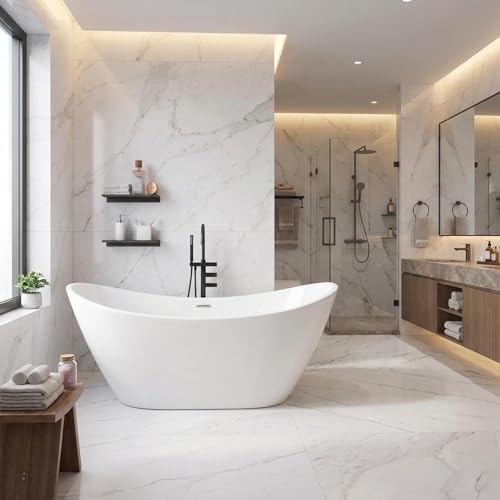
67 Inch Double-Walled Insulated Bathtub
This is the one bathtub in the six whose listing title uses the word insulated, and it earns the top spot on that basis alone: a 67-inch acrylic freestanding soaking tub built with double walls, an anti-clog drain and overflow, cUPC certification and heavy-duty resin reinforcement, finished in white. Double-wall construction is the honest mechanism behind heat retention in an acrylic tub — two shells with an insulating air gap between them slow the transfer of warmth from bathwater to room, in a way a single skin of acrylic cannot. Everything else in this guide will be discussed in those construction terms, because their titles do not make this claim.
Mini spec box
- Length: 67 inches
- Construction: Acrylic, double-walled and described as insulated in the title
- Drain and overflow: Anti-clog drain and overflow included
- Certification named: cUPC certified
- Reinforcement: Heavy-duty resin reinforcement
- Colour: White
Strengths
- The only explicit double-walled insulated construction in this line-up, stated in its own title
- 67 inches gives tall bathers a genuine stretch rather than a knees-up compromise
- Anti-clog drain, cUPC certification and resin reinforcement show the engineering was thought through
Trade-offs
- A 67-inch footprint needs a bathroom with real floor area and door clearance to deliver it
- Double-wall construction typically means a heavier tub to manoeuvre during installation
- White is the only colour its title offers
Heat retention is where this tub’s design logic compounds. The outer shell faces the room, the inner shell holds the water, and the cavity between them blunts the cooling that single-wall acrylic suffers, so a long soak needs fewer hot top-ups and the water’s temperature curve flattens noticeably across a half hour. The anti-clog drain is a quieter virtue: freestanding tubs bury their drainage in ways that make blockages miserable, so a drain designed against clogging is worth real money over a decade of ownership. Resin reinforcement addresses the other acrylic anxiety — flex and creak — by stiffening the shell. If your brief is literally the title of this article, an insulated freestanding tub, this is the pick that matches it word for word.
It is worth being precise about what insulated can and cannot promise here. No title in this guide quotes a temperature-retention figure, and this review will not invent one: the claim rests on construction, and construction is a sound basis for comparison because the physics of an air gap are not controversial. What varies between households is everything around the tub — room temperature, how full you run it, whether the floor beneath is heated — and those variables will move your experience more than small differences between rival double-wall designs. Judge this pick as the category’s clearest expression of its own idea: maximum stated insulation intent, full-size length, and hardware specified with unusual completeness for a listing title.
Best for: long-soak bathers who want the one explicitly insulated, double-walled design on the market list. / Not suited for: small bathrooms or anyone needing a colour beyond white.
See the double-walled insulated tub on Amazon

Favfurish 47 Inch Stone Resin Bathtub
The Favfurish changes both material and scale: 47 inches of stone resin in a matte white oval, designed explicitly for small spaces, with a pop-up drain and overflow. Stone resin — a composite of stone material and resin — is dense, and density is its thermal argument: a massive shell absorbs heat slowly and gives it back slowly, so the tub wall stops behaving like a cold sink against the water and the bather’s back. Its title never says insulated, and this review will not say it for them; what it offers instead is thermal mass in a compact footprint, which is a different and equally legitimate route to a warmer-feeling bath.
Mini spec box
- Length: 47 inches
- Material: Stone resin
- Shape: Oval, contemporary soaking design
- Drain: Pop-up drain and overflow included
- Finish: Matte white
- Intended setting: Compact design for small spaces, per the title
Strengths
- Stone resin’s density gives a solid, cool-to-warm feel that thin acrylic cannot imitate
- 47 inches opens freestanding bathing to small bathrooms and ensuites
- Matte white finish suits contemporary, minimalist interiors
Trade-offs
- Stone resin is heavy, so floor strength and delivery logistics need checking
- A 47-inch tub suits seated soaking; tall bathers will sit up rather than stretch out
- Matte surfaces can show marks differently from gloss and reward prompt rinsing
Compact freestanding tubs live or die on whether they feel like a compromise, and material is how the Favfurish refuses to feel like one. In a small bathroom, a stone resin oval reads as a deliberate design object — dense, matte, sculptural — rather than a shrunken version of a bigger tub. The soaking style at this length is upright and enveloping, closer to a deep plunge for one than to a stretched-out float, and many bathers honestly prefer it: less water to fill, faster to heat, easier to keep warm simply because the volume is smaller. That last point is the compact tub’s hidden thermal virtue. A 47-inch bath holds far less water than a 67-inch one, so the water you heat is the water you sit in, and its temperature holds across a soak with fewer litres surrendering heat to the room.
Installation deserves a paragraph of its own for this pick. A dense stone resin tub concentrates a lot of weight in a small footprint, and while most modern floors cope, older joists, upper-floor ensuites and any bathroom with a raised or weakened subfloor deserve a professional opinion before the tub arrives rather than after. Delivery is the second logistics item: compact in length does not mean light in the arms, and staircases have ended more stone resin plans than bathrooms have. None of this diminishes the product; it simply prices its material honesty in effort. Households willing to plan the route in are rewarded with the most tactile, furniture-like object in this entire guide.
Best for: small bathrooms that want a dense, matte, design-led soaking tub. / Not suited for: bathers who soak fully stretched, or floors that cannot take concentrated weight.
Look at the Favfurish stone resin tub on Amazon

Maxsa 67 Inch Freestanding Bathtub
Maxsa’s 67-inch entry sells space itself: an extra large oval freestanding tub with chrome drain and overflow, framed in its title as a spacious soaking experience for a relaxing home spa retreat. Notice what that framing does and does not contain. There is no insulation claim and no material named in the title at all, so this review treats the Maxsa as the line-up’s pure volume play — the biggest bathing area, a classic oval silhouette and bright chrome hardware — and judges its warmth story by the physics of large water volumes rather than by any construction promise the listing never made.
Mini spec box
- Length: 67 inches
- Shape: Extra large oval
- Drain hardware: Chrome drain and overflow
- Soaking framing: Spacious soaking experience, home spa retreat positioning
- Wall construction: The title does not describe the wall build
- Material: The tub’s material is not named in the listing title
Strengths
- Extra large oval interior is the most generous bathing space in this guide
- Classic oval form and chrome hardware suit traditional and transitional bathrooms alike
- A large water volume, once hot, changes temperature slowly across a long soak
Trade-offs
- The title names neither material nor wall construction, so both need checking on the full listing
- 67 inches of oval demands the joint-largest footprint here
- A big tub uses more water and more heating energy for every bath
There is a legitimate thermal argument for sheer size, and it belongs to this tub. A large body of water holds a large store of heat, and its temperature declines in proportion to surface losses rather than volume, so a full 67-inch oval can coast through a long soak respectably even without any special wall construction — provided you fill it generously and the room is not cold. The spa framing in the title is about experience rather than engineering: room to shift position, water deep over the shoulders, a silhouette that makes the bathroom feel like a destination. The homework is equally clear. With material and construction unstated in the title, a careful buyer reads the full listing for both before ordering, because those two facts decide weight, feel and longevity more than any photograph can.
The Maxsa also raises the honest question of how often a very large tub gets used as intended. Households that bathe nightly in a full, deep oval spend real money on water and heating across a year, while households that treat it as a weekly ritual find the cost trivial against the pleasure. Neither pattern is wrong, but the tub rewards the second and taxes the first, and its generous oval will wait patiently either way. If your bathroom has the floor for it and your bathing style is unhurried and occasional, this is the pick whose sheer roominess will still be making you smile in five years, long after spec-sheet differences between rivals have faded from memory.
Best for: spacious bathrooms and ritual bathers who value room to move above stated insulation. / Not suited for: buyers who want material and construction confirmed in the title itself.
Check the Maxsa extra-large oval on Amazon

WOODBRIDGE 59 Inch Bathtub Brushed Gold
WOODBRIDGE appears twice in this guide at two lengths, and the 59-inch version pairs its white acrylic contemporary body with brushed gold overflow and drain hardware — a finish choice that moves a bathroom’s whole mood from clinical to considered. At 59 inches it occupies the sensible middle of the freestanding market: long enough for most adults to soak with knees bent in comfort, compact enough for bathrooms that cannot host a 67-inch statement. Its title makes no insulation claim, so its warmth case rests on acrylic’s ordinary virtues and on the smaller water volume that a mid-size tub needs to fill.
Mini spec box
- Length: 59 inches
- Material: Acrylic
- Style: Contemporary soaking tub, white
- Hardware finish: Brushed gold overflow and drain
- Model reference in title: BTA1516-BG-Drain-&O
- Wall construction: No wall build is described in the listing title
Strengths
- Brushed gold hardware gives a white tub a warm, designed finish without a coloured shell
- 59 inches fits bathrooms that the 67-inch picks cannot
- Acrylic is light, warm to the touch and forgiving during installation
Trade-offs
- Gold hardware commits you to matching taps and accessories in the same finish family
- Acrylic’s warmth case here is generic; no insulated construction is claimed
- Mid-size length still asks taller bathers to soak with knees raised
Hardware finish is the decision this pick forces, and it deserves to be made with eyes open. Brushed gold against white acrylic is a genuinely elegant combination that photographs beautifully and warms a room’s palette, but it starts a chain: the bath filler, basin taps and even towel rails will look best echoing that finish, and mixing it carelessly with chrome elsewhere can make a bathroom feel undecided. Buyers already planning a warm-metal scheme will find this tub the easiest route in the guide; buyers with a chrome bathroom should either commit to changing it or choose the chrome-drained picks instead. On the bathing itself, 59 inches of acrylic is the market’s proven compromise — thousands of households soak happily at exactly this size, and its moderate fill volume keeps both water bills and cool-down rates reasonable.
There is a maintenance footnote specific to coloured hardware. Brushed finishes generally hide water spots and fingerprints more gracefully than polished ones, which is why brushed gold is the practical way to own a gold bathroom, but any plated finish rewards gentle cleaning and suffers under abrasive scouring. Factor that temperament into a household with hard water and enthusiastic cleaners. The acrylic body, meanwhile, asks for the usual kindnesses — no abrasive pads, prompt rinsing after bath products — and returns them with a surface that stays warm against the back in a way denser, colder materials take minutes to match. For a mid-size bathroom being renovated in a warm palette, this is the most design-coherent pick of the six.
Best for: mid-size bathrooms being styled around warm brushed-gold metalwork. / Not suited for: chrome-finished bathrooms or bathers who need a full 67-inch stretch.
View the WOODBRIDGE 59 with gold trim on Amazon

WOODBRIDGE 67 Inch Bathtub Brushed Gold
The second WOODBRIDGE stretches the same formula to 67 inches: white acrylic, contemporary soaking shape, brushed gold overflow and drain. Everything said about the finish’s design implications for its 59-inch sibling applies here at full length, and the extra eight inches change the bathing from comfortable compromise to genuine stretch for most adults. Like its sibling, its title claims no insulation, so this is a pick bought for space, material and finish — with warmth supplied by acrylic’s naturally warm surface and by the heat-storing volume of a large fill rather than by any double-wall construction.
Mini spec box
- Length: 67 inches
- Material: Acrylic
- Style: Contemporary soaking tub, white
- Hardware finish: Brushed gold overflow and drain
- Model reference in title: B0013-BG
- Wall construction: The listing title gives no wall construction detail
Strengths
- 67 inches of acrylic gives tall bathers a full-length soak in a light, manageable material
- Brushed gold hardware carries the same warm, designed finish as the 59-inch model
- A large fill volume holds its temperature steadily once heated
Trade-offs
- Needs the floor area and door clearance of any 67-inch tub
- Gold hardware still commits the room’s other fittings to its finish family
- No insulated construction is stated, so heat retention rests on volume and material alone
Choosing between the two WOODBRIDGE picks is really choosing a bathroom size, and choosing between this one and the double-walled opener is choosing a philosophy. The insulated pick spends its engineering on the wall; this pick spends its budget on length and finish, trusting water volume to do the thermal work. For ritual bathers who fill deep and soak long in a warm room, that trust is usually repaid. For bathers in a cold bathroom who linger past forty minutes, the wall construction argument grows stronger with every top-up of the hot tap. Neither answer is a failure of the other product; they are different allocations of the same money, and this guide’s job is to make the allocation visible rather than to pretend one tub wins every axis at once.
Acrylic at this size has a practical installation virtue worth stating: it is the lightest way to own a 67-inch tub, which simplifies delivery, positioning and any future bathroom rearrangement, and it places the gentlest demands on the floor beneath. Against that, a large acrylic shell’s long-term happiness depends on a well-supported base during installation, since flex is the enemy of both comfort and seals. Have the tub levelled and supported exactly as its maker directs, and a 67-inch acrylic will feel as solid as its owners expect. In a large bathroom being finished in warm metals, this is the most complete space-and-style package in the guide, and its honest title — length, material, finish, nothing inflated — is part of its appeal.
Best for: large bathrooms and tall bathers who want full length with warm gold hardware. / Not suited for: buyers whose priority is stated insulated construction above size and finish.
See the WOODBRIDGE 67 gold-trim tub on Amazon

Freestanding Bathtub 59 Inch Acrylic
The list closes with the straightforward option: a 59-inch acrylic freestanding tub with chrome drain and overflow, described in its title as an ergonomic stand alone design. In a guide full of special claims — insulation, stone resin, gold hardware, spa framing — this pick’s modesty is its identity. It offers the market’s most proven combination, mid-size acrylic and chrome, with an ergonomic shaping cue that suggests attention to how a back actually meets a tub wall. No insulation is claimed, and none is implied in this review; the warmth here is acrylic’s warm touch and a moderate fill, honestly labelled.
Mini spec box
- Length: 59 inches
- Material: Acrylic
- Hardware finish: Chrome drain and overflow
- Design cue in title: Ergonomic stand alone tub
- Style: Freestanding, for the bathroom generally
- Wall construction: No construction detail appears in the listing title
Strengths
- Chrome hardware matches the majority of existing bathrooms without a restyle
- 59-inch acrylic is the lightest, easiest installation proposition in this guide alongside its WOODBRIDGE rival
- An ergonomic design cue suggests the backrest angle was considered, not just the silhouette
Trade-offs
- The title is the sparsest here, leaving construction and detail to the full listing
- Chrome shows water spots more readily than brushed finishes
- No stated insulation, stone density or oversize volume to call on for heat retention
There is a strong case for buying the tub with the fewest special features when the bathroom is ordinary, the budget is finite and the bathing is frequent. This 59-inch acrylic will be filled more often than a giant tub, because its volume is affordable; it will suit more bathers adequately than a compact one, because its length is mainstream; and its chrome will never fight the room. Ergonomic shaping, if it delivers what the word promises, matters more across a year of baths than a dramatic finish: the angle of a backrest and the position of the overflow decide whether a soak is restful or a slow slide. Judge this pick as the guide’s control sample — the standard against which every special claim above it must justify its premium — and it holds that role with dignity.
Value analysis in this category often fixates on the purchase and forgets the decade. A mainstream acrylic tub at a mainstream size has mainstream parts, mainstream care and a shape any future buyer of your home will accept without blinking, all of which protect its long-term worth. Its unadventurous title also means the listing itself must be read for the details this review could not confirm — wall build, included fittings, installation requirements — and a buyer who does that reading will know exactly what they own. For landlords fitting a quality rental, for guest bathrooms, and for main bathrooms in chrome-finished homes, this unassuming tub may be the most rational purchase in the entire six.
Best for: chrome bathrooms wanting a proven, ergonomic mid-size acrylic without frills. / Not suited for: shoppers chasing a statement material, finish or stated insulation.
Check the ergonomic 59-inch acrylic tub on Amazon
Side-by-side comparison
| Pick | Length | Material or construction | Best for |
|---|---|---|---|
| 67 Inch Double-Walled Insulated Bathtub | 67 inches | Acrylic, double-walled and described as insulated in the title | The only pick whose title actually says insulated |
| Favfurish 47 Inch Stone Resin Bathtub | 47 inches | Stone resin | Compact stone resin for small spaces |
| Maxsa 67 Inch Freestanding Bathtub | 67 inches | Extra large oval | Extra-large oval space for a home spa feel |
| WOODBRIDGE 59 Inch Bathtub Brushed Gold | 59 inches | Acrylic | Mid-size acrylic with brushed gold hardware |
| WOODBRIDGE 67 Inch Bathtub Brushed Gold | 67 inches | Acrylic | Full-length acrylic with brushed gold hardware |
| Freestanding Bathtub 59 Inch Acrylic | 59 inches | Acrylic | Ergonomic 59-inch acrylic with chrome hardware |
The comparison reduces to three honest strategies for a warmer bath: insulate the wall, add material mass, or add water volume. The opener does the first, the Favfurish the second, the big 67-inch models the third, and the 59-inch acrylics trade a little of each for lightness, price of fill and everyday practicality.
Bathroom comfort is a whole-room project, and readers planning one often pair this guide with Best Odor Resistant Slippers for the walk across a cold floor that precedes every soak.
How to choose a freestanding tub that stays warm?
What actually keeps bathwater hot?
Four things, in the order you can control them. Wall construction decides how fast heat escapes through the tub itself, which is why a double-walled design with an air cavity is the category’s one explicit answer. Material mass decides how much heat the shell steals at the start: a dense stone resin wall absorbs warmth early and returns it slowly, while acrylic’s light shell takes little and feels warm almost immediately. Water volume decides the size of the heat reservoir, favouring bigger, deeper fills. And room temperature decides the gradient driving every loss, which is why the same tub feels miraculous in a heated bathroom and ordinary in a cold one. A buyer who understands those four levers can read any title in this category and know exactly which levers it pulls.
Which length fits your body and your bathroom?
Measure both. A 67-inch tub lets most adults stretch fully and needs a bathroom that can spare the floor and the delivery route; a 59-inch tub asks for knees bent and rewards you with easier fills and wider room compatibility; a 47-inch compact changes the soaking style to upright and deep, which suits smaller bodies and smaller rooms while using notably less water. Sit in your current bath, note where your knees and shoulders land, and translate that honesty into a length. Then measure the bathroom door, the stair turn and the final floor space with the tub’s footprint in mind, because more freestanding projects fail on logistics than on bathing.
Acrylic or stone resin — which material suits your household?
Acrylic is light, warm to the touch, repairable and forgiving of both installers and budgets; its enemies are flex from poor support and scratches from abrasive cleaning. Stone resin is dense, matte and furniture-like, with a cool solidity that feels expensive and a weight that must be planned for structurally and logistically. Households renovating an upper floor or working to a tight installation window usually land on acrylic. Households building a design-led ensuite around one sculptural object often choose stone resin and accept the planning it demands. Neither material is the premium answer in the abstract; each is premium in the house it suits.
What should you check about drains and hardware?
Freestanding tubs hide their plumbing, so the drain and overflow in the title deserve more attention than shoppers usually give them. Note whether a drain is included, what finish it wears, and whether any anti-clog or pop-up mechanism is stated, because retrofitting hardware to an installed freestanding tub ranges from annoying to expensive. Match the finish to the room’s other metalwork or make a deliberate decision to change that metalwork, especially with brushed gold, which looks intentional only when it is echoed. Certification named in a title, such as the cUPC note on the opening pick, is worth crediting where it appears and worth asking about where it does not.
The cold-floor problem: the room around the tub
A freestanding tub’s warmth story begins before the taps open. These designs expose their entire outer shell to the room, unlike alcove tubs sheltered by walls, so a cold bathroom taxes them from every side. Underfloor heating is the luxurious answer, but humbler measures move the needle: a bath mat that insulates bare feet changes how the whole soak feels, a door that closes properly keeps the room’s warm air where you made it, and running the shower briefly beforehand can take the chill off a small bathroom’s air and tiles. None of this appears in any listing title, yet it explains why two owners of the same tub report different warmth. Buy the best construction you can, then give it a room that cooperates, and the combination will outperform a theoretically better tub installed in a draughty one.
Filling, soaking and the economics of a long bath
Water volume is the running cost of this entire category, and the lengths in this guide imply very different bills. A compact 47-inch soak can be filled deeply for a fraction of a 67-inch oval’s volume, while the big tubs repay their fill with room and heat storage. Households on metered water or with small hot-water systems should do the unglamorous arithmetic before choosing a length: a tub you cannot afford to fill to its designed depth is worse than a smaller tub filled properly. The insulated opener and the stone resin compact both make a kind of economic sense at opposite ends of the size range — one by slowing heat loss, the other by needing less hot water to begin with — and that symmetry is a useful reminder that efficiency in bathing wears more than one shape.
Installation day: what freestanding really involves
Freestanding tubs look effortless in photographs and are honest work in person. The tub must arrive through the route you measured, sit level on a floor you have verified, and connect to drainage that was positioned with unusual precision, because there is no alcove to hide an approximate pipe. Acrylic models reward a careful two-person lift and a perfectly supported base; stone resin rewards patience, more hands and a route rehearsed before the crate opens. In both cases the overflow and drain hardware named in these titles gets fitted and tested before the tub is declared installed, since access afterwards is the category’s known inconvenience.
Budget the invisible items while you plan: a suitable filler tap, whether floor-standing or wall-mounted, is part of the bathing system even though no title here bundles one, and its reach must suit the tub’s rim position. Floor protection during the works, a plumber’s familiarity with freestanding drainage, and a plan for the old tub’s exit all belong in the same spreadsheet as the purchase. Households that plan installation this thoroughly describe the project as smooth; households that buy on a photograph and improvise describe the same project very differently, and the tub itself is rarely the variable that separated them.
Two bathers, one tub: reading size honestly
Oval tubs at 67 inches invite the question of shared bathing, and the honest answer is dimensional rather than romantic. An extra-large oval like the Maxsa gives two average adults a plausible, companionable soak with arranged knees; a standard 67-inch contemporary shape gives one bather luxury and two bathers a negotiation; and the 59-inch and compact models are single-bather designs whose charm is depth and efficiency rather than company. Water displacement matters too: two bodies raise the level significantly, so fills start lower and the overflow earns its keep. Couples for whom shared bathing is a genuine weekly ritual should prioritise interior width and oval geometry over every other variable in this guide, including insulation, because a warm tub that fits one is still a tub that fits one.
Cleaning and keeping the finish
Each material in this guide has a cleaning temperament. Acrylic wants non-abrasive products and soft cloths, and repays them by staying glossy and warm-feeling for years; its scratches, when they happen, are often polishable rather than fatal. Stone resin’s matte surface wants prompt rinsing after bath oils and coloured products, which can sit visibly on a light matte finish, and rewards a wipe-down habit that takes under a minute after a soak. Brushed gold hardware wants the gentlest treatment of all — soft cloth, mild cleaner, no scouring — while chrome wants regular drying in hard-water homes to keep its mirror. None of these regimes is burdensome, but they are different, and a household that knows its own cleaning honesty should let that knowledge vote alongside size and style.
Common mistakes when buying a freestanding soaking tub
Reading ‘insulated’ into titles that never say it. Five of these six titles make no insulation claim. Their warmth comes from material, mass and volume, and buying them expecting double-wall performance misreads an honest listing.
Confusing a soaking tub with a cold plunge. These are warm-bath products with drains, overflows and finishes chosen for comfort; plunge products are engineered for chilling and recovery, and neither substitutes for the other.
Measuring the bathroom but not the route in. Doors, stair turns and landing space decide whether a 67-inch or stone resin tub can even reach its room. Measure the journey, not just the destination.
Ignoring floor strength with dense materials. Stone resin concentrates serious weight. A quick structural sanity check before ordering is cheap; discovering a problem with the tub in the hallway is not.
Overlooking the water supply behind the wall.
A large tub filled through an undersized supply or from a small hot-water tank becomes a lukewarm compromise no wall construction can rescue, so check that your system can deliver a full, hot fill at the volume your chosen length implies — the most glamorous 67-inch oval in this guide still obeys the boiler it is plumbed to, and an honest conversation with a plumber before ordering protects the entire project.
Judging a tub by its empty weight in a showroom.
Lifting a corner of a display model tells you about shell construction but almost nothing about ownership, because the number that governs your evenings is the filled weight your floor carries and the filled volume your boiler serves, both of which can be estimated from the stated length and a conversation with your installer long before anyone tests their back against a showroom sample.
Forgetting that children and grandparents will use it too.
A high-sided freestanding tub that delights a thirty-year-old can challenge an older relative or a small child at the step-over, so households bathing three generations should think about entry height, a nearby grab point and a stool as part of the same purchase, rather than discovering on the first family visit that the room’s beautiful centrepiece is also its highest hurdle.
Assuming the photograph’s bathroom comes with it.
Listing images place tubs in vast, heated, window-lit rooms that flatter both size and warmth, while your own bathroom offers its actual dimensions and its actual January temperature, so let the stated inches and the stated construction — the two things that survive the journey to your house unchanged — carry the decision.
Choosing hardware finish in isolation. A brushed gold drain in a chrome bathroom looks like a mistake even when it is a upgrade. Decide the room’s metal story first, then pick the tub that speaks it.
A renovation planner’s view of the six
Step back from bathing for a moment and look at these tubs as renovation decisions, because that is the timescale on which they will be judged. A freestanding tub is the visual anchor of a modern bathroom: it is what guests remember, what estate photographs lead with, and what the room’s other choices get arranged around. That anchoring role argues for choosing the tub early in a renovation, before tiles and taps narrow its options, and for letting its finish — chrome or brushed gold, gloss white or matte — set the room’s metal and surface story rather than follow it. The WOODBRIDGE pair exist for exactly that planning style, offering one finish at two lengths so the design decision and the size decision can be made independently.
The same planner’s lens clarifies the insulation question. In a full renovation, wall construction is one line in a system that also includes room heating, window quality and how the bather actually lives. A household renovating to a high thermal standard may find a standard acrylic tub perfectly warm in its new, well-heated room; a household dropping a freestanding tub into an otherwise untouched cold bathroom is asking the tub to do all the work, and for them the double-walled opener is not a luxury but the correct specification. Context, as much as construction, decides which of these six is the insulated tub in practice.
What a year of ownership teaches
Owners’ long-term reports in this category converge on a few lessons that no showroom visit teaches. The drain becomes a personality trait: tubs whose drainage was designed thoughtfully, like the opener’s anti-clog specification, disappear from consciousness, while awkward drains are cursed monthly for a decade. The rim becomes furniture: wide enough to hold a book and a glass, or narrow enough to forbid both, it shapes every soak’s rituals. And the outside of the tub becomes a cleaning surface in its own right, since a freestanding design shows its full body to the room and to the mop. Shoppers who weigh those three mundane axes — drainage, rim, exterior — alongside the glamorous ones of size and finish consistently report happier second years, which is the year that decides whether a tub was a purchase or an investment.
Testing warmth claims without a laboratory
You cannot run a thermal trial in a showroom, but you can interrogate a listing more cleverly than most shoppers do. Separate every warmth-related phrase into one of three kinds. Construction claims — double-walled, insulated — describe something built, and they are the strongest evidence a title can offer. Material claims — stone resin, acrylic — describe the substance whose thermal behaviour is known and predictable. Atmosphere claims — spa retreat, relaxing, spacious — describe a mood, and they may be perfectly true while saying nothing about heat at all. The six titles in this guide contain all three kinds, and the reviews have kept them labelled as such throughout, because a shopper who can sort claims this way will never pay a construction price for an atmosphere.
At home, your own first week is the real test, and it is worth running deliberately: fill to a consistent depth, note the starting temperature with a simple bath thermometer if you are curious, and observe the soak at ten-minute intervals without topping up. That small experiment calibrates your expectations, teaches you your own tub’s rhythm — when to add hot water, how the room’s temperature changes the result — and turns a vague hope about warmth into a routine you control. Owners who do this once stop chasing spec-sheet promises and start bathing better in whatever tub they own.
Bathing rituals that reward the right tub
Consider the reader’s soak: forty minutes, a novel, water deep enough to cover the shoulders, and a hard requirement that page-turning not require reheating the bath. That ritual is the double-walled opener’s home ground, with the big ovals close behind on stored volume, because both strategies protect a long, still soak. Now consider the athlete’s soak: twenty hot minutes after training, in and out with purpose. Duration shrinks, depth matters more than length, and the compact stone resin — quick to fill, dense, enveloping — becomes arguably the smartest tool in the guide. The evening unwind sits between them: half an hour, music, no book, and almost any of the six will serve it well, which is why mid-size acrylics sell in the numbers they do.
Writing your own ritual down before shopping sounds precious and works embarrassingly well. Duration, depth, company, reading or scrolling, morning or night — five honest answers narrow six tubs to two finalists faster than any comparison table, and they protect you from buying a photograph of somebody else’s bathing life. The tubs in this guide are all, in their stated terms, good at something real; the buyer’s task is simply to make sure the something is theirs.
Guest bathrooms, rentals and other second stages
Not every freestanding tub is bought for its owner’s daily ritual. In a guest bathroom, the tub’s job is to make visitors feel considered and to survive weeks of standing empty without complaint; a mainstream acrylic at 59 inches with chrome hardware — the closing pick’s exact brief — is the connoisseur’s choice there, because it photographs as generous, cleans without specialist knowledge and never asks a guest to decode an unfamiliar system. In a quality rental, the same logic intensifies: durability, standard parts and an uncontroversial silhouette protect the investment, and any warmth story is a bonus the listing can mention rather than a promise a tenant will test nightly.
At the opposite pole, a tub bought for a forever-home’s main ensuite should be chosen almost selfishly: your length, your material, your finish, your ritual. That is the purchase where the insulated opener’s construction or the stone resin’s tactility earns its premium, because you will collect the difference hundreds of times. Naming which of those two purchases you are making — the hospitable one or the personal one — is the last piece of honesty this guide asks for, and it reliably settles the finalists that specs alone leave tied.
Final recommendation
If your brief is the literal one — insulation, stated — the 67-inch double-walled opener is the answer, and its anti-clog drain and certification make it a well-specified one. Small bathrooms should take the Favfurish’s stone resin seriously, because density and compact volume are a real thermal strategy, not a consolation. The Maxsa serves bathers who equate luxury with space, the two WOODBRIDGE models serve the brushed-gold bathroom at two lengths, and the closing chrome acrylic is the rational mainstream buy. Whichever you choose, give it a warm room and an honest fill, and it will hold up its end of the soak. For the approach to the bathroom itself, our guide to Best Stair Runner Rugs covers the route many of these tubs’ owners walk, towel in hand.
Frequently asked questions
Which of these tubs is actually insulated?
Only the first pick’s title states it: the 67-inch acrylic model described as double-walled and insulated. The stone resin Favfurish offers thermal mass, and the larger acrylics rely on water volume and acrylic’s warm surface. Those are real effects, but they are construction and physics, not an insulation claim, and this guide keeps the vocabulary separate on purpose.
Is a bigger tub always warmer for longer?
Not automatically. A bigger fill stores more heat and cools proportionally slower, but it also presents more surface to a cold room and costs more to heat. In a warm bathroom, volume wins; in a cold one, wall construction matters more, which is why the double-walled pick and the big ovals are answers to slightly different questions.
Can these tubs be used for cold plunging?
They are designed and finished as warm soaking tubs, and this guide does not present them as plunge products. Anyone building a cold-water routine should shop that dedicated category, where insulation is engineered for keeping water cold and the designs assume ice and chillers rather than a relaxing soak.
Does stone resin need a stronger floor than acrylic?
It deserves more checking, yes. Stone resin is substantially denser, and the Favfurish concentrates that weight in a compact footprint. Most sound modern floors are fine, but older or upper-floor installations merit a professional opinion before purchase — a cheap question compared with the alternatives.
What length suits a tall bather?
Look at the 67-inch models first: the insulated opener, the Maxsa oval and the WOODBRIDGE with gold hardware all give a genuine stretch. At 59 inches most tall bathers soak happily with knees raised, and at 47 inches the style becomes upright and deep rather than extended, which some tall bathers still enjoy as a plunge-like soak.
How long does a freestanding tub take to install compared with an alcove tub?
Longer, mostly in preparation: precise drainage positioning, a verified level floor and the delivery route all take planning before the tub itself is set, whereas the physical placement of a lightweight acrylic model can be quick once those are ready. Stone resin adds handling time because of its weight. Most households should think in terms of a planned project day rather than a simple swap, and should have the filler tap and its reach decided before the tub is positioned.
Choose the wall, the mass or the volume — but choose it knowingly, and the water will stay on your side.


