What's inside
- Key Takeaways
- Quick Picks
- How Did We Choose These Beach Pairs?
- The Six Beach Slippers and Flip-Flops in Detail
- How Do the Six Beach Pairs Compare?
- Sand, Salt, Sun: What a Beach Actually Does to Footwear
- How Should a Flip-Flop Fit?
- What Mistakes Do Beach Buyers Make?
- The Promenade Versus the Sand: Two Different Sports
- Rock Pools, Reefs, and the Water’s Edge
- Children at the Beach: Small Feet, Same Physics
- The Evening Promenade: When the Beach Day Changes Shoes
- Hot Sand Physics: The Midday Problem
- What the Lifeguards and the Locals Wear
- The Pool Deck and the Spa: The Beach’s Indoor Cousins
- Buying the Second Season: Durability, Honestly Priced
- Beach Weddings, Beach Bars, and the Dress Code Between
- The Drive, the Flight, and the Journey’s Own Footwear
- Sustainability at the Shoreline: The Pair That Lasts
- One Beach, Four Generations: Fitting the Whole Party
- The Last Hundred Metres: Carrying Everything at Once
- When the Flip-Flop Is the Wrong Shoe Entirely
- The Homecoming: Beach Pairs in the Rest of the Year
- A Short Defence of the Simple Thing, Well Made
- The Spare Strap, the Lost Pair, and Other Beach Realities
- The Beach Bag Audit: What Actually Gets Carried
- The Verdict of the Wet Footprint
- Final Recommendation
- Frequently Asked Questions
- Related Guides
As an Amazon Associate I earn from qualifying purchases. This post may contain affiliate links at no extra cost to you.
cottageverdict.com is reader-supported. When you buy through links on our site, we may earn an affiliate commission.
Where to buy: All six pairs are available on Amazon under the names linked below — check price on Amazon there, and size flip-flops by the listing’s chart, because a toe-post sandal fits nothing like a shoe.
The best beach slippers and flip-flops are asked to do a deceptively difficult job: walk on hot sand without cooking the foot, grip a wet pool deck without drama, survive being buried, soaked, stood on in the sea, and left in the sun, and then walk back up the beach path in the evening as if none of it happened. A flip-flop is the simplest footwear humans make — a sole and a strap — and that simplicity is why the differences between a good one and a bad one are so exposed: there is nowhere for a flaw to hide.
This guide’s six picks divide the beach by philosophy. The Crocs Crocband is the indestructible classic, foam-moulded and cheerful. The AOMIG platform answers the fashion end of the beach, where height and a holiday look are the brief. The shevalues, KuaiLu, and WHITIN form the arch-support contingent — flip-flops with shaped footbeds for the wearer who walks miles of promenade and wants the geometry to keep up. And the Rosoz is the traveller’s spare: light, packable, and made to live in a suitcase corner until a beach appears.
What unites them is the beach’s real specification, which no listing prints: sand, salt, sun, and wet stone, in rotation, for a fortnight, without complaint. Every pick here was read against that specification first and against its styling second.
Key Takeaways
- Decide your beach first: sand-and-sea durability, promenade miles, or holiday looks — each family here serves one best.
- The Crocs Crocband is the default for pure beach abuse; it rinses, dries, and shrugs off a season.
- Arch-support flip-flops (shevalues, KuaiLu, WHITIN) are for walkers, not loungers — the shaping pays off in miles.
- Platform styles are a look decision; buy them for evenings and resorts, not for rock pools.
- A travel pair (Rosoz) is the cheapest insurance in a suitcase: light, flat-packing, and ready for any shore.
- Fit a flip-flop by the strap and the bed together: heel seated, post comfortable, no overhang at either end.
Quick Picks
| Pick | Badge | Why it earns its place |
|---|---|---|
| Crocs Crocband Flip Flops | The indestructible classic | Moulded Croslite comfort and total water indifference — the beach’s default footwear. |
| AOMIG Flip Flops Platform | The holiday platform | Height and a dressed-up beach look for resorts, boardwalks, and evenings. |
| shevalues Arch Support Flip Flops | Shaped, women’s | Arch geometry in a beach sandal for women who walk the promenade, not just the sand. |
| KuaiLu Mens Flip Flops Arch Support | Shaped, men’s | A contoured men’s flip-flop built for distance on hard seaside surfaces. |
| WHITIN Mens Arch Support Flip Flops | The walking man’s pair | Support and a secure strap for men who treat the beach path as a route, not a backdrop. |
| Rosoz Flip Flops Travel | The suitcase spare | Feather-light and flat-packing — the pair that lives in luggage and answers any beach. |
How Did We Choose These Beach Pairs?
The screening began with the beach’s four elements and eliminated anything that feared one of them: leather that salt ruins, fabrics that stay wet for hours, soles that polish smooth on wet stone, straps that blister by the second day. What survived was then sorted by intent — durability, distance, looks, or luggage — because a beach guide that ranks a platform against a hiking flip-flop on a single scale helps nobody choose.
Within each intent we weighted the unglamorous details: how the toe post is finished, whether the strap’s underside is smooth where it crosses the foot, whether the bed sheds sand or hoards it, and how the pair behaves at the two moments beach footwear actually fails — the wet rocks at the water’s edge and the long hot walk back when feet are tired, sandy, and slightly sunburned.
Nothing here was chosen for a photograph. The beach is a workplace for footwear, and this guide’s picks are its current best workers, dressed in descending order of how much walking they expect to do.
The Six Beach Slippers and Flip-Flops in Detail

Crocs Crocband Flip Flops — The indestructible classic
The Crocband flip is the beach’s default for a reason that has nothing to do with fashion: it is a single idea — moulded Croslite foam — executed without weak points. There is no glue to fail in the heat, no fabric to stay wet, no layered sole to delaminate in salt water; the whole shoe can be hosed down, shaken dry, and walked in within minutes, and a season of that abuse leaves it looking much as it arrived. The retro stripe around the midsole gives it the Crocband identity, and the bed’s moulded contours give it more shape than a flat foam flip has any right to.
Its comfort is the foam’s: forgiving, slightly springy, and kind to feet that have been barefoot on sand all day. It will not support an arch through a promenade marathon and does not claim to; its kingdom is the beach itself — sand, sea, pool deck, and the path between — and within that kingdom it is very close to unbeatable value across a summer.
- Build: one-piece moulded Croslite
- Water: total indifference — rinse and go
- Bed: moulded contours, foam comfort
- Character: the beach default
- Best terrain: sand, sea, pool decks
Strengths
- Survives a season of beach abuse without ageing visibly
- Dries in minutes and never stays soggy
- Comfort that suits all-day beach wear
Trade-offs
- Foam shaping is comfort, not arch support
- The sporty look will not dress up
- Wet grip is good, not mountaineering
Best for: beach-first holidays and pool decks. Not suited for: long promenade walks needing shaped support.

AOMIG Flip Flops Platform — The holiday platform
The AOMIG answers the beach’s other brief: the resort, the boardwalk café, the evening when the flip-flop is also the outfit. Its platform sole lifts the wearer — literally — above the purely functional end of the category, and the design dresses the simplest footwear shape into something that holds its own with a sundress at a beach bar. Judged as holiday clothing rather than beach equipment, it is a coherent and cheerful piece of work.
The honest limits follow from the height: platforms and rock pools do not mix, wet cobbles ask for care, and nobody should walk three miles of promenade on a raised sole when the shaped pairs in this guide exist. Bought for its actual brief — the resort’s social geography, where the distances are short and the photographs are many — it needs no apology, and this guide includes it because that brief describes a large share of real beach holidays.
- Sole: raised platform
- Brief: resort and evening beachwear
- Character: the dressed-up flip-flop
- Best terrain: boardwalks, resorts, cafés
- Fit: women’s holiday sizing
Strengths
- Height and presence the flat pairs cannot offer
- Dresses a beach outfit up without shoes
- Comfortable for resort distances
Trade-offs
- Not for rocks, reefs, or long walks
- Platform asks for care on wet stone
- A look purchase — buy it as one
Best for: resort holidays and beach evenings. Not suited for: rock pools, distance walking, or rough paths.

shevalues Arch Support Flip Flops — Shaped, women’s
The shevalues brings the arch-support idea to the beach in women’s form: a flip-flop whose bed is contoured — a real rise under the arch, a seated heel — rather than the flat foam slab the category defaults to. Its wearer is the promenade walker, the woman whose beach day includes the length of the seafront twice, on pavement that gives nothing back, and who has learned that a flat flip-flop’s simplicity is paid for by the evening.
Shaping in a wet, sandy environment asks more of construction than shaping in a bedroom does, and the pair’s build — moulded bed, secure strap — is aimed at keeping the geometry located while the foot is wet and the strap is the only thing holding the shoe’s position. It succeeds well enough that its owners tend to become the category’s evangelists: the beach walker who converts her friends one promenade at a time.
- Bed: contoured with arch rise
- Brief: walking beaches and promenades
- Character: support in a sandal
- Best terrain: promenades, paths, town
- Fit: women’s size run
Strengths
- Genuine shaping where rivals are flat
- Built for seafront miles, not just sand
- Secure fit for a toe-post design
Trade-offs
- Shaping needs the usual adjustment days
- Less purely beach-proof than the Crocs
- Looks functional rather than festive
Best for: women who walk their beach holidays. Not suited for: pure loungers who never leave the sand.
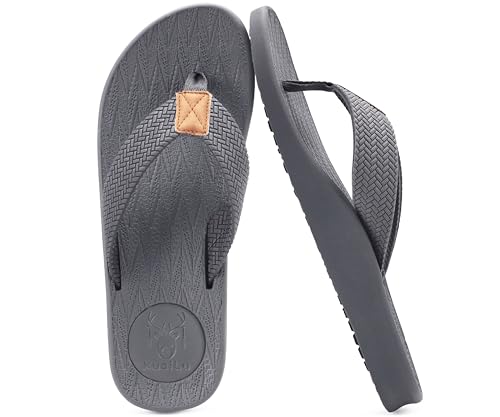
KuaiLu Mens Flip Flops Arch Support — Shaped, men’s
KuaiLu’s men’s flip-flop is the distance walker’s sandal: a contoured, orthopedic-styled bed with a definite arch, a strap built to hold the shoe through a stride rather than merely rest on the foot, and a sole with the substance to take promenade, path, and harbour wall in stride. It is the flip-flop for the man whose beach holiday is measured in miles — the coastal path between villages, the length of the bay at low tide — and who has discovered that a flat foam flip charges interest on every one of them.
The firm’s adjustment logic from the bedroom category applies here in the sun: a few days of graduated wear before the long walk, and the bed’s geography becomes the foot’s expectation. Men who clear that week tend to buy the second colour, which in this category is the sincerest review there is.
- Bed: firm contoured arch support
- Strap: stride-secure build
- Brief: distance on seaside surfaces
- Best terrain: promenades, paths, harbours
- Fit: men’s size run
Strengths
- The most walking-shaped bed in the guide
- Strap security at a stride, not a shuffle
- Sole substance for hard seaside ground
Trade-offs
- Firm bed needs adjustment days
- Heavier than a foam beach flip
- Overbuilt for towel-to-water wear
Best for: men who walk the coast. Not suited for: pure sand-and-swim minimalists.

WHITIN Mens Arch Support Flip Flops — The walking man’s pair
WHITIN’s entry is the second men’s shaped option, and its register sits a half-step friendlier than the KuaiLu’s: arch support with the same intent, delivered in a slightly more forgiving bed and a design that reads as an ordinary good flip-flop until the foot reports otherwise. The pair suits the man who wants the promenade’s miles eased rather than engineered — support as a background condition, not a headline.
Between the two men’s shaped picks, the choice is temperament again: the KuaiLu for definite architecture, the WHITIN for the gentler version of the same idea. Both outwalk the flat pairs by design, and both ask the same few adjustment days as the price of admission.
- Bed: contoured, friendlier register
- Brief: walking with eased geometry
- Character: support in the background
- Best terrain: promenades and beach paths
- Fit: men’s size run
Strengths
- Shaping without the firmest adjustment
- Ordinary good looks, extraordinary bed
- Secure for a full day’s walking
Trade-offs
- Less definite than the KuaiLu for structure-seekers
- Still more shoe than a foam flip
- Adjustment days still apply
Best for: men easing into shaped sandals. Not suited for: wearers wanting maximum firm architecture.
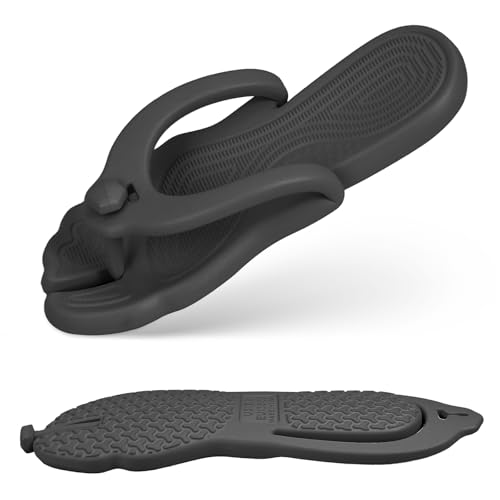
Rosoz Flip Flops Travel — The suitcase spare
The Rosoz is the guide’s insurance policy: a feather-light flip-flop designed to travel — flat-packing, negligible in a luggage allowance, and ready to serve on whatever shore the trip produces. Its virtues are logistical rather than luxurious, and they are real: the unexpected beach, the hotel pool, the hostel shower, the long-haul flight’s walk to the galley, all answered by a pair that took less room than this paragraph’s subject deserves.
As a main beach pair it is outclassed by everything above it — thinner, flatter, and built to a travel brief rather than a fortnight’s abuse — and this guide places it last with that honesty attached. But as a second pair, a spare, a just-in-case that weighs nothing, it has no rival in the list, and experienced travellers will recognise the category instantly: the thing you pack once and thank for a decade.
- Build: ultralight, flat-packing
- Brief: travel spare and backup
- Character: logistics over luxury
- Best terrain: pools, showers, light beach use
- Role: lives in the suitcase
Strengths
- Packs to nothing and weighs less
- Answers pools, showers, and spare-pair duty
- The cheapest insurance in the guide
Trade-offs
- Not a main pair for a beach fortnight
- Flat bed, no shaping
- Thin sole on rough ground
Best for: travellers who pack a spare. Not suited for: anyone’s only beach pair on a walking holiday.
How Do the Six Beach Pairs Compare?
| Pick | Family | Shaping | Water manners | Best for |
|---|---|---|---|---|
| Crocs Crocband | Beach classic | Moulded foam comfort | Total — rinse and go | Sand, sea, pool decks |
| AOMIG Platform | Holiday fashion | Flat, raised | Light splashes | Resorts and evenings |
| shevalues Arch | Shaped women’s | Contoured rise | Good | Promenade walking |
| KuaiLu Men | Shaped men’s | Firm contour | Good | Coastal distance |
| WHITIN Men | Shaped men’s | Friendly contour | Good | Eased walking miles |
| Rosoz Travel | Travel spare | Flat | Good | Suitcases and spares |
The comparison sorts by intent, as the category demands: the Crocs owns the water’s edge, the shaped three own the promenade, the AOMIG owns the evening, and the Rosoz owns the suitcase. A buyer who names their beach honestly will find the table has already chosen for them.
Sand, Salt, Sun: What a Beach Actually Does to Footwear
Sand is an abrasive that works its way into every seam and strap junction, grinding quietly all day; salt water corrodes metal fittings and stiffens fabrics as it dries; and sun — the element nobody prices — degrades foams, fades colours, and makes dark soles hot enough to teach a barefoot dancer new steps. A beach pair is therefore a materials decision before it is a style one, and the moulded one-piece builds in this guide are not a fashion preference but the engineering answer: nothing to delaminate, nothing to corrode, nothing to stay wet.
The care that extends any pair’s season is correspondingly simple: rinse the salt off when the day ends, shake the sand out before it grinds overnight, and store the pair out of the direct sun that cooked the beach. Five minutes of that discipline doubles a flip-flop’s life, which is the best return on maintenance in this entire batch of guides.
How Should a Flip-Flop Fit?
A flip-flop fits at three points, and all three can be checked in thirty seconds. The heel should sit on the bed, not hang off its back edge — overhang behind is the classic too-small signature and the fastest route to a sore stride. The toe post should sit between the toes without pulling the foot forward, so the toes end with a small margin of bed in front of them rather than gripping the edge. And the strap should hold the shoe through a walking stride without the foot having to claw to keep it — a flip-flop the toes must grip is a flip-flop that will tire the foot by the promenade’s end.
Between sizes, the beach argues for the fraction larger: feet swell in heat, sand adds its own millimetres, and a toe post with grace is a blister avoided. Shaped pairs add their own rule — the arch’s rise must land under the arch, which fixes the size more precisely than the strap does — and a shaped pair should be fitted by the bed first and the strap second.
What Mistakes Do Beach Buyers Make?
Buying by the photograph leads, as it does across this batch: the platform bought for a rocky cove, the fashion pair bought for a walking holiday, the expedition-shaped pair bought for a towel. Second is the holiday-eve purchase with no break-in — new straps meet their first mile on the first morning, and the blister writes the review. Third is sizing like a shoe, snug and exact, in a category that swells, slips, and runs sandy.
The quiet mistake is the single pair for a mixed fortnight. A beach holiday is several terrains wearing one name — sand, promenade, rock, resort — and the experienced traveller’s two-pair system (a water pair and a walking pair, with the Rosoz as the system’s cheap third) covers them all for less than one premium pair asked to do everything. This guide’s table is, read rightly, a packing list.
The Promenade Versus the Sand: Two Different Sports
Sand walking and promenade walking load a foot so differently that they might be different sports sharing a venue. Sand yields, grips, and works the whole foot and calf — barefoot’s home ground, where the flip-flop’s job is mostly to survive the hot and sharp stretches between towel and water. The promenade is a pavement: unyielding, mile-long, and graded exactly like a town walk, which is why the shaped beds earn their place there and why the flat foam pair that was perfect at noon is an ache by the evening’s return.
Most beach holidays mix the sports daily, and the honest footwear plan mixes with them. The two-pair system is not indulgence; it is the recognition that the Crocs and the KuaiLu are answers to different questions asked by the same day, and that the day will ask both.
Rock Pools, Reefs, and the Water’s Edge
The water’s edge is the beach’s examination room, and it grades grip, security, and drainage in about four seconds. Wet rock is the sternest surface in the holiday — algae-slicked, uneven, and usually crossed carrying something — and it is where the flat, grippy, low pairs in this guide earn their soles and where the platform should be honestly excused. The Crocs’ moulded tread and low centre make it the edge’s default; the shaped walkers manage it carefully; and any pair whose strap loosens when wet should be kept for the sand it was photographed on.
Reef and shingle beaches add the second test: sharp ground under a thin sole. The travel pair’s thinness, a virtue in the suitcase, is a liability on shingle, and the holiday that includes a famous pebble beach should pack accordingly — the moulded pair’s substance is the difference between a swim and a hobble. Local knowledge is the real specification here: read what the beach is made of before deciding what to stand on it in, because the word “beach” covers terrains as different as flour and gravel.
Drainage, the third test, is the quiet one: a pair that holds water squelches, chafes, and stays damp into the evening, while a moulded or open pair sheds it in strides. Every pick in this guide drains by design except where fashion has been allowed a vote, and the water’s edge is where that vote is counted.
Children at the Beach: Small Feet, Same Physics
Children’s beach footwear obeys the same physics with two additions: they run everywhere, including across the surfaces adults cross carefully, and they lose things into the sea with a reliability that should be treated as a specification. The system that survives a family beach holiday is therefore the adult system with the volumes turned up — a water pair that grips and rinses, sized with the growth margin children’s feet always need by August; a walking pair for the excursion days, because small legs walk the promenade too and flat foam charges them the same interest; and a spare pair, cheap and cheerful, bought in the expectation of loss rather than in hope against it.
Fit matters more, not less, at small scale: a toe post that rubs will be refused, loudly, by the second day, and a refused pair is dead weight in the family bag. Let the child walk the shop in them, on a hard floor, for longer than feels reasonable — the beach will ask for hours, and the shop’s five minutes is the cheapest rehearsal available.
Colour is the family’s secret weapon: in the bright, unnatural shade no other child on the beach is wearing. Beach footwear is communal by gravity — it migrates to piles, cafés, and other families’ bags — and the pair that can be spotted at thirty metres is the pair that comes home.
The Evening Promenade: When the Beach Day Changes Shoes
There is a moment in every beach day — the shower, the change, the first cold drink — when the beach’s footwear hands over to the evening’s, and the handover is where holiday packing is won. The day pair, sandy and salt-stiff, stays at the door; the evening asks for something that walks a promenade at a stroll, sits under a café table without embarrassment, and carries a slightly sunburned foot kindly. The AOMIG platform was chosen for exactly that hour, and the shaped walkers double for it when the evening includes distance — the bay’s far end, the old town’s lanes — because an evening walk on holiday is still a walk.
Houses and apartments with terraces blur the handover: the evening pair becomes the terrace pair, and its virtues shift toward the house’s — comfort across hours, kindness to tired feet, and soles that treat a tiled terrace and a wooden deck as home. The traveller packing light can let one shaped pair cover promenade and terrace both, which is the strongest luggage argument the arch-support contingent has: it is the only family in this guide that works both sides of the shower.
The day pair’s evening duty is to dry, and it should be given the chance: rinsed, shaken, and left where the night air reaches it. A pair that starts the morning dry starts it honest, and the fortnight’s comfort is mostly the sum of such small disciplines.
Hot Sand Physics: The Midday Problem
At midday in high summer, dry sand reaches temperatures that make the towel-to-water walk a small endurance event, and the flip-flop’s oldest job reasserts itself: it is a heat shield before it is anything else. Sole thickness is the specification that matters at noon — the travel pair’s thinness, invisible in the suitcase, is felt through every step at one o’clock — and colour compounds it, since a black sole stored in the sun arrives at the foot pre-heated. The moulded pairs’ substance is the midday answer, and the experienced beachgoer’s habit of parking footwear in the umbrella’s shade is materials science wearing a holiday hat.
Wet sand resets the problem and adds its own: it grips the sole with a suction that tests every strap’s anchoring, and the flip-flop that pulls off in wet sand at a run — the category’s most comic failure — is usually a pair whose strap was fitted for looks on dry land. Walking pace forgives it; a child, a dog, or a beach game does not, and the secure-strapped walkers in this guide earn their straps at exactly that moment.
By evening the sand has cooled and the physics relaxes, which is why the beach day can be read as a footwear timetable — substance at noon, security at the water, shaping on the promenade, style after the shower — and why this guide’s six picks, between them, cover a clock as much as a coastline.
What the Lifeguards and the Locals Wear
Every beach has a resident footwear consensus, worn by the people who work it, and it is worth reading before buying for it. Lifeguards and beach staff converge, beach after beach, on moulded foam pairs of the Crocs family — not from brand loyalty but from the arithmetic of eight wet hours a day: what rinses, dries, and never blisters wins, and everything else is a hobby. Surf instructors add the secure strap for the same reason a walker does, and the shaped pairs appear on exactly the feet that walk the front for a living — the promenade traders, the guides, the café staff whose shift is a distance event.
The locals’ second lesson is replacement rhythm: working beach footwear is a consumable, renewed without sentiment when the tread polishes or the post loosens, because the water’s edge forgives nothing worn smooth. Holiday buyers, who use a pair thirty days a year, can stretch that rhythm across summers — but the test is the same, and a pair that fails it should be retired to the garden before it fails somewhere wetter.
None of this requires copying the professionals’ exact pairs; it requires copying their criteria, which is what this guide’s screening did. The beach is a workplace that admits tourists, and its dress code was written by the staff.
The Pool Deck and the Spa: The Beach’s Indoor Cousins
Half the modern beach holiday is spent on the pool deck, a surface with its own physics: wet tile, smooth stone, and water that arrives by the bucket from other people’s children. The deck grades grip above all, and it is the second surface — after wet rock — where a polished sole announces itself without appeal. The moulded pairs pass it as a birthright; the shaped walkers pass it on their tread; the platform, again, should be walked there with the respect height owes to water.
The spa extends the deck’s logic into quieter rooms, and adds the social specification: footwear that does not squeak, slap, or announce its wearer across a marble hall. Flip-flops are the spa’s native dress, and the guide’s quieter-soled picks serve it best — a small virtue at the beach, a real one in a corridor of people resting.
Hotels that provide their own disposable slippers have not solved this problem, incidentally; they have merely standardised it at the thinnest end of the market, and the traveller whose Rosoz lives in the suitcase is immune to the whole question. The travel pair’s brief quietly includes every tiled, wet, shared floor of the holiday, which is why it earns its corner against competition from an entire wardrobe.
Buying the Second Season: Durability, Honestly Priced
A beach pair’s price should be read against seasons, not summers’ photographs. The moulded Crocs, at the category’s honest middle price, commonly delivers three or more holiday seasons — the cheapest per-wear arithmetic in this guide despite not being its cheapest pair. The shaped walkers amortise across every promenade of every trip and the home summers between, since a contoured flip-flop works in a garden as happily as on a seafront. The platform’s arithmetic is social rather than seasonal, and the travel pair’s is measured in disasters avoided, a currency that never devalues.
The false economy is the bargain-bin pair bought at the airport: one fortnight of blisters and a strap failure at the far end of a beach is the most expensive footwear a holiday can contain, because it is paid for in the holiday itself. The beach is a poor place to discover that footwear, like sunscreen, is a product where the cheap version costs more.
Retirement, when it comes, is visible: tread polished at the heel, a post that moves in its socket, foam that has stopped springing back by morning. Any one of the three is the pair asking to become a garden shoe, and the household that listens keeps its beach kit honest without ever quite buying the same pair twice in a row — the category improves, and next season’s version of a favourite is usually its best one yet.
Beach Weddings, Beach Bars, and the Dress Code Between
A surprising share of beach holidays contains one event with a dress code — a wedding on the sand, a beach club with opinions, a restaurant that has drawn its line at swimwear — and the flip-flop’s place in that event is decided by its finish rather than its family. The AOMIG platform exists for precisely this hour: it reads as a sandal that has made an effort, which is the entire requirement. The moulded and shaped pairs, for all their virtues, announce leisure too loudly for a ceremony, and no amount of beach-side reasoning will seat them at a wedding.
The traveller with one such event in a fortnight of beaches faces the category’s classic packing problem, and the platform is its elegant answer: one pair that serves the resort’s evenings and the event both, bought as clothing and judged as clothing. The error is to reverse the logic — to buy the event pair and ask it to serve the rocks, the miles, and the midday sand — because clothing asked to be equipment fails as both, usually by the third day.
Households that holiday in groups will recognise the social version: the beach’s footwear sorts itself by evening into the dressed and the functional, and the person in the wrong register feels it. A guide’s duty is to name the registers plainly, which this one has tried to do from its first table onward.
The Drive, the Flight, and the Journey’s Own Footwear
Beach footwear begins working before the beach: the long drive in summer traffic, the flight’s hours of swelling feet, the ferry deck, the station platform with a suitcase. The flip-flop is the journey’s natural shoe — nothing to lace at security, room for a foot that has expanded at altitude, and a sole that handles a wet ferry deck without comment — and the pairs in this guide divide the journey as they divide the shore: the moulded pair for the driver, whose pedal asks for a sole with manners; the travel pair for the flyer, packed in hand luggage against the checked bag’s disappearance; the shaped pair for the traveller whose journey includes the walking — the connection across a great station, the old town between hotel and harbour.
The driving point deserves its emphasis, because it is the one safety note in a light-hearted category: a loose flip-flop can slip from a pedal or catch beneath one, and the driver should wear the secure pair for the road and change at the shore if their beach pair is a looser fashion. The category’s convenience does not extend to the brake pedal, and the guide would rather say so once than imply it never.
Arriving is the journey’s last footwear event: the first walk from car or station to sand, often across the hottest ground of the trip, in the pair that travelled. A system that has thought about the journey arrives with its beach already begun; a system that has not starts the holiday with hot feet and a small, unnecessary grievance against the weather.
Sustainability at the Shoreline: The Pair That Lasts
The beach is where footwear waste is most visible — every shoreline collects the category’s failures, one strap at a time — and the most sustainable flip-flop is unfashionably simple: the one that lasts several seasons and is worn for all of them. The moulded one-piece construction leads that argument structurally, since a shoe with no glued layers has fewer ways to die young, and the shaped walkers follow on durability of a different kind: a pair bought for real walking is a pair that gets used hard enough to justify its materials.
The travel spare complicates the sermon honestly: a thin pair bought as insurance and used for a decade of hotel floors is a better citizen than a premium pair bought for one fortnight and retired to a cupboard. Use is the greenest specification, outranking every material claim on every listing, and this guide’s system approach — buy by role, wear by role, retire on evidence — is as much an environmental position as a practical one.
Disposal, at the end, follows the household rule for all footwear in this batch: a retired beach pair descends to the garden, the garage, and the messy jobs, and only leaves the house when it can no longer stay on a foot. A pair with three lives in it was never really waste at all.
One Beach, Four Generations: Fitting the Whole Party
A family beach holiday is a footwear census: grandparents whose promenade is their exercise and whose footing deserves the shaped pairs’ respect; parents running the towel-to-water economy in the moulded defaults; teenagers whose beach is a social venue and whose platform logic is, on their own terms, entirely rational; and children in the bright spares. The guide’s six families scale across the census without strain, which is less a compliment to the guide than to the category: the flip-flop is the one footwear form every generation already speaks.
The fittings differ by generation in predictable ways — the oldest feet benefit most from the shaped bed and the secure strap, the youngest from the margin and the colour, the middle from whatever ends the argument fastest — and the household that buys by role rather than by matching sets will outfit the census better for less. Matching family flip-flops are a photograph; a fitted family is a holiday.
The Last Hundred Metres: Carrying Everything at Once
Every beach day ends with the same logistics problem — chairs, towels, a bag, a child, a cool box — carried across the day’s hottest or tiredest ground by a person whose hands are entirely full. That walk is the flip-flop’s final examination, and it grades security above every other virtue: the pair that stays on without toe-gripping, on a slope of loose sand, under a load, is the pair that was fitted and strapped for walking rather than posing. The shaped walkers and the moulded default pass it as a matter of design; the platform and the travel thin pass it as a matter of luck, and luck is a poor porter.
The practical corollaries are small and worth the sentence each: footwear goes on before the load is lifted, not balanced during it; the route back is chosen for its surface, not its shortness, when the load is largest; and the spare pair, if the day has produced a failure, is already in the beach bag because the system put it there. Beach competence is mostly such unglamorous foresight, and the footwear is where it shows first.
When the Flip-Flop Is the Wrong Shoe Entirely
A guide earns its authority at its edges, and this category’s edge is plainly marked. Cliff paths, via ferrata coastlines, tidal crossings with a timetable, and any terrain where a turned ankle is an incident rather than an anecdote all want a shoe or a strapped sandal, and no pick in this guide should be promoted into that company. The same honesty applies to the long-distance end: a coastal trail measured in days is a walking-shoe brief that a contoured flip-flop can flatter for an afternoon and fail across a week.
Weather draws the other edge. The beach in a storm, the promenade in November, the seaside town out of season — all are shoe weather wearing a beach’s name, and the traveller whose holiday slides toward them should let the suitcase’s other footwear take the day. The flip-flop’s genius is its narrowness: it is the perfect tool for a specific, sunlit set of problems, and a guide that pretended otherwise would be selling the problems short.
The Homecoming: Beach Pairs in the Rest of the Year
The beach pair’s year does not end at the airport. The moulded default becomes the garden’s summer shoe, the bathroom’s post-shower pair, and the house’s answer to every wet errand; the shaped walkers take the summer’s town miles and the school run’s dry days; even the platform finds its second season at garden parties, where its height finally meets grass it should probably avoid but its owner will not. A category bought for a fortnight and used for fifty weeks is the opposite of holiday waste, and it is one more reason to buy the fortnight’s footwear properly rather than cheaply.
The travel pair, alone, keeps its single duty — back into the suitcase, washed and dry, ready for the next shore — and its discipline is the system’s memory. When the next trip is packed, the Rosoz is already there, and the holiday’s footwear planning is finished before it starts.
A Short Defence of the Simple Thing, Well Made
It is worth ending the topical sections where the category itself begins: with the observation that the flip-flop is one of humanity’s oldest footwear forms, a sole and a strap that Egyptian, Indian, and Japanese traditions all arrived at independently, and that its survival into the age of engineered footwear is not nostalgia but fitness. The six picks in this guide are that ancient form at six modern addresses — moulded, platformed, contoured, and packed — and the differences among them are the differences the modern beach has added to an old problem: distance, dress codes, luggage allowances, and hard promenades.
Buy the form for your terrain, fit it with its small margin, rinse it when the day ends, and retire it on evidence. Do those four unfashionable things and the simplest footwear in the world will serve a holiday better than the most complicated shoe in the suitcase — which is, in the end, the entire argument of this guide and of the beach itself.
The Spare Strap, the Lost Pair, and Other Beach Realities
Beach footwear fails in public and at distance from shops, which is why the experienced traveller’s system includes its own quiet redundancies: the travel spare in the bag, a pair of ordinary sandals in the car, and the knowledge that a broken toe post at the far end of a bay is a barefoot walk home on hot ground. None of this is pessimism; it is the arithmetic of a product with exactly two components, each of which is a single point of failure, used in the one environment where a failure cannot be answered by a taxi.
The households that holiday together pool the redundancy sensibly — one spare pair per family bag rather than per person, in the size that fits the most feet approximately — and the beach bag that contains it also tends to contain the plasters, the spare strap of common sense that every other section of this guide has been describing in different words: a system, fitted honestly, maintained nightly, and never asked to be more than it is.
The Beach Bag Audit: What Actually Gets Carried
Open a veteran’s beach bag and the footwear system is visible at a glance: the water pair in a mesh pocket where it can dry against the bag’s side, the walking pair worn rather than carried, and the spare flattened at the bottom under the towels, where it has lived since the first trip and will live until it is needed. Nothing in the arrangement is decorative, and every item in it has survived several rounds of being left behind and reinstated — the audit a holiday gives its equipment each year. A new pair joining that bag should expect the same audit: it will be carried exactly as long as it is used, and used exactly as long as it fits the terrain it was bought for. Buy for the bag’s real contents, and the pair will still be in it, sand and all, when the children are grown.
The Verdict of the Wet Footprint
There is a simple field test that summarises this entire guide, and any buyer can run it in a shop with a wet floor or at home on the first morning: wet the sole, walk ten paces on a hard floor, and read the footprints. A pair that prints clean, separate treads and leaves the foot dry above them has passed the beach’s three examinations at once — grip, drainage, and a bed that does not drink. A pair that prints a smear and squelches on the return walk has told you, honestly and in advance, exactly the holiday it plans to give you. The six pairs in this guide were chosen because they print clean; the market’s wider shelf is full of smears at every price, which is why the test outranks the tag.
Final Recommendation
For the beach itself, buy the Crocs and stop deliberating. For a walking holiday, buy your shaped pair — shevalues, KuaiLu, or WHITIN by foot and register — and give it its adjustment days before the miles. Add the AOMIG if your holiday has evenings to dress for, and the Rosoz if your suitcase has the corner it deserves. Back indoors, the evening’s own footwear waits in Best Bedroom Slippers.
Frequently Asked Questions
Can I wear arch-support flip-flops in the sea?
They tolerate water, but their brief is walking, not swimming — the Crocs-style moulded pair is the better sea shoe. Rinse shaped pairs after salt water and let them dry fully, and their beds will keep their geometry.
Why do new flip-flops blister between the toes?
A new toe post and an unaccustomed strap meet skin that has worn shoes all year. Break any pair in with short walks before the holiday’s long ones, and size so the post sits without pulling.
Are platform flip-flops safe on wet surfaces?
They ask for care: height plus wet stone is a combination to respect. Keep platforms for dry boardwalks and resort ground, and switch to a flat, grippy pair for rocks and pool edges.
How long should a beach pair last?
A moulded pair like the Crocs commonly serves several summers of holidays; straps and posts are the usual failure points elsewhere. Rinsing salt and storing out of sun, as this guide describes, roughly doubles any pair’s life.
Is one pair enough for a two-week beach holiday?
For a single-terrain holiday, yes. For the usual mixed fortnight — sand, promenade, evenings — the two-pair system (water pair plus walking pair) is the experienced answer, and a travel spare makes three for very little weight.
Do flip-flops stretch or mould over time?
Foam beds compress and take a light impression of the foot; straps relax slightly. Neither rescues a wrong size — fit them right in the shop, with the small margin this guide recommends.
What should I pack for a beach trip with children?
The same system at smaller scale: a water pair that rinses, a walking pair for excursions, and a spare, because children’s beach footwear has a documented talent for disappearing into the sea. Distinctive colours help more than any feature.
Can flip-flops handle a coastal path?
The shaped walking pairs can handle promenade-grade paths; a true coastal trail — mud, stiles, gradients — wants a sandal with a heel strap or a shoe. Know which path your holiday means by the word.
Related Guides
The holiday’s other footwear questions: Best College Shower Slippers covers the shared-shower end of travel, Best All-Around Men’s Slippers is the warm-evening pair for the apartment after the beach, and Best Affordable Outdoor Rugs furnishes the terrace the holiday comes home to.


