What's inside
- Key Takeaways
- Quick Picks
- How Did We Choose the Best No-Lint Bath Towels?
- Comparison Table
- What Is Lint, Exactly, and Why Do Towels Produce It?
- Why Should You Distrust Any Cotton Towel That Promises Zero Lint?
- How Should You Wash New Towels to Finish the Shedding Phase Quickly?
- How Do You Test a Towel’s Lint Before Committing to a Whole Set?
- What Mistakes Make a Towel’s Lint Problem Worse?
- Who Notices Lint Most, and Which Pick Serves Them?
- How Does Lint Behave Across a Towel’s Whole Working Life?
- What Do Hotels and Spas Know About Lint That Homes Can Borrow?
- How Should Low-Lint Towels Be Stored and Handled Between Washes?
- What About Washcloths, Hand Towels, and the Rest of the Rail?
- How Do Color and Dye Choices Interact With Lint?
- Final Recommendation
- Frequently Asked Questions
- Related Guides
As an Amazon Associate I earn from qualifying purchases. This post may contain affiliate links at no extra cost to you.
cottageverdict.com is reader-supported. When you buy through links on our site, we may earn an affiliate commission.
Where to buy: All six picks below are sold on Amazon, where you can check price on Amazon and verify pack counts and sizes on the listing itself. In this category the fiber description matters more than the headline, so read what the towel is actually made of before ordering.
Lint announces itself in small humiliations. You dry off after a shower and step into black trousers already wearing a faint grey fuzz. You wipe a steamed mirror and leave it dustier than you found it. You dry a freshly washed face and pick cotton fibers off your skin one by one. The best no-lint bath towels exist for people who are done with that — but this guide begins with the honesty the category usually avoids: no cotton towel is truly lint-free from day one. Every new cotton towel sheds loose fiber in its first several washes, because weaving leaves short, unanchored fibers in the pile, and only washing carries them away.
So “no lint,” read honestly, means this: a towel whose construction sheds as little as possible to begin with, and whose shedding phase ends quickly and completely when the towel is washed correctly. Two constructions achieve that by design. Microfiber, being a continuous synthetic filament rather than a spun natural fiber, has almost nothing loose to shed, and the better microfiber towels in this guide are as close to genuinely lint-free as a towel gets. Long-staple cotton, ring-spun and tightly woven, comes second: its longer fibers anchor into the yarn instead of escaping it, so after a short break-in the towel leaves skin, mirrors, and dark clothing essentially clean.
The six picks below divide along exactly that line — two microfiber sets that skip the shedding phase entirely, and four cotton options chosen for the fiber and spinning methods that minimize it. Whichever side you choose, the washing guidance in this guide matters as much as the purchase, because lint is a partnership between how a towel is made and how it is laundered.
One more piece of framing before the picks: lint tolerance is personal and situational, and this guide refuses to pretend otherwise. A trace of fiber that a beach house never notices can be a daily irritation in a black-and-chrome bathroom where every surface testifies. Read the picks against your own rooms, your own wardrobe, and your own patience for a break-in period, and the right choice usually identifies itself before the comparison table confirms it.
Key Takeaways
- Every new cotton towel sheds some lint in its first washes; honest “no lint” means minimal shedding that ends quickly.
- Microfiber sheds least of all, because its continuous filaments have no short loose fibers to release.
- Long-staple, ring-spun cotton is the lowest-lint natural option, since longer fibers stay anchored in the yarn.
- Washing new towels separately, without softener, and cleaning the dryer filter shortens the shedding phase dramatically.
- Lint shows worst against black clothing, glass, mirrors, and freshly moisturized skin — judge a towel there, not on white tiles.
- Short-staple, loosely spun budget cotton is the category’s worst shedder, whatever its label promises.
Quick Picks
| Pick | Badge | Why it made the cut |
|---|---|---|
| JML Microfiber Bath Towel Set | Best Truly Lint-Free Set | Six large microfiber bath towels, sold as lint free with no pilling, that skip the cotton shedding phase entirely. |
| POLYTE Waffle Bath Towel Set | Best Waffle Lint-Free Set | A 430 GSM waffle microfiber set with body, hand, and wash sizes, all in a lint-free poly blend. |
| Tens Towels Cream Bath Towels | Best Low-Lint Cotton, Oversized | Four 30 by 60 inch cotton towels in a lighter, tighter build that sheds less and settles faster than plush cotton. |
| Towel Bazaar Extra Large Bath Towels | Best Long-Staple Cotton | Turkish long-staple cotton with double-stitched hems, the fiber choice that anchors lint at its source. |
| Utopia Premium Bath Towels 600 GSM | Best Ring-Spun Cotton | Ring-spun 600 GSM cotton, spun for smoothness, in a four-pack of classic 27 by 54 inch bath towels. |
| White Cotton Bath Towels 6-Pack | Best Budget Low-Lint Cotton | A plain white six-pack of absorbent cotton towels for households that launder often and replace without drama. |
How Did We Choose the Best No-Lint Bath Towels?
We started at the fiber, because lint is decided there before a towel is ever woven. For the microfiber picks, the questions were filament quality and surface finish: a well-made microfiber towel presents a uniform face with no loose loops to break down, and both microfiber picks here are sold explicitly as lint free. For the cotton picks, we looked for the vocabulary that predicts low shedding — long-staple fiber, ring spinning, combed yarn, tight weaving — and treated vague promises of softness as the warning sign they usually are, since the plushest-feeling new towels are often plush precisely because their fibers are loosely held.
Construction came next. Double-stitched hems keep edges from becoming a lint source of their own, and a towel woven at moderate density sheds less than an over-lofted one, because its yarns are packed tightly enough to hold their fibers. That is why this guide favors several lighter, tighter cotton builds over the thickest hotel-style towels: in the lint category, restraint in the weave is a feature, and the 600 GSM ring-spun pick is here as the plushest option that still keeps its fibers to itself.
We also read the care labels as evidence. A towel whose maker instructs separate first washes is a towel whose maker understands its own product; vague care guidance across a listing often travels with vague construction. Every pick here arrives with workable, ordinary care instructions, because the audience for a low-lint towel is precisely the audience that follows them.
Finally, we judged the whole ownership arc rather than the first week. A towel that sheds for two washes and then stops is a better no-lint towel than one that sheds lightly forever, so fiber choices known to settle — long staple above all — ranked ahead of coatings or finishes that promise low lint chemically. Care demands mattered too: every pick here tolerates ordinary machine washing, because a low-lint towel that needs laboratory laundry conditions would fail in real bathrooms.

JML Microfiber Bath Towel Set — Best Truly Lint-Free Set
The JML set is the straightforward answer to the lint problem: remove the fiber that causes it. These are microfiber bath towels, 30 by 60 inches each in a six-pack, and microfiber’s structure — continuous split filaments rather than short spun fibers — means there is essentially no loose fiber available to shed onto skin, clothing, or glass. The maker sells the set as lint free, fade resistant, and free of pilling, and the construction supports the claim in a way cotton claims must be qualified. If your lint frustration is total and immediate, this is the pick that ends it on the first day rather than after a break-in month.
Each towel carries a hanging loop, a detail that matters more in this category than it first appears, because a towel that hangs fully dries faster and spends less time bunched in a hamper abrading against other fabrics — abrasion being one of the ways even good towels generate surface fuzz over time. The 30 by 60 inch cut is a genuine bath-sheet-adjacent size, wide enough to wrap, and the grey colorway hides the faint shadowing that any hard-working towel develops while showing far less stray fiber than white would against dark clothing.
The trade is the microfiber experience itself, which this guide will not disguise: the surface feels smooth and slightly grippy rather than plush, absorbency works by pressing rather than rubbing, and the towel asks to be kept away from fabric softener and high dryer heat. Bathers who accept those terms get the cleanest post-shower result in this guide — step out, dry off, dress in black, and find nothing on the fabric. For people whose lint complaints center on clothing, mirrors, and skincare routines, that result outweighs the missing terry sensation.
- Fabric: microfiber
- Size listed: 30 x 60 in
- Format: 6 pack
- Color shown: Grey
- Details: hanging loop on each towel; sold as lint free and no pilling
Strengths
- Essentially zero shedding from the first use, with no break-in phase
- Generous 30 by 60 inch size in a full six-towel set
- Hanging loops speed drying and reduce hamper abrasion
Trade-offs
- Smooth microfiber feel will not satisfy committed terry bathers
- Requires the press-and-pat technique rather than a brisk rub
- Softener and high heat degrade microfiber and must be avoided
Best for: black-clothing wearers, mirror-and-glass households, and anyone who wants the lint problem simply over. Not suited for: bathers whose shower ritual depends on plush terry texture.
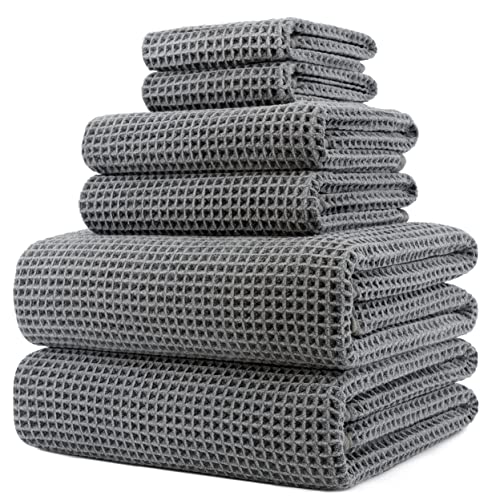
POLYTE Waffle Bath Towel Set — Best Waffle Lint-Free Set
POLYTE takes the microfiber route and adds architecture. The set is a 430 GSM waffle weave in an 85 percent polyester, 15 percent polyamide blend — the polyamide fraction is the absorbent partner in better microfiber — and the waffle’s recessed pockets give the towel a texture that behaves a little more like cloth and a little less like a chamois. The set is sold as lint free, and like the JML it earns that description structurally: there are no short natural fibers in the cloth to escape it. What the waffle adds over a flat microfiber is drying speed and a surface that feels less slick on wet skin.
The six pieces divide into two body towels, two hand towels, and two washcloths, which makes this the only pick here that solves lint across the whole bathroom at once. That matters because lint complaints rarely stop at the bath towel: the hand towel that dusts the mirror, the washcloth that leaves fibers on a just-washed face, are usually the same problem in smaller sizes. A matched lint-free set ends the problem at every rail and hook simultaneously, and the uniform oversize cut of the body towels keeps the bath experience consistent with the rest.
Waffle microfiber also dries with unusual speed, since the weave’s pockets expose extra surface to the air, and in a humid bathroom that speed is a lint-adjacent virtue: a towel that dries fully is a towel that gets washed on schedule rather than worked damp for days, and damp overuse is hard on every fabric’s surface. Households converting a steamy, slow-drying bathroom to low-lint textiles will feel this set working on both problems at once.
- Fabric: microfiber poly blend, 85% polyester / 15% polyamide
- Weight listed: 430 GSM
- Weave: waffle
- Format: set of 6 — 2 body towels, 2 hand towels, 2 washcloths
- Details: oversize body towels; sold as lint free
Strengths
- Solves lint at bath, hand, and face sizes in one matched set
- Waffle texture feels more cloth-like than flat microfiber
- Dries exceptionally fast, suiting humid bathrooms
Trade-offs
- Only two body towels, so heavy bath rotation needs a second set
- Waffle texture is a distinct feel that not every bather prefers
- Synthetic blend will not please natural-fiber loyalists
Best for: whole-bathroom lint conversions and humid, slow-drying bathrooms. Not suited for: households committed to natural fibers at every size.
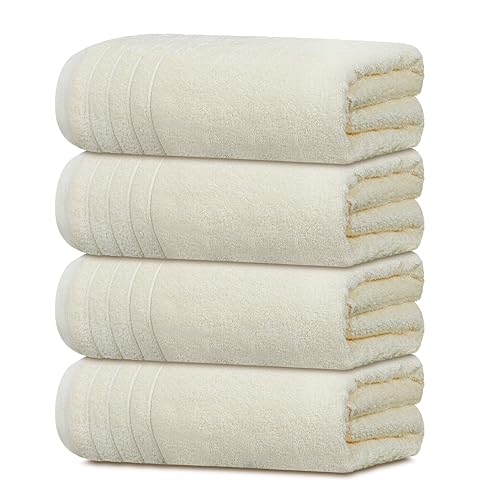
Tens Towels Cream Bath Towels — Best Low-Lint Cotton, Oversized
Tens Towels approaches lint from the cotton side with a build that makes sense: 100 percent cotton woven larger and lighter — 30 by 60 inches in a four-piece set — rather than smaller and denser. A lighter, tighter cotton construction holds its fibers more securely than an over-lofted one, because there is less loosely twisted pile standing away from the yarn’s core. In practice these towels shed modestly in their first washes, as all cotton does, and then settle quickly into the low-lint behavior their construction promises. The cream colorway is the honest test color, too: it will show you exactly how little the towel sheds against the dark clothes in your wardrobe.
The oversize cut is the other half of this pick’s appeal. Thirty by sixty is the dimension at which a bath towel becomes a wrap, and Tens keeps that coverage while shedding the weight that makes big terry towels slow to dry and heavy in the wash. A household running these towels will notice the laundry difference within a week: loads wash cleaner, dry faster, and the towels return to the rail the same day, which keeps the rotation honest and the towels fresher.
Expect the cotton experience in full — the familiar blot, the natural hand feel, the softness that builds across the first month — with a shedding phase that is shorter and lighter than the plush-towel norm. For buyers who want cotton and calm about lint, and who are willing to run the first three washes separately as this guide advises, the Tens set is the balanced answer.
- Fabric: 100% cotton
- Size listed: 30 x 60 in
- Format: 4 piece set
- Color shown: Cream
- Character: larger and lighter weight, quicker to dry
Strengths
- Tight, lighter build sheds less and settles faster than plush cotton
- True wrap-size coverage without bath-sheet weight
- Lighter loads wash and dry quickly, easing rotation
Trade-offs
- Still cotton: a short shedding phase in early washes is unavoidable
- Lighter hand feel will read as thin to bathers who prize heft
- Cream shows soil sooner than mid-tone colorways
Best for: cotton loyalists who want low lint with full wrap coverage. Not suited for: anyone demanding zero shedding from the very first shower.

Towel Bazaar Extra Large Bath Towels — Best Long-Staple Cotton
If one cotton specification predicts low lint, it is staple length, and Towel Bazaar builds its towel on exactly that: Turkish cotton with long-staple fiber, in a 30 by 60 inch four-pack finished with double-stitched hems. Long-staple cotton’s fibers are simply longer, so when they are spun into yarn, each fiber is gripped along more of its length and has fewer free ends standing out of the yarn to break away as lint. The difference is not marketing poetry; it is geometry, and it shows in the first month of ownership, when these towels shed noticeably less than short-staple equivalents and finish their shedding phase sooner.
The supporting details align with the fiber choice. Double-stitched hems close the towel’s edges — the place where lesser towels unravel into a secondary lint source — and the maker notes natural dyes and a chemical-free positioning that suits buyers who read labels closely. The dark gray colorway is a shrewd choice for this category: it neither shows lint dramatically nor hides soil completely, and it coordinates with the monochrome bathrooms where lint complaints are most often born, since black fixtures and dark grout advertise every stray fiber.
In use, expect a towel that feels substantial without the extreme loft that sheds worst, that grows softer across its first season, and that keeps its surface integrity wash after wash. This is the pick for the buyer who has done the reading, wants cotton, and wants the specific cotton that fiber science points to. It will still ask for the standard courtesies — separate early washes, no softener — but it asks from the strongest starting position of any cotton towel here.
- Fabric: 100% Turkish cotton, long-staple fiber
- Size listed: 30 x 60 in
- Format: 4 pack
- Color shown: Dark Gray
- Details: double-stitched hems; natural dyes per maker
Strengths
- Long-staple fiber anchors lint at its source, by construction
- Double-stitched hems remove the edges as a shedding source
- Softens over the first season while holding its surface
Trade-offs
- Sits above the budget cotton picks in tier
- Early washes still shed lightly, as all cotton does
- Dark gray shows light-colored dust in lint-prone homes
Best for: informed cotton buyers who want the lowest-shedding natural towel. Not suited for: buyers who want the absolute zero-lint result only microfiber gives.

Utopia Premium Bath Towels 600 GSM — Best Ring-Spun Cotton
Utopia’s contribution to the lint question is the spinning. These bath towels are ring-spun cotton at 600 GSM in the classic 27 by 54 inch cut, sold as a four-pack in cool grey. Ring spinning draws and twists the fibers into a smoother, stronger, more uniform yarn than the open-end spinning used in cheaper towels, and a smoother yarn is a yarn with fewer fiber ends poking out of its surface — which is to say, fewer candidates for lint. The 600 GSM weight gives the towel a genuinely plush hand, making this the pick for bathers who want the traditional thick-towel experience with the shedding engineered down rather than merely wished away.
Honesty requires the follow-up: at 600 GSM, there is simply more cotton per towel, and more cotton means a longer, more noticeable early shedding phase than the lighter Tens build produces — lighter in character, but present for more washes. Ring spinning reduces the rate; it does not repeal the arithmetic. Buyers choosing this pick should plan the disciplined first month this guide describes: separate washes, no softener, a cleaned dryer filter, and patience. On the far side of that month stands a soft, heavy, well-behaved towel that leaves very little behind it.
The cool grey colorway and standard sizing make the set an easy fit for existing linen closets, and Utopia’s positioning in the accessible tier means a household can run a full rotation of them without ceremony. For families whose bathrooms serve many bathers daily, that combination — plush feel, tamed lint, painless replacement — is the pragmatic center of this category.
- Fabric: ring spun cotton
- Weight listed: 600 GSM
- Size listed: 27 x 54 in
- Format: 4 pack
- Color shown: Cool Grey
Strengths
- Ring-spun yarn is smoother and sheds less than open-end equivalents
- Genuine 600 GSM plushness for traditional bathers
- Standard size and accessible tier suit full household rotations
Trade-offs
- More cotton means a longer early shedding phase to wash through
- Heavier towels dry more slowly on the rail and in the machine
- 27 by 54 inches wraps less generously than the 30 by 60 picks
Best for: plush-towel households willing to launder through a disciplined first month. Not suited for: impatient buyers who will judge the towel by its second wash.

White Cotton Bath Towels 6-Pack — Best Budget Low-Lint Cotton
Not every lint strategy is about fiber science; some are about laundry volume. This plain white six-pack of cotton bath towels, at a compact 24 by 50 inches, serves households that wash towels constantly — large families, homes with swimmers, anyone whose towels cycle fast. A towel washed often and dried fully sheds its loose fiber early in its life simply because the washes come thick and fast, and a six-pack at an accessible tier means the rotation never depends on one towel being worked past its clean window. White, additionally, is the one colorway that can be hot-washed and brightened without negotiation, and hot washing is itself a lint-phase accelerator.
The compromises are equally plain. The fiber here is ordinary cotton rather than long-staple or ring-spun, so the early shedding will be the most noticeable of the cotton picks in this guide, and the 24 by 50 inch cut is a working bath towel rather than a wrap. Buyers should choose this pack with eyes open: it is a volume-and-laundry answer to lint, not a construction answer, and it performs best in homes whose laundry rhythm is genuinely frequent.
Within that rhythm, the pack is quietly excellent value. Six towels that can all be bleached bright, boiled through illness weeks, and replaced individually without grief form the backbone of many real households, and their lint behavior after the first month of heavy washing settles to the same low level as fancier cotton. Sometimes the right towel is the one the household actually launders properly, and this is that towel.
- Fabric: cotton
- Size listed: 24 x 50 in
- Format: 6 pack
- Color: White
- Character: high-rotation, hot-wash-friendly basics
Strengths
- Six-pack volume keeps a fast, honest laundry rotation possible
- White tolerates hot washes that shorten the shedding phase
- Accessible tier makes individual replacement painless
Trade-offs
- Ordinary cotton sheds most noticeably among these cotton picks early on
- Compact 24 by 50 inch cut dries rather than wraps
- White shows every soil mark between washes
Best for: large families and high-turnover households with frequent laundry. Not suited for: buyers seeking a luxurious wrap or a construction-led lint solution.
Comparison Table
| Pick | Fiber | Format | Lint behavior | Feel | Choose it if… |
|---|---|---|---|---|---|
| JML Microfiber Bath Towel Set | Microfiber | 6 pack, 30 x 60 in | Essentially none, from day one | Smooth, grippy | you want lint simply finished |
| POLYTE Waffle Bath Towel Set | Microfiber blend | Set of 6, mixed sizes | Essentially none, from day one | Textured waffle | you want every size lint-free |
| Tens Towels Cream Bath Towels | Cotton | 4 pack, 30 x 60 in | Light early shed, settles fast | Light, natural | you want cotton with wrap coverage |
| Towel Bazaar Extra Large Bath Towels | Long-staple Turkish cotton | 4 pack, 30 x 60 in | Lowest shed among cotton picks | Substantial, smooth | fiber quality leads your decision |
| Utopia Premium Bath Towels 600 GSM | Ring-spun cotton | 4 pack, 27 x 54 in | Moderate early shed, then low | Plush, classic | you want heft with tamed lint |
| White Cotton Bath Towels 6-Pack | Cotton | 6 pack, 24 x 50 in | Most early shed; settles with frequent washing | Plain, workmanlike | your laundry rhythm is your strategy |
What Is Lint, Exactly, and Why Do Towels Produce It?
Lint is fiber that has left its yarn. A cotton towel is a hierarchy: fibers are spun into yarn, yarn is woven or looped into cloth, and at every level the shortest, least-anchored fibers sit closest to freedom. Friction — against skin, against other laundry, against the dryer’s drum — works those fibers loose, and once loose they travel: onto your shoulders, your dark clothing, your mirror, the bathroom floor. Every cotton towel contains a population of such fibers from the day it is woven, because spinning cannot grip a short fiber along its whole length. The population is finite, which is the good news hidden in the problem: a towel sheds its loose fibers and then, if its yarn was well made, largely stops.
This is why fiber length dominates the category. A long-staple fiber is gripped by the yarn along more of its length and presents fewer free ends, so the towel’s loose population is small to begin with. Spinning method is the second lever: ring spinning twists fibers into a tighter, smoother yarn that holds its members, while cheaper open-end spinning leaves a fuzzier yarn with more escapees. Weave density is the third: tightly packed yarns shelter each other, while lofty, airy pile stands exposed to every friction the towel meets.
Microfiber exits this system entirely. Its filaments are continuous — a single filament runs the length of the yarn — so there is no short-fiber population to shed. What microfiber can produce, late in a hard life, is pilling from surface abrasion, which is a different phenomenon with a different look. For the pure lint complaint, that structural difference is why the two microfiber picks in this guide stand apart from even the best cotton.
Why Should You Distrust Any Cotton Towel That Promises Zero Lint?
Because the promise cannot survive its first wash, and a category built on an impossible promise trains buyers to misjudge good towels. A brand-new cotton towel, however fine, carries loose fiber from manufacturing — fibers cut in weaving, ends raised in finishing, dust of the mill itself. The first washes remove that population, and during those washes the towel sheds. This is not a defect, a scam, or a sign you bought badly; it is the physics of spun natural fiber, and it happens to the finest long-staple towels in the world, only less and for fewer cycles.
The honest measures are two: how much a towel sheds at its worst, and how quickly the shedding ends. Long-staple, ring-spun, tightly woven towels win on both. Loosely spun short-staple towels lose on both, sometimes shedding noticeably for months because their yarn keeps generating new loose ends as it wears. When a listing promises a cotton towel with absolutely no lint ever, the realistic reading is that the promise refers to the towel’s settled state, generously rounded — or that the towel is not cotton at all.
Buyers serve themselves better by planning the shedding phase than by hunting for a towel that skips it. Buy cotton before you need it, run the break-in washes described below in the first week, and judge the towel from its fourth wash onward. Judged that way, the cotton picks in this guide perform admirably — and judged by their first wash, even they would disappoint you, which is precisely the misunderstanding this section exists to prevent.
How Should You Wash New Towels to Finish the Shedding Phase Quickly?
Wash new towels separately, full stop. The loose fiber a new towel releases will otherwise migrate onto everything else in the load, and the dark clothing you were trying to protect will come out of its own wash wearing the towel’s first shed. Two or three separate warm washes before the towels enter general service will carry away the great majority of the loose population. Adding a cup of white vinegar to an early rinse is a traditional and harmless assist: it helps clear manufacturing residue and relax fibers without coating them.
Keep fabric softener out of these washes and, ideally, out of the towels’ lives. Softener works by depositing a lubricating film, and on towels that film both reduces absorbency and glues some loose fibers temporarily in place, stretching the shedding phase across more washes instead of letting it end. Dryer balls or a clean tennis ball in the dryer achieve softness mechanically, by beating the cloth gently, while also knocking loose fiber into the filter where it belongs.
Speaking of the filter: clean it after every one of these early loads, because a clogged filter recirculates lint-laden air over the very towels you are trying to clear. Shake each towel out before drying — outdoors if possible — to release what washing loosened. After roughly three to five such cycles, a well-made cotton towel’s shedding falls to a trace, and the microfiber picks, of course, needed none of this ceremony at all.
How Do You Test a Towel’s Lint Before Committing to a Whole Set?
Buy one towel first when the listing allows it, and put it through the tests that mimic your actual complaint. The black test is the classic: wash the towel three times, dry yourself with it, then dress in your darkest clothing and inspect in good light. The mirror test follows: wipe a steamed bathroom mirror and look for the fine dusting that low-quality pile leaves behind. The skin test matters for skincare households: dry a just-washed face and check whether fibers remain to be picked off before moisturizer or makeup goes on.
A towel that passes all three after its third wash will behave for its whole life, because the shedding curve only improves from there. A towel still dusting the mirror at wash five is telling you its yarn will keep generating loose ends, and no laundry ritual will fully cure it; return it while you can and move to a longer-staple or microfiber option. Testing one towel costs a week; committing a household to a shedding set costs a season of irritation.
Apply the same skepticism in reverse to your existing towels before replacing them. Some household lint is legacy lint — old, loosely spun towels deep into their wear phase, shedding regenerated fuzz indefinitely. If the black test identifies one ancient towel as the source, retiring that single towel may solve what felt like a whole-closet problem.
What Mistakes Make a Towel’s Lint Problem Worse?
Washing towels with fleece, flannel, and other high-shed fabrics tops the list: lint is contagious in the wash, and a low-lint towel laundered with a shedding blanket emerges wearing the blanket’s fiber. Sort towels with smooth cottons and like colors, and give notorious shedders their own load. Overloading the machine is the second mistake, because towels packed tight abrade against each other for the whole cycle, mechanically generating the very fuzz you are trying to eliminate.
Skipping the dryer’s lint filter between loads quietly undoes good washing, and using softener, as covered above, both coats the fibers and prolongs the shed. A subtler mistake is drying towels to a crisp: over-dried cotton becomes brittle at the fiber surface, and brittle fibers break into shorter pieces — tomorrow’s lint, manufactured today. Dry to just-dry, especially in hot machines.
The final mistake is impatience at the shelf: judging a cotton towel in week one, concluding the category is hopeless, and either returning a towel that was about to settle or resigning yourself to a shedder that never would have. The shedding phase has a shape — worst at first, fading fast, done within the month for good towels. Work with the shape, and the category rewards you; fight it, and every towel looks like a liar.
Who Notices Lint Most, and Which Pick Serves Them?
People who dress in black and navy notice first, and for them the answer is unambiguous: the microfiber picks, which leave nothing on a dark blazer or dress. Skincare and makeup routines notice second — a fiber on a freshly moisturized face is a fiber in the foundation — and here the POLYTE set’s lint-free washcloths earn their place alongside its bath towels. Households with black fixtures, dark grout, and large mirrors notice third, because those surfaces publish every fiber; for them the long-staple Towel Bazaar in dark gray is the elegant match, low-shedding and camouflaged at once.
Allergy-conscious households often ask about lint as airborne dust, and the honest answer is that towel lint is a minor contributor compared with bedding and clothing — but a low-lint bathroom is still a less dusty bathroom, and the microfiber picks, which also dry fast and wash clean, suit that goal well. Pet owners run the equation in reverse: their towels collect hair rather than shed fiber, and microfiber’s slight grip makes it the better hair-lifter after a dog’s bath, while cotton towels emerge from pet duty wearing a coat of their own.
Guest bathrooms deserve a mention, because guests judge a household by its towels more than by almost anything else in the room. A guest dried with a shedding towel notices; a guest handed a clean, fiber-free towel — long-staple cotton, properly broken in — registers quality without knowing why. Keep your best-behaved set for the guest rail and let the workhorse packs serve the family bathroom’s daily traffic.
How Does Lint Behave Across a Towel’s Whole Working Life?
A towel’s lint story has three chapters, and knowing which chapter you are in prevents most bad decisions. The first chapter is the break-in, covered throughout this guide: manufacturing’s loose fibers depart over the first several washes, heavily at first and then hardly at all. The second chapter is the long settled plateau, which for a well-made towel lasts years — the surface stays intact, the towel sheds a negligible trace, and the only fibers you see are the ones other laundry donates to it. The third chapter is wear: yarns thin, pile breaks down, and the towel begins generating fresh loose fiber from its own substance. Shedding that returns after a quiet plateau is the signature of chapter three.
The chapters matter because the correct response differs in each. In chapter one, the answer is washing — separately, patiently, without softener. In chapter two, the answer is nothing at all, beyond keeping the towel away from high-shed laundry companions. In chapter three, washing only clears today’s crop; the towel has become a lint source by constitution, and the honest moves are demotion or replacement. Buyers who mistake chapter one for a defective towel return good products; buyers who mistake chapter three for a laundry problem wash a dying towel forever.
Construction stretches or compresses the chapters. Long-staple, ring-spun, tightly woven towels have a brief first chapter and a long second one. Loosely spun towels blur the first chapter into the second and arrive at the third early. This is the deepest reason this guide weights fiber and spinning so heavily: you are not buying a towel’s first week, you are buying the length of its quiet middle years.
What Do Hotels and Spas Know About Lint That Homes Can Borrow?
Professional laundries treat lint as a process problem, not a product mystery, and their habits translate directly to home bathrooms. They wash towels only with towels, sorted by color, in loads sized so the cloth can move — because abrasion in an overpacked drum is a lint factory. They avoid softener entirely, relying on correct detergent dosing and full rinsing for hand feel. And they dry with disciplined filter maintenance, since a commercial dryer with a clogged filter will redeposit lint on an entire load, a failure any home dryer reproduces faithfully at smaller scale.
Hotels also choose their towels with lint in the specification. The classic hotel towel is white, moderately weighted, and woven tighter than the plush retail towels marketed with hotel imagery — chosen because it survives hundreds of industrial washes while shedding predictably little after break-in. The white six-pack in this guide follows that same logic at household scale, and the lesson generalizes: when a spa’s serene white towels impress you, what you are admiring is mostly a laundry system wearing a decent towel.
The final professional habit is retirement discipline. Hotels replace towels on condition — thinning, edge wear, returning shed — rather than on sentiment or on a calendar. Homes keep towels years past their settled plateau and then blame the category for the fuzz. Audit your own rails with the black test once a year, demote the chapter-three towels to the garage and the dog, and the bathroom’s lint level will fall further than any single purchase could push it.
How Should Low-Lint Towels Be Stored and Handled Between Washes?
Storage sounds too gentle to matter, but a towel’s surface spends most of its life at rest, and rest has its own abrasions. Towels crammed tightly onto a shelf rub their neighbors every time one is pulled free, and that slow friction raises surface fuzz across a whole stack. Fold low-lint towels smoothly, store them with a little air in the stack, and pull from the middle of the pile rather than dragging the top towel across the ones beneath it. The effect per incident is tiny; multiplied by a year of mornings, it is visible.
Hampers deserve the same thought. A towel tossed damp into a deep hamper under heavier laundry is compressed, abraded, and kept moist — three small insults that together roughen its surface and shorten its settled plateau. Hang used towels to dry before they go to the hamper, and the hamper itself stops being a lint source. In the bathroom, hooks that bunch a towel into folds abrade less than they trap moisture, so for lint purposes the rail beats the hook; where hooks are unavoidable, rotate which fold of the towel takes the hook’s pressure.
None of this requires ceremony — it requires only that the household treat a low-lint towel as a finished surface rather than as bulk cloth. The buyers who keep a long-staple towel immaculate for five years are rarely doing anything dramatic; they are doing several undramatic things consistently, and consistency is what fiber remembers.
What About Washcloths, Hand Towels, and the Rest of the Rail?
Bath towels get the blame, but the smaller textiles often shed closer to where it matters. A washcloth works directly on the face, where a single fiber is felt and seen; a hand towel is the one pressed into mirror duty and shaken out over the sink a dozen times a day. A household that solves lint only at bath size will still find fibers on skin and glass, donated by the smaller pieces nobody thought to audit. This is the practical argument for the POLYTE set in this guide, which replaces all three sizes in one lint-free construction.
For cotton households, apply the same fiber logic at small sizes: long-staple or ring-spun hand towels and washcloths, broken in with the same separate early washes. Small pieces actually finish their shedding phase faster than bath towels, because their surface-to-mass ratio means each wash reaches more of their fiber — a washcloth can be fully settled while its matching bath towel is still in week two. Replace small pieces more readily, too; they are inexpensive, heavily worked, and the first to reach their wear chapter.
One coordination note: mixing a lint-free bath towel with shedding hand towels in the same wash partially undoes the purchase, since the load redistributes fiber impartially. Launder the low-lint set together, keep the old shedders in their own loads during their remaining service, and the bathroom’s fiber economy stays exactly as you designed it.
How Do Color and Dye Choices Interact With Lint?
Lint is most visible where contrast is highest, which is why the same towel can seem innocent in one bathroom and guilty in another. White lint on black clothing, black lint on a white sink, grey fuzz on a navy dress — the fiber has not changed, only its stage lighting. Households furnishing a dark, dramatic bathroom should weight low-shed construction more heavily than households with pale tiles and white fixtures, where a trace of shedding passes unnoticed for months. Judge your own tolerance by your own surfaces, not by a showroom’s.
Matching towel color to wardrobe color is the quiet cheat available to everyone. A household that dresses mostly in mid-tones and denim can run grey or cream towels — like the Tens and Utopia picks here — whose minimal shed blends invisibly against the clothes it might land on. A household of black tailoring has no such camouflage available and should buy construction instead: microfiber, or long-staple cotton in the Towel Bazaar’s dark gray, which at least ensures that whatever trace remains is close in tone to the garments beneath it.
Dye quality plays a smaller, real role. Towels dyed with stable, well-fixed color hold their surface more evenly through hot washing, while poorly fixed dyes sometimes signal loosely finished cloth generally. It is a soft signal, not a rule — but in a category where every clue about construction matters, a towel that keeps its color usually keeps its fibers too.
Final Recommendation
Choose by how absolute your lint standard is. If the answer is “none, ever, starting today,” the JML set ends the discussion, and the POLYTE set extends the same peace to your hand towels and washcloths. If you want cotton’s feel with lint engineered down to a trace, the Towel Bazaar’s long-staple build is the strongest natural-fiber answer here, with the Tens Towels close behind for buyers who prize wrap size and quick laundry. The Utopia ring-spun set serves plush traditionalists, and the white six-pack serves households whose real strategy is a fast, hot, frequent wash.
Whatever you bring home, give it its break-in washes before you judge it and keep the softener away from it — the calmest linen closet in this category belongs to the buyer who understood the shedding curve and simply washed through it.
And keep the perspective the category deserves: lint is a nuisance of surfaces, not a failure of hygiene, and a towel that leaves a trace in its first fortnight may serve spotlessly for the following five years. Buy the construction, run the washes, and let the mirror be the judge — it is the strictest critic in the house, and once it is satisfied, every other surface will be too.
Frequently Asked Questions
Are microfiber towels really lint-free?
For practical purposes, yes. Microfiber is made of continuous filaments rather than short spun fibers, so there is no loose fiber population to shed onto skin or clothing. Over a long life a microfiber towel can eventually pill slightly from abrasion, but the fine dusting that cotton leaves on mirrors and black fabric does not occur.
How many washes until a cotton towel stops shedding?
A well-made cotton towel sheds most heavily in its first two or three washes and settles to a trace by roughly the fifth. Long-staple and ring-spun towels settle fastest. A towel still shedding noticeably after eight or ten washes is usually loosely spun, and its shedding is a wear pattern rather than a phase.
Does fabric softener reduce lint?
No — it disguises it briefly while making the underlying situation worse. Softener coats fibers, which can hold some loose ends down for a wash or two, but it also reduces absorbency and stretches the shedding phase out. Mechanical softening with dryer balls, plus correct washing, is the better route for towels.
Why does my towel leave lint on the mirror but not on my skin?
Because glass shows what skin hides. A fine fiber that would go unnoticed against skin stands out against a smooth, dark, reflective surface, and wiping a steamed mirror presses the towel’s loosest surface fibers directly onto it. The mirror is the strictest lint test in the bathroom, which is why this guide uses it as a benchmark.
Is higher GSM better or worse for lint?
Neither, directly — but loft is the enemy. A heavy towel made of well-spun, long-staple yarn can shed very little once settled, while a light towel of loose, short-staple yarn can shed for months. In practice, very plush towels carry more total fiber and a longer early phase, so moderate weights settle fastest.
Do dark towels shed less than light ones?
They shed the same; they testify differently. A dark towel’s lint is light-colored fiber ends and dust against a dark ground, which is why dark towels can look linty on their own surface while leaving little visible trace on dark clothing. Construction decides how much a towel sheds — color only decides who notices, and where.
Can I fix an old towel that has started shedding again?
Sometimes. Shedding that returns late in life usually means the yarn itself is wearing and generating fresh loose ends; a few hot washes will clear what is loose today, but the towel will generate more. If the towel is otherwise sound, demote it to pet, car, or cleaning duty and replace it on the bath rail.
Related Guides
A natural companion to this guide is Best Bath Towel Sets, for readers ready to outfit the whole rail at once. Those furnishing the rest of the guest kit will find Best Buffalo Hide Slippers a durable detour, and anyone whose lint problem began at the workbench should see Best Affordable Microfiber Towels for Detailing. Finally, our bathroom-floor companion, Best Bath Rugs for Front-Load Washers, covers the textile that shares your towels’ laundry day.


